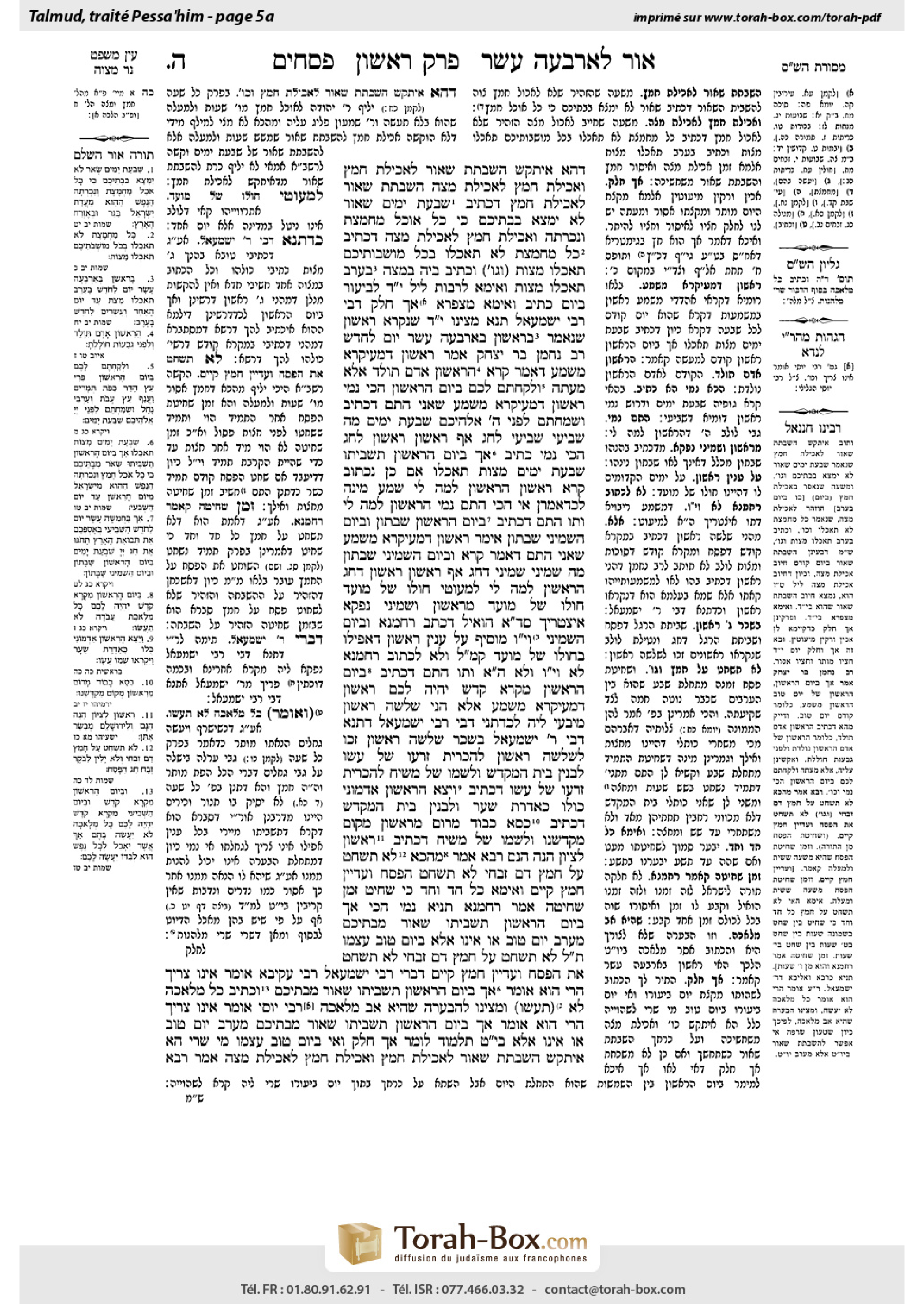
Pesachim 5a: Talmud study for Daf Yomi
Daf Yomi is the daily study of one Talmud folio. Explore 37 tractates with scans, Hebrew text, Sefaria English and AI-generated French translations where annotated.
Passage selection and English or AI-generated French translation are available where the scan has annotations. Daf Study is independent of Torah-Box and Sefaria.
Browse Pesachim · פסחים · All tractatesPesachim 5a text and translations
This page of Pesachim includes the Aramaic text, an English translation and an AI-generated French translation, alongside the scan above.
פסחים ה׳ א · Aramaic and Hebrew text
דְּהָא אִיתַּקַּשׁ הַשְׁבָּתַת שְׂאוֹר לַאֲכִילַת חָמֵץ, וַאֲכִילַת חָמֵץ לַאֲכִילַת מַצָּה.
הַשְׁבָּתַת שְׂאוֹר לַאֲכִילַת חָמֵץ, דִּכְתִיב: ״שִׁבְעַת יָמִים שְׂאֹר לֹא יִמָּצֵא בְּבָתֵּיכֶם כִּי כָּל אֹכֵל מַחְמֶצֶת וְנִכְרְתָה״.
וַאֲכִילַת חָמֵץ לַאֲכִילַת מַצָּה, דִּכְתִיב: ״כָּל מַחְמֶצֶת לֹא תֹאכֵלוּ בְּכֹל מוֹשְׁבֹתֵיכֶם תֹּאכְלוּ מַצּוֹת (וְגוֹ׳)״, וּכְתִיב בֵּיהּ בְּמַצָּה: ״בָּעֶרֶב תֹּאכְלוּ מַצּוֹת״.
וְאֵימָא לְרַבּוֹת לֵיל אַרְבָּעָה עָשָׂר לְבִיעוּר? ״בַּיּוֹם״ כְּתִיב.
וְאֵימָא מִצַּפְרָא! ״אַךְ״ חִלֵּק.
דְּבֵי רַבִּי יִשְׁמָעֵאל תָּנָא: מָצִינוּ אַרְבָּעָה עָשָׂר שֶׁנִּקְרָא רִאשׁוֹן, שֶׁנֶּאֱמַר: ״בָּרִאשׁוֹן בְּאַרְבָּעָה עָשָׂר יוֹם לַחֹדֶשׁ״. רַב נַחְמָן בַּר יִצְחָק אָמַר: רִאשׁוֹן — דְּמֵעִיקָּרָא מַשְׁמַע, דְּאָמַר קְרָא: ״הָרִאשׁוֹן אָדָם תִּוָּלֵד״.
אֶלָּא מֵעַתָּה, ״וּלְקַחְתֶּם לָכֶם בַּיּוֹם הָרִאשׁוֹן״, הָכִי נָמֵי רִאשׁוֹן דְּמֵעִיקָּרָא מַשְׁמַע?
שָׁאנֵי הָתָם, דִּכְתִיב: ״וּשְׂמַחְתֶּם לִפְנֵי ה׳ אֱלֹהֵיכֶם שִׁבְעַת יָמִים״, מָה ״שְׁבִיעִי״ — שְׁבִיעִי לֶחָג, אַף ״רִאשׁוֹן״ — רִאשׁוֹן לֶחָג.
הָכָא נָמֵי כְּתִיב: ״אַךְ בַּיּוֹם הָרִאשׁוֹן תַּשְׁבִּיתוּ שִׁבְעַת יָמִים מַצּוֹת תֹּאכֵלוּ״! אִם כֵּן, נִכְתּוֹב קְרָא ״רִאשׁוֹן״, ״הָרִאשׁוֹן״ לְמָה לִי? שְׁמַע מִינַּהּ לִכְדַאֲמַרַן.
אִי הָכִי הָתָם נָמֵי, ״הָרִאשׁוֹן״ לְמָה לִי? וְתוּ, הָתָם דִּכְתִיב: ״בַּיּוֹם הָרִאשׁוֹן שַׁבָּתוֹן וּבַיּוֹם הַשְּׁמִינִי שַׁבָּתוֹן״, אֵימַר ״רִאשׁוֹן״ דְּמֵעִיקָּרָא מַשְׁמַע? שָׁאנֵי הָתָם דְּאָמַר קְרָא: ״וּבַיּוֹם הַשְּׁמִינִי שַׁבָּתוֹן״, מָה ״שְׁמִינִי״ — שְׁמִינִי דְּחַג, אַף ״רִאשׁוֹן״ — רִאשׁוֹן דְּחַג.
״הָרִאשׁוֹן״ לְמָה לִי? לְמַעוֹטֵי חוּלּוֹ שֶׁל מוֹעֵד. חוּלּוֹ שֶׁל מוֹעֵד מֵ״רִאשׁוֹן״ וּ״שְׁמִינִי״ נָפְקָא!
אִיצְטְרִיךְ: סָלְקָא דַּעְתָּךְ אָמֵינָא, הוֹאִיל דִּכְתַב רַחֲמָנָא: ״וּבַיּוֹם הַשְּׁמִינִי״, וָיו מוֹסִיף עַל עִנְיָן רִאשׁוֹן, דַּאֲפִילּוּ בְּחוּלּוֹ שֶׁל מוֹעֵד, קָא מַשְׁמַע לַן.
וְלָא לִכְתּוֹב רַחֲמָנָא לָא וָיו וְלָא הֵא?! וְתוּ, הָתָם דִּכְתִיב: ״בַּיּוֹם הָרִאשׁוֹן מִקְרָא קֹדֶשׁ יִהְיֶה לָכֶם״ — רִאשׁוֹן דְּמֵעִיקָּרָא מַשְׁמַע?!
אֶלָּא, הָנֵי שְׁלֹשָׁה ״רִאשׁוֹן״ מִיבְּעֵי לֵיהּ לְכִדְתָנֵי דְּבֵי רַבִּי יִשְׁמָעֵאל. דְּתָנָא דְּבֵי רַבִּי יִשְׁמָעֵאל: בִּשְׂכַר שְׁלֹשָׁה ״רִאשׁוֹן״, זָכוּ לִשְׁלֹשָׁה ״רִאשׁוֹן״: לְהַכְרִית זַרְעוֹ שֶׁל עֵשָׂו, לְבִנְיַן בֵּית הַמִּקְדָּשׁ, וְלִשְׁמוֹ שֶׁל מָשִׁיחַ.
לְהַכְרִית זַרְעוֹ שֶׁל עֵשָׂו, דִּכְתִיב: ״וַיֵּצֵא הָרִאשׁוֹן אַדְמוֹנִי כֻּלּוֹ כְּאַדֶּרֶת שֵׂעָר״. וּלְבִנְיַן בֵּית הַמִּקְדָּשׁ, דִּכְתִיב: ״כִּסֵּא כָבוֹד מָרוֹם מֵרִאשׁוֹן מְקוֹם מִקְדָּשֵׁנוּ״. וְלִשְׁמוֹ שֶׁל מָשִׁיחַ, דִּכְתִיב: ״רִאשׁוֹן לְצִיּוֹן הִנֵּה הִנָּם״.
רָבָא אָמַר, מֵהָכָא: ״לֹא תִשְׁחַט עַל חָמֵץ דַּם זִבְחִי״ — לֹא תִּשְׁחַט הַפֶּסַח וַעֲדַיִן חָמֵץ קַיָּים.
וְאֵימָא: כָּל חַד וְחַד כִּי שָׁחֵיט! זְמַן שְׁחִיטָה אָמַר רַחֲמָנָא.
תַּנְיָא נָמֵי הָכִי: ״אַךְ בַּיּוֹם הָרִאשׁוֹן תַּשְׁבִּיתוּ שְּׂאֹר מִבָּתֵּיכֶם״ — מֵעֶרֶב יוֹם טוֹב. אוֹ אֵינוֹ אֶלָּא בְּיוֹם טוֹב עַצְמוֹ? תַּלְמוּד לוֹמַר: ״לֹא תִשְׁחַט עַל חָמֵץ דַּם זִבְחִי״ — לֹא תִּשְׁחַט אֶת הַפֶּסַח וַעֲדַיִין חָמֵץ קַיָּים, דִּבְרֵי רַבִּי יִשְׁמָעֵאל.
רַבִּי עֲקִיבָא אוֹמֵר: אֵינוֹ צָרִיךְ, הֲרֵי הוּא אוֹמֵר: ״אַךְ בַּיּוֹם הָרִאשׁוֹן תַּשְׁבִּיתוּ שְּׂאֹר מִבָּתֵּיכֶם״, וּכְתִיב: ״כָּל מְלָאכָה לֹא (תַעֲשׂוּ)״, וּמָצִינוּ לַהַבְעָרָה שֶׁהִיא אַב מְלָאכָה.
רַבִּי יוֹסֵי אוֹמֵר: אֵינוֹ צָרִיךְ, הֲרֵי הוּא אוֹמֵר: ״אַךְ בַּיּוֹם הָרִאשׁוֹן תַּשְׁבִּיתוּ שְּׂאֹר מִבָּתֵּיכֶם״ — מֵעֶרֶב יוֹם טוֹב. אוֹ אֵינוֹ אֶלָּא בְּיוֹם טוֹב — תַּלְמוּד לוֹמַר ״אַךְ״, חִלֵּק. וְאִי בְּיוֹם טוֹב עַצְמוֹ, מִי שְׁרֵי? הָא אִיתַּקַּשׁ הַשְׁבָּתַת שְׂאוֹר לַאֲכִילַת חָמֵץ, וַאֲכִילַת חָמֵץ לַאֲכִילַת מַצָּה! אָמַר רָבָא:
Pesachim 5a · English translation
The time for the removal of leaven is juxtaposed to the time when the eating of leavened bread is prohibited. When the prohibition against eating leaven goes into effect, the obligation to remove leaven is in effect as well. And furthermore, the time of the prohibition against the eating of leavened bread is juxtaposed to the time for the eating of matza, as its prohibition takes effect from the time that the mitzva to eat matza takes effect.
The Gemara elaborates: The removal of leaven is juxtaposed to the eating of leavened bread, as they appear in the same verse, as it is written: “Seven days leaven shall not be found in your houses, as anyone who eats that which is leavened, that soul shall be cut off from the congregation of Israel” (Exodus 12:19).
And the prohibition against the eating of leavened bread is juxtaposed to the eating of matza, as both appear in the same verse, as it is written: “You shall not eat anything that is leavened; in all of your dwellings you shall eat matzot, etc.” (Exodus 12:20), and it is written with regard to matza: “On the first day, on the fourteenth day in the evening you shall eat matzot” (Exodus 12:18). Since the halakha that leaven is prohibited on the first night of Passover is derived from this source, there is no need for an additional derivation.
The Gemara asks: And say that the verse: “Yet on the first day you shall remove leaven from your houses” comes to include the night of the fourteenth in the obligation to remove leaven, which would mean that one must remove all leaven from his house on the night of the fourteenth. The Gemara rejects this suggestion: That is not possible, as “on the day” is written.
The Gemara continues to ask: And say that leaven must be removed immediately from the morning of the fourteenth. The Gemara answers: That is also incorrect, as the verse says, “Yet on the first day”; and the word yet divides. The connotation of the word yet is one of restriction. In this context, it teaches that leaven is prohibited not for the entire day, but only for part of it. One is obligated to remove leaven only for the second half of the fourteenth of Nisan, not for the first half of the day.
The school of Rabbi Yishmael taught: We found that the fourteenth day is called: First, as it is stated: “On harishon, on the fourteenth day of the month” (Exodus 12:18). Rav Naḥman bar Yitzḥak said: It is evident from the verse itself that it is referring to the removal of leaven on the fourteenth, as rishon means previous. In this context, first means the day that precedes the others, i.e., the day before the Festival begins, as the verse stated: “Are you first [rishon] man born? Or were you brought forth before the hills?” (Job 15:7). Based on the parallelism between the two parts of the verse, the word rishon here means before; the one preceding all others.
The Gemara asks: But if that is so, consider a verse written with regard to Sukkot: “And you shall take for yourselves on the first [harishon] day the fruit of a beautiful tree, branches of palm trees, and boughs of thick trees, and willows of the brook” (Leviticus 23:40). So too, in this case, does harishon mean the day previous to the Festival? Clearly, one is not obligated to take the four species on the fourteenth of Tishrei, the eve of Sukkot.
The Gemara rejects this contention. There it is different, as it is written immediately thereafter: “And you shall rejoice before the Lord your God seven days” (Leviticus 23:40). Just as the seventh of these seven days is the seventh day of the Festival, so too, the first of these days is the first day of the Festival itself, not the day before Sukkot. However, where it is not explicitly stated, rishon means the day before the Festival.
The Gemara raises a difficulty. Here too, it is written with regard to Passover: “Yet on the first [harishon] day you shall remove leaven from your houses”; “for seven days you shall eat matza” (Exodus 12:15). Just as seventh here is referring to the seventh day of the Festival, so too, rishon must refer to the first day of the Festival. The Gemara answers: If so, let the verse write rishon; why do I need the addition of the definite article, harishon? Learn from it, as we said: Harishon means the day before the Festival.
The Gemara raises an objection: If so, there too, with regard to Sukkot, why do I need the verse to say harishon? And furthermore, there it is written: “On the first [harishon] day a solemn rest and on the eighth day a solemn rest” (Leviticus 23:39). Here too, say that first means previous, the day preceding the Festival. The Gemara rejects this suggestion: It is different there, as the verse said: “And on the eighth day a solemn rest,” from which it can be inferred that just as the eighth means the eighth day of the Festival, so too, rishon is referring to the first day of the Festival.
The Gemara repeats its earlier question: Why do I need the verse to say harishon? The Gemara answers: The definite article comes to exclude the intermediate days of the Festival. It is not prohibited to perform labor on these days, as the full-fledged sanctity of the Festival does not apply to them. The Gemara says: The status of the intermediate days is derived from the words first and eighth. The fact that the verse mentions only the first and the eighth days as Festivals clearly indicates that the days between them are not Festivals.
The Gemara answers: Nevertheless, a special verse was necessary to exclude the intermediate Festival days, as otherwise it could enter your mind to say that since the Merciful One writes: “And on the eighth day,” the principle: The letter vav adds to the previous matter, applies. When a phrase begins with the conjunction vav, meaning and, it is a continuation of the previous matter rather than a new topic. Based on this principle, I might have said that one must treat even the intermediate days as full-fledged Festival days. Therefore, the definite article teaches us not that this is not so.
The Gemara asks: And let the Merciful One write in the Torah neither the conjunction vav nor the definite article heh. Since they neutralize each other, as explained above, the same result could have been achieved by omitting both. And furthermore, there, in its description of Passover, it is written: “On the first [harishon] day you shall have a sacred convocation; you shall do no servile work” (Leviticus 23:7). Does first mean previous, the day preceding the Festival, in this case too? Labor is permitted on the eve of the Festival.
Rather, the Gemara explains that those three times the word rishon is mentioned with regard to the Festivals are necessary for that which the school of Rabbi Yishmael taught. As the school of Rabbi Yishmael taught: In reward for the three times the word rishon is stated with regard to the Festivals observed by the Jewish people, they were entitled to three matters also referred to as rishon: To eradicate the descendants of Esau, to the construction of the Temple, and to the name of Messiah.
The tanna provides the sources for his statement. To eradicate the descendants of Esau, as it is written: “And the first [harishon] came forth red, all over like a hairy mantle; and they called his name Esau” (Genesis 25:25). And to the construction of the Temple, as it is written: “The Throne of Glory, on High from the beginning [merishon], the place of our Temple” (Jeremiah 17:12). And the Jewish people were also entitled to the name of Messiah, as it is written: “A harbinger [rishon] to Zion I will give: Behold, behold them; and to Jerusalem a messenger of good tidings” (Isaiah 41:27). However, harishon stated with regard to Passover is referring to the day before the Festival.
Rava said: The halakha that leaven is prohibited from midday on the fourteenth of Nisan is derived from here: “You shall not slaughter the blood of My offering over leavened bread; neither shall the offering of the feast of the Passover be left to the morning” (Exodus 34:25). This verse means that you shall not slaughter the Paschal lamb while your leavened bread is still intact. In other words, all leaven must be removed before the time the Paschal lamb may be slaughtered.
The Gemara raises a difficulty: And say that the verse means that each and every person must ensure that he has no leaven in his possession when he slaughters his own Paschal lamb, and there is no fixed time for this prohibition. The Gemara answers: The Merciful One states the time of the slaughter of the Paschal lamb, which begins at the end of the sixth hour. In other words, this verse is referring to a particular point in time, rather than the individual act of slaughtering the Paschal lamb.
The Gemara adds that some of the aforementioned opinions were also taught in a baraita: “Yet on the first day you shall remove leaven from your houses” (Exodus 12:15). This prohibition is in effect from the eve of the Festival. Or perhaps that is not the case, but it applies only to the Festival itself. The verse states: “You shall not slaughter the blood of My offering over leavened bread” (Exodus 34:25), meaning that you shall not slaughter the Paschal lamb while your leavened bread is still intact. This is the statement of Rabbi Yishmael.
Rabbi Akiva says: There is no need for this proof, as it says: “Yet on the first day you shall remove leaven from your houses,” and it is written: “And on the first day there shall be to you a sacred convocation, and on the seventh day a sacred convocation; you shall perform no manner of work on them” (Exodus 12:16). And we found that kindling a fire is a primary category of prohibited labor. Since the fire in which the leaven is burned is not for the preparation of food, kindling it is not performed for the purpose of the Festival. Therefore, it is prohibited to burn the leaven on the Festival itself. Consequently, one must burn the leaven on the day before the Festival.
Rabbi Yosei says: There is no need for that proof either, as it says: “Yet on the first day you shall remove leaven from your houses.” This prohibition applies from the eve of the Festival. Or perhaps that is not the case, but it applies only to the Festival itself. The verse states: Yet, which comes to divide the day into two parts; the first half, when leaven is permitted, and the second half, when it is prohibited. And if this verse is referring to the first day of the Festival itself, is leaven permitted on the actual Festival? As explained above, the removal of leaven is juxtaposed to the eating of leavened bread, and the eating of leavened bread is juxtaposed to the eating of matza. Rava said:
Pesachim 5a · Traduction française (IA)
Le moment où le levain doit être éliminé est mis en relation avec celui où la consommation de pain levé est interdite. Lorsque l’interdiction de consommer du pain levé entre en vigueur, l’obligation d’éliminer le levain entre elle aussi en vigueur. De plus, le moment où la consommation de pain levé est interdite est mis en relation avec celui où l’on doit manger de la matsa, puisque cette interdiction prend effet dès que la mitsva de manger de la matsa prend effet.
La Guemara développe : l’élimination du levain est mise en relation avec l’interdiction de consommer du pain levé, car les deux figurent dans le même verset, comme il est écrit : « Pendant sept jours, on ne trouvera pas de levain dans vos maisons, car quiconque mange ce qui est levé, cette personne sera retranchée de la communauté d’Israël » (Exode 12:19).
L’interdiction de consommer du pain levé est mise en relation avec l’obligation de manger de la matsa, car les deux figurent dans le même verset, comme il est écrit : « Vous ne mangerez rien de ce qui est levé ; dans toutes vos demeures, vous mangerez des matsot, etc. » (Exode 12:20), et il est écrit au sujet de la matsa : « Le premier jour, le quatorzième jour, au soir, vous mangerez des matsot » (Exode 12:18). Puisque la halakha selon laquelle le levain est interdit la première nuit de Pessa’h se déduit de cette source, aucune déduction supplémentaire n’est nécessaire.
La Guemara demande : Et si le verset « Pourtant, le premier jour, vous éliminerez le levain de vos maisons » incluait la nuit du quatorzième dans l’obligation d’éliminer le levain, ce qui signifierait qu’il faut ôter tout le levain de sa maison dans la nuit du quatorzième ? La Guemara rejette cette suggestion : cela n’est pas possible, car il est écrit « le jour ».
La Guemara poursuit : Et si le levain devait être éliminé dès le matin du quatorzième ? La Guemara répond : Cela aussi est incorrect, car le verset dit : « Pourtant, le premier jour » ; le mot « pourtant » divise. Il exprime une restriction. Ici, il enseigne que le levain n’est pas interdit pendant toute la journée, mais seulement une partie de celle-ci. On n’est tenu d’éliminer le levain que durant la seconde moitié du quatorze Nissan, et non durant la première moitié de la journée.
L’école de Rabbi Yishmaël enseigna : Nous avons trouvé que le quatorzième jour est appelé « premier », comme il est dit : « Le premier [harishon], le quatorzième jour du mois » (Exode 12:18). Rav Naḥman bar Yitzḥak dit : Le verset lui-même montre clairement qu’il s’agit de l’élimination du levain le quatorzième, car rishon signifie « précédent ». Ici, « premier » désigne le jour qui précède les autres, c’est-à-dire celui qui précède le début de la fête, comme il est dit : « Es-tu le premier [rishon] des hommes à être né ? Ou as-tu été enfanté avant les collines ? » (Job 15:7). Le parallélisme entre les deux parties du verset montre que le mot rishon signifie ici « avant », c’est-à-dire celui qui précède tous les autres.
La Guemara demande : Mais si tel est le cas, considérons un verset relatif à Souccot : « Vous prendrez pour vous, le premier [harishon] jour, le fruit d’un bel arbre, des branches de palmier, des rameaux d’arbres touffus et des saules du torrent » (Lévitique 23:40). Ici aussi, harishon signifierait-il le jour précédant la fête ? Il est évident qu’on n’est pas tenu de prendre les quatre espèces le quatorze Tichri, la veille de Souccot.
La Guemara rejette cette objection. Dans ce cas, la situation est différente, car le verset dit aussitôt après : « Et vous vous réjouirez devant le Seigneur votre Dieu pendant sept jours » (Lévitique 23:40). De même que le septième de ces sept jours est le septième jour de la fête, le premier de ces jours est également le premier jour de la fête elle-même, et non le jour précédant Souccot. Cependant, lorsque cela n’est pas explicitement précisé, rishon signifie le jour qui précède la fête.
La Guemara soulève une difficulté : ici aussi, au sujet de Pessa’h, il est écrit : « Pourtant, le premier [harishon] jour, vous éliminerez le levain de vos maisons » ; « pendant sept jours, vous mangerez de la matsa » (Exode 12:15). De même que « le septième » désigne ici le septième jour de la fête, rishon doit donc désigner le premier jour de la fête. La Guemara répond : Si tel était le cas, que le verset écrive rishon ; pourquoi ai-je besoin de l’article défini dans harishon ? Il faut en déduire ce que nous avons dit : harishon signifie le jour qui précède la fête.
La Guemara soulève une objection : dans ce cas, là aussi, au sujet de Souccot, pourquoi le verset doit-il dire harishon ? De plus, il est écrit là-bas : « Le premier [harishon] jour, repos solennel, et le huitième jour, repos solennel » (Lévitique 23:39). Ici aussi, disons que « premier » signifie le jour précédent, celui qui précède la fête. La Guemara rejette cette suggestion : le cas est différent, car le verset dit « et le huitième jour, repos solennel », d’où l’on peut déduire que, de même que le huitième désigne le huitième jour de la fête, rishon désigne aussi le premier jour de la fête.
La Guemara répète sa question précédente : pourquoi le verset doit-il dire harishon ? La Guemara répond : l’article défini vient exclure les jours intermédiaires de la fête. Il est permis d’y effectuer des travaux, car la pleine sainteté de la fête ne s’y applique pas. La Guemara dit : Le statut des jours intermédiaires se déduit des termes « premier » et « huitième ». Le fait que le verset ne mentionne que les premier et huitième jours comme jours de fête indique clairement que les jours qui les séparent ne sont pas des jours de fête.
La Guemara répond : néanmoins, un verset particulier était nécessaire pour exclure les jours intermédiaires de la fête, car autrement, on aurait pu penser que, puisque le Miséricordieux écrit « et le huitième jour », le principe selon lequel la lettre vav ajoute à ce qui précède s’applique. Lorsqu’une expression commence par la conjonction vav, qui signifie « et », elle poursuit le sujet précédent au lieu d’introduire un nouveau sujet. Selon ce principe, j’aurais pu dire qu’il faut traiter même les jours intermédiaires comme des jours de fête à part entière. L’article défini nous enseigne donc que ce n’est pas le cas.
La Guemara demande : Et si le Miséricordieux n’écrivait dans la Torah ni la conjonction vav ni l’article défini heh ? Puisqu’ils s’annulent mutuellement, comme expliqué plus haut, on aurait pu parvenir au même résultat en omettant les deux. De plus, là-bas, dans la description de Pessa’h, il est écrit : « Le premier [harishon] jour, il y aura pour vous une sainte convocation ; vous ne ferez aucun travail servile » (Lévitique 23:7). Ici aussi, « premier » signifie-t-il « précédent », le jour qui précède la fête ? Les travaux sont permis la veille de la fête.
La Guemara explique plutôt que les trois occurrences du mot rishon au sujet des fêtes sont nécessaires pour justifier ce que l’école de Rabbi Yishmaël a enseigné. L’école de Rabbi Yishmaël enseigna : En récompense des trois occurrences du mot rishon au sujet des fêtes célébrées par le peuple juif, celui-ci a mérité trois choses également désignées par rishon : l’éradication des descendants d’Ésaü, la construction du Temple et le nom du Messie.
Le tanna apporte les sources de son enseignement. Pour l’éradication des descendants d’Ésaü, il est écrit : « Le premier [harishon] sortit roux, tout son corps semblable à un manteau de poils ; on l’appela Ésaü » (Genèse 25:25). Pour la construction du Temple, il est écrit : « Le trône de gloire, élevé dès le commencement [merishon], le lieu de notre Temple » (Jérémie 17:12). Le peuple juif a également mérité le nom du Messie, comme il est écrit : « Un messager [rishon] pour Sion, je le donnerai : “Les voici, les voici !”, et à Jérusalem un messager de bonnes nouvelles » (Isaïe 41:27). Cependant, harishon, employé au sujet de Pessa’h, désigne le jour qui précède la fête.
Rava dit : La halakha selon laquelle le levain est interdit à partir de la mi-journée du quatorze Nissan se déduit de ce verset : « Tu ne sacrifieras pas le sang de mon sacrifice sur du pain levé ; et le sacrifice de la fête de Pessa’h ne sera pas laissé jusqu’au matin » (Exode 34:25). Ce verset signifie qu’on ne doit pas sacrifier l’agneau pascal alors que l’on a encore du pain levé en sa possession. Autrement dit, tout le levain doit être éliminé avant le moment où l’agneau pascal peut être sacrifié.
La Guemara soulève une difficulté : et si le verset signifiait que chaque personne doit veiller à ne pas avoir de levain en sa possession lorsqu’elle sacrifie son propre agneau pascal, sans qu’il y ait de moment déterminé pour cette interdiction ? La Guemara répond : le Miséricordieux indique le moment du sacrifice de l’agneau pascal, qui commence à la fin de la sixième heure. Autrement dit, ce verset renvoie à un moment déterminé, et non à l’acte individuel de sacrifier l’agneau pascal.
La Guemara ajoute que certaines des opinions précédentes ont également été enseignées dans une baraïta : « Pourtant, le premier jour, vous éliminerez le levain de vos maisons » (Exode 12:15). Cette interdiction s’applique dès la veille de la fête. Ou peut-être n’en est-il pas ainsi et ne s’applique-t-elle qu’à la fête elle-même ? Le verset dit : « Tu ne sacrifieras pas le sang de mon sacrifice sur du pain levé » (Exode 34:25), ce qui signifie qu’on ne doit pas sacrifier l’agneau pascal alors que l’on a encore du pain levé en sa possession. Telle est l’opinion de Rabbi Yishmaël.
Rabbi Akiva dit : Cette preuve n’est pas nécessaire, car il est dit : « Pourtant, le premier jour, vous éliminerez le levain de vos maisons », et il est écrit : « Le premier jour, il y aura pour vous une sainte convocation, et le septième jour une sainte convocation ; vous n’accomplirez aucun travail ces jours-là » (Exode 12:16). Or, nous avons appris que l’allumage d’un feu constitue une catégorie principale de travail interdit. Puisque le feu dans lequel le levain est brûlé ne sert pas à préparer de la nourriture, on ne l’allume pas en vue de la fête. Il est donc interdit de brûler le levain pendant la fête elle-même. Par conséquent, il faut le brûler la veille de la fête.
Rabbi Yossei dit : Cette preuve non plus n’est pas nécessaire, car il est dit : « Pourtant, le premier jour, vous éliminerez le levain de vos maisons. » Cette interdiction s’applique dès la veille de la fête. Ou peut-être n’en est-il pas ainsi et ne s’applique-t-elle qu’à la fête elle-même ? Le verset dit « pourtant », terme qui divise la journée en deux parties : la première moitié, où le levain est permis, et la seconde, où il est interdit. Et si ce verset se rapporte au premier jour de la fête elle-même, le levain est-il donc permis pendant la fête proprement dite ? Comme expliqué plus haut, l’élimination du levain est mise en relation avec l’interdiction de consommer du pain levé, et l’interdiction de consommer du pain levé est mise en relation avec l’obligation de manger de la matsa. Rava dit :
Traduction française générée par IA à partir de l’édition anglaise de Sefaria. Vérifie toujours un passage avec le texte source.
Text from Sefaria: William Davidson Edition - Vocalized Aramaic (CC BY NC); William Davidson Edition - English (CC BY NC).