Pesachim 10b: Talmud study for Daf Yomi
Daf Yomi is the daily study of one Talmud folio. Explore 37 tractates with scans, Hebrew text, Sefaria English and AI-generated French translations where annotated.
Passage selection and English or AI-generated French translation are available where the scan has annotations. Daf Study is independent of Torah-Box and Sefaria.
Browse Pesachim · פסחים · All tractatesPesachim 10b text and translations
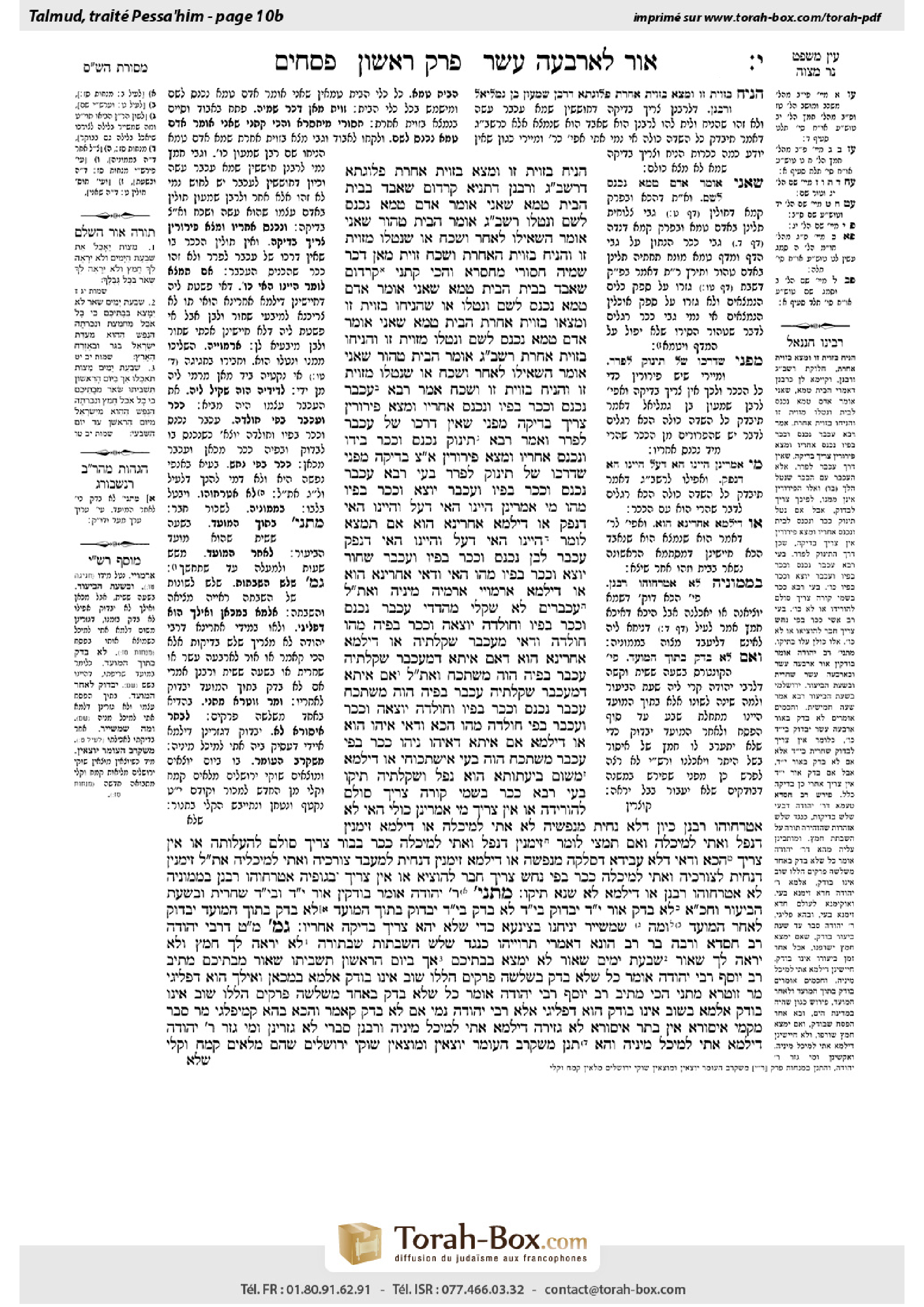
This page of Pesachim includes the Aramaic text, an English translation and an AI-generated French translation, alongside the scan above.
פסחים י׳ ב · Aramaic and Hebrew text
הִנִּיחַ בְּזָוִית זוֹ וּמָצָא בְּזָוִית אַחֶרֶת — פְּלוּגְתָּא דְּרַבָּן שִׁמְעוֹן בֶּן גַּמְלִיאֵל וְרַבָּנַן, דְּתַנְיָא: קַרְדּוֹם שֶׁאָבַד בְּבַיִת — הַבַּיִת טָמֵא. שֶׁאֲנִי אוֹמֵר: אָדָם טָמֵא נִכְנַס לְשָׁם וּנְטָלוֹ. רַבָּן שִׁמְעוֹן בֶּן גַּמְלִיאֵל אוֹמֵר: הַבַּיִת טָהוֹר, שֶׁאֲנִי אוֹמֵר: הִשְׁאִילוֹ לְאַחֵר וְשָׁכַח, אוֹ שֶׁנְּטָלוֹ מִזָּוִית זוֹ וְהִנִּיחַ בְּזָוִית הָאַחֶרֶת וְשָׁכַח.
זָוִית מַאן דְּכַר שְׁמֵיהּ?
חַסּוֹרֵי מְחַסְּרָא, וְהָכִי קָתָנֵי: קַרְדּוֹם שֶׁאָבַד בְּבַיִת — הַבַּיִת טָמֵא, שֶׁאֲנִי אוֹמֵר: אָדָם טָמֵא נִכְנַס לְשָׁם וּנְטָלוֹ. אוֹ שֶׁהִנִּיחוֹ בְּזָוִית זוֹ וּמְצָאוֹ בְּזָוִית אַחֶרֶת — הַבַּיִת טָמֵא, שֶׁאֲנִי אוֹמֵר: אָדָם טָמֵא נִכְנַס לְשָׁם וּנְטָלוֹ מִזָּוִית זוֹ וְהִנִּיחוֹ בְּזָוִית אַחֶרֶת. רַבָּן שִׁמְעוֹן בֶּן גַּמְלִיאֵל אוֹמֵר: הַבַּיִת טָהוֹר, שֶׁאֲנִי אוֹמֵר הִשְׁאִילוֹ לְאַחֵר וְשָׁכַח, אוֹ שֶׁנְּטָלוֹ מִזָּוִית זוֹ וְהִנִּיחַ בְּזָוִית זוֹ וְשָׁכַח.
אָמַר רָבָא: עַכְבָּר נִכְנָס וְכִכָּר בְּפִיו, וְנִכְנַס אַחֲרָיו וּמָצָא פֵּירוּרִין — צָרִיךְ בְּדִיקָה, מִפְּנֵי שֶׁאֵין דַּרְכּוֹ שֶׁל עַכְבָּר לְפָרֵר. וְאָמַר רָבָא: תִּינוֹק נִכְנָס וְכִכָּר בְּיָדוֹ, וְנִכְנַס אַחֲרָיו וּמָצָא פֵּירוּרִין — אֵין צָרִיךְ בְּדִיקָה, מִפְּנֵי שֶׁדַּרְכּוֹ שֶׁל תִּינוֹק לְפָרֵר.
בָּעֵי רָבָא: עַכְבָּר נִכְנָס וְכִכָּר בְּפִיו, וְעַכְבָּר יוֹצֵא וְכִכָּר בְּפִיו, מַהוּ? מִי אָמְרִינַן: הַיְינוּ הַאי דְּעָל, וְהַיְינוּ הַאי דִּנְפַק. אוֹ דִילְמָא, אַחֲרִינָא הוּא.
אִם תִּמְצָא לוֹמַר הַיְינוּ הַאי דְּעָל וְהַיְינוּ הַאי דִּנְפַק: עַכְבָּר לָבָן נִכְנָס וְכִכָּר בְּפִיו, וְעַכְבָּר שָׁחוֹר יוֹצֵא וְכִכָּר בְּפִיו, מַהוּ? הַאי וַדַּאי אַחֲרִינָא הוּא. אוֹ דִילְמָא, אַרְמוֹיֵי אַרְמְיֵהּ מִינֵּיהּ?
וְאִם תִּמְצָא לוֹמַר עַכְבָּרִים לָא שָׁקְלִי מֵהֲדָדֵי: עַכְבָּר נִכְנָס וְכִכָּר בְּפִיו, וְחוּלְדָּה יוֹצְאָה וְכִכָּר בְּפִיהָ, מַהוּ? חוּלְדָּה וַדַּאי מֵעַכְבָּר שְׁקַלְתֵּיהּ. אוֹ דִילְמָא, אַחֲרִינָא הוּא. דְּאִם אִיתָא דְּמֵעַכְבָּר שְׁקַלְתֵּיהּ — עַכְבָּר בְּפִיהָ הֲוָה מִשְׁתְּכַח.
וְאִם תִּמְצָא לוֹמַר אִם אִיתָא דְּמֵעַכְבָּר שְׁקַלְתֵּיהּ, עַכְבָּר בְּפִיהָ הֲוָה מִשְׁתְּכַח: עַכְבָּר נִכְנָס וְכִכָּר בְּפִיו, וְחוּלְדָּה יוֹצְאָה וְכִכָּר וְעַכְבָּר בְּפִי חוּלְדָּה, מַהוּ? הָכָא וַדַּאי אִיהוּ הוּא, אוֹ דִילְמָא: אִם אִיתָא דְּאִיהוּ נִיהוּ — כִּכָּר בְּפִי עַכְבָּר מִשְׁתְּכַח הֲוָה בָּעֵי אִישְׁתְּכוֹחֵי. אוֹ דִילְמָא: מִשּׁוּם בִּיעֲתוּתָא הוּא נְפַל, וּשְׁקַלְתֵּיהּ. תֵּיקוּ.
בָּעֵי רָבָא: כִּכָּר בִּשְׁמֵי קוֹרָה — צָרִיךְ סוּלָּם לְהוֹרִידָהּ, אוֹ אֵין צָרִיךְ? מִי אָמְרִינַן: כּוּלֵּי הַאי לָא אַטְרְחוּהוּ רַבָּנַן, כֵּיוָן דְּלָא נָחֵית מִנַּפְשֵׁיהּ — לָא אָתֵי לְמֵיכְלַהּ. אוֹ דִילְמָא: זִימְנִין דְּנָפֵל וְאָתֵי לְמֵיכְלַהּ.
וְאִם תִּמְצֵי לוֹמַר זִימְנִין דְּנָפֵל וְאָתֵי לְמֵיכְלַהּ: כִּכָּר בְּבוֹר — צָרִיךְ סוּלָּם לְהַעֲלוֹתָהּ, אוֹ אֵין צָרִיךְ? הָכָא וַדַּאי דְּלָא עֲבִידָא דְּסָלְקָה מִנַּפְשַׁהּ, אוֹ דִילְמָא: זִימְנִין דְּנָחֵית לְמֶעְבַּד צוּרְכֵּיהּ, וְאָתֵי לְמֵיכְלַיהּ.
אִם תִּמְצָא לוֹמַר זִימְנִין דְּנָחֵית לְצוּרְכֵּיהּ וְאָתֵי לְמֵיכְלַהּ: כִּכָּר בְּפִי נָחָשׁ — צָרִיךְ חַבָּר לְהוֹצִיא, אוֹ אֵין צָרִיךְ?
בְּגוּפֵיהּ אַטְרְחוּהוּ רַבָּנַן, בְּמָמוֹנֵיהּ לָא אַטְרְחוּהוּ רַבָּנַן. אוֹ דִילְמָא לָא שְׁנָא. תֵּיקוּ.
מַתְנִי׳ רַבִּי יְהוּדָה אוֹמֵר: בּוֹדְקִין אוֹר אַרְבָּעָה עָשָׂר, וּבְאַרְבָּעָה עָשָׂר שַׁחֲרִית, וּבִשְׁעַת הַבִּיעוּר. וַחֲכָמִים אוֹמְרִים: לֹא בָּדַק אוֹר אַרְבָּעָה עָשָׂר — יִבְדּוֹק בְּאַרְבָּעָה עָשָׂר.
לֹא בָּדַק בְּאַרְבָּעָה עָשָׂר — יִבְדּוֹק בְּתוֹךְ הַמּוֹעֵד. לֹא בָּדַק בְּתוֹךְ הַמּוֹעֵד — יִבְדּוֹק לְאַחַר הַמּוֹעֵד. וּמַה שֶּׁמְּשַׁיֵּיר יַנִּיחֶנּוּ בְּצִינְעָא, כְּדֵי שֶׁלֹּא יְהֵא צָרִיךְ בְּדִיקָה אַחֲרָיו.
גְּמָ׳ מַאי טַעְמָא דְּרַבִּי יְהוּדָה? רַב חִסְדָּא וְרַבָּה בַּר רַב הוּנָא דְּאָמְרִי תַּרְוַיְיהוּ: כְּנֶגֶד שָׁלֹשׁ הַשְׁבָּתוֹת שֶׁבַּתּוֹרָה — ״לֹא יֵרָאֶה לְךָ חָמֵץ וְלֹא יֵרָאֶה לְךָ שְׂאֹר״, ״שִׁבְעַת יָמִים שְׂאֹר לֹא יִמָּצֵא בְּבָתֵּיכֶם״, ״אַךְ בַּיּוֹם הָרִאשׁוֹן תַּשְׁבִּיתוּ שְּׂאֹר מִבָּתֵּיכֶם״.
מֵתִיב רַב יוֹסֵף, רַבִּי יְהוּדָה אוֹמֵר: כׇּל שֶׁלֹּא בָּדַק בִּשְׁלֹשָׁה פְּרָקִים הַלָּלוּ — שׁוּב אֵינוֹ בּוֹדֵק. אַלְמָא בְּמִכָּאן וְאֵילָךְ הוּא דִּפְלִיגִי.
מָר זוּטְרָא מַתְנֵי הָכִי: מֵתִיב רַב יוֹסֵף, רַבִּי יְהוּדָה אוֹמֵר: כׇּל שֶׁלֹּא בָּדַק בְּאֶחָד מִשְּׁלֹשָׁה פְּרָקִים הַלָּלוּ — שׁוּב אֵינוֹ בּוֹדֵק. אַלְמָא בְּשׁוּב אֵינוֹ בּוֹדֵק הוּא דִּפְלִיגִי.
אֶלָּא רַבִּי יְהוּדָה נָמֵי, אִם לֹא בָּדַק קָאָמַר.
וְהָכָא בְּהָא קָמִיפַּלְגִי: מָר סָבַר: מִקַּמֵּי אִיסּוּרָא — אִין, בָּתַר אִיסּוּרָא — לָא, גְּזֵירָה דִּילְמָא אָתֵי לְמֵיכַל מִינֵּיהּ. וְרַבָּנַן סָבְרִי: לָא גָּזְרִינַן.
וּמִי גָּזַר רַבִּי יְהוּדָה דִּילְמָא אָתֵי לְמֵיכַל מִינֵּיהּ? וְהָא תְּנַן: מִשֶּׁקָּרַב הָעוֹמֶר יוֹצְאִין וּמוֹצְאִין שׁוּקֵי יְרוּשָׁלַיִם שֶׁהֵם מְלֵאִים קֶמַח וְקָלִי.
Pesachim 10b · English translation
The Gemara addresses yet another case: If one placed leaven in this corner and found it in another corner, this is akin to the dispute between Rabban Shimon ben Gamliel and the Rabbis, as it was taught in a baraita: With regard to an axe that was lost in a house, the house is impure, as I say that a ritually impure person entered the house and took the axe, touching other items in the process. Rabban Shimon ben Gamliel says: The house is ritually pure, as I say that he lent the axe to another person and forgot, or that he took it from this corner and placed it in the other corner and forgot.
The Gemara asks: A corner, who mentioned anything about it? The baraita was referring to an axe that was lost, not one that was in a different corner.
The Gemara answers: The baraita is incomplete, and is teaching the following: With regard to an axe that was lost in a house, the house is ritually impure, as I say that an impure person entered the house and took the axe, or, if the owner placed it in this corner and later found it in another corner, the house is likewise ritually impure, as I say that an impure person entered the house and took the axe from this corner and placed in another corner. Rabban Shimon ben Gamliel says: The house is ritually pure, as I say that he lent it to another person and forgot, or that he took it from this corner and placed it in that corner and forgot about it. When the baraita is interpreted in this manner, the dispute between Rabban Shimon ben Gamliel and the Rabbis applies to the question about leaven.
Rava said: If one saw a mouse enter a house with a loaf of bread in its mouth, and he entered after the mouse and found crumbs, the house requires additional searching, due to the fact that a mouse does not typically generate crumbs. Therefore, it cannot be assumed that these crumbs are from the loaf snatched by the mouse. And Rava also said: If one saw a child enter with a loaf in his hand, and he entered after the child and found crumbs, the house does not require additional searching, because a child typically generates crumbs, and one can therefore assume that the crumbs are from that loaf.
Although the rulings in these cases were clear to Rava, Rava raised a dilemma with regard to a related case: If one saw a mouse enter with a loaf in its mouth, and he saw a mouse leave with a loaf in its mouth, what is the halakha? The Gemara elaborates: Do we say that this mouse that entered is that same mouse that left and there is no more leaven left in the house? Or perhaps it is a different mouse.
The Gemara adds: If you say that this mouse that entered was this one that left, another dilemma arises: If one saw a white mouse enter with a loaf of bread in its mouth and a black mouse leave with a loaf of bread in its mouth, what is the halakha? Do I say this is certainly a different mouse, or perhaps the black mouse took the loaf from the white mouse?
The Gemara continues to suggest variations on this case: And if you say that mice do not take from each other, as one mouse is generally not significantly stronger than another, if one saw a mouse enter with a loaf of bread in its mouth and a marten leave with a loaf of bread in its mouth, what is the halakha? Do I say that the marten certainly took it from the mouse, as it is larger and stronger? Or perhaps it is a different loaf, for if it is so, that the marten took the loaf from the mouse, the mouse itself would also be found in its mouth, as the marten would presumably take not only the loaf of bread but the mouse as well.
And if you say that we accept the contention that if it is so, that if the marten took it from the mouse the mouse itself would be in its mouth, in regard to a case where one saw a mouse enter with a loaf of bread in its mouth and a marten leave with both a loaf of bread and a mouse in its mouth, what is the halakha? Do I say that this is certainly the same mouse and loaf, or perhaps even this conclusion can be disputed: If it is so, that this is the same mouse, the loaf would have been found in the mouse’s mouth rather than in the marten’s mouth. Consequently, this must be a different loaf of bread. Or perhaps the loaf of bread fell from the mouse’s mouth due to its fear and the marten took it separately. No satisfactory answer was found for these dilemmas and the Gemara concludes: Let them stand unresolved.
Rava raised a dilemma: If there was a loaf of bread on a high beam in the ceiling, does one need to climb a ladder to take it down or is this effort not necessary? Do we say: The Sages did not obligate one to exert himself that much in his search for leaven, and since the loaf of bread will not fall on its own he will not come to eat it? Or perhaps it can be claimed that sometimes the loaf may fall and he will come to eat it, as objects placed high up occasionally drop.
And if you say with regard to a loaf of bread on a beam, sometimes it will fall and he will come to eat it, in a case where the loaf was in a pit, does one need to use a ladder to bring it up, or is this effort not necessary? The Gemara explains the two sides of the dilemma: Here the loaf will certainly not come up on its own, and one can therefore let it remain where it is; or perhaps there is still a concern that sometimes he might go down into the pit to perform some requirement of his, and he will come to eat it.
The Gemara continues to discuss the various permutations of this case. And if you say that sometimes one goes down into the pit for some requirement of his, and he will come to eat it, with regard to a loaf that was in the mouth of a snake, is it necessary for him to bring a snake charmer to take the loaf out of the snake’s mouth, or is this effort not necessary?
Once again the Gemara explains the two sides of the dilemma: Do I say that with regard to his own body the Sages obligate one to exert himself and search everywhere, but with regard to his money the Sages do not obligate one to exert himself, i.e., he is not required to spend money in order to destroy leaven? Or perhaps, the legal status of his money is no different than that of his body, as one must remove leaven wherever he finds it, in any way he can? This series of dilemmas is also left answered and the Gemara concludes: Let them stand unresolved.
MISHNA: Rabbi Yehuda says: One searches for leaven on the evening of the fourteenth of Nisan, and on the fourteenth in the morning, and at the time of the removal of leaven. And the Rabbis say: that is not the case; however, if one did not search on the evening of the fourteenth he should search on the fourteenth during the day.
If he did not search on the fourteenth, he should search during the festival of Passover. If he did not search during the Festival, he should search after the Festival, as any leaven that remained in his possession during the Festival is classified as leaven owned by a Jew during Passover, which one is obligated to remove. And the principle is: With regard to the leaven that one leaves after the search, he should place it in a concealed location where it will most likely be left untouched, so that it will not require searching after it if it goes missing.
GEMARA: The Gemara asks: What is the reason for the statement of Rabbi Yehuda that one must conduct a search three times? The Gemara answers: It is Rav Ḥisda and Rabba bar Rav Huna who both say: The requirement to conduct three searches corresponds to the three times that the removal of leaven is mentioned in the Torah. One verse says: “Matzot shall be eaten for seven days, and no leavened bread shall be seen with you, neither shall there be leaven seen with you, in all your borders” (Exodus 13:7), and another verse states: “Seven days shall there be no leaven found in your houses” (Exodus 12:19), while a third verse says: “Seven days shall you eat matzot, yet on the first day you shall remove leaven from your houses” (Exodus 12:15).
Rav Yosef raised an objection to this explanation, seeking to prove that even according to Rabbi Yehuda one need not conduct three searches for leaven. He explained that Rabbi Yehuda lists the three times when one may conduct a search for leaven. It was taught in a baraita that Rabbi Yehuda says: Anyone who did not search at these three times may no longer search. Apparently, Rabbi Yehuda does not hold that one must conduct three searches. Rather, in regard to whether or not one may conduct a search for leaven if he failed to conduct a search at one of those three opportunities, it is from this point forward that they disagree. The Rabbis hold that one may conduct the search even after the time of the removal of leaven, and Rabbi Yehuda disagrees.
Mar Zutra taught Rav Yosef’s statement in this manner: Rav Yosef raised an objection from that which Rabbi Yehuda says: Anyone who did not search at one of these three times may no longer search. In Mar Zutra’s version, Rabbi Yehuda explicitly states: One of these three times, which reinforces the claim that he obligates one to conduct only one search. The Gemara similarly concludes: Apparently, it is with regard to whether or not one may no longer search that they disagree.
Rather, the Gemara concludes that Rabbi Yehuda also said: If one did not search for leaven bread at the first opportunity, he may do so at the second or third opportunities; however, he may not search for leaven after these three times have passed.
And here, in the mishna, it is about this that they disagree: One Sage, Rabbi Yehuda, maintains that before the prohibition against eating leaven takes effect, yes, one may conduct a search; after the prohibition against eating leaven takes effect, no, one may no longer conduct a search, due to a rabbinic decree lest one come to eat from the leaven while searching for it. And the Rabbis maintain: We do not issue a decree lest one come to eat from the leaven, and he may therefore conduct a search even after the prohibition against eating leaven has taken effect.
The Gemara raises a difficulty: And does Rabbi Yehuda issue a decree lest one come to eat from the leaven in whose removal he is engaged? But didn’t we learn in a mishna: Once the omer offering was sacrificed, people would go out and find the markets of Jerusalem filled with flour and toasted grain, all from the new crop. This grain was undoubtedly harvested and processed when the Torah prohibition against eating from the new crop was still in effect.
Pesachim 10b · Traduction française (IA)
La Guemara examine un autre cas : si quelqu’un a placé du ‘hamets dans un coin et l’a retrouvé dans un autre, cela ressemble à la controverse entre Rabban Chimon ben Gamliel et les Sages. En effet, il a été enseigné dans une baraïta : à propos d’une hache perdue dans une maison, la maison est impure, car je dis qu’une personne rituellement impure est entrée dans la maison et a pris la hache, touchant d’autres objets au passage. Rabban Chimon ben Gamliel dit : la maison est rituellement pure, car je dis qu’il l’a prêtée à quelqu’un et l’a oublié, ou qu’il l’a prise dans ce coin, l’a placée dans l’autre coin et l’a oublié.
La Guemara demande : Qui a parlé d’un coin ? La baraïta parlait d’une hache perdue, non d’une hache qui se trouvait dans un autre coin.
La Guemara répond : Le texte de la baraïta est incomplet et enseigne ce qui suit : à propos d’une hache perdue dans une maison, la maison est rituellement impure, car je dis qu’une personne impure est entrée dans la maison et a pris la hache ; ou bien, si le propriétaire l’a placée dans un coin et l’a retrouvée plus tard dans un autre, la maison est également rituellement impure, car je dis qu’une personne impure est entrée dans la maison, a pris la hache dans ce coin et l’a placée dans un autre. Rabban Chimon ben Gamliel dit : la maison est rituellement pure, car je dis qu’il l’a prêtée à quelqu’un et l’a oublié, ou qu’il l’a prise dans ce coin, l’a placée dans l’autre et l’a oubliée. Ainsi interprétée, la controverse entre Rabban Chimon ben Gamliel et les Sages s’applique à la question du ‘hamets.
Rava dit : si quelqu’un a vu une souris entrer dans une maison avec un pain dans la bouche, puis est entré après elle et a trouvé des miettes, la maison doit faire l’objet d’une recherche supplémentaire, car une souris ne laisse généralement pas de miettes. On ne peut donc pas supposer que ces miettes proviennent du pain emporté par la souris. Rava dit également : si quelqu’un a vu un enfant entrer avec un pain à la main, puis est entré après lui et a trouvé des miettes, la maison n’a pas besoin d’une recherche supplémentaire, car un enfant laisse généralement des miettes ; on peut donc supposer que celles-ci proviennent de ce pain.
Bien que les décisions concernant ces cas fussent claires pour Rava, il souleva une question à propos d’un cas apparenté : si quelqu’un a vu une souris entrer avec un pain dans la bouche, puis a vu une souris sortir avec un pain dans la bouche, quelle est la halakha ? La Guemara précise : dit-on que la souris qui est entrée est la même que celle qui est sortie et qu’il ne reste donc plus de ‘hamets dans la maison ? Ou peut-être s’agit-il d’une autre souris.
La Guemara ajoute : si l’on dit que la souris qui est entrée est celle qui est sortie, une autre question se pose : si quelqu’un a vu une souris blanche entrer avec un pain dans la bouche et une souris noire sortir avec un pain dans la bouche, quelle est la halakha ? Dois-je dire qu’il s’agit certainement d’une autre souris, ou peut-être la souris noire a-t-elle pris le pain à la souris blanche ?
La Guemara poursuit en proposant des variantes de ce cas : si l’on dit que les souris ne se prennent pas leur nourriture les unes aux autres, puisqu’en général aucune n’est nettement plus forte qu’une autre, quelle est la halakha si quelqu’un a vu une souris entrer avec un pain dans la bouche et une fouine sortir avec un pain dans la bouche ? Dois-je dire que la fouine l’a certainement pris à la souris, puisqu’elle est plus grande et plus forte ? Ou peut-être s’agit-il d’un autre pain ; car si la fouine avait pris le pain à la souris, la souris elle-même se trouverait aussi dans sa gueule, puisqu’on peut présumer que la fouine aurait pris non seulement le pain, mais aussi la souris.
Et si l’on admet que, si la fouine avait pris le pain à la souris, la souris elle-même se trouverait dans sa gueule, quelle est la halakha dans le cas où quelqu’un a vu une souris entrer avec un pain dans la bouche et une fouine sortir avec, dans sa gueule, à la fois un pain et une souris ? Dois-je dire qu’il s’agit certainement de la même souris et du même pain, ou peut-être cette conclusion peut-elle elle aussi être contestée : si c’était la même souris, le pain aurait été retrouvé dans la bouche de la souris plutôt que dans celle de la fouine. Il s’agirait donc nécessairement d’un autre pain. Ou peut-être le pain est-il tombé de la bouche de la souris sous l’effet de la peur, et la fouine l’a pris séparément. Aucune réponse satisfaisante n’a été trouvée à ces questions, et la Guemara conclut : laissons-les sans réponse.
Rava souleva une question : si un pain se trouve sur une poutre élevée du plafond, faut-il monter à une échelle pour le descendre, ou cet effort n’est-il pas nécessaire ? Dit-on que les Sages n’ont pas obligé quelqu’un à faire un effort aussi important pour rechercher le ‘hamets et que, puisque le pain ne tombera pas de lui-même, il ne risque pas de le manger ? Ou peut-on soutenir que le pain peut parfois tomber et qu’il risque alors de le manger, car les objets placés en hauteur tombent parfois ?
Et si l’on dit, au sujet d’un pain posé sur une poutre, qu’il peut parfois tomber et qu’il risque alors de le manger, que se passe-t-il si le pain se trouve dans une fosse ? Faut-il utiliser une échelle pour l’en retirer, ou cet effort n’est-il pas nécessaire ? La Guemara expose les deux aspects de la question : ici, le pain ne remontera certainement pas de lui-même, et on peut donc le laisser là où il est ; ou peut-être subsiste-t-il une inquiétude, car il arrive qu’il descende dans la fosse pour ses propres besoins et qu’il le mange.
La Guemara poursuit l’examen des différentes variantes de ce cas. Et si l’on dit qu’il arrive parfois qu’on descende dans la fosse pour ses propres besoins et qu’on risque alors de manger le pain, que faut-il faire dans le cas d’un pain qui se trouve dans la gueule d’un serpent ? Est-il nécessaire de faire venir un charmeur de serpents pour retirer le pain de la gueule du serpent, ou cet effort n’est-il pas nécessaire ?
La Guemara explique de nouveau les deux aspects de la question : dois-je dire que, pour ce qui est de son propre corps, les Sages obligent quelqu’un à faire un effort et à chercher partout, mais que, pour ce qui est de son argent, ils ne l’obligent pas à faire un effort, c’est-à-dire qu’il n’est pas tenu de dépenser de l’argent pour éliminer le ‘hamets ? Ou peut-être le statut de son argent ne diffère-t-il pas de celui de son corps, puisqu’il faut éliminer le ‘hamets partout où on le trouve, de toute manière possible ? Cette série de questions reste elle aussi sans réponse, et la Guemara conclut : laissons-les sans réponse.
MICHNA : Rabbi Yehouda dit : on recherche le ‘hamets le soir du quatorze Nissan, le quatorze au matin et au moment de l’élimination du ‘hamets. Les Sages disent : il n’en est pas ainsi ; toutefois, si quelqu’un n’a pas fait la recherche le soir du quatorze, il la fera le quatorze pendant la journée.
S’il n’a pas fait la recherche le quatorze, il la fera pendant la fête de Pessa’h. S’il ne l’a pas faite pendant la fête, il la fera après la fête, car tout ‘hamets qui est resté en sa possession pendant la fête est considéré comme du ‘hamets appartenant à un Juif pendant Pessa’h, qu’il est tenu d’éliminer. Et le principe est le suivant : le ‘hamets qu’on laisse après la recherche doit être placé dans un endroit caché où il restera probablement intact, afin qu’il ne soit pas nécessaire de le rechercher s’il venait à disparaître.
GUEMARA : La Guemara demande : quelle est la raison de la déclaration de Rabbi Yehouda selon laquelle il faut effectuer trois recherches ? La Guemara répond : Rav Ḥisda et Rabba bar Rav Houna disent tous deux que l’obligation d’effectuer trois recherches correspond aux trois occurrences, dans la Torah, de l’élimination du ‘hamets. Un verset dit : « On mangera des matsot pendant sept jours ; on ne verra chez toi aucun pain levé, et on ne verra chez toi aucun levain, dans tout ton territoire » (Exode 13, 7). Un autre verset dit : « Pendant sept jours, il ne se trouvera pas de levain dans vos maisons » (Exode 12, 19). Un troisième verset dit : « Pendant sept jours, vous mangerez des matsot ; dès le premier jour, vous éliminerez le levain de vos maisons » (Exode 12, 15).
Rav Yossef objecta à cette explication, cherchant à démontrer que, même selon Rabbi Yehouda, il n’est pas nécessaire d’effectuer trois recherches du ‘hamets. Il expliqua que Rabbi Yehouda énumère les trois moments où l’on peut rechercher le ‘hamets. Il a été enseigné dans une baraïta que Rabbi Yehouda dit : quiconque n’a pas fait la recherche à ces trois moments ne peut plus la faire. Apparemment, Rabbi Yehouda ne considère pas qu’il faille effectuer trois recherches. Leur désaccord porte plutôt sur la question de savoir si l’on peut rechercher le ‘hamets après avoir manqué l’une de ces trois occasions. Les Sages considèrent qu’on peut effectuer la recherche même après le moment de l’élimination du ‘hamets, tandis que Rabbi Yehouda n’est pas d’accord.
Mar Zoutra transmit ainsi la déclaration de Rav Yossef : Rav Yossef objecta à partir de ce que dit Rabbi Yehouda : quiconque n’a pas fait la recherche à l’un de ces trois moments ne peut plus la faire. Dans la version de Mar Zoutra, Rabbi Yehouda précise explicitement : « l’un de ces trois moments », ce qui renforce l’argument selon lequel il n’oblige à effectuer qu’une seule recherche. La Guemara conclut de même : apparemment, leur désaccord porte sur la question de savoir si l’on peut encore faire la recherche.
La Guemara conclut plutôt que Rabbi Yehouda a également dit : si quelqu’un n’a pas recherché le pain levé à la première occasion, il peut le faire à la deuxième ou à la troisième ; toutefois, il ne peut plus rechercher le ‘hamets une fois ces trois moments passés.
Et ici, dans la Michna, leur désaccord porte sur ce point : Rabbi Yehouda soutient qu’avant l’entrée en vigueur de l’interdiction de manger du ‘hamets, oui, on peut faire la recherche ; après l’entrée en vigueur de cette interdiction, non, on ne peut plus la faire, en raison d’un décret rabbinique, de crainte qu’on ne mange du ‘hamets pendant qu’on le recherche. Les Sages soutiennent, quant à eux, qu’il n’y a pas lieu de décréter qu’on risque d’en manger ; on peut donc faire la recherche même après l’entrée en vigueur de l’interdiction de manger du ‘hamets.
La Guemara soulève une difficulté : Rabbi Yehouda décrète-t-il qu’on risque de manger le ‘hamets qu’on s’emploie à éliminer ? N’avons-nous pas appris dans une Michna : une fois l’offrande de l’omer sacrifiée, les gens sortaient et trouvaient les marchés de Jérusalem remplis de farine et de grains grillés, le tout provenant de la nouvelle récolte ? Cette récolte avait certainement été moissonnée et transformée alors que l’interdiction de la Torah de consommer les produits de la nouvelle récolte était encore en vigueur.
Traduction française générée par IA à partir de l’édition anglaise de Sefaria. Vérifie toujours un passage avec le texte source.
Text from Sefaria: William Davidson Edition - Vocalized Aramaic (CC BY NC); William Davidson Edition - English (CC BY NC).