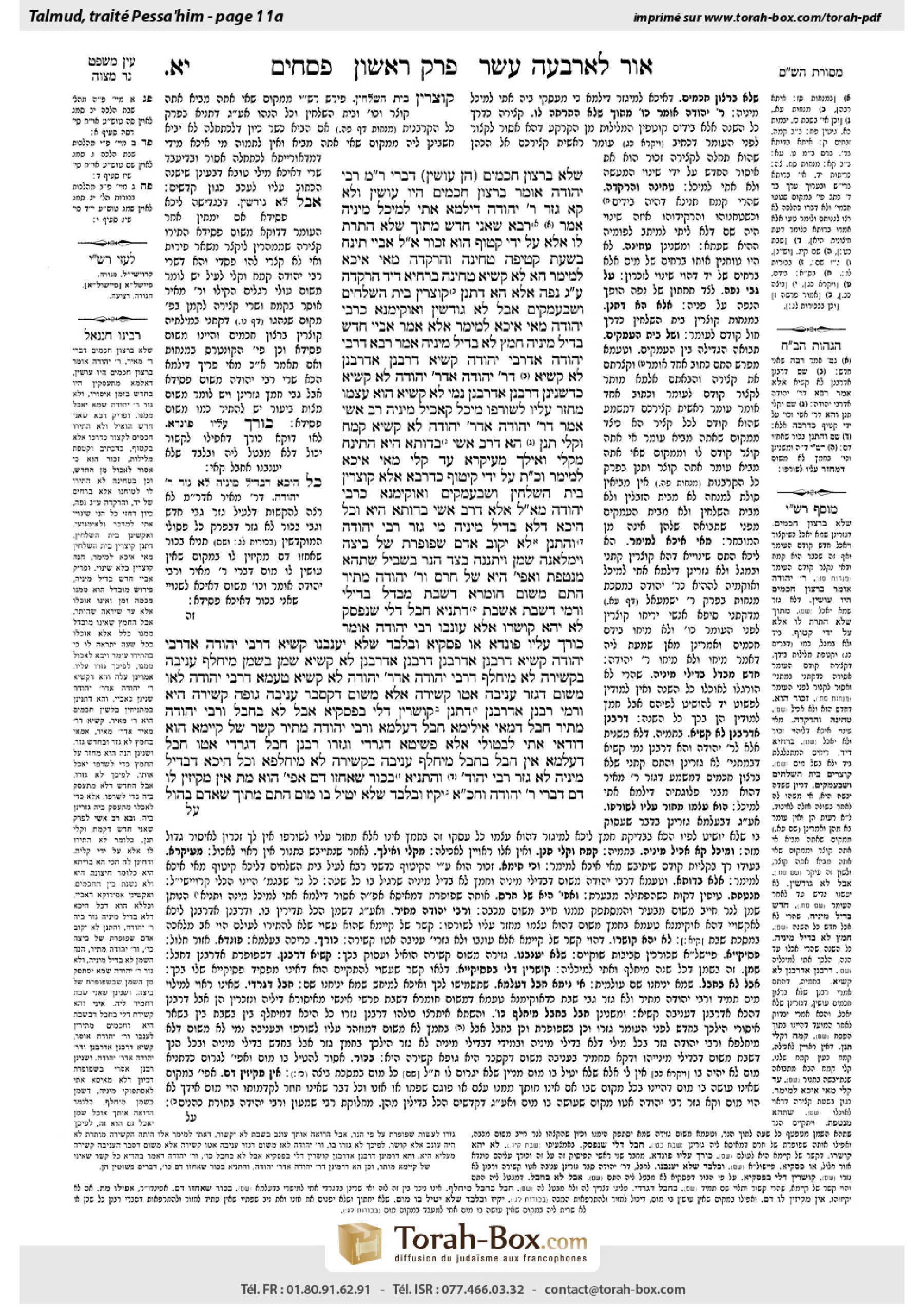
Pesachim 11a: Talmud study for Daf Yomi
Daf Yomi is the daily study of one Talmud folio. Explore 37 tractates with scans, Hebrew text, Sefaria English and AI-generated French translations where annotated.
Passage selection and English or AI-generated French translation are available where the scan has annotations. Daf Study is independent of Torah-Box and Sefaria.
Browse Pesachim · פסחים · All tractatesPesachim 11a text and translations
This page of Pesachim includes the Aramaic text, an English translation and an AI-generated French translation, alongside the scan above.
פסחים י״א א · Aramaic and Hebrew text
שֶׁלֹּא בִּרְצוֹן חֲכָמִים (הֵן עוֹשִׂין), דִּבְרֵי רַבִּי מֵאִיר. רַבִּי יְהוּדָה אוֹמֵר: בִּרְצוֹן חֲכָמִים הָיוּ עוֹשִׂין. וְלָא קָא גָזַר רַבִּי יְהוּדָה דִּילְמָא אָתֵי לְמֵיכַל מִינֵּיהּ? אָמַר רָבָא: שָׁאנֵי חָדָשׁ, מִתּוֹךְ שֶׁלֹּא הִתַּרְתָּ לוֹ אֶלָּא עַל יְדֵי קִטּוּף, הוּא זָכוּר.
אֲמַר לֵיהּ אַבָּיֵי: תִּינַח בִּשְׁעַת קְטִיפָה, טְחִינָה וְהַרְקָדָה מַאי אִיכָּא לְמֵימַר? הָא לָא קַשְׁיָא: טְחִינָה בְּרִחְיָא דְיָד, הַרְקָדָה עַל גַּבֵּי נָפָה.
אֶלָּא הָא דִּתְנַן: קוֹצְרִין בֵּית הַשְּׁלָחִים וְשֶׁבַּעֲמָקִים, אֲבָל לֹא גּוֹדְשִׁין. וְאוֹקִימְנָא כְּרַבִּי יְהוּדָה, מַאי אִיכָּא לְמֵימַר!
אֶלָּא אָמַר אַבָּיֵי: חָדָשׁ — בָּדֵיל מִינֵּיהּ, חָמֵץ — לָא בָּדֵיל מִינֵּיהּ.
אָמַר רָבָא: דְּרַבִּי יְהוּדָה אַדְּרַבִּי יְהוּדָה קַשְׁיָא, דְּרַבָּנַן אַדְּרַבָּנַן לָא קַשְׁיָא?
דְּרַבִּי יְהוּדָה אַדְּרַבִּי יְהוּדָה לָא קַשְׁיָא — כִּדְשַׁנִּינַן. דְּרַבָּנַן אַדְּרַבָּנַן נָמֵי לָא קַשְׁיָא — הוּא עַצְמוֹ מְחַזֵּר עָלָיו לְשׂוֹרְפוֹ, מֵיכַל קָאָכֵיל מִינֵּיהּ?!
רַב אָשֵׁי אָמַר: דְּרַבִּי יְהוּדָה אַדְּרַבִּי יְהוּדָה לָא קַשְׁיָא: ״קֶמַח וְקָלִי״ תְּנַן.
הָא דְּרַב אָשֵׁי בְּדוּתָא הִיא: הָתִינַח מִקָּלִי וְאֵילָךְ, מֵעִיקָּרָא עַד קָלִי מַאי אִיכָּא לְמֵימַר?
וְכִי תֵּימָא עַל יְדֵי קִיטּוּף כִּדְרָבָא, אֶלָּא ״קוֹצְרִין בֵּית הַשְּׁלָחִין וְשֶׁבָּעֲמָקִים״, וְאוֹקִימְנָא כְּרַבִּי יְהוּדָה, מַאי אִיכָּא לְמֵימַר? אֶלָּא דְּרַב אָשֵׁי בְּדוּתָא הִיא.
וְכׇל הֵיכָא דְּלָא בָּדֵיל מִינֵּיהּ, מִי גָּזַר רַבִּי יְהוּדָה?
וְהָתְנַן: לֹא יִקּוֹב אָדָם שְׁפוֹפֶרֶת שֶׁל בֵּיצָה וִימַלְּאֶנָּה שֶׁמֶן וְיִתְּנֶנָּה בְּצַד הַנֵּר בִּשְׁבִיל שֶׁתְּהֵא מְנַטֶּפֶת, וַאֲפִילּוּ הִיא שֶׁל חֶרֶס.
וְרַבִּי יְהוּדָה מַתִּיר! הָתָם, מִשּׁוּם חוּמְרָא דְּשַׁבָּת מִבְדָּל בְּדִילִי.
וּרְמִי דְּשַׁבָּת אַשַּׁבָּת, דְּתַנְיָא: חֶבֶל דְּלִי שֶׁנִּפְסַק, לֹא יְהֵא קוֹשְׁרוֹ אֶלָּא עוֹנְבוֹ. רַבִּי יְהוּדָה אוֹמֵר: כּוֹרֵךְ עָלָיו פּוּנְדָּא אוֹ פָּסִקְיָא, וּבִלְבַד שֶׁלֹּא יַעַנְבֶנּוּ.
קַשְׁיָא דְּרַבִּי יְהוּדָה אַדְּרַבִּי יְהוּדָה, קַשְׁיָא דְּרַבָּנַן אַדְּרַבָּנַן!
דְּרַבָּנַן אַדְּרַבָּנַן לָא קַשְׁיָא: שֶׁמֶן בְּשֶׁמֶן — מִיחַלַּף, עֲנִיבָה בִּקְשִׁירָה — לָא מִיחַלַּף.
דְּרַבִּי יְהוּדָה אַדְּרַבִּי יְהוּדָה לָא קַשְׁיָא: טַעְמָא דְּרַבִּי יְהוּדָה לָאו מִשּׁוּם דְּגָזַר עֲנִיבָה אַטּוּ קְשִׁירָה, אֶלָּא מִשּׁוּם דְּקָסָבַר עֲנִיבָה גּוּפַהּ קְשִׁירָה הִיא.
וְרָמֵי רַבָּנַן אַדְּרַבָּנַן, דִּתְנַן: קוֹשְׁרִין דְּלִי בְּפָסִקְיָא אֲבָל לֹא בְּחֶבֶל, וְרַבִּי יְהוּדָה מַתִּיר. חֶבֶל דְּמַאי? אִילֵּימָא חֶבֶל דְּעָלְמָא, ״וְרַבִּי יְהוּדָה מַתִּיר״? קֶשֶׁר שֶׁל קַיָּימָא הוּא, דְּוַדַּאי אָתֵי לְבַטּוֹלֵי!
אֶלָּא פְּשִׁיטָא דְּגַרְדִּי.
וּגְזַרוּ רַבָּנַן חֶבֶל דְּגַרְדִּי אַטּוּ חֶבֶל דְּעָלְמָא? אִין, חֶבֶל בְּחֶבֶל — מִיחַלַּף, עֲנִיבָה בִּקְשִׁירָה — לָא מִיחַלְּפָא.
וְכׇל הֵיכָא דְּבָדֵיל מִינֵּיהּ לָא גָּזַר רַבִּי יְהוּדָה? וְהָתַנְיָא: בְּכוֹר שֶׁאֲחָזוֹ דָּם, אֲפִילּוּ הוּא מֵת — אֵין מַקִּיזִין לוֹ דָּם, דִּבְרֵי רַבִּי יְהוּדָה.
וַחֲכָמִים אוֹמְרִים: יַקִּיז, וּבִלְבַד שֶׁלֹּא יָטִיל בּוֹ מוּם. הָתָם, מִתּוֹךְ שֶׁאָדָם בָּהוּל
Pesachim 11a · English translation
However, with regard to those people who harvest the crop before the omer is sacrificed, they act contrary to the will of the Sages. This is the statement of Rabbi Meir. The concern is that while working with the grain they might come to eat from it, despite the fact that it is still prohibited. Rabbi Yehuda says: They act in accordance with the will of the Sages. And in that case, Rabbi Yehuda did not issue a decree lest one eat from it. Why, then, does he issue a decree with regard to leaven? Rava said that the prohibition of new grain is different: Since before the omer you permitted one to harvest the crop only by picking it by hand and may not harvest it in the typical manner, he will remember the prohibition and refrain from eating it. That is not the case with regard to leaven.
Abaye said to him: This works out well in explaining Rabbi Yehuda’s opinion with regard to the time when one is picking the grain; however, with regard to the time of grinding and sifting, what can be said? Apparently, it is permitted to perform these acts in a typical manner. Why, then, is there no concern lest one eat the grain at that stage? The Gemara responds: This is not difficult, as one also performs grinding in an atypical manner. One must grind the grain before the sacrificing of the omer with a hand mill, not with a mill powered by an animal or by water. Likewise, sifting is performed atypically, not in the interior of the sifter. Instead, it is performed on top of the sifter. Since all of these actions are performed in an atypical manner, there is no concern lest he come to eat the grain.
The Gemara raises another difficulty: However, with regard to that which we learned in a mishna: One may harvest grain from a field that requires irrigation and from fields in the valleys, as their grain ripens long before the omer is sacrificed, but one may not pile the produce, and the Gemara adds: And we established that this mishna is in accordance with the opinion of Rabbi Yehuda; what can be said? The use of the term: One may harvest, in this mishna indicates that the grain was harvested in a typical manner, not by hand.
Rather, Abaye said: This difference between the cases of the omer and leaven is not based on the manner in which one harvests, grinds, or sifts. Instead, the reason for the different rulings is that from new grain, one distances himself, as it is prohibited to eat the new grain all year until the omer is offered. But from leavened bread one does not distance himself, as it is permitted during the rest of the year. Therefore, he is more likely to unwittingly eat leaven.
Rava said: Is the contradiction between one statement of Rabbi Yehuda and the other statement of Rabbi Yehuda difficult, while the contradiction between one statement of the Rabbis and the other statement of the Rabbis is not difficult? There is also an apparent contradiction between the opinion of the Rabbis, i.e., Rabbi Meir, who rule that the Sages issued a decree with regard to new grain but did not issue a decree with regard to leaven.
Rava explains as follows: The contradiction between one statement of Rabbi Yehuda and the other statement of Rabbi Yehuda is not difficult, as we resolved it above. The contradiction between one ruling of the Rabbis and the other ruling of the Rabbis is also not difficult: The Rabbis maintain that there is no need to issue a decree prohibiting searching for leaven after leaven is prohibited, as, with regard to one who himself is seeking out leaven to burn it, will he eat from that leaven? However, in the case of new grain, he is processing the grain, preparing it for consumption. Therefore, the concern is that he will come to eat it unwittingly.
Rav Ashi said: The contradiction between one statement of Rabbi Yehuda and the other statement of Rabbi Yehuda is not difficult, as the difficulty can be resolved in an alternative manner, as we learned in the mishna that the markets of Jerusalem were filled with flour and toasted grain. It is permitted to prepare only these foods before the omer, as they will not be eaten without further preparation. Therefore, there is no concern lest one eat it unwittingly before the omer offering is sacrificed.
The Gemara rejects this interpretation: That statement of Rav Ashi is a mistake, as this suggestion can easily be refuted. That works out well with regard to the status of the grain from the point that the grain was processed into flour or toasted grain and forward, as there is no concern lest one come to eat it. However, with regard to its status initially until it became toasted grain, what can be said? There must have been a certain point when the grain kernels were edible before they were transformed into toasted grain. Why is there no concern that one might come to eat the grain at this earlier stage?
And lest you say that the grain is distinguished by the atypical manner in which it is harvested, in accordance with the earlier statement of Rava, but with regard to the difficulty raised to Rava’s opinion that one may harvest a field that requires irrigation and a field that is in the valleys in the typical manner and we established that statement in accordance with the opinion of Rabbi Yehuda, what can be said? Rather, the Gemara rejects this explanation and concludes that Rav Ashi’s statement is a mistake.
The above conclusion was that Rabbi Yehuda distinguishes between prohibitions involving substances from which people regularly separate themselves and prohibitions involving substances from which people are not used to keeping their distance. The Gemara asks: And anywhere that one does not distance himself from a prohibition, does Rabbi Yehuda issue a decree that one must keep away from a prohibited item to avoid accidentally using it?
But didn’t we learn in a mishna: A person may not pierce a hole in an eggshell, and fill it with oil, and place it beside a lamp so that the egg will drip additional oil into the lamp and thereby extend the time that it burns? And this is the ruling even if it is not an actual egg but an earthenware tube, from which most people consider it unsuitable to drink. The concern is lest one forget and take the tube and use the oil for some other purpose, and violate the prohibition against extinguishing a flame on Shabbat.
And Rabbi Yehuda permits using a tube in that manner, as he is not concerned lest one remove it. Apparently, Rabbi Yehuda does not issue a decree even with regard to an item from which people do not distance themselves, e.g., oil. The Gemara answers: There, due to the stringency of Shabbat, one distances himself, as on Shabbat one is careful to distance himself from a candle or anything placed alongside it.
And the Gemara raised a contradiction between this halakha of Shabbat and another halakha of Shabbat, as it was taught in a baraita: With regard to the rope of a bucket that was severed on Shabbat, where one needs the rope to draw water from a well, he may not tie it with a regular knot, as by Torah law it is prohibited to tie a permanent knot. Rather, he may tie it into a bow. However, Rabbi Yehuda says: One may wrap a money belt [punda] around it or a sash [pesikya], provided that he does not tie it into a bow, lest he tie a proper knot.
This presents a difficulty, as there is a contradiction between one statement of Rabbi Yehuda, who permits placing a tube of oil beside the lamp, and the other statement of Rabbi Yehuda, who prohibits tying a bow to reattach the severed rope of a bucket. There is likewise a difficulty between one statement of the Rabbis, who prohibit placing a tube of oil beside the lamp, and the other ruling of the Rabbis, where they permit tying a bow to reattach the severed rope of a bucket.
The Gemara answers: The apparent contradiction between one statement of the Rabbis and the other statement of the Rabbis is not difficult, as one usage of oil might be confused with another usage of oil. Given that it is permitted to use oil for other purposes, one is apt to utilize this oil as well. However, tying a bow will not be confused with the dissimilar tying of a knot. Consequently, the Rabbis do not issue a decree in that case.
The Gemara continues: Likewise, the contradiction between one statement of Rabbi Yehuda and the other statement of Rabbi Yehuda is not difficult, as the reason for the opinion of Rabbi Yehuda is not because he issues a decree to prohibit tying a bow due to the prohibition against tying a knot. Rather, the reason is more fundamental, because Rabbi Yehuda maintains that a bow itself is a full-fledged knot. According to Rabbi Yehuda, tying a bow is included in the prohibition against tying a knot on Shabbat.
And the Gemara raised a contradiction between one statement of the Rabbis and another statement of the Rabbis, as we learned in a mishna: One may tie a bucket with a sash, to draw water from a well, but one may not do so with a rope, and Rabbi Yehuda permits the use of a rope. Before addressing the aforementioned contradiction, the Gemara asks: The mishna is referring to a rope of what kind? If you say it is referring to a standard rope, does Rabbi Yehuda permit tying a knot in this rope? It is a permanent knot, as in tying the rope to the bucket he certainly comes to negate any other use of the rope. He performs a primary category of prohibited labor by tying a permanent knot.
Rather, it is obvious that the mishna is speaking about a rope used in the work of a weaver [gardi]. The legal status of this rope differs from that of an ordinary rope, as the weaver will certainly not leave his rope attached to a bucket and thereby negate any other use. Consequently, this knot is a temporary one.
The Gemara asks: And did the Rabbis issue a decree prohibiting the rope of a weaver due to a standard rope but they did not issue a decree prohibiting a bow due to a knot? The Gemara explains: Yes, the Rabbis indeed issued a decree prohibiting the rope of a weaver, as one rope may be interchanged with another rope, leading one to mistakenly tie a knot with a different rope. However, a bow is not interchanged with a knot.
The Gemara asks: And anywhere that one distances himself from the prohibition, does Rabbi Yehuda not issue a decree? But wasn’t it taught in a baraita: What should one do if he has an unblemished firstborn kosher animal whose blood circulation is constricted, and it can be healed only through bloodletting? This situation is problematic, as an unblemished firstborn animal is consecrated, and wounding it is prohibited. Even if it dies due to this condition, one may not let its blood at all; this is the statement of Rabbi Yehuda.
And the Rabbis say: One may let the animal’s blood, provided that he does not inflict a blemish on the firstborn animal. In this case Rabbi Yehuda issues a decree with regard to a firstborn animal, despite the fact that its use is generally prohibited and people distance themselves from consecrated items. The Gemara answers: There, in the case of a firstborn animal, since a person is agitated and anxious
Pesachim 11a · Traduction française (IA)
Cependant, ceux qui récoltent les céréales avant que le omer soit offert agissent contrairement à la volonté des Sages. Telle est l’opinion de Rabbi Meïr. On craint qu’en travaillant les céréales, ils en viennent à en manger, alors qu’elles sont encore interdites. Rabbi Yehouda dit : Ils agissent conformément à la volonté des Sages. Dans ce cas, Rabbi Yehouda n’a donc pas édicté de décret par crainte qu’on en mange. Pourquoi, alors, édicte-t-il un décret concernant le hamets ? Rava dit que l’interdiction du grain nouveau est différente : puisque, avant le omer, on n’a autorisé à récolter les céréales qu’en les cueillant à la main, et non de la manière habituelle, on se souviendra de l’interdiction et on s’abstiendra d’en manger. Il n’en va pas de même pour le hamets.
Abayé lui dit : Cela permet d’expliquer l’opinion de Rabbi Yehouda concernant le moment de la cueillette du grain ; mais que dire du moment où on le moud et le tamise ? Apparemment, ces opérations peuvent être effectuées de la manière habituelle. Pourquoi, alors, ne craint-on pas qu’on mange le grain à ce stade ? La Guemara répond : Il n’y a pas de difficulté, car on moud également d’une manière inhabituelle. Avant l’offrande du omer, il faut moudre le grain avec un moulin à main, et non avec un moulin mû par un animal ou par l’eau. De même, le tamisage se fait d’une manière inhabituelle : non pas à l’intérieur du tamis, mais au-dessus. Puisque toutes ces opérations se font d’une manière inhabituelle, on ne craint pas qu’on en vienne à manger le grain.
La Guemara soulève une autre difficulté : que dire de ce que nous avons appris dans une Michna : on peut récolter le grain d’un champ irrigué et de champs situés dans les vallées, car leur grain mûrit longtemps avant que le omer soit offert, mais on ne peut pas entasser la récolte ? La Guemara a établi que cette Michna suit l’opinion de Rabbi Yehouda. L’expression « on peut récolter » employée dans cette Michna indique que le grain a été récolté de la manière habituelle, et non à la main.
Abayé dit plutôt : la différence entre les cas du omer et du hamets ne repose pas sur la manière dont on récolte, moud ou tamise. La raison des décisions différentes est plutôt que l’on se tient à l’écart du grain nouveau, puisqu’il est interdit d’en manger toute l’année, jusqu’à ce que le omer soit offert. En revanche, on ne se tient pas à l’écart du pain levé, puisqu’il est permis le reste de l’année. On est donc davantage susceptible de manger du hamets par inadvertance.
Rava dit : La contradiction entre une déclaration de Rabbi Yehouda et une autre déclaration de Rabbi Yehouda serait-elle difficile, alors que la contradiction entre une déclaration des Rabbins et une autre déclaration des Rabbins ne le serait pas ? Il y a également une contradiction apparente dans l’opinion des Rabbins, c’est-à-dire Rabbi Meïr, qui statuent que les Sages ont édicté un décret concernant le grain nouveau, mais pas concernant le hamets.
Rava explique ainsi : la contradiction entre une déclaration de Rabbi Yehouda et une autre déclaration de Rabbi Yehouda n’est pas difficile, car nous l’avons résolue plus haut. La contradiction entre une décision des Rabbins et une autre décision des Rabbins n’est pas difficile non plus : les Rabbins estiment qu’il n’est pas nécessaire d’édicter un décret interdisant de rechercher le hamets une fois que celui-ci est interdit, car celui qui recherche lui-même du hamets pour le brûler, en mangera-t-il ? En revanche, dans le cas du grain nouveau, on travaille le grain et on le prépare à la consommation. On craint donc qu’on en vienne à en manger par inadvertance.
Rav Achi dit : La contradiction entre une déclaration de Rabbi Yehouda et une autre déclaration de Rabbi Yehouda n’est pas difficile, car on peut la résoudre d’une autre manière : nous avons appris dans la Michna que les marchés de Jérusalem étaient remplis de farine et de grain grillé. Seuls ces aliments peuvent être préparés avant le omer, car ils ne seront pas consommés sans préparation supplémentaire. On ne craint donc pas qu’on en vienne à en manger par inadvertance avant que l’offrande du omer soit offerte.
La Guemara rejette cette interprétation : cette déclaration de Rav Achi est erronée, car cette proposition peut aisément être réfutée. Cela permet d’expliquer le statut du grain à partir du moment où il a été transformé en farine ou en grain grillé, mais que dire de son statut initial, avant qu’il ne devienne du grain grillé ? Il y a nécessairement eu un moment où les grains étaient comestibles avant d’être transformés en grain grillé. Pourquoi ne craint-on pas qu’on en vienne à manger le grain à ce stade antérieur ?
Et à supposer que tu dises que le grain se distingue par la manière inhabituelle dont il est récolté, conformément à la déclaration précédente de Rava, que dire alors de la difficulté soulevée contre l’opinion de Rava : on peut récolter de la manière habituelle un champ irrigué et un champ situé dans les vallées, et nous avons établi que cette déclaration suit l’opinion de Rabbi Yehouda ? La Guemara rejette donc cette explication et conclut que la déclaration de Rav Achi est erronée.
La conclusion précédente était que Rabbi Yehouda distingue les interdictions concernant des substances dont les gens se tiennent habituellement à l’écart de celles concernant des substances dont ils n’ont pas l’habitude de s’éloigner. La Guemara demande : chaque fois qu’on ne se tient pas à distance d’une chose interdite, Rabbi Yehouda édicte-t-il un décret imposant de s’en écarter afin d’éviter de s’en servir par inadvertance ?
Mais n’avons-nous pas appris dans une Michna : on ne peut pas percer un trou dans une coquille d’œuf, la remplir d’huile et la placer près d’une lampe, afin que l’œuf fasse couler davantage d’huile dans la lampe et prolonge ainsi sa combustion ? Cette décision s’applique même s’il ne s’agit pas d’un véritable œuf, mais d’un tube en terre cuite, que la plupart des gens considèrent comme impropre à la boisson. On craint qu’on l’oublie, qu’on prenne le tube et qu’on utilise l’huile à une autre fin, enfreignant ainsi l’interdiction d’éteindre une flamme pendant Chabbat.
Rabbi Yehouda permet d’utiliser un tube de cette manière, car il ne craint pas qu’on le retire. Apparemment, Rabbi Yehouda n’édicte donc pas de décret, même au sujet d’une substance dont les gens ne se tiennent pas à distance, comme l’huile. La Guemara répond : dans ce cas, en raison de la rigueur du Chabbat, on se tient à distance, car le Chabbat, on prend soin de s’éloigner d’une lampe ou de tout objet placé à côté d’elle.
La Guemara a soulevé une contradiction entre cette halakha relative au Chabbat et une autre halakha relative au Chabbat, car il a été enseigné dans une baraïta : si la corde d’un seau se rompt pendant Chabbat, alors qu’on a besoin de la corde pour puiser de l’eau dans un puits, on ne peut pas la renouer avec un nœud ordinaire, car, selon la Torah, il est interdit de faire un nœud permanent. On peut plutôt la renouer en faisant une boucle. Rabbi Yehouda dit toutefois : on peut enrouler autour de la corde une ceinture porte-monnaie [punda] ou une écharpe [pesikya], à condition de ne pas la nouer, de peur de faire un véritable nœud.
Cela pose une difficulté, car il y a une contradiction entre une déclaration de Rabbi Yehouda, qui permet de placer un tube d’huile près de la lampe, et une autre déclaration de Rabbi Yehouda, qui interdit de renouer en faisant une boucle la corde rompue d’un seau. Il y a également une difficulté entre une déclaration des Rabbins, qui interdisent de placer un tube d’huile près de la lampe, et une autre décision des Rabbins, qui permettent de renouer en faisant une boucle la corde rompue d’un seau.
La Guemara répond : la contradiction apparente entre une déclaration des Rabbins et une autre déclaration des Rabbins n’est pas difficile, car on pourrait confondre un usage de l’huile avec un autre. Puisqu’il est permis d’utiliser l’huile à d’autres fins, on est porté à utiliser également cette huile. En revanche, on ne confondra pas une boucle avec un nœud, qui est différent. Par conséquent, les Rabbins n’édictent pas de décret dans ce cas.
La Guemara poursuit : de même, la contradiction entre une déclaration de Rabbi Yehouda et une autre déclaration de Rabbi Yehouda n’est pas difficile, car la raison de l’opinion de Rabbi Yehouda n’est pas qu’il édicte un décret interdisant de faire une boucle en raison de l’interdiction de nouer un nœud. La raison est plus fondamentale : Rabbi Yehouda estime qu’une boucle constitue elle-même un véritable nœud. Selon Rabbi Yehouda, faire une boucle relève de l’interdiction de nouer un nœud pendant Chabbat.
La Guemara a soulevé une contradiction entre une déclaration des Rabbins et une autre déclaration des Rabbins, car nous avons appris dans une Michna : on peut attacher un seau avec une écharpe pour puiser de l’eau dans un puits, mais on ne peut pas le faire avec une corde ; Rabbi Yehouda permet, lui, d’utiliser une corde. Avant d’aborder la contradiction susmentionnée, la Guemara demande : de quel type de corde la Michna parle-t-elle ? Si tu dis qu’il s’agit d’une corde ordinaire, Rabbi Yehouda permet-il de faire un nœud sur cette corde ? Ce serait un nœud permanent, car en attachant la corde au seau, on renoncerait certainement à tout autre usage de cette corde. Il accomplirait ainsi une catégorie principale de travail interdit en faisant un nœud permanent.
Il est donc évident que la Michna parle d’une corde utilisée dans le travail d’un tisserand [gardi]. Le statut juridique de cette corde diffère de celui d’une corde ordinaire, car le tisserand ne laissera certainement pas sa corde attachée à un seau, ce qui l’empêcherait de l’utiliser à d’autres fins. Ce nœud est donc temporaire.
La Guemara demande : les Rabbins ont-ils édicté un décret interdisant la corde d’un tisserand à cause d’une corde ordinaire, mais n’ont-ils pas édicté de décret interdisant une boucle à cause d’un nœud ? La Guemara explique : oui, les Rabbins ont bien édicté un décret interdisant la corde d’un tisserand, car une corde peut être confondue avec une autre, ce qui pourrait conduire à faire par erreur un nœud sur une autre corde. En revanche, on ne confondra pas une boucle avec un nœud.
La Guemara demande : chaque fois qu’on se tient à distance d’une interdiction, Rabbi Yehouda n’édicte-t-il pas de décret ? Mais n’a-t-on pas enseigné dans une baraïta : que doit-on faire si l’on possède un animal casher premier-né sans défaut, dont la circulation sanguine est entravée et qui ne peut être guéri que par une saignée ? La situation pose problème, car un animal premier-né sans défaut est consacré, et il est interdit de le blesser. Même s’il meurt de cette affection, on ne doit en aucun cas le saigner ; telle est l’opinion de Rabbi Yehouda.
Les Rabbins disent : on peut saigner l’animal, à condition de ne pas lui infliger de défaut. Dans ce cas, Rabbi Yehouda édicte un décret au sujet d’un animal premier-né, alors même que son usage est généralement interdit et que les gens se tiennent à distance des choses consacrées. La Guemara répond : dans ce cas de l’animal premier-né, puisqu’une personne est agitée et inquiète
Traduction française générée par IA à partir de l’édition anglaise de Sefaria. Vérifie toujours un passage avec le texte source.
Text from Sefaria: William Davidson Edition - Vocalized Aramaic (CC BY NC); William Davidson Edition - English (CC BY NC).