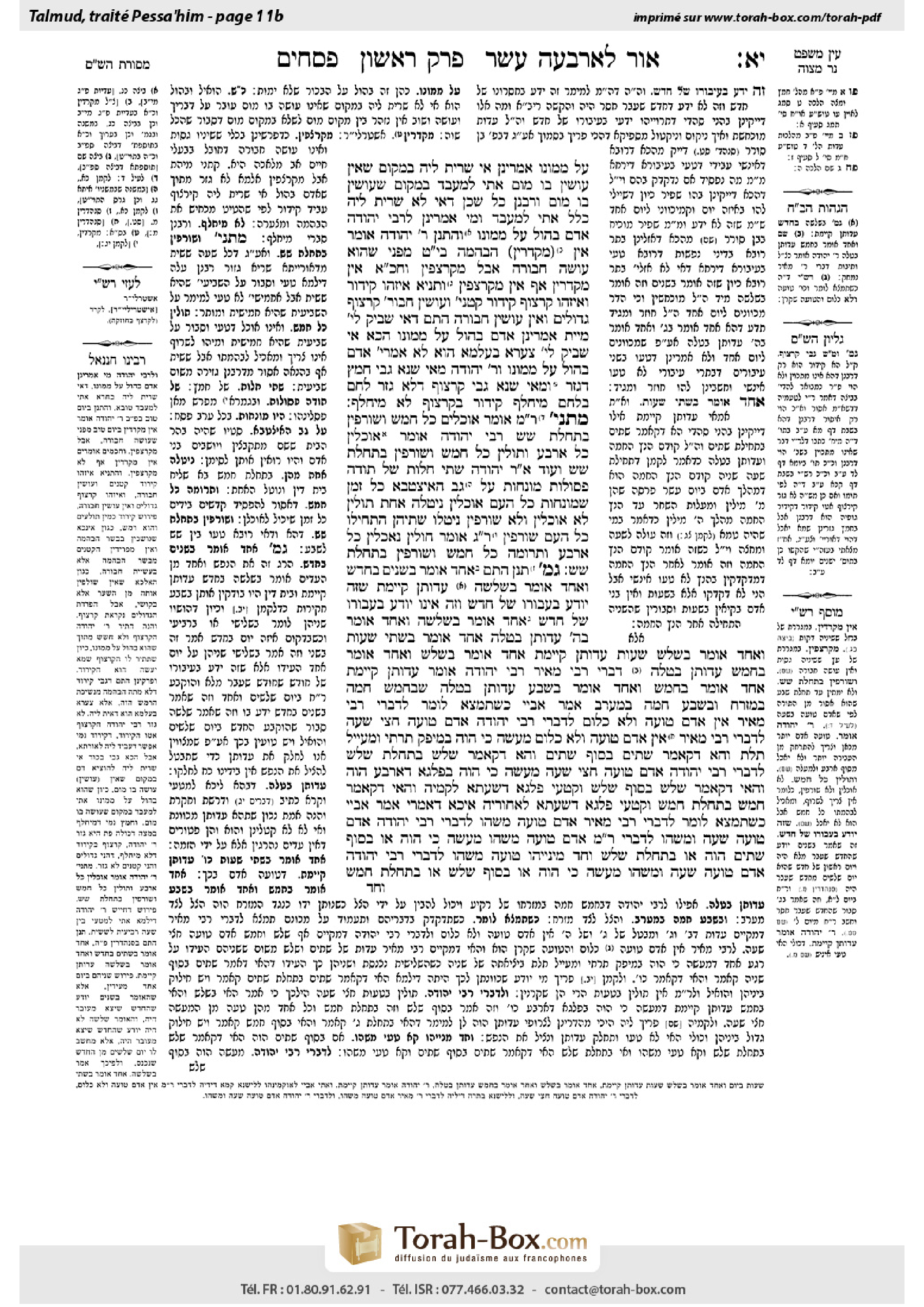
Pesachim 11b: Talmud study for Daf Yomi
Daf Yomi is the daily study of one Talmud folio. Explore 37 tractates with scans, Hebrew text, Sefaria English and AI-generated French translations where annotated.
Passage selection and English or AI-generated French translation are available where the scan has annotations. Daf Study is independent of Torah-Box and Sefaria.
Browse Pesachim · פסחים · All tractatesPesachim 11b text and translations
This page of Pesachim includes the Aramaic text, an English translation and an AI-generated French translation, alongside the scan above.
פסחים י״א ב · Aramaic and Hebrew text
עַל מָמוֹנוֹ, אָמְרִינַן: אִי שָׁרֵית לֵיהּ בִּמְקוֹם שֶׁאֵין עוֹשִׂין בּוֹ מוּם — אָתֵי לְמֶעְבַּד בִּמְקוֹם שֶׁעוֹשִׂין בּוֹ מוּם.
וְרַבָּנַן — כׇּל שֶׁכֵּן דְּאִי לָא שָׁרֵית לֵיהּ כְּלָל אָתֵי לְמֶעְבַּד.
וּמִי אָמְרִינַן לְרַבִּי יְהוּדָה אָדָם בָּהוּל עַל מָמוֹנוֹ? וְהָתְנַן, רַבִּי יְהוּדָה אוֹמֵר: אֵין (מְקַדְּרִין) הַבְּהֵמָה בְּיוֹם טוֹב — מִפְּנֵי שֶׁהוּא עוֹשֶׂה חַבּוּרָה, אֲבָל מְקַרְצְפִין. וַחֲכָמִים אוֹמְרִים: אֵין מְקַדְּרִין, אַף אֵין מְקַרְצְפִין.
וְתַנְיָא: אֵיזֶהוּ קִידּוּר וְאֵיזֶהוּ קִרְצוּף? קִידּוּר — קְטַנִּים, וְעוֹשִׂין חַבּוּרָה. קִרְצוּף — גְּדוֹלִים, וְאֵין עוֹשִׂין חַבּוּרָה.
הָתָם, דְּאִי שָׁבֵיק לֵיהּ — מָיֵית, אָמְרִינַן אָדָם בָּהוּל עַל מָמוֹנוֹ. הָכָא, אִי שָׁבֵיק לֵיהּ — צַעֲרָא בְּעָלְמָא הוּא, לָא אָמְרִינַן אָדָם בָּהוּל עַל מָמוֹנוֹ.
וְרַבִּי יְהוּדָה, מַאי שְׁנָא גַּבֵּי חָמֵץ דְּגָזַר, וּמַאי שְׁנָא גַּבֵּי קִרְצוּף דְּלָא גָּזַר? לֶחֶם בְּלֶחֶם — מִיחַלַּף. קִידּוּר בְּקִרְצוּף — לָא מִיחַלַּף.
מַתְנִי׳ רַבִּי מֵאִיר אוֹמֵר: אוֹכְלִים כׇּל חָמֵשׁ, וְשׂוֹרְפִין בִּתְחִלַּת שֵׁשׁ. רַבִּי יְהוּדָה אוֹמֵר: אוֹכְלִין כׇּל אַרְבַּע, וְתוֹלִין כׇּל חָמֵשׁ, וְשׂוֹרְפִין בִּתְחִלַּת שֵׁשׁ.
וְעוֹד אָמַר רַבִּי יְהוּדָה: שְׁתֵּי חַלּוֹת שֶׁל תּוֹדָה פְּסוּלוֹת מוּנָּחוֹת עַל גַּב הָאִיצְטְבָא, כׇּל זְמַן שֶׁמּוּנָּחוֹת — כׇּל הָעָם אוֹכְלִין. נִיטְּלָה אַחַת — תּוֹלִין; לֹא אוֹכְלִין וְלֹא שׂוֹרְפִין. נִיטְּלוּ שְׁתֵּיהֶן — הִתְחִילוּ כׇּל הָעָם שׂוֹרְפִין.
רַבָּן גַּמְלִיאֵל אוֹמֵר: חוּלִּין נֶאֱכָלִין כׇּל אַרְבַּע, וּתְרוּמָה כׇּל חָמֵשׁ, וְשׂוֹרְפִין בִּתְחִלַּת שֵׁשׁ.
גְּמָ׳ תְּנַן הָתָם: אֶחָד אוֹמֵר בִּשְׁנַיִם בַּחֹדֶשׁ, וְאֶחָד אוֹמֵר בִּשְׁלֹשָׁה — עֵדוּתָן קַיֶּימֶת,
שֶׁזֶּה יוֹדֵעַ בְּעִבּוּרוֹ שֶׁל חֹדֶשׁ, וְזֶה אֵינוֹ יוֹדֵעַ בְּעִבּוּרוֹ שֶׁל חֹדֶשׁ.
אֶחָד אוֹמֵר בִּשְׁלֹשָׁה, וְאֶחָד אוֹמֵר בַּחֲמִשָּׁה — עֵדוּתָן בְּטֵלָה. אֶחָד אוֹמֵר בִּשְׁתֵּי שָׁעוֹת, וְאֶחָד אוֹמֵר בְּשָׁלֹשׁ שָׁעוֹת — עֵדוּתָן קַיֶּימֶת. אֶחָד אוֹמֵר בְּשָׁלֹשׁ, וְאֶחָד אוֹמֵר בְּחָמֵשׁ — עֵדוּתָן בְּטֵלָה, דִּבְרֵי רַבִּי מֵאִיר.
רַבִּי יְהוּדָה אוֹמֵר: עֵדוּתָן קַיֶּימֶת. אֶחָד אוֹמֵר בְּחָמֵשׁ, וְאֶחָד אוֹמֵר בְּשֶׁבַע — עֵדוּתָן בְּטֵלָה. שֶׁבְּחָמֵשׁ חַמָּה בְּמִזְרַח, וּבְשֶׁבַע חַמָּה בְּמַעֲרָב.
אָמַר אַבָּיֵי: כְּשֶׁתִּמְצָא לוֹמַר, לְדִבְרֵי רַבִּי מֵאִיר — אֵין אָדָם טוֹעֶה וְלֹא כְּלוּם; לְדִבְרֵי רַבִּי יְהוּדָה — אָדָם טוֹעֶה חֲצִי שָׁעָה. לְדִבְרֵי רַבִּי מֵאִיר — אֵין אָדָם טוֹעֶה וְלֹא כְּלוּם: מַעֲשֶׂה כִּי הֲוָה, בְּמִיפַּק תַּרְתֵּי וּמְעַיֵּיל תְּלָת. וְהָא דְּקָאָמַר שְׁתַּיִם — בְּסוֹף שְׁתַּיִם, וְהָא דְּקָאָמַר שָׁלֹשׁ — בִּתְחִלַּת שָׁלֹשׁ.
לְדִבְרֵי רַבִּי יְהוּדָה — אָדָם טוֹעֶה חֲצִי שָׁעָה: מַעֲשֶׂה כִּי הֲוָה, בְּפַלְגָא דְאַרְבַּע הֲוָה, וְהַאי דְּקָאָמַר שָׁלֹשׁ — בְּסוֹף שָׁלֹשׁ, וְקָטָעֵי פַּלְגָא דְשַׁעְתָּא לְקַמֵּיהּ. וְהַאי דְּקָאָמַר חָמֵשׁ — בִּתְחִלַּת חָמֵשׁ, וְקָטָעֵי פַּלְגָא דְשַׁעְתָּא לַאֲחוֹרֵיהּ.
אִיכָּא דְּאָמְרִי, אָמַר אַבָּיֵי: כְּשֶׁתִּמְצָא לוֹמַר, לְדִבְרֵי רַבִּי מֵאִיר — אָדָם טוֹעֶה מַשֶּׁהוּ; לְדִבְרֵי רַבִּי יְהוּדָה — אָדָם טוֹעֶה שָׁעָה וּמַשֶּׁהוּ. לְדִבְרֵי רַבִּי מֵאִיר — אָדָם טוֹעֶה מַשֶּׁהוּ: מַעֲשֶׂה כִּי הֲוָה, אוֹ בְּסוֹף שְׁתַּיִם הֲוָה אוֹ בִּתְחִלַּת שָׁלֹשׁ, וְחַד מִינַּיְיהוּ טוֹעֶה מַשֶּׁהוּ. לְדִבְרֵי רַבִּי יְהוּדָה — אָדָם טוֹעֶה שָׁעָה וּמַשֶּׁהוּ: מַעֲשֶׂה כִּי הֲוָה — אוֹ בְּסוֹף שָׁלֹשׁ אוֹ בִּתְחִלַּת חָמֵשׁ,
Pesachim 11b · English translation
about his property, as the priest who is watching the firstborn wants to slaughter it before it dies, as if it dies, eating it would be prohibited. Therefore, we say: If you permit him to let blood in a place that does not cause a blemish in the animal, he will come to do so in a place that causes a blemish in it, to save his animal.
And the Rabbis respond that if that is the case, all the more so should it be permitted to let blood in a manner that will not cause a blemish, for if you do not permit him to take any steps to save the animal at all, he will come to act in a prohibited manner and cause a blemish. If there is a legitimate alternative, he will not cause a blemish in the firstborn.
The Gemara challenges this explanation: And do we say that according to Rabbi Yehuda a person is agitated about his property? But didn’t we learn in a mishna that Rabbi Yehuda says: One may not scrape an animal on a Festival with a fine-tooth comb, because in doing so he inflicts a wound, which is prohibited on Festivals? However, one may scratch an animal with a wide-tooth comb, as this does not inflict a wound. And the Rabbis say: One may neither scrape nor even scratch, for if one were permitted to scratch an animal he might come to scrape it as well.
And it was taught in the Tosefta: What is scraping and what is scratching? Scraping is performed with a comb with small teeth and with which one inflicts a wound. Scratching is performed with a comb that has large teeth and with which one does not inflict a wound. Apparently, Rabbi Yehuda does not issue a decree to prohibit scratching lest one come to scrape, even though he is agitated over his property.
The Gemara rejects this contention: There, with regard to a firstborn, it is different, for if he leaves it and does nothing the animal will die, and therefore we say that a person is agitated over his property. In his agitated state he will overlook the details of permitted and prohibited actions and violate a prohibition. Here, however, if he leaves his animal and does not comb it, it will merely suffer pain from the stinging insects. In that case we do not say that a person is agitated about his property.
The Gemara asks: And according to Rabbi Yehuda, what is different with regard to leavened bread that he issued a decree lest a person come to eat the prohibited food, and what is different with regard to scraping that he did not issue a comparable decree? The Gemara answers: Rabbi Yehuda maintains that unleavened bread might be interchanged with leavened bread, whereas scraping would not be interchanged with scratching. Since one uses a completely different utensil in the performance of the prohibited action, interchanging the two actions is unlikely.
MISHNA: The tanna’im disagree regarding until what time leaven may be eaten and at what time it must be removed on Passover eve. Rabbi Meir says: One may eat leaven the entire fifth hour of the fourteenth of Nisan, and one must burn it immediately afterward at the beginning of the sixth hour. Rabbi Yehuda says: One may eat the entire fourth hour and one places it in abeyance for the entire fifth hour, and one burns it at the beginning of the sixth hour.
And furthermore, Rabbi Yehuda said: Two disqualified loaves of a thanks-offering are placed on the bench in the colonnade in the Temple as an indicator. There was a specially designated place for these loaves in the Temple. As long as the loaves are placed there, the entire nation continues to eat leaven. When one of the loaves was taken away, the people know that the time had come to place the leaven in abeyance, meaning that they neither eat nor burn their leaven. When they were both taken away, the entire nation began burning their leaven.
Rabban Gamliel says that the times are divided differently: Non-sacred foods are eaten the entire fourth hour, and teruma may be eaten during the entire fifth hour. Since it is a mitzva to eat teruma and burning it is prohibited, additional time was allocated for its consumption. And one burns all leaven including teruma at the beginning of the sixth hour.
GEMARA: The Gemara seeks to draw a comparison between this dispute of Rabbi Meir and Rabbi Yehuda and a dispute between them on a different topic. We learned in a mishna there: If one witness says that an incident occurred on the second day of the month and one other witness says that it happened on the third day of that month, their testimony is valid. This minor contradiction does not invalidate the testimony.
The mishna explains: The reason is that this witness knows about the addition of an extra day to the previous month. Since he knows that the court added a day to the previous month, which lasted thirty days, he testifies that the incident occurred on the second day of the month. And that witness does not know about the addition of an extra day to the previous month, and he therefore thinks that the incident in question occurred on the third of the month.
If one says that the incident occurred on the third day of the month and one says it happened on the fifth, their testimony is void, as there is no way to rationalize this contradiction. Similarly, if one says the incident occurred at two hours of the day and one says it happened at three hours, their testimony is valid, as that discrepancy could be the result of the lack of precision. However, if one says it occurred at three hours and one says it took place at five hours, their testimony is void. This is the statement of Rabbi Meir.
Rabbi Yehuda says: In the last case, their testimony is valid, as it could be that one is slightly mistaken. However, if one says it happened at five hours and one says at seven hours, everyone agrees that their testimony is void. That is a clear contradiction that cannot be rationalized as a miscalculation, as at five hours of the day the sun is in the east, and at seven hours the sun is already in the west. It is impossible to confuse the fifth hour with the seventh.
Abaye said: When analyzing the matter, you will find that you can say that according to the statement of Rabbi Meir a person does not err at all, as Rabbi Meir assumes that people know the exact time of day. According to the statement of Rabbi Yehuda a person errs up to half an hour. Abaye elaborates: According to the statement of Rabbi Meir, a person does not err at all, and the reason that in the case where one says two hours and one says three the testimony is valid is that the incident actually occurred as the second hour ended and the third hour began. And when this witness said it happened in the second hour he was referring to the end of the second hour. When that witness said the third hour he was referring to the beginning of the third hour. It is possible that both witnesses spoke the truth.
Abaye continues his explanation: According to the statement of Rabbi Yehuda, a person errs by half an hour, as when the incident occurred, it occurred at the midpoint of the fourth hour, at three and a half hours of the day. And this witness, who says three hours, means the end of the third hour, and he errs by saying that it occurred half an hour before the incident actually occurred. And that witness, who says five hours, means the beginning of the fifth hour, i.e., the end of the fourth hour, and he errs by saying that it occurred half an hour after the incident actually occurred. Since it is possible that their testimonies do not conflict, their testimony is valid.
Some say a different version of this statement. Abaye said: When analyzing the matter, you will find that you can say that according to Rabbi Meir a person errs a bit, and according to Rabbi Yehuda a person errs by an hour and a bit. Abaye elaborates: According to Rabbi Meir, a person errs a bit, as when the incident occurred, it occurred either at the end of the second hour or at the beginning of the third hour, and one of the two witnesses errs a bit. According to Rabbi Yehuda, a person errs by an hour and a bit, as when the incident occurred, it occurred either at the end of the third hour or at the beginning of the fifth hour,
Pesachim 11b · Traduction française (IA)
au sujet de ses biens, car le prêtre chargé de surveiller le premier-né veut l’abattre avant qu’il ne meure, puisque, s’il meurt, il sera interdit de le consommer. Nous disons donc : si tu lui permets de le saigner à un endroit qui ne provoque pas de défaut chez l’animal, il finira par le faire à un endroit qui lui en provoque un, afin de sauver son animal.
Les Sages répondent que, si tel est le cas, à plus forte raison faut-il lui permettre de le saigner d’une manière qui ne provoque pas de défaut : si tu ne lui permets de prendre aucune mesure pour sauver l’animal, il finira par agir de façon interdite et lui causer un défaut. S’il existe une solution licite, il ne provoquera pas de défaut chez le premier-né.
La Guemara conteste cette explication : dit-on vraiment que, selon Rabbi Yehouda, une personne est préoccupée par ses biens ? N’avons-nous pas appris dans une Michna que Rabbi Yehouda dit : On ne peut pas étriller un animal pendant un jour de fête avec un peigne à dents fines, car cela lui inflige une blessure, ce qui est interdit pendant les jours de fête. On peut toutefois gratter un animal avec un peigne à dents larges, car cela ne lui inflige pas de blessure. Les Sages disent : On ne peut ni étriller ni même gratter, car si l’on permettait de gratter un animal, on pourrait finir par l’étriller.
Et il a été enseigné dans la Tosefta : Qu’appelle-t-on étriller et qu’appelle-t-on gratter ? L’étrillage se fait avec un peigne à petites dents, qui inflige une blessure. Le grattage se fait avec un peigne à grandes dents, qui n’inflige pas de blessure. Il apparaît donc que Rabbi Yehouda ne décrète pas l’interdiction de gratter, de peur que l’on en vienne à étriller, même lorsqu’une personne est préoccupée par ses biens.
La Guemara rejette cette objection : dans le cas du premier-né, c’est différent, car si on le laisse sans rien faire, l’animal mourra ; nous disons donc qu’une personne est préoccupée par ses biens. Dans cet état d’agitation, elle ne prêtera plus attention aux détails des actes permis et interdits et transgressera une interdiction. Ici, en revanche, si elle laisse son animal sans le peigner, celui-ci souffrira simplement des piqûres d’insectes. Dans ce cas, nous ne disons pas qu’une personne est préoccupée par ses biens.
La Guemara demande : Selon Rabbi Yehouda, pourquoi a-t-il décrété, dans le cas du pain levé, de peur que quelqu’un n’en vienne à manger l’aliment interdit, mais n’a-t-il pas décrété de la même façon dans le cas de l’étrillage ? La Guemara répond : Rabbi Yehouda estime que le pain azyme peut être confondu avec le pain levé, tandis que l’étrillage ne peut pas être confondu avec le grattage. Puisqu’on utilise un ustensile entièrement différent pour l’acte interdit, il est peu probable que l’on confonde les deux actes.
MICHNA : Les tannaïm sont en désaccord sur l’heure jusqu’à laquelle on peut manger du pain levé et celle à laquelle il faut l’éliminer la veille de Pessa’h. Rabbi Meïr dit : On peut manger du pain levé pendant toute la cinquième heure du quatorze Nissan, et on doit le brûler aussitôt après, au début de la sixième heure. Rabbi Yehouda dit : On peut en manger pendant toute la quatrième heure ; on le met en suspens pendant toute la cinquième heure, puis on le brûle au début de la sixième heure.
En outre, Rabbi Yehouda a dit : On place deux pains invalidés d’une offrande de reconnaissance sur le banc de la colonnade du Temple, comme repère. Un emplacement était spécialement réservé à ces pains dans le Temple. Tant qu’ils y sont placés, tout le peuple continue à manger du pain levé. Lorsque l’un des pains est retiré, le peuple sait qu’il est temps de mettre le pain levé en suspens, c’est-à-dire de ne ni le manger ni le brûler. Lorsque les deux pains sont retirés, tout le peuple commence à brûler son pain levé.
Rabban Gamliel dit que les horaires sont répartis autrement : les aliments non consacrés peuvent être consommés pendant toute la quatrième heure, et la terouma peut être consommée pendant toute la cinquième heure. Puisqu’il y a une mitsva de consommer la terouma et qu’il est interdit de la brûler, on a accordé davantage de temps pour la consommer. On brûle tout le pain levé, y compris la terouma, au début de la sixième heure.
GUEMARA : La Guemara cherche à établir un parallèle entre le désaccord de Rabbi Meïr et de Rabbi Yehouda et un désaccord qui les oppose sur un autre sujet. Nous avons appris dans une Michna : Si un témoin dit qu’un événement a eu lieu le deuxième jour du mois et qu’un autre témoin dit qu’il a eu lieu le troisième jour de ce mois, leur témoignage est valable. Cette légère contradiction n’invalide pas le témoignage.
La Michna explique : La raison en est que ce témoin sait qu’un jour supplémentaire a été ajouté au mois précédent. Sachant que le tribunal a ajouté un jour au mois précédent, qui a compté trente jours, il témoigne que l’événement a eu lieu le deuxième jour du mois. L’autre témoin, lui, ignore qu’un jour supplémentaire a été ajouté au mois précédent et pense donc que l’événement en question a eu lieu le troisième jour du mois.
Si l’un dit que l’événement a eu lieu le troisième jour du mois et l’autre qu’il a eu lieu le cinquième, leur témoignage est nul, car il n’y a aucun moyen d’expliquer cette contradiction. De même, si l’un dit qu’il a eu lieu à la deuxième heure du jour et l’autre à la troisième heure, leur témoignage est valable, car cet écart peut résulter d’un manque de précision. En revanche, si l’un dit qu’il a eu lieu à la troisième heure et l’autre à la cinquième, leur témoignage est nul. Telle est la déclaration de Rabbi Meïr.
Rabbi Yehouda dit : dans le dernier cas, leur témoignage est valable, car l’un peut s’être trompé légèrement. Toutefois, si l’un dit que l’événement a eu lieu à la cinquième heure et l’autre à la septième, tous s’accordent à dire que leur témoignage est nul. Il s’agit d’une contradiction manifeste, qui ne peut s’expliquer par une erreur de calcul, car à la cinquième heure du jour, le soleil est à l’est, tandis qu’à la septième heure, il est déjà à l’ouest. Il est impossible de confondre la cinquième heure avec la septième.
Abayé dit : en examinant la question, on peut conclure que, selon Rabbi Meïr, une personne ne se trompe pas du tout, car Rabbi Meïr estime que les gens connaissent l’heure exacte de la journée. Selon Rabbi Yehouda, une personne se trompe jusqu’à une demi-heure. Abayé développe : selon Rabbi Meïr, une personne ne se trompe pas du tout ; si, dans le cas où l’un dit la deuxième heure et l’autre la troisième, le témoignage est valable, c’est parce que l’événement a réellement eu lieu au moment où la deuxième heure s’achevait et où la troisième commençait. Lorsque ce témoin a dit que cela s’était produit à la deuxième heure, il parlait de la fin de la deuxième heure. Lorsque l’autre témoin a dit la troisième heure, il parlait du début de la troisième heure. Il est possible que les deux témoins aient dit la vérité.
Abayé poursuit son explication : selon Rabbi Yehouda, une personne se trompe d’une demi-heure, car l’événement a eu lieu au milieu de la quatrième heure, soit à trois heures et demie du jour. Le témoin qui dit la troisième heure entend par là la fin de la troisième heure et se trompe en situant l’événement une demi-heure avant le moment où il a réellement eu lieu. L’autre témoin, qui dit la cinquième heure, entend par là le début de la cinquième heure, c’est-à-dire la fin de la quatrième heure, et se trompe en situant l’événement une demi-heure après le moment où il a réellement eu lieu. Puisqu’il est possible que leurs témoignages ne se contredisent pas, leur témoignage est valable.
Certains transmettent une autre version de cette déclaration. Abayé dit : en examinant la question, on peut conclure que, selon Rabbi Meïr, une personne se trompe légèrement, et que, selon Rabbi Yehouda, elle se trompe d’une heure et d’un peu plus. Abayé développe : selon Rabbi Meïr, une personne se trompe légèrement, car l’événement a eu lieu soit à la fin de la deuxième heure, soit au début de la troisième, et l’un des deux témoins se trompe légèrement. Selon Rabbi Yehouda, une personne se trompe d’une heure et d’un peu plus, car l’événement a eu lieu soit à la fin de la troisième heure, soit au début de la cinquième.
Traduction française générée par IA à partir de l’édition anglaise de Sefaria. Vérifie toujours un passage avec le texte source.
Text from Sefaria: William Davidson Edition - Vocalized Aramaic (CC BY NC); William Davidson Edition - English (CC BY NC).