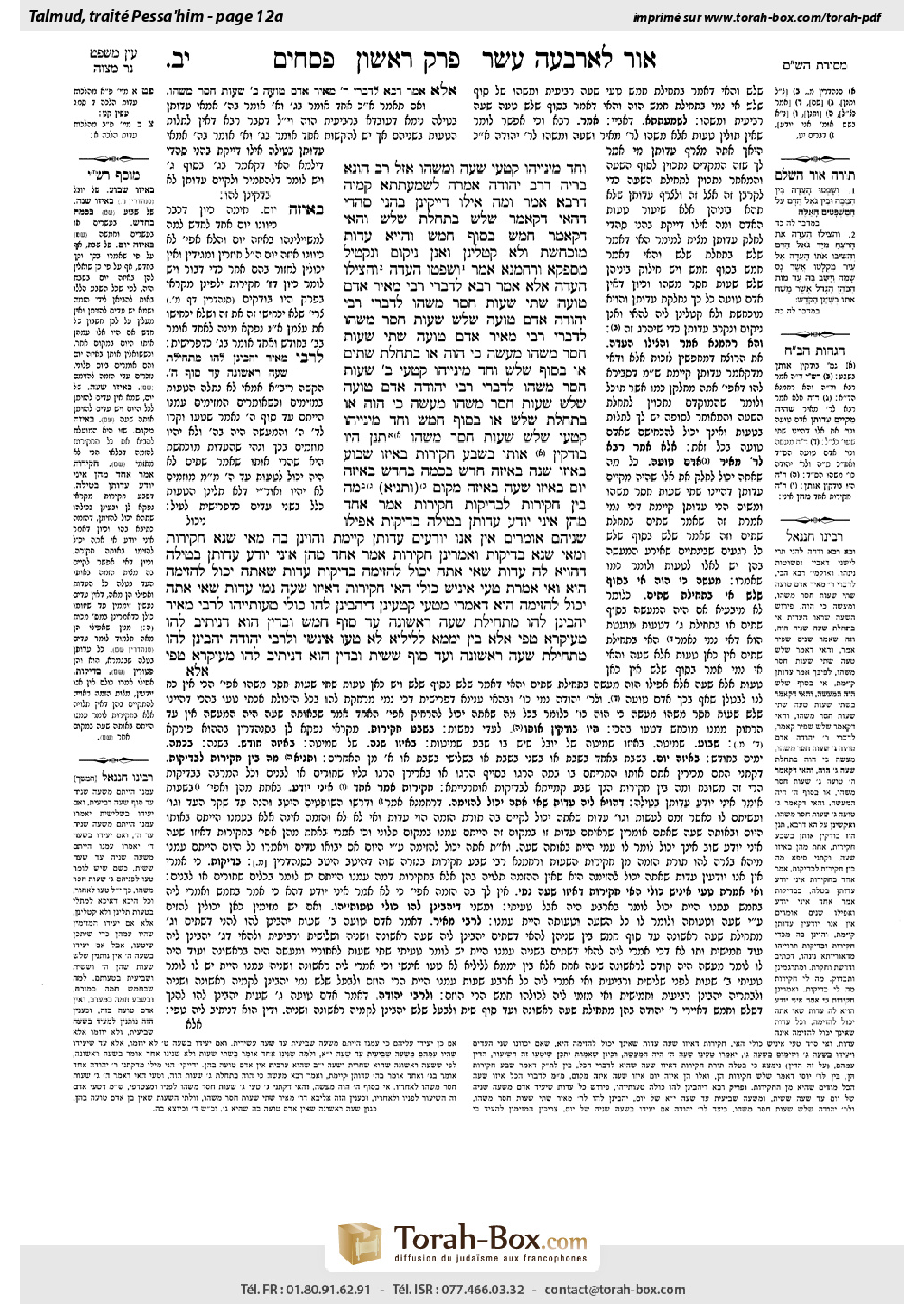
Pesachim 12a: Talmud study for Daf Yomi
Daf Yomi is the daily study of one Talmud folio. Explore 37 tractates with scans, Hebrew text, Sefaria English and AI-generated French translations where annotated.
Passage selection and English or AI-generated French translation are available where the scan has annotations. Daf Study is independent of Torah-Box and Sefaria.
Browse Pesachim · פסחים · All tractatesPesachim 12a text and translations
This page of Pesachim includes the Aramaic text, an English translation and an AI-generated French translation, alongside the scan above.
פסחים י״ב א · Aramaic and Hebrew text
וְחַד מִינַּיְיהוּ קָטָעֵי שָׁעָה וּמַשֶּׁהוּ.
אֲזַל רַב הוּנָא בְּרֵיהּ דְּרַב יְהוּדָה, אַמְרַהּ לִשְׁמַעְתְּתָא קַמֵּיהּ דְּרָבָא. אָמַר: וּמָה אִילּוּ דָּיְיקִינַן בְּהָנֵי סָהֲדֵי, דְּהַאי דְּקָאָמַר שָׁלֹשׁ — בִּתְחִלַּת שָׁלֹשׁ, וְהַאי דְּקָאָמַר חָמֵשׁ — בְּסוֹף חָמֵשׁ, וְהָוְיָא עֵדוּת מוּכְחֶשֶׁת, וְלָא קָטְלִינַן, וַאֲנַן נֵיקוּם וְנִקְּטֹיל מִסְּפֵקָא?! וְרַחֲמָנָא אָמַר: ״וְשָׁפְטוּ הָעֵדָה״ ״וְהִצִּילוּ הָעֵדָה״!
אֶלָּא אָמַר רָבָא: לְדִבְרֵי רַבִּי מֵאִיר — אָדָם טוֹעֶה שְׁתֵּי שָׁעוֹת חָסֵר מַשֶּׁהוּ; לְדִבְרֵי רַבִּי יְהוּדָה — אָדָם טוֹעֶה שָׁלֹשׁ שָׁעוֹת חָסֵר מַשֶּׁהוּ. לְדִבְרֵי רַבִּי מֵאִיר — אָדָם טוֹעֶה שְׁתֵּי שָׁעוֹת חָסֵר מַשֶּׁהוּ, מַעֲשֶׂה כִּי הֲוָה, אוֹ בִּתְחִלַּת שְׁתַּיִם אוֹ בְּסוֹף שָׁלֹשׁ, וְחַד מִינַּיְיהוּ קָטָעֵי שְׁתֵּי שָׁעוֹת חָסֵר מַשֶּׁהוּ.
לְדִבְרֵי רַבִּי יְהוּדָה — אָדָם טוֹעֶה שָׁלֹשׁ שָׁעוֹת חָסֵר מַשֶּׁהוּ, מַעֲשֶׂה כִּי הֲוָה אוֹ בִּתְחִלַּת שָׁלֹשׁ אוֹ בְּסוֹף חָמֵשׁ, וְחַד מִינַּיְיהוּ קָטָעֵי שָׁלֹשׁ שָׁעוֹת חָסֵר מַשֶּׁהוּ.
תְּנַן: הָיוּ בּוֹדְקִין אוֹתוֹ בְּשֶׁבַע חֲקִירוֹת: בְּאֵיזוֹ שָׁבוּעַ, בְּאֵיזוֹ שָׁנָה, בְּאֵיזֶה חֹדֶשׁ, בְּכַמָּה בַּחֹדֶשׁ, בְּאֵיזֶה יוֹם, בְּאֵיזוֹ שָׁעָה, בְּאֵיזֶה מָקוֹם. (וְתַנְיָא:) מָה בֵּין חֲקִירוֹת לִבְדִיקוֹת? חֲקִירוֹת, אָמַר אֶחָד מֵהֶן ״אֵינִי יוֹדֵעַ״ — עֵדוּתָן בְּטֵילָה. בְּדִיקוֹת, אֲפִילּוּ שְׁנֵיהֶם אוֹמְרִים ״אֵין אָנוּ יוֹדְעִים״ — עֵדוּתָן קַיֶּימֶת.
וְהָוִינַן בַּהּ: מַאי שְׁנָא חֲקִירוֹת וּמַאי שְׁנָא בְּדִיקוֹת?
וְאָמְרִינַן: חֲקִירוֹת, אָמַר אֶחָד מֵהֶן ״אֵינִי יוֹדֵעַ״ — עֵדוּתָן בְּטֵילָה, דְּהָוְיָא לַהּ עֵדוּת שֶׁאִי אַתָּה יָכוֹל לַהֲזִימָּהּ.
בְּדִיקוֹת, עֵדוּת שֶׁאַתָּה יָכוֹל לַהֲזִימָּהּ הִיא.
וְאִי אָמְרַתְּ טָעֵי אִינִישׁ כּוּלֵּי הַאי, חֲקִירוֹת דְּ״אֵיזוֹ שָׁעָה״ נָמֵי עֵדוּת שֶׁאִי אַתָּה יָכוֹל לַהֲזִימָּהּ הִיא, דְּאָמְרִי: מִטְעֵי קָטָעִינַן!
דְּיָהֲבִינַן לְהוּ כּוּלֵּי טָעוּתַיְיהוּ. לְרַבִּי מֵאִיר — יָהֲבִינַן לְהוּ מִתְּחִילַּת שָׁעָה רִאשׁוֹנָה עַד סוֹף חָמֵשׁ.
וּבְדִין הוּא דְּנִיתֵּיב לְהוּ מֵעִיקָּרָא טְפֵי, אֶלָּא בֵּין יְמָמָא לְלֵילְיָא לָא טָעוּ אִינָשֵׁי.
וּלְרַבִּי יְהוּדָה — יָהֲבִינַן לְהוּ מִתְּחִילַּת שָׁעָה רִאשׁוֹנָה וְעַד סוֹף שִׁשִּׁית. וּבְדִין הוּא דְּנִיתֵּיב לְהוּ מֵעִיקָּרָא טְפֵי,
Pesachim 12a · English translation
and one of them errs by an hour and a bit.
Rav Huna, son of Rav Yehuda, went and said the halakha of Abaye before Rava. Rava said to him that Abaye’s explanation must be rejected: And were we to closely examine the statements of these witnesses and ask them when precisely the incident occurred, and find that the one who says at three hours means that it occurred at the beginning of the third hour, and the one who says at five hours means that it occurred at the end of the fifth hour, it would be contradictory testimony and we would not kill the accused on the basis of this testimony; and will we arise and kill based on uncertainty? Although their testimony could be valid, it could also be void. Can the court execute the accused based on that uncertainty? And consider that the Merciful One says in the Torah: “And the congregation shall judge…and the congregation shall deliver” (Numbers 35:24–25), from which it is derived that judges must do everything in their power to save an accused from the death penalty.
Rather, Rava said: In fact, according to the statement of Rabbi Meir, a person errs by two hours less a bit; according to the statement of Rabbi Yehuda, a person errs by three hours less a bit. The Gemara elaborates: According to the statement of Rabbi Meir, a person errs by two hours less a bit. How so? When the incident occurred, it was either at the beginning of the second hour or at the end of the third hour and one of the witnesses erred by two hours less a bit, as that is a reasonable discrepancy.
According to the statement of Rabbi Yehuda, a person errs by three hours less a bit. How so? When the incident occurred, it was either in the beginning of the third hour or at the end of the fifth hour, and one of them errs by three hours less a bit. According to Rabbi Yehuda, that is a reasonable discrepancy.
We learned in a mishna: The judges of the court would examine witnesses with seven forms of interrogation: In which seven-year Sabbatical cycle of the Jubilee did the incident occur, in which year of the seven-year Sabbatical cycle, in which month of that year, on which date of that month, on which day of the week, at which hour of the day, at which place did the incident occur? And it was taught in a baraita: What is the difference between interrogations and examinations? With regard to each of the forms of interrogation, if one of the witnesses said: I do not know, their testimony is void. However, with regard to examinations, even if they both say: We do not know, their testimony is valid.
The Gemara continues. And we discussed this baraita: In what way are interrogations different and in what way are examinations different? Why is the testimony of a person who cannot answer one of the interrogations void, but his testimony is valid if he cannot answer one of the examinations?
And we said in response: With regard to interrogations, if one of them says: I do not know, their testimony is void, as this is testimony that you cannot render as false, conspiring testimony. Witnesses are determined to be false, conspiring witnesses when other witnesses arrive in court and testify that the first pair of witnesses could not possibly have witnessed the incident in question, as they were at a different place at that time together with them. If a witness says he does not know when the incident occurred or where it occurred, it would be impossible to testify that he was elsewhere and render him a false, conspiring witness. The Torah disqualifies the testimony of a witness who cannot be rendered a false, conspiring witness.
However, with regard to examinations, even if the witness cannot remember every detail, it remains testimony that you can render as false, conspiring testimony. Even without that detail, the second pair of witnesses can still testify that the first pair of witnesses was with them in a different place at that time.
Based on the above, the Gemara returns to discuss the matter of discrepancies in the testimony of the witnesses with regard to the hour that the incident occurred. And if you say that a person errs by that much, e.g., several hours, with regard to the interrogations of what time of day the incident occurred, this is also testimony that you cannot render as false, conspiring testimony, for if other witnesses claim that they were elsewhere at that time, the witnesses can say: We are mistaken, and the incident did not actually occur at that time, but a few hours earlier or later. Consequently, it is impossible to prove that they are false, conspiring witnesses.
The Gemara explains that we give leeway to the first pair of witnesses for the entire duration of the potential margin of their error. In order to render them false, conspiring witnesses, the second pair of witnesses must testify that the first witnesses were with them for the entire period during which their testimony would be accepted, despite the discrepancy with regard to the hour in which it occurred. According to Rabbi Meir, we give the witnesses who testified that the incident occurred at two or three hours of the day, from the beginning of the first hour until the end of the fifth hour. If they testified that the incident occurred in the second hour or the third hour, the court must take into account a mistake of two hours in either direction.
And by right we should give them even more leeway at the beginning. Since one errs by two hours less a bit, if the witnesses testified that the incident occurred at approximately two hours of the day, they might have erred by roughly two hours and the incident actually occurred before sunrise. However, since between day and night people do not err, and as the witnesses testify that the incident occurred during the second or third hour of the day, it could not have occurred before sunrise.
And according to Rabbi Yehuda, we give the witnesses a margin of error from the beginning of the first hour until the end of the sixth hour. And by right we should give them even more leeway at the beginning, as according to his opinion one errs by three hours less a bit, and therefore the margin for error should be greater.
Pesachim 12a · Traduction française (IA)
et l’un d’eux se trompe d’une heure et un peu.
Rav Houna, fils de Rav Yehouda, alla rapporter à Rava la halakha d’Abayé. Rava lui dit qu’il fallait rejeter l’explication d’Abayé : si nous examinions attentivement les déclarations de ces témoins et leur demandions précisément quand l’incident s’était produit, et que nous découvrions que celui qui dit « à la troisième heure » veut dire que l’incident s’est produit au début de la troisième heure, tandis que celui qui dit « à la cinquième heure » veut dire qu’il s’est produit à la fin de la cinquième heure, leurs témoignages seraient contradictoires et nous ne mettrions pas l’accusé à mort sur la base de ces témoignages. Allons-nous alors nous lever et le mettre à mort sur la base d’un doute ? Bien que leur témoignage puisse être valide, il pourrait aussi être nul. Le tribunal peut-il exécuter l’accusé sur la base de ce doute ? Considère également que le Miséricordieux dit dans la Torah : « Et l’assemblée jugera… et l’assemblée délivrera » (Nombres 35, 24-25), d’où l’on déduit que les juges doivent faire tout ce qui est en leur pouvoir pour sauver un accusé de la peine de mort.
Rava dit plutôt : en réalité, selon l’opinion de Rabbi Méïr, une personne se trompe de deux heures moins un peu ; selon celle de Rabbi Yehouda, une personne se trompe de trois heures moins un peu. La Guemara développe : selon l’opinion de Rabbi Méïr, une personne se trompe de deux heures moins un peu. Comment cela ? Lorsque l’incident s’est produit, c’était soit au début de la deuxième heure, soit à la fin de la troisième heure, et l’un des témoins s’est trompé de deux heures moins un peu, car un tel écart est raisonnable.
Selon l’opinion de Rabbi Yehouda, une personne se trompe de trois heures moins un peu. Comment cela ? Lorsque l’incident s’est produit, c’était soit au début de la troisième heure, soit à la fin de la cinquième heure, et l’un d’eux se trompe de trois heures moins un peu. Selon Rabbi Yehouda, un tel écart est raisonnable.
Nous avons appris dans une Michna : les juges du tribunal interrogeaient les témoins au moyen de sept interrogatoires : dans quel cycle sabbatique de sept ans du Jubilé l’incident s’est-il produit ? En quelle année du cycle sabbatique de sept ans ? En quel mois de cette année ? À quelle date de ce mois ? Quel jour de la semaine ? À quelle heure de la journée ? À quel endroit l’incident s’est-il produit ? Et une baraïta a enseigné : quelle est la différence entre les interrogatoires et les vérifications ? Pour chacun des interrogatoires, si l’un des témoins dit : « Je ne sais pas », leur témoignage est nul. En revanche, pour les vérifications, même s’ils disent tous deux : « Nous ne savons pas », leur témoignage est valide.
La Guemara poursuit. Nous avons discuté de cette baraïta : en quoi les interrogatoires diffèrent-ils des vérifications ? Pourquoi le témoignage d’une personne qui ne peut répondre à l’un des interrogatoires est-il nul, alors que son témoignage reste valide si elle ne peut répondre à l’une des vérifications ?
Nous avons répondu : pour les interrogatoires, si l’un d’eux dit : « Je ne sais pas », leur témoignage est nul, car c’est un témoignage qu’on ne peut pas rendre mensonger au moyen de témoins comploteurs. Des témoins sont déclarés faux et comploteurs lorsque d’autres témoins comparaissent devant le tribunal et attestent que la première paire de témoins n’a pas pu assister à l’incident en question, puisqu’ils se trouvaient avec eux ailleurs à ce moment-là. Si un témoin dit qu’il ne sait pas quand ni où l’incident s’est produit, il serait impossible d’attester qu’il se trouvait ailleurs et d’en faire un faux témoin comploteur. La Torah disqualifie le témoignage d’un témoin qu’on ne peut pas rendre faux et comploteur.
En revanche, pour les vérifications, même si le témoin ne se souvient pas de chaque détail, son témoignage peut toujours être rendu mensonger au moyen de témoins comploteurs. Même sans ce détail, la seconde paire de témoins peut encore attester que la première paire se trouvait avec eux ailleurs à ce moment-là.
À la lumière de ce qui précède, la Guemara revient sur la question des divergences entre les témoignages concernant l’heure à laquelle l’incident s’est produit. Si l’on dit qu’une personne peut se tromper autant, par exemple de plusieurs heures, pour les interrogatoires portant sur l’heure de la journée à laquelle l’incident s’est produit, ce témoignage est lui aussi impossible à rendre mensonger au moyen de témoins comploteurs : si d’autres témoins affirment qu’ils se trouvaient ailleurs à ce moment-là, les témoins peuvent répondre : « Nous nous trompons ; l’incident ne s’est pas réellement produit à ce moment-là, mais quelques heures plus tôt ou plus tard. » Il est donc impossible de prouver qu’ils sont de faux témoins comploteurs.
La Guemara explique que nous accordons à la première paire de témoins toute la marge correspondant à la durée possible de leur erreur. Pour les déclarer faux témoins comploteurs, la seconde paire doit attester que les premiers témoins se trouvaient avec eux pendant toute la période où leur témoignage serait accepté, compte tenu de l’écart concernant l’heure à laquelle l’incident s’est produit. Selon Rabbi Méïr, nous accordons aux témoins qui ont déclaré que l’incident s’était produit à la deuxième ou à la troisième heure de la journée une marge allant du début de la première heure à la fin de la cinquième heure. S’ils ont témoigné que l’incident s’était produit à la deuxième ou à la troisième heure, le tribunal doit tenir compte d’une erreur de deux heures dans un sens comme dans l’autre.
En toute rigueur, nous devrions leur accorder une marge encore plus large au début. Puisqu’une personne se trompe de deux heures moins un peu, si les témoins ont déclaré que l’incident s’était produit vers la deuxième heure de la journée, ils ont pu se tromper d’environ deux heures et l’incident s’est en réalité produit avant le lever du soleil. Cependant, comme les gens ne se trompent pas sur la distinction entre le jour et la nuit, et que les témoins attestent que l’incident s’est produit à la deuxième ou à la troisième heure de la journée, il n’a pas pu se produire avant le lever du soleil.
Et selon Rabbi Yehouda, nous accordons aux témoins une marge d’erreur allant du début de la première heure à la fin de la sixième heure. En toute rigueur, nous devrions leur accorder une marge encore plus large au début, car, selon son opinion, une personne se trompe de trois heures moins un peu ; la marge d’erreur devrait donc être plus grande.
Traduction française générée par IA à partir de l’édition anglaise de Sefaria. Vérifie toujours un passage avec le texte source.
Text from Sefaria: William Davidson Edition - Vocalized Aramaic (CC BY NC); William Davidson Edition - English (CC BY NC).