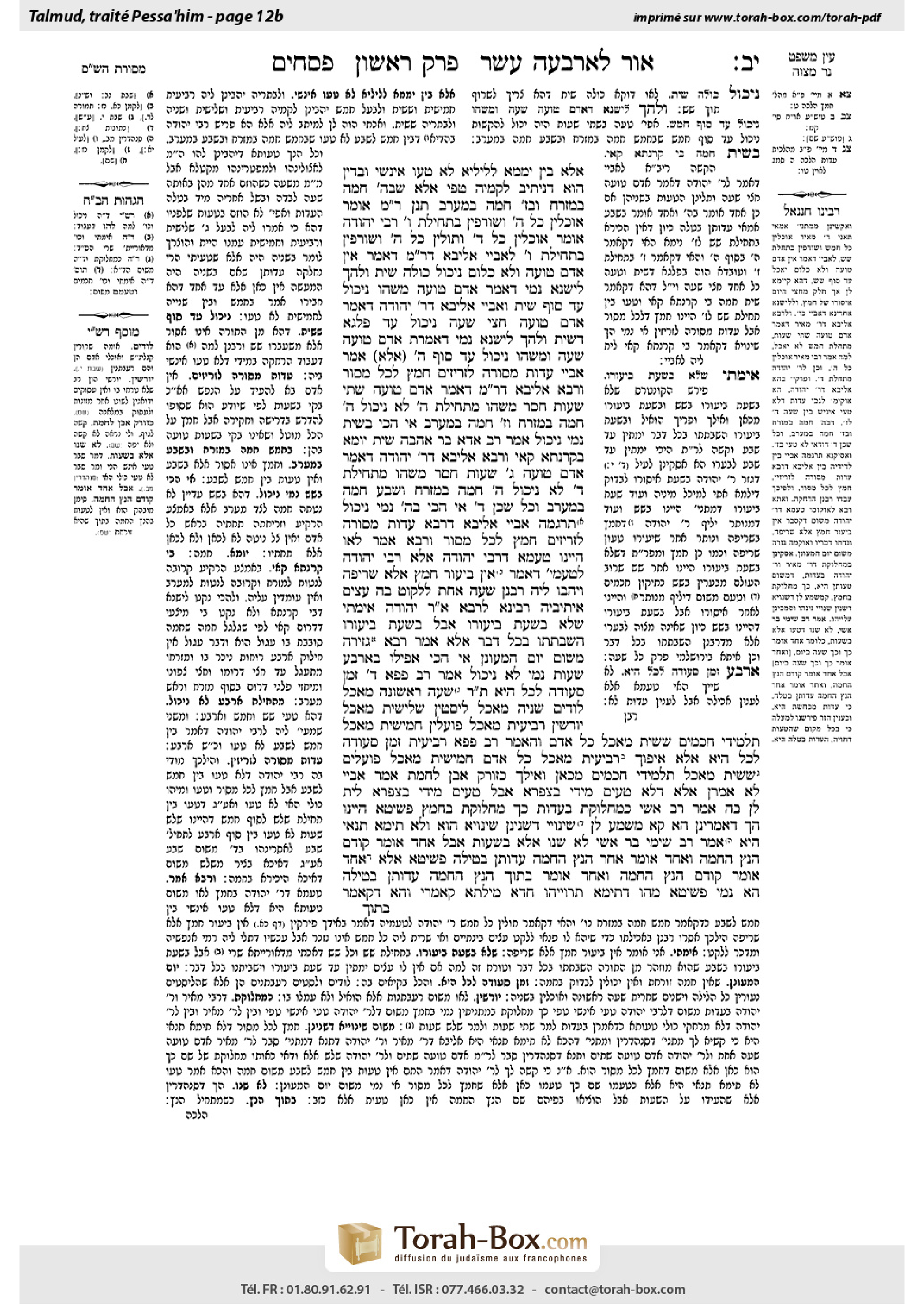
Pesachim 12b: Talmud study for Daf Yomi
Daf Yomi is the daily study of one Talmud folio. Explore 37 tractates with scans, Hebrew text, Sefaria English and AI-generated French translations where annotated.
Passage selection and English or AI-generated French translation are available where the scan has annotations. Daf Study is independent of Torah-Box and Sefaria.
Browse Pesachim · פסחים · All tractatesPesachim 12b text and translations
This page of Pesachim includes the Aramaic text, an English translation and an AI-generated French translation, alongside the scan above.
פסחים י״ב ב · Aramaic and Hebrew text
אֶלָּא בֵּין יְמָמָא לְלֵילְיָא לָא טָעוּ אִינָשֵׁי. וּבְדִין הוּא דְּנִיתֵּיב לְקַמֵּיהּ טְפֵי, אֶלָּא שֶׁבְּחָמֵשׁ חַמָּה בַּמִּזְרָח, וּבְשֶׁבַע חַמָּה בַּמַּעֲרָב.
תְּנַן רַבִּי מֵאִיר אוֹמֵר: אוֹכְלִין כׇּל חָמֵשׁ, וְשׂוֹרְפִין בִּתְחִילַּת שֵׁשׁ. רַבִּי יְהוּדָה אוֹמֵר: אוֹכְלִין כׇּל אַרְבַּע, וְתוֹלִין כׇּל חָמֵשׁ, וְשׂוֹרְפִין בִּתְחִילַּת שֵׁשׁ.
לְאַבָּיֵי אַלִּיבָּא דְּרַבִּי מֵאִיר, דְּאָמַר: אֵין אָדָם טוֹעֶה וְלֹא כְּלוּם — נֵיכוֹל כּוּלַּהּ שֵׁית. וּלְהַךְ לִישָּׁנָא נָמֵי דְּאָמַר: אָדָם טוֹעֶה מַשֶּׁהוּ — נֵיכוֹל עַד סוֹף שֵׁית.
וְאַבָּיֵי אַלִּיבָּא דְּרַבִּי יְהוּדָה, דְּאָמַר: אָדָם טוֹעֶה חֲצִי שָׁעָה — נֵיכוֹל עַד פַּלְגָא דְשֵׁית. וּלְהָךְ לִישָּׁנָא נָמֵי דְּאָמְרַתְּ: אָדָם טוֹעֶה שָׁעָה וּמַשֶּׁהוּ — נֵיכוֹל עַד סוֹף חָמֵשׁ.
(אֶלָּא) אָמַר אַבָּיֵי: עֵדוּת מְסוּרָה לִזְרִיזִים, חָמֵץ לַכֹּל מָסוּר.
וְרָבָא אַלִּיבָּא דְּרַבִּי מֵאִיר, דְּאָמַר: אָדָם טוֹעֶה שְׁתֵּי שָׁעוֹת חָסֵר מַשֶּׁהוּ — מִתְּחִילַּת חָמֵשׁ לָא נֵיכוֹל! חָמֵשׁ חַמָּה בַּמִּזְרָח, וְשֶׁבַע חַמָּה בַּמַּעֲרָב.
אִי הָכִי, בְּשֵׁית נָמֵי נֵיכוֹל?! אָמַר רַב אַדָּא בַּר אַהֲבָה: שֵׁית, יוֹמָא בְּקַרְנָתָא קָאֵי.
וְרָבָא אַלִּיבָּא דְּרַבִּי יְהוּדָה, דְּאָמַר: אָדָם טוֹעֶה שָׁלֹשׁ שָׁעוֹת חָסֵר מַשֶּׁהוּ — מִתְּחִילַּת אַרְבַּע לָא נֵיכוֹל! חָמֵשׁ חַמָּה בַּמִּזְרָח, וְשֶׁבַע חַמָּה בַּמַּעֲרָב. וְכׇל שֶׁכֵּן אַרְבַּע. אִי הָכִי, בְּחָמֵשׁ נָמֵי נֵיכוֹל!
תַּרְגְּמַהּ אַבָּיֵי אַלִּיבָּא דְּרָבָא: עֵדוּת מְסוּרָה לִזְרִיזִים, חָמֵץ לַכֹּל מָסוּר.
וְרָבָא אָמַר: לָאו הַיְינוּ טַעְמָא דְּרַבִּי יְהוּדָה. אֶלָּא רַבִּי יְהוּדָה לְטַעְמֵיהּ, דְּאָמַר: אֵין בִּיעוּר חָמֵץ אֶלָּא שְׂרֵיפָה, וִיהַבוּ לֵיהּ רַבָּנַן שָׁעָה אַחַת לִלְקוֹט בָּהּ עֵצִים.
אֵיתִיבֵיהּ רָבִינָא לְרָבָא: אָמַר רַבִּי יְהוּדָה: אֵימָתַי — שֶׁלֹּא בִּשְׁעַת בִּיעוּרוֹ. אֲבָל בִּשְׁעַת בִּיעוּרוֹ — הַשְׁבָּתָתוֹ בְּכׇל דָּבָר!
אֶלָּא אָמַר רָבָא: גְּזֵירָה מִשּׁוּם יוֹם הַמְעוּנָּן. אִי הָכִי, אֲפִילּוּ בְּאַרְבַּע שָׁעוֹת נָמֵי לָא נֵיכוֹל! אָמַר רַב פָּפָּא: אַרְבַּע זְמַן סְעוּדָה לַכֹּל הִיא.
תָּנוּ רַבָּנַן: שָׁעָה רִאשׁוֹנָה — מַאֲכַל לוּדִים. שְׁנִיָּה — מַאֲכַל לִיסְטִין. שְׁלִישִׁית — מַאֲכַל יוֹרְשִׁין. רְבִיעִית — מַאֲכַל פּוֹעֲלִין. חֲמִישִׁית — מַאֲכַל תַּלְמִידֵי חֲכָמִים. שִׁשִּׁית — מַאֲכַל כׇּל אָדָם.
וְהָאָמַר רַב פָּפָּא: רְבִיעִית — זְמַן סְעוּדָה לְכׇל הִיא! אֶלָּא אֵיפוֹךְ: רְבִיעִית — מַאֲכַל כׇּל אָדָם, חֲמִישִׁית — מַאֲכַל פּוֹעֲלִים, שִׁשִּׁית — מַאֲכַל תַּלְמִידֵי חֲכָמִים.
מִכָּאן וְאֵילָךְ, כְּזוֹרֵק אֶבֶן לַחֵמֶת. אָמַר אַבָּיֵי: לָא אֲמַרַן אֶלָּא דְּלָא טָעֵים מִידֵּי בְּצַפְרָא. אֲבָל טָעֵים מִידֵּי בְּצַפְרָא — לֵית לַן בַּהּ.
אָמַר רַב אָשֵׁי: כְּמַחְלוֹקֶת בְּעֵדוּת, כָּךְ מַחְלוֹקֶת בְּחָמֵץ. פְּשִׁיטָא, הַיְינוּ הָךְ דְּאָמְרִינַן! הָא קָא מַשְׁמַע לַן: שִׁינּוּיֵי דְּשַׁנִּינַן — שִׁינּוּיָא הוּא, וְלָא תֵּימָא תַּנָּאֵי הִיא.
אָמַר רַב שִׁימִי בַּר אָשֵׁי: לֹא שָׁנוּ אֶלָּא בְּשָׁעוֹת, אֲבָל אֶחָד אוֹמֵר קוֹדֶם הָנֵץ הַחַמָּה וְאֶחָד אוֹמֵר אַחַר הָנֵץ הַחַמָּה — עֵדוּתָן בְּטֵילָה. פְּשִׁיטָא!
אֶלָּא: אֶחָד אוֹמֵר קוֹדֶם הָנֵץ הַחַמָּה וְאֶחָד אוֹמֵר בְּתוֹךְ הָנֵץ הַחַמָּה — עֵדוּתָן בְּטֵילָה. הָא נָמֵי פְּשִׁיטָא! מַהוּ דְּתֵימָא: תַּרְוַיְיהוּ חֲדָא מִילְּתָא קָאָמְרִי, וְהָא דְּקָאָמַר
Pesachim 12b · English translation
However, between day and night people do not err, and therefore there is no concern that they might have erred in this regard. And similarly, by right we should give them even more leeway at the end of the period. However, this too is not a reasonable discrepancy, as at five hours of the day the sun is in the east and at seven hours the sun is in the west. No one confuses the morning with the afternoon.
In light of the above conclusions, the Gemara returns to address the issue of leaven. We learned in the mishna that Rabbi Meir says: One may eat leaven the entire fifth hour of the fourteenth of Nisan, and one must burn it immediately afterward at the beginning of the sixth hour. Rabbi Yehuda says: One may eat the entire fourth hour, and one places it in abeyance for the entire fifth hour, and one burns it at the beginning of the sixth hour.
The Gemara raises a difficulty: According to Abaye’s explanation in accordance with the opinion of Rabbi Meir, that he said a person does not err about the time at all, let him eat leaven for the entire sixth hour, as by Torah law it is permitted to eat until the end of the sixth hour, i.e., midday. The Sages issued a decree prohibiting the consumption of leaven from the beginning of the sixth hour, lest one unwittingly come to eat after midday. However, according to Rabbi Meir, people do not err in this regard at all and that concern is unfounded. And according to that version of Rabbi Meir’s opinion, that he said a person errs a bit, let him eat leaven until just before the end of the sixth hour.
And according to Abaye’s explanation in accordance with the opinion of Rabbi Yehuda, that he said: A person errs by half an hour; let him eat leaven until the midpoint of the sixth hour. And even according to the version of Rabbi Yehuda’s opinion, that he said: A person errs by an hour plus a bit; let him eat leaven until just before the end of the fifth hour. From the fact that this is not the ruling of these Sages, apparently Abaye’s assessment of the amount of time that a person errs is incorrect.
Rather, Abaye said: There is a difference between the issues of testimony and leaven, as testimony is entrusted to the vigilant. One comes to testify only if he thoroughly scrutinized the subject of his testimony. Therefore, he will not err significantly with regard to the time in question. However, the prohibition against eating leavened bread is a halakha entrusted to all, and not everyone is able to correctly determine the time. Consequently, Rabbi Meir and Rabbi Yehuda both extend the margin for error, so that people will not unwittingly eat leaven after the time that it is prohibited to do so.
The Gemara raises another difficulty: And according to Rava’s explanation in accordance with the opinion of Rabbi Meir, that he said: A person errs by two hours less a bit; from the beginning of the fifth hour let one no longer eat leaven. After all, one could confuse the fifth hour with the seventh hour, when it is prohibited to eat leaven by Torah law. The Gemara answers: Since at five hours the sun is in the east and at seven hours the sun is in the west, no one confuses morning with afternoon.
The Gemara raises a difficulty: If so, during the sixth hour let him eat leaven as well, as one distinguishes between the sixth hour and the seventh hour since the sun tends westward only during the seventh hour. Rav Adda bar Ahava said: In the sixth hour, the day, i.e., the sun, stands at the meridian, equidistant between east and west, and it is unclear toward which direction it tends. Therefore, confusion between the sixth and seventh hours is possible.
The Gemara asks: And according to Rava’s explanation in accordance with the opinion of Rabbi Yehuda, that he said: A person errs by three hours less a bit; from the beginning of the fourth hour let one no longer eat leaven. The Gemara answers: If, since at five hours the sun is in the east and at seven hours the sun is in the west, one does not confuse the morning with the evening, and all the more so one will not confuse seven hours of the day with four hours of the day, when the sun is further east. The Gemara raises a difficulty: If so, i.e., there is no concern lest one confuse morning and afternoon, during the fifth hour let him eat leaven as well.
Abaye interpreted it in accordance with the opinion of Rava: Testimony is entrusted to the vigilant, and therefore a witness is less likely to err, whereas the prohibition against eating leavened bread is entrusted to all. Since a common person is more likely to err, the Sages were more stringent with regard to leaven than with regard to testimony.
And Rava said: That is not the reason for the added hour in the opinion of Rabbi Yehuda, as he is not concerned lest people err. Rather, Rabbi Yehuda conforms to his standard line of reasoning, as he said: The removal of leaven can be performed only by burning it, and therefore by prohibiting the consumption of leaven, the Sages provided him with one hour during which to gather wood to burn the leaven.
Ravina raised an objection to the opinion of Rava from a baraita. Rabbi Yehuda said: When is it that the elimination of leaven can be performed only by burning it? It is only when one removes the leaven not at the time designated for its removal. Then, one should seek out the preferred method of removal and implement it in the ideal manner. However, when one removes the leaven at the time designated for its removal, at the end of the sixth hour when he must remove the leaven immediately, the removal of leaven may be performed in any manner, and one need not seek wood for burning. Why, then, was it necessary for the Sages to provide him with an hour to gather wood?
Rather, Rava reconsidered the previous explanation and said: It is a rabbinic decree due to a cloudy day, when one is unable to observe the precise position of the sun, increasing the likelihood of confusion. The Gemara raises a difficulty: If so, then even at fourth hour let one no longer eat leaven, as according to Rabbi Yehuda a person errs by three hours less a bit. Rav Pappa said: The fourth hour is mealtime for everyone, and therefore everyone is aware of that hour and will not confuse it with another.
In light of Rav Pappa’s statement, the Gemara discusses the topic of mealtimes. The Sages taught in a baraita: Eating in the first hour of the morning is the time of eating for Ludim, who are members of a nation of cannibals, and they are ravenous and in a hurry to eat. The second hour is the time of eating for robbers [listin]. Since they spend the night stealing, they eat early in the morning. The third hour is the time of eating for heirs, i.e., people who inherited a lot of money and do not work for their sustenance. Their only preoccupation in the early hours of the morning is eating. The fourth hour is the time of eating for workers. The fifth hour is the time of eating for Torah scholars. The sixth hour is the time of eating for all people.
The Gemara raises a difficulty: But didn’t Rav Pappa say that the fourth hour is the time of eating for all? Rather, reverse the fourth, fifth, and sixth hours: The fourth hour is mealtime for all people, the fifth hour is the time of eating for workers, and the sixth hour is the time of eating for Torah scholars.
One who eats from this point forward does not benefit from eating, as he is like one who throws a stone into a leather bottle, i.e., it does not contribute to his health. Abaye said: We only said that eating from the sixth hour onward is not beneficial, when he did not taste anything in the morning; however, if he tasted something in the morning we have no problem with it.
Rav Ashi said: Like the dispute between Rabbi Meir and Rabbi Yehuda with regard to testimony, so too is their dispute with regard to leavened bread. The Gemara comments: This is obvious, as this is precisely that which we said. The Gemara explains: Rav Ashi comes to teach us that the answers that we answered, distinguishing between the cases of testimony and leaven, are legitimate answers. And do not say that the different rulings in the two cases reflect a dispute between tanna’im with regard to the opinions of Rabbi Meir and Rabbi Yehuda and the answers are merely forced attempts to resolve the contradiction but not legitimate answers.
Rav Shimi bar Ashi said: They taught that the court does not reject testimony due to a discrepancy over time only with regard to testimony ascribed to different hours of the day. However, if one witness says that the incident occurred before sunrise and the other one says it occurred after sunrise, their testimony is void. The Gemara asks: It is obvious that this is the case, as a blatant contradiction of this kind could not possibly be the result of miscalculation.
Rather, emend the previous statement: If one witness says the incident occurred before sunrise and one says it occurred during sunrise, their testimony is void. The Gemara asks: That too is obvious, as the difference between those times is similarly conspicuous. The Gemara answers: It is necessary to teach this halakha, lest you say that both of the witnesses are saying one matter, and the fact that one witness says
Pesachim 12b · Traduction française (IA)
Cependant, entre le jour et la nuit, les gens ne se trompent pas ; il n’y a donc pas lieu de craindre qu’ils aient commis une erreur à cet égard. De même, en toute logique, nous devrions leur accorder encore plus de marge à la fin de la période. Mais cet écart n’est pas non plus plausible : à la cinquième heure du jour, le soleil est à l’est, tandis qu’à la septième heure, il est à l’ouest. Personne ne confond le matin avec l’après-midi.
À la lumière des conclusions précédentes, la Guemara revient à la question du hamets. Nous avons appris dans la Michna que Rabbi Meïr dit : On peut manger du hamets pendant toute la cinquième heure du quatorzième jour de Nissan, puis on doit le brûler immédiatement, au début de la sixième heure. Rabbi Yehouda dit : On peut en manger pendant toute la quatrième heure, on le met en suspens pendant toute la cinquième heure et on le brûle au début de la sixième heure.
La Guemara soulève une difficulté : selon l’explication d’Abayé conforme à l’opinion de Rabbi Meïr, qui dit qu’une personne ne se trompe pas du tout sur l’heure, qu’on la laisse donc manger du hamets pendant toute la sixième heure, puisque, selon la Torah, il est permis d’en manger jusqu’à la fin de la sixième heure, c’est-à-dire jusqu’à midi. Les Sages ont décrété qu’il était interdit d’en manger dès le début de la sixième heure, de peur qu’on en vienne sans le vouloir à en manger après midi. Mais, selon Rabbi Meïr, les gens ne se trompent absolument pas à cet égard, et cette crainte est sans fondement. Et selon cette version de l’opinion de Rabbi Meïr, selon laquelle une personne se trompe un peu, qu’on la laisse donc manger du hamets jusqu’à peu avant la fin de la sixième heure.
Et selon l’explication d’Abayé conforme à l’opinion de Rabbi Yehouda, qui dit qu’une personne se trompe d’une demi-heure, qu’on la laisse donc manger du hamets jusqu’au milieu de la sixième heure. Même selon cette version de l’opinion de Rabbi Yehouda, qui dit qu’une personne se trompe d’un peu plus d’une heure, qu’on la laisse donc manger du hamets jusqu’à peu avant la fin de la cinquième heure. Puisque ces Sages n’ont pas statué ainsi, il semble que l’évaluation par Abayé de la durée pendant laquelle une personne se trompe soit inexacte.
Abayé dit plutôt : il y a une différence entre le témoignage et le hamets, car le témoignage est confié à des personnes vigilantes. On ne vient témoigner que si l’on a examiné avec soin l’objet de son témoignage. Par conséquent, on ne se trompera pas beaucoup sur l’heure en question. En revanche, l’interdiction de manger du pain levé est une halakha qui concerne tout le monde, et tous ne sont pas capables de déterminer correctement l’heure. Rabbi Meïr et Rabbi Yehouda accordent donc tous deux une marge d’erreur plus grande, afin que les gens ne mangent pas involontairement du hamets après l’heure où cela est interdit.
La Guemara soulève une autre difficulté : selon l’explication de Rava conforme à l’opinion de Rabbi Meïr, qui dit qu’une personne se trompe de presque deux heures, qu’on interdise donc de manger du hamets dès le début de la cinquième heure. En effet, on pourrait confondre la cinquième heure avec la septième, alors qu’il est interdit, selon la Torah, de manger du hamets. La Guemara répond : puisque, à la cinquième heure, le soleil est à l’est et qu’à la septième heure il est à l’ouest, personne ne confond le matin avec l’après-midi.
La Guemara soulève une difficulté : dans ce cas, qu’on permette aussi de manger du hamets pendant la sixième heure, puisqu’on distingue la sixième heure de la septième, car le soleil ne s’incline vers l’ouest qu’à la septième heure. Rav Adda bar Ahava dit : à la sixième heure, le jour, c’est-à-dire le soleil, se tient au méridien, à égale distance de l’est et de l’ouest, et il est difficile de savoir vers quelle direction il s’incline. Il est donc possible de confondre la sixième et la septième heure.
La Guemara demande : et selon l’explication de Rava conforme à l’opinion de Rabbi Yehouda, qui dit qu’une personne se trompe de presque trois heures, qu’on interdise donc de manger du hamets dès le début de la quatrième heure. La Guemara répond : si, puisque le soleil est à l’est à la cinquième heure et à l’ouest à la septième, on ne confond pas le matin avec le soir, à plus forte raison ne confondra-t-on pas la septième heure du jour avec la quatrième, où le soleil est encore plus à l’est. La Guemara soulève une difficulté : dans ce cas, c’est-à-dire s’il n’y a pas lieu de craindre qu’on confonde le matin et l’après-midi, qu’on permette aussi de manger du hamets pendant la cinquième heure.
Abayé l’interpréta conformément à l’opinion de Rava : le témoignage est confié à des personnes vigilantes, et un témoin est donc moins susceptible de se tromper, tandis que l’interdiction de manger du pain levé concerne tout le monde. Comme une personne ordinaire est plus susceptible de se tromper, les Sages ont été plus stricts à propos du hamets qu’à propos du témoignage.
Et Rava dit : telle n’est pas la raison de l’heure supplémentaire selon l’opinion de Rabbi Yehouda, car celui-ci ne craint pas que les gens se trompent. Rabbi Yehouda suit plutôt son raisonnement habituel : il dit que l’élimination du hamets ne peut se faire qu’en le brûlant. En interdisant de manger du hamets, les Sages lui ont donc laissé une heure pour ramasser du bois afin de le brûler.
Ravina objecta à l’opinion de Rava à partir d’une baraïta. Rabbi Yehouda dit : Quand l’élimination du hamets ne peut-elle se faire qu’en le brûlant ? Uniquement lorsqu’on l’élimine en dehors du moment fixé à cet effet. Il faut alors rechercher la méthode d’élimination préférable et l’appliquer de la manière idéale. Mais lorsqu’on élimine le hamets au moment fixé, à la fin de la sixième heure, alors qu’on doit l’éliminer immédiatement, on peut le faire de n’importe quelle manière et il n’est pas nécessaire de chercher du bois pour le brûler. Pourquoi, dès lors, les Sages auraient-ils dû lui accorder une heure pour ramasser du bois ?
Rava revint plutôt sur l’explication précédente et dit : c’est un décret rabbinique motivé par les jours nuageux, où l’on ne peut pas observer la position exacte du soleil, ce qui accroît le risque de confusion. La Guemara soulève une difficulté : dans ce cas, qu’on interdise donc aussi de manger du hamets dès la quatrième heure, puisque, selon Rabbi Yehouda, une personne se trompe de presque trois heures. Rav Pappa dit : la quatrième heure est l’heure du repas de tout le monde ; chacun connaît donc cette heure et ne la confondra pas avec une autre.
À la lumière de la déclaration de Rav Pappa, la Guemara aborde la question des heures des repas. Les Sages ont enseigné dans une baraïta : la première heure du matin est l’heure du repas des Ludiens, membres d’un peuple de cannibales, affamés et pressés de manger. La deuxième heure est l’heure du repas des brigands [listin]. Comme ils passent la nuit à voler, ils mangent tôt le matin. La troisième heure est l’heure du repas des héritiers, c’est-à-dire des personnes qui ont hérité de beaucoup d’argent et n’ont pas besoin de travailler pour subvenir à leurs besoins. Au début de la matinée, leur seule préoccupation est de manger. La quatrième heure est l’heure du repas des travailleurs. La cinquième heure est l’heure du repas des érudits en Torah. La sixième heure est l’heure du repas de tout le monde.
La Guemara soulève une difficulté : Rav Pappa n’a-t-il pas dit que la quatrième heure est l’heure du repas de tout le monde ? Il faut plutôt inverser les quatrième, cinquième et sixième heures : la quatrième heure est l’heure du repas de tout le monde, la cinquième heure est celle des travailleurs et la sixième heure est celle des érudits en Torah.
Celui qui mange à partir de ce moment-là ne tire aucun bénéfice de son repas, car il est comme quelqu’un qui jette une pierre dans une outre de cuir, c’est-à-dire que cela ne contribue pas à sa santé. Abayé dit : nous avons dit que manger à partir de la sixième heure n’est pas bénéfique uniquement lorsqu’on n’a rien goûté le matin ; mais si l’on a goûté quelque chose le matin, il n’y a pas de problème.
Rav Achi dit : de même qu’il y a une controverse entre Rabbi Meïr et Rabbi Yehouda au sujet du témoignage, de même y en a-t-il une au sujet du pain levé. La Guemara fait remarquer : cela va de soi, car c’est précisément ce que nous avons dit. La Guemara explique : Rav Achi vient nous enseigner que les réponses que nous avons apportées, en distinguant les cas du témoignage et du hamets, sont recevables. Il ne faut pas dire que les décisions différentes dans les deux cas reflètent une controverse entre tannaïm au sujet des opinions de Rabbi Meïr et de Rabbi Yehouda, et que ces réponses ne sont que des tentatives forcées pour résoudre la contradiction, sans être des réponses recevables.
Rav Shimi bar Ashi dit : les Sages ont enseigné que le tribunal ne rejette pas un témoignage en raison d’un écart concernant l’heure uniquement lorsque les témoignages situent l’événement à des heures différentes du jour. Mais si un témoin dit que l’incident s’est produit avant le lever du soleil et l’autre qu’il s’est produit après le lever du soleil, leur témoignage est invalide. La Guemara demande : cela va de soi, car une contradiction manifeste de ce genre ne peut pas résulter d’une erreur de calcul.
Il faut plutôt rectifier la déclaration précédente : si un témoin dit que l’incident s’est produit avant le lever du soleil et l’autre qu’il s’est produit pendant le lever du soleil, leur témoignage est invalide. La Guemara demande : cela aussi va de soi, car la différence entre ces moments est tout aussi manifeste. La Guemara répond : il était nécessaire d’enseigner cette halakha, de peur que tu ne dises que les deux témoins disent une seule et même chose, et que le fait qu’un témoin dise
Traduction française générée par IA à partir de l’édition anglaise de Sefaria. Vérifie toujours un passage avec le texte source.
Text from Sefaria: William Davidson Edition - Vocalized Aramaic (CC BY NC); William Davidson Edition - English (CC BY NC).