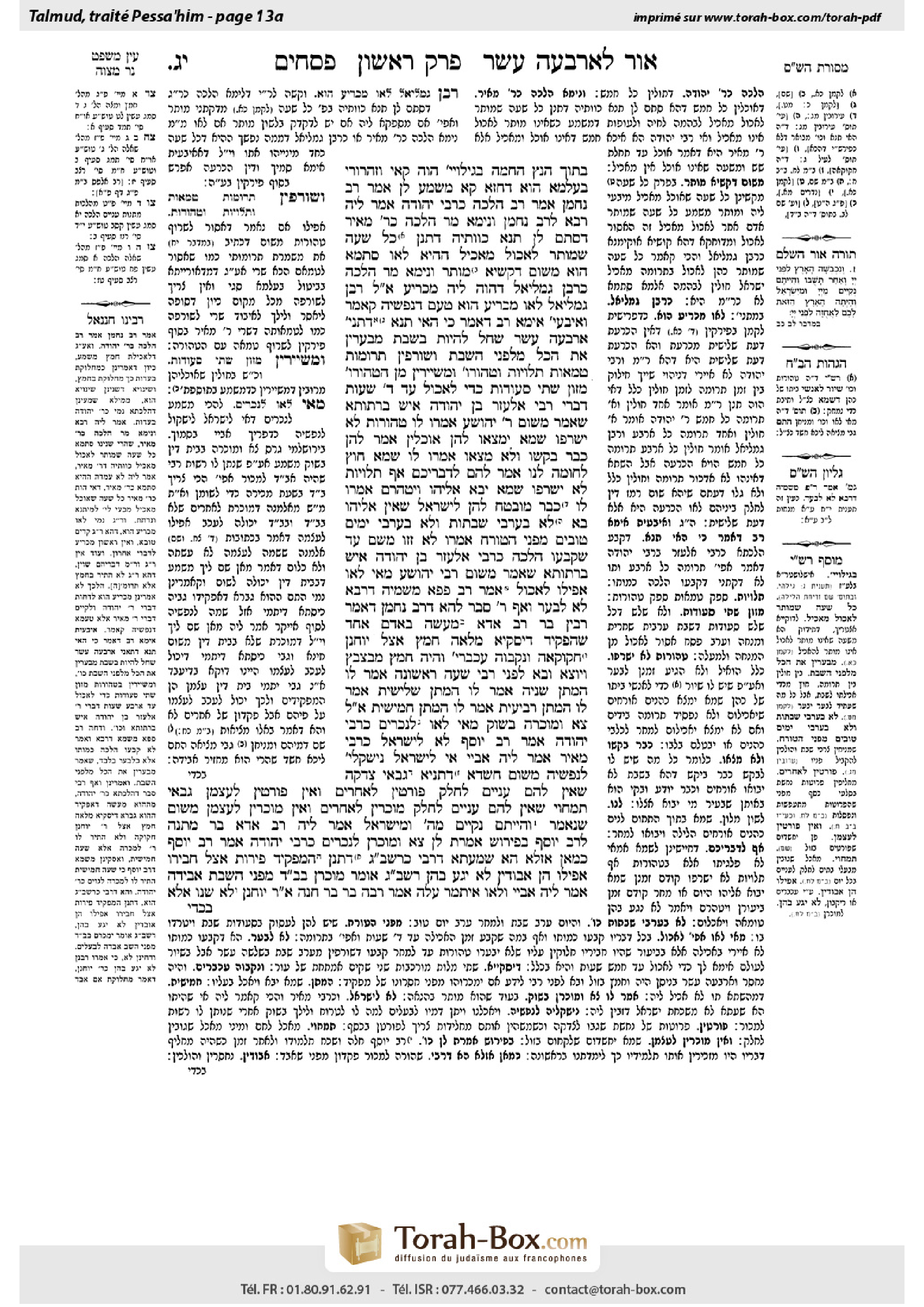
Pesachim 13a: Talmud study for Daf Yomi
Daf Yomi is the daily study of one Talmud folio. Explore 37 tractates with scans, Hebrew text, Sefaria English and AI-generated French translations where annotated.
Passage selection and English or AI-generated French translation are available where the scan has annotations. Daf Study is independent of Torah-Box and Sefaria.
Browse Pesachim · פסחים · All tractatesPesachim 13a text and translations
This page of Pesachim includes the Aramaic text, an English translation and an AI-generated French translation, alongside the scan above.
פסחים י״ג א · Aramaic and Hebrew text
בְּתוֹךְ הָנֵץ הַחַמָּה — בְּגִילּוּיָיא הֲוָה קָאֵי, וְזַהֲרוּרֵי בְּעָלְמָא הוּא דַּחֲזָא. קָא מַשְׁמַע לַן.
אָמַר רַב נַחְמָן אָמַר רַב: הֲלָכָה כְּרַבִּי יְהוּדָה. אֲמַר לֵיהּ רָבָא לְרַב נַחְמָן: וְנֵימָא מָר הֲלָכָה כְּרַבִּי מֵאִיר, דִּסְתַם לַן תְּנָא כְּווֹתֵיהּ.
דִּתְנַן: כׇּל שָׁעָה שֶׁמּוּתָּר לֶאֱכוֹל — מַאֲכִיל!
הָהִיא לָאו סְתָמָא הוּא, מִשּׁוּם דְּקַשְׁיָא ״מוּתָּר״.
וְנֵימָא מָר הֲלָכָה כְּרַבָּן גַּמְלִיאֵל, דְּהָוֵה לֵיהּ מַכְרִיעַ. אֲמַר לֵיהּ: רַבָּן גַּמְלִיאֵל לָאו מַכְרִיעַ הוּא, טַעַם דְּנַפְשֵׁיהּ קָאָמַר.
וְאִיבָּעֵית אֵימָא: רַב דְּאָמַר כִּי הַאי תַּנָּא, דְּתַנְיָא: אַרְבָּעָה עָשָׂר שֶׁחָל לִהְיוֹת בְּשַׁבָּת — מְבַעֲרִין אֶת הַכֹּל מִלִּפְנֵי הַשַּׁבָּת. וְשׂוֹרְפִין תְּרוּמוֹת טְמֵאוֹת, תְּלוּיוֹת, וּטְהוֹרוֹת. וּמְשַׁיְּירִין מִן הַטְּהוֹרוֹת מְזוֹן שְׁתֵּי סְעוּדוֹת, כְּדֵי לֶאֱכוֹל עַד אַרְבַּע שָׁעוֹת, דִּבְרֵי רַבִּי אֶלְעָזָר בֶּן יְהוּדָה אִישׁ בַּרְתּוֹתָא, שֶׁאָמַר מִשּׁוּם רַבִּי יְהוֹשֻׁעַ.
אָמְרוּ לוֹ: טְהוֹרוֹת לֹא יִשָּׂרְפוּ, שֶׁמָּא יִמָּצְאוּ לָהֶן אוֹכְלִין. אָמַר לָהֶן: כְּבָר בִּקְּשׁוּ וְלֹא מָצְאוּ. אָמְרוּ לוֹ: שֶׁמָּא חוּץ לַחוֹמָה לָנוּ?
אָמַר לָהֶם: לְדִבְרֵיכֶם, אַף תְּלוּיוֹת לֹא יִשָּׂרְפוּ — שֶׁמָּא יָבֹא אֵלִיָּהוּ וִיטַהֲרֵם. אָמְרוּ לוֹ: כְּבָר מוּבְטָח לָהֶן לְיִשְׂרָאֵל שֶׁאֵין אֵלִיָּהוּ בָּא לֹא בְּעַרְבֵי שַׁבָּתוֹת וְלֹא בְּעַרְבֵי יָמִים טוֹבִים, מִפְּנֵי הַטּוֹרַח.
אָמְרוּ: לֹא זָזוּ מִשָּׁם עַד שֶׁקָּבְעוּ הֲלָכָה כְּרַבִּי אֶלְעָזָר בֶּן יְהוּדָה אִישׁ בַּרְתּוֹתָא שֶׁאָמַר מִשּׁוּם רַבִּי יְהוֹשֻׁעַ.
מַאי לָאו, אֲפִילּוּ לֶאֱכוֹל? אָמַר רַב פָּפָּא מִשְּׁמֵיהּ דְּרָבָא: לֹא, לְבַעֵר.
וְאַף רַבִּי סָבַר לְהָא דְּרַב נַחְמָן. דְּאָמַר רָבִין בַּר רַב אַדָּא: מַעֲשֶׂה בְּאָדָם אֶחָד שֶׁהִפְקִיד דִּיסַקַּיָּא מְלֵאָה חָמֵץ אֵצֶל יוֹחָנָן חָקוֹקָאָה, וּנְקָבוּהָ עַכְבָּרִים, וְהָיָה חָמֵץ מְבַצְבֵּץ וְיוֹצֵא. וּבָא לִפְנֵי רַבִּי, שָׁעָה רִאשׁוֹנָה אָמַר לוֹ: הַמְתֵּן. שְׁנִיָּה, אָמַר לוֹ: הַמְתֵּן. שְׁלִישִׁית, אָמַר לוֹ: הַמְתֵּן. רְבִיעִית, אָמַר לוֹ: הַמְתֵּן. חֲמִישִׁית, אָמַר לוֹ: צֵא וּמוֹכְרֶהָ בַּשּׁוּק.
מַאי לָאו, לְגוֹיִם — כְּרַבִּי יְהוּדָה? אָמַר רַב יוֹסֵף: לָא, לְיִשְׂרָאֵל — כְּרַבִּי מֵאִיר. אֲמַר לֵיהּ אַבָּיֵי: אִי לְיִשְׂרָאֵל — נִישְׁקְלֵיהּ לְנַפְשֵׁיהּ?
מִשּׁוּם חֲשָׁדָא, דְּתַנְיָא: גַּבָּאֵי צְדָקָה שֶׁאֵין לָהֶם עֲנִיִּים לְחַלֵּק — פּוֹרְטִין לַאֲחֵרִים, וְאֵין פּוֹרְטִין לְעַצְמָן.
גַּבָּאֵי תַמְחוּי, שֶׁאֵין לָהֶם עֲנִיִּים לְחַלֵּק — מוֹכְרִין לַאֲחֵרִים וְאֵין מוֹכְרִין לְעַצְמָן, מִשּׁוּם שֶׁנֶּאֱמַר: ״וִהְיִיתֶם נְקִיִּים מֵה׳ וּמִיִּשְׂרָאֵל״.
אֲמַר לֵיהּ רַב אַדָּא בַּר מַתְנָה לְרַב יוֹסֵף: בְּפֵירוּשׁ אֲמַרְתְּ לַן, צֵא וּמוֹכְרֵן לַגּוֹיִם, כְּרַבִּי יְהוּדָה.
אָמַר רַב יוֹסֵף: כְּמַאן אָזְלָא הָא שְׁמַעְתָּא דְּרַבִּי — כְּרַבָּן שִׁמְעוֹן בֶּן גַּמְלִיאֵל, דִּתְנַן: הַמַּפְקִיד פֵּירוֹת אֵצֶל חֲבֵירוֹ, אֲפִילּוּ הֵן אֲבוּדִין — לֹא יִגַּע בָּהֶן. רַבָּן שִׁמְעוֹן בֶּן גַּמְלִיאֵל אוֹמֵר: מוֹכְרָן בְּבֵית דִּין מִפְּנֵי הֲשָׁבַת אֲבֵידָה.
אֲמַר לֵיהּ אַבָּיֵי: וְלָאו אִיתְּמַר עֲלַהּ, אָמַר רַבָּה בַּר בַּר חָנָה אָמַר רַב יוֹחָנָן: לֹא שָׁנוּ אֶלָּא
Pesachim 13a · English translation
that the incident occurred during sunrise is because he was standing out in the open and they were mere rays of light that he saw which he mistook for sunrise. In actuality, he too is testifying to an incident that occurred before sunrise, and the testimony of the two witnesses is therefore compatible testimony. Rav Shimi bar Ashi therefore teaches us that there is no concern that it transpired in that manner.
Rav Naḥman said that Rav said: The halakha is in accordance with the opinion of Rabbi Yehuda. Rava said to Rav Naḥman: And let the Master say that the halakha is in accordance with the opinion of Rabbi Meir, who maintains that one may eat during the entire fifth hour, as the tanna taught an unattributed mishna in accordance with his opinion, indicating that this is the halakha.
As we learned in a mishna: For the entire time that one is permitted to eat leaven himself, he feeds it to his animal. It can be inferred from this mishna that there is no intermediate period when it is prohibited for a person to eat leaven but he may feed it to his animal. This unattributed mishna must be in accordance with the opinion of Rabbi Meir, as Rabbi Yehuda maintains that during the fifth hour it is prohibited to eat leaven but one may feed it to an animal.
The Gemara rejects this contention: That mishna is not classified as unattributed, as it is in accordance with the opinion of Rabban Gamliel, due to the fact that had the mishna been in accordance with the opinion of Rabbi Meir, the term: Permitted, is difficult. Instead, the mishna should have been formulated: When one eats he may feed.
Rava raised an additional difficulty to Rav Naḥman: And let the Master say that the halakha is in accordance with the opinion of Rabban Gamliel, as he is the decisor in this dispute, and there is a general principle that the halakha is always in accordance with the decisor who states an opinion that compromises between two opinions cited previously. He said to him: Rabban Gamliel is not a decisor; he is stating a reason of his own. Rabbi Yehuda and Rabbi Meir disagree with regard to consumption of any type of leaven; they do not distinguish between teruma and non-sacred food. Since Rabban Gamliel distinguishes between the time one must desist from eating teruma and the latest time that one may eat non-sacred food, his is evidently an unrelated opinion that is in no way a compromise between the other two rulings.
And if you wish, say instead: When Rav said that the halakha is in accordance with the opinion of Rabbi Yehuda, he ruled in accordance with the opinion of this tanna, as it was taught in a baraita: With regard to the fourteenth of Nisan that occurs on Shabbat, one does not remove leaven on Passover eve in the usual manner. Rather, one removes everything leavened before Shabbat, and one burns ritually impure teruma: Teruma in abeyance, whose purity is uncertain, and even any pure teruma that he does not require for his Shabbat meals. And one leaves from the pure leaven food for two meals, the meal at night and the one in the morning, in order to eat and finish until four hours of Shabbat morning. This is the statement of Rabbi Elazar ben Yehuda of Bartota, who said it in the name of Rabbi Yehoshua.
The Sages said to him: One should not burn pure teruma, as perhaps those who can eat it will be found on Shabbat, and he will have retroactively violated a Torah prohibition by burning pure teruma unnecessarily. Instead, one places the teruma aside, and if no one is found to eat it, he feeds it to the dogs or renders it null and void in his heart. He said to them: They already sought people to eat the teruma and they did not find any other priests in the city to eat it. They said to him: Perhaps those priests who could eat the teruma on that Shabbat slept outside the wall of the city and will enter the city on Shabbat morning, at which point they could eat the teruma.
He said to the Sages: According to your statement, that you take into account this unlikely scenario, one should not even burn teruma in abeyance, as perhaps Elijah the Prophet will come on Shabbat and establish prophetically that the teruma is not ritually impure, and render it ritually pure. They said to him: That possibility is no source of concern, as the Jewish people have already been assured that Elijah will come neither on a Friday nor on the eve of a Festival, due to the exertion involved preparing for the upcoming holy day. Consequently, Elijah will certainly come neither on Friday, nor on Shabbat itself, which is Passover eve.
They said: They did not move from there until the Sages voted and they established the halakha in accordance with the opinion of Rabbi Elazar ben Yehuda of Bartota, who said it in the name of Rabbi Yehoshua.
Apropos the previous statement that the halakha is in accordance with the opinion of Rabbi Yehuda, what, is it not that the halakha is in accordance with his opinion even with regard to eating? Rav’s ruling indicates that one may eat leaven until the end of the fourth hour, in accordance with the opinion of Rabbi Yehuda. Rav Pappa said in the name of Rava: No, the aforementioned ruling applies only to the obligation to remove leaven, i.e., the Sages agreed that it is permitted to remove pure teruma on Friday only if there is no one available to eat it.
The Gemara notes: And even Rabbi Yehuda HaNasi holds in accordance with this statement of Rav Naḥman, and rules that the halakha is in accordance with the opinion of Rabbi Yehuda. As Ravin bar Rav Adda said: There was an incident that occurred involving a certain person who deposited a saddlebag [disakkayya] filled with leavened bread with Yoḥanan Ḥakuka’a, and mice bore a hole in the bag, and leavened bread was spilling out of the sack. And he came before Rabbi Yehuda HaNasi on Passover eve to ask what he should do. In the first hour of the day Rabbi Yehuda HaNasi said to him: Wait, as the owner of the bag might yet return to take it from you and eat the leaven. In the second hour he said to him: Wait. In the third hour he said to him: Wait. In the fourth hour he said to him: Wait. In the fifth hour, concluding that the person was not coming, he said to him: Go and sell it in the market.
What, did Rabbi Yehuda HaNasi not mean that Yoḥanan Ḥakuka’a should sell this leaven to gentiles, in accordance with the opinion of Rabbi Yehuda, who says that it is prohibited for a Jew to eat leaven during the fifth hour? Rav Yosef said: No, it could be that he meant to sell it to a Jew, in accordance with the opinion of Rabbi Meir that one may eat leaven during the fifth hour. Rabbi Yehuda HaNasi was simply advising him to sell the leaven quickly before the sixth hour begins, at which point it would be prohibited for Jews to eat it. Abaye said to him: If it is permitted for a Jew to eat leaven, let him take it for himself and pay the owner back later. Why trouble him to sell it to someone else?
The Gemara responds: Eating it himself is not an option due to the potential of suspicion. As it was taught in a baraita with regard to a similar situation: Collectors of charity who have no poor people to whom they can distribute the money, change the money with other people and do not change it themselves, i.e., with their own coins.
Likewise, collectors of food for the charity plate, who would collect food in large vessels for the poor to eat, who do not have poor people to whom to distribute the food, sell the food to others and do not sell it to themselves, as it is stated: “And you shall be clear before God and before Israel” (Numbers 32:22). It is not sufficient that a person is without sin in the eyes of God. He must also appear upright in the eyes of other people so that they will not suspect him of wrongdoing.
Rav Adda bar Mattana said to Rav Yosef: You told us explicitly that Rabbi Yehuda HaNasi meant: Go and sell it to gentiles, in accordance with the opinion of Rabbi Yehuda. Rav Yosef took ill late in life and forgot his studies, and therefore his student would remind him that he also agreed with that version of the incident.
Rav Yosef said: In accordance with whose opinion, i.e., the opinion of which tanna, is that halakha which was taught by Rabbi Yehuda HaNasi, that one should sell leaven deposited with him in order to prevent the depositor from losing his possession? Rav Yosef explains: It is in accordance with the opinion of Rabban Shimon ben Gamliel, as we learned in a mishna: With regard to one who deposits produce with another, even if the produce will be ruined by insects or mold, he should not touch them. Rabban Shimon ben Gamliel says: He should sell them in court, due to the obligation to restore lost property. Just as one is required to return a lost item, he is likewise required to prevent loss of another’s property for which he assumed responsibility.
Abaye said to him: Wasn’t it stated with regard to that mishna that Rabba bar bar Ḥana said that Rabbi Yoḥanan said: The Rabbis taught that one may not touch them only if
Pesachim 13a · Traduction française (IA)
S’il a témoigné que l’incident s’était produit au lever du soleil, c’est parce qu’il se tenait à découvert et qu’il n’avait vu que de simples rayons de lumière, qu’il avait pris pour le lever du soleil. En réalité, lui aussi témoigne d’un incident survenu avant le lever du soleil ; les témoignages des deux témoins sont donc compatibles. Rav Shimi bar Ashi nous enseigne ainsi qu’il n’y a pas lieu de craindre que les choses se soient passées de cette manière.
Rav Naḥman a dit au nom de Rav : La halakha est conforme à l’opinion de Rabbi Yehouda. Rava dit à Rav Naḥman : Que le Maître dise plutôt que la halakha est conforme à l’opinion de Rabbi Meir, qui soutient que l’on peut manger pendant toute la cinquième heure, puisque le tanna a enseigné une Michna anonyme conforme à son opinion, ce qui indique que telle est la halakha.
En effet, nous avons appris dans une Michna : Pendant toute la période où l’on est autorisé à manger du levain, on peut en donner à son animal. On peut déduire de cette Michna qu’il n’existe pas de période intermédiaire durant laquelle il est interdit à une personne de manger du levain, mais où elle peut en donner à son animal. Cette Michna anonyme doit être conforme à l’opinion de Rabbi Meir, car Rabbi Yehouda soutient que, pendant la cinquième heure, il est interdit de manger du levain, mais qu’on peut en donner à un animal.
La Guemara rejette cette affirmation : cette Michna n’est pas considérée comme anonyme, car elle est conforme à l’opinion de Rabban Gamliel. En effet, si elle était conforme à l’opinion de Rabbi Meir, le terme « autorisé » poserait problème. La Michna aurait plutôt dû être formulée ainsi : « Pendant qu’on mange, on peut en donner à son animal. »
Rava soulève une autre difficulté à Rav Naḥman : Que le Maître dise plutôt que la halakha est conforme à l’opinion de Rabban Gamliel, puisqu’il est l’arbitre dans cette controverse et qu’un principe général veut que la halakha suive toujours l’arbitre qui énonce un avis conciliant deux opinions citées précédemment. Rav Naḥman lui répondit : Rabban Gamliel n’est pas un arbitre ; il avance une raison qui lui est propre. Rabbi Yehouda et Rabbi Meir sont en désaccord au sujet de la consommation de toute sorte de levain ; ils ne font pas de distinction entre la terouma et les aliments profanes. Puisque Rabban Gamliel distingue le moment où l’on doit cesser de manger la terouma de la dernière heure à laquelle on peut manger des aliments profanes, son opinion est manifestement indépendante et ne constitue en rien un compromis entre les deux autres décisions.
Et si tu le souhaites, dis plutôt que lorsque Rav a déclaré que la halakha est conforme à l’opinion de Rabbi Yehouda, il a tranché conformément à l’opinion de ce tanna, comme on l’a enseigné dans une baraïta : Lorsque le quatorze Nissan tombe un Chabbat, on ne retire pas le levain la veille de Pessa’h de la manière habituelle. On retire plutôt tout ce qui est levé avant Chabbat, et l’on brûle la terouma rituellement impure : la terouma en suspens, dont la pureté est incertaine, ainsi que toute terouma pure dont on n’a pas besoin pour les repas de Chabbat. On conserve de quoi faire deux repas avec des aliments levés purs, celui du soir et celui du matin, afin de les manger et de tout terminer avant la quatrième heure du matin de Chabbat. Telle est la déclaration de Rabbi Elazar ben Yehuda de Bartota, qui l’a faite au nom de Rabbi Yehoshoua.
Les Sages lui dirent : Il ne faut pas brûler la terouma pure, car il se pourrait que l’on trouve Chabbat des personnes capables de la manger ; en la brûlant inutilement, il aurait alors transgressé rétroactivement une interdiction de la Torah. Il faut plutôt mettre la terouma de côté et, si l’on ne trouve personne pour la manger, la donner aux chiens ou la rendre nulle dans son esprit. Il leur dit : On a déjà cherché des personnes pour manger la terouma, mais on n’a trouvé aucun autre prêtre dans la ville qui puisse la manger. Ils lui dirent : Peut-être les prêtres capables de manger la terouma ce Chabbat ont-ils dormi à l’extérieur des remparts de la ville et entreront-ils dans la ville le matin de Chabbat ; ils pourront alors manger la terouma.
Il dit aux Sages : Selon votre raisonnement, puisque vous tenez compte de cette éventualité improbable, il ne faudrait même pas brûler la terouma en suspens, car peut-être le prophète Élie viendra-t-il Chabbat et établira-t-il par prophétie que la terouma n’est pas rituellement impure et qu’elle est donc rituellement pure. Ils lui dirent : Cette éventualité n’est pas à craindre, car le peuple juif a déjà reçu l’assurance qu’Élie ne viendra ni un vendredi ni la veille d’une fête, en raison des efforts qu’exige la préparation du jour saint à venir. Par conséquent, Élie ne viendra certainement ni le vendredi ni le jour même de Chabbat, qui est la veille de Pessa’h.
Ils dirent : Ils ne quittèrent pas les lieux avant que les Sages aient voté et établi la halakha conformément à l’opinion de Rabbi Elazar ben Yehuda de Bartota, qui l’avait énoncée au nom de Rabbi Yehoshoua.
À propos de la déclaration précédente selon laquelle la halakha est conforme à l’opinion de Rabbi Yehouda, cela signifie-t-il que l’on suit son opinion même en ce qui concerne la consommation ? La décision de Rav indique que l’on peut manger du levain jusqu’à la fin de la quatrième heure, conformément à l’opinion de Rabbi Yehouda. Rav Pappa a dit au nom de Rava : Non, la décision susmentionnée ne concerne que l’obligation de retirer le levain ; les Sages ont convenu qu’il n’est permis de retirer la terouma pure un vendredi que si personne n’est disponible pour la manger.
La Guemara relève que Rabbi Yehouda HaNassi lui-même suit également cette déclaration de Rav Naḥman et tranche que la halakha est conforme à l’opinion de Rabbi Yehouda. En effet, Ravin bar Rav Adda a dit : Un incident s’est produit au sujet d’un homme qui avait confié une sacoche [disakkayya] remplie de pain levé à Yoḥanan Ḥakuka’a. Des souris percèrent un trou dans le sac, et du pain levé s’en échappait. La veille de Pessa’h, Yoḥanan vint consulter Rabbi Yehouda HaNassi pour lui demander quoi faire. À la première heure du jour, Rabbi Yehouda HaNassi lui dit : Attends, car le propriétaire du sac reviendra peut-être encore le reprendre et manger le levain. À la deuxième heure, il lui dit : Attends. À la troisième heure, il lui dit : Attends. À la quatrième heure, il lui dit : Attends. À la cinquième heure, concluant que l’homme ne venait pas, il lui dit : Va le vendre au marché.
Rabbi Yehouda HaNassi voulait-il dire que Yoḥanan Ḥakuka’a devait vendre ce levain à des non-Juifs, conformément à l’opinion de Rabbi Yehouda, qui dit qu’il est interdit à un Juif de manger du levain pendant la cinquième heure ? Rav Yosef dit : Non, il se peut qu’il ait voulu dire de le vendre à un Juif, conformément à l’opinion de Rabbi Meir, selon laquelle on peut manger du levain pendant la cinquième heure. Rabbi Yehouda HaNassi lui conseillait simplement de vendre rapidement le levain, avant le début de la sixième heure, à partir de laquelle il serait interdit aux Juifs d’en manger. Abayé lui dit : S’il est permis à un Juif de manger du levain, qu’il le prenne pour lui-même et rembourse le propriétaire plus tard. Pourquoi lui donner la peine de le vendre à quelqu’un d’autre ?
La Guemara répond : Le manger lui-même n’était pas une option, en raison du risque qu’on le soupçonne. En effet, une baraïta a été enseignée au sujet d’une situation semblable : les collecteurs de tsédaka qui n’ont aucun pauvre à qui distribuer l’argent le changent auprès d’autres personnes et ne le changent pas eux-mêmes, c’est-à-dire contre leurs propres pièces.
De même, les collecteurs de denrées pour le plateau de tsédaka, qui recueillaient de la nourriture dans de grands récipients pour que les pauvres la mangent et qui n’ont aucun pauvre à qui la distribuer, vendent cette nourriture à d’autres et ne se la vendent pas à eux-mêmes, comme il est dit : « Vous serez irréprochables devant Dieu et devant Israël » (Nombres 32,22). Il ne suffit pas qu’une personne soit sans faute aux yeux de Dieu ; elle doit aussi paraître intègre aux yeux des autres, afin qu’ils ne la soupçonnent pas de mal agir.
Rav Adda bar Mattana dit à Rav Yosef : Tu nous as dit explicitement que Rabbi Yehouda HaNassi voulait dire : « Va le vendre à des non-Juifs », conformément à l’opinion de Rabbi Yehouda. Rav Yosef était tombé malade sur le tard et avait oublié ses études ; son élève lui rappelait donc qu’il avait lui aussi approuvé cette version de l’incident.
Rav Yosef dit : Selon l’opinion de qui, c’est-à-dire de quel tanna, Rabbi Yehouda HaNassi a-t-il enseigné cette halakha, selon laquelle il faut vendre le levain qu’on a déposé chez soi afin d’éviter que le déposant ne perde son bien ? Rav Yosef explique : Cela est conforme à l’opinion de Rabban Shimon ben Gamliel, comme nous l’avons appris dans une Michna : Celui qui dépose des produits chez quelqu’un d’autre ne doit pas y toucher, même si ces produits vont être abîmés par des insectes ou des moisissures. Rabban Shimon ben Gamliel dit : Il doit les vendre devant un tribunal, en raison de l’obligation de restituer les biens perdus. De même qu’on est tenu de rendre un objet perdu, on est également tenu d’empêcher la perte du bien d’autrui, dont on a accepté la responsabilité.
Abayé lui dit : N’a-t-il pas été dit au sujet de cette Michna que Rabba bar bar Ḥana a dit au nom de Rabbi Yoḥanan : Les Sages ont enseigné qu’on ne doit pas y toucher uniquement si
Traduction française générée par IA à partir de l’édition anglaise de Sefaria. Vérifie toujours un passage avec le texte source.
Text from Sefaria: William Davidson Edition - Vocalized Aramaic (CC BY NC); William Davidson Edition - English (CC BY NC).