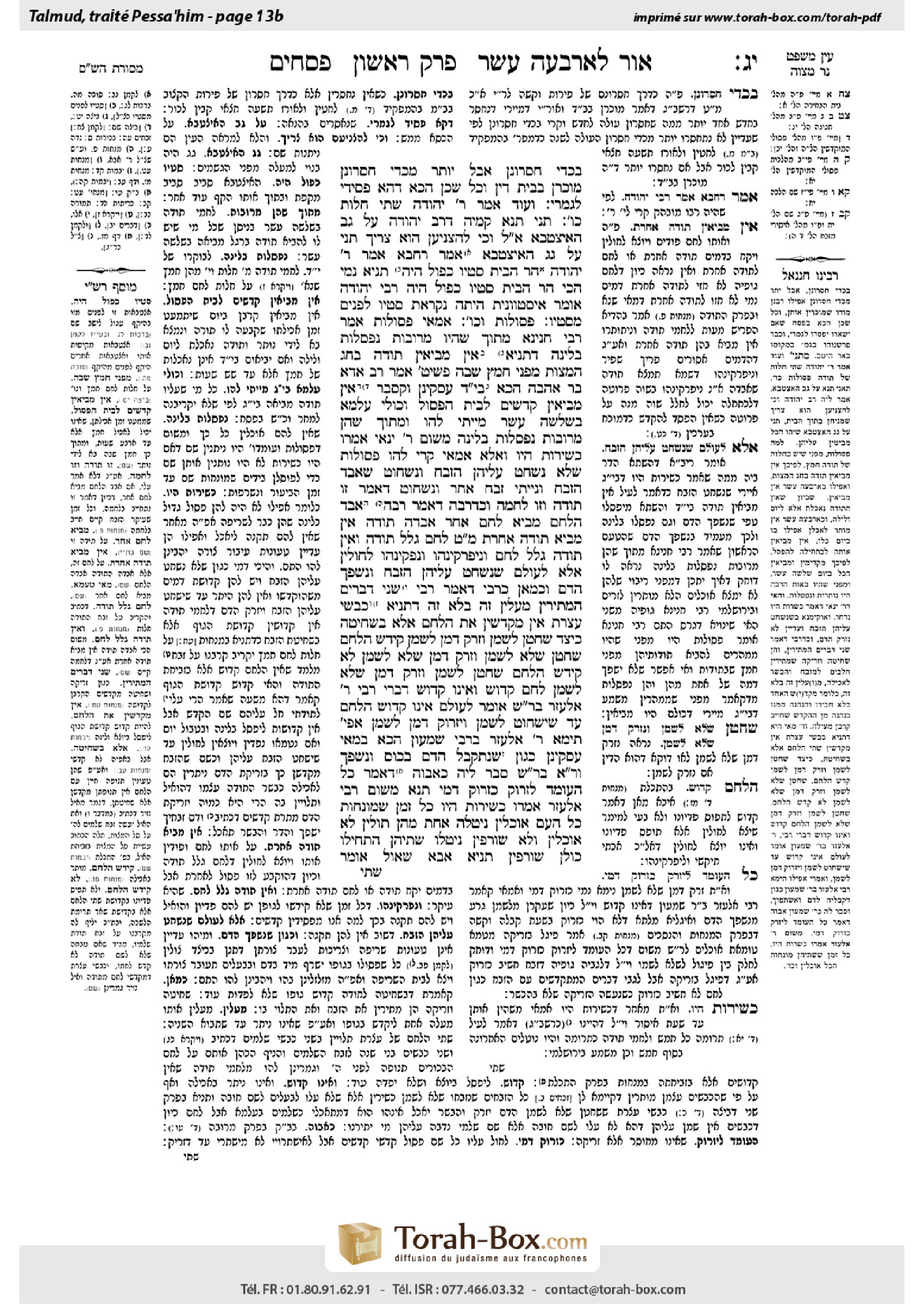
Pesachim 13b: Talmud study for Daf Yomi
Daf Yomi is the daily study of one Talmud folio. Explore 37 tractates with scans, Hebrew text, Sefaria English and AI-generated French translations where annotated.
Passage selection and English or AI-generated French translation are available where the scan has annotations. Daf Study is independent of Torah-Box and Sefaria.
Browse Pesachim · פסחים · All tractatesPesachim 13b text and translations
This page of Pesachim includes the Aramaic text, an English translation and an AI-generated French translation, alongside the scan above.
פסחים י״ג ב · Aramaic and Hebrew text
בִּכְדֵי חֶסְרוֹנָן, אֲבָל יוֹתֵר מִכְּדֵי חֶסְרוֹנָן — מוֹכְרָן בְּבֵית דִּין. וְכׇל שֶׁכֵּן הָכָא, דְּהָא פְּסִידִי לִגְמָרֵי.
וְעוֹד אָמַר רַבִּי יְהוּדָה שְׁתֵּי חַלּוֹת כּוּ׳. תָּנֵי תַּנָּא קַמֵּיהּ דְּרַב יְהוּדָה ״עַל גַּב הָאִיצְטְבָא״. אֲמַר לֵיהּ: וְכִי לְהַצְנִיעָן הוּא צָרִיךְ?! תְּנִי ״עַל גַּג הָאִיצְטְבָא״.
אָמַר רַחֲבָא אָמַר רַבִּי יְהוּדָה: הַר הַבַּיִת סְטָיו כָּפוּל הָיָה. תַּנְיָא נָמֵי הָכִי: הַר הַבַּיִת סְטָיו כָּפוּל הָיָה. רַבִּי יְהוּדָה אוֹמֵר: אִיסְטְווֹנִית הָיְתָה נִקְרֵאת — סְטָיו לְפָנִים מִסְּטָיו.
פְּסוּלוֹת וְכוּ׳. אַמַּאי פְּסוּלוֹת? אָמַר רַבִּי חֲנִינָא: מִתּוֹךְ שֶׁהָיוּ מְרוּבּוֹת — נִפְסָלוֹת בְּלִינָה. דְּתַנְיָא: אֵין מְבִיאִין תּוֹדָה בְּחַג הַמַּצּוֹת, מִפְּנֵי חָמֵץ שֶׁבָּהּ.
פְּשִׁיטָא? אָמַר רַב אַדָּא בַּר אַהֲבָה: הָכָא בְּאַרְבָּעָה עָשָׂר עָסְקִינַן, וְקָסָבַר: אֵין מְבִיאִין קָדָשִׁים לְבֵית הַפְּסוּל.
וְכוּלֵּי עָלְמָא בִּשְׁלֹשָׁה עָשָׂר מַיְיתֵי לְהוּ, וּמִתּוֹךְ שֶׁהֵן מְרוּבּוֹת — נִפְסָלוֹת בְּלִינָה.
מִשּׁוּם רַבִּי יַנַּאי אָמְרוּ: כְּשֵׁירוֹת הָיוּ, וְאֶלָּא אַמַּאי קָרֵי לְהוּ פְּסוּלוֹת — שֶׁלֹּא נִשְׁחַט עֲלֵיהֶן הַזֶּבַח. וְנִשְׁחוֹט! שֶׁאָבַד הַזֶּבַח.
וְנַיְיתֵי זֶבַח אַחֵר וְנִשְׁחוֹט! דְּאָמַר: ״זוֹ תּוֹדָה וְזוֹ לַחְמָהּ״, וְכִדְרַבָּה. דְּאָמַר רַבָּה: אָבַד הַלֶּחֶם — מֵבִיא לֶחֶם אַחֵר, אָבְדָה תּוֹדָה — אֵין מֵבִיא תּוֹדָה אַחֶרֶת. מַאי טַעְמָא — לֶחֶם גְּלַל תּוֹדָה, וְאֵין תּוֹדָה גְּלַל לֶחֶם.
וְנִיפְרְקִינְהוּ וְנַפְּקִינְהוּ לְחוּלִּין! אֶלָּא: לְעוֹלָם שֶׁנִּשְׁחַט עֲלֵיהֶן הַזֶּבַח וְנִשְׁפַּךְ הַדָּם.
וּכְמַאן — כְּרַבִּי. דְּאָמַר רַבִּי: שְׁנֵי דְבָרִים הַמַּתִּירִין — מַעֲלִין זֶה בְּלֹא זֶה. דְּתַנְיָא: כִּבְשֵׂי עֲצֶרֶת אֵין מְקַדְּשִׁין אֶת הַלֶּחֶם אֶלָּא בִּשְׁחִיטָה. כֵּיצַד? שְׁחָטָן לִשְׁמָן וְזָרַק דָּמָן לִשְׁמָן — קִידֵּשׁ הַלֶּחֶם.
שְׁחָטָן שֶׁלֹּא לִשְׁמָן וְזָרַק דָּמָן שֶׁלֹּא לִשְׁמָן — לֹא קִידֵּשׁ הַלֶּחֶם. שְׁחָטָן לִשְׁמָן וְזָרַק דָּמָן שֶׁלֹּא לִשְׁמָן — לֶחֶם קָדוֹשׁ וְאֵינוֹ קָדוֹשׁ, דִּבְרֵי רַבִּי.
רַבִּי אֶלְעָזָר בְּרַבִּי שִׁמְעוֹן אוֹמֵר: לְעוֹלָם אֵינוֹ קָדוֹשׁ הַלֶּחֶם, עַד שֶׁיִּשְׁחוֹט לִשְׁמָן וְיִזְרוֹק דָּמָן לִשְׁמָן.
אֲפִילּוּ תֵּימָא רַבִּי אֶלְעָזָר בְּרַבִּי שִׁמְעוֹן, הָכָא בְּמַאי עָסְקִינַן, כְּגוֹן שֶׁנִּתְקַבֵּל הַדָּם בְּכוֹס וְנִשְׁפַּךְ,
וְרַבִּי אֶלְעָזָר בְּרַבִּי שִׁמְעוֹן סָבַר לֵיהּ כַּאֲבוּהּ, דְּאָמַר: כׇּל הָעוֹמֵד לִזְרוֹק כְּזָרוּק דָּמֵי.
תָּנָא, מִשּׁוּם רַבִּי אֶלְעָזָר אָמְרוּ: כְּשֵׁירוֹת הָיוּ. כׇּל זְמַן שֶׁמּוּנָּחוֹת — כׇּל הָעָם אוֹכְלִין. נִיטְּלָה אַחַת מֵהֶן — תּוֹלִין; לֹא אוֹכְלִין וְלֹא שׂוֹרְפִין. נִיטְּלוּ שְׁתֵּיהֶן — הִתְחִילוּ כּוּלָּן שׂוֹרְפִין.
תַּנְיָא, אַבָּא שָׁאוּל אוֹמֵר:
Pesachim 13b · English translation
their decrease in value is at the standard rate of stored produce, due to rot and rodents. However, if their decrease in value is beyond the standard rate, everyone agrees that one sells them in court; and all the more so in the case here, with regard to leavened bread, as the bread will be entirely lost. Once the leaven is prohibited, it remains prohibited even after Passover. Consequently, everyone agrees that one is obligated to sell the leaven.
We learned in the mishna: And furthermore, Rabbi Yehuda said: Two disqualified loaves of a thanks-offering are placed on the pillars surrounding the Temple as an indicator. The tanna who recited mishnayot in the study hall taught a baraita before Rav Yehuda: The loaves were placed on [al gav] the bench in the Temple. He said to him: And does he need to conceal them? No one would see them if they were placed there. Rather, teach the baraita: On the roof of [al gag] the colonnade, where everyone could see them.
Raḥava said that Rabbi Yehuda said: The Temple Mount was a double colonnade, i.e., surrounded by two rows of columns. That was also taught in a baraita: Rabbi Yehuda says it was called an istevanit and it was a colonnade within a colonnade.
We learned in the mishna that Rabbi Yehuda says these two loaves placed outside were disqualified. The Gemara asks: Why were they disqualified? What caused their disqualification? Rabbi Ḥanina said: Since the thanks-offerings brought that day are numerous, and the priests are unable to eat their portions from the loaves of all the offerings, the remaining loaves are disqualified by virtue of their being left overnight. The Gemara explains that so many loaves were brought that day, as it was taught in a baraita: One may not bring a thanks-offering on the festival of Passover due to the leavened bread included with it, as ten of the forty loaves brought with a thanks-offering are loaves of leavened bread.
The Gemara raises a difficulty: It is obvious that one may not bring this offering on Passover, as it contains leaven. Rav Adda bar Ahava said: Here this baraita is not referring to the prohibition against bringing the offering on Passover itself. Rather, we are dealing with the issue of sacrificing a thanks-offering on the fourteenth of Nisan, and this tanna maintains: One may not bring consecrated offerings to a situation where the time that they may be eaten is restricted, thereby increasing the likelihood of disqualification. Although it is permitted to eat leavened bread until the sixth hour of the fourteenth of Nisan, one may not bring a thanks-offering on Passover eve. The reason is that a thanks-offering may be eaten for one full day and the following night, and if it is brought on the eve of Passover, the time available before disqualification is reduced.
And therefore, everyone who ascended on the pilgrimage to Jerusalem and were obligated to bring thanks-offerings brought them on the thirteenth of Nisan. And since these thanks-offerings are numerous, they are disqualified by virtue of their being left overnight, as priests are unable to eat their portions from the loaves of all the offerings brought that day.
They said in the name of Rabbi Yannai: The loaves placed as an indicator were not disqualified by being left overnight. Rather, why did the tanna call them disqualified? It was due to the fact that no animal offering was slaughtered together with them to consecrate them, but they were consecrated as thanks-offering loaves independently. They could not be eaten until the offering with which they were brought was slaughtered. The Gemara asks: And let us slaughter the thanks-offering to render the loaves permitted. The Gemara answers: The mishna is referring to a case where the animal for the offering was lost.
The Gemara raises a further difficulty: And let us bring another animal to replace the first one for sacrifice and let them slaughter it. The Gemara answers: This is a case where the one who consecrated the thanks-offering said: This is a thanks-offering and these are its loaves. He consecrated the animal and the loaves together, and this is in accordance with the opinion of Rabba, as Rabba said: If the loaf of a thanks-offering is lost, its owner brings another loaf to complete the offering. However, if the thanks-offering was lost and the loaves remain, one may not bring another thanks-offering. What is the reason for this? The loaves are brought due to the thanks-offering but the thanks-offering is not brought on account of the loaves. The animal sacrificed is the primary component of the offering while the loaves are subordinate to it.
The Gemara asks: And let us redeem the loaves from their consecrated status and render them non-sacred, and there will be no need to burn the loaves. Rather, the Gemara explains that actually the case is one where the animal offering was indeed slaughtered over the loaves to permit them, but the animal’s blood spilled before it could be sprinkled on the altar. Once the animal has been slaughtered, the loaves are fully consecrated and cannot be redeemed, but in this case, neither can they be eaten, as the blood was not sprinkled on the altar.
And in accordance with whose opinion is this statement that the slaughter of the animal consecrates the loaves and from that point they can no longer be redeemed? It is in accordance with the opinion of Rabbi Yehuda HaNasi, as Rabbi Yehuda HaNasi said: Each of two factors that are indispensable in permitting the sacrifice of an offering, elevates the subordinate components of the offering to consecrated status, without the other. In this case, the loaves are consecrated when the animal to be sacrificed is slaughtered, even if the blood was not sprinkled, as it was taught in a baraita: The lambs sacrificed on the festival of Assembly, i.e., Shavuot, consecrate the loaves that accompany them only by means of their slaughter. How so? If one slaughtered the lambs for their own sake, i.e., as lambs for Shavuot, in the appropriate manner, and the priest sprinkled their blood for their own sake, the loaves are consecrated.
However, if one slaughtered them not for their own sake, and the priest sprinkled their blood not for their own sake, the loaves are not consecrated, as the factors indispensable in rendering the offering permitted were not properly performed. If one slaughtered them for their own sake, and he sprinkled their blood not for their own sake, the fact that the lambs were properly slaughtered renders the loaves partially consecrated. Therefore, the loaves are consecrated to the extent that they cannot be redeemed, but they are not consecrated to the extent that they may be eaten. This is the statement of Rabbi Yehuda HaNasi.
Rabbi Elazar, son of Rabbi Shimon, says: Actually, the loaves are consecrated only when one slaughters the offerings for their own sake and sprinkles their blood for their own sake, i.e., only if both factors indispensable in rendering the offering permitted were properly performed. The previous answer in the Gemara is in accordance with the opinion of Rabbi Yehuda HaNasi.
The Gemara adds: Even if you say that the previous answer is in accordance with the opinion of Rabbi Elazar, son of Rabbi Shimon, it is understood, as with what case are we dealing here? It is in a unique case where after the slaughter, the blood was received in the cup and it only then spilled before it was sprinkled.
And Rabbi Elazar, son of Rabbi Shimon, holds in accordance with the opinion of his father, Rabbi Shimon, who stated a principle: The legal status of any blood that is about to be sprinkled and prepared for sprinkling is like that of blood that had already been sprinkled. Therefore, the loaves are consecrated when the blood is received in the vessel and thereby prepared to be sprinkled. They may not be eaten until the blood is actually sprinkled.
It was taught in the Tosefta that they said in the name of Rabbi Elazar: These loaves were entirely fit. As long as the loaves were placed there, the entire nation continued to eat leaven. When one of the loaves was taken away, the people knew that the time had come to place the leaven in abeyance, meaning that they neither eat nor burn their leaven. When both of the loaves were taken away, they all began burning their leaven.
It was taught in a baraita that Abba Shaul says:
Pesachim 13b · Traduction française (IA)
La diminution de leur valeur correspond au taux habituel pour les denrées entreposées, en raison de la pourriture et des rongeurs. Toutefois, si leur valeur diminue au-delà du taux habituel, tous conviennent qu’on les vend au tribunal ; à plus forte raison dans le cas présent, celui du pain levé, puisque celui-ci sera entièrement perdu. Une fois le hamets interdit, il le reste même après Pessa'h. Par conséquent, tous conviennent qu’on est tenu de vendre le hamets.
Nous avons appris dans la Michna : « Et de plus, Rabbi Yehuda a dit : Deux pains disqualifiés d’une offrande de remerciement sont placés sur les piliers qui entourent le Temple, comme signal. » Le tanna qui récitait les Michnayot à la maison d’étude enseigna une baraïta devant Rav Yehuda : « Les pains étaient placés sur [al gav] le banc du Temple. » Il lui dit : « Faudrait-il donc les dissimuler ? Personne ne les verrait s’ils étaient placés là. Enseigne plutôt dans la baraïta : sur le toit de [al gag] la colonnade, où tout le monde pourrait les voir. »
Raḥava a dit au nom de Rabbi Yehuda : Le mont du Temple était entouré d’une double colonnade, c’est-à-dire de deux rangées de colonnes. Cela a également été enseigné dans une baraïta : Rabbi Yehuda dit qu’elle était appelée istevanit et qu’il s’agissait d’une colonnade à l’intérieur d’une colonnade.
Nous avons appris dans la Michna que, selon Rabbi Yehuda, ces deux pains placés à l’extérieur étaient disqualifiés. La Guemara demande : Pourquoi l’étaient-ils ? Qu’est-ce qui avait entraîné leur disqualification ? Rabbi Ḥanina a dit : Les offrandes de remerciement apportées ce jour-là étaient nombreuses, et les prêtres ne pouvaient pas manger leur part des pains de toutes ces offrandes ; les pains restants étaient donc disqualifiés parce qu’ils avaient passé la nuit. La Guemara explique que tant de pains avaient été apportés ce jour-là parce qu’il a été enseigné dans une baraïta : On ne peut pas apporter d’offrande de remerciement pendant la fête de Pessa'h, en raison du pain levé qu’elle comporte, puisque dix des quarante pains apportés avec une offrande de remerciement sont des pains levés.
La Guemara soulève une difficulté : Il est évident qu’on ne peut pas apporter cette offrande à Pessa'h, puisqu’elle contient du hamets. Rav Adda bar Ahava a dit : Ici, cette baraïta ne traite pas de l’interdiction d’apporter l’offrande pendant Pessa'h même. Il s’agit plutôt de la question du sacrifice d’une offrande de remerciement le quatorze nissan, et ce tanna estime qu’on ne doit pas placer des offrandes consacrées dans une situation où la période durant laquelle elles peuvent être consommées est limitée, ce qui accroît le risque de disqualification. Bien qu’il soit permis de manger du pain levé jusqu’à la sixième heure du quatorze nissan, on ne peut pas apporter d’offrande de remerciement la veille de Pessa'h. En effet, une offrande de remerciement peut être consommée pendant une journée entière et la nuit qui suit ; si elle est apportée la veille de Pessa'h, le temps disponible avant sa disqualification est réduit.
C’est pourquoi tous ceux qui montaient à Jérusalem pour le pèlerinage et étaient tenus d’apporter des offrandes de remerciement les apportaient le treize nissan. Comme ces offrandes de remerciement étaient nombreuses, elles étaient disqualifiées parce qu’elles avaient passé la nuit, les prêtres ne pouvant pas manger leur part des pains de toutes les offrandes apportées ce jour-là.
On a dit au nom de Rabbi Yannai : Les pains placés comme signal n’étaient pas disqualifiés parce qu’ils avaient passé la nuit. Pourquoi le tanna les a-t-il donc qualifiés de disqualifiés ? Parce qu’aucune offrande animale n’avait été abattue avec eux pour les consacrer ; ils avaient été consacrés séparément, en tant que pains d’offrande de remerciement. Ils ne pouvaient pas être consommés avant l’abattage de l’offrande avec laquelle ils avaient été apportés. La Guemara demande : Qu’on abatte donc l’offrande de remerciement pour rendre les pains permis. La Guemara répond : La Michna traite d’un cas où l’animal destiné à l’offrande avait été perdu.
La Guemara soulève une autre difficulté : Qu’on apporte un autre animal pour remplacer le premier en vue du sacrifice, puis qu’on l’abatte. La Guemara répond : Il s’agit d’un cas où celui qui a consacré l’offrande de remerciement a dit : « Ceci est une offrande de remerciement, et voici ses pains. » Il a consacré ensemble l’animal et les pains. Cela correspond à l’opinion de Rabba, car Rabba a dit : Si un pain d’une offrande de remerciement est perdu, son propriétaire en apporte un autre pour compléter l’offrande. Toutefois, si l’offrande de remerciement a été perdue et que les pains sont encore là, on ne peut pas apporter une autre offrande de remerciement. Pour quelle raison ? Les pains sont apportés en raison de l’offrande de remerciement, mais l’offrande de remerciement n’est pas apportée en raison des pains. L’animal sacrifié est l’élément principal de l’offrande, tandis que les pains lui sont subordonnés.
La Guemara demande : Qu’on rachète donc les pains afin de les libérer de leur statut consacré et de les rendre profanes ; il ne serait alors pas nécessaire de les brûler. La Guemara explique plutôt qu’en réalité, l’animal de l’offrande a bien été abattu en vue de rendre les pains permis, mais son sang s’est répandu avant de pouvoir être aspergé sur l’autel. Dès que l’animal a été abattu, les pains sont pleinement consacrés et ne peuvent pas être rachetés ; dans ce cas, ils ne peuvent pas non plus être consommés, puisque le sang n’a pas été aspergé sur l’autel.
Et selon l’opinion de qui faut-il comprendre cette déclaration, selon laquelle l’abattage de l’animal consacre les pains et ceux-ci ne peuvent dès lors plus être rachetés ? Selon l’opinion de Rabbi Yehuda HaNasi, car Rabbi Yehuda HaNasi a dit : Chacun des deux actes indispensables pour rendre le sacrifice d’une offrande permis confère à lui seul un statut consacré aux éléments subordonnés de l’offrande, indépendamment de l’autre. Dans ce cas, les pains sont consacrés lorsque l’animal destiné au sacrifice est abattu, même si le sang n’a pas été aspergé, comme il a été enseigné dans une baraïta : Les agneaux sacrifiés lors de la fête de l’Assemblée, c’est-à-dire Chavouot, ne consacrent les pains qui les accompagnent que par leur abattage. Comment cela ? Si l’on a abattu les agneaux pour eux-mêmes, c’est-à-dire en tant qu’agneaux de Chavouot, selon la procédure requise, et que le prêtre a aspergé leur sang pour eux-mêmes, les pains sont consacrés.
Toutefois, si on les a abattus non pour eux-mêmes et que le prêtre a aspergé leur sang non pour eux-mêmes, les pains ne sont pas consacrés, puisque les actes indispensables pour rendre l’offrande permise n’ont pas été accomplis correctement. Si on les a abattus pour eux-mêmes et qu’on a aspergé leur sang non pour eux-mêmes, le fait que les agneaux aient été abattus correctement confère aux pains un statut partiellement consacré. Les pains sont donc consacrés au point de ne pas pouvoir être rachetés, mais pas au point de pouvoir être consommés. Telle est la déclaration de Rabbi Yehuda HaNasi.
Rabbi Elazar, fils de Rabbi Shimon, dit : En réalité, les pains ne sont consacrés que si l’on abat les offrandes pour elles-mêmes et que l’on asperge leur sang pour elles-mêmes, c’est-à-dire seulement si les deux actes indispensables pour rendre l’offrande permise ont été accomplis correctement. La réponse précédente de la Guemara correspond à l’opinion de Rabbi Yehuda HaNasi.
La Guemara ajoute : Même si tu dis que la réponse précédente correspond à l’opinion de Rabbi Elazar, fils de Rabbi Shimon, elle se comprend : de quel cas s’agit-il ici ? D’un cas particulier où, après l’abattage, le sang a été recueilli dans la coupe, puis s’est répandu avant d’être aspergé.
Et Rabbi Elazar, fils de Rabbi Shimon, suit l’opinion de son père, Rabbi Shimon, qui a énoncé un principe : Le statut de tout sang prêt à être aspergé est celui d’un sang qui aurait déjà été aspergé. Par conséquent, les pains sont consacrés lorsque le sang est recueilli dans le récipient et qu’il est ainsi prêt à être aspergé. Ils ne peuvent pas être consommés avant que le sang ne soit effectivement aspergé.
Il a été enseigné dans la Tosefta qu’on a dit au nom de Rabbi Elazar : Ces pains étaient parfaitement valides. Tant qu’ils restaient à leur place, tout le peuple continuait à manger du hamets. Lorsqu’on en retirait un, le peuple savait que le moment était venu de mettre le hamets en suspens, c’est-à-dire de ne ni le manger ni le brûler. Lorsqu’on retirait les deux pains, tous se mettaient à brûler leur hamets.
Il a été enseigné dans une baraïta qu’Abba Shaul dit :
Traduction française générée par IA à partir de l’édition anglaise de Sefaria. Vérifie toujours un passage avec le texte source.
Text from Sefaria: William Davidson Edition - Vocalized Aramaic (CC BY NC); William Davidson Edition - English (CC BY NC).