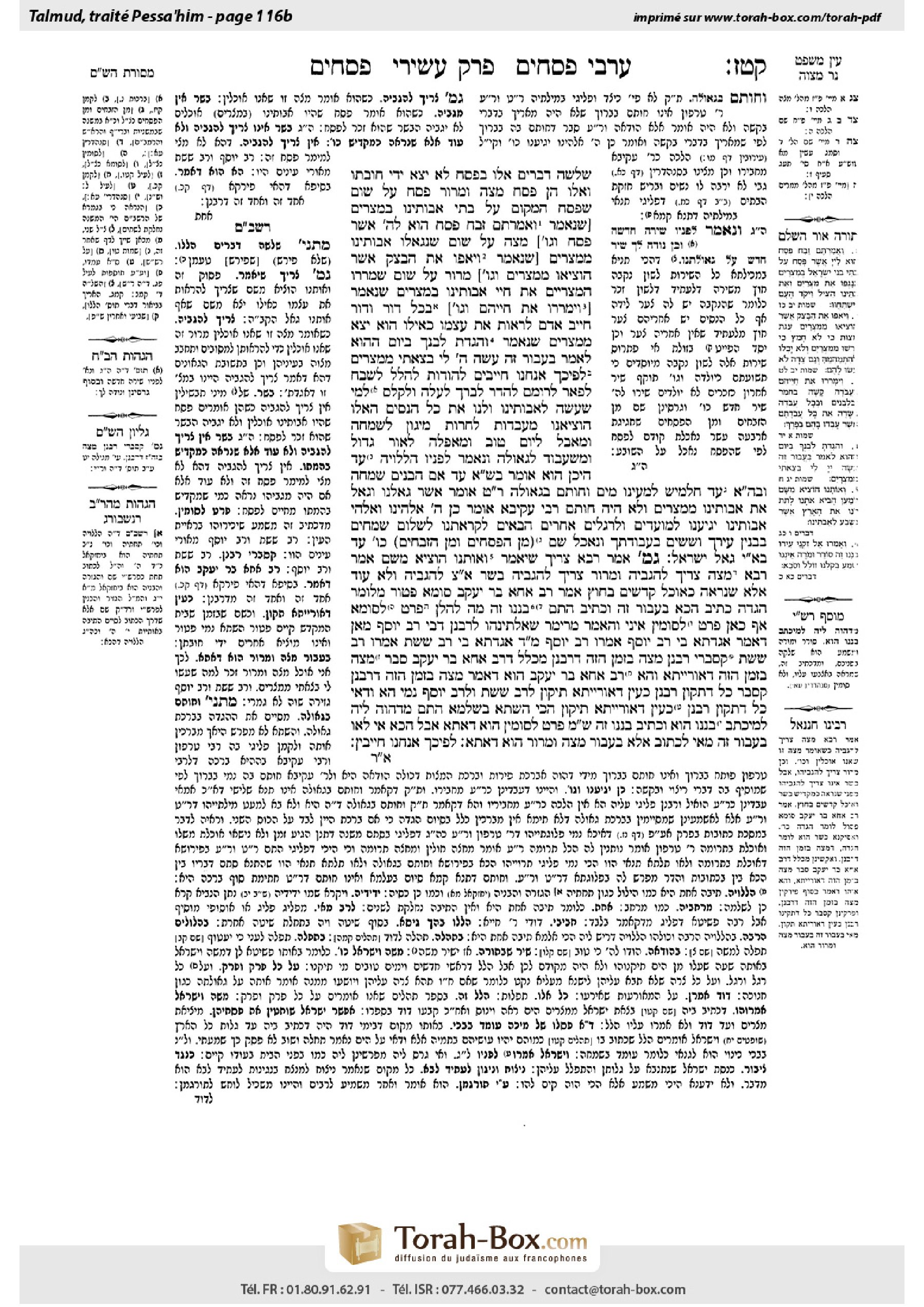
Pesachim 116b: Talmud study for Daf Yomi
Daf Yomi is the daily study of one Talmud folio. Explore 37 tractates with scans, Hebrew text, Sefaria English and AI-generated French translations where annotated.
Passage selection and English or AI-generated French translation are available where the scan has annotations. Daf Study is independent of Torah-Box and Sefaria.
Browse Pesachim · פסחים · All tractatesPesachim 116b text and translations
This page of Pesachim includes the Aramaic text, an English translation and an AI-generated French translation, alongside the scan above.
פסחים קי״ו ב · Aramaic and Hebrew text
שְׁלֹשָׁה דְּבָרִים אֵלּוּ בַּפֶּסַח לֹא יָצָא יְדֵי חוֹבָתוֹ, וְאֵלּוּ הֵן: פֶּסַח, מַצָּה, וּמָרוֹר. פֶּסַח — עַל שׁוּם שֶׁפָּסַח הַמָּקוֹם עַל בָּתֵּי אֲבוֹתֵינוּ בְּמִצְרַיִם, [שֶׁנֶּאֱמַר: ״וַאֲמַרְתֶּם זֶבַח פֶּסַח הוּא לַה׳ אֲשֶׁר פָּסַח וְגוֹ׳״].
מַצָּה — עַל שׁוּם שֶׁנִּגְאֲלוּ אֲבוֹתֵינוּ מִמִּצְרַיִם, [שֶׁנֶּאֱמַר: ״וַיֹּאפוּ אֶת הַבָּצֵק אֲשֶׁר הוֹצִיאוּ מִמִּצְרַיִם וְגוֹ׳״]. מָרוֹר — עַל שׁוּם שֶׁמֵּרְרוּ הַמִּצְרִיִּים אֶת חַיֵּי אֲבוֹתֵינוּ בְּמִצְרַיִם, שֶׁנֶּאֱמַר: [״וַיְמָרְרוּ אֶת חַיֵּיהֶם וְגוֹ׳״].
בְּכׇל דּוֹר וָדוֹר חַיָּיב אָדָם לִרְאוֹת אֶת עַצְמוֹ כְּאִילּוּ הוּא יָצָא מִמִּצְרַיִם, שֶׁנֶּאֱמַר: ״וְהִגַּדְתָּ לְבִנְךָ בַּיּוֹם הַהוּא לֵאמֹר בַּעֲבוּר זֶה עָשָׂה ה׳ לִי בְּצֵאתִי מִמִּצְרָיִם״.
לְפִיכָךְ אֲנַחְנוּ חַיָּיבִים לְהוֹדוֹת, לְהַלֵּל, לְשַׁבֵּחַ, לְפָאֵר, לְרוֹמֵם, לְהַדֵּר, לְבָרֵךְ, לְעַלֵּה וּלְקַלֵּס לְמִי שֶׁעָשָׂה לַאֲבוֹתֵינוּ וְלָנוּ אֶת כׇּל הַנִּסִּים הָאֵלּוּ. הוֹצִיאָנוּ מֵעַבְדוּת לְחֵרוּת, מִיָּגוֹן לְשִׂמְחָה, וּמֵאֵבֶל לְיוֹם טוֹב, וּמֵאֲפֵלָה לְאוֹר גָּדוֹל, וּמִשִּׁעְבּוּד לִגְאוּלָּה. וְנֹאמַר לְפָנָיו הַלְלוּיָהּ.
עַד הֵיכָן הוּא אוֹמֵר? בֵּית שַׁמַּאי אוֹמְרִים: עַד ״אֵם הַבָּנִים שְׂמֵחָה״. וּבֵית הִלֵּל אוֹמְרִים: עַד ״חַלָּמִישׁ לְמַעְיְנוֹ מָיִם״. וְחוֹתֵם בִּגְאוּלָּה. רַבִּי טַרְפוֹן אוֹמֵר: אֲשֶׁר גְּאָלָנוּ וְגָאַל אֶת אֲבוֹתֵינוּ מִמִּצְרַיִם, וְלֹא הָיָה חוֹתֵם.
רַבִּי עֲקִיבָא אוֹמֵר: ״כֵּן ה׳ אֱלֹהֵינוּ וֵאלֹהֵי אֲבוֹתֵינוּ יַגִּיעֵנוּ לְמוֹעֲדִים וְלִרְגָלִים אֲחֵרִים הַבָּאִים לִקְרָאתֵנוּ לְשָׁלוֹם, שְׂמֵחִים בְּבִנְיַן עִירֶךָ, וְשָׂשִׂים בַּעֲבוֹדָתֶךְ. וְנֹאכַל שָׁם (מִן הַפְּסָחִים וּמִן הַזְּבָחִים) כּוּ׳״, עַד ״בָּרוּךְ אַתָּה ה׳ גָּאַל יִשְׂרָאֵל״.
גְּמָ׳ אָמַר רָבָא: צָרִיךְ שֶׁיֹּאמַר ״וְאוֹתָנוּ הוֹצִיא מִשָּׁם״. אָמַר רָבָא: מַצָּה — צָרִיךְ לְהַגְבִּיהַּ, וּמָרוֹר — צָרִיךְ לְהַגְבִּיהַּ. בָּשָׂר — אֵין צָרִיךְ לְהַגְבִּיהַּ. וְלֹא עוֹד, אֶלָּא שֶׁנִּרְאֶה כְּאוֹכֵל קָדָשִׁים בַּחוּץ.
אָמַר רַב אַחָא בַּר יַעֲקֹב: סוֹמֵא פָּטוּר מִלּוֹמַר הַגָּדָה. כְּתִיב הָכָא: ״בַּעֲבוּר זֶה״, וּכְתִיב הָתָם: ״בְּנֵנוּ זֶה״. מַה לְּהַלָּן — פְּרָט לְסוֹמֵא, אַף כָּאן — פְּרָט לְסוֹמִין.
אִינִי? וְהָאָמַר מָרִימָר, שְׁאֵלְתִּינְהוּ לְרַבָּנַן דְּבֵי רַב יוֹסֵף: מַאן דְּאָמַר אַגָּדְתָּא בֵּי רַב יוֹסֵף? אֲמַרוּ: רַב יוֹסֵף. מַאן דְּאָמַר אַגָּדְתָּא בֵּי רַב שֵׁשֶׁת? אָמְרוּ: רַב שֵׁשֶׁת. קָסָבְרִי רַבָּנַן, מַצָּה בִּזְמַן הַזֶּה — דְּרַבָּנַן.
מִכְּלָל דְּרַב אַחָא בַּר יַעֲקֹב סָבַר מַצָּה בִּזְמַן הַזֶּה דְּאוֹרָיְיתָא? וְהָא רַב אַחָא בַּר יַעֲקֹב הוּא דְּאָמַר: מַצָּה בִּזְמַן הַזֶּה דְּרַבָּנַן! קָסָבַר: כֹּל דְּתַקּוּן רַבָּנַן — כְּעֵין דְּאוֹרָיְיתָא תַּיקּוּן.
לְרַב שֵׁשֶׁת וּלְרַב יוֹסֵף נָמֵי, הָא וַדַּאי כׇּל דְּתַקּוּן רַבָּנַן — כְּעֵין דְּאוֹרָיְיתָא תַּיקּוּן?
הָכִי הַשְׁתָּא?! בִּשְׁלָמָא הָתָם, מִדַּהֲוָה לֵיהּ לְמִיכְתַּב ״בְּנֵנוּ הוּא״, וּכְתִיב ״בְּנֵנוּ זֶה״ — שְׁמַע מִינַּהּ: פְּרָט לְסוֹמִין הוּא דַּאֲתָא. אֲבָל הָכָא, אִי לָאו ״בַּעֲבוּר זֶה״, מַאי לִכְתּוֹב? אֶלָּא בַּעֲבוּר מַצָּה וּמָרוֹר הוּא דַּאֲתָא.
לְפִיכָךְ אֲנַחְנוּ חַיָּיבִים.
Pesachim 116b · English translation
these three matters on Passover has not fulfilled his obligation: The Paschal lamb, matza, and bitter herbs. When one mentions these matters, he must elaborate and explain them: The Paschal lamb is brought because the Omnipresent passed over [pasaḥ] the houses of our forefathers in Egypt, as it is stated: “That you shall say: It is the sacrifice of the Lord’s Paschal offering for He passed over the houses of the children of Israel in Egypt, when he smote the Egyptians, and delivered our houses” (Exodus 12:27).
Rabban Gamliel continues to explain: The reason for matza is because our forefathers were redeemed from Egypt, as it is stated: “And they baked the dough that they took out of Egypt as cakes of matzot, for it was not leavened, as they were thrust out of Egypt and could not tarry, neither had they prepared for themselves any victual” (Exodus 12:39). The reason for bitter herbs is because the Egyptians embittered our forefathers’ lives in Egypt, as it is stated: “And they embittered their lives with hard service, in mortar and in brick; in all manner of service in the field, all the service that they made them serve was with rigor” (Exodus 1:14).
The tanna of the mishna further states: In each and every generation a person must view himself as though he personally left Egypt, as it is stated: “And you shall tell your son on that day, saying: It is because of this which the Lord did for me when I came forth out of Egypt” (Exodus 13:8). In every generation, each person must say: “This which the Lord did for me,” and not: This which the Lord did for my forefathers.
The mishna continues with the text of the Haggadah. Therefore we are obligated to thank, praise, glorify, extol, exalt, honor, bless, revere, and laud [lekales] the One who performed for our forefathers and for us all these miracles: He took us out from slavery to freedom, from sorrow to joy, from mourning to a Festival, from darkness to a great light, and from enslavement to redemption. And we will say before Him: Halleluya. At this point one recites the hallel that is said on all joyous days.
Since one does not complete hallel at this point in the seder, the mishna asks: Until where does one recite hallel? Beit Shammai say: Until “Who makes the barren woman dwell in her house as a joyful mother of children, halleluya” (Psalms 113:9). And Beit Hillel say: Until “Who turned the rock into a pool of water, the flint into a fountain of waters” (Psalms 114:8). And one concludes this section of hallel with a blessing that refers to redemption. Rabbi Tarfon says that although one should recite: Who redeemed us and redeemed our forefathers from Egypt, one who did so would not conclude with the formula: Blessed are You, Lord.
Rabbi Akiva says that one recites a different version of this blessing: So too, the Lord our God and the God of our forefathers will bring us to future holidays and Festivals in peace, happy over the building of Your city and joyous in Your service. And there we will eat from the Paschal lamb and other offerings, etc., until: Blessed are You, Lord, Who redeemed Israel.
GEMARA: Rava said: When mentioning the exodus from Egypt one must say: And He took us out from there. Furthermore, Rava said: When one mentions matza in the list of the three matters one must recall during the seder, he must lift it for display before the assembled company. Likewise, when discussing bitter herbs, one must raise them. However, nowadays one need not raise the meat. And not only that, but it is prohibited to do so, for if one lifts the meat it appears as though he is eating sacrificial meat outside the Temple. An observer might think he is presenting it as the meat of a Paschal lamb, and it is prohibited by Torah law to slaughter a sheep as a Paschal lamb outside the Temple.
Rav Aḥa bar Ya’akov said: A blind person is exempt from reciting the Haggadah. The proof is that it is written here, with regard to the Paschal lamb: “And you shall tell your son on that day saying, it is because of this which the Lord did for me when I came forth out of Egypt” (Exodus 13:8), and it was written there, with regard to the stubborn and rebellious son, that his parents say: “This son of ours is stubborn and rebellious, he does not listen to our voice; he is a glutton, and a drunkard” (Deuteronomy 21:20). The Gemara explains the verbal analogy of the word “this”: Just as there, in the case of the rebellious son, the Sages expound that the verse excludes a blind person, as a blind parent cannot say: This son of ours, for he cannot point to him; so too here, in the case of the recitation of the Passover Haggadah, the word “this” excludes blind people.
The Gemara asks: Is that so? But didn’t Mareimar say: I asked the Sages from the school of Rav Yosef, who was blind: Who recited the Haggadah in the house of Rav Yosef? They said to him: Rav Yosef himself recited it. Mareimar subsequently asked: Who recited the Haggadah in the house of Rav Sheshet, who was also blind? They said to him: Rav Sheshet himself recited it. This indicates that a blind person is obligated to recite the Haggadah. The Gemara answers: These Sages, Rav Yosef and Rav Sheshet, maintain that nowadays the halakhot of eating matza and the recitation of the Haggadah that accompanies it apply by rabbinic law. For this reason, blind people can recite the Haggadah for others.
The Gemara asks: Does this prove by inference that Rav Aḥa bar Ya’akov maintains that eating matza nowadays applies by Torah law? But isn’t Rav Aḥa bar Ya’akov the one who said that eating matza nowadays applies by rabbinic law? Rav Aḥa bar Ya’akov apparently contradicts himself. The Gemara answers: Rav Aḥa bar Ya’akov maintains that everything the Sages instituted through their decrees, they instituted similar to the model established by Torah law. In other words, although the obligations to eat matza and recite the Haggadah are rabbinic, the stringencies and restrictions that apply to Torah mitzvot apply here as well. Therefore, a blind person is exempt from reciting the Haggadah.
The Gemara asks: According to the opinion of Rav Sheshet and Rav Yosef too, certainly everything the Sages instituted through their decrees, they instituted similar to the model established by Torah law. Why, then, did these blind Sages recite the Haggadah themselves?
The Gemara rejects this difficulty: How can these cases, the verses dealing with rebellious son and the Passover Haggadah, be compared? Granted, there, in the case of the rebellious son, as the verse could have written: He is our son, and instead it is written: “This son of ours,” I can learn from it that the parents must point with a finger to their son, which comes to exclude blind parents. However, here, if the verse did not use the phrase “because of this,” what could it have written in reference to matzot and bitter herbs? Rather, this verse comes because of the matza and bitter herbs. Consequently, there is no need to actually point with one’s finger in this instance, and therefore the blind are also obligated to recite the Haggadah.
The mishna states: Therefore we are obligated to thank.
Pesachim 116b · Traduction française (IA)
Celui qui n’a pas exposé ces trois éléments à Pessa’h n’a pas rempli son obligation : le sacrifice pascal, la matsa et les herbes amères. Lorsqu’on les mentionne, il faut les développer et les expliquer : le sacrifice pascal est offert parce que le Tout-Puissant a passé par-dessus [pasaḥ] les maisons de nos ancêtres en Égypte, comme il est dit : « Vous direz : C’est le sacrifice pascal de l’Éternel, car Il est passé par-dessus les maisons des enfants d’Israël en Égypte, lorsqu’Il frappa les Égyptiens et épargna nos maisons » (Exode 12, 27).
Rabban Gamliel poursuit son explication : La matsa rappelle que nos ancêtres furent délivrés d’Égypte, comme il est dit : « Ils firent cuire en galettes de matsot la pâte qu’ils avaient emportée d’Égypte, car elle n’avait pas levé ; ils avaient été chassés d’Égypte et n’avaient pu s’attarder, et ils ne s’étaient pas préparé de provisions » (Exode 12, 39). Les herbes amères rappellent que les Égyptiens rendirent amère la vie de nos ancêtres en Égypte, comme il est dit : « Ils leur rendirent la vie amère par un dur labeur, avec le mortier et les briques, ainsi que toutes sortes de travaux des champs ; tout le travail qu’ils leur imposaient était accompli avec dureté » (Exode 1, 14).
Le tanna de la Michna poursuit : À chaque génération, chacun doit se considérer comme s’il était lui-même sorti d’Égypte, comme il est dit : « Tu raconteras à ton fils en ce jour-là, en disant : C’est à cause de cela que l’Éternel a agi pour moi lorsque je suis sorti d’Égypte » (Exode 13, 8). À chaque génération, chacun doit dire : « C’est ce que l’Éternel a fait pour moi », et non : « C’est ce que l’Éternel a fait pour mes ancêtres. »
La Michna poursuit avec le texte de la Haggada : C’est pourquoi nous sommes tenus de remercier, louer, magnifier, exalter, glorifier, honorer, bénir, révérer et célébrer [lekales] Celui qui a accompli pour nos ancêtres et pour nous tous ces miracles : Il nous a fait passer de l’esclavage à la liberté, de la peine à la joie, du deuil à un jour de fête, des ténèbres à une grande lumière et de la servitude à la délivrance. Et nous dirons devant Lui : Halleluya. On récite alors le Hallel dit lors de tous les jours de réjouissance.
Comme on n’achève pas le Hallel à ce stade du seder, la Michna demande : Jusqu’où récite-t-on le Hallel ? Beit Chammaï disent : jusqu’à « Il fait habiter la femme stérile dans sa maison, mère joyeuse de fils. Halleluya » (Psaumes 113, 9). Beit Hillel disent : jusqu’à « Il a changé le rocher en étang, le roc en source d’eaux » (Psaumes 114, 8). On conclut cette partie du Hallel par une bénédiction faisant référence à la délivrance. Rabbi Tarfon dit que, bien qu’on doive réciter : « Qui nous a délivrés, nous et nos ancêtres, d’Égypte », celui qui le fait ne conclut pas par la formule : « Béni sois-Tu, Éternel. »
Rabbi Akiva dit qu’on récite une autre version de cette bénédiction : « De même, l’Éternel notre Dieu et le Dieu de nos ancêtres nous conduira aux fêtes et aux jours de fête à venir en paix, heureux de la reconstruction de Ta ville et joyeux dans Ton service. Là, nous mangerons du sacrifice pascal et des autres sacrifices, etc. », jusqu’à : « Béni sois-Tu, Éternel, qui a délivré Israël. »
GUEMARA : Rava dit : Lorsqu’on mentionne la sortie d’Égypte, il faut dire : « Et Il nous a fait sortir de là. » Rava dit en outre : Lorsqu’on mentionne la matsa parmi les trois éléments dont il faut se souvenir pendant le seder, il faut la soulever pour la montrer à l’assemblée. De même, lorsqu’on parle des herbes amères, il faut les soulever. Toutefois, de nos jours, il ne faut pas soulever la viande. Non seulement cela, mais c’est interdit, car si l’on soulève la viande, on donne l’impression de manger de la viande sacrificielle hors du Temple. Un observateur pourrait penser qu’on la présente comme la viande d’un sacrifice pascal, alors qu’il est interdit par la Torah d’abattre un mouton en sacrifice pascal hors du Temple.
Rav Aḥa bar Ya’akov dit : Un aveugle est dispensé de réciter la Haggada. La preuve en est qu’il est écrit ici, à propos du sacrifice pascal : « Tu raconteras à ton fils en ce jour-là, en disant : C’est à cause de cela que l’Éternel a agi pour moi lorsque je suis sorti d’Égypte » (Exode 13, 8), et qu’il est écrit là, à propos du fils rebelle et indocile, que ses parents disent : « Ce fils que nous avons est rebelle et indocile ; il n’écoute pas notre voix ; c’est un glouton et un ivrogne » (Deutéronome 21, 20). La Guemara explique l’analogie verbale fondée sur le mot « ce » : de même que là, dans le cas du fils rebelle, les Sages interprètent le verset comme excluant un aveugle, car un parent aveugle ne peut pas dire « ce fils que nous avons », puisqu’il ne peut pas le désigner, de même ici, dans le cas de la récitation de la Haggada de Pessa’h, le mot « ce » exclut les aveugles.
La Guemara demande : En est-il ainsi ? Mareimar n’a-t-il pas dit : « J’ai demandé aux Sages de l’école de Rav Yosef, qui était aveugle : “Qui récitait la Haggada dans la maison de Rav Yosef ?” Ils m’ont répondu : “Rav Yosef lui-même la récitait.” » Mareimar demanda ensuite : « Qui récitait la Haggada dans la maison de Rav Sheshet, qui était également aveugle ? » Ils lui répondirent : « Rav Sheshet lui-même la récitait. » Cela indique qu’un aveugle est tenu de réciter la Haggada. La Guemara répond : Ces Sages, Rav Yosef et Rav Sheshet, considèrent que, de nos jours, les halakhot relatives à la consommation de matsa et à la récitation de la Haggada qui l’accompagne relèvent de la loi rabbinique. C’est pourquoi les aveugles peuvent réciter la Haggada pour autrui.
La Guemara demande : Faut-il en déduire que Rav Aḥa bar Ya’akov considère que, de nos jours, l’obligation de manger de la matsa relève de la Torah ? Pourtant, Rav Aḥa bar Ya’akov est précisément celui qui a dit que, de nos jours, l’obligation de manger de la matsa relève de la loi rabbinique. Rav Aḥa bar Ya’akov se contredirait donc. La Guemara répond : Rav Aḥa bar Ya’akov considère que tout ce que les Sages ont institué par leurs décrets, ils l’ont institué sur le modèle établi par la Torah. Autrement dit, bien que les obligations de manger de la matsa et de réciter la Haggada soient rabbiniques, les rigueurs et les restrictions qui s’appliquent aux mitsvot de la Torah s’appliquent également ici. Par conséquent, un aveugle est dispensé de réciter la Haggada.
La Guemara demande : Selon l’opinion de Rav Sheshet et de Rav Yosef également, tout ce que les Sages ont institué par leurs décrets l’a été, bien entendu, sur le modèle établi par la Torah. Pourquoi donc ces Sages aveugles récitaient-ils eux-mêmes la Haggada ?
La Guemara écarte cette difficulté : comment peut-on comparer ces cas, les versets relatifs au fils rebelle et à la Haggada de Pessa’h ? Certes, là, dans le cas du fils rebelle, puisque le verset aurait pu dire : « C’est notre fils », mais dit à la place : « Ce fils que nous avons », je peux en déduire que les parents doivent désigner leur fils du doigt, ce qui exclut les parents aveugles. Mais ici, si le verset n’avait pas employé l’expression « à cause de cela », que pouvait-il dire au sujet des matsot et des herbes amères ? Cette expression se rapporte plutôt à la matsa et aux herbes amères. Par conséquent, il n’est pas nécessaire de désigner quoi que ce soit du doigt dans ce cas, et les aveugles sont donc eux aussi tenus de réciter la Haggada.
La Michna dit : C’est pourquoi nous sommes tenus de remercier.
Traduction française générée par IA à partir de l’édition anglaise de Sefaria. Vérifie toujours un passage avec le texte source.
Text from Sefaria: William Davidson Edition - Vocalized Aramaic (CC BY NC); William Davidson Edition - English (CC BY NC).