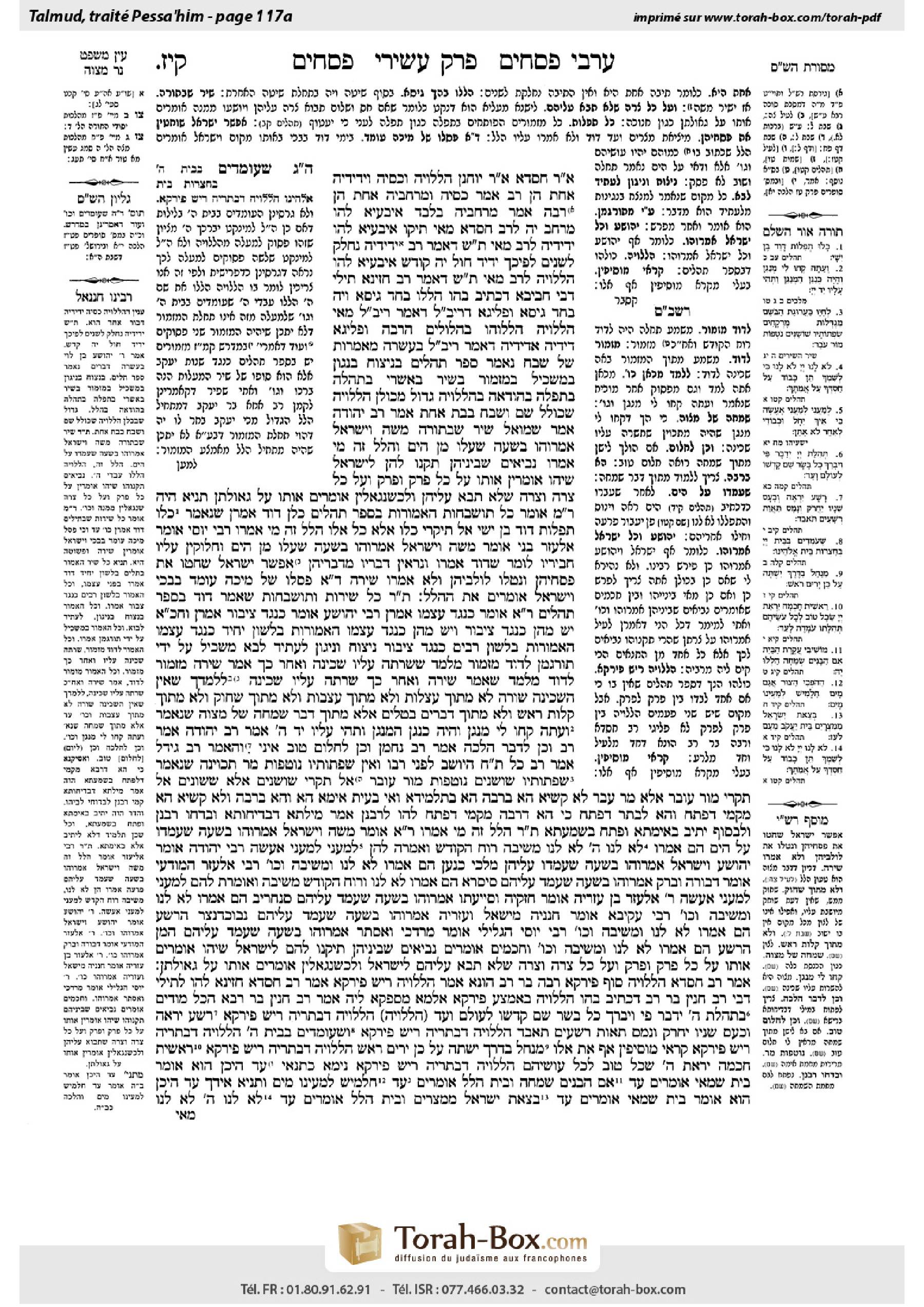
Pesachim 117a: Talmud study for Daf Yomi
Daf Yomi is the daily study of one Talmud folio. Explore 37 tractates with scans, Hebrew text, Sefaria English and AI-generated French translations where annotated.
Passage selection and English or AI-generated French translation are available where the scan has annotations. Daf Study is independent of Torah-Box and Sefaria.
Browse Pesachim · פסחים · All tractatesPesachim 117a text and translations
This page of Pesachim includes the Aramaic text, an English translation and an AI-generated French translation, alongside the scan above.
פסחים קי״ז א · Aramaic and Hebrew text
אָמַר רַב חִסְדָּא אָמַר רַבִּי יוֹחָנָן: ״הַלְלוּיָהּ״ וְ״כֵסְיָהּ״ וִ״ידִידְיָה״ — אַחַת הֵן. רַב אָמַר: ״כֵּסְיָהּ״ וּ״מֶרְחַבְיָהּ״ — אַחַת הֵן. רַבָּה אָמַר: ״מֶרְחַבְיָהּ״ בִּלְבַד.
אִיבַּעְיָא לְהוּ: ״מֶרְחָב יָהּ״ לְרַב חִסְדָּא, מַאי? תֵּיקוּ.
אִיבַּעְיָא לְהוּ: ״יְדִידְיָהּ״ לְרַב, מַאי? תָּא שְׁמַע, דְּאָמַר רַב: ״יְדִידְיָהּ״ נֶחְלָק לִשְׁנַיִם, לְפִיכָךְ: יְדִיד חוֹל, יָהּ קוֹדֶשׁ.
אִיבַּעְיָא לְהוּ: ״הַלְלוּיָהּ״ לְרַב, מַאי? תָּא שְׁמַע, דְּאָמַר רַב: חֲזֵינָא תִּילֵּי דְּבֵי חַבִּיבָא דִּכְתִיב בְּהוּ ״הַלְלוּ״ בְּחַד גִּיסָא, וְ״יָהּ״ בְּחַד גִּיסָא.
וּפְלִיגָא דְּרַבִּי יְהוֹשֻׁעַ בֶּן לֵוִי, דְּאָמַר רַבִּי יְהוֹשֻׁעַ בֶּן לֵוִי: מַאי ״הַלְלוּיָהּ״? הַלְּלוּהוּ בְּהִלּוּלִים הַרְבֵּה.
ופְלִיגָא דִּידֵיהּ אַדִּידֵיהּ, דְּאָמַר רַבִּי יְהוֹשֻׁעַ בֶּן לֵוִי: בַּעֲשָׂרָה מַאֲמָרוֹת שֶׁל שֶׁבַח נֶאֱמַר סֵפֶר תְּהִלִּים: בְּ״נִיצּוּחַ״, בְּ״נִגּוּן״, בְּ״מַשְׂכִּיל״, בְּ״מִזְמוֹר״, בְּ״שִׁיר״, בְּ״אַשְׁרֵי״, בִּ״תְהִלָּה״, בִּ״תְפִלָּה״, בְּ״הוֹדָאָה״, בְּ״הַלְלוּיָהּ״. גָּדוֹל מִכּוּלָּן ״הַלְלוּיָהּ״, שֶׁכּוֹלֵל שֵׁם וָשֶׁבַח בְּבַת אַחַת.
אָמַר רַב יְהוּדָה אָמַר שְׁמוּאֵל: שִׁיר שֶׁבַּתּוֹרָה, מֹשֶׁה וְיִשְׂרָאֵל אֲמָרוּהוּ בְּשָׁעָה שֶׁעָלוּ מִן הַיָּם. וְהַלֵּל זֶה מִי אֲמָרוֹ? נְבִיאִים שֶׁבֵּינֵיהֶן תִּקְּנוּ לָהֶן לְיִשְׂרָאֵל שֶׁיְּהוּ אוֹמְרִין אוֹתוֹ עַל כׇּל פֶּרֶק וּפֶרֶק, וְעַל כׇּל צָרָה וְצָרָה שֶׁלֹּא תָּבֹא עֲלֵיהֶן. וְלִכְשֶׁנִּגְאָלִין, אוֹמְרִים אוֹתוֹ עַל גְּאוּלָּתָן.
תַּנְיָא, הָיָה רַבִּי מֵאִיר אוֹמֵר: כׇּל תּוּשְׁבָּחוֹת הָאֲמוּרוֹת בְּסֵפֶר תְּהִלִּים כֻּלָּן דָּוִד אֲמָרָן, שֶׁנֶּאֱמַר: ״כׇּלּוּ תְפִלּוֹת דָּוִד בֶּן יִשָׁי״ — אַל תִּיקְרֵי ״כׇּלּוּ״, אֶלָּא ״כׇּל אֵלּוּ״.
הַלֵּל זֶה מִי אֲמָרוֹ? רַבִּי יוֹסֵי אוֹמֵר, אֶלְעָזָר בְּנִי אוֹמֵר: מֹשֶׁה וְיִשְׂרָאֵל אֲמָרוּהוּ בְּשָׁעָה שֶׁעָלוּ מִן הַיָּם. וַחֲלוּקִין עָלָיו חֲבֵירָיו לוֹמַר שֶׁדָּוִד אֲמָרוֹ. וְנִרְאִין דְּבָרָיו מִדִּבְרֵיהֶן. אֶפְשָׁר יִשְׂרָאֵל שָׁחֲטוּ אֶת פִּסְחֵיהֶן וְנָטְלוּ לוּלְבֵיהֶן וְלֹא אָמְרוּ שִׁירָה?!
דָּבָר אַחֵר: פִּסְלוֹ שֶׁל מִיכָה עוֹמֵד בִּבְכִי, וְיִשְׂרָאֵל אוֹמְרִים אֶת הַהַלֵּל?
תָּנוּ רַבָּנַן: כׇּל שִׁירוֹת וְתוּשְׁבָּחוֹת שֶׁאָמַר דָּוִד בְּסֵפֶר תְּהִלִּים, רַבִּי אֱלִיעֶזֶר אוֹמֵר: כְּנֶגֶד עַצְמוֹ אֲמָרָן. רַבִּי יְהוֹשֻׁעַ אוֹמֵר: כְּנֶגֶד צִיבּוּר אֲמָרָן. וַחֲכָמִים אוֹמְרִים: יֵשׁ מֵהֶן כְּנֶגֶד צִיבּוּר וְיֵשׁ מֵהֶן כְּנֶגֶד עַצְמוֹ. הָאֲמוּרוֹת בִּלְשׁוֹן יָחִיד — כְּנֶגֶד עַצְמוֹ, הָאֲמוּרוֹת בִּלְשׁוֹן רַבִּים — כְּנֶגֶד צִיבּוּר.
״נִיצּוּחַ״ וְ״נִיגּוּן״ — לֶעָתִיד לָבֹא. ״מַשְׂכִּיל״ — עַל יְדֵי תּוּרְגְּמָן. ״לְדָוִד מִזְמוֹר״ — מְלַמֵּד שֶׁשָּׁרְתָה עָלָיו שְׁכִינָה וְאַחַר כָּךְ אָמַר שִׁירָה. ״מִזְמוֹר לְדָוִד״ — מְלַמֵּד שֶׁאָמַר שִׁירָה וְאַחַר כָּךְ שָׁרְתָה עָלָיו שְׁכִינָה.
לְלַמֶּדְךָ שֶׁאֵין הַשְּׁכִינָה שׁוֹרָה, לֹא מִתּוֹךְ עַצְלוּת וְלֹא מִתּוֹךְ עַצְבוּת וְלֹא מִתּוֹךְ שְׂחוֹק וְלֹא מִתּוֹךְ קַלּוּת רֹאשׁ וְלֹא מִתּוֹךְ דְּבָרִים בְּטֵלִים, אֶלָּא מִתּוֹךְ דְּבַר שִׂמְחָה שֶׁל מִצְוָה. שֶׁנֶּאֱמַר: ״וְעַתָּה קְחוּ לִי מְנַגֵּן וְהָיָה כְּנַגֵּן הַמְנַגֵּן וַתְּהִי עָלָיו יַד ה׳״.
אָמַר רַב יְהוּדָה אָמַר רַב: וְכֵן לִדְבַר הֲלָכָה. אָמַר רַב נַחְמָן: וְכֵן לַחֲלוֹם טוֹב.
אִינִי?! וְהָאָמַר רַב גִּידֵּל אָמַר רַב: כׇּל תַּלְמִיד חָכָם הַיּוֹשֵׁב לִפְנֵי רַבּוֹ וְאֵין שִׂפְתוֹתָיו נוֹטְפוֹת מַר — תִּכָּוֶינָה, שֶׁנֶּאֱמַר: ״שִׂפְתוֹתָיו שׁוֹשַׁנִּים נוֹטְפוֹת מוֹר עוֹבֵר״. אַל תִּקְרֵי ״שׁוֹשַׁנִּים״, אֶלָּא ״שֶׁשּׁוֹנִים״. אַל תִּקְרֵי ״מוֹר עוֹבֵר״, אֶלָּא ״מַר עוֹבֵר״.
לָא קַשְׁיָא: הָא — בְּרַבָּה, הָא — בְּתַלְמִידָא.
וְאִי בָּעֵית אֵימָא: הָא וְהָא בְּרַבָּה, וְלָא קַשְׁיָא: הָא — מִקַּמֵּי דְּפָתַח, וְהָא — לְבָתַר דְּפָתַח. כִּי הָא דְּרַבָּה, מִקַּמֵּי דְּפָתַח לְהוּ לְרַבָּנַן, אָמַר מִילְּתָא דִּבְדִיחוּתָא וּבָדְחוּ רַבָּנַן, וּלְבַסּוֹף יָתֵיב בְּאֵימְתָא, וּפָתַח בִּשְׁמַעְתָּא.
תָּנוּ רַבָּנַן: הַלֵּל זֶה מִי אֲמָרוֹ? רַבִּי אֱלִיעֶזֶר אוֹמֵר: מֹשֶׁה וְיִשְׂרָאֵל אֲמָרוּהוּ בְּשָׁעָה שֶׁעָמְדוּ עַל הַיָּם. הֵם אָמְרוּ: ״לֹא לָנוּ ה׳ לֹא לָנוּ״, מְשִׁיבָה רוּחַ הַקּוֹדֶשׁ וְאָמְרָה לָהֶן: ״לְמַעֲנִי לְמַעֲנִי אֶעֱשֶׂה״. רַבִּי יְהוּדָה אוֹמֵר: יְהוֹשֻׁעַ וְיִשְׂרָאֵל אֲמָרוּהוּ בְּשָׁעָה שֶׁעָמְדוּ עֲלֵיהֶן מַלְכֵי כְנַעַן. הֵם אָמְרוּ: ״לֹא לָנוּ״, וּמְשִׁיבָה וְכוּ׳:
רַבִּי אֶלְעָזָר הַמּוֹדָעִי אוֹמֵר: דְּבוֹרָה וּבָרָק אֲמָרוּהוּ בְּשָׁעָה שֶׁעָמַד עֲלֵיהֶם סִיסְרָא. הֵם אָמְרוּ: ״לֹא לָנוּ״, וְרוּחַ הַקּוֹדֶשׁ מְשִׁיבָה וְאוֹמֶרֶת לָהֶם: ״לְמַעֲנִי לְמַעֲנִי אֶעֱשֶׂה״. רַבִּי אֶלְעָזָר בֶּן עֲזַרְיָה אוֹמֵר: חִזְקִיָּה וְסִייעָתוֹ אֲמָרוּהוּ בְּשָׁעָה שֶׁעָמַד עֲלֵיהֶם סַנְחֵרִיב. הֵם אָמְרוּ: ״לֹא לָנוּ״, וּמְשִׁיבָה וְכוּ׳. רַבִּי עֲקִיבָא אוֹמֵר: חֲנַנְיָה מִישָׁאֵל וַעֲזַרְיָה אֲמָרוּהוּ בְּשָׁעָה שֶׁעָמַד עֲלֵיהֶם נְבוּכַדְנֶצַּר הָרָשָׁע. הֵם אָמְרוּ: ״לֹא לָנוּ״, וּמְשִׁיבָה וְכוּ׳. רַבִּי יוֹסֵי הַגְּלִילִי אוֹמֵר: מָרְדְּכַי וְאֶסְתֵּר אֲמָרוּהוּ בְּשָׁעָה שֶׁעָמַד עֲלֵיהֶם הָמָן הָרָשָׁע. הֵם אָמְרוּ: ״לֹא לָנוּ״, וּמְשִׁיבָה וְכוּ׳.
וַחֲכָמִים אוֹמְרִים: נְבִיאִים שֶׁבֵּינֵיהֶן תִּיקְּנוּ לָהֶם לְיִשְׂרָאֵל שֶׁיְּהוּ אוֹמְרִים אוֹתוֹ עַל כׇּל פֶּרֶק וּפֶרֶק וְעַל כׇּל צָרָה וְצָרָה שֶׁלֹּא תָּבֹא עֲלֵיהֶם לְיִשְׂרָאֵל. וְלִכְשֶׁנִּגְאָלִין, אוֹמְרִים אוֹתוֹ עַל גְּאוּלָּתָן.
אָמַר רַב חִסְדָּא: ״הַלְלוּיָהּ״ — סוֹף פִּירְקָא. רַבָּה בַּר רַב הוּנָא אָמַר: ״הַלְלוּיָהּ״ — רֵישׁ פִּירְקָא. אָמַר רַב חִסְדָּא: חֲזֵינָא לְהוּ לְתִילֵּי דְּבֵי רַב חָנִין בַּר רַב דִּכְתִיב בְּהוּ ״הַלְלוּיָהּ״ בְּאֶמְצַע פִּירְקָא. אַלְמָא מְסַפְּקָא לֵיהּ.
אָמַר רַב חָנִין בַּר רָבָא: הַכֹּל מוֹדִים בִּ״תְהִלַּת ה׳ יְדַבֶּר פִּי וִיבָרֵךְ כׇּל בָּשָׂר שֵׁם קׇדְשׁוֹ לְעוֹלָם וָעֶד (הַלְלוּיָהּ)״, ״הַלְלוּיָהּ״ דְּבָתְרֵיהּ — רֵישׁ פִּירְקָא. ״רָשָׁע יִרְאֶה וְכָעָס שִׁנָּיו יַחֲרֹק וְנָמָס תַּאֲוַת רְשָׁעִים תֹּאבֵד״, ״הַלְלוּיָהּ״ דְּבָתְרֵיהּ — רֵישׁ פִּירְקָא. וְ״שֶׁעוֹמְדִים בְּבֵית ה׳״, ״הַלְלוּיָהּ״ דְּבָתְרֵיהּ — רֵישׁ פִּירְקָא.
קָרָאֵי מוֹסִיפִין אַף אֶת אֵלּוּ: ״מִנַּחַל בַּדֶּרֶךְ יִשְׁתֶּה עַל כֵּן יָרִים רֹאשׁ״, ״הַלְלוּיָהּ״ דְּבָתְרֵיהּ — רֵישׁ פִּירְקָא. ״רֵאשִׁית חׇכְמָה יִרְאַת ה׳ שֵׂכֶל טוֹב לְכׇל עוֹשֵׂיהֶם״, ״הַלְלוּיָהּ״ דְּבָתְרֵיהּ — רֵישׁ פִּירְקָא.
נֵימָא כְּתַנָּאֵי: עַד הֵיכָן הוּא אוֹמֵר? בֵּית שַׁמַּאי אוֹמְרִים: עַד ״אֵם הַבָּנִים שְׂמֵחָה״, וּבֵית הִלֵּל אוֹמְרִים: עַד ״חַלָּמִישׁ לְמַעְיְנוֹ מָיִם״. וְתַנְיָא אִידַּךְ, עַד הֵיכָן הוּא אוֹמֵר? בֵּית שַׁמַּאי אוֹמְרִים: עַד ״בְּצֵאת יִשְׂרָאֵל מִמִּצְרָיִם״. וּבֵית הִלֵּל אוֹמְרִים: עַד ״לֹא לָנוּ ה׳ לֹא לָנוּ״.
Pesachim 117a · English translation
The mishna states that we will say before Him: Halleluya. The Gemara discusses the meaning of this term. Rav Ḥisda said that Rabbi Yoḥanan said: The word halleluya and the word kesya (Exodus 17:16) and the name Yedidya (II Samuel 12:25) are each regarded as a single word, not an amalgamation of two smaller words, i.e., Hallelu-ya. Rav said that kesya and merḥavya (Psalms 118:5) are single words. Rabba said: Only merḥavya is a single word; the others are two words.
A dilemma was raised before the Sages: According to the opinion of Rav Ḥisda, what is the status of merḥavya? Is it counted as two words or one? This dilemma was raised because Rav Ḥisda himself did not mention this term. No answer was found for this dilemma, and therefore the Gemara states: Let it stand unresolved.
Another dilemma was raised before the Sages: According to the opinion of Rav, what is the status of the name Yedidya? The Gemara answers: Come and hear, as Rav said explicitly: Yedidya is divided into two separate names. Therefore, yedid is a mundane word, whereas ya is a sacred name, which must be treated respectfully like the other sacred names of God.
A dilemma was raised before the Sages: According to the opinion of Rav, what is the status of halleluya? Is it one word or two? The Gemara answers: Come and hear, as Rav said: I saw a book of Psalms in the study hall of my uncle, Rabbi Ḥiyya, in which the word hallelu is written on one side, at the end of a line, and ya was written on one side, at the beginning of the next line. This shows that the word halleluya can indeed be split in two.
The Gemara comments: This opinion disputes that of Rabbi Yehoshua ben Levi, as Rabbi Yehoshua ben Levi said: What is the meaning of the word halleluya? It means praise Him [halleluhu] with many praises [hillulim]. According to this opinion, the ya at the end of the word is a superlative, not a divine name.
The Gemara adds: This statement of Rabbi Yehoshua ben Levi disagrees with another ruling that he himself issued, as Rabbi Yehoshua ben Levi said: The book of Psalms is said by means of ten expressions of praise: By nitzuaḥ, niggun, maskil, mizmor, shir, ashrei, tehilla, tefilla, hoda’a, and halleluya. He continues: The greatest of them all is halleluya, as it includes God’s name and praise at one time. This statement indicates that Rabbi Yehoshua ben Levi considers halleluya to be a combination of two words, one of which is the name of God.
Rav Yehuda said that Shmuel said: The song in the Torah, i.e., the Song at the Sea (Exodus 15:1–19), Moses and the Jewish people recited it when they ascended from the sea. The Gemara asks: And who said this hallel mentioned in the mishna, Psalms 113–118? The Gemara answers: The Prophets among them established this hallel for the Jewish people, that they should recite it on every appropriate occasion; and for every trouble, may it not come upon them, they recite the supplications included in hallel. When they are redeemed, they recite it over their redemption, as hallel includes expressions of gratitude for the redemption.
It was taught in a baraita that Rabbi Meir would say: All the praises stated in the book of Psalms were recited by David, as it is stated: “The prayers of David, son of Yishai, are ended [kalu]” (Psalms 72:20). Do not read kalu; rather, read kol elu, all of these, which indicates that the entire book of Psalms consists of the prayers of King David.
The Gemara clarifies: According to those who dispute Rabbi Meir’s claim that the entire book of Psalms was composed by King David, who recited this hallel? Rabbi Yosei says: My son Elazar says that Moses and the Jewish people recited it when they ascended from the sea. And his colleagues dispute him, saying that it was recited by King David. And the statement of my son, Elazar, appears more accurate than their statement. The reason is as follows: Is it possible that the Jewish people slaughtered their Paschal lambs and took and waved their lulavim all those generations without reciting a song? Rather, the Jews must have recited a song each year. Since it is the custom to sing hallel nowadays, it is evidently an ancient institution.
Alternatively, is it possible that Micah’s idol stood in tears, and the Jewish people were reciting hallel before it? The reference is to the idol of Micah, which was still standing in the days of David (see Judges 17). The Gemara states that the idol was crying, as a euphemism for its laughter, to avoid shaming the Jewish people (ge’onim). The point is that the Jews would not have chanted: “They who make them shall be like them” (Psalms 115:8) at a time that they were worshipping idols. Rather, hallel must be older than that, and it dates back to the Song at the Sea.
The Sages taught in a baraita that with regard to all the songs and praise that David recited in the book of Psalms, Rabbi Eliezer says: David said them about himself. They were the praises of an individual that were later transmitted to the community. Rabbi Yehoshua says: He originally said them about the community. He composed all of the psalms for the people, including those he wrote about himself. And the Rabbis say: There are among these psalms some that are about the community, and there are among these psalms some that are about himself. The Rabbis clarify their opinion: The psalms that are stated in the singular form are about himself, and those stated in the plural form are about the community.
The Gemara continues to discuss the book of Psalms. If a psalm begins with the terms nitzuaḥ or niggun, this indicates that its praise will be fulfilled in the future. Psalms that begin with the word maskil were delivered by means of a disseminator, a spokesman in a public address. The lecturer would speak softly, followed by a repetition of his discourse in the disseminator’s louder voice, so that everyone could hear. If a psalm begins: Of David a psalm, this teaches that the Divine Presence rested upon him first and afterward he recited the song. However, if a psalm opens with: A psalm of David, this teaches that he first recited the song, and afterward the Divine Presence rested upon him.
The Gemara adds: Incidentally, this serves to teach you that the Divine Presence rests upon an individual neither from an atmosphere of laziness, nor from an atmosphere of sadness, nor from an atmosphere of laughter, nor from an atmosphere of frivolity, nor from an atmosphere of idle chatter, but rather from an atmosphere imbued with the joy of a mitzva. As it is stated with regard to Elisha, after he became angry at the king of Israel, his prophetic spirit left him until he requested: “But now bring me a minstrel; and it came to pass when the minstrel played, that the hand of the Lord came upon him” (II Kings 3:15).
Rav Yehuda said that Rav said: And, so too, one should be joyful before stating a matter of halakha. Rav Naḥman said: And, so too, one should be joyful before going to sleep, to ensure he will have a good dream.
The Gemara asks: Is that so, that one should introduce matters of halakha joyfully? Didn’t Rav Giddel say that Rav said: Any Torah scholar who sits before his teacher and his lips are not dripping with bitterness due to fear of his teacher, those lips shall be burned, as it is stated: “His lips are as lilies [shoshanim] dripping with flowing myrrh [notefot mor over]” (Song of Songs 5:13). He interpreted homiletically: Do not read it as shoshanim, lilies; rather, read it as sheshonim, who are studying. Likewise, do not read it as mor over, flowing myrrh; rather, read it as mar over, flowing bitterness. In other words, lips that are studying Torah must be full of bitterness.
The Gemara explains: This is not difficult; there is no contradiction here, as this statement, which teaches that one should introduce matters of halakha joyfully, is referring to a rabbi, and that statement, which teaches that one must be filled with bitterness, is referring to a student, who must listen to his teacher with trepidation.
And if you wish, say instead that this and that are referring to a rabbi, and it is not difficult. This statement, where it is taught that one must be joyful, is before one begins teaching; that statement, where it is taught that he must be filled with bitterness and trepidation, is after he already began teaching halakha. The Gemara adds: That explanation is like that practice of Rabba’s. Before he began teaching halakha to the Sages, he would say some humorous comment, and the Sages would be cheered. Ultimately, he sat in trepidation and began teaching the halakha.
The Sages taught: This hallel, who initially recited it? Rabbi Eliezer says: Moses and the Jewish people recited it when they stood by the sea. They said: “Not to us, God, not to us, but to Your name give glory” (Psalms 115:1). The Divine Spirit responded and said to them: “For My own sake, for My own sake, will I do it” (Isaiah 48:11). Rabbi Yehuda says: Joshua and the Jewish people recited it when they defeated the kings of Canaan who stood against them (see Joshua 12:7–24). They said: Not to us, and the Divine Spirit responded: For My own sake.
Rabbi Elazar HaModa’i says: Deborah and Barak recited it when Sisera stood against them (see Judges 4–5). They said: Not to us, and the Divine Spirit responded and said to them: For My own sake, for My own sake, will I do it. Rabbi Elazar ben Azarya says: Hezekiah and his company recited it when Sennacherib stood against them (see II Kings 18–19). They said: Not to us and the Divine Spirit responded: For My own sake. Rabbi Akiva says: Hananiah, Mishael, and Azariah recited it when the wicked Nebuchadnezzar stood against them (see Daniel 3). They said: Not to us, and the Divine Spirit responded: For My own sake. Rabbi Yosei HaGelili says: Mordecai and Esther recited it when the wicked Haman stood against them. They said: Not to us, and the Divine Spirit responded: For My own sake (see the book of Esther).
And the Rabbis say that hallel was not established for any specific event, but the Prophets among them instituted that the Jewish people should recite it on every appropriate occasion, and for every trouble, may it not come upon the Jewish people. When they are redeemed, they recite it over their redemption.
The Gemara continues to discuss the term halleluya. Rav Ḥisda said: The halleluya stated in the final verse in several Psalms signifies the end of a chapter. Rabba bar Rav Huna said: Halleluya marks the start of a new chapter, the beginning of the next psalm. Rav Ḥisda said: I saw a book of Psalms in the study hall of Rav Ḥanin bar Rav, in which it is written halleluya in the middle of the chapter, i.e., between the chapters, neither at the start of one psalm nor at the end of the next. Apparently, Rav Ḥanin bar Rav was uncertain where the word belonged.
Rav Ḥanin bar Rava said: Everyone concedes with regard to the verse: “My mouth shall speak the praise of the Lord; and let all flesh bless His holy name forever and ever” (Psalms 145:21), that the halleluya that follows, the opening word of the subsequent psalm, marks the start of the next chapter, not the conclusion of the previous one. Likewise, with regard to the verse: “The wicked shall see and be vexed; he shall gnash with his teeth, and melt away; the desire of the wicked shall perish” (Psalms 112:10), the halleluya that follows it, is the start of the next chapter. And similarly, with regard to: “You who stand in the house of the Lord” (Psalms 135:2) the halleluya that follows it, in verse 3, signifies the start of the next chapter.
Those Sages who were expert in the verses of the Bible add these too: “He will drink of the brook in the way; therefore will he lift up the head” (Psalms 110:7); the halleluya that follows it, the first word of the subsequent psalm, is the start of the next chapter. With regard to the verse: “The fear of God is the beginning of wisdom; a good understanding have all they who practice them; His praise endures forever” (Psalms 111:10), the halleluya that follows it, marks the start of the next chapter.
The Gemara suggests: Let us say it is parallel to a dispute between the tanna’im, as we learned in the mishna: Until where does one recite hallel? Beit Shammai say: Until “A joyful mother of children, halleluya” (Psalms 113:9). And Beit Hillel say: Until “The flint into a fountain of waters” (Psalms 114:8). And it was taught in another source, a baraita: Until where does one recite hallel? Beit Shammai say: Until “When Israel came forth out of Egypt” (Psalms 114:1), the beginning of the first passage after “A joyful mother of children, halleluya.” And Beit Hillel say: Until “Not to us, God, not to us” (Psalms 115:1), which follows “the flint into a fountain of waters.”
Pesachim 117a · Traduction française (IA)
La Michna affirme que nous dirons devant Lui : « Halleluya ». La Guemara examine le sens de ce terme. Rav Ḥisda a dit au nom de Rabbi Yoḥanan : Les mots halleluya, kesya (Exode 17:16) et le nom Yedidya (II Samuel 12:25) sont chacun considérés comme un seul mot, et non comme la réunion de deux mots plus petits, c’est-à-dire hallelu-ya. Rav a dit que kesya et merḥavya (Psaumes 118:5) sont chacun un seul mot. Rabba a dit : Seul merḥavya est un seul mot ; les autres sont composés de deux mots.
Les Sages ont soulevé une question : selon l’opinion de Rav Ḥisda, quel est le statut de merḥavya ? Est-il considéré comme un ou deux mots ? Cette question se pose parce que Rav Ḥisda lui-même n’a pas mentionné ce terme. Aucune réponse n’a été trouvée ; la Guemara conclut donc : Laissons la question sans réponse.
Les Sages ont soulevé une autre question : selon l’opinion de Rav, quel est le statut du nom Yedidya ? La Guemara répond : Viens et écoute, car Rav a dit explicitement que Yedidya se divise en deux noms distincts. Ainsi, yedid est un mot profane, tandis que ya est un nom sacré, qui doit être traité avec le respect dû aux autres noms sacrés de Dieu.
Les Sages ont soulevé une question : selon l’opinion de Rav, quel est le statut de halleluya ? Est-ce un ou deux mots ? La Guemara répond : Viens et écoute, car Rav a dit : J’ai vu un livre des Psaumes dans la maison d’étude de mon oncle, Rabbi Ḥiyya, où le mot hallelu était écrit à la fin d’une ligne, et ya au début de la ligne suivante. Cela montre que le mot halleluya peut effectivement être scindé en deux.
La Guemara relève que cette opinion contredit celle de Rabbi Yehoshua ben Levi, car celui-ci a dit : Quel est le sens du mot halleluya ? Il signifie : Louez-Le [halleluhu] par de nombreuses louanges [hillulim]. Selon cette opinion, le ya final est un superlatif et non un nom divin.
La Guemara ajoute : Cette déclaration de Rabbi Yehoshua ben Levi contredit une autre décision qu’il a lui-même rendue, car il a dit : Le livre des Psaumes recourt à dix expressions de louange : nitzuaḥ, niggun, maskil, mizmor, shir, ashrei, tehilla, tefilla, hoda’a et halleluya. Il poursuit : La plus grande de toutes est halleluya, car elle réunit le nom de Dieu et la louange. Cette déclaration indique que Rabbi Yehoshua ben Levi considère halleluya comme la combinaison de deux mots, dont l’un est le nom de Dieu.
Rav Yehuda a dit au nom de Shmuel : Le chant de la Torah, c’est-à-dire le Cantique de la mer (Exode 15:1–19), a été récité par Moïse et le peuple juif lorsqu’ils sont remontés de la mer. La Guemara demande : Et qui a prononcé le hallel mentionné dans la Michna, les Psaumes 113–118 ? La Guemara répond : Les Prophètes parmi eux ont institué ce hallel pour le peuple juif, afin qu’il le récite en toute occasion appropriée ; et face à chaque détresse — puisse-t-elle ne pas s’abattre sur lui —, il récite les supplications contenues dans le hallel. Lorsqu’il est délivré, il le récite pour célébrer sa délivrance, car le hallel contient des expressions de gratitude pour celle-ci.
Il a été enseigné dans une baraïta que Rabbi Meïr disait : Toutes les louanges énoncées dans le livre des Psaumes ont été récitées par David, comme il est dit : « Les prières de David, fils de Yishaï, sont achevées [kalu] » (Psaumes 72:20). Ne lis pas kalu ; lis plutôt kol elu, « toutes celles-ci », ce qui indique que tout le livre des Psaumes est constitué des prières du roi David.
La Guemara précise : Selon ceux qui contestent l’affirmation de Rabbi Meïr selon laquelle le roi David a composé tout le livre des Psaumes, qui a récité ce hallel ? Rabbi Yosei dit : Mon fils Elazar affirme que Moïse et le peuple juif l’ont récité lorsqu’ils sont remontés de la mer. Ses collègues le contestent et disent que c’est le roi David qui l’a récité. La déclaration de mon fils Elazar semble plus exacte que la leur. Voici pourquoi : Est-il possible que le peuple juif ait égorgé ses agneaux pascals, pris ses loulavim et les ait agités, durant toutes ces générations, sans réciter de chant ? Le peuple juif devait plutôt réciter un chant chaque année. Puisqu’on a aujourd’hui l’habitude de chanter le hallel, il s’agit manifestement d’une institution ancienne.
Ou encore, est-il possible que l’idole de Michée se soit tenue en pleurs, tandis que le peuple juif récitait le hallel devant elle ? Il s’agit de l’idole de Michée, qui se trouvait encore debout à l’époque de David (voir Juges 17). La Guemara dit que l’idole pleurait, euphémisme pour désigner son rire, afin de ne pas faire honte au peuple juif (Géonim). L’idée est que les Juifs n’auraient pas chanté : « Ceux qui les fabriquent leur seront semblables » (Psaumes 115:8), alors qu’ils pratiquaient le culte des idoles. Le hallel doit donc être plus ancien et remonter au Cantique de la mer.
Les Sages ont enseigné dans une baraïta qu’au sujet de tous les chants et de toutes les louanges que David a récités dans le livre des Psaumes, Rabbi Eliezer dit : David les a prononcés à son propre sujet. C’étaient les louanges d’un individu, transmises ensuite à la communauté. Rabbi Yehoshua dit : À l’origine, il les a prononcées au sujet de la communauté. Il a composé tous les psaumes pour le peuple, y compris ceux qu’il a écrits à son propre sujet. Les Sages disent : Parmi ces psaumes, certains concernent la communauté et d’autres David lui-même. Ils précisent leur opinion : Les psaumes formulés au singulier le concernent lui-même, tandis que ceux formulés au pluriel concernent la communauté.
La Guemara poursuit son examen du livre des Psaumes. Si un psaume commence par les termes nitzuaḥ ou niggun, cela indique que sa louange s’accomplira dans l’avenir. Les psaumes qui commencent par le mot maskil ont été transmis par l’intermédiaire d’un porte-parole, qui prononçait une allocution publique. Le conférencier parlait à voix basse, puis son discours était répété à voix plus forte par le porte-parole, afin que tous puissent l’entendre. Si un psaume commence par : « De David, un psaume », cela enseigne que la Présence divine s’est d’abord posée sur lui, puis qu’il a récité le chant. En revanche, si un psaume commence par : « Un psaume de David », cela enseigne qu’il a d’abord récité le chant, puis que la Présence divine s’est posée sur lui.
La Guemara ajoute : Incidemment, cela t’enseigne que la Présence divine ne repose sur un individu ni dans une atmosphère de paresse, ni dans une atmosphère de tristesse, ni dans une atmosphère de rire, ni dans une atmosphère de frivolité, ni dans une atmosphère de bavardage futile ; elle repose plutôt dans une atmosphère imprégnée de la joie d’une mitsva. Car il est dit au sujet d’Élisée qu’après s’être mis en colère contre le roi d’Israël, son esprit prophétique le quitta, jusqu’à ce qu’il demande : « Mais maintenant, amenez-moi un musicien ; et il arriva que, lorsque le musicien jouait, la main du Seigneur se posa sur lui » (II Rois 3:15).
Rav Yehuda a dit au nom de Rav : De même, il faut être joyeux avant d’énoncer une halakha. Rav Naḥman a dit : De même, il faut être joyeux avant de s’endormir, afin de s’assurer de faire un bon rêve.
La Guemara demande : Est-il vrai qu’il faut aborder les questions de halakha avec joie ? Rav Giddel n’a-t-il pas dit au nom de Rav : Tout érudit de Torah qui s’assied devant son maître sans que ses lèvres ruissellent d’amertume par crainte de son maître, ces lèvres seront brûlées, comme il est dit : « Ses lèvres sont comme des lis [shoshanim], distillant une myrrhe liquide [notefot mor over] » (Cantique des Cantiques 5:13). Il l’a interprété par homilétique : Ne lis pas shoshanim, « des lis » ; lis plutôt sheshonim, « ceux qui étudient ». De même, ne lis pas mor over, « une myrrhe liquide » ; lis plutôt mar over, « une amertume liquide ». Autrement dit, les lèvres de ceux qui étudient la Torah doivent être pleines d’amertume.
La Guemara explique : Il n’y a pas de difficulté ni de contradiction ici, car cette déclaration, qui enseigne qu’il faut aborder les questions de halakha avec joie, concerne un rabbin, tandis que l’autre déclaration, qui enseigne qu’il faut être rempli d’amertume, concerne un élève, qui doit écouter son maître avec appréhension.
Et si tu le souhaites, dis plutôt que les deux déclarations concernent un rabbin, sans qu’il y ait de difficulté. La déclaration qui enseigne qu’il faut être joyeux s’applique avant de commencer à enseigner ; celle qui enseigne qu’il faut être rempli d’amertume et d’appréhension s’applique après qu’il a commencé à enseigner la halakha. La Guemara ajoute : Cette explication correspond à la pratique de Rabba. Avant de commencer à enseigner la halakha aux Sages, il faisait une remarque humoristique, et les Sages se réjouissaient. Ensuite, il s’asseyait avec appréhension et commençait à enseigner la halakha.
Les Sages ont enseigné : Qui a récité ce hallel en premier ? Rabbi Eliezer dit : Moïse et le peuple juif l’ont récité lorsqu’ils se tenaient au bord de la mer. Ils ont dit : « Non pas à nous, Dieu, non pas à nous, mais à Ton nom donne gloire » (Psaumes 115:1). L’Esprit divin leur a répondu : « C’est pour Moi, pour Moi-même, que j’agirai » (Isaïe 48:11). Rabbi Yehuda dit : Josué et le peuple juif l’ont récité lorsqu’ils ont vaincu les rois de Canaan qui s’étaient dressés contre eux (voir Josué 12:7–24). Ils ont dit : « Non pas à nous », et l’Esprit divin a répondu : « C’est pour Moi-même ».
Rabbi Elazar HaModa’i dit : Déborah et Barak l’ont récité lorsque Sisera s’est dressé contre eux (voir Juges 4–5). Ils ont dit : « Non pas à nous », et l’Esprit divin leur a répondu : « C’est pour Moi, pour Moi-même, que j’agirai ». Rabbi Elazar ben Azarya dit : Ézéchias et les siens l’ont récité lorsque Sennachérib s’est dressé contre eux (voir II Rois 18–19). Ils ont dit : « Non pas à nous », et l’Esprit divin a répondu : « C’est pour Moi-même ». Rabbi Akiva dit : Hanania, Mishaël et Azaria l’ont récité lorsque le méchant Nabuchodonosor s’est dressé contre eux (voir Daniel 3). Ils ont dit : « Non pas à nous », et l’Esprit divin a répondu : « C’est pour Moi-même ». Rabbi Yosei HaGelili dit : Mardochée et Esther l’ont récité lorsque le méchant Haman s’est dressé contre eux. Ils ont dit : « Non pas à nous », et l’Esprit divin a répondu : « C’est pour Moi-même » (voir le livre d’Esther).
Les Sages disent que le hallel n’a pas été institué pour un événement précis, mais que les Prophètes parmi eux ont institué que le peuple juif le récite en toute occasion appropriée, ainsi que face à chaque détresse — puisse-t-elle ne pas s’abattre sur le peuple juif. Lorsqu’il est délivré, il le récite pour célébrer sa délivrance.
La Guemara poursuit son examen du terme halleluya. Rav Ḥisda a dit : Le halleluya qui apparaît au dernier verset de plusieurs psaumes marque la fin d’un chapitre. Rabba bar Rav Huna a dit : Halleluya marque le début d’un nouveau chapitre, c’est-à-dire du psaume suivant. Rav Ḥisda a dit : J’ai vu un livre des Psaumes dans la maison d’étude de Rav Ḥanin bar Rav, où halleluya était écrit au milieu du chapitre, c’est-à-dire entre les chapitres, ni au début d’un psaume ni à la fin du précédent. Il semble que Rav Ḥanin bar Rav ne savait pas où rattacher le mot.
Rav Ḥanin bar Rava a dit : Tous reconnaissent, au sujet du verset : « Ma bouche proclamera la louange du Seigneur, et que toute chair bénisse Son saint nom pour toujours et à jamais » (Psaumes 145:21), que le halleluya qui suit, premier mot du psaume suivant, marque le début du chapitre suivant et non la fin du précédent. De même, au sujet du verset : « Le méchant le verra et sera irrité ; il grincera des dents et dépérira ; le désir des méchants périra » (Psaumes 112:10), le halleluya qui suit marque le début du chapitre suivant. De même encore, au sujet du verset : « Vous qui vous tenez dans la maison du Seigneur » (Psaumes 135:2), le halleluya qui suit, au verset 3, marque le début du chapitre suivant.
Les Sages experts dans les versets de la Bible ajoutent également ceux-ci : « Il boira au torrent en chemin ; c’est pourquoi il relèvera la tête » (Psaumes 110:7) ; le halleluya qui suit, premier mot du psaume suivant, marque le début du chapitre suivant. Au sujet du verset : « La crainte de Dieu est le commencement de la sagesse ; tous ceux qui les pratiquent ont une bonne intelligence ; sa louange demeure à jamais » (Psaumes 111:10), le halleluya qui suit marque le début du chapitre suivant.
La Guemara propose : Disons que cela correspond à une controverse entre les tannaïm, comme nous l’avons appris dans la Michna : Jusqu’où récite-t-on le hallel ? Beit Shammaï dit : Jusqu’à « Une mère joyeuse de ses enfants, halleluya » (Psaumes 113:9). Et Beit Hillel dit : Jusqu’à « Le rocher en source d’eaux » (Psaumes 114:8). Une autre source, une baraïta, enseigne : Jusqu’où récite-t-on le hallel ? Beit Shammaï dit : Jusqu’à « Quand Israël sortit d’Égypte » (Psaumes 114:1), le début du premier passage après « Une mère joyeuse de ses enfants, halleluya ». Et Beit Hillel dit : Jusqu’à « Non pas à nous, Dieu, non pas à nous » (Psaumes 115:1), qui suit « le rocher en source d’eaux ».
Traduction française générée par IA à partir de l’édition anglaise de Sefaria. Vérifie toujours un passage avec le texte source.
Text from Sefaria: William Davidson Edition - Vocalized Aramaic (CC BY NC); William Davidson Edition - English (CC BY NC).