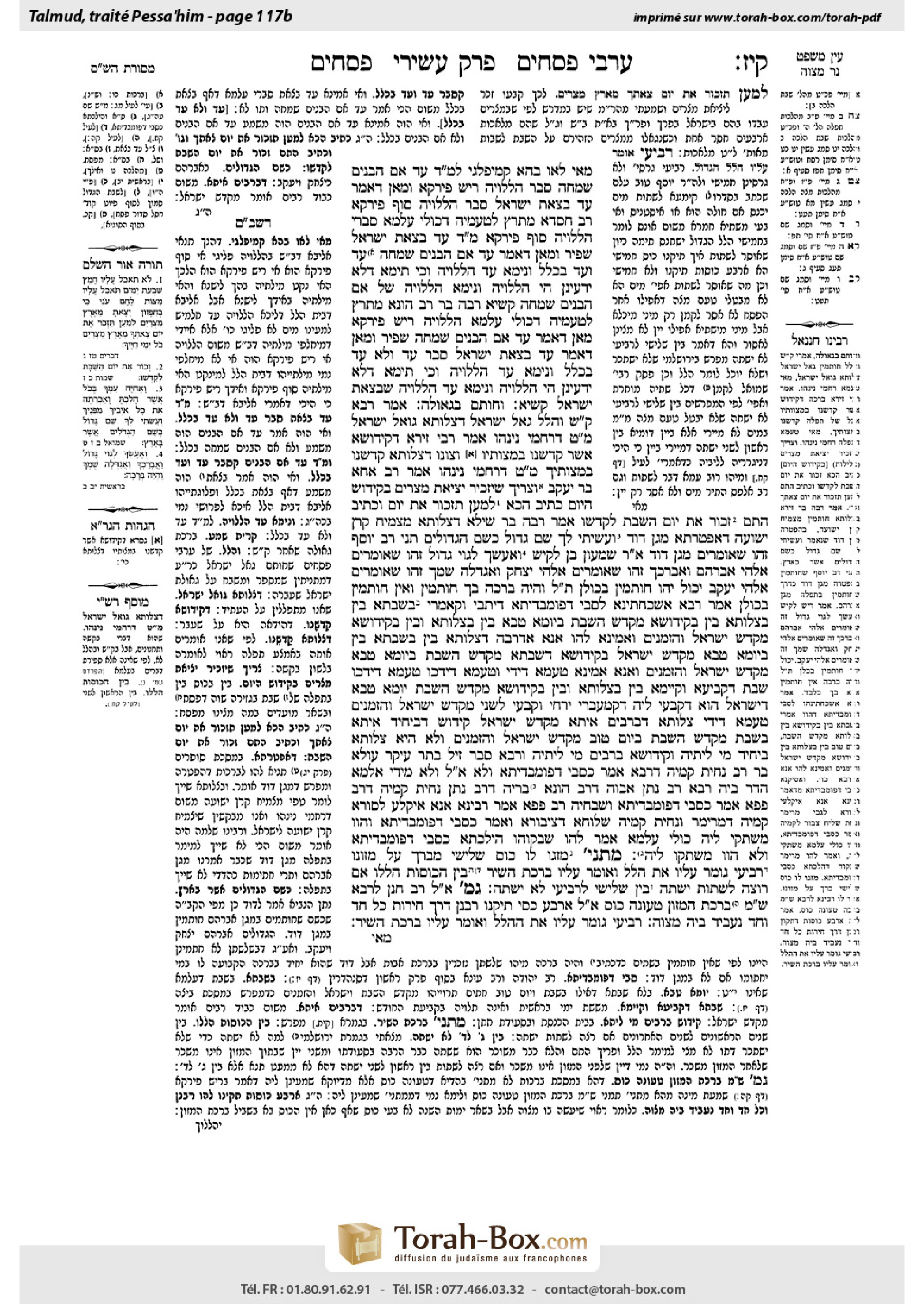
Pesachim 117b: Talmud study for Daf Yomi
Daf Yomi is the daily study of one Talmud folio. Explore 37 tractates with scans, Hebrew text, Sefaria English and AI-generated French translations where annotated.
Passage selection and English or AI-generated French translation are available where the scan has annotations. Daf Study is independent of Torah-Box and Sefaria.
Browse Pesachim · פסחים · All tractatesPesachim 117b text and translations
This page of Pesachim includes the Aramaic text, an English translation and an AI-generated French translation, alongside the scan above.
פסחים קי״ז ב · Aramaic and Hebrew text
מַאי לָאו, בְּהָא קָמִיפַּלְגִי: לְמַאן דְּאָמַר עַד ״אֵם הַבָּנִים שְׂמֵחָה״, סָבַר ״הַלְלוּיָהּ״ — רֵישׁ פִּירְקָא, וּמַאן דְּאָמַר עַד ״בְּצֵאת יִשְׂרָאֵל״, סָבַר ״הַלְלוּיָהּ״ — סוֹף פִּירְקָא.
רַב חִסְדָּא מְתָרֵץ לְטַעְמֵיהּ, דְּכוּלֵּי עָלְמָא סָבְרִי: ״הַלְלוּיָהּ״ — סוֹף פִּירְקָא. מַאן דְּאָמַר עַד ״בְּצֵאת יִשְׂרָאֵל״ שַׁפִּיר, וּמַאן דְּאָמַר עַד ״אֵם הַבָּנִים שְׂמֵחָה״, עַד — וְעַד בַּכְּלָל.
וְנֵימָא עַד ״הַלְלוּיָהּ״! וְכִי תֵּימָא דְּלָא יָדְעִינַן הֵי ״הַלְלוּיָהּ״ — וְנֵימָא ״הַלְלוּיָהּ״ שֶׁל ״אֵם הַבָּנִים שְׂמֵחָה״? קַשְׁיָא.
רַבָּה בַּר רַב הוּנָא מְתָרֵץ לְטַעְמֵיהּ: דְּכוּלֵּי עָלְמָא ״הַלְלוּיָהּ״ — רֵישׁ פִּירְקָא, מַאן דְּאָמַר עַד ״אֵם הַבָּנִים שְׂמֵחָה״ — שַׁפִּיר, וּמַאן דְּאָמַר עַד ״בְּצֵאת יִשְׂרָאֵל״, סָבַר: עַד — וְלֹא עַד בַּכְּלָל.
וְנֵימָא: עַד ״הַלְלוּיָהּ״, וְכִי תֵּימָא דְּלָא יָדְעִינַן הֵי ״הַלְלוּיָהּ״ — וְנֵימָא עַד ״הַלְלוּיָהּ״ שֶׁ״בְּצֵאת יִשְׂרָאֵל״? קַשְׁיָא.
וְחוֹתֵם בִּגְאוּלָּה. אָמַר רָבָא: קְרִיאַת שְׁמַע וְהַלֵּל — ״גָּאַל יִשְׂרָאֵל״. דִּצְלוֹתָא — ״גּוֹאֵל יִשְׂרָאֵל״. מַאי טַעְמָא — דְּרַחֲמֵי נִינְהוּ.
אָמַר רַבִּי זֵירָא: דְּקִידּוּשָׁא — ״אֲשֶׁר קִדְּשָׁנוּ בְּמִצְוֹתָיו וְצִוָּנוּ״. דִּצְלוֹתָא — ״קַדְּשֵׁנוּ בְּמִצְוֹתֶיךָ״. מַאי טַעְמָא — דְּרַחֲמֵי נִינְהוּ.
אָמַר רַב אַחָא בַּר יַעֲקֹב: וְצָרִיךְ שֶׁיַּזְכִּיר יְצִיאַת מִצְרַיִם בְּקִידּוּשׁ הַיּוֹם. כְּתִיב הָכָא: ״לְמַעַן תִּזְכּוֹר אֶת יוֹם״. וּכְתִיב הָתָם: ״זָכוֹר אֶת יוֹם הַשַּׁבָּת לְקַדְּשׁוֹ״.
אָמַר רַבָּה בַּר שֵׁילָא: דִּצְלוֹתָא — ״מַצְמִיחַ קֶרֶן יְשׁוּעָה״, דְּאַפְטָרְתָּא — ״מָגֵן דָּוִד״.
״וְעָשִׂיתִי לְךָ שֵׁם גָּדוֹל כְּשֵׁם הַגְּדוֹלִים״, תָּנֵי רַב יוֹסֵף: זֶהוּ שֶׁאוֹמְרִים ״מָגֵן דָּוִד״.
אָמַר רַבִּי שִׁמְעוֹן בֶּן לָקִישׁ: ״וְאֶעֶשְׂךָ לְגוֹי גָּדוֹל״, זֶהוּ שֶׁאוֹמְרִים ״אֱלֹהֵי אַבְרָהָם״. ״וַאֲבָרֶכְךָ״, זֶהוּ שֶׁאוֹמְרִים ״אֱלֹהֵי יִצְחָק״. ״וַאֲגַדְּלָה שְׁמֶךָ״, זֶהוּ שֶׁאוֹמְרִים ״אֱלֹהֵי יַעֲקֹב״.
יָכוֹל יְהוּ חוֹתְמִין בְּכוּלָּן? תַּלְמוּד לוֹמַר: ״וֶהְיֵה בְּרָכָה״. בְּךָ חוֹתְמִין, וְאֵין חוֹתְמִין בְּכוּלָּן.
אָמַר רָבָא: אַשְׁכַּחְתִּינָא לְסָבֵי דְפוּמְבְּדִיתָא דְּיָתְבִי וְקָאָמְרִי: בְּשַׁבְּתָא — בֵּין בִּצְלוֹתָא בֵּין בְּקִידּוּשָׁא: ״מְקַדֵּשׁ הַשַּׁבָּת״. בְּיוֹמָא טָבָא — בֵּין בִּצְלוֹתָא וּבֵין בְּקִידּוּשָׁא: ״מְקַדֵּשׁ יִשְׂרָאֵל וְהַזְּמַנִּים״. וְאָמֵינָא לְהוּ אֲנָא: אַדְּרַבָּה, דִּצְלוֹתָא — בֵּין בְּשַׁבְּתָא בֵּין בְּיוֹמָא טָבָא: ״מְקַדֵּשׁ יִשְׂרָאֵל״, בְּקִידּוּשָׁא דְשַׁבְּתָא: ״מְקַדֵּשׁ הַשַּׁבָּת״, בְּיוֹמָא טָבָא: ״מְקַדֵּשׁ יִשְׂרָאֵל וְהַזְּמַנִּים״.
וַאֲנָא אָמֵינָא טַעְמָא דִידִי וְטַעְמָא דִידְכוּ. טַעְמָא דִידְכוּ: שַׁבָּת, דִּקְבִיעָא וְקַיְימָא — בֵּין בִּצְלוֹתָא וּבֵין בְּקִידּוּשָׁא: ״מְקַדֵּשׁ הַשַּׁבָּת״. יוֹמָא טָבָא, דְּיִשְׂרָאֵל הוּא דְּקָבְעִי לֵיהּ — דְּקָמְעַבְּרִי יַרְחֵי וְקָבְעִי לְשָׁנֵי: ״מְקַדֵּשׁ יִשְׂרָאֵל וְהַזְּמַנִּים״.
טַעְמָא דִידִי: צְלוֹתָא, דִּבְרַבִּים אִיתָא: ״מְקַדֵּשׁ יִשְׂרָאֵל״. קִידּוּשׁ, דִּבְיָחִיד אִיתָא, בְּשַׁבָּת: ״מְקַדֵּשׁ הַשַּׁבָּת״, בְּיוֹם טוֹב: ״מְקַדֵּשׁ יִשְׂרָאֵל וְהַזְּמַנִּים״.
וְלָא הִיא, צְלוֹתָא בְּיָחִיד מִי לֵיתֵיהּ? וְקִידּוּשָׁא בְּרַבִּים מִי לֵיתֵיהּ? וְרָבָא סָבַר: זִיל בָּתַר עִיקָּר.
עוּלָּא בַּר רַב נְחֵית קַמֵּיהּ דְּרָבָא, אֲמַר כְּסָבֵי דְפוּמְבְּדִיתָא, וְלָא אֲמַר לֵיהּ וְלָא מִידֵּי. אַלְמָא הֲדַר בֵּיהּ רָבָא. רַב נָתָן אֲבוּהּ דְּרַב הוּנָא בְּרֵיהּ דְּרַב נָתָן נְחֵית קַמֵּיהּ דְּרַב פָּפָּא, אֲמַר כְּסָבֵי דְפוּמְבְּדִיתָא, וְשַׁבְּחֵיהּ רַב פָּפָּא.
אָמַר רָבִינָא: אֲנָא אִיקְּלַעִי לְסוּרָא קַמֵּיהּ דְּמָרִימָר, וּנְחֵית קַמֵּיהּ שְׁלוּחָא דְצִיבּוּרָא וַאֲמַר כְּסָבֵי דְפוּמְבְּדִיתָא, וַהֲווֹ מְשַׁתְּקִי לֵיהּ כּוּלֵּי עָלְמָא, אֲמַר לְהוּ: שִׁבְקוּהוּ הִילְכְתָא כְּסָבֵי דְפוּמְבְּדִיתָא, וְלָא הֲווֹ מְשַׁתְּקוּ לֵיהּ.
מַתְנִי׳ מָזְגוּ לוֹ כּוֹס שְׁלִישִׁי מְבָרֵךְ עַל מְזוֹנוֹ. רְבִיעִי גּוֹמֵר עָלָיו אֶת הַלֵּל, וְאוֹמֵר עָלָיו בִּרְכַּת הַשִּׁיר. בֵּין הַכּוֹסוֹת הַלָּלוּ, אִם רוֹצֶה לִשְׁתּוֹת — יִשְׁתֶּה, בֵּין שְׁלִישִׁי לִרְבִיעִי — לֹא יִשְׁתֶּה.
גְּמָ׳ אֲמַר לֵיהּ רַב חָנָן לְרָבָא: שְׁמַע מִינַּהּ בִּרְכַּת הַמָּזוֹן טְעוּנָה כּוֹס. אֲמַר לֵיהּ: אַרְבַּע כָּסֵי תִּיקְּנוּ רַבָּנַן דֶּרֶךְ חֵירוּת, כֹּל חַד וְחַד נַעֲבֵיד בֵּיהּ מִצְוָה.
רְבִיעִי גּוֹמֵר עָלָיו אֶת הַהַלֵּל וְאוֹמֵר עָלָיו בִּרְכַּת הַשִּׁיר.
Pesachim 117b · English translation
What, is it not the case that the mishna and the baraita disagree concerning the following matter: According to the one who says that one must recite until “A joyful mother of children,” he maintains that the subsequent halleluya is the start of a chapter. And the one who said that one must recite until “When Israel came forth” maintains that halleluya is the end of the previous chapter. The mishna and the baraita disagree only with regard to when the word halleluya should be recited, at this point in the seder or when hallel is resumed after the meal.
The Gemara rejects this contention: This is no proof, as Rav Ḥisda explains the difference between the mishna and the baraita in accordance with his reasoning, that everyone maintains that halleluya marks the end of a chapter. However, the one who said that one must recite until “When Israel came forth” spoke well, as he cites the beginning of the next verse. And the one who said that one must recite until “A joyful mother of children” means until and including, i.e., one finishes the entire verse including the word halleluya.
The Gemara asks: If so, let the tanna say: Until halleluya. And if you say that we would not know which halleluya he meant, let the tanna say: The halleluya of “A joyful mother of children.” The Gemara comments: This is indeed difficult for the opinion of Rav Ḥisda.
Likewise, Rabba bar Rav Huna explains the difference between the mishna and the baraita in accordance with his reasoning, that everyone agrees that halleluya signifies the start of a chapter. The one who said that one must recite until “A joyful mother of children” spoke well, and the one who said that one must recite until “When Israel came forth” maintains that the term means until and not including, as one does not conclude with the word halleluya after “A joyful mother of children.”
The Gemara asks a similar question with regard to the opinion of Rabba bar Rav Huna: If so, let the tanna say: Until halleluya. And if you say that we would not know which halleluya he meant, let the tanna say: The halleluya of “When Israel came forth.” The Gemara comments: This is indeed difficult for Rabba bar Rav Huna’s opinion.
And the mishna stated that one concludes this section of hallel with a blessing that refers to redemption. With regard to the dispute over how to conclude the blessing, Rava said: For the recitation of Shema and hallel on Passover, the wording of the final blessing is: Who redeemed Israel, in the past tense, whereas the seventh blessing of the weekday Amida prayer concludes with: Who redeems Israel, in the present tense. What is the reason for this difference? Prayer is a supplication for mercy and therefore one mentions and requests the anticipated redemption in his prayers.
Likewise, Rabbi Zeira said: The formula of kiddush is: Who sanctified us with His mitzvot and commanded us, in the past tense. In contrast, the formula in the Amida prayer is: Sanctify us with Your mitzvot, in the future tense. What is the reason for this difference? Prayer is a supplication for mercy, and one submits a request for the future.
Rav Aḥa bar Ya’akov said: And one must mention the exodus from Egypt in the kiddush of Shabbat day, despite the fact that Shabbat is not directly connected to the Exodus. The proof is that here, with regard to Passover, it is written: “That you may remember the day when you came out of the land of Egypt all the days of your life” (Deuteronomy 16:3); and it is written there, with regard to Shabbat: “Remember the Shabbat day to sanctify it” (Exodus 20:8). By means of a verbal analogy of the word “day,” these verses teach that one must also recall the Exodus on Shabbat.
The Gemara discusses the formulas of other prayers. Rabba bar Sheila said: The prayer that describes the future restoration of the kingship of Israel concludes with: He Who causes the horn of salvation to flourish, while the blessing recited after the haftara, the portion read from the Prophets, concludes with: Shield of David.
Incidentally, the Gemara cites the promise God issued to David through Nathan the Prophet: “And I will make you a great name, like the names of the great ones in the earth” (II Samuel 7:9). Rav Yosef teaches: This is the meaning of the phrase “like the names of the great ones,” that Jews will say: Shield of David, just as they say: Shield of Avraham.
Rabbi Shimon ben Lakish said with regard to God’s blessing of Avraham: “And I will make of you a great nation, and I will bless you, and I will make your name great, and you will be a blessing” (Genesis 12:2). “And I will make of you a great nation”; this is fulfilled in the opening of the first blessing of the Amida, as Jews say: God of Abraham. “And I will bless you”; this is fulfilled when they say: God of Isaac, as it is a blessing for a father when the name of his son is eternalized. “And I will make your name great”; this is fulfilled when they say: God of Jacob.
One might have thought that Jews should conclude the first blessing of the Amida prayer with the names of all the forefathers; therefore the verse states: “And you will be a blessing” i.e., with you, Avraham, they will conclude the blessing, and they will not conclude with a mention of all of the forefathers. This is why the first blessing of the Amida prayer ends: Shield of Avraham.
Rava said: I found the Elders of Pumbedita sitting and saying: On Shabbat, both in prayer and in kiddush, one recites: Who sanctifies Shabbat. On a Festival, both in prayer and in kiddush one recites: Who sanctifies Israel and the seasons. And I said to them: On the contrary, in prayer, both on Shabbat and on a Festival, one should recite: Who sanctifies Israel. However, in the kiddush of Shabbat one should recite: Who sanctifies Shabbat, whereas in the kiddush of a Festival one should recite: Who sanctifies Israel and the seasons.
Rava further said to the Elders of Pumbedita: And I can say my reason and your reason. Your reason is that since Shabbat is established and permanent, i.e., it always occurs on the seventh day of the week, both in prayers and in kiddush one should recite: Who sanctifies Shabbat. It is not necessary for Israel to sanctify Shabbat, as it is permanently sanctified by God. Conversely, with regard to a Festival, as it is Israel who establishes it, as the Sages add extra days to certain months and establish years by intercalating them, one recites: Who sanctifies Israel and the seasons. This is Rava’s explanation of the reason for the ruling of the Elders of Pumbedita.
Rava continues: My reason is that in the case of prayer, which is in public, one recites: Who sanctifies Israel, in honor of the community. Conversely, for kiddush, which is recited by an individual alone on Shabbat, one says: Who sanctifies Shabbat, as Israel does not sanctify Shabbat. On a Festival one recites: Who sanctifies Israel and the seasons. In this case, Israel is mentioned, as its Sages sanctify the Festivals.
The Gemara rejects Rava’s reason: And that is not so. Is there not also the prayer recited by a person who is alone; and is there not also kiddush in public? The above distinction is rendered meaningless in practice. But Rava maintains: Follow the main practice of each mitzva. Prayer is primarily a communal activity, whereas kiddush is fundamentally the obligation of each individual.
The Gemara reports: Ulla bar Rav descended to lead the prayer service before Rava. He said the formula in accordance with the opinion of the Elders of Pumbedita, and Rava did not say anything to him. Apparently, Rava retracted his opinion and accepted the formula of the Elders of Pumbedita. Likewise, the Gemara relates: Rav Natan, father of Rav Huna, son of Rav Natan, descended to lead the prayer service before Rav Pappa and recited the liturgy in accordance with the opinion of the Elders of Pumbedita, and Rav Pappa praised him for his correct recitation.
Ravina said: I happened to come to Sura before Mareimar, and the prayer leader descended before him and recited the liturgy in accordance with the opinion of the Elders of Pumbedita, and everyone tried to silence him, as they had never heard that version of the prayer before. Mareimar said to them: Leave him, as the halakha is in accordance with the opinion of the Elders of Pumbedita. And the people in attendance listened to him and no longer tried to silence the prayer leader, but allowed him to complete the prayer.
MISHNA: They poured for the leader of the seder the third cup of wine, and he recites the blessing over his food, Grace After Meals. Next, they pour him the fourth cup. He completes hallel over it, as he already recited the first part of hallel before the meal. And he also recites the blessing of the song at the end of hallel over the fourth cup. During the period between these cups, i.e., the first three cups established by the Sages, if one wishes to drink more he may drink; however, between the third cup and the fourth cup one should not drink.
GEMARA: Ran Ḥanan said to Rava: Since the mishna states that Grace After Meals must be recited over the third cup, learn from it that Grace After Meals requires a cup of wine. Rava said to him: This is no proof, for although the Sages instituted the drinking of four cups in the manner of freedom, once the four cups are in place, with each and every one of them we will perform a mitzva, despite the fact that they were not originally instituted for this purpose. After the Sages instituted these four cups, they attached a special mitzva to each one. However, this does not prove that there is an obligation to recite Grace After Meals over a cup of wine during the rest of the year.
We learned in the mishna that they pour the leader of the seder the fourth cup and he completes hallel over it, and he recites the blessing of the song at the end of hallel over that cup.
Pesachim 117b · Traduction française (IA)
Quoi donc ? N’est-il pas vrai que la Michna et la baraïta sont en désaccord sur le point suivant : selon celui qui dit qu’il faut réciter jusqu’à « Une mère joyeuse de ses enfants », le halleluya qui suit marque le début d’un chapitre. Celui qui dit qu’il faut réciter jusqu’à « Quand Israël sortit » considère, quant à lui, que halleluya marque la fin du chapitre précédent. La Michna et la baraïta ne sont en désaccord que sur le moment où le mot halleluya doit être récité : à ce stade du seder ou lorsque le Hallel reprend après le repas.
La Guemara rejette cette argumentation : cela ne prouve rien, car Rav Ḥisda explique la différence entre la Michna et la baraïta conformément à son raisonnement : tous considèrent que halleluya marque la fin d’un chapitre. Celui qui dit qu’il faut réciter jusqu’à « Quand Israël sortit » s’exprime correctement, puisqu’il cite le début du verset suivant. Quant à celui qui dit qu’il faut réciter jusqu’à « Une mère joyeuse de ses enfants », il veut dire jusqu’à cette expression incluse, c’est-à-dire qu’on récite le verset entier, y compris le mot halleluya.
La Guemara demande : Dans ce cas, que le tanna dise : jusqu’à halleluya. Et si tu dis qu’on ne saurait pas de quel halleluya il parle, que le tanna dise : le halleluya de « Une mère joyeuse de ses enfants ». La Guemara remarque : Cela constitue effectivement une difficulté pour l’opinion de Rav Ḥisda.
De même, Rabba bar Rav Huna explique la différence entre la Michna et la baraïta conformément à son raisonnement : tous conviennent que halleluya marque le début d’un chapitre. Celui qui dit qu’il faut réciter jusqu’à « Une mère joyeuse de ses enfants » s’exprime correctement. Quant à celui qui dit qu’il faut réciter jusqu’à « Quand Israël sortit », il considère que l’expression signifie « jusqu’à », mais sans inclure ce qui suit, car on ne termine pas par le mot halleluya après « Une mère joyeuse de ses enfants ».
La Guemara pose une question semblable au sujet de l’opinion de Rabba bar Rav Huna : Dans ce cas, que le tanna dise : jusqu’à halleluya. Et si tu dis qu’on ne saurait pas de quel halleluya il parle, que le tanna dise : le halleluya de « Quand Israël sortit ». La Guemara remarque : Cela constitue effectivement une difficulté pour l’opinion de Rabba bar Rav Huna.
La Michna indiquait également qu’on conclut cette partie du Hallel par une bénédiction faisant référence à la rédemption. À propos du désaccord sur la formulation de la bénédiction finale, Rava a dit : Pour la récitation du Chéma et du Hallel à Pessaḥ, la bénédiction finale est formulée au passé : « Qui a délivré Israël », tandis que la septième bénédiction de la Amida des jours de semaine se termine au présent : « Qui délivre Israël ». Quelle est la raison de cette différence ? La prière est une supplication pour obtenir la miséricorde ; c’est pourquoi on mentionne dans ses prières la rédemption espérée et on la demande.
De même, Rabbi Zeira a dit : La formule du kiddouch est : « Qui nous a sanctifiés par Ses mitsvot et nous a ordonné », au passé. En revanche, la formule de la Amida est : « Sanctifie-nous par Tes mitsvot », au futur. Quelle est la raison de cette différence ? La prière est une supplication pour obtenir la miséricorde, et l’on formule une demande pour l’avenir.
Rav Aḥa bar Ya’akov a dit : Il faut également mentionner la sortie d’Égypte dans le kiddouch du jour de Chabbat, bien que Chabbat ne soit pas directement lié à l’Exode. La preuve est que, ici, à propos de Pessaḥ, il est écrit : « Afin que tu te souviennes tous les jours de ta vie du jour où tu es sorti du pays d’Égypte » (Deutéronome 16:3) ; et que, là, à propos de Chabbat, il est écrit : « Souviens-toi du jour du Chabbat pour le sanctifier » (Exode 20:8). Par une analogie verbale fondée sur le mot « jour », ces versets enseignent qu’il faut également rappeler la sortie d’Égypte à Chabbat.
La Guemara examine les formulations d’autres prières. Rabba bar Sheila a dit : La prière qui décrit le rétablissement futur de la royauté d’Israël se conclut par : « Celui qui fait fleurir la corne du salut », tandis que la bénédiction récitée après la haftara, le passage tiré des Prophètes, se conclut par : « Bouclier de David ».
À ce propos, la Guemara cite la promesse que Dieu fit à David par l’intermédiaire de Nathan le prophète : « Je rendrai ton nom grand, comme les noms des grands de la terre » (II Samuel 7:9). Rav Yosef enseigne que l’expression « comme les noms des grands » signifie que les Juifs diront : « Bouclier de David », tout comme ils disent : « Bouclier d’Avraham ».
Rabbi Shimon ben Lakish a dit au sujet de la bénédiction que Dieu accorda à Avraham : « Je ferai de toi une grande nation, je te bénirai, je rendrai ton nom grand, et tu seras une bénédiction » (Genèse 12:2). « Je ferai de toi une grande nation » s’accomplit dans les premiers mots de la première bénédiction de la Amida, lorsque les Juifs disent : « Dieu d’Avraham ». « Je te bénirai » s’accomplit lorsqu’ils disent : « Dieu d’Isaac », car c’est une bénédiction pour un père que le nom de son fils soit perpétué. « Je rendrai ton nom grand » s’accomplit lorsqu’ils disent : « Dieu de Jacob ».
On aurait pu penser que les Juifs devraient conclure la première bénédiction de la Amida en mentionnant les noms de tous les patriarches. C’est pourquoi le verset dit : « Et tu seras une bénédiction », c’est-à-dire qu’avec toi, Avraham, ils concluront la bénédiction, sans y mentionner tous les patriarches. C’est pourquoi la première bénédiction de la Amida se termine par : « Bouclier d’Avraham ».
Rava a dit : J’ai trouvé les Anciens de Pumbedita assis et disant qu’à Chabbat, tant dans la prière que dans le kiddouch, on récite : « Qui sanctifie Chabbat ». À une fête, tant dans la prière que dans le kiddouch, on récite : « Qui sanctifie Israël et les saisons ». Je leur ai dit : Au contraire, dans la prière, tant à Chabbat qu’à une fête, il faut réciter : « Qui sanctifie Israël ». En revanche, dans le kiddouch de Chabbat, il faut réciter : « Qui sanctifie Chabbat », tandis que dans le kiddouch d’une fête, il faut réciter : « Qui sanctifie Israël et les saisons ».
Rava dit encore aux Anciens de Pumbedita : Je peux exposer aussi bien votre raison que la mienne. Votre raison est que, puisque Chabbat est fixé et permanent, c’est-à-dire qu’il tombe toujours le septième jour de la semaine, on doit réciter tant dans les prières que dans le kiddouch : « Qui sanctifie Chabbat ». Il n’est pas nécessaire qu’Israël sanctifie Chabbat, car Dieu l’a sanctifié de façon permanente. À l’inverse, pour une fête, puisque c’est Israël qui la fixe — les Sages ajoutant des jours à certains mois et établissant les années par l’intercalation —, on récite : « Qui sanctifie Israël et les saisons ». Telle est l’explication que donne Rava de la raison de la décision des Anciens de Pumbedita.
Rava poursuit : Ma raison est que, dans le cas de la prière, qui est publique, on récite : « Qui sanctifie Israël », en l’honneur de la communauté. En revanche, pour le kiddouch, récité seul par un individu à Chabbat, on dit : « Qui sanctifie Chabbat », car Israël ne sanctifie pas Chabbat. À une fête, on récite : « Qui sanctifie Israël et les saisons ». Dans ce cas, Israël est mentionné, car ses Sages sanctifient les fêtes.
La Guemara rejette le raisonnement de Rava : Ce n’est pas ainsi. N’y a-t-il pas aussi la prière récitée par une personne seule ? Et n’y a-t-il pas aussi le kiddouch en public ? En pratique, la distinction ci-dessus ne tient donc plus. Mais Rava maintient qu’il faut suivre la pratique principale propre à chaque mitsva. La prière est essentiellement une activité communautaire, tandis que le kiddouch relève fondamentalement de l’obligation de chaque individu.
La Guemara rapporte : Ulla bar Rav descendit pour diriger l’office devant Rava. Il récita la formule conformément à l’opinion des Anciens de Pumbedita, et Rava ne lui dit rien. Apparemment, Rava était revenu sur son opinion et avait accepté la formule des Anciens de Pumbedita. De même, la Guemara relate que Rav Natan, père de Rav Huna, fils de Rav Natan, descendit pour diriger l’office devant Rav Pappa et récita la liturgie conformément à l’opinion des Anciens de Pumbedita ; Rav Pappa le félicita pour sa récitation correcte.
Ravina a dit : Il m’arriva de venir à Sura, auprès de Mareimar. L’officiant se leva devant lui et récita la liturgie conformément à l’opinion des Anciens de Pumbedita, et tous tentèrent de le faire taire, car ils n’avaient jamais entendu cette version de la prière. Mareimar leur dit : « Laissez-le, car la halakha suit l’opinion des Anciens de Pumbedita. » Les personnes présentes l’écoutèrent et ne tentèrent plus de faire taire l’officiant, mais le laissèrent terminer la prière.
MICHNA : On verse au responsable du seder la troisième coupe de vin, et il récite la bénédiction sur son repas, le birkat hamazon. Ensuite, on lui verse la quatrième coupe. Il achève le Hallel sur cette coupe, puisqu’il en a déjà récité la première partie avant le repas. Il récite également sur la quatrième coupe la bénédiction du chant, à la fin du Hallel. Entre ces coupes, c’est-à-dire entre les trois premières coupes instituées par les Sages, s’il souhaite boire davantage, il le peut ; toutefois, entre la troisième et la quatrième coupe, il ne faut pas boire.
GUEMARA : Ran Ḥanan a dit à Rava : Puisque la Michna stipule que le birkat hamazon doit être récité sur la troisième coupe, apprends-en que le birkat hamazon requiert une coupe de vin. Rava lui a dit : Cela ne prouve rien, car, bien que les Sages aient institué la consommation de quatre coupes comme signe de liberté, une fois celles-ci établies, nous accomplissons une mitsva avec chacune d’elles, même si elles n’ont pas été instituées à l’origine dans ce but. Après avoir institué ces quatre coupes, les Sages ont associé une mitsva particulière à chacune d’elles. Cela ne prouve toutefois pas qu’il y ait, le reste de l’année, l’obligation de réciter le birkat hamazon sur une coupe de vin.
Nous avons appris dans la Michna qu’on verse au responsable du seder la quatrième coupe, qu’il achève le Hallel sur cette coupe et qu’il récite sur celle-ci la bénédiction du chant, à la fin du Hallel.
Traduction française générée par IA à partir de l’édition anglaise de Sefaria. Vérifie toujours un passage avec le texte source.
Text from Sefaria: William Davidson Edition - Vocalized Aramaic (CC BY NC); William Davidson Edition - English (CC BY NC).