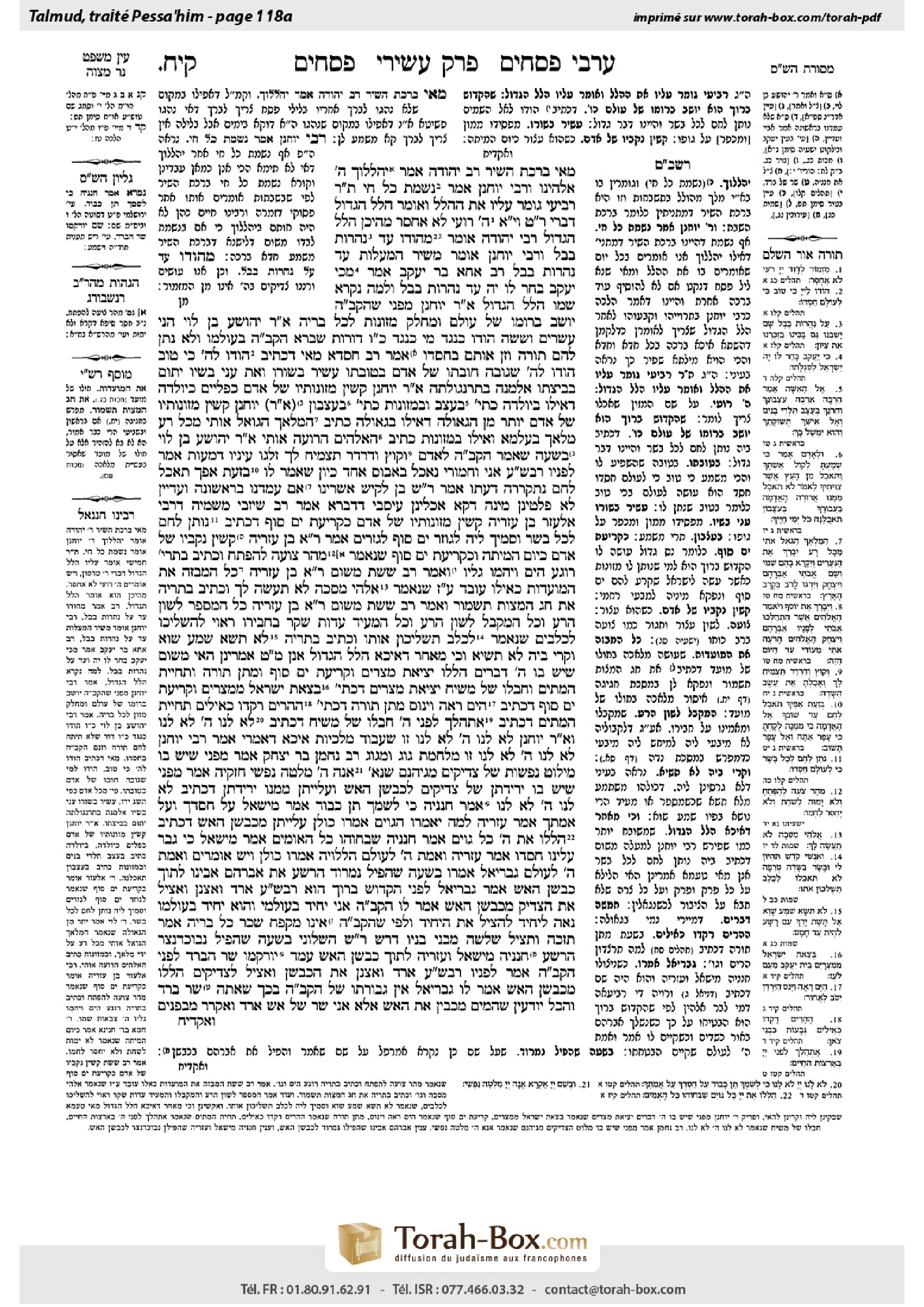
Pesachim 118a: Talmud study for Daf Yomi
Daf Yomi is the daily study of one Talmud folio. Explore 37 tractates with scans, Hebrew text, Sefaria English and AI-generated French translations where annotated.
Passage selection and English or AI-generated French translation are available where the scan has annotations. Daf Study is independent of Torah-Box and Sefaria.
Browse Pesachim · פסחים · All tractatesPesachim 118a text and translations
This page of Pesachim includes the Aramaic text, an English translation and an AI-generated French translation, alongside the scan above.
פסחים קי״ח א · Aramaic and Hebrew text
מַאי ״בִּרְכַּת הַשִּׁיר״? רַב יְהוּדָה אָמַר: ״יְהַלְלוּךָ ה׳ אֱלֹהֵינוּ״. וְרַבִּי יוֹחָנָן אָמַר: ״נִשְׁמַת כָּל חַי״. תָּנוּ רַבָּנַן: רְבִיעִי גּוֹמֵר עָלָיו אֶת הַהַלֵּל, וְאוֹמֵר הַלֵּל הַגָּדוֹל, דִּבְרֵי רַבִּי טַרְפוֹן. וְיֵשׁ אוֹמְרִים: ״ה׳ רוֹעִי לֹא אֶחְסָר״.
מֵהֵיכָן הַלֵּל הַגָּדוֹל? רַבִּי יְהוּדָה אוֹמֵר: מֵ״הוֹדוּ״ עַד ״נַהֲרוֹת בָּבֶל״. וְרַבִּי יוֹחָנָן אוֹמֵר: מִ״שִּׁיר הַמַּעֲלוֹת״ עַד ״נַהֲרוֹת בָּבֶל״. רַב אַחָא בַּר יַעֲקֹב אָמַר: מִ״כִּי יַעֲקֹב בָּחַר לוֹ יָהּ״ עַד ״נַהֲרוֹת בָּבֶל״.
וְלָמָּה נִקְרָא שְׁמוֹ הַלֵּל הַגָּדוֹל? אָמַר רַבִּי יוֹחָנָן: מִפְּנֵי שֶׁהַקָּדוֹשׁ בָּרוּךְ הוּא יוֹשֵׁב בְּרוּמוֹ שֶׁל עוֹלָם וּמְחַלֵּק מְזוֹנוֹת לְכׇל בְּרִיָּה.
אָמַר רַבִּי יְהוֹשֻׁעַ בֶּן לֵוִי: הָנֵי עֶשְׂרִים וְשִׁשָּׁה ״הוֹדוּ״, כְּנֶגֶד מִי — כְּנֶגֶד עֶשְׂרִים וְשִׁשָּׁה דּוֹרוֹת שֶׁבָּרָא הַקָּדוֹשׁ בָּרוּךְ הוּא בְּעוֹלָמוֹ וְלֹא נָתַן לָהֶם תּוֹרָה, וְזָן אוֹתָם בְּחַסְדּוֹ.
אָמַר רַב חִסְדָּא: מַאי דִּכְתִיב ״הוֹדוּ לַה׳ כִּי טוֹב״? הוֹדוּ לַה׳ שֶׁגּוֹבֶה חוֹבָתוֹ שֶׁל אָדָם בְּטוֹבָתוֹ: עָשִׁיר בְּשׁוֹרוֹ, וְאֶת עָנִי בְּשֵׂיוֹ, יָתוֹם בְּבֵיצָתוֹ, אַלְמָנָה בְּתַרְנְגוֹלְתָּהּ.
אָמַר רַבִּי יוֹחָנָן: קָשִׁין מְזוֹנוֹתָיו שֶׁל אָדָם כִּפְלַיִים כַּיּוֹלֵדָה, דְּאִילּוּ בְּיוֹלֵדָה כְּתִיב: ״בְּעֶצֶב״, וּבִמְזוֹנוֹת כְּתִיב ״בְּעִצָּבוֹן״.
וְאָמַר רַבִּי יוֹחָנָן: קָשִׁין מְזוֹנוֹתָיו שֶׁל אָדָם יוֹתֵר מִן הַגְּאוּלָּה, דְּאִילּוּ בִּגְאוּלָּה כְּתִיב: ״הַמַּלְאָךְ הַגּוֹאֵל אוֹתִי מִכׇּל רָע״, מַלְאָךְ בְּעָלְמָא, וְאִילּוּ בִּמְזוֹנוֹת כְּתִיב: ״הָאֱלֹהִים הָרוֹעֶה אֹתִי״.
אָמַר רַבִּי יְהוֹשֻׁעַ בֶּן לֵוִי: בְּשָׁעָה שֶׁאָמַר הַקָּדוֹשׁ בָּרוּךְ הוּא לָאָדָם ״וְקוֹץ וְדַרְדַּר תַּצְמִיחַ לָךְ״ זָלְגוּ עֵינָיו דְּמָעוֹת, אָמַר לְפָנָיו: רִבּוֹנוֹ שֶׁל עוֹלָם, אֲנִי וַחֲמוֹרִי נֹאכַל בְּאֵבוּס אֶחָד? כֵּיוָן שֶׁאָמַר לוֹ: ״בְּזֵעַת אַפֶּךָ תֹּאכַל לֶחֶם״, נִתְקָרְרָה דַּעְתּוֹ.
אָמַר רַבִּי שִׁמְעוֹן בֶּן לָקִישׁ: אַשְׁרֵינוּ אִם עָמַדְנוּ בָּרִאשׁוֹנָה, וַעֲדַיִין לָא פָּלְטִינַן מִינַּהּ, דְּקָא אָכְלִינַן עִיסְבֵי דְּדַבְרָא.
אָמַר רַב שֵׁיזְבִי מִשְּׁמֵיהּ דְּרַבִּי אֶלְעָזָר בֶּן עֲזַרְיָה: קָשִׁין מְזוֹנוֹתָיו שֶׁל אָדָם כִּקְרִיעַת יַם סוּף, דִּכְתִיב: ״נוֹתֵן לֶחֶם לְכׇל בָּשָׂר״, וּסְמִיךְ לֵיהּ: ״לְגוֹזֵר יַם סוּף לִגְזָרִים״.
אָמַר רַבִּי אֶלְעָזָר בֶּן עֲזַרְיָה: קָשִׁין נְקָבָיו שֶׁל אָדָם כְּיוֹם הַמִּיתָה וְכִקְרִיעַת יַם סוּף, שֶׁנֶּאֱמַר: ״מִהַר צוֹעֶה לְהִפָּתֵחַ״, וּכְתִיב בָּתְרֵיהּ: ״רוֹגַע הַיָּם וַיֶּהֱמוּ גַּלָּיו״.
וְאָמַר רַב שֵׁשֶׁת מִשּׁוּם רַבִּי אֶלְעָזָר בֶּן עֲזַרְיָה: כׇּל הַמְבַזֶּה אֶת הַמּוֹעֲדוֹת כְּאִילּוּ עוֹבֵד עֲבוֹדָה זָרָה, שֶׁנֶּאֱמַר: ״אֱלֹהֵי מַסֵּכָה לֹא תַעֲשֶׂה לָּךְ״, וּכְתִיב בָּתְרֵיהּ: ״אֶת חַג הַמַּצּוֹת תִּשְׁמוֹר״.
וְאָמַר רַב שֵׁשֶׁת מִשּׁוּם רַבִּי אֶלְעָזָר בֶּן עֲזַרְיָה: כׇּל הַמְסַפֵּר לָשׁוֹן הָרָע, וְכׇל הַמְקַבֵּל לָשׁוֹן הָרָע, וְכׇל הַמֵּעִיד עֵדוּת שֶׁקֶר בַּחֲבֵירוֹ — רָאוּי לְהַשְׁלִיכוֹ לִכְלָבִים, שֶׁנֶּאֱמַר: ״לַכֶּלֶב תַּשְׁלִיכוּן אוֹתוֹ״, וּכְתִיב בָּתְרֵיהּ: ״לֹא תִשָּׂא שֵׁמַע שָׁוְא״, וּקְרִי בֵּיהּ: ״לֹא תַּשִּׂיא״.
וְכִי מֵאַחַר דְּאִיכָּא הַלֵּל הַגָּדוֹל, אֲנַן מַאי טַעְמָא אָמְרִינַן הַאי? מִשּׁוּם שֶׁיֵּשׁ בּוֹ חֲמִשָּׁה דְבָרִים הַלָּלוּ: יְצִיאַת מִצְרַיִם, קְרִיעַת יַם סוּף, וּמַתַּן תּוֹרָה, וּתְחִיַּית הַמֵּתִים, וְחֶבְלוֹ שֶׁל מָשִׁיחַ.
יְצִיאַת מִצְרַיִם, דִּכְתִיב: ״בְּצֵאת יִשְׂרָאֵל מִמִּצְרַיִם״. וּקְרִיעַת יַם סוּף, דִּכְתִיב: ״הַיָּם רָאָה וַיָּנוֹס״. מַתַּן תּוֹרָה, דִּכְתִיב: ״הֶהָרִים רָקְדוּ כְאֵילִים״. תְּחִיַּית הַמֵּתִים, דִּכְתִיב: ״אֶתְהַלֵּךְ לִפְנֵי ה׳״.
חֶבְלוֹ שֶׁל מָשִׁיחַ, דִּכְתִיב: ״לֹא לָנוּ ה׳ לֹא לָנוּ״, וְאָמַר רַבִּי יוֹחָנָן: ״לֹא לָנוּ ה׳ לֹא לָנוּ״ — זוֹ שִׁעְבּוּד מַלְכִיּוֹת. אִיכָּא דְאָמְרִי, אָמַר רַבִּי יוֹחָנָן: ״לֹא לָנוּ ה׳ לֹא לָנוּ״ — זוֹ מִלְחֶמֶת גּוֹג וּמָגוֹג.
רַב נַחְמָן בַּר יִצְחָק אָמַר: מִפְּנֵי שֶׁיֵּשׁ בּוֹ מִילּוּט נְפָשׁוֹת שֶׁל צַדִּיקִים מִגֵּיהִנָּם, שֶׁנֶּאֱמַר: ״אָנָּה ה׳ מַלְּטָה נַפְשִׁי״. חִזְקִיָּה אָמַר: מִפְּנֵי שֶׁיֵּשׁ בּוֹ יְרִידָתָן שֶׁל צַדִּיקִים לְכִבְשַׁן הָאֵשׁ, וַעֲלִיָּיתָן מִמֶּנּוּ.
יְרִידָתָן, דִּכְתִיב: ״לֹא לָנוּ ה׳ לֹא לָנוּ״ אָמַר חֲנַנְיָה, ״כִּי לְשִׁמְךָ תֵּן כָּבוֹד״ אָמַר מִישָׁאֵל, ״עַל חַסְדְּךָ וְעַל אֲמִתֶּךָ״ אָמַר עֲזַרְיָה, ״לָמָּה יֹאמְרוּ הַגּוֹיִם״ אָמְרוּ כּוּלָּן.
עֲלִיָּיתָן מִכִּבְשַׁן הָאֵשׁ, דִּכְתִיב: ״הַלְלוּ אֶת ה׳ כׇּל גּוֹיִם״ אָמַר חֲנַנְיָה, ״שַׁבְּחוּהוּ כָּל הָאוּמִּים״ אָמַר מִישָׁאֵל, ״כִּי גָבַר עָלֵינוּ חַסְדּוֹ״ אָמַר עֲזַרְיָה, ״וֶאֱמֶת ה׳ לְעוֹלָם הַלְלוּיָהּ״ אָמְרוּ כּוּלָּן.
וְיֵשׁ אוֹמְרִים: ״וֶאֱמֶת ה׳ לְעוֹלָם״ גַּבְרִיאֵל אֲמָרוֹ. בְּשָׁעָה שֶׁהִפִּיל נִמְרוֹד הָרָשָׁע אֶת אַבְרָהָם אָבִינוּ לְתוֹךְ כִּבְשַׁן הָאֵשׁ אָמַר גַּבְרִיאֵל לִפְנֵי הַקָּדוֹשׁ בָּרוּךְ הוּא: רִבּוֹנוֹ שֶׁל עוֹלָם, אֵרֵד וַאֲצַנֵּן וְאַצִּיל אֶת הַצַּדִּיק מִכִּבְשַׁן הָאֵשׁ. אָמַר לוֹ הַקָּדוֹשׁ בָּרוּךְ הוּא: אֲנִי יָחִיד בְּעוֹלָמִי וְהוּא יָחִיד בְּעוֹלָמוֹ, נָאֶה לַיָּחִיד לְהַצִּיל אֶת הַיָּחִיד. וּלְפִי שֶׁהַקָּדוֹשׁ בָּרוּךְ הוּא אֵינוֹ מְקַפֵּחַ שְׂכַר כׇּל בְּרִיָּה, אָמַר: תִּזְכֶּה וְתַצִּיל שְׁלֹשָׁה מִבְּנֵי בָנָיו.
דָּרַשׁ רַבִּי שִׁמְעוֹן הַשִּׁלוֹנִי: בְּשָׁעָה שֶׁהִפִּיל נְבוּכַדְנֶצַּר הָרָשָׁע חֲנַנְיָה מִישָׁאֵל וַעֲזַרְיָה לְתוֹךְ כִּבְשַׁן הָאֵשׁ, עָמַד יוֹרֶקְמוֹ שַׂר הַבָּרָד לִפְנֵי הַקָּדוֹשׁ בָּרוּךְ הוּא, אָמַר לְפָנָיו: רִבּוֹנוֹ שֶׁל עוֹלָם, אֵרֵד וַאֲצַנֵּן אֶת הַכִּבְשָׁן וְאַצִּיל לַצַּדִּיקִים הַלָּלוּ מִכִּבְשַׁן הָאֵשׁ. אָמַר לוֹ גַּבְרִיאֵל: אֵין גְּבוּרָתוֹ שֶׁל הַקָּדוֹשׁ בָּרוּךְ הוּא בְּכָךְ שֶׁאַתָּה שַׂר בָּרָד, וְהַכֹּל יוֹדְעִין שֶׁהַמַּיִם מְכַבִּין אֶת הָאֵשׁ. אֶלָּא, אֲנִי שַׂר שֶׁל אֵשׁ אֵרֵד וַאֲקָרֵר מִבִּפְנִים,
Pesachim 118a · English translation
The Gemara asks: What is the blessing of the song mentioned in the mishna? Rav Yehuda said: It is the blessing that begins with: They shall praise You, Lord, our God. And Rabbi Yoḥanan said that one also recites: The breath of all living, a prayer that follows the verses of praise [pesukei dezimra]. The Sages taught in a baraita: With regard to the fourth cup, one completes hallel over it and recites the great hallel; this is the statement of Rabbi Tarfon. And some say that one recites: “The Lord is my shepherd, I shall not want” (Psalms 23:1), in appreciation of the food he ate at the meal.
The Gemara asks: From where does the great hallel begin and where does it end? Rabbi Yehuda says: From “Give thanks” (Psalms 136:1) until “The rivers of Babylon” (Psalms 137:1). And Rabbi Yoḥanan says: From “A song of ascents” (Psalms 134:1) until “The rivers of Babylon.” Rav Aḥa bar Ya’akov said: From “For the Lord has chosen Jacob for Himself” (Psalms 135:4) until “The rivers of Babylon.”
The Gemara asks: And why is this section called the great hallel? Rabbi Yoḥanan said: Because this passage states that the Holy One, Blessed be He, sits in the heights of the universe and dispenses food to every creature. The whole world praises God for His kindness through the great hallel, which includes the verse: “Who gives food to all flesh” (Psalms 136:25).
Rabbi Yehoshua ben Levi said: These twenty-six mentions of the word hodu, give praise, in this hallel (Psalms 136), to what do they correspond? He explains: They correspond to the twenty-six generations that the Holy One, Blessed be He, created in His world, and to whom He did not give the Torah. There were ten generations from Adam to Noah, another ten from Noah to Abraham, and six generations from Abraham to Moses and the revelation at Sinai, i.e., Isaac, Jacob, Levi, Kehat, Amram, and Moses. And why did these generations survive, despite the fact that they did not learn Torah or perform mitzvot? They survived only because God sustained them through His mercy, even though they were undeserving.
Rav Ḥisda said: What is the meaning of that which is written: “Give thanks to the Lord for He is good” (Psalms 136:1)? It means give thanks to the Lord who exacts one’s debt, the punishment for a person’s sins and wickedness, in accordance with the goodness of each individual. God punishes each person based on his means. He punishes a wealthy person by taking his ox, and He punishes a poor person by means of his sheep. He punishes the orphan by taking away his egg, and He punishes the widow by means of her chicken. God punishes each person based on his ability to endure deprivation, and He does not punish people with more than they can handle.
With regard to the praise due to God for sustaining the world, the Gemara cites a statement that Rabbi Yoḥanan said: The task of providing a person’s food is twice as difficult as the suffering endured by a woman in childbirth. While, with regard to a woman in childbirth, it is written: “In pain [be’etzev] you shall bring forth children” (Genesis 3:16), with regard to food, it is written: “In toil [be’itzavon] you shall eat of it, all the days of your life” (Genesis 3:17). Itzavon is a superlative form of etzev, which indicates that it is more difficult to support oneself than to give birth.
And Rabbi Yoḥanan said: The task of providing a person’s food is more difficult than the redemption. While, with regard to the redemption, it is written: “The angel who has redeemed me from all evil” (Genesis 48:16), indicating that a mere angel is sufficient to protect a person from all evil; whereas, with regard to sustenance, it is written: “The God who has been my shepherd all my life long to this day” (Genesis 48:15). This verse implies that only God can help one who is struggling to earn a living.
The Gemara cites a similar statement. Rabbi Yehoshua ben Levi said: When the Holy One, Blessed be He, said to Adam: “Thorns also and thistles shall it bring forth to you, and you shall eat the herb of the field” (Genesis 3:18), his eyes streamed with tears. Adam said before Him: Master of the Universe, will my donkey and I eat from one trough? After God said to him: “In the sweat of your face shall you eat bread” (Genesis 3:19), his mind was settled, assured that if he toils he will be able to eat bread, unlike the donkey.
Rabbi Shimon ben Lakish said: We would have been fortunate had we remained under the first decree and were still able to eat the herbs of the field. And we still have not entirely escaped from this decree, as we sometimes eat the grass of the field, in the form of vegetables and leaves.
Rav Sheizvi said, citing Rabbi Elazar ben Azarya: The task of providing a person’s food is as difficult as the splitting of the Red Sea, as it is written: “He gives food to all flesh, for His mercy endures forever” (Psalms 136:25), and juxtaposed to it is the verse: “To Him who divided the Red Sea in sunder, for His mercy endures forever” (Psalms 136:13). The reiteration of the last part of the verse indicates that the two praises are to a certain extent equivalent.
Likewise, Rabbi Elazar ben Azarya said: A person’s orifices, when he cannot properly relieve himself, are as difficult for him as the day of death and the splitting of the Red Sea, as it is stated: “He who is bent down shall speedily be loosed; and he shall not go down dying into the pit, neither shall his bread fail” (Isaiah 51:14). The phrase “dying into the pit” indicates that the opening of the orifices is similar to a rescue from death. And afterward it is written: “Who stirs up the sea, that its waves roar” (Isaiah 51:15), which compares the previous matter to the splitting of the sea.
After citing a statement of Rabbi Elazar ben Azarya that was transmitted by amora’im, the Gemara quotes additional expositions attributed to him. And Rav Sheshet said, citing Rabbi Elazar ben Azarya: Anyone who disparages the Festivals, it is considered as though he engages in idol worship. This, too, is derived from the juxtaposition of verses, as it is stated: “You shall make yourself no molten gods” (Exodus 34:17), and afterward it is written: “The Festival of matzot you shall keep” (Exodus 34:18), from which it can be inferred that anyone who does not observe the Festivals properly is likened to one who fashions idols.
And Rav Sheshet further said, citing Rabbi Elazar ben Azarya: Anyone who speaks slander, and anyone who accepts and believes the slander he hears, and anyone who testifies falsely about another, it is fitting to throw him to the dogs, as it is stated: “And you shall not eat any flesh that is torn of beasts in the field, you shall cast it to the dogs” (Exodus 22:30), and afterward it is written: “You shall not utter [tisa] a false report; put not your hand with the wicked to be an unrighteous witness” (Exodus 23:1). Uttering rumors is here equated to delivering false testimony. Furthermore, read into the verse as though it stated: Do not cause a false report to be accepted [tasi], i.e., do not lead others to accept your false reports.
The Gemara asks: And since there is the great hallel, which contains the special praise of “Who gives food to all flesh” (Psalms 136:25), as explained above, what is the reason that one also recites this hallel of Psalms 113–118, the section recited on every joyous occasion? The Gemara answers: The reason is because the regular hallel contains these five matters: The remembrance of the exodus from Egypt, the splitting of the Red Sea, the giving of the Torah, the resurrection of the dead, and the pangs of the Messiah. Since it mentions these key concepts, this hallel is also considered important.
The Gemara elaborates: The exodus from Egypt, as it is written: “When Israel came forth out of Egypt, the house of Jacob from a people of strange language” (Psalms 114:1). And the splitting of the Red Sea, as it is written: “The sea saw it and fled; the Jordan turned backward” (Psalms 114:3). The giving of the Torah, as it is written: “The mountains skipped like rams” (Psalms 114:4), which is similar to the description of the giving of the Torah found elsewhere in the books of the Prophets. The resurrection of the dead, as it is written: “I will walk before the Lord in the lands of the living” (Psalms 116:9), which follows the verse: “For you have delivered my soul from death.” After mentioning death, the psalm describes the resurrection in the lands of the living.
The pangs of the Messiah, as it is written: “Not to us, God, not to us, but to Your name give glory” (Psalms 115:1). And Rabbi Yoḥanan said: The verse “Not to us, God, not to us” and the entire psalm, including the verse “Why should the nations say, where now is their God?” (Psalms 115:2), is referring to the era of the enslavement of the kingdoms and the redemption of the Jewish people from their dominion. Some say that Rabbi Yoḥanan said: The verse “Not to us, God, not to us” is referring to the war of Gog and Magog, the catastrophes and wars that will befall the Jewish people in the end of days from which they will be delivered.
Rav Naḥman bar Yitzḥak said: Another reason why one recites hallel of Psalms 113–118 is because it contains a reference to the deliverance of the souls of the righteous from Gehenna, as it is stated: “I beseech you, Lord, deliver my soul” (Psalms 116:4). Ḥizkiya said: Another reason is because it contains the story of the descent of the righteous Hananiah, Mishael, and Azariah into the fiery furnace and their miraculous ascent from it.
Ḥizkiya clarifies his previous statement: Their descent is mentioned in this hallel, as it is written: “Not to us, God, not to us,” a verse that Hananiah recited. Mishael recited: “But to Your name give glory.” Azariah recited: “For Your mercy and for Your truth’s sake.” They all recited together: “Why should the nations say: Where now is their God?”
This hallel also alludes to the ascent of Hananiah, Mishael, and Azariah from the fiery furnace, as it is written: “Praise the Lord, all you nations, laud Him all you peoples. For His mercy is great toward us, and the truth of the Lord endures forever, halleluya” (Psalms 117). Hananiah recited: “Praise the Lord, all you nations,” for the overt miracle performed for them before the nations. Mishael recited: “Laud Him all you peoples.” Azariah recited: “For His mercy is great toward us.” They all recited together: “And the truth of the Lord endures forever, halleluya.”
And some say that the angel Gabriel recited: “And the truth of the Lord endures forever.” This Gemara elaborates: When the evil Nimrod threw our father, Abraham, into the fiery furnace, Gabriel said before the Holy One, Blessed be He: Master of the Universe, I will descend and cool the furnace, and I will thereby save the righteous Abraham from the fiery furnace. The Holy One, Blessed be He, said to him: I am unique in my world and Abraham is still unique in his world. It is fitting for the unique to save the unique. Therefore, God Himself went down and saved him. And as the Holy One, Blessed be He, does not withhold reward from any creature who sought to perform a good deed, He said to Gabriel: You will merit the rescue of three of his descendants under similar circumstances.
Rabbi Shimon HaShiloni taught: When the evil Nebuchadnezzar threw Hananiah, Mishael, and Azariah into the fiery furnace, Yurkamo, the ministering angel of hail, stood before the Holy One, Blessed be He, and said before Him: Master of the Universe, I will go down and cool the fiery furnace, and I will save these righteous ones from the fiery furnace. Gabriel said to him: The strength of the Holy One, Blessed be He, will not be evident in this manner, as you are the minister of hail, and everyone knows that water extinguishes fire. Your action would not be regarded as a great miracle. Rather, I, the ministering angel of fire, will descend, and I will cool the furnace from within,
Pesachim 118a · Traduction française (IA)
La Guemara demande : Quelle est la bénédiction du chant mentionnée dans la Michna ? Rav Yehouda dit : C’est la bénédiction qui commence ainsi : « Qu’ils Te louent, Seigneur notre Dieu. » Rabbi Yoḥanan dit qu’on récite également : « Le souffle de tout être vivant », une prière qui suit les versets de louange [pesukei dezimra]. Les Sages enseignent dans une baraïta : Pour la quatrième coupe, on achève le Hallel et on récite le grand Hallel ; telle est l’opinion de Rabbi Tarfon. Certains disent qu’on récite : « Le Seigneur est mon berger, je ne manquerai de rien » (Psaumes 23, 1), en reconnaissance pour la nourriture consommée au repas.
La Guemara demande : Où commence et où s’achève le grand Hallel ? Rabbi Yehouda dit : De « Rendez grâce » (Psaumes 136, 1) jusqu’à « Au bord des fleuves de Babylone » (Psaumes 137, 1). Rabbi Yoḥanan dit : De « Cantique des montées » (Psaumes 134, 1) jusqu’à « Au bord des fleuves de Babylone ». Rav Aḥa bar Ya’akov dit : De « Car le Seigneur a choisi Jacob pour Lui-même » (Psaumes 135, 4) jusqu’à « Au bord des fleuves de Babylone ».
La Guemara demande : Pourquoi cette section est-elle appelée le grand Hallel ? Rabbi Yoḥanan dit : Parce que ce passage dit que le Saint, béni soit-Il, siège dans les hauteurs de l’univers et dispense la nourriture à toutes les créatures. Le monde entier loue Dieu pour Sa bonté dans le grand Hallel, qui comprend le verset : « Lui qui donne la nourriture à toute chair » (Psaumes 136, 25).
Rabbi Yehoshua ben Levi dit : À quoi correspondent les vingt-six occurrences du mot hodu, « rendez grâce », dans ce Hallel (Psaumes 136) ? Il explique : Elles correspondent aux vingt-six générations que le Saint, béni soit-Il, a créées dans Son monde sans leur donner la Torah. Il y eut dix générations d’Adam à Noé, dix autres de Noé à Abraham, puis six générations d’Abraham à Moïse et à la révélation du Sinaï, à savoir Isaac, Jacob, Lévi, Kehat, Amram et Moïse. Et pourquoi ces générations ont-elles survécu, alors qu’elles n’étudiaient pas la Torah et n’accomplissaient pas les mitsvot ? Elles n’ont survécu que parce que Dieu les a entretenues par Sa miséricorde, bien qu’elles ne l’aient pas mérité.
Rav Ḥisda dit : Que signifie ce qui est écrit : « Rendez grâce au Seigneur, car Il est bon » (Psaumes 136, 1) ? Cela signifie : rendez grâce au Seigneur, qui fait payer à chacun sa dette — la punition de ses péchés et de sa méchanceté — selon la condition de chacun. Dieu punit chaque personne en fonction de ses moyens. Il punit le riche en lui prenant son bœuf, et le pauvre au moyen de son mouton. Il punit l’orphelin en lui prenant son œuf, et la veuve au moyen de sa poule. Dieu punit chacun selon sa capacité à supporter la privation et ne punit personne au-delà de ce qu’il peut endurer.
À propos des louanges dues à Dieu pour le maintien du monde, la Guemara rapporte une déclaration de Rabbi Yoḥanan : Pourvoir à la nourriture d’une personne est deux fois plus difficile que les souffrances endurées par une femme en couches. En effet, à propos de la femme en couches, il est écrit : « C’est dans la douleur [be’etzev] que tu enfanteras des enfants » (Genèse 3, 16), tandis qu’à propos de la nourriture, il est écrit : « C’est dans le labeur [be’itzavon] que tu en mangeras, tous les jours de ta vie » (Genèse 3, 17). Itzavon est une forme intensive de etzev, ce qui indique qu’il est plus difficile de subvenir à ses besoins que d’accoucher.
Rabbi Yoḥanan dit également : Pourvoir à la nourriture d’une personne est plus difficile que la rédemption. En effet, à propos de la rédemption, il est écrit : « L’ange qui m’a racheté de tout mal » (Genèse 48, 16), ce qui indique qu’un simple ange suffit pour protéger une personne de tout mal ; tandis qu’à propos de la subsistance, il est écrit : « Le Dieu qui a été mon berger toute ma vie jusqu’à ce jour » (Genèse 48, 15). Ce verset laisse entendre que seul Dieu peut aider celui qui peine à gagner sa vie.
La Guemara rapporte une déclaration similaire. Rabbi Yehoshua ben Levi dit : Lorsque le Saint, béni soit-Il, dit à Adam : « Elle fera pousser pour toi des épines et des chardons, et tu mangeras l’herbe des champs » (Genèse 3, 18), ses yeux ruisselèrent de larmes. Adam lui dit : Maître de l’univers, mon âne et moi mangerons-nous dans la même mangeoire ? Après que Dieu lui eut dit : « C’est à la sueur de ton visage que tu mangeras du pain » (Genèse 3, 19), il fut rassuré, certain que s’il travaille, il pourra manger du pain, contrairement à l’âne.
Rabbi Shimon ben Lakish dit : Nous aurions été heureux si nous étions restés soumis au premier décret et avions encore pu manger les herbes des champs. Et nous ne nous sommes toujours pas complètement soustraits à ce décret, car il nous arrive de manger l’herbe des champs sous forme de légumes et de feuilles.
Rav Sheizvi dit au nom de Rabbi Elazar ben Azarya : Pourvoir à la nourriture d’une personne est aussi difficile que la scission de la mer Rouge, comme il est écrit : « Lui qui donne la nourriture à toute chair, car Sa miséricorde est éternelle » (Psaumes 136, 25), et le verset qui lui fait pendant est : « À Lui qui a fendu la mer Rouge, car Sa miséricorde est éternelle » (Psaumes 136, 13). La répétition de la fin du verset indique que ces deux louanges sont, dans une certaine mesure, équivalentes.
De même, Rabbi Elazar ben Azarya dit : Les orifices d’une personne, lorsqu’elle ne peut pas se soulager correctement, lui sont aussi pénibles que le jour de la mort et la scission de la mer Rouge, comme il est dit : « Celui qui est courbé sera bientôt délivré ; il ne descendra pas mourant dans la fosse, et son pain ne lui fera pas défaut » (Isaïe 51, 14). L’expression « mourant dans la fosse » indique que l’ouverture des orifices s’apparente à un sauvetage de la mort. Puis il est écrit : « Celui qui agite la mer, dont les vagues mugissent » (Isaïe 51, 15), ce qui compare le sujet précédent à la scission de la mer.
Après avoir cité une déclaration de Rabbi Elazar ben Azarya transmise par des amoraïm, la Guemara rapporte d’autres interprétations qui lui sont attribuées. Rav Sheshet dit au nom de Rabbi Elazar ben Azarya : Quiconque méprise les fêtes est considéré comme s’il pratiquait l’idolâtrie. Cela aussi se déduit de la juxtaposition des versets, comme il est dit : « Tu ne te feras pas de dieux en métal fondu » (Exode 34, 17), puis : « Tu observeras la fête des Matzot » (Exode 34, 18). On peut en déduire que quiconque n’observe pas correctement les fêtes est assimilé à celui qui façonne des idoles.
Rav Sheshet dit également au nom de Rabbi Elazar ben Azarya : Quiconque dit du mal d’autrui, quiconque accepte et croit la médisance qu’il entend, et quiconque porte un faux témoignage contre autrui mérite d’être jeté aux chiens, comme il est dit : « Vous ne mangerez aucune chair déchirée par les bêtes dans les champs ; vous la jetterez aux chiens » (Exode 22, 30), puis : « Tu ne proféreras [tisa] pas de faux rapport ; ne prête pas ta main au méchant pour être un témoin inique » (Exode 23, 1). La propagation de rumeurs est ici assimilée au faux témoignage. En outre, lis le verset comme s’il disait : « Ne fais pas accepter [tasi] un faux rapport », c’est-à-dire ne pousse pas les autres à accepter tes faux rapports.
La Guemara demande : Puisqu’il y a le grand Hallel, qui contient la louange particulière « Lui qui donne la nourriture à toute chair » (Psaumes 136, 25), comme expliqué plus haut, pourquoi récite-t-on aussi ce Hallel des Psaumes 113 à 118, la section récitée à chaque occasion joyeuse ? La Guemara répond : C’est parce que le Hallel habituel contient cinq thèmes : le souvenir de la sortie d’Égypte, la scission de la mer Rouge, le don de la Torah, la résurrection des morts et les douleurs du Messie. Puisqu’il mentionne ces notions essentielles, ce Hallel est lui aussi considéré comme important.
La Guemara développe : La sortie d’Égypte, comme il est écrit : « Quand Israël sortit d’Égypte, la maison de Jacob, d’un peuple à la langue étrangère » (Psaumes 114, 1). La scission de la mer Rouge, comme il est écrit : « La mer le vit et s’enfuit ; le Jourdain retourna en arrière » (Psaumes 114, 3). Le don de la Torah, comme il est écrit : « Les montagnes bondirent comme des béliers » (Psaumes 114, 4), ce qui ressemble à la description du don de la Torah que l’on trouve ailleurs dans les livres des Prophètes. La résurrection des morts, comme il est écrit : « Je marcherai devant le Seigneur dans les terres des vivants » (Psaumes 116, 9), verset qui suit : « Car Tu as délivré mon âme de la mort. » Après avoir évoqué la mort, le psaume décrit la résurrection dans les terres des vivants.
Les douleurs du Messie, comme il est écrit : « Non pas à nous, Dieu, non pas à nous, mais à Ton nom donne gloire » (Psaumes 115, 1). Rabbi Yoḥanan dit : Le verset « Non pas à nous, Dieu, non pas à nous » et le psaume tout entier, y compris le verset « Pourquoi les nations diraient-elles : Où est donc leur Dieu ? » (Psaumes 115, 2), font référence à l’époque de l’asservissement par les royaumes et de la délivrance du peuple juif de leur domination. Certains disent que Rabbi Yoḥanan a dit : Le verset « Non pas à nous, Dieu, non pas à nous » fait référence à la guerre de Gog et Magog, aux catastrophes et aux guerres qui s’abattront sur le peuple juif à la fin des temps et dont il sera délivré.
Rav Naḥman bar Yitzḥak dit : Une autre raison pour laquelle on récite le Hallel des Psaumes 113 à 118 est qu’il fait référence à la délivrance des âmes des justes de la Géhenne, comme il est dit : « Je T’en prie, Seigneur, délivre mon âme » (Psaumes 116, 4). Ḥizkiya dit : Une autre raison est qu’il évoque la descente des justes Hananiah, Mishael et Azariah dans la fournaise ardente et leur sortie miraculeuse de celle-ci.
Ḥizkiya précise sa déclaration précédente : Leur descente est évoquée dans ce Hallel, comme il est écrit : « Non pas à nous, Dieu, non pas à nous », verset que Hananiah récita. Mishael récita : « Mais à Ton nom donne gloire. » Azariah récita : « À cause de Ta miséricorde et de Ta vérité. » Ils récitèrent tous ensemble : « Pourquoi les nations diraient-elles : Où est donc leur Dieu ? »
Ce Hallel fait également allusion à la sortie de Hananiah, Mishael et Azariah de la fournaise ardente, comme il est écrit : « Louez le Seigneur, vous toutes les nations, célébrez-Le, vous tous les peuples. Car Sa miséricorde est grande envers nous, et la vérité du Seigneur subsiste à jamais, halleluya » (Psaumes 117). Hananiah récita : « Louez le Seigneur, vous toutes les nations », en raison du miracle manifeste accompli pour eux devant les nations. Mishael récita : « Célébrez-Le, vous tous les peuples. » Azariah récita : « Car Sa miséricorde est grande envers nous. » Ils récitèrent tous ensemble : « Et la vérité du Seigneur subsiste à jamais, halleluya. »
Certains disent que l’ange Gabriel récita : « Et la vérité du Seigneur subsiste à jamais. » La Guemara développe : Lorsque le méchant Nimrod jeta notre père Abraham dans la fournaise ardente, Gabriel dit devant le Saint, béni soit-Il : Maître de l’univers, je descendrai refroidir la fournaise et sauverai ainsi le juste Abraham de la fournaise ardente. Le Saint, béni soit-Il, lui dit : Je suis unique dans Mon monde, et Abraham est encore unique dans son monde. Il convient que l’unique sauve l’unique. Dieu descendit donc Lui-même et le sauva. Et comme le Saint, béni soit-Il, ne prive aucune créature de récompense lorsqu’elle a voulu accomplir une bonne action, Il dit à Gabriel : Tu mériteras de sauver trois de ses descendants dans des circonstances semblables.
Rabbi Shimon HaShiloni enseigna : Lorsque le méchant Nabuchodonosor jeta Hananiah, Mishael et Azariah dans la fournaise ardente, Yurkamo, l’ange préposé à la grêle, se tint devant le Saint, béni soit-Il, et Lui dit : Maître de l’univers, je vais descendre refroidir la fournaise ardente et sauver ces justes de la fournaise ardente. Gabriel lui dit : La puissance du Saint, béni soit-Il, ne se manifesterait pas ainsi, car tu es préposé à la grêle et tout le monde sait que l’eau éteint le feu. Ton intervention ne serait pas considérée comme un grand miracle. C’est plutôt moi, l’ange préposé au feu, qui vais descendre et refroidir la fournaise de l’intérieur,
Traduction française générée par IA à partir de l’édition anglaise de Sefaria. Vérifie toujours un passage avec le texte source.
Text from Sefaria: William Davidson Edition - Vocalized Aramaic (CC BY NC); William Davidson Edition - English (CC BY NC).