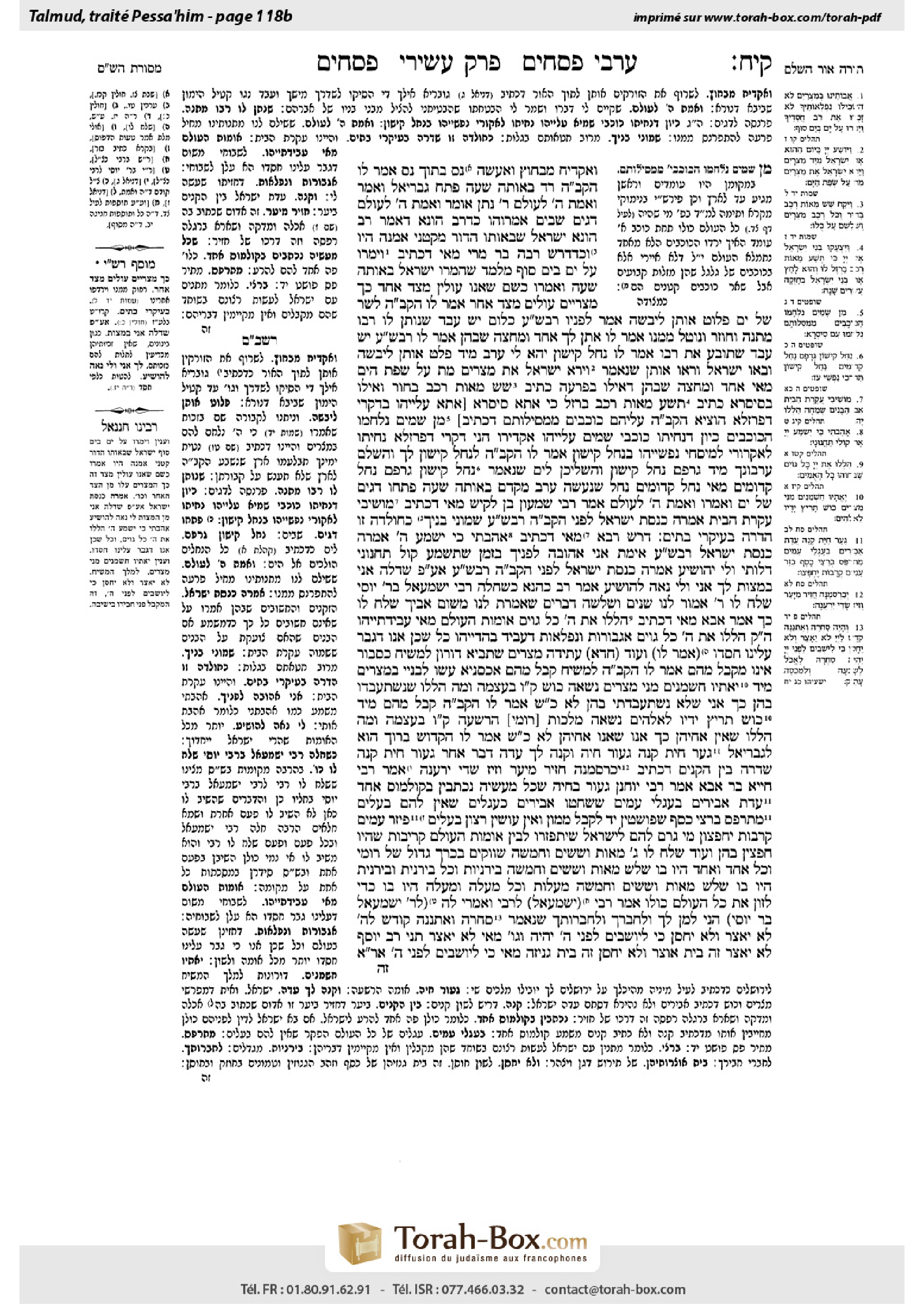
Pesachim 118b: Talmud study for Daf Yomi
Daf Yomi is the daily study of one Talmud folio. Explore 37 tractates with scans, Hebrew text, Sefaria English and AI-generated French translations where annotated.
Passage selection and English or AI-generated French translation are available where the scan has annotations. Daf Study is independent of Torah-Box and Sefaria.
Browse Pesachim · פסחים · All tractatesPesachim 118b text and translations
This page of Pesachim includes the Aramaic text, an English translation and an AI-generated French translation, alongside the scan above.
פסחים קי״ח ב · Aramaic and Hebrew text
וְאַקְדִּיחַ מִבַּחוּץ, וְאֶעֱשֶׂה נֵס בְּתוֹךְ נֵס. אָמַר לוֹ הַקָּדוֹשׁ בָּרוּךְ הוּא: רֵד! בְּאוֹתָהּ שָׁעָה פָּתַח גַּבְרִיאֵל וְאָמַר: ״וֶאֱמֶת ה׳ לְעוֹלָם״.
רַבִּי נָתָן אוֹמֵר: ״וֶאֱמֶת ה׳ לְעוֹלָם״ — דָּגִים שֶׁבַּיָּם אֲמָרוּהוּ, כִּדְרַב הוּנָא. דְּאָמַר רַב הוּנָא: יִשְׂרָאֵל שֶׁבְּאוֹתוֹ הַדּוֹר מִקְּטַנֵּי אֲמָנָה הָיוּ, וְכִדְדָרֵשׁ רַבָּה בַּר מָרִי: מַאי דִּכְתִיב ״וַיַּמְרוּ עַל יָם בְּיַם סוּף״ — מְלַמֵּד שֶׁהִמְרוּ יִשְׂרָאֵל בְּאוֹתָהּ שָׁעָה וְאָמְרוּ: כְּשֵׁם שֶׁאָנוּ עוֹלִין מִצַּד אֶחָד, כָּךְ מִצְרִיִּים עוֹלִים מִצַּד אַחֵר.
אָמַר לוֹ הַקָּדוֹשׁ בָּרוּךְ הוּא לְשַׂר שֶׁל יָם: פְּלוֹט אוֹתָן לַיַּבָּשָׁה! אָמַר לְפָנָיו: רִבּוֹנוֹ שֶׁל עוֹלָם, כְּלוּם יֵשׁ עֶבֶד שֶׁנּוֹתֵן לוֹ רַבּוֹ מַתָּנָה וְחוֹזֵר וְנוֹטֵל מִמֶּנּוּ? אָמַר לוֹ: אֶתֵּן לָךְ אֶחָד וּמֶחֱצָה שֶׁבָּהֶן.
אָמַר לוֹ: רִבּוֹנוֹ שֶׁל עוֹלָם, יֵשׁ עֶבֶד שֶׁתּוֹבֵעַ אֶת רַבּוֹ? אָמַר לוֹ: נַחַל קִישׁוֹן יְהֵא לִי עָרֵב. מִיָּד פָּלַט אוֹתָן לַיַּבָּשָׁה וּבָאוּ יִשְׂרָאֵל וְרָאוּ אוֹתָן. שֶׁנֶּאֱמַר: ״וַיַּרְא יִשְׂרָאֵל אֶת מִצְרַיִם מֵת עַל שְׂפַת הַיָּם״.
מַאי אֶחָד וּמֶחֱצָה שֶׁבָּהֶן? דְּאִילּוּ בְּפַרְעֹה כְּתִיב: ״שֵׁשׁ מֵאוֹת רֶכֶב בָּחוּר״, וְאִילּוּ בְּסִיסְרָא כְּתִיב: ״תְּשַׁע מֵאוֹת רֶכֶב בַּרְזֶל״.
כִּי אֲתָא סִיסְרָא [אֲתָא עֲלַיְיהוּ בְּדִקְרֵי דְפַרְזְלָא, הוֹצִיא הַקָּדוֹשׁ בָּרוּךְ הוּא עֲלֵיהֶם כּוֹכָבִים מִמְּסִילּוֹתָם, דִּכְתִיב:] ״מִן שָׁמַיִם נִלְחָמוּ הַכּוֹכָבִים״. כֵּיוָן דִּנְחִיתוּ כּוֹכְבֵי שָׁמַיִם עֲלַיְיהוּ, אַקְדִּירוּ הָנֵי דִּקְרֵי דְפַרְזְלָא. נְחִיתוּ לְאַקְרוֹרֵי לְמִיסְחֵי נַפְשַׁיְיהוּ בְּנַחַל קִישׁוֹן,
אָמַר לוֹ הַקָּדוֹשׁ בָּרוּךְ הוּא לְנַחַל קִישׁוֹן: לֵךְ וְהַשְׁלֵם עֵרְבוֹנְךָ. מִיָּד גְּרָפָם נַחַל קִישׁוֹן וְהִשְׁלִיכָן לַיָּם, שֶׁנֶּאֱמַר: ״נַחַל קִישׁוֹן גְּרָפָם נַחַל קְדוּמִים״, מַאי ״נַחַל קְדוּמִים״? נַחַל שֶׁנַּעֲשָׂה עָרֵב מִקֶּדֶם. בְּאוֹתָהּ שָׁעָה פָּתְחוּ דָּגִים שֶׁל יָם וְאָמְרוּ: ״וֶאֱמֶת ה׳ לְעוֹלָם״.
אָמַר רַבִּי שִׁמְעוֹן בֶּן לָקִישׁ, מַאי דִּכְתִיב: ״מוֹשִׁיבִי עֲקֶרֶת הַבַּיִת״ — אָמְרָה כְּנֶסֶת יִשְׂרָאֵל לִפְנֵי הַקָּדוֹשׁ בָּרוּךְ הוּא: רִבּוֹנוֹ שֶׁל עוֹלָם, שָׂמוּנִי בָּנֶיךָ כְּחוּלְדָּה זוֹ הַדָּרָה בְּעִיקָּרֵי בָתִּים.
דָּרֵשׁ רָבָא, מַאי דִּכְתִיב: ״אָהַבְתִּי כִּי יִשְׁמַע ה׳״ — אָמְרָה כְּנֶסֶת יִשְׂרָאֵל: רִבּוֹנוֹ שֶׁל עוֹלָם אֵימַת אֲנִי אֲהוּבָה לְפָנֶיךָ — בִּזְמַן שֶׁתִּשְׁמַע קוֹל תַּחֲנוּנַי. ״דַּלּוֹתִי וְלִי יְהוֹשִׁיעַ״ — אָמְרָה כְּנֶסֶת יִשְׂרָאֵל לִפְנֵי הַקָּדוֹשׁ בָּרוּךְ הוּא: רִבּוֹנוֹ שֶׁל עוֹלָם, אַף עַל פִּי שֶׁדַּלָּה אֲנִי בְּמִצְוֹת, לְךָ אֲנִי וְלִי נָאֶה לְהוֹשִׁיעַ.
אָמַר רַב כָּהֲנָא: כְּשֶׁחָלָה רַבִּי יִשְׁמָעֵאל בְּרַבִּי יוֹסֵי, שָׁלַח לוֹ רַבִּי: אֱמוֹר לָנוּ שְׁנַיִם וּשְׁלֹשָׁה דְּבָרִים שֶׁאָמַרְתָּ לָנוּ מִשּׁוּם אָבִיךָ.
שָׁלַח לוֹ: כָּךְ אָמַר אַבָּא, מַאי דִּכְתִיב: ״הַלְלוּ אֶת ה׳ כׇּל גּוֹיִם״, אוּמּוֹת הָעוֹלָם מַאי עֲבִידְתַּיְיהוּ? הָכִי קָאָמַר: ״הַלָּלוּ אֶת ה׳ כׇּל גּוֹיִם״ אַגְּבוּרוֹת וְנִפְלָאוֹת דְּעָבֵיד בַּהֲדַיְיהוּ, כׇּל שֶׁכֵּן אָנוּ דְּ״גָבַר עָלֵינוּ חַסְדּוֹ״.
וְעוֹד: עֲתִידָה מִצְרַיִם שֶׁתָּבִיא דּוֹרוֹן לַמָּשִׁיחַ. כְּסָבוּר, אֵינוֹ מְקַבֵּל מֵהֶם. אָמַר לוֹ הַקָּדוֹשׁ בָּרוּךְ הוּא לַמָּשִׁיחַ: קַבֵּל מֵהֶם! אַכְסַנְיָא עָשׂוּ לְבָנַיי בְּמִצְרַיִם. מִיָּד: ״יֶאֱתָיוּ חַשְׁמַנִּים מִנִּי מִצְרָיִם״.
נָשְׂאָה כּוּשׁ קַל וָחוֹמֶר בְּעַצְמָהּ: וּמָה הַלָּלוּ שֶׁנִּשְׁתַּעְבְּדוּ בָּהֶן כָּךְ, אֲנִי שֶׁלֹּא נִשְׁתַּעְבַּדְתִּי בָּהֶן לֹא כׇּל שֶׁכֵּן. אָמַר לוֹ הַקָּדוֹשׁ בָּרוּךְ הוּא: קַבֵּל מֵהֶם. מִיָּד ״כּוּשׁ תָּרִיץ יָדָיו לֵאלֹהִים״.
נָשְׂאָה מַלְכוּת (רוֹמִי) הָרְשָׁעָה קַל וָחוֹמֶר בְּעַצְמָהּ: וּמָה הַלָּלוּ שֶׁאֵין אֲחֵיהֶן כָּךְ, אָנוּ שֶׁאָנוּ אֲחֵיהֶן — לֹא כׇּל שֶׁכֵּן?! אָמַר לוֹ הַקָּדוֹשׁ בָּרוּךְ הוּא לְגַבְרִיאֵל: ״גְּעַר חַיַּת קָנֶה״ — גְּעוֹר חַיָּה וּקְנֵה לְךָ עֵדָה.
דָּבָר אַחֵר: ״גְּעוֹר חַיַּת קָנֶה״ שֶׁדָּרָה בֵּין הַקָּנִים, דִּכְתִיב: ״יְכַרְסְמֶנָּה חֲזִיר מִיָּעַר וְזִיז שָׂדַי יִרְעֶנָּה״.
אָמַר רַבִּי חִיָּיא בַּר אַבָּא אָמַר רַבִּי יוֹחָנָן: גְּעוֹר בְּחַיָּה שֶׁכׇּל מַעֲשֶׂיהָ נִכְתָּבִין בְּקוּלְמוֹס אֶחָד. ״עֲדַת אַבִּירִים בְּעֶגְלֵי עַמִּים״ — שֶׁשָּׁחֲטוּ אַבִּירִים כַּעֲגָלִים שֶׁאֵין לָהֶם בְּעָלִים.
״מִתְרַפֵּס בְּרַצֵּי כָסֶף״ — שֶׁפּוֹשְׁטִין יָד לְקַבֵּל מָמוֹן, וְאֵין עוֹשִׂין רְצוֹן בְּעָלִים. ״פִּיזַּר עַמִּים קְרָבוֹת יֶחְפָּצוּן״ — מִי גָּרַם לָהֶם לְיִשְׂרָאֵל שֶׁיִּתְפַּזְּרוּ לְבֵין אוּמּוֹת הָעוֹלָם? קְרִיבוֹת שֶׁהָיוּ חֲפֵצִין בָּהֶן.
וְעוֹד שָׁלַח לוֹ: שְׁלֹשׁ מֵאוֹת וְשִׁשִּׁים וַחֲמִשָּׁה שְׁוָוקִים בִּכְרַךְ גָּדוֹל שֶׁל רוֹמִי, וְכׇל אֶחָד וְאֶחָד (הָיוּ) [יֵשׁ] בּוֹ שְׁלֹשׁ מֵאוֹת וְשִׁשִּׁים וַחֲמִשָּׁה בִּירָנִיּוֹת, וְכׇל בִּירָנִית וּבִירָנִית (הָיוּ בּוֹ) [יֵשׁ בָּהּ] שְׁלֹשׁ מֵאוֹת וְשִׁשִּׁים וַחֲמִשָּׁה מַעֲלוֹת, וְכׇל מַעֲלָה וּמַעֲלָה (הָיוּ בּוֹ) [יֵשׁ בָּהּ] כְּדֵי לָזוּן אֶת כָּל הָעוֹלָם כּוּלּוֹ.
אָמַר רַבִּי (יִשְׁמָעֵאל) [שִׁמְעוֹן בְּרַבִּי] לְרַבִּי, וְאָמְרִי לַהּ (לְ)רַבִּי יִשְׁמָעֵאל בַּר יוֹסֵי [לְרַבִּי]: הָנֵי לְמַן? לָךְ וּלְחַבְרָךְ וּלְחַבְרוּתָךְ, שֶׁנֶּאֱמַר: ״סַחְרָהּ וְאֶתְנַנָּהּ קוֹדֶשׁ לַה׳ לֹא יֵאָצֵר וְלֹא יֵחָסֵן כִּי לַיּוֹשְׁבִים לִפְנֵי ה׳ יִהְיֶה וְגוֹ׳״.
מַאי ״לֹא יֵאָצֵר״? תָּנֵי רַב יוֹסֵף: ״לֹא יֵאָצֵר״ — זֶה בֵּית אוֹצָר, ״וְלֹא יֵחָסֵן״ — זֶה בֵּית גְּנִיזָה. מַאי ״כִּי לַיּוֹשְׁבִים לִפְנֵי ה׳״? אָמַר רַבִּי אֶלְעָזָר:
Pesachim 118b · English translation
and I will burn it from the outside, to consume those who threw the three righteous men into the furnace; and I will thereby perform a miracle within a miracle. The Holy One, Blessed be He, said to him: Descend. At that time Gabriel began praising God and recited: “And the truth of the Lord endures forever” (Psalms 117:2), as God fulfilled His promise to him from more than a thousand years earlier.
Rabbi Natan says: “And the truth of the Lord endures forever” was actually recited by the fish in the sea, in accordance with a statement of Rav Huna. As Rav Huna said: The Jewish people of that generation, during the Exodus, were of little faith. And this statement is as Rabba bar Mari taught: What is the meaning of that which is written: “But they were rebellious at the sea, even at the Red Sea” (Psalms 106:7)? This teaches that the Jews rebelled against Moses at that time, and said: Perhaps, just as we are ascending from one side, so too the Egyptians are ascending from the other side, and we will not be saved.
The Holy One, Blessed be He, said to the ministering angel of the sea: Spew out the dead Egyptians onto dry land. The sea said before Him: Master of the Universe, is there a servant whose master gives him a gift and then takes it from him? Since the dead Egyptians were given to me for my fish to eat, how can God retract His gift? He said to him: I will give you one and a half times their number. Although I am taking them back now, later I will give you one and a half times as many people.
He said to him: Master of the Universe, can a servant issue a claim against his master for a gift promised to him? Who will be my guarantor? He said to him: The Kishon River will be a guarantor for Me. Immediately, the sea spewed them out onto the land, and the Jewish people came and saw that they were dead. As it is stated: “And Israel saw the Egyptians dead upon the seashore” (Exodus 14:30).
The Gemara asks: What is this one and a half times their number? How was God’s promise fulfilled? The Gemara answers: While, with regard to Pharaoh, it is written: “Six hundred chosen chariots” (Exodus 14:7), whereas, with regard to Sisera, it is written: “Nine hundred iron chariots” (Judges 4:13).
The Gemara relates: When Sisera came to fight Israel, he came upon them with iron spears, whereupon the Holy One, Blessed be He, removed the stars from their orbits to fight against Sisera’s army, as it is written: “They fought from heaven, the stars in their courses fought against Sisera” (Judges 5:20). Since the stars fell on them, these iron spears heated up and they went to cool them and wash themselves in the Kishon River.
At this point, the Holy One, Blessed be He, said to the Kishon River: Go and pay your guarantee that you issued to the ministering angel of the sea. Immediately, the Kishon River swept them away and cast them into the sea, as it is stated: “The Kishon River swept them away, that ancient river” (Judges 5:21). What is the meaning of the expression: “ancient river”? The Gemara explains: This is referring to the river that was appointed a guarantor from ancient times. At that time, the fish of the sea began praising God and recited: “And the truth of the Lord endures forever,” in reference to God’s fulfillment of the promise He issued centuries earlier.
The Gemara cites more midrashim on the verses of hallel. Rabbi Shimon ben Lakish said: What is the meaning of that which is written: “Who makes the barren woman dwell in her house as a joyful mother of children, halleluya” (Psalms 113:9)? The Congregation of Israel, i.e., the leaders of the Jewish people, said before the Holy One, Blessed be He: Master of the Universe, due to their sins, Your children treat me like this rat that dwells in the vaults of houses, barely able to find a place in the house.
Rava taught: What is the meaning of that which is written: “I love that the Lord should hear my voice and my supplications” (Psalms 116:1)? The Congregation of Israel said: Master of the Universe, when am I beloved by You, and I know that I am loved? When You hear the voice of my supplications. “I was brought low, and He saved me” (Psalms 116:6). The Congregation of Israel said before the Holy One, Blessed be He: Master of the Universe, although I am lowly in mitzvot, as I do not always fulfill them properly, I am Yours, and therefore it is fitting that I should be saved.
Rav Kahana said: When Rabbi Yishmael, son of Rabbi Yosei, fell ill, Rabbi Yehuda HaNasi sent a message to him: Tell us two or three matters that you said to us, citing your father.
He sent back to him: My father said as follows: What is the meaning of that which is written: “Praise the Lord, all you nations, laud Him all you peoples. For His mercy is great toward us, and the truth of the Lord endures forever, halleluya” (Psalms 117)? What are the nations of the world doing by praising God for His great mercies toward Israel? Rabbi Yosei explained: Rather, this is what the verse is saying: “Praise the Lord, all you nations” for the mighty acts and the wonders that God performed before their eyes. All the more so we, the recipients of these acts, should praise and thank Him, as His mercy is great toward us.
And furthermore, Rabbi Yishmael sent another of his father’s teachings to Rabbi Yehuda HaNasi: In the future, Egypt will bring a gift to the Messiah when all of the nations gather before him, as the verse says: “Out of Your temple at Jerusalem, where kings shall bring presents to you” (Psalms 68:30). The Messiah will think it appropriate not to accept gifts from them, as the Egyptians abused Israel. The Holy One, Blessed be He, will say to the Messiah: Accept their gifts from them, as they granted lodging to My children in Egypt. They lived there for many years before being enslaved. Immediately, “Nobles shall come out of Egypt” (Psalms 68:32).
Upon seeing that Egypt’s gift has been accepted, Kush will want to bring a gift too. Kush will draw an a fortiori inference with regard to itself: Just as the gifts of these Egyptians were accepted despite the fact that they enslaved the Jewish people, all the more so is it not clear that a gift from me, who did not enslave them, should be accepted? The Holy One, Blessed be He, will say to the Messiah: Accept it from them. Immediately, “Kush shall hasten to stretch out her hands to God” (Psalms 68:32).
After that, the wicked kingdom of Rome will draw an a fortiori inference with regard to itself: Just as the gifts of these, who are not their brothers, were accepted in this manner, we, the descendants of Edom, who are their brothers, all the more so is it not clear that our gifts will be accepted? The Holy One, Blessed be He, will say to Gabriel: “Rebuke the wild beast of the reeds [kaneh], the multitude of [adat] the bulls” (Psalms 68:31). Rebuke the beast and acquire [keneh] the congregation [eda] of Israel. The nation of Rome, which enslaved Israel in its current exile, is less worthy than the other two nations.
Alternatively, the verse “Rebuke the wild beast of the reeds,” means rebuke the beast that dwells between the reeds, as it is written: “The pig out of the wood ravages it, and that which moves in the field feeds on it” (Psalms 80:14). This verse is referring to Edom, whose behavior is compared elsewhere to that of a pig.
Rabbi Ḥiyya bar Abba said that Rabbi Yoḥanan said that the verse means: Rebuke the beast, all of whose actions are written with a single quill. Kaneh can mean a reed, or a quill. In other words, rebuke a nation that speaks of others in only one manner, for the worse. The verse continues: “The multitude of the bulls, with the calves of the peoples, everyone submitting himself with pieces of silver. He has scattered the peoples who delight in war” (Psalms 68:31). “The multitude of the bulls [abirim], with the calves of the peoples”; this is referring to Rome, who slaughtered mighty people [abirim] like ownerless calves.
“Everyone submitting himself with pieces of silver,” means that the officials of Rome open their hands to receive money as bribes or taxes, but actually they do not perform the will of their masters, as they cannot be trusted even in this regard. “He has scattered the peoples who delight in war”; what caused the Jewish people to be scattered among the nations of the world? The intimacies that they desired with them. Their exile among the nations was caused by their attraction to the customs and behavior of gentiles.
And Rabbi Yishmael further sent to Rabbi Yehuda HaNasi: There were 365 markets in the great city of Rome, and each and every one of them contained 365 towers, and each and every tower contained 365 floors, and each and every floor contained enough food to sustain the entire world.
Rabbi Yishmael also said to Rabbi Yehuda HaNasi, and some say that he said it to Rabbi Yishmael, son of Rabbi Yosei: For whom did they store all this food? He replied: For you and your colleagues and the colleagues of your colleagues, i.e., for the Jewish people and their Sages, as it is stated: “Her grain and her hire shall be consecrated to the Lord; it shall not be treasured nor laid up; for her gain shall be for those who dwell before the Lord, to eat their fill, and for stately clothing” (Isaiah 23:18).
The Gemara asks: What is the meaning of the phrase: “It shall not be treasured”? Rav Yosef teaches: “It shall not be treasured,” this is referring to items brought into a storehouse; “nor laid up,” this means a treasury, where valuable items were stored behind guarded walls. What is the meaning of the phrase: “Who dwell before the Lord?” Rabbi Elazar said:
Pesachim 118b · Traduction française (IA)
et je le brûlerai de l’extérieur, afin de consumer ceux qui ont jeté les trois justes dans la fournaise ; j’accomplirai ainsi un miracle au sein d’un miracle. Le Saint, béni soit-Il, lui dit : « Descends. » À ce moment-là, Gabriel se mit à louer Dieu et récita : « Et la vérité du Seigneur demeure à jamais » (Psaumes 117, 2), car Dieu tenait ainsi la promesse qu’Il lui avait faite plus de mille ans auparavant.
Rabbi Natan dit : « Et la vérité du Seigneur demeure à jamais » fut en réalité récité par les poissons de la mer, conformément à une déclaration de Rav Houna. Car Rav Houna dit : Les enfants d’Israël de cette génération, lors de la sortie d’Égypte, avaient peu de foi. Cela correspond à ce qu’enseigna Rabba bar Mari : Quel est le sens de ce qui est écrit : « Mais ils se rebellèrent contre Lui au bord de la mer, auprès de la mer Rouge » (Psaumes 106, 7) ? Cela enseigne que les Juifs se rebellèrent alors contre Moïse et dirent : « Peut-être que, de même que nous montons d’un côté, les Égyptiens montent eux aussi de l’autre côté, et nous ne serons pas sauvés. »
Le Saint, béni soit-Il, dit à l’ange préposé à la mer : « Rejette sur la terre ferme les cadavres des Égyptiens. » La mer lui dit : « Maître de l’univers, existe-t-il un serviteur à qui son maître donne un présent pour le lui reprendre ensuite ? Puisque les cadavres des Égyptiens m’ont été donnés pour que mes poissons les mangent, comment Dieu pourrait-Il reprendre Son présent ? » Il lui dit : « Je t’en donnerai une fois et demie leur nombre. » Même si Je les reprends maintenant, plus tard Je te donnerai une fois et demie autant de personnes.
La mer lui dit : « Maître de l’univers, un serviteur peut-il réclamer à son maître un présent qui lui a été promis ? Qui se portera garant pour Moi ? » Il lui dit : « Le torrent de Kishon se portera garant pour Moi. » Aussitôt, la mer les rejeta sur la terre ferme, et les enfants d’Israël vinrent et virent qu’ils étaient morts. Comme il est dit : « Israël vit les Égyptiens morts sur le rivage de la mer » (Exode 14, 30).
La Guemara demande : Que signifie « une fois et demie leur nombre » ? Comment Dieu tint-Il Sa promesse ? La Guemara répond : Au sujet de Pharaon, il est écrit : « Six cents chars d’élite » (Exode 14, 7), tandis qu’au sujet de Sisera, il est écrit : « Neuf cents chars de fer » (Juges 4, 13).
La Guemara rapporte : Lorsque Sisera vint combattre Israël, il les attaqua avec des lances de fer. Alors, le Saint, béni soit-Il, fit sortir les étoiles de leurs orbites pour combattre l’armée de Sisera, comme il est écrit : « Du ciel, les étoiles combattirent ; de leurs trajectoires, elles combattirent contre Sisera » (Juges 5, 20). Comme les étoiles leur tombaient dessus, leurs lances de fer chauffèrent ; ils allèrent alors les refroidir et se baigner dans le torrent de Kishon.
À ce moment-là, le Saint, béni soit-Il, dit au torrent de Kishon : « Va payer la garantie que tu as donnée à l’ange préposé à la mer. » Aussitôt, le torrent de Kishon les emporta et les jeta dans la mer, comme il est dit : « Le torrent de Kishon les emporta, ce torrent antique » (Juges 5, 21). Quel est le sens de l’expression « torrent antique » ? La Guemara explique : Cela désigne le torrent qui s’était porté garant depuis les temps anciens. Alors, les poissons de la mer se mirent à louer Dieu et récitèrent : « Et la vérité du Seigneur demeure à jamais », en référence au fait que Dieu avait tenu la promesse faite des siècles auparavant.
La Guemara cite d’autres midrachim sur les versets du Hallel. Rabbi Shimon ben Lakish dit : Quel est le sens de ce qui est écrit : « Il fait habiter la femme stérile dans sa maison, mère joyeuse d’enfants. Halleluya » (Psaumes 113, 9) ? La communauté d’Israël, c’est-à-dire les dirigeants du peuple juif, dit au Saint, béni soit-Il : « Maître de l’univers, à cause de leurs péchés, Tes enfants me traitent comme cette souris qui habite dans les caves des maisons, peinant à y trouver une place. »
Rava enseigna : Quel est le sens de ce qui est écrit : « J’aime que le Seigneur entende ma voix, mes supplications » (Psaumes 116, 1) ? La communauté d’Israël dit : « Maître de l’univers, quand suis-je aimée de Toi, et comment sais-je que Tu m’aimes ? Lorsque Tu entends la voix de mes supplications. » « J’étais abaissée, et Il m’a sauvé » (Psaumes 116, 6). La communauté d’Israël dit au Saint, béni soit-Il : « Maître de l’univers, bien que je sois pauvre en mitsvot, car je ne les accomplis pas toujours comme il convient, je T’appartiens ; il est donc juste que je sois sauvée. »
Rav Kahana dit : Lorsque Rabbi Yishmael, fils de Rabbi Yosei, tomba malade, Rabbi Yehuda HaNasi lui envoya ce message : « Raconte-nous deux ou trois choses que tu nous as dites en citant ton père. »
Il lui renvoya cette réponse : « Mon père a dit ce qui suit : Quel est le sens de ce qui est écrit : “Louez le Seigneur, vous toutes les nations, célébrez-Le, vous tous les peuples ! Car Sa bonté envers nous est grande, et la vérité du Seigneur demeure à jamais. Halleluya” (Psaumes 117) ? Pourquoi les nations du monde loueraient-elles Dieu pour les grandes bontés qu’Il a accordées à Israël ? Rabbi Yosei expliqua : Le verset dit plutôt ceci : “Louez le Seigneur, vous toutes les nations” pour les actes puissants et les prodiges que Dieu a accomplis sous vos yeux. À plus forte raison, nous, qui avons bénéficié de ces actes, devons Le louer et Le remercier, car Sa bonté envers nous est grande. »
De plus, Rabbi Yishmael transmit à Rabbi Yehuda HaNasi un autre enseignement de son père : À l’avenir, l’Égypte apportera un présent au Messie lorsque toutes les nations se rassembleront devant lui, comme le dit le verset : « De Ton Temple à Jérusalem, où les rois T’apporteront des présents » (Psaumes 68, 30). Le Messie jugera approprié de ne pas accepter leurs présents, car les Égyptiens ont maltraité Israël. Le Saint, béni soit-Il, dira au Messie : « Accepte leurs présents, car ils ont accordé l’hospitalité à Mes enfants en Égypte. Ils y ont vécu de nombreuses années avant d’être asservis. » Aussitôt : « Des nobles sortiront d’Égypte » (Psaumes 68, 32).
En voyant que le présent de l’Égypte a été accepté, Koush voudra, elle aussi, apporter un présent. Koush fera à son sujet un raisonnement a fortiori : « Puisque les présents de ces Égyptiens ont été acceptés malgré le fait qu’ils ont asservi le peuple juif, à plus forte raison un présent venant de moi, qui ne l’ai pas asservi, devrait-il être accepté. » Le Saint, béni soit-Il, dira au Messie : « Accepte-le de leur part. » Aussitôt : « Koush se hâtera de tendre les mains vers Dieu » (Psaumes 68, 32).
Ensuite, le royaume impie de Rome fera à son sujet un raisonnement a fortiori : « Puisque les présents de ceux qui ne sont pas leurs frères ont été ainsi acceptés, nous, les descendants d’Édom, qui sommes leurs frères, à plus forte raison nos présents seront-ils acceptés. » Le Saint, béni soit-Il, dira à Gabriel : « Réprimande la bête des roseaux [kaneh], la multitude des [adat] taureaux » (Psaumes 68, 31). Réprimande la bête et acquiers [keneh] l’assemblée [eda] d’Israël. La nation de Rome, qui a asservi Israël pendant son exil actuel, est moins digne que les deux autres nations.
Autre interprétation : le verset « Réprimande la bête des roseaux » signifie : réprimande la bête qui habite parmi les roseaux, comme il est écrit : « Le sanglier de la forêt la ravage, et ce qui se meut dans les champs s’en nourrit » (Psaumes 80, 14). Ce verset fait référence à Édom, dont le comportement est ailleurs comparé à celui d’un porc.
Rabbi Ḥiyya bar Abba dit au nom de Rabbi Yoḥanan que le verset signifie : « Réprimande la bête dont tous les actes sont écrits avec une seule plume. » Kaneh peut signifier « roseau » ou « plume ». Autrement dit, réprimande une nation qui ne parle des autres que d’une seule manière, toujours en mal. Le verset poursuit : « La multitude des taureaux, avec les veaux des peuples, chacun se soumettant avec des pièces d’argent. Il a dispersé les peuples qui se plaisent à combattre » (Psaumes 68, 31). « La multitude des taureaux [abirim], avec les veaux des peuples » désigne Rome, qui massacrait de puissants hommes [abirim] comme des veaux sans maître.
« Chacun se soumettant avec des pièces d’argent » signifie que les fonctionnaires de Rome tendent la main pour recevoir de l’argent sous forme de pots-de-vin ou d’impôts, mais qu’en réalité ils n’exécutent pas la volonté de leurs maîtres, car on ne peut même pas leur faire confiance à cet égard. « Il a dispersé les peuples qui se plaisent à combattre » : qu’est-ce qui a provoqué la dispersion du peuple juif parmi les nations du monde ? Les relations intimes qu’il désirait avoir avec elles. Son exil parmi les nations fut causé par son attirance pour les coutumes et le comportement des non-Juifs.
Rabbi Yishmael transmit encore à Rabbi Yehuda HaNasi : La grande ville de Rome comptait 365 marchés ; chacun d’eux contenait 365 tours, chaque tour 365 étages, et chaque étage renfermait assez de nourriture pour nourrir le monde entier.
Rabbi Yishmael dit également à Rabbi Yehuda HaNasi — certains disent qu’il le dit à Rabbi Yishmael, fils de Rabbi Yosei : « Pour qui avaient-ils entreposé toute cette nourriture ? » Il lui répondit : « Pour toi, tes collègues et les collègues de tes collègues », c’est-à-dire pour le peuple juif et ses Sages, comme il est dit : « Son blé et son salaire seront consacrés au Seigneur ; ils ne seront ni amassés ni mis en réserve, car son gain sera pour ceux qui demeurent devant le Seigneur, afin qu’ils mangent à satiété et aient de beaux vêtements » (Isaïe 23, 18).
La Guemara demande : Quel est le sens de l’expression « ils ne seront pas mis en réserve » ? Rav Yosef enseigne : « Ils ne seront pas amassés » désigne les biens apportés dans un entrepôt ; « ni mis en réserve » désigne un trésor, où les objets de valeur étaient conservés derrière des murs gardés. Quel est le sens de l’expression « ceux qui demeurent devant le Seigneur » ? Rabbi Elazar dit :
Traduction française générée par IA à partir de l’édition anglaise de Sefaria. Vérifie toujours un passage avec le texte source.
Text from Sefaria: William Davidson Edition - Vocalized Aramaic (CC BY NC); William Davidson Edition - English (CC BY NC).