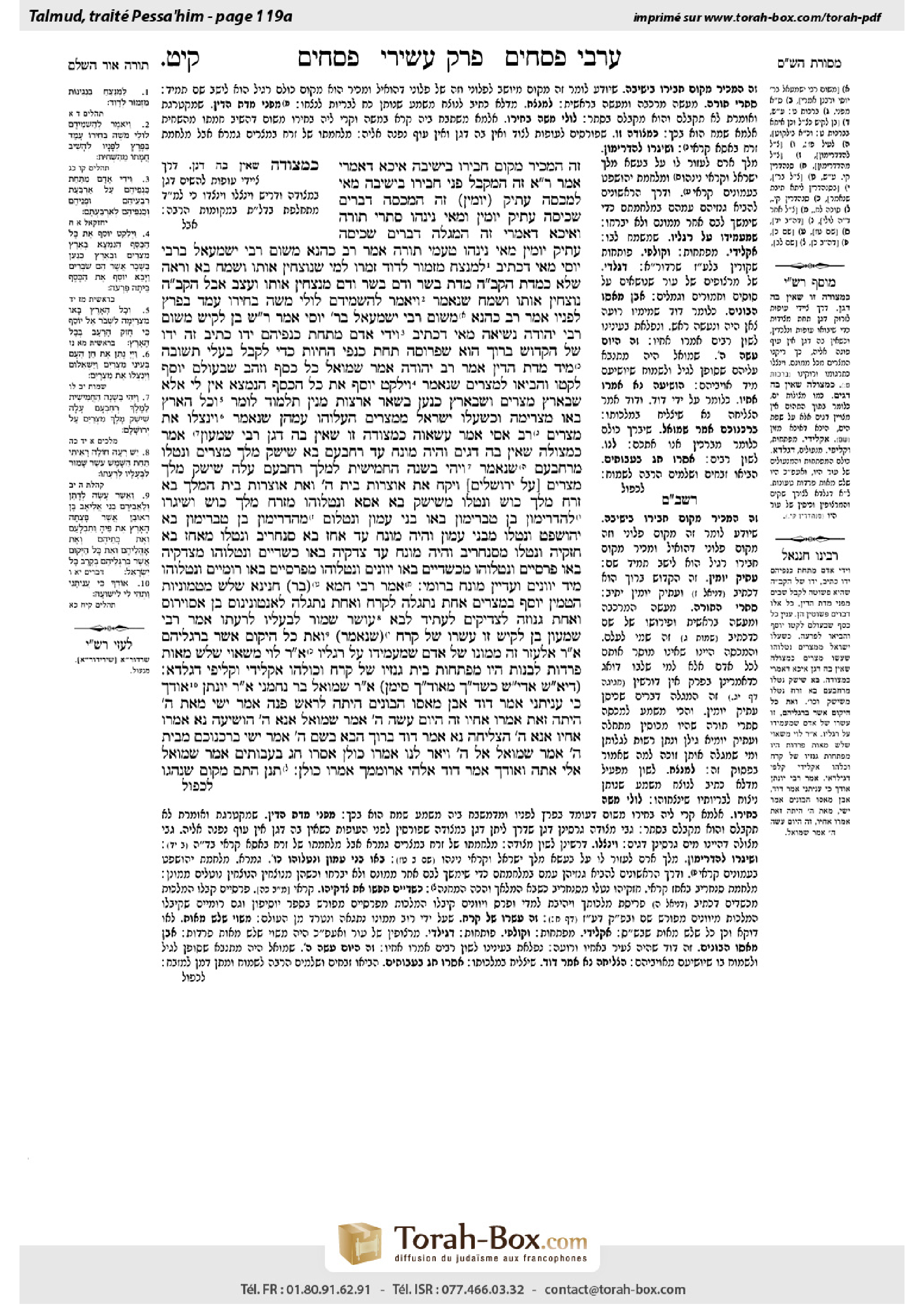
Pesachim 119a: Talmud study for Daf Yomi
Daf Yomi is the daily study of one Talmud folio. Explore 37 tractates with scans, Hebrew text, Sefaria English and AI-generated French translations where annotated.
Passage selection and English or AI-generated French translation are available where the scan has annotations. Daf Study is independent of Torah-Box and Sefaria.
Browse Pesachim · פסחים · All tractatesPesachim 119a text and translations
This page of Pesachim includes the Aramaic text, an English translation and an AI-generated French translation, alongside the scan above.
פסחים קי״ט א · Aramaic and Hebrew text
זֶה הַמַּכִּיר מְקוֹם חֲבֵירוֹ בַּיְּשִׁיבָה. אִיכָּא דְאָמְרִי, אָמַר רַבִּי אֶלְעָזָר: זֶה הַמְקַבֵּל פְּנֵי חֲבֵירוֹ בַּיְּשִׁיבָה.
מַאי ״לִמְכַסֶּה עָתִיק״ — זֶה הַמְכַסֶּה דְּבָרִים שֶׁכִּיסָּה עַתִּיק יוֹמִין, וּמַאי נִינְהוּ? סִתְרֵי תוֹרָה. וְאִיכָּא דְּאָמְרִי: זֶה הַמְגַלֶּה דְּבָרִים שֶׁכִּיסָּה עַתִּיק יוֹמִין, מַאי נִינְהוּ? טַעֲמֵי תוֹרָה.
אָמַר רַב כָּהֲנָא מִשּׁוּם רַבִּי יִשְׁמָעֵאל בְּרַבִּי יוֹסֵי, מַאי דִּכְתִיב: ״לַמְנַצֵּחַ מִזְמוֹר לְדָוִד״ — זַמְּרוּ לְמִי שֶׁנּוֹצְחִין אוֹתוֹ וְשָׂמֵחַ.
בֹּא וּרְאֵה שֶׁלֹּא כְּמִדַּת הַקָּדוֹשׁ בָּרוּךְ הוּא מִדַּת בָּשָׂר וָדָם. בָּשָׂר וָדָם — מְנַצְּחִין אוֹתוֹ וְעָצֵב, אֲבָל הַקָּדוֹשׁ בָּרוּךְ הוּא — נוֹצְחִין אוֹתוֹ וְשָׂמֵחַ, שֶׁנֶּאֱמַר: ״וַיֹּאמֶר לְהַשְׁמִידָם לוּלֵי מֹשֶׁה בְחִירוֹ עָמַד בַּפֶּרֶץ לְפָנָיו״.
אָמַר רַב כָּהֲנָא מִשּׁוּם רַבִּי יִשְׁמָעֵאל בְּרַבִּי יוֹסֵי אָמַר רַבִּי שִׁמְעוֹן בֶּן לָקִישׁ מִשּׁוּם רַבִּי יְהוּדָה נְשִׂיאָה: מַאי דִּכְתִיב: ״וִידֵי אָדָם מִתַּחַת כַּנְפֵיהֶם״, ״יָדוֹ״ כְּתִיב — זֶה יָדוֹ שֶׁל הַקָּדוֹשׁ בָּרוּךְ הוּא שֶׁפְּרוּסָה תַּחַת כַּנְפֵי הַחַיּוֹת כְּדֵי לְקַבֵּל בַּעֲלֵי תְשׁוּבָה מִיַּד מִדַּת הַדִּין.
אָמַר רַב יְהוּדָה אָמַר שְׁמוּאֵל: כׇּל כֶּסֶף וְזָהָב שֶׁבָּעוֹלָם יוֹסֵף לִקְּטוֹ וֶהֱבִיאוֹ לְמִצְרַיִם, שֶׁנֶּאֱמַר: ״וַיְלַקֵּט יוֹסֵף אֶת כׇּל הַכֶּסֶף הַנִּמְצָא״. אֵין לִי אֶלָּא שֶׁבְּאֶרֶץ מִצְרַיִם וְשֶׁבְּאֶרֶץ כְּנַעַן, בִּשְׁאָר אֲרָצוֹת מִנַּיִן? תַּלְמוּד לוֹמַר: ״וְכׇל הָאָרֶץ בָּאוּ מִצְרַיְמָה״.
וּכְשֶׁעָלוּ יִשְׂרָאֵל מִמִּצְרַיִם הֶעֱלוּהוּ עִמָּהֶן, שֶׁנֶּאֱמַר: ״וַיְנַצְּלוּ אֶת מִצְרָיִם״, רַב אַסִּי אָמַר: עֲשָׂאוּהָ כִּמְצוּדָה זוֹ שֶׁאֵין בָּהּ דָּגָן, רַבִּי שִׁמְעוֹן אָמַר: כִּמְצוּלָה שֶׁאֵין בָּהּ דָּגִים.
וְהָיָה מוּנָּח עַד רְחַבְעָם. בָּא שִׁישַׁק מֶלֶךְ מִצְרַיִם וּנְטָלוֹ מֵרְחַבְעָם, שֶׁנֶּאֱמַר: ״וַיְהִי בַּשָּׁנָה הַחֲמִישִׁית לַמֶּלֶךְ רְחַבְעָם עָלָה שִׁישַׁק מֶלֶךְ מִצְרַיִם [עַל יְרוּשָׁלִַים] וַיִּקַּח אֶת אוֹצְרוֹת בֵּית ה׳ וְאֶת אוֹצְרוֹת בֵּית הַמֶּלֶךְ״. בָּא זֶרַח מֶלֶךְ כּוּשׁ וּנְטָלוֹ מִשִּׁישַׁק.
בָּא אָסָא וּנְטָלוֹ מִזֶּרַח מֶלֶךְ כּוּשׁ וְשִׁיגְּרוֹ לְהַדְרִימּוֹן בֶּן טַבְרִימּוֹן. בָּאוּ בְּנֵי עַמּוֹן וּנְטָלוּם מֵהַדְרִימּוֹן בֶּן טַבְרִימּוֹן. בָּא יְהוֹשָׁפָט וּנְטָלוֹ מִבְּנֵי עַמּוֹן וְהָיָה מוּנָּח עַד אָחָז.
בָּא סַנְחֵרִיב וּנְטָלוֹ מֵאָחָז. בָּא חִזְקִיָּה וּנְטָלוֹ מִסַּנְחֵרִיב וְהָיָה מוּנָּח עַד צִדְקִיָּה. בָּאוּ כַּשְׂדִּיִּים וּנְטָלוּהוּ מִצִּדְקִיָּה. בָּאוּ פָּרְסִיִּים וּנְטָלוּהוּ מִכַּשְׂדִּיִּים. בָּאוּ יְוָונִים וּנְטָלוּהוּ מִפָּרְסִיִּים. בָּאוּ רוֹמִיִּים וּנְטָלוּהוּ מִיַּד יְוָונִים, וַעֲדַיִין מוּנָּח בְּרוֹמִי.
אָמַר רַבִּי חָמָא (בַּר) חֲנִינָא: שָׁלֹשׁ מַטְמוֹנִיּוֹת הִטְמִין יוֹסֵף בְּמִצְרַיִם, אַחַת נִתְגַּלָּה לְקֹרַח, וְאַחַת נִתְגַּלָּה לְאַנְטוֹנִינוּס בֶּן אַסְוִירוּס, וְאַחַת גְּנוּזָה לְצַדִּיקִים לֶעָתִיד לָבֹא.
״עוֹשֶׁר שָׁמוּר לִבְעָלָיו לְרָעָתוֹ״, אָמַר רַבִּי שִׁמְעוֹן בֶּן לָקִישׁ: זוֹ עׇשְׁרוֹ שֶׁל קֹרַח. (שֶׁנֶּאֱמַר:) ״וְאֶת כׇּל הַיְקוּם אֲשֶׁר בְּרַגְלֵיהֶם״, אָמַר רַבִּי אֶלְעָזָר: זֶה מָמוֹנוֹ שֶׁל אָדָם שֶׁמַּעֲמִידוֹ עַל רַגְלָיו. אָמַר רַבִּי לֵוִי: מַשּׂאוֹי שְׁלֹשׁ מֵאוֹת פְּרָדוֹת לְבָנוֹת הָיוּ מַפְתְּחוֹת בֵּית גְּנָזָיו שֶׁל קֹרַח, וְכוּלְּהוּ אַקְלִידֵי וּקְלִיפֵּי דְגִלְדָּא.
(דיא״ש אדי״ש כשד״ך מאוד״ך סִימָן). אָמַר רַבִּי שְׁמוּאֵל בַּר נַחְמָנִי אָמַר רַבִּי יוֹנָתָן: ״אוֹדְךָ כִּי עֲנִיתָנִי״ — אָמַר דָּוִד. ״אֶבֶן מָאֲסוּ הַבּוֹנִים הָיְתָה לְרֹאשׁ פִּנָּה״ — אָמַר יִשַׁי. ״מֵאֵת ה׳ הָיְתָה זֹּאת״ — אָמְרוּ אֶחָיו. ״זֶה הַיּוֹם עָשָׂה ה׳״ — אָמַר שְׁמוּאֵל.
״אָנָּא ה׳ הוֹשִׁיעָה נָּא״ — אָמְרוּ אֶחָיו. ״אָנָּא ה׳ הַצְלִיחָה נָּא״ — אָמַר דָּוִד. ״בָּרוּךְ הַבָּא בְּשֵׁם ה׳״ — אָמַר יִשַׁי. ״בֵּרַכְנוּכֶם מִבֵּית ה׳״ — אָמַר שְׁמוּאֵל. ״אֵל ה׳ וַיָּאֶר לָנוּ״ — אָמְרוּ כּוּלָּן. ״אִסְרוּ חַג בַּעֲבוֹתִים״ — אָמַר שְׁמוּאֵל. ״אֵלִי אַתָּה וְאוֹדֶךָּ״ — אָמַר דָּוִד. ״אֱלֹהַי אֲרוֹמְמֶךָּ״ — אָמְרוּ כּוּלָּן.
תְּנַן הָתָם: מָקוֹם שֶׁנָּהֲגוּ
Pesachim 119a · English translation
This is one who recognizes his colleague’s place in the yeshiva, as he is there often enough to know where everyone sits. Some say that Rabbi Elazar said a different explanation: This is one who greets his colleague in the yeshiva, as he is always there to meet him.
The Gemara asks: What is the meaning of the continuation of this verse: “For stately clothing [limekhaseh atik]” This is one who conceals [mekhaseh] matters that the Ancient of Days [atik yomin], i.e., God, concealed. And what are these? These are the secrets of the Torah, the esoteric Act of Creation and the Act of the Divine Chariot, which should remain hidden. And some say: This verse is referring to one who reveals matters that the Ancient of Days concealed. And what are these? These are the reasons for different mitzvot in the Torah, which should be kept secret.
The Gemara cites another statement attributed to Rabbi Yishmael, son of Rabbi Yosei. Rav Kahana said, citing Rabbi Yishmael, son of Rabbi Yosei: What is the meaning of that which is written: “Lamenatzeaḥ a psalm of David” (e.g., Psalms 13:1)? It means: Sing to the One who rejoices when conquered [shenotzḥin oto].
Come and see how the characteristics of the Holy One, Blessed be He, are unlike the characteristics of flesh and blood: When a flesh and blood person is conquered, he is sad; however, when the Holy One, Blessed be He, is conquered, He rejoices, as it is stated: “Therefore He said that He would destroy them, had not Moses His chosen stood before Him in the breach, to turn back His wrath lest He should destroy them” (Psalms 106:23). In this verse Moses is called “His chosen,” although he defeated God, as it were, by preventing Him from destroying the Jewish people.
Furthermore, Rav Kahana said, citing Rabbi Yishmael, son of Rabbi Yosei, who said that Rabbi Shimon ben Lakish said, citing Rabbi Yehuda Nesia: What is the meaning of that which is written in the description of the sacred ḥayyot, the angels that carried the Divine chariot: “And they had the hands of a man under their wings” (Ezekiel 1:8)? Although the word is read hands in the plural, actually “his hand” is written in the singular. This is the hand of the Holy One, Blessed be He, that is spread under the wings of the ḥayyot to accept penitents from the claims of the attribute of justice. God accepts sincere penitents, despite the fact that in accordance with the strict attribute of justice they should not be given the opportunity to repent.
Rav Yehuda said that Shmuel said: Joseph collected all the silver and gold in the world and brought it to Egypt, as it is stated: “And Joseph collected all the money found in the land of Egypt and in the land of Canaan” (Genesis 47:14). I have derived only that he collected the money that was in the land of Egypt and that was in the Land of Canaan. From where do I derive that he also collected all the money that was in other lands? The verse states “And all the land came to Egypt to buy food from Joseph, because the famine was sore in all the earth” (Genesis 41:57).
And when the Jewish people ascended from Egypt they took this treasure with them, as it is stated: “They despoiled [vayenatzlu] Egypt” (Exodus 12:36). The Sages explain this term. Rav Asi said: They made Egypt like this trap [metzuda] for birds, where grain is usually placed as bait, in which there is no grain. Rabbi Shimon said: They made Egypt like the depths [kimetzula] of the sea in which there are no fish.
And this treasure remained in Eretz Yisrael until the time of Rehoboam, at which point Shishak, king of Egypt, came and took it from Rehoboam, as it is stated: “And it came to pass in the fifth year of king Rehoboam, that Shishak king of Egypt came up against Jerusalem. And he took the treasures of the house of the Lord, and the treasures of the king’s house; and he took away all” (I Kings 14:25–26). Zerah, king of Kush, who ruled over Egypt, later came and took it from Shishak.
Asa came and took it from Zerah, king of Kush, when he defeated him in battle (II Chronicles 14) and sent it to Hadrimmon ben Tabrimmon, king of Aram (see I Kings 15). The children of Ammon came and took it from Hadrimmon ben Tabrimmon, as learned by tradition. Jehosaphat came and took it from the children of Ammon (see II Chronicles 20), and it remained in Eretz Yisrael until the reign of Ahaz.
Sennacherib came and took it from Ahaz. Hezekiah came and took it from Sennacherib, and it remained in Jerusalem until the reign of Zedekiah. The Chaldeans came and took it from Zedekiah. The Persians came and took it from the Chaldeans. The Greeks came and took it from the Persians. The Romans came and took it from the Greeks, and this treasure of silver and gold still remains in Rome.
With regard to this matter, Rabbi Ḥama bar Ḥanina said: Joseph hid three treasures in Egypt. One of them was revealed to Korah, one was revealed to Antoninos ben Asveiros, king of Rome, and one is hidden for the righteous in the future.
With regard to Korah’s wealth, the Gemara cites the verse: “Riches kept by his owner to his hurt” (Ecclesiastes 5:12). Rabbi Shimon ben Lakish said: This is the wealth of Korah, which caused him to grow arrogant and lead to his destruction. As it is stated: “And what He did to Dathan and Abiram, the sons of Eliab, son of Reuben; how the earth opened her mouth and swallowed them up, and their households, and their tents, and all the sustenance that was at their feet” (Deuteronomy 11:6). Rabbi Elazar said: This is referring to a person’s money that stands him upon his own two feet. Rabbi Levi said: The keys to Korah’s treasuries were a load of three hundred strong white mules, and they were all keys [aklidei] and locks made of leather.
Dalet, yod, alef, shin, alef, dalet, yod, shin, khaf, shin, dalet, khaf, mem, alef, vav, dalet, khaf is a mnemonic device for the following passage. Returning to the issue of hallel, the Gemara states that these psalms include choruses in which each section is sung by a different person. Rabbi Shmuel bar Naḥmani said that Rabbi Yonatan said that David recited: “I will give thanks to You, for You have answered me” (Psalms 118:21), with regard to the success of his reign. Yishai recited: “The stone which the builders rejected has become the chief keystone” (Psalms 118:22). The brothers of David recited: “This is the Lord’s doing; it is marvelous in our eyes” (Psalms 118:23). Samuel the Prophet recited: “This is the day which the Lord has made; we will rejoice and be glad in it” (Psalms 118:24).
The brothers of David recited: “We beseech You, Lord, save now” (Psalms 118:25). David recited: “We beseech You, Lord, make us prosper now” (Psalms 118:25). Yishai recited: “Blessed be he who comes in the name of the Lord” (Psalms 118:26). Samuel recited: “We bless you out of the house of the Lord” (Psalms 118:26). They all recited: “The Lord is God, and has given us light” (Psalms 118:27). Samuel recited: “Order the Festival procession with boughs, even to the horns of the altar” (Psalms 118:27). David recited: “You are my God, and I will give thanks to You” (Psalms 118:28). They all recited: “You are my God, I will exalt You” (Psalms 118:28).
We learned in a mishna there, in Sukka: In a place where they were accustomed
Pesachim 119a · Traduction française (IA)
Il s’agit de celui qui connaît la place de son collègue à la yéchiva, car il s’y rend assez souvent pour savoir où chacun s’assoit. Certains disent que Rabbi Elazar a donné une autre explication : il s’agit de celui qui salue son collègue à la yéchiva, car il s’y rend constamment pour le rencontrer.
La Guemara demande : Que signifie la suite de ce verset : « Pour les vêtements magnifiques [limekhaseh atik] » ? Il s’agit de celui qui dissimule [mekhaseh] les sujets que l’Ancien des jours [atik yomin], c’est-à-dire Dieu, a dissimulés. Et quels sont-ils ? Les secrets de la Torah, l’œuvre ésotérique de la Création et celle du Char divin, qui doivent rester cachées. Certains disent que ce verset désigne celui qui dévoile les sujets que l’Ancien des jours a dissimulés. Et quels sont-ils ? Les raisons des différentes mitsvot de la Torah, qui doivent rester secrètes.
La Guemara cite un autre enseignement attribué à Rabbi Yishmael, fils de Rabbi Yosei. Rav Kahana a dit au nom de Rabbi Yishmael, fils de Rabbi Yosei : Que signifie ce qui est écrit : « Au chef des chantres. Psaume de David » (par exemple, Psaumes 13:1) ? Cela signifie : Chantez pour Celui qui se réjouit lorsqu’on Le vainc [shenotzḥin oto].
Venez voir en quoi les attributs du Saint, béni soit-Il, diffèrent de ceux des êtres de chair et de sang : lorsqu’un être de chair et de sang est vaincu, il est triste ; mais lorsque le Saint, béni soit-Il, est vaincu, Il se réjouit, comme il est dit : « Il dit qu’Il les détruirait, si Moïse, son élu, ne s’était tenu devant Lui dans la brèche, pour détourner Sa colère et l’empêcher de les détruire » (Psaumes 106:23). Dans ce verset, Moïse est appelé « son élu », bien qu’il ait, pour ainsi dire, vaincu Dieu en L’empêchant de détruire le peuple juif.
En outre, Rav Kahana a dit au nom de Rabbi Yishmael, fils de Rabbi Yosei, qui avait rapporté que Rabbi Shimon ben Lakish avait dit au nom de Rabbi Yehuda Nesia : Que signifie ce qui est écrit au sujet des saintes ḥayyot, les anges qui portaient le Char divin : « Elles avaient des mains d’homme sous leurs ailes » (Ézéchiel 1:8) ? Bien que le mot soit lu au pluriel, « mains », il est en réalité écrit au singulier : « sa main ». Il s’agit de la main du Saint, béni soit-Il, étendue sous les ailes des ḥayyot afin d’accueillir les repentants et de les soustraire aux revendications de l’attribut de justice. Dieu accepte ceux qui se repentent sincèrement, bien que, selon l’attribut strict de justice, ils ne devraient pas avoir la possibilité de se repentir.
Rav Yehuda a dit au nom de Shmuel : Joseph a rassemblé tout l’argent et l’or du monde et les a apportés en Égypte, comme il est dit : « Joseph rassembla tout l’argent qui se trouvait au pays d’Égypte et au pays de Canaan » (Genèse 47:14). J’ai seulement déduit qu’il avait rassemblé l’argent qui se trouvait au pays d’Égypte et celui qui se trouvait au pays de Canaan. Comment déduire qu’il avait également rassemblé tout l’argent qui se trouvait dans les autres pays ? Le verset dit : « Toute la terre vint en Égypte pour acheter de la nourriture auprès de Joseph, car la famine était sévère dans toute la terre » (Genèse 41:57).
Lorsque le peuple juif quitta l’Égypte, il emporta ce trésor, comme il est dit : « Ils dépouillèrent [vayenatzlu] l’Égypte » (Exode 12:36). Les Sages expliquent ce terme. Rav Asi a dit : Ils rendirent l’Égypte semblable à un piège [metzuda] pour les oiseaux, dans lequel on place habituellement du grain comme appât, mais qui n’en contient plus. Rabbi Shimon a dit : Ils rendirent l’Égypte semblable aux profondeurs [kimetzula] de la mer, où il n’y a pas de poissons.
Ce trésor resta en Eretz Yisrael jusqu’à l’époque de Roboam. Alors Shishak, roi d’Égypte, vint le prendre à Roboam, comme il est dit : « La cinquième année du roi Roboam, Shishak, roi d’Égypte, marcha contre Jérusalem. Il prit les trésors de la maison de l’Éternel et les trésors de la maison du roi ; il prit tout » (I Rois 14:25–26). Zérah, roi de Koush, qui régnait sur l’Égypte, vint ensuite le prendre à Shishak.
Asa le prit à Zérah, roi de Koush, après l’avoir vaincu au combat (II Chroniques 14), et l’envoya à Hadrimmon ben Tabrimmon, roi d’Aram (voir I Rois 15). Les fils d’Ammon le prirent à Hadrimmon ben Tabrimmon, selon une tradition reçue. Yehoshafat le prit aux fils d’Ammon (voir II Chroniques 20), et il resta en Eretz Yisrael jusqu’au règne d’Achaz.
Sennachérib le prit à Achaz. Ézéchias le prit à Sennachérib, et il resta à Jérusalem jusqu’au règne de Sédécias. Les Chaldéens le prirent à Sédécias. Les Perses le prirent aux Chaldéens. Les Grecs le prirent aux Perses. Les Romains le prirent aux Grecs, et ce trésor d’argent et d’or se trouve encore à Rome.
À ce propos, Rabbi Ḥama bar Ḥanina a dit : Joseph cacha trois trésors en Égypte. L’un fut découvert par Korah, l’un par Antoninos ben Asveiros, roi de Rome, et l’un est caché pour les justes dans l’avenir.
Au sujet de la fortune de Korah, la Guemara cite le verset : « La richesse conservée par son propriétaire pour son malheur » (Ecclésiaste 5:12). Rabbi Shimon ben Lakish a dit : Il s’agit de la richesse de Korah, qui le rendit arrogant et entraîna sa destruction. Comme il est dit : « Et ce qu’Il fit à Dathan et Abiram, fils d’Éliab, fils de Ruben : la terre ouvrit sa bouche et les engloutit, eux, leurs maisons, leurs tentes et tous leurs biens, à leurs pieds » (Deutéronome 11:6). Rabbi Elazar a dit : Cela désigne l’argent d’une personne, qui la fait tenir sur ses deux pieds. Rabbi Levi a dit : Les clés des trésors de Korah représentaient la charge de trois cents mulets blancs et vigoureux ; elles étaient toutes des clés [aklidei] et des serrures en cuir.
Dalet, yod, alef, shin, alef, dalet, yod, shin, khaf, shin, dalet, khaf, mem, alef, vav, dalet, khaf est un moyen mnémotechnique pour le passage suivant. Revenant à la question du hallel, la Guemara indique que ces psaumes comportent des refrains, chaque partie étant chantée par une personne différente. Rabbi Shmuel bar Naḥmani a dit au nom de Rabbi Yonatan que David récita : « Je Te rendrai grâce, car Tu m’as répondu » (Psaumes 118:21), à propos du succès de son règne. Yishaï récita : « La pierre rejetée par les bâtisseurs est devenue la pierre angulaire » (Psaumes 118:22). Les frères de David récitaient : « Cela vient de l’Éternel ; c’est une merveille à nos yeux » (Psaumes 118:23). Le prophète Samuel récita : « Voici le jour que l’Éternel a fait ; réjouissons-nous et soyons dans l’allégresse » (Psaumes 118:24).
Les frères de David récitaient : « Nous T’en prions, Éternel, sauve-nous maintenant » (Psaumes 118:25). David récitait : « Nous T’en prions, Éternel, fais-nous réussir maintenant » (Psaumes 118:25). Yishaï récitait : « Béni soit celui qui vient au nom de l’Éternel » (Psaumes 118:26). Samuel récitait : « Nous vous bénissons depuis la maison de l’Éternel » (Psaumes 118:26). Tous récitaient : « L’Éternel est Dieu, et Il nous a éclairés » (Psaumes 118:27). Samuel récitait : « Ordonnez la procession de la fête avec des rameaux, jusqu’aux cornes de l’autel » (Psaumes 118:27). David récitait : « Tu es mon Dieu, et je Te rendrai grâce » (Psaumes 118:28). Tous récitaient : « Tu es mon Dieu, je T’exalterai » (Psaumes 118:28).
Nous avons appris dans une Michna de Soukka : À l’endroit où l’on avait l’habitude
Traduction française générée par IA à partir de l’édition anglaise de Sefaria. Vérifie toujours un passage avec le texte source.
Text from Sefaria: William Davidson Edition - Vocalized Aramaic (CC BY NC); William Davidson Edition - English (CC BY NC).