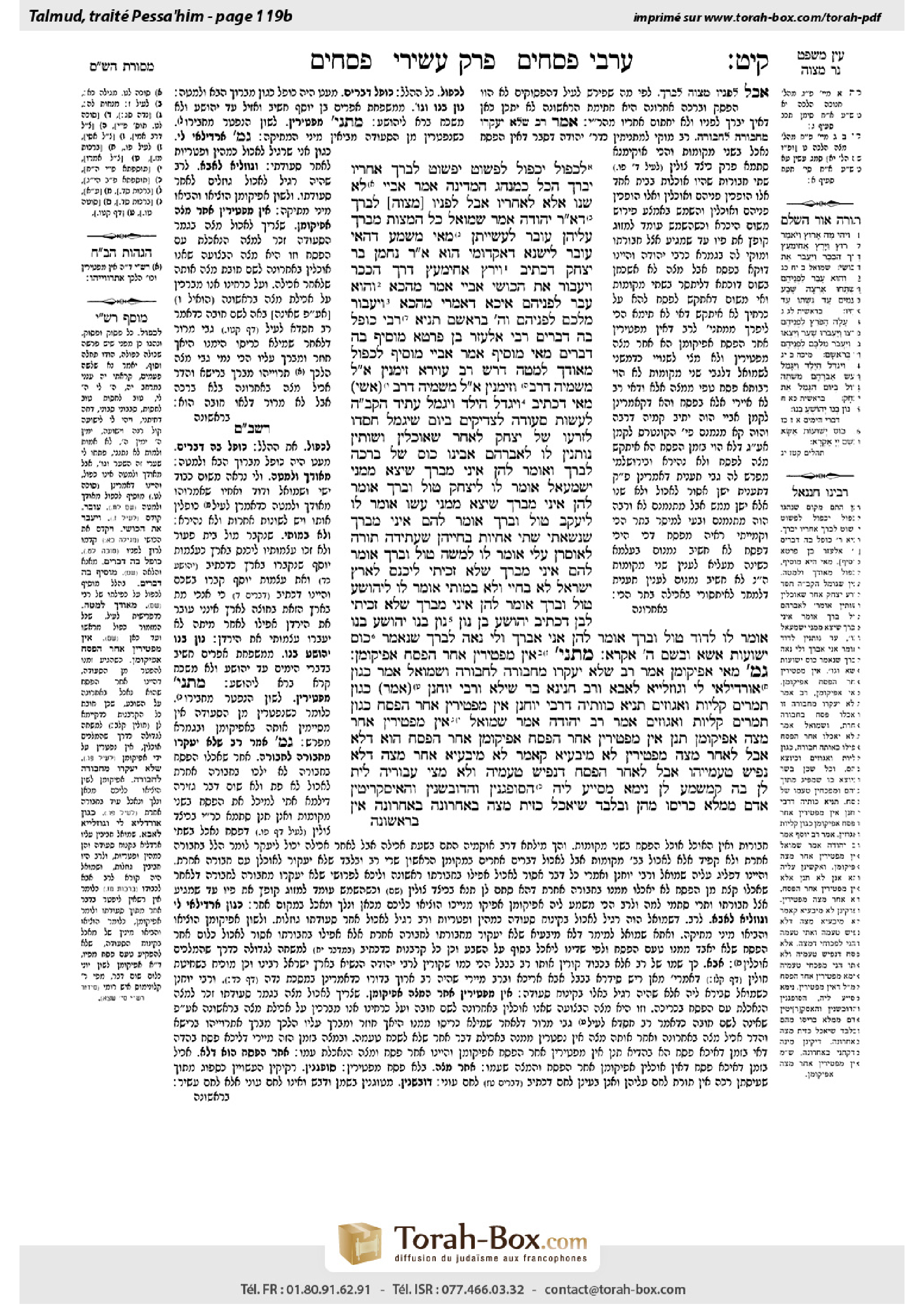
Pesachim 119b: Talmud study for Daf Yomi
Daf Yomi is the daily study of one Talmud folio. Explore 37 tractates with scans, Hebrew text, Sefaria English and AI-generated French translations where annotated.
Passage selection and English or AI-generated French translation are available where the scan has annotations. Daf Study is independent of Torah-Box and Sefaria.
Browse Pesachim · פסחים · All tractatesPesachim 119b text and translations
This page of Pesachim includes the Aramaic text, an English translation and an AI-generated French translation, alongside the scan above.
פסחים קי״ט ב · Aramaic and Hebrew text
לִכְפּוֹל — יִכְפּוֹל, לִפְשׁוֹט — יִפְשׁוֹט, לְבָרֵךְ אַחֲרָיו — יְבָרֵךְ, הַכֹּל כְּמִנְהַג הַמְּדִינָה. אָמַר אַבָּיֵי: לֹא שָׁנוּ אֶלָּא לְאַחֲרָיו, אֲבָל לְפָנָיו — [מִצְוָה] לְבָרֵךְ. דְּאָמַר רַב יְהוּדָה אָמַר שְׁמוּאֵל: כׇּל הַמִּצְוֹת מְבָרֵךְ עֲלֵיהֶן עוֹבֵר לַעֲשִׂיָּיתָן.
מַאי מַשְׁמַע דְּהַאי ״עוֹבֵר״ לִישָּׁנָא דְּאַקְדּוֹמֵי הוּא? אָמַר רַבִּי נַחְמָן בַּר יִצְחָק, דִּכְתִיב: ״וַיָּרׇץ אֲחִימַעַץ דֶּרֶךְ הַכִּכָּר וַיַּעֲבוֹר אֶת הַכּוּשִׁי״. אַבָּיֵי אָמַר, מֵהָכָא: ״וְהוּא עָבַר לִפְנֵיהֶם״. אִיכָּא דְּאָמְרִי מֵהָכָא: ״וַיַּעֲבוֹר מַלְכָּם לִפְנֵיהֶם וַה׳ בְּרֹאשָׁם״.
תַּנְיָא: רַבִּי כּוֹפֵל בָּהּ דְּבָרִים, רַבִּי אֶלְעָזָר בֶּן פַּרְטָא מוֹסִיף בָּהּ דְּבָרִים. מַאי מוֹסִיף? אָמַר אַבָּיֵי: מוֹסִיף לִכְפּוֹל מֵ״אוֹדְךָ״ לְמַטָּה.
דָּרֵשׁ רַב עַוִּירָא, זִימְנִין אָמַר לֵיהּ מִשְּׁמֵיהּ דְּרַב אַמֵּי וְזִימְנִין אָמַר לֵיהּ מִשְּׁמֵיהּ דְּרַב אַסִּי: מַאי דִּכְתִיב: ״וַיִּגְדַּל הַיֶּלֶד וַיִּגָּמַל״ — עָתִיד הַקָּדוֹשׁ בָּרוּךְ הוּא לַעֲשׂוֹת סְעוּדָה לַצַּדִּיקִים בְּיוֹם שֶׁיִּגְמֹל חַסְדּוֹ לְזַרְעוֹ שֶׁל יִצְחָק. לְאַחַר שֶׁאוֹכְלִין וְשׁוֹתִין נוֹתְנִין לוֹ לְאַבְרָהָם אָבִינוּ כּוֹס שֶׁל בְּרָכָה לְבָרֵךְ,
וְאוֹמֵר לָהֶן: אֵינִי מְבָרֵךְ, שֶׁיָּצָא מִמֶּנִּי יִשְׁמָעֵאל. אוֹמֵר לוֹ לְיִצְחָק: טוֹל וּבָרֵךְ. אוֹמֵר לָהֶן: אֵינִי מְבָרֵךְ, שֶׁיָּצָא מִמֶּנִּי עֵשָׂו. אוֹמֵר לוֹ לְיַעֲקֹב: טוֹל וּבָרֵךְ. אוֹמֵר לָהֶם: אֵינִי מְבָרֵךְ, שֶׁנָּשָׂאתִי שְׁתֵּי אֲחָיוֹת בְּחַיֵּיהֶן, שֶׁעֲתִידָה תּוֹרָה לְאוֹסְרָן עָלַי.
אוֹמֵר לוֹ לְמֹשֶׁה: טוֹל וּבָרֵךְ. אוֹמֵר לָהֶם: אֵינִי מְבָרֵךְ, שֶׁלֹּא זָכִיתִי לִיכָּנֵס לְאֶרֶץ יִשְׂרָאֵל, לֹא בְּחַיַּי וְלֹא בְּמוֹתִי. אוֹמֵר לוֹ לִיהוֹשֻׁעַ: טוֹל וּבָרֵךְ, אוֹמֵר לָהֶן: אֵינִי מְבָרֵךְ, שֶׁלֹּא זָכִיתִי לְבֵן, דִּכְתִיב: ״יְהוֹשֻׁעַ בִּן נוּן״, ״נוֹן בְּנוֹ יְהוֹשֻׁעַ בְּנוֹ״.
אוֹמֵר לוֹ לְדָוִד: טוֹל וּבָרֵךְ. אוֹמֵר לָהֶן: אֲנִי אֲבָרֵךְ, וְלִי נָאֶה לְבָרֵךְ, שֶׁנֶּאֱמַר: ״כּוֹס יְשׁוּעוֹת אֶשָּׂא וּבְשֵׁם ה׳ אֶקְרָא״.
מַתְנִי׳ אֵין מַפְטִירִין אַחַר הַפֶּסַח אֲפִיקוֹמָן.
גְּמָ׳ מַאי אֲפִיקוֹמָן? אָמַר רַב: שֶׁלֹּא יֵעָקְרוּ מֵחֲבוּרָה לַחֲבוּרָה.
וּשְׁמוּאֵל אָמַר: כְּגוֹן אוֹרְדִּילָאֵי לִי וְגוֹזָלַיָּיא לְאַבָּא. וְרַב חֲנִינָא בַּר שֵׁילָא וְרַבִּי יוֹחָנָן (אָמַר) [אָמְרוּ]: כְּגוֹן תְּמָרִים קְלָיוֹת וֶאֱגוֹזִים. תַּנְיָא כְּווֹתֵיהּ דְּרַבִּי יוֹחָנָן: אֵין מַפְטִירִין אַחַר הַפֶּסַח כְּגוֹן תְּמָרִים קְלָיוֹת וֶאֱגוֹזִים.
אָמַר רַב יְהוּדָה אָמַר שְׁמוּאֵל: אֵין מַפְטִירִין אַחַר מַצָּה אֲפִיקוֹמָן. תְּנַן: אֵין מַפְטִירִין אַחַר הַפֶּסַח אֲפִיקוֹמָן. אַחַר הַפֶּסַח הוּא דְּלָא, אֲבָל לְאַחַר מַצָּה — מַפְטִירִין!
לָא מִיבַּעְיָא קָאָמַר: לָא מִיבַּעְיָא אַחַר מַצָּה — דְּלָא נְפִישׁ טַעְמַיְיהוּ, אֲבָל לְאַחַר הַפֶּסַח, דִּנְפִישׁ טַעְמֵיהּ וְלָא מָצֵי עַבּוֹרֵיהּ — לֵית לַן בַּהּ, קָמַשְׁמַע לַן.
נֵימָא מְסַיַּיע לֵיהּ: הַסּוּפְגָּנִין וְהַדּוּבְשָׁנִין וְהָאִיסְקְרִיטִין, אָדָם מְמַלֵּא כְּרֵיסוֹ מֵהֶן, וּבִלְבַד שֶׁיֹּאכַל כְּזַיִת מַצָּה בָּאַחֲרוֹנָה. בָּאַחֲרוֹנָה אִין,
Pesachim 119b · English translation
to double certain verses in hallel, one doubles them and reads them twice. In a place where the custom is to recite them simply, i.e., only once, one recites them simply. In a place where it is customary to recite a blessing after hallel, one should recite a blessing. Everything is in accordance with the regional custom. Abaye said: They taught that it depends on the local custom only with regard to the blessing after hallel; however, in all places it is a mitzva to recite a blessing before hallel. As Rav Yehuda said that Shmuel said: With regard to all the mitzvot, one recites a blessing over them prior to their performance.
The Gemara asks: From where may it be inferred that the word over is a formulation that means before an action is performed? Rav Naḥman bar Yitzḥak said that this is as it is written: “And Ahimaaz ran by way of the square and he passed [vaya’avor] the Kushite” (II Samuel 18:23), i.e., Ahimaaz overtook the Kushite. Abaye said that it is derived from here: “And he passed [avar] before them” (Genesis 33:3). Some say that the proof is from here: “And their king shall pass on [vaya’avor] before them, and God at their head” (Micah 2:13).
It was taught in a baraita: Rabbi Yehuda HaNasi doubles certain matters in hallel. Rabbi Elazar ben Perata added matters to hallel. The Gemara asks: What did he add? Certainly this cannot mean that Rabbi Elazar ben Perata added statements of his own to hallel. Abaye said: He added repetitions, i.e., he repeated other verses, from “I will give thanks to You” and onward. From that point on, he repeated each verse.
In connection to its discussion of hallel, the Gemara cites a statement that Rav Avira taught. Sometimes he said this exposition citing Rav Ami, and sometimes he said it citing Rav Asi: What is the meaning of that which is written: “And the child grew and was weaned [vayiggamal], and Abraham made a great feast on the day that Isaac was weaned” (Genesis 21:8)? In the future, the Holy One, Blessed be He, will prepare a feast for the righteous on the day that He extends [sheyigmol] His mercy to the descendants of Isaac. After they eat and drink, the celebrants will give Abraham our father a cup of blessing to recite the blessing, as he is the first of our forefathers.
And Abraham will say to them: I will not recite the blessing, as I am blemished, for the wicked Ishmael came from me. Abraham will say to Isaac: Take the cup and recite the blessing. Isaac will say to them: I will not recite the blessing, as the wicked Esau came from me. Isaac will say to Jacob: Take the cup and recite the blessing. Jacob will say to them: I will not recite the blessing, as I married two sisters, Rachel and Leah, in their lifetimes, and in the future the Torah forbade them to me. Although at the time it was not prohibited to wed two sisters, this practice would eventually be considered a serious transgression.
Jacob will say to Moses: Take the cup and recite the blessing. Moses will say to them: I will not recite the blessing, as I did not merit to enter Eretz Yisrael, neither in my life nor in my death. Moses will say to Joshua: Take the cup and recite the blessing. Joshua will say to them: I will not recite the blessing, as I did not merit to have a son. The proof for this is that it is written: “Joshua the son of Nun” (Numbers 14:6), and in the genealogical list of Ephraim it states: “Nun his son, Joshua his son” (I Chronicles 7:27). Since the verse does not mention any children of Joshua, evidently he had no sons.
Joshua will say to David: Take the cup and recite the blessing. David will say to them: I will recite the blessing, and it is fitting for me to recite the blessing, as it is stated: “I will lift up the cup of salvation, and I will call upon the name of the Lord” (Psalms 116:13).
MISHNA: One does not conclude after the Paschal lamb with an afikoman.
GEMARA: The Gemara asks: What is the meaning of afikoman? Rav said: It means that a member of a group that ate the Paschal lamb together should not leave that group to join another group. One who joined one group for the Paschal lamb may not leave and take food with him. According to this interpretation, afikoman is derived from the phrase afiku mani, take out the vessels. The reason for this prohibition is that people might remove the Paschal lamb to another location after they had begun to eat it elsewhere. This is prohibited, as the Paschal lamb must be eaten in a single location by one group.
And Shmuel said: It means that one may not eat dessert after the meal, like mushrooms [urdila’ei] for me, and chicks for Abba, Rav. It was customary for them to eat delicacies after the meal. And Rav Ḥanina bar Sheila and Rabbi Yoḥanan say: Afikoman refers to foods such as dates, roasted grains, and nuts, which are eaten during the meal. It was taught in a baraita in accordance with the opinion of Rabbi Yoḥanan: One does not conclude by eating after the Paschal lamb foods such as dates, roasted grains, and nuts.
Rav Yehuda said that Shmuel said an additional halakha: Nowadays, when we have no Paschal lamb, one does not conclude after matza with an afikoman. The Gemara asks: We learned in the mishna that one does not conclude after the Paschal lamb with an afikoman. The Gemara infers from the mishna: It is after the Paschal lamb that one may not conclude with an afikoman; however, after matza one may conclude with an afikoman. This statement of the mishna apparently contradicts Shmuel’s ruling.
The Gemara rejects this contention: That is an incorrect inference, as the mishna is stated in the style of: Needless to say. The mishna should be understood as follows: Needless to say that one may not conclude with an afikoman after eating matza, as the taste of matza is slight. If one eats anything else afterward, the taste of the matza will dissipate. However, after the Paschal lamb, which has a strong taste that is not easily removed, one might think that we have no problem with it. Therefore, the mishna teaches us that it is prohibited to conclude with an afikoman after the Paschal lamb as well.
The Gemara proposes: Let us say that the Tosefta supports Shmuel’s ruling: With regard to unleavened sponge cakes, cakes fried in oil and honey, and honey cakes, a person may fill his stomach with them on Passover night, provided that he eats an olive-bulk of matza after all that food. The Gemara infers from here that if he eats the matza after those cakes, yes, this is acceptable, as the matza is eaten last.
Pesachim 119b · Traduction française (IA)
Pour certains versets du Hallel que l’on a coutume de répéter, on les récite deux fois. Là où l’usage est de les réciter simplement, c’est-à-dire une seule fois, on les récite une seule fois. Là où l’usage est de réciter une bénédiction après le Hallel, on récite une bénédiction. Tout dépend de l’usage local. Abayé dit : Ils ont enseigné que cela dépend de l’usage local uniquement en ce qui concerne la bénédiction après le Hallel ; cependant, partout, c’est une mitsva de réciter une bénédiction avant le Hallel. Car Rav Yehouda a dit au nom de Chmouel : Pour toutes les mitsvot, on récite une bénédiction avant de les accomplir.
La Guemara demande : D’où peut-on déduire que le mot « sur » désigne ce qui précède l’accomplissement d’une action ? Rav Naḥman bar Yitzḥak dit que cela ressort de ce qui est écrit : « Ahimaats courut par le chemin de la plaine et dépassa [vaya’avor] le Kouchite » (II Samuel 18:23), c’est-à-dire qu’Ahimaats dépassa le Kouchite. Abayé dit que cela se déduit d’ici : « Il passa [avar] devant eux » (Genèse 33:3). Certains disent que la preuve vient d’ici : « Leur roi passera [vaya’avor] devant eux, et Dieu sera à leur tête » (Michée 2:13).
Il a été enseigné dans une baraïta : Rabbi Yehouda HaNassi répète certains passages du Hallel. Rabbi Elazar ben Perata ajoutait des passages au Hallel. La Guemara demande : Qu’ajoutait-il ? Il ne peut certainement pas s’agir de propos que Rabbi Elazar ben Perata aurait ajoutés de son propre chef au Hallel. Abayé dit : Il ajoutait des répétitions, c’est-à-dire qu’il répétait d’autres versets à partir de « Je Te rendrai grâce » et jusqu’à la fin. À partir de là, il répétait chaque verset.
À propos de sa discussion du Hallel, la Guemara rapporte un enseignement de Rav Avira. Tantôt, il rapportait cette interprétation au nom de Rav Ami, tantôt au nom de Rav Assi : Que signifie ce qui est écrit : « L’enfant grandit et fut sevré [vayiggamal], et Abraham donna un grand festin le jour où Isaac fut sevré » (Genèse 21:8) ? À l’avenir, le Saint, béni soit-Il, préparera un festin pour les justes, le jour où Il accordera [sheyigmol] Sa miséricorde aux descendants d’Isaac. Après avoir mangé et bu, les convives donneront à Abraham notre père une coupe de bénédiction, afin qu’il récite la bénédiction, car il est le premier de nos patriarches.
Abraham leur dira : Je ne réciterai pas la bénédiction, car je suis imparfait, puisque le méchant Ismaël est issu de moi. Abraham dira à Isaac : Prends la coupe et récite la bénédiction. Isaac leur dira : Je ne réciterai pas la bénédiction, car le méchant Ésaü est issu de moi. Isaac dira à Jacob : Prends la coupe et récite la bénédiction. Jacob leur dira : Je ne réciterai pas la bénédiction, car j’ai épousé deux sœurs, Rachel et Léa, de leur vivant, alors que la Torah les a ensuite interdites. Bien qu’à l’époque il ne fût pas interdit d’épouser deux sœurs, cette pratique finirait par être considérée comme une grave transgression.
Jacob dira à Moïse : Prends la coupe et récite la bénédiction. Moïse leur dira : Je ne réciterai pas la bénédiction, car je n’ai pas mérité d’entrer en terre d’Israël, ni de mon vivant ni après ma mort. Moïse dira à Josué : Prends la coupe et récite la bénédiction. Josué leur dira : Je ne réciterai pas la bénédiction, car je n’ai pas mérité d’avoir un fils. La preuve en est qu’il est écrit : « Josué, fils de Noun » (Nombres 14:6), et que dans la généalogie d’Éphraïm, il est dit : « Noun son fils, Josué son fils » (I Chroniques 7:27). Puisque le verset ne mentionne aucun enfant de Josué, il est évident qu’il n’avait pas de fils.
Josué dira à David : Prends la coupe et récite la bénédiction. David leur dira : Je réciterai la bénédiction, et il convient que je la récite, car il est dit : « Je lèverai la coupe du salut et j’invoquerai le nom de l’Éternel » (Psaumes 116:13).
MICHNA : On ne termine pas après l’agneau pascal par un afikoman.
GUEMARA : La Guemara demande : Que signifie afikoman ? Rav dit : Cela signifie qu’un membre d’un groupe ayant mangé ensemble l’agneau pascal ne doit pas quitter ce groupe pour en rejoindre un autre. Celui qui s’est joint à un groupe pour manger l’agneau pascal ne peut pas le quitter en emportant de la nourriture. Selon cette interprétation, afikoman dérive de l’expression afiku mani, « sortez les récipients ». Cette interdiction vise à éviter que l’on transporte l’agneau pascal dans un autre lieu après avoir commencé à le manger ailleurs. C’est interdit, car l’agneau pascal doit être mangé par un seul groupe en un seul endroit.
Et Chmouel dit : Cela signifie qu’on ne doit pas manger de dessert après le repas, comme des champignons [urdila’ei] pour moi, et des poussins pour Abba, Rav. Ils avaient coutume de manger des mets délicats après le repas. Rav Ḥanina bar Sheila et Rabbi Yoḥanan disent : Afikoman désigne des aliments tels que les dattes, les grains grillés et les noix, que l’on mange pendant le repas. Il a été enseigné dans une baraïta conformément à l’opinion de Rabbi Yoḥanan : On ne termine pas le repas après l’agneau pascal en mangeant des aliments tels que des dattes, des grains grillés et des noix.
Rav Yehouda a dit au nom de Chmouel une halakha supplémentaire : De nos jours, alors que nous n’avons pas d’agneau pascal, on ne termine pas après la matsa par un afikoman. La Guemara demande : Nous avons appris dans la Michna qu’on ne termine pas après l’agneau pascal par un afikoman. La Guemara en déduit que c’est après l’agneau pascal qu’on ne peut pas terminer par un afikoman ; toutefois, après la matsa, on peut terminer par un afikoman. Cette déclaration de la Michna semble contredire la décision de Chmouel.
La Guemara rejette cette déduction : elle est erronée, car la Michna est formulée selon le principe du « à plus forte raison ». Il faut comprendre la Michna ainsi : à plus forte raison, on ne peut pas terminer par un afikoman après avoir mangé de la matsa, car le goût de la matsa est léger. Si l’on mange quoi que ce soit ensuite, le goût de la matsa disparaîtra. En revanche, après l’agneau pascal, dont le goût est prononcé et ne s’efface pas facilement, on aurait pu penser qu’il n’y a aucun problème. La Michna nous enseigne donc qu’il est également interdit de terminer par un afikoman après l’agneau pascal.
La Guemara propose : Disons que la Tossefta appuie la décision de Chmouel : en ce qui concerne les gâteaux de pâte sans levain, les gâteaux frits à l’huile et au miel, ainsi que les gâteaux au miel, on peut s’en rassasier pendant la nuit de Pessaḥ, à condition de manger ensuite un volume d’olive de matsa. La Guemara en déduit que s’il mange la matsa après ces gâteaux, oui, cela convient, puisque la matsa est consommée en dernier.
Traduction française générée par IA à partir de l’édition anglaise de Sefaria. Vérifie toujours un passage avec le texte source.
Text from Sefaria: William Davidson Edition - Vocalized Aramaic (CC BY NC); William Davidson Edition - English (CC BY NC).