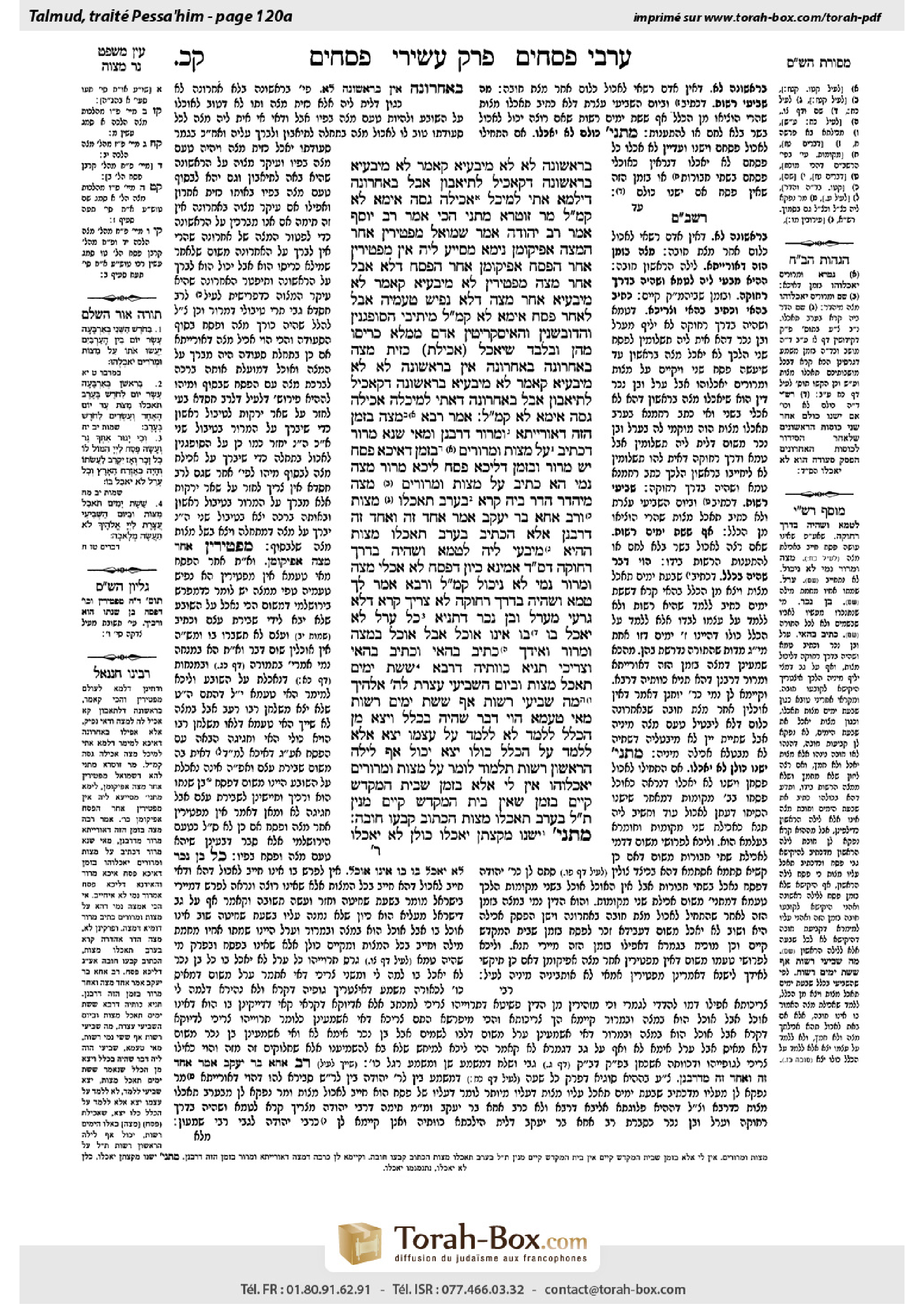
Pesachim 120a: Talmud study for Daf Yomi
Daf Yomi is the daily study of one Talmud folio. Explore 37 tractates with scans, Hebrew text, Sefaria English and AI-generated French translations where annotated.
Passage selection and English or AI-generated French translation are available where the scan has annotations. Daf Study is independent of Torah-Box and Sefaria.
Browse Pesachim · פסחים · All tractatesPesachim 120a text and translations
This page of Pesachim includes the Aramaic text, an English translation and an AI-generated French translation, alongside the scan above.
פסחים ק״כ א · Aramaic and Hebrew text
בָּרִאשׁוֹנָה לָא. לָא מִיבַּעְיָא קָאָמַר. לָא מִיבַּעְיָא בָּרִאשׁוֹנָה — דְּקָאָכֵיל לְתֵיאָבוֹן, אֲבָל בָּאַחֲרוֹנָה דִּילְמָא אָתֵי לְמֵיכַל אֲכִילָה גַּסָּה — אֵימָא לָא, קָא מַשְׁמַע לַן.
מָר זוּטְרָא מַתְנֵי הָכִי: אָמַר רַב יוֹסֵף אָמַר רַב יְהוּדָה אָמַר שְׁמוּאֵל: מַפְטִירִין אַחַר הַמַּצָּה אֲפִיקוֹמָן. נֵימָא מְסַיַּיע לֵיהּ, אֵין מַפְטִירִין אַחַר הַפֶּסַח אֲפִיקוֹמָן: אַחַר הַפֶּסַח דְּלָא, אֲבָל אַחַר מַצָּה — מַפְטִירִין.
לָא מִיבַּעְיָא קָאָמַר. לָא מִיבַּעְיָא אַחַר מַצָּה — דְּלָא נְפִישׁ טַעְמֵיהּ, אֲבָל לְאַחַר פֶּסַח — אֵימָא לָא, קָא מַשְׁמַע לַן.
מֵיתִיבִי: הַסּוּפְגָּנִין וְהַדּוּבְשָׁנִין וְהָאִיסְקְרִיטִין אָדָם מְמַלֵּא כְּרֵיסוֹ מֵהֶן וּבִלְבַד שֶׁיֹּאכַל (אֲכִילַת) כְּזַיִת מַצָּה בָּאַחֲרוֹנָה. בָּאַחֲרוֹנָה אִין, בָּרִאשׁוֹנָה לָא!
לָא מִיבַּעְיָא קָאָמַר. לָא מִיבַּעְיָא בָּרִאשׁוֹנָה — דְּקָאָכֵיל לְתֵיאָבוֹן, אֲבָל בָּאַחֲרוֹנָה דְּאָתֵי לְמֵיכְלַהּ אֲכִילָה גַּסָּה — אֵימָא לָא, קָא מַשְׁמַע לַן.
אָמַר רָבָא: מַצָּה בִּזְמַן הַזֶּה דְּאוֹרָיְיתָא, וּמָרוֹר דְּרַבָּנַן. וּמַאי שְׁנָא מָרוֹר, דִּכְתִיב: ״עַל מַצּוֹת וּמְרוֹרִים״, בִּזְמַן דְּאִיכָּא פֶּסַח — יֵשׁ מָרוֹר, וּבִזְמַן דְּלֵיכָּא פֶּסַח — לֵיכָּא מָרוֹר.
מַצָּה נָמֵי, הָא כְּתִיב: ״עַל מַצּוֹת וּמְרוֹרִים״! מַצָּה מִיהְדָּר הָדַר בֵּיהּ קְרָא: ״בָּעֶרֶב תֹּאכְלוּ מַצּוֹת״. וְרַב אַחָא בַּר יַעֲקֹב אָמַר: אֶחָד זֶה וְאֶחָד זֶה דְּרַבָּנַן.
אֶלָּא הָכְתִיב: ״בָּעֶרֶב תֹּאכְלוּ מַצּוֹת״! הָהִיא מִיבְּעֵי לֵיהּ לְטָמֵא וְשֶׁהָיָה בְּדֶרֶךְ רְחוֹקָה, דְּסָלְקָא דַּעְתָּךְ אָמֵינָא כֵּיוָן דְּפֶסַח לָא אָכְלִי — מַצָּה וּמָרוֹר נָמֵי לָא נֵיכוֹל, קָא מַשְׁמַע לַן.
וְרָבָא אָמַר לָךְ: טָמֵא וְשֶׁהָיָה בְּדֶרֶךְ רְחוֹקָה לָא צְרִיךְ קָרָא, דְּלָא גָּרְעִי מֵעָרֵל וּבֶן נֵכָר. דְּתַנְיָא: ״כׇּל עָרֵל לֹא יֹאכַל בּוֹ״ — ״בּוֹ״ אֵינוֹ אוֹכֵל, אֲבָל אוֹכֵל בְּמַצָּה וּמָרוֹר.
וְאִידַּךְ? כְּתִיב בְּהַאי וּכְתִיב בְּהַאי, וּצְרִיכִי.
תַּנְיָא כְּווֹתֵיהּ דְּרָבָא: ״שֵׁשֶׁת יָמִים תֹּאכַל מַצּוֹת וּבַיּוֹם הַשְּׁבִיעִי עֲצֶרֶת לַה׳ אֱלֹהֶיךָ״. מָה שְׁבִיעִי רְשׁוּת, אַף שֵׁשֶׁת יָמִים רְשׁוּת.
מַאי טַעְמָא? הָוֵי דָּבָר שֶׁהָיָה בַּכְּלָל, וְיָצָא מִן הַכְּלָל לְלַמֵּד, לֹא לְלַמֵּד עַל עַצְמוֹ יָצָא, אֶלָּא לְלַמֵּד עַל הַכְּלָל כּוּלּוֹ יָצָא.
יָכוֹל אַף לַיְלָה הָרִאשׁוֹן רְשׁוּת, תַּלְמוּד לוֹמַר: ״עַל מַצּוֹת וּמְרוֹרִים יֹאכְלוּהוּ״.
אֵין לִי אֶלָּא בִּזְמַן שֶׁבֵּית הַמִּקְדָּשׁ קַיָּים, בִּזְמַן שֶׁאֵין בֵּית הַמִּקְדָּשׁ קַיָּים מִנַּיִן? תַּלְמוּד לוֹמַר: ״בָּעֶרֶב תֹּאכְלוּ מַצּוֹת״, הַכָּתוּב קְבָעוֹ חוֹבָה.
מַתְנִי׳ יָשְׁנוּ מִקְצָתָן — יֹאכֵלוּ. כּוּלָּן — לֹא יֹאכֵלוּ.
Pesachim 120a · English translation
However, if one eats matza before these other foods, no, one may not start eating other foods after matza. The mishna apparently supports Rav Yehuda’s opinion. The Gemara rejects this proof: The Tosefta is stated in the style of: Needless to say. Needless to say, one fulfills his obligation if he eats matza before other foods, as he eats it with an appetite. However, if one eats matza after eating other foods, perhaps he will come to eat it in the manner of excessive eating, as he is compelled to eat when he is not hungry. Consequently, you might say that one does not fulfill his obligation if he eats matza after all those other foods. Therefore, the Tosefta teaches us that one may eat matza even after consuming those foods.
This is how Mar Zutra taught this discussion: Rav Yosef said that Rav Yehuda said that Shmuel said: One may conclude after the matza with an afikoman. The Gemara suggests: Let us say that the mishna supports his opinion: One does not conclude after the Paschal lamb with an afikoman. The Gemara infers: It is after the Paschal lamb that one may not conclude with an afikoman; however, after matza one may conclude with an afikoman.
The Gemara rejects this contention: The mishna is stated in the style of: Needless to say. Needless to say, one may not conclude with an afikoman after eating matza, as the taste of matza is slight; however, after the Paschal lamb, one might say that this prohibition does not apply. Therefore, the mishna teaches us that it is prohibited to conclude with an afikoman after the Paschal lamb as well.
The Gemara raises an objection: With regard to unleavened sponge cakes, cakes fried in oil and honey, and honey cakes, a person may fill his stomach with them on Passover night, provided that he eats an olive-bulk of matza after consuming them. The Gemara infers from here that if he eats matza after those cakes, yes, this is permitted; however, if one eats matza before these other foods, no, this is not an acceptable practice.
The Gemara answers: As explained above, the Tosefta is stated in the style of: Needless to say. Needless to say, one fulfills his obligation if he eats matza before other foods, as he eats it with an appetite. However, if he eats matza after eating other foods, when he might come to eat it in the manner of an excessive eating, you might say that one does not fulfill his obligation if he eats matza after all those other foods. Therefore, the Tosefta teaches us that one may eat matza even after consuming those foods.
Rava said: The mitzva of matza nowadays, even after the destruction of the Temple, applies by Torah law; but the mitzva to eat bitter herbs applies by rabbinic law. The Gemara asks: And in what way is the mitzva of bitter herbs different from matza? As it is written, with regard to the Paschal lamb: “They shall eat it with matzot and bitter herbs” (Numbers 9:11), from which it is derived: When there is an obligation to eat the Paschal lamb, there is likewise a mitzva to eat bitter herbs; and when there is no obligation to eat the Paschal lamb, there is also no mitzva to eat bitter herbs.
The Gemara asks: But if so, the same reasoning should apply to matza as well, as it is written: “With matzot and bitter herbs.” The mitzva of matza should also depend on the obligation of the Paschal lamb. The Gemara rejects this contention: The verse repeats the obligation to eat matza, as it states: “In the first month, on the fourteenth day of the month in the evening, you shall eat matzot” (Exodus 12:18). This verse establishes a separate obligation to eat matza, unrelated to the Paschal lamb. And Rav Aḥa bar Ya’akov said: Nowadays, both this, the mitzva to eat matza, and that, the mitzva to eat bitter herbs, apply by rabbinic law, as the Torah obligation to eat these foods is in effect only when the Paschal lamb is sacrificed.
The Gemara challenges: But isn’t it written: “In the evening, you shall eat matzot”? The Gemara answers: Rav Aḥa bar Ya’akov needs that verse for the following halakha: When the Temple was standing, one who was ritually impure or one who was on a distant road was nonetheless obligated to eat matza. As it could enter your mind to say that since these two categories of people do not eat the Paschal lamb on the first Pesaḥ, they also do not eat matza and bitter herbs. According to Rav Aḥa bar Ya’akov, this verse teaches us that even one who was ritually impure and one who was on a distant road are obligated to eat matza and bitter herbs, as these mitzvot do not depend on one’s eligibility to sacrifice the Paschal lamb on the first Pesaḥ.
The Gemara asks: And Rava, who maintains that it is a mitzva from the Torah to eat matza nowadays, how could he respond to that interpretation of the verse? Rava could have said to you: I do not require a special verse to teach that a ritually impure person and a person who was on a distant road are obligated to eat matza. These people are obligated because they are no worse than an uncircumcised man or an alien, i.e., one who does not observe the mitzvot, who are obligated to eat matza despite the fact that they do not sacrifice the Paschal lamb. As it was taught in a baraita: “But no uncircumcised man shall eat from it” (Exodus 12:48). “From it” indicates that he may not eat from the Paschal lamb; however, he does eat matza and bitter herbs. The same is true for anyone else who is prevented from eating the Paschal lamb.
The Gemara asks: And the other, Rav Aḥa bar Ya’akov, how does he respond to this argument? The Gemara answers: According to Rav Aḥa bar Ya’akov, the halakha that one must eat matza and bitter herbs despite being unable to partake of the Paschal lamb was written with regard to this person, an uncircumcised man, and it was written also with regard to that one, a ritually impure person, and both verses are necessary. We cannot learn the halakha of a ritually impure person from that of an uncircumcised man, or vice versa, as is explained in several places.
The Gemara comments: It was taught in a baraita in accordance with the opinion of Rava: “Six days you shall eat matzot, and on the seventh day shall be a solemn assembly to the Lord your God” (Deuteronomy 16:8). Just as eating matza on the seventh day is merely optional, i.e., there is no obligation to eat matza on the last day of Passover, but only to avoid eating leavened bread, as the verse states: “Six days you shall eat matzot,” so too, eating matza during the first six days is optional.
What is the reason that it is optional to eat matza on the first six days of Passover as well as the seventh? The seventh day of Passover is something that was included in a generalization but was explicitly singled out to teach. According to the rules of exegesis, it was intended to teach not just about itself but about the entire generalization. In other words, the seventh day of Passover was initially included in the verse: “You shall eat matzot for seven days” (Exodus 12:15), but was excluded from this generalization by the verse: “Six days you shall eat matzot.” In accordance with the above principle, the halakha of the seventh day applies to all the other days of Passover as well. That means there is no obligation to eat matza for all seven days of the Festival, but only on the first day.
The baraita continues: I might have thought that even the mitzva to eat matza on the first night of Passover is included by the above principle, and it too is merely optional; therefore, the verse states: “They shall eat it with matzot and bitter herbs” (Numbers 9:11).
I have derived nothing other than that one is obligated to eat matza when the Temple is standing. From where is it derived that one is obligated to eat matza on the first night of Passover even when the Temple is not standing? The verse states: “In the evening you shall eat matzot.” The verse here establishes the mitzva of matza as obligatory, in accordance with the opinion of Rava.
MISHNA: If some of the participants at the seder fell asleep, thereby interrupting their meal, they may eat from the Paschal lamb when they awake. If the entire company fell asleep, they may not eat any more. If they all fall asleep, this is considered a complete interruption, and if they were to resume their meal it would be akin to eating the offering in two different places.
Pesachim 120a · Traduction française (IA)
Cependant, si l’on mange la matsa avant ces autres aliments, non : on ne peut pas commencer à manger d’autres aliments après la matsa. La Michna semble appuyer l’opinion de Rav Yehouda. La Guemara rejette cette preuve : la Tossefta est formulée selon le principe du « à plus forte raison ». À plus forte raison, on s’acquitte de son obligation si l’on mange la matsa avant les autres aliments, puisqu’on la mange avec appétit. En revanche, si l’on mange la matsa après d’autres aliments, on pourrait en venir à la manger par excès, puisqu’on est alors contraint de manger sans avoir faim. On pourrait donc penser que l’on ne s’acquitte pas de son obligation si l’on mange la matsa après tous ces autres aliments. La Tossefta nous enseigne donc que l’on peut manger de la matsa même après avoir consommé ces aliments.
Mar Zutra transmit ainsi cette discussion : Rav Yossef dit au nom de Rav Yehouda, qui dit au nom de Chmouel : on peut terminer par un afikoman après la matsa. La Guemara suggère : disons que la Michna appuie son opinion : on ne termine pas par un afikoman après l’agneau pascal. La Guemara en déduit que c’est après l’agneau pascal qu’on ne peut pas terminer par un afikoman ; toutefois, après la matsa, on le peut.
La Guemara rejette cette proposition : la Michna est formulée selon le principe du « à plus forte raison ». À plus forte raison, on ne peut pas terminer par un afikoman après avoir mangé de la matsa, car son goût est peu prononcé ; en revanche, on pourrait penser que cette interdiction ne s’applique pas après l’agneau pascal. La Michna nous enseigne donc qu’il est également interdit de terminer par un afikoman après l’agneau pascal.
La Guemara soulève une objection : en ce qui concerne les galettes de pâte sans levain, les gâteaux frits dans l’huile et le miel, ainsi que les gâteaux au miel, une personne peut s’en remplir l’estomac pendant la nuit de Pessa’h, à condition de manger ensuite un volume d’olive de matsa. La Guemara en déduit que si elle mange de la matsa après ces gâteaux, c’est permis ; toutefois, si elle mange de la matsa avant ces autres aliments, ce n’est pas une pratique acceptable.
La Guemara répond : comme expliqué plus haut, la Tossefta est formulée selon le principe du « à plus forte raison ». À plus forte raison, on s’acquitte de son obligation si l’on mange de la matsa avant les autres aliments, puisqu’on la mange avec appétit. En revanche, si l’on mange de la matsa après d’autres aliments, on pourrait en venir à la manger par excès ; on pourrait alors penser que l’on ne s’acquitte pas de son obligation en mangeant la matsa après tous ces autres aliments. La Tossefta nous enseigne donc que l’on peut manger de la matsa même après avoir consommé ces aliments.
Rava dit : de nos jours, même après la destruction du Temple, la mitsva de manger de la matsa relève de la Torah ; en revanche, la mitsva de manger des herbes amères relève d’une ordonnance rabbinique. La Guemara demande : en quoi la mitsva des herbes amères diffère-t-elle de celle de la matsa ? Il est écrit, à propos de l’agneau pascal : « Ils le mangeront avec des matsot et des herbes amères » (Nombres 9:11), d’où l’on déduit que lorsqu’il y a l’obligation de manger l’agneau pascal, il y a également une mitsva de manger des herbes amères ; et lorsqu’il n’y a pas l’obligation de manger l’agneau pascal, il n’y a pas non plus de mitsva de manger des herbes amères.
La Guemara demande : mais, dans ce cas, le même raisonnement devrait s’appliquer à la matsa, puisqu’il est écrit : « avec des matsot et des herbes amères ». La mitsva de manger de la matsa devrait elle aussi dépendre de l’obligation de manger l’agneau pascal. La Guemara rejette cette proposition : le verset répète l’obligation de manger de la matsa, comme il est écrit : « Le premier mois, le quatorzième jour du mois, au soir, vous mangerez des matsot » (Exode 12:18). Ce verset établit une obligation distincte de manger de la matsa, indépendante de l’agneau pascal. Rav A’ha bar Yaakov dit : de nos jours, tant la mitsva de manger de la matsa que celle de manger des herbes amères relèvent d’une ordonnance rabbinique, car l’obligation toranique de manger ces aliments n’est en vigueur que lorsque l’agneau pascal est offert.
La Guemara objecte : mais n’est-il pas écrit : « Au soir, vous mangerez des matsot » ? La Guemara répond : Rav A’ha bar Yaakov a besoin de ce verset pour établir la halakha suivante : lorsque le Temple était debout, une personne rituellement impure ou se trouvant sur un chemin éloigné était néanmoins tenue de manger de la matsa. En effet, on aurait pu penser que, puisque ces deux catégories de personnes ne mangent pas l’agneau pascal à Pessa’h, elles ne mangent pas non plus de matsa ni d’herbes amères. Selon Rav A’ha bar Yaakov, ce verset nous enseigne que même une personne rituellement impure et une personne se trouvant sur un chemin éloigné sont tenues de manger de la matsa et des herbes amères, car ces mitsvot ne dépendent pas de leur aptitude à offrir l’agneau pascal à Pessa’h.
La Guemara demande : et Rava, qui soutient qu’il y a de nos jours une mitsva toranique de manger de la matsa, que pourrait-il répondre à cette interprétation du verset ? Rava pourrait te répondre : je n’ai pas besoin d’un verset particulier pour enseigner qu’une personne rituellement impure et une personne se trouvant sur un chemin éloigné sont tenues de manger de la matsa. Elles y sont tenues, car elles ne sont pas dans une situation plus défavorable qu’un incirconcis ou un étranger, c’est-à-dire quelqu’un qui n’observe pas les mitsvot, lesquels sont tenus de manger de la matsa bien qu’ils n’offrent pas l’agneau pascal. Comme il a été enseigné dans une baraïta : « Aucun incirconcis n’en mangera » (Exode 12:48). « N’en » indique qu’il ne peut pas manger de l’agneau pascal ; toutefois, il mange de la matsa et des herbes amères. Il en va de même pour toute autre personne empêchée de manger l’agneau pascal.
La Guemara demande : et l’autre, Rav A’ha bar Yaakov, que répond-il à cet argument ? La Guemara répond : selon Rav A’ha bar Yaakov, la halakha selon laquelle on doit manger de la matsa et des herbes amères même lorsqu’on ne peut pas prendre part à l’agneau pascal a été écrite à propos de cet homme, l’incirconcis, et aussi à propos de cet autre, la personne rituellement impure ; les deux versets sont nécessaires. On ne peut pas déduire la halakha concernant une personne rituellement impure de celle concernant un incirconcis, ni inversement, comme cela est expliqué en plusieurs endroits.
La Guemara fait remarquer : une baraïta a été enseignée conformément à l’opinion de Rava : « Pendant six jours, tu mangeras des matsot, et le septième jour sera une assemblée solennelle pour l’Éternel, ton Dieu » (Deutéronome 16:8). De même que manger de la matsa le septième jour est facultatif — c’est-à-dire qu’il n’y a pas d’obligation d’en manger le dernier jour de Pessa’h, mais seulement de s’abstenir de manger du pain levé, comme le dit le verset : « Pendant six jours, tu mangeras des matsot » —, de même, manger de la matsa pendant les six premiers jours est facultatif.
Pourquoi manger de la matsa pendant les six premiers jours de Pessa’h est-il également facultatif, comme le septième jour ? Le septième jour de Pessa’h est inclus dans une généralité, mais en est explicitement distingué afin d’enseigner une règle. Selon les règles d’exégèse, cette distinction vise à enseigner non seulement à son sujet, mais aussi au sujet de toute la généralité. Autrement dit, le septième jour de Pessa’h était initialement inclus dans le verset : « Vous mangerez des matsot pendant sept jours » (Exode 12:15), mais il a été exclu de cette généralité par le verset : « Pendant six jours, tu mangeras des matsot ». Conformément au principe énoncé ci-dessus, la halakha du septième jour s’applique également à tous les autres jours de Pessa’h. Cela signifie qu’il n’y a pas d’obligation de manger de la matsa pendant les sept jours de la fête, mais seulement le premier jour.
La baraïta poursuit : j’aurais pu penser que même la mitsva de manger de la matsa la première nuit de Pessa’h est incluse dans le principe ci-dessus et qu’elle est, elle aussi, seulement facultative. Le verset enseigne donc : « Ils le mangeront avec des matsot et des herbes amères » (Nombres 9:11).
Je n’ai déduit de là que l’obligation de manger de la matsa lorsque le Temple est debout. D’où déduit-on qu’il y a obligation de manger de la matsa la première nuit de Pessa’h même lorsque le Temple n’est pas debout ? Le verset dit : « Au soir, vous mangerez des matsot ». Ce verset établit le caractère obligatoire de la mitsva de manger de la matsa, conformément à l’opinion de Rava.
MICHNA : Si certains des participants au séder se sont endormis, interrompant ainsi leur repas, ils peuvent manger de l’agneau pascal à leur réveil. Si tout le groupe s’est endormi, ils ne peuvent plus rien manger. Si tous s’endorment, cela constitue une interruption complète ; s’ils reprenaient leur repas, ce serait comme manger le sacrifice en deux endroits différents.
Traduction française générée par IA à partir de l’édition anglaise de Sefaria. Vérifie toujours un passage avec le texte source.
Text from Sefaria: William Davidson Edition - Vocalized Aramaic (CC BY NC); William Davidson Edition - English (CC BY NC).