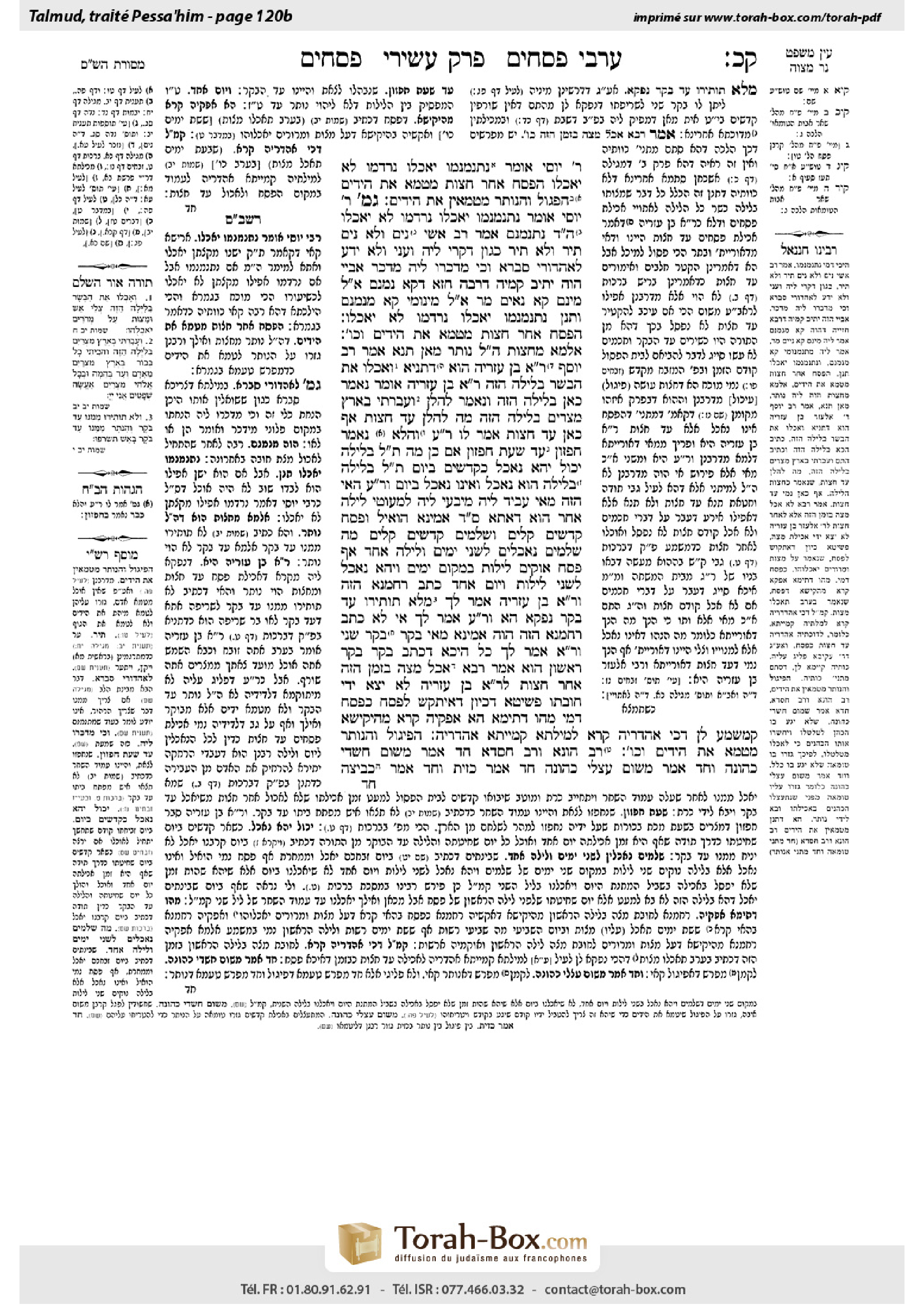
Pesachim 120b: Talmud study for Daf Yomi
Daf Yomi is the daily study of one Talmud folio. Explore 37 tractates with scans, Hebrew text, Sefaria English and AI-generated French translations where annotated.
Passage selection and English or AI-generated French translation are available where the scan has annotations. Daf Study is independent of Torah-Box and Sefaria.
Browse Pesachim · פסחים · All tractatesPesachim 120b text and translations
This page of Pesachim includes the Aramaic text, an English translation and an AI-generated French translation, alongside the scan above.
פסחים ק״כ ב · Aramaic and Hebrew text
רַבִּי יוֹסֵי אוֹמֵר: נִתְנַמְנְמוּ — יֹאכֵלוּ, נִרְדְּמוּ — לֹא יֹאכֵלוּ. הַפֶּסַח אַחַר חֲצוֹת מְטַמֵּא אֶת הַיָּדַיִם. הַפִּגּוּל וְהַנּוֹתָר מְטַמְּאִין אֶת הַיָּדַיִם.
גְּמָ׳ רַבִּי יוֹסֵי אוֹמֵר: נִתְנַמְנְמוּ — יֹאכֵלוּ, נִרְדְּמוּ — לֹא יֹאכֵלוּ. הֵיכִי דָּמֵי נִתְנַמְנֵם? אָמַר רַב אָשֵׁי: נִים וְלָא נִים, תִּיר וְלָא תִּיר. כְּגוֹן דְּקָרֵי לֵיהּ וְעָנֵי, וְלָא יָדַע לְאַהְדּוֹרֵי סְבָרָא, וְכִי מַדְכְּרוּ לֵיהּ — מִדְּכַר.
אַבָּיֵי הֲוָה יָתֵיב קַמֵּיהּ דְּרַבָּה. חֲזָא דְּקָא נַמְנֵם, אֲמַר לֵיהּ: מֵינָם קָא נָאֵים מָר. אֲמַר לֵיהּ: מֵינוֹמֵי קָא (מְנַמְנֵם) [מְנַמְנַמְנָא], וּתְנַן: נִתְנַמְנְמוּ — יֹאכֵלוּ, נִרְדְּמוּ — לֹא יֹאכֵלוּ.
הַפֶּסַח אַחַר חֲצוֹת מְטַמֵּא אֶת הַיָּדַיִם וְכוּ׳. אַלְמָא מֵחֲצוֹת הָוֵה לֵיהּ נוֹתָר. מַאן תַּנָּא?
אָמַר רַב יוֹסֵף: רַבִּי אֶלְעָזָר בֶּן עֲזַרְיָה הוּא, דְּתַנְיָא: ״וְאָכְלוּ אֶת הַבָּשָׂר בַּלַּיְלָה הַזֶּה״, רַבִּי אֶלְעָזָר בֶּן עֲזַרְיָה אוֹמֵר: נֶאֱמַר כָּאן ״בַּלַּיְלָה הַזֶּה״, וְנֶאֱמַר לְהַלָּן ״וְעָבַרְתִּי בְאֶרֶץ מִצְרַיִם בַּלַּיְלָה הַזֶּה״.
מַה לְהַלָּן — עַד חֲצוֹת, אַף כָּאן — עַד חֲצוֹת.
אָמַר לוֹ רַבִּי עֲקִיבָא: וַהֲלֹא נֶאֱמַר ״חִפָּזוֹן״ — עַד שְׁעַת חִפָּזוֹן.
אִם כֵּן, מָה תַּלְמוּד לוֹמַר ״בַּלַּיְלָה״? יָכוֹל יְהֵא נֶאֱכָל כַּקֳּדָשִׁים בַּיּוֹם — תַּלְמוּד לוֹמַר: ״בַּלַּיְלָה״, בַּלַּיְלָה הוּא נֶאֱכָל, וְאֵינוֹ נֶאֱכָל בְּיוֹם.
וְרַבִּי עֲקִיבָא, הַאי ״הַזֶּה״ מַאי עָבֵיד לֵיהּ? מִיבְּעֵי לֵיהּ לְמַעוֹטֵי לַיְלָה אַחֵר הוּא דַּאֲתָא. סָלְקָא דַּעְתָּךְ אָמֵינָא: הוֹאִיל וּפֶסַח קָדָשִׁים קַלִּים, וּשְׁלָמִים קָדָשִׁים קַלִּים — מָה שְׁלָמִים נֶאֱכָלִים לִשְׁנֵי יָמִים וְלַיְלָה אֶחָד, אַף פֶּסַח;
אוֹקֵים לֵילוֹת בִּמְקוֹם יָמִים, וִיהֵא נֶאֱכָל לִשְׁנֵי לֵילוֹת וְיוֹם אֶחָד, כְּתַב רַחֲמָנָא: ״הַזֶּה״.
וְרַבִּי אֶלְעָזָר בֶּן עֲזַרְיָה אָמַר לָךְ: מִ״לֹּא תוֹתִירוּ עַד בֹּקֶר״ נָפְקָא הָא.
וְרַבִּי עֲקִיבָא אָמַר לָךְ: אִי לָא כְּתַב רַחֲמָנָא ״הַזֶּה״, הֲוָה אָמֵינָא: מַאי ״בֹּקֶר״ — בֹּקֶר שֵׁנִי. וְרַבִּי אֶלְעָזָר אָמַר לָךְ: כׇּל הֵיכָא דִּכְתַב ״בֹּקֶר״ — בֹּקֶר רִאשׁוֹן הוּא.
אָמַר רָבָא: אָכַל מַצָּה בִּזְמַן הַזֶּה אַחַר חֲצוֹת, לְרַבִּי אֶלְעָזָר בֶּן עֲזַרְיָה לֹא יָצָא יְדֵי חוֹבָתוֹ. פְּשִׁיטָא! דְּכֵיוָן דְּאִיתַּקַּשׁ לְפֶסַח — כְּפֶסַח דָּמֵי.
מַהוּ דְּתֵימָא: הָא אַפְּקֵיהּ קְרָא מֵהֶיקֵּישָׁא. קָמַשְׁמַע לַן דְּכִי אַהְדְּרֵיהּ קְרָא — לְמִילְּתָא קַמַּיְיתָא אַהְדְּרֵיהּ.
הַפִּיגּוּל וְהַנּוֹתָר מְטַמֵּא אֶת הַיָּדַיִם וְכוּ׳. רַב הוּנָא וְרַב חִסְדָּא, חַד אָמַר: מִשּׁוּם חֲשֵׁדֵי כְהוּנָּה, וְחַד אָמַר: מִשּׁוּם עֲצֵלֵי כְהוּנָּה. חַד אָמַר: כְּזַיִת, וְחַד אָמַר: כְּבֵיצָה.
Pesachim 120b · English translation
Rabbi Yosei says: If they dozed they may eat from the Paschal lamb when they awake, but if they fell fast asleep they may not eat from it. The Sages further said: The Paschal lamb after midnight renders one’s hands ritually impure, as it becomes notar, an offering that remained after the time when they may be eaten has expired; and the Sages ruled that both piggul, offerings that were invalidated due to inappropriate intent while being sacrificed, and notar render one’s hands ritually impure.
GEMARA: We learned in the mishna that Rabbi Yosei says: If they dozed they may eat from the Paschal lamb, but if they fell asleep they may not eat from it. The Gemara asks: What are the circumstances of dozing? Rav Ashi said: One is asleep but not asleep, awake but not awake, when, if they call him, he will answer, but he is unable to provide a reasonable answer. And when they later inform him of what happened, he remembers it.
The Gemara cites a related episode: Abaye was sitting before Rabba, and he saw that Rabba was dozing off after he had begun to eat the final obligatory piece of matza. He said to him: Is the Master sleeping? Rabba said to him: I am dozing, and we learned in the mishna: If they dozed, they may eat from the Paschal lamb, but if they fell fast asleep they may not eat from it.
We learned in the mishna that the Paschal lamb after midnight renders one’s hands ritually impure. The Gemara infers: Apparently, from midnight and onward the Paschal lamb is classified as notar. The Gemara asks: Who is the tanna who maintains this opinion?
Rav Yosef said: It is Rabbi Elazar ben Azarya, as it was taught in a baraita: With regard to the verse “And they shall eat of the meat on that night” (Exodus 12:8), Rabbi Elazar ben Azarya says: Here it is stated “on that night,” from which it cannot be determined when the night ends. And below it is stated: “And I will pass through the land of Egypt on that night and I will strike every firstborn in the land of Egypt” (Exodus 12:12). The Torah states with regard to the death of the firstborns: “Thus said the Lord: At about midnight, I will go out into the midst of Egypt and every firstborn in Egypt shall die” (Exodus 11:4–5).
The baraita continues: Just as in the verse below, the striking of the firstborns took place until midnight, as stated explicitly in the verse, so too, in the verse here, the mitzva to eat the Paschal lamb continues until midnight but not beyond. Evidently, the Paschal lamb may not be eaten after midnight.
Rabbi Akiva said to Rabbi Elazar ben Azarya: But wasn’t it already stated: “Thus you shall eat it, with your loins girded, your shoes on your feet, your staffs in your hands, and you will eat it in haste, for it is the Paschal offering for the Lord” (Exodus 12:11)? This verse indicates that the Paschal lamb may be eaten until the time of haste, i.e., until dawn, as the Jewish people left Egypt the next day.
Rabbi Akiva continues: If that is so, what is the meaning when the verse states: “On that night,” with regard to eating the Paschal lamb? The Gemara explains that this phrase is necessary, as I might have thought that the Paschal lamb is eaten during the day, like all other offerings, which must be slaughtered and eaten during the day. Therefore, the verse states: “On that night,” to underscore that this particular offering is eaten at night, and it is not eaten during the day.
The Gemara asks: And Rabbi Akiva, what does he do with the word “that”? As he doesn’t use it for a verbal analogy, what does Rabbi Akiva learn from this word? The Gemara answers: He needs it to exclude another night. It could enter your mind to say that since the Paschal lamb falls into the category of offerings of lesser sanctity, and peace-offerings are also offerings of lesser sanctity, just as peace-offerings may be eaten for two days and one night, i.e., the day they are sacrificed through the following day, as stated in the Torah, so too, the same halakha should apply to the Paschal lamb.
The Gemara explains the previous statement. How could the Paschal lamb be eaten for two days and one night if one starts eating it at night? The Gemara explains: One may say: I will substitute the nights that the Paschal lamb may be eaten instead of the days that a peace-offering is eaten. And accordingly, the Paschal lamb may be eaten for two nights and one day. Therefore, the Torah wrote the word “that,” to teach that the Paschal lamb may be eaten only on that one night.
And Rabbi Elazar ben Azarya, from where might he derive the halakha that the Paschal lamb may not be eaten for two nights? Rabbi Elazar ben Azarya could have said to you: This halakha is derived from the verse: “You shall let nothing of it remain until the morning; and that of it which remains until the morning you shall burn with fire” (Exodus 12:10). If it is prohibited to leave any part of the Paschal lamb until the morning, it is certainly prohibited to leave any of it until the following night. Therefore, it is unnecessary to cite an additional source to teach that the Paschal lamb may be eaten only on the first night.
And Rabbi Akiva could have said to you, in response to this argument: If the Torah hadn’t written “on that night,” I would have said: What is indicated by the word “morning” in that verse? It means the second morning after the Festival, the day of the sixteenth of Nisan. Therefore, it was necessary for the Torah to write that one may eat the Paschal lamb only on that night and no other. And Rabbi Elazar could have said to you in response: Anywhere that the Torah writes “morning,” it is referring to the first, i.e., the next morning. If that were not the case, no biblical text could have any definitive meaning.
Rava said: Nowadays, if one ate matza after midnight, according to the opinion of Rabbi Elazar ben Azarya, he has not fulfilled his obligation. The Gemara expresses surprise at this statement: It is obvious that this is the case, for since the verse juxtaposes matza to the Paschal lamb, it is considered like the Paschal lamb, and therefore matza may also be eaten only until midnight.
The Gemara answers: Rava’s statement is necessary, lest you say that the verse has removed the halakha of matza from this juxtaposition, as Rava maintains that eating matza is a distinct mitzva that applies even nowadays. One might therefore have thought that the halakhot of eating matza differ entirely from those of the Paschal lamb. Rava therefore teaches us that when the verse repeats the mitzva to eat matza on the first night, it restores this mitzva to its original status, which means that one may eat matza only at a time when he may also eat the Paschal lamb.
The mishna taught that piggul and notar render one’s hands ritually impure. This issue is subject to a dispute between Rav Huna and Rav Ḥisda. One of them said: The reason for this enactment is due to suspected priests, i.e., priests who were suspected of invalidating offerings; and the other one said the reason is due to lazy priests. Rav Huna and Rav Ḥisda also disagree about another matter: One of them said that the ritual impurity of notar and piggul applies even to an olive-bulk of the meat; and one of them said it applies only to an egg-bulk.
Pesachim 120b · Traduction française (IA)
Rabbi Yossi dit : S’ils se sont assoupis, ils peuvent manger de l’agneau pascal à leur réveil ; mais s’ils se sont profondément endormis, ils ne peuvent pas en manger. Les Sages ont également dit : Après minuit, l’agneau pascal rend les mains rituellement impures, car il devient notar, une offrande restée après l’expiration du délai pendant lequel elle pouvait être consommée ; et les Sages ont décrété que le piggul, c’est-à-dire les offrandes invalidées en raison d’une intention inadéquate au moment du sacrifice, ainsi que le notar, rendent les mains rituellement impures.
GUEMARA : Nous avons appris dans la Michna que Rabbi Yossi dit : S’ils se sont assoupis, ils peuvent manger de l’agneau pascal, mais s’ils se sont endormis, ils ne peuvent pas en manger. La Guemara demande : Dans quelles circonstances parle-t-on d’assoupissement ? Rav Ashi dit : On est endormi sans l’être, éveillé sans l’être ; si on l’appelle, on répond, mais on est incapable de donner une réponse cohérente. Et lorsqu’on lui raconte ensuite ce qui s’est passé, il s’en souvient.
La Guemara cite un épisode apparenté : Abayé était assis devant Rabba et vit que celui-ci s’assoupissait après avoir commencé à manger le dernier morceau de matsa obligatoire. Il lui dit : « Le maître dort-il ? » Rabba lui répondit : « Je m’assoupis, et nous avons appris dans la Michna : S’ils se sont assoupis, ils peuvent manger de l’agneau pascal, mais s’ils se sont profondément endormis, ils ne peuvent pas en manger. »
Nous avons appris dans la Michna qu’après minuit, l’agneau pascal rend les mains rituellement impures. La Guemara en déduit qu’apparemment, à partir de minuit, l’agneau pascal est considéré comme du notar. La Guemara demande : Qui est le tanna qui soutient cette opinion ?
Rav Yossef dit : C’est Rabbi Elazar ben Azarya, comme il a été enseigné dans une baraïta : À propos du verset « Et ils en mangeront la viande cette nuit-là » (Exode 12, 8), Rabbi Elazar ben Azarya dit : Ici, il est écrit « cette nuit-là », sans que l’on puisse déterminer quand cette nuit prend fin. Et plus loin, il est écrit : « Je traverserai le pays d’Égypte cette nuit-là et je frapperai tous les premiers-nés du pays d’Égypte » (Exode 12, 12). La Torah dit, à propos de la mort des premiers-nés : « Ainsi parle le Seigneur : Vers minuit, je sortirai au milieu de l’Égypte, et tous les premiers-nés d’Égypte mourront » (Exode 11, 4–5).
La baraïta poursuit : De même que, dans le verset cité plus loin, la frappe des premiers-nés eut lieu jusqu’à minuit, comme le verset l’énonce explicitement, de même, dans le verset cité ici, la mitsva de manger l’agneau pascal se poursuit jusqu’à minuit, mais pas au-delà. Il ressort donc de là que l’agneau pascal ne peut pas être mangé après minuit.
Rabbi Akiva dit à Rabbi Elazar ben Azarya : Mais n’est-il pas déjà écrit : « Vous le mangerez ainsi, les reins ceints, les chaussures aux pieds, les bâtons à la main, et vous le mangerez à la hâte, car c’est l’offrande pascale pour le Seigneur » (Exode 12, 11) ? Ce verset indique que l’agneau pascal peut être mangé jusqu’au moment de la hâte, c’est-à-dire jusqu’à l’aube, puisque le peuple juif quitta l’Égypte le lendemain.
Rabbi Akiva poursuit : Si tel est le cas, que signifie l’expression « cette nuit-là », à propos de la consommation de l’agneau pascal ? La Guemara explique que cette expression est nécessaire, car j’aurais pu penser que l’agneau pascal se mange pendant la journée, comme toutes les autres offrandes, qui doivent être abattues et consommées pendant la journée. Le verset précise donc : « cette nuit-là », pour souligner que cette offrande particulière se mange la nuit et ne se mange pas pendant la journée.
La Guemara demande : Et que fait Rabbi Akiva du mot « cette » ? Puisqu’il ne s’en sert pas pour établir une analogie verbale, que déduit-il de ce mot ? La Guemara répond : Il en a besoin pour exclure une autre nuit. On pourrait penser que, puisque l’agneau pascal appartient à la catégorie des offrandes de moindre sainteté, et que les offrandes de paix appartiennent elles aussi à cette catégorie, de même que les offrandes de paix peuvent être mangées pendant deux jours et une nuit, c’est-à-dire le jour où elles sont sacrifiées et le jour suivant, comme la Torah le dit, la même halakha devrait s’appliquer à l’agneau pascal.
La Guemara explique l’énoncé précédent. Comment l’agneau pascal pourrait-il être mangé pendant deux jours et une nuit, alors qu’on commence à le manger la nuit ? On pourrait dire : Je remplacerai les jours pendant lesquels se mange une offrande de paix par les nuits pendant lesquelles se mange l’agneau pascal. Ainsi, l’agneau pascal pourrait être mangé pendant deux nuits et un jour. La Torah a donc écrit le mot « cette », pour enseigner que l’agneau pascal ne peut être mangé que cette seule nuit.
Et d’où Rabbi Elazar ben Azarya pourrait-il déduire la halakha selon laquelle l’agneau pascal ne peut pas être mangé pendant deux nuits ? Rabbi Elazar ben Azarya pourrait te répondre : Cette halakha se déduit du verset : « Vous n’en laisserez rien jusqu’au matin ; ce qui en restera jusqu’au matin, vous le brûlerez au feu » (Exode 12, 10). S’il est interdit de laisser jusqu’au matin une partie quelconque de l’agneau pascal, il est à plus forte raison interdit d’en laisser jusqu’à la nuit suivante. Il n’est donc pas nécessaire de citer une autre source pour enseigner que l’agneau pascal ne peut être mangé que la première nuit.
Et Rabbi Akiva pourrait te répondre à cet argument : Si la Torah n’avait pas écrit « cette nuit-là », j’aurais dit : Que désigne le mot « matin » dans ce verset ? Il désigne le deuxième matin après la fête, c’est-à-dire le 16 Nissan. Il était donc nécessaire que la Torah écrive que l’on ne peut manger l’agneau pascal que cette nuit-là, et aucune autre. Et Rabbi Elazar pourrait te répondre : Partout où la Torah écrit « matin », elle désigne le premier matin, c’est-à-dire le lendemain. S’il n’en était pas ainsi, aucun texte biblique ne pourrait avoir de sens déterminé.
Rava dit : De nos jours, si quelqu’un a mangé de la matsa après minuit, selon l’opinion de Rabbi Elazar ben Azarya, il n’a pas accompli son obligation. La Guemara s’étonne de cette déclaration : Cela va de soi, car puisque le verset met en parallèle la matsa et l’agneau pascal, la matsa est considérée comme celui-ci ; par conséquent, elle aussi ne peut être mangée que jusqu’à minuit.
La Guemara répond : La déclaration de Rava est nécessaire, de peur que tu ne dises que le verset a soustrait la halakha de la matsa à ce parallèle, puisque Rava soutient que manger de la matsa constitue une mitsva distincte, qui s’applique même de nos jours. On aurait donc pu penser que les halakhot concernant la consommation de la matsa diffèrent entièrement de celles concernant l’agneau pascal. Rava nous enseigne donc que lorsque le verset répète la mitsva de manger de la matsa la première nuit, il rétablit cette mitsva dans son statut originel, ce qui signifie qu’on ne peut manger de la matsa qu’au moment où l’on peut également manger l’agneau pascal.
La Michna enseignait que le piggul et le notar rendent les mains rituellement impures. Cette question fait l’objet d’un désaccord entre Rav Houna et Rav Hisda. L’un dit que ce décret est dû aux prêtres suspects, c’est-à-dire aux prêtres soupçonnés d’invalider des offrandes ; l’autre dit qu’il est dû aux prêtres négligents. Rav Houna et Rav Hisda sont également en désaccord sur une autre question : l’un dit que l’impureté rituelle du notar et du piggul s’applique même à une quantité de viande du volume d’une olive ; l’autre dit qu’elle ne s’applique qu’à une quantité du volume d’un œuf.
Traduction française générée par IA à partir de l’édition anglaise de Sefaria. Vérifie toujours un passage avec le texte source.
Text from Sefaria: William Davidson Edition - Vocalized Aramaic (CC BY NC); William Davidson Edition - English (CC BY NC).