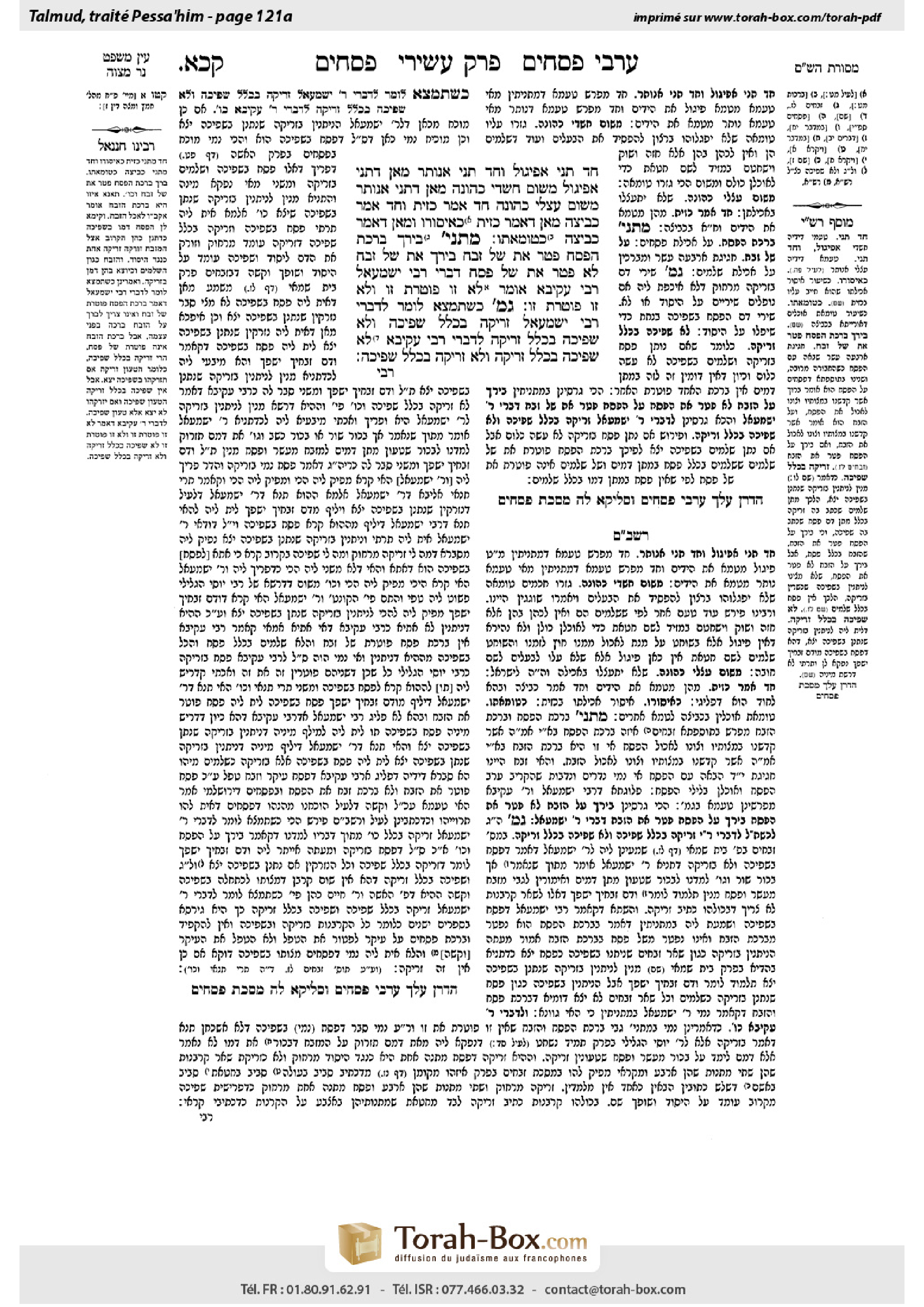
Pesachim 121a: Talmud study for Daf Yomi
Daf Yomi is the daily study of one Talmud folio. Explore 37 tractates with scans, Hebrew text, Sefaria English and AI-generated French translations where annotated.
Passage selection and English or AI-generated French translation are available where the scan has annotations. Daf Study is independent of Torah-Box and Sefaria.
Browse Pesachim · פסחים · All tractatesPesachim 121a text and translations
This page of Pesachim includes the Aramaic text, an English translation and an AI-generated French translation, alongside the scan above.
פסחים קכ״א א · Aramaic and Hebrew text
חַד תָּנֵי אַפִּיגּוּל, וְחַד תָּנֵי אַנּוֹתָר.
מַאן דְּתָנֵי אַפִּיגּוּל — מִשּׁוּם חֲשֵׁדֵי כְהוּנָּה. מַאן דְּתָנֵי אַנּוֹתָר — מִשּׁוּם עֲצֵלֵי כְהוּנָּה.
חַד אָמַר כְּזַיִת וְחַד אָמַר כְּבֵיצָה. מַאן דְּאָמַר כְּזַיִת — כְּאִיסּוּרוֹ, וּמַאן דְּאָמַר כְּבֵיצָה — כְּטוּמְאָתוֹ.
מַתְנִי׳ בֵּירַךְ בִּרְכַּת הַפֶּסַח — פָּטַר אֶת שֶׁל זֶבַח. בֵּירַךְ אֶת שֶׁל זֶבַח — לֹא פָּטַר אֶת שֶׁל פֶּסַח, דִּבְרֵי רַבִּי יִשְׁמָעֵאל. רַבִּי עֲקִיבָא אוֹמֵר: לֹא זוֹ פּוֹטֶרֶת זוֹ וְלֹא זוֹ פּוֹטֶרֶת זוֹ.
גְּמָ׳ כְּשֶׁתִּמְצָא לוֹמַר, לְדִבְרֵי רַבִּי יִשְׁמָעֵאל: זְרִיקָה בִּכְלַל שְׁפִיכָה. וְלֹא שְׁפִיכָה בִּכְלַל זְרִיקָה.
לְדִבְרֵי רַבִּי עֲקִיבָא: לֹא שְׁפִיכָה בִּכְלַל זְרִיקָה, וְלֹא זְרִיקָה בִּכְלַל שְׁפִיכָה.
Pesachim 121a · English translation
The Gemara explains that there is no dispute between Rav Huna and Rav Ḥisda concerning the reason for the prohibition. One of these two Sages teaches his explanation with regard to the case of piggul, mentioned in the mishna; and the other one teaches it with regard to notar.
The Gemara elaborates: The one who teaches it with regard to piggul maintains that the reason is due to suspected priests. As a result of enmity, a priest might cause the offerings to become piggul. To dissuade priests from doing so, the Sages instituted that one who touches piggul is rendered ritually impure, which ensures that the offending priest also suffers from his actions. He who teaches this explanation with regard to notar claims that the reason is due to lazy priests, to prevent sloth among the priests. The Sages decreed that notar causes ritual impurity, to ensure that the priests ate the sacrificial meat within the allotted time.
It was stated above that Rav Huna and Rav Ḥisda disagree with regard to the size of the meat that confers ritual impurity. One of them said that an olive-bulk of meat contracts ritual impurity, and one of them said that only an egg-bulk contracts ritual impurity. The Gemara explains the reasoning behind this debate. The one who said that an olive-bulk contracts ritual impurity maintains that the ritual impurity of notar and piggul is similar to its prohibition. Since notar and piggul are prohibited when they are an olive-bulk, the same applies to their ritual impurity. And the one who said that sacrificial meat becomes ritually impure when it is an egg-bulk maintains that it is similar to its ritual impurity. In other words, just as the minimum size of ritual impurity for other types of meat is an egg-bulk, the same applies to piggul and notar.
MISHNA: If one recited the blessing over the Paschal lamb, which is: Who sanctified us with His mitzvot and commanded us to eat the Paschal lamb, he has also exempted himself from reciting a blessing over the Festival offering. The blessing for the Festival peace-offering of the fourteenth of Nisan is: Who sanctified us with His mitzvot and commanded us to eat the offering. However, if he recited the blessing over the Festival offering, he has not exempted himself from reciting a blessing over the Paschal lamb. This is the statement of Rabbi Yishmael. Rabbi Akiva says: This blessing does not exempt one from reciting a blessing over this one, and that blessing does not exempt that one, as there is a separate blessing for each offering.
GEMARA: The Gemara explains the opinions of the tanna’im in the mishna. When you analyze the matter you will find that according to the opinion of Rabbi Yishmael, sprinkling of the blood on the altar is included in the more general category of pouring. In other words, the blessing over the Paschal lamb, whose blood is poured, includes the Festival peace-offering, whose blood is sprinkled, as sprinkling is included within the general category of pouring. But conversely, pouring is not included in sprinkling. Consequently, when one recites the blessing over the Festival peace-offering, he has not exempted himself from reciting a blessing over the Paschal lamb.
By contrast, according to the opinion of Rabbi Akiva, these are two separate mitzvot: Pouring is not included in sprinkling, and sprinkling is not included in pouring. Therefore, Rabbi Akiva maintains that each offering requires its own blessing.
Pesachim 121a · Traduction française (IA)
La Guemara explique qu’il n’y a pas de désaccord entre Rav Houna et Rav Ḥisda quant à la raison de l’interdiction. L’un des deux Sages expose son explication à propos du cas du piggoul, mentionné dans la Michna, et l’autre à propos du notar.
La Guemara développe : celui qui expose son explication à propos du piggoul estime que la raison tient à la méfiance envers les prêtres. Par hostilité, un prêtre pourrait rendre les offrandes piggoul. Pour dissuader les prêtres d’agir ainsi, les Sages ont institué que quiconque touche du piggoul devient rituellement impur, de sorte que le prêtre fautif subisse lui aussi les conséquences de ses actes. Celui qui expose cette explication à propos du notar affirme que la raison tient à la paresse des prêtres, afin de les empêcher de traîner. Les Sages ont décrété que le notar entraîne l’impureté rituelle, afin que les prêtres mangent la viande sacrificielle dans le délai imparti.
Il a été dit plus haut que Rav Houna et Rav Ḥisda sont en désaccord sur la quantité de viande qui confère l’impureté rituelle. Selon l’un, une quantité de viande équivalant à une olive contracte l’impureté rituelle ; selon l’autre, seule une quantité équivalant à un œuf la contracte. La Guemara explique le raisonnement qui sous-tend ce débat. Celui qui dit qu’une quantité équivalant à une olive contracte l’impureté rituelle estime que l’impureté rituelle du notar et du piggoul est comparable à leur interdiction. Puisque le notar et le piggoul sont interdits à partir d’une quantité équivalant à une olive, il en va de même pour leur impureté rituelle. Celui qui dit que la viande sacrificielle contracte l’impureté rituelle à partir d’une quantité équivalant à un œuf estime, quant à lui, que cette règle suit celle de l’impureté rituelle en général. Autrement dit, de même que, pour les autres types de viande, la quantité minimale entraînant l’impureté rituelle équivaut à un œuf, il en va de même pour le piggoul et le notar.
MICHNA : Si quelqu’un a récité la bénédiction sur l’agneau pascal — « Qui nous a sanctifiés par Ses mitsvot et nous a ordonné de manger l’agneau pascal » —, il s’est également acquitté de la bénédiction sur l’offrande festive. La bénédiction sur le sacrifice de paix festif du quatorze Nissan est : « Qui nous a sanctifiés par Ses mitsvot et nous a ordonné de manger le sacrifice. » Cependant, s’il a récité la bénédiction sur l’offrande festive, il ne s’est pas acquitté de la bénédiction sur l’agneau pascal. Telle est la déclaration de Rabbi Yichmaël. Rabbi Akiva dit : « Cette bénédiction ne dispense pas de réciter une bénédiction sur celui-ci, et cette bénédiction ne dispense pas de réciter une bénédiction sur celui-là », car chaque offrande a sa propre bénédiction.
GUEMARA : La Guemara explique les opinions des tannaïm dans la Michna. À l’examen, on constate que, selon Rabbi Yichmaël, l’aspersion du sang sur l’autel relève de la catégorie plus générale du versement. Autrement dit, la bénédiction sur l’agneau pascal, dont le sang est versé, inclut l’offrande festive, dont le sang est aspergé, puisque l’aspersion relève de la catégorie générale du versement. En revanche, le versement n’est pas inclus dans l’aspersion. Par conséquent, lorsqu’on récite la bénédiction sur l’offrande festive, on ne s’est pas acquitté de celle sur l’agneau pascal.
À l’inverse, selon Rabbi Akiva, il s’agit de deux mitsvot distinctes : le versement n’est pas inclus dans l’aspersion, et l’aspersion n’est pas incluse dans le versement. Rabbi Akiva estime donc que chaque offrande nécessite sa propre bénédiction.
Traduction française générée par IA à partir de l’édition anglaise de Sefaria. Vérifie toujours un passage avec le texte source.
Text from Sefaria: William Davidson Edition - Vocalized Aramaic (CC BY NC); William Davidson Edition - English (CC BY NC).