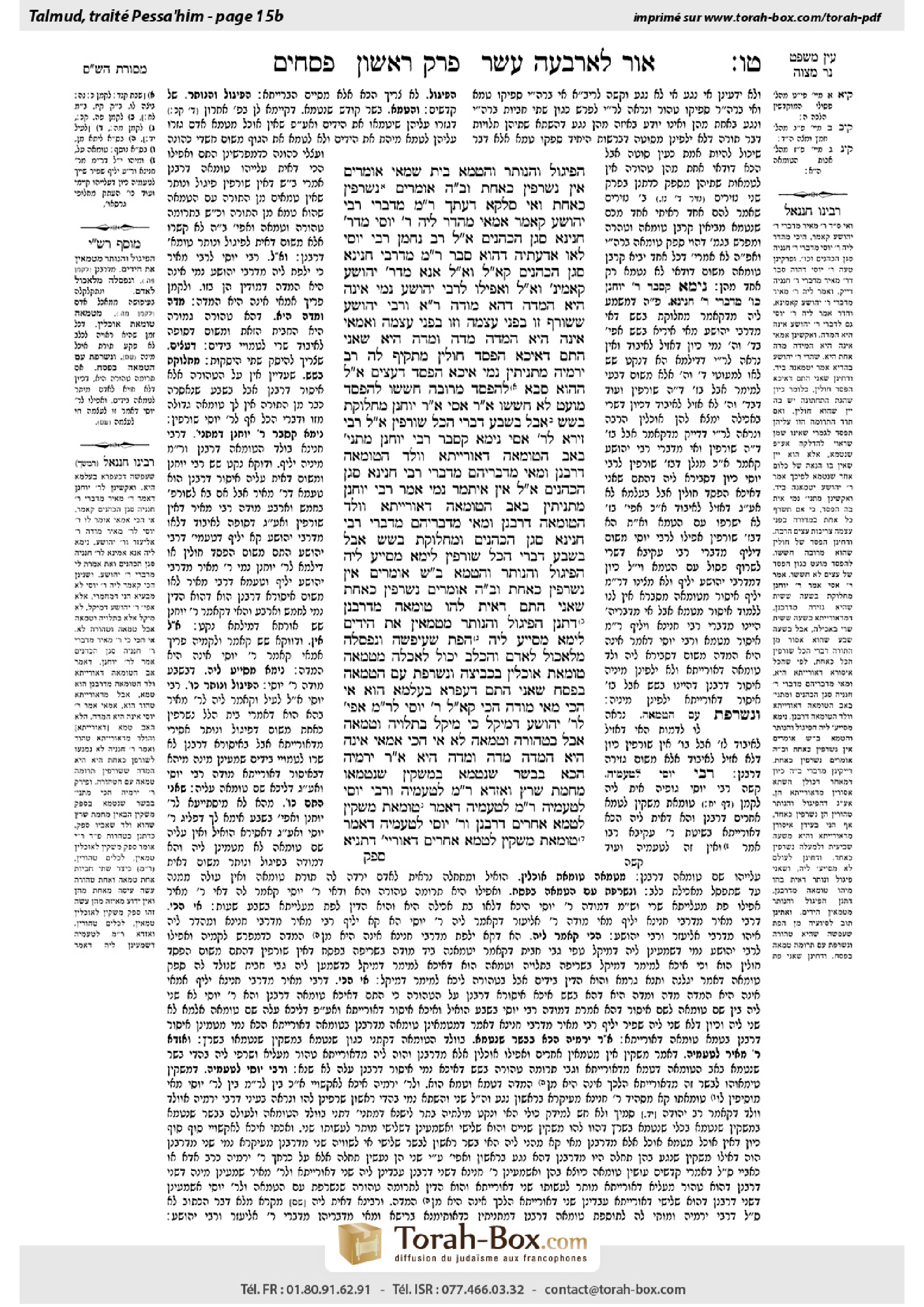
Pesachim 15b: Talmud study for Daf Yomi
Daf Yomi is the daily study of one Talmud folio. Explore 37 tractates with scans, Hebrew text, Sefaria English and AI-generated French translations where annotated.
Passage selection and English or AI-generated French translation are available where the scan has annotations. Daf Study is independent of Torah-Box and Sefaria.
Browse Pesachim · פסחים · All tractatesPesachim 15b text and translations
This page of Pesachim includes the Aramaic text, an English translation and an AI-generated French translation, alongside the scan above.
פסחים י״ה ב · Aramaic and Hebrew text
הַפִּיגּוּל וְהַנּוֹתָר וְהַטָּמֵא — בֵּית שַׁמַּאי אוֹמְרִים: אֵין נִשְׂרָפִין כְּאַחַת. וּבֵית הִלֵּל אוֹמְרִים: נִשְׂרָפִין כְּאַחַת.
וְאִי סָלְקָא דַעְתָּךְ רַבִּי מֵאִיר מִדִּבְרֵי רַבִּי יְהוֹשֻׁעַ קָאָמַר, אַמַּאי מַהְדַּר לֵיהּ רַבִּי יוֹסֵי מִדְּרַבִּי חֲנִינָא סְגַן הַכֹּהֲנִים? אֲמַר לֵיהּ רַב נַחְמָן: רַבִּי יוֹסֵי לָאו אַדַּעְתֵּיהּ, דְּהוּא סָבַר רַבִּי מֵאִיר מִדְּרַבִּי חֲנִינָא סְגַן הַכֹּהֲנִים קָאָמַר לֵיהּ, וַאֲמַר לֵיהּ: אֲנָא מִדְּרַבִּי יְהוֹשֻׁעַ קָאָמֵינָא,
וַאֲמַר לֵיהּ: וַאֲפִילּוּ לְרַבִּי יְהוֹשֻׁעַ נָמֵי אֵינָהּ הִיא הַמִּדָּה, דְּהָא מוֹדֶה רַבִּי אֱלִיעֶזֶר וְרַבִּי יְהוֹשֻׁעַ שֶׁשּׂוֹרֵף זוֹ בִּפְנֵי עַצְמָהּ וְזוֹ בִּפְנֵי עַצְמָהּ.
וְאַמַּאי אֵינָהּ הִיא הַמִּדָּה? מִדָּה וּמִדָּה הִיא!
שָׁאנֵי הָתָם, דְּאִיכָּא הֶפְסֵד חוּלִּין.
מַתְקֵיף לַהּ רַב יִרְמְיָה: מַתְנִיתִין נָמֵי אִיכָּא הֶפְסֵד דְּעֵצִים! אֲמַר לֵיהּ הָהוּא סָבָא: לְהֶפְסֵד מְרוּבֶּה — חָשְׁשׁוּ, לְהֶפְסֵד מוּעָט — לֹא חָשְׁשׁוּ.
אָמַר רַבִּי אַסִּי אָמַר רַבִּי יוֹחָנָן: מַחֲלוֹקֶת בְּשֵׁשׁ, אֲבָל בְּשֶׁבַע — דִּבְרֵי הַכֹּל שׂוֹרְפִין.
אֲמַר לֵיהּ רַבִּי זֵירָא לְרַבִּי אַסִּי: נֵימָא קָסָבַר רַבִּי יוֹחָנָן מַתְנִיתִין בְּאַב הַטּוּמְאָה דְּאוֹרָיְיתָא וְולַד הַטּוּמְאָה דְּרַבָּנַן, וּמַאי ״מִדִּבְרֵיהֶם״ — מִדִּבְרֵי רַבִּי חֲנִינָא סְגַן הַכֹּהֲנִים.
אֲמַר לֵיהּ: אִין. אִיתְּמַר נָמֵי, אָמַר רַבִּי יוֹחָנָן: מַתְנִיתִין בְּאַב הַטּוּמְאָה דְּאוֹרָיְיתָא וְולַד הַטּוּמְאָה דְּרַבָּנַן, וּמַאי ״מִדִּבְרֵיהֶם״ — מִדִּבְרֵי רַבִּי חֲנִינָא סְגַן הַכֹּהֲנִים. וּמַחְלוֹקֶת בְּשֵׁשׁ, אֲבָל בְּשֶׁבַע — דִּבְרֵי הַכֹּל שׂוֹרְפִין.
לֵימָא מְסַיַּיע לֵיהּ: הַפִּיגּוּל וְהַנּוֹתָר וְהַטָּמֵא, בֵּית שַׁמַּאי אוֹמְרִים: אֵין נִשְׂרָפִין כְּאַחַת, וּבֵית הִלֵּל אוֹמְרִים: נִשְׂרָפִין כְּאַחַת.
שָׁאנֵי הָתָם: דְּאִית לְהוּ טוּמְאָה מִדְּרַבָּנַן. דִּתְנַן: הַפִּיגּוּל וְהַנּוֹתָר מְטַמְּאִין אֶת הַיָּדַיִם.
לֵימָא מְסַיַּיע לֵיהּ: הַפַּת שֶׁעִיפְּשָׁה וְנִפְסְלָה מִלֶּאֱכוֹל לְאָדָם, וְהַכֶּלֶב יָכוֹל לְאׇכְלָהּ — מְטַמְּאָה טוּמְאַת אוֹכָלִין בִּכְבֵיצָה, וְנִשְׂרֶפֶת עִם הַטְּמֵאָה בַּפֶּסַח.
שָׁאנֵי הָתָם, דְּעַפְרָא בְּעָלְמָא הוּא.
אִי הָכִי מַאי מוֹדֶה? הָכִי קָאָמַר לֵיהּ רַבִּי יוֹסֵי לְרַבִּי מֵאִיר: אֲפִילּוּ לְרַבִּי יְהוֹשֻׁעַ דְּמֵיקֵל, כִּי מֵיקֵל — בִּתְלוּיָה וּטְמֵאָה, אֲבָל בִּטְהוֹרָה וּטְמֵאָה — לָא.
אִי הָכִי, אַמַּאי אֵינָהּ הִיא הַמִּדָּה? מִדָּה וּמִדָּה הִיא!
אָמַר רַבִּי יִרְמְיָה: הָכָא בְּבָשָׂר שֶׁנִּטְמָא בְּמַשְׁקִין שֶׁנִּטְמְאוּ מֵחֲמַת שֶׁרֶץ, וְאַזְדָּא רַבִּי מֵאִיר לְטַעְמֵיהּ וְרַבִּי יוֹסֵי לְטַעְמֵיהּ.
רַבִּי מֵאִיר לְטַעְמֵיהּ, דְּאָמַר: טוּמְאַת מַשְׁקִין לְטַמֵּא אֲחֵרִים דְּרַבָּנַן.
וְרַבִּי יוֹסֵי לְטַעְמֵיהּ, דְּאָמַר: טוּמְאַת מַשְׁקִין לְטַמֵּא אֲחֵרִים דְּאוֹרָיְיתָא. דְּתַנְיָא:
Pesachim 15b · English translation
The Tosefta continues: Piggul is an offering disqualified by the improper intention during the performance of the four sacrificial rites to sacrifice it or eat it after its appropriate time; and notar is the flesh of a sacrifice that is left over beyond its allotted time. The Sages decreed ritual impurity on both, and both, as well as sacrificial meat deemed ritually impure by Torah law, may not be eaten and must be burned. Beit Shammai say: They may not be burned together, as in doing so the piggul and notar, which are impure by rabbinic law, will come into contact with meat impure by Torah law, adding impurity to their impurity. And Beit Hillel say: They may be burned together.
The Gemara returns to the issue under discussion: And if it enters your mind that Rabbi Meir is saying that he derives his opinion from the statement of Rabbi Yehoshua, why does Rabbi Yosei respond to him from the statement of Rabbi Ḥanina the deputy High Priest? Rav Naḥman said to him: Rabbi Yosei did not have Rabbi Meir’s reasoning in mind, as he did not understand Rabbi Meir’s reasoning. As Rabbi Yosei maintains that Rabbi Meir is saying to him proof from the statement of Rabbi Ḥanina the deputy High Priest, and Rabbi Meir said to him: I am stating my proof from the statement of Rabbi Yehoshua.
And Rabbi Yosei said to Rabbi Meir in response: And even according to Rabbi Yehoshua, that is not the inference from which the halakha of burning pure and impure leavened teruma together can be learned, as Rabbi Eliezer and Rabbi Yehoshua concede that one should burn this meat by itself and that meat by itself, as stated in the mishna. From an analysis of the mishna and the Tosefta, it is possible to reconstruct the original dispute.
The Gemara raises a difficulty with regard to the above statement: But why does Rabbi Yosei say: That is not the inference from which it can be learned? On the contrary, it is a perfectly legitimate inference. In both cases the dispute is the same: Is one permitted to actively render an object impure preemptively if it will ultimately be destroyed regardless?
The Gemara rejects this contention: The case there, of the broken barrel in the upper press, where according to Rabbi Yehoshua it is permitted to actively render the teruma impure, is different, as in that case there is the potential loss of non-sacred produce. If one does not render the teruma in the upper press impure by receiving it in impure vessels, it will flow down and render the impure, non-sacred wine in the lower press impure teruma. However, in the case of leaven, no loss will be incurred. Why, then, shouldn’t each teruma be burned independently?
Rav Yirmeya strongly objects to this claim: In the mishna, too, there is the loss of wood, as one requires additional wood to kindle a second fire and burn the impure teruma separately. A certain Elder said to him: With regard to this and similar issues, the Sages were concerned about a great loss; however, they were not concerned about the minimal loss of several pieces of wood.
Rabbi Asi said that Rabbi Yoḥanan said: This dispute between Rabbi Meir and Rabbi Yosei refers to the sixth hour, when leaven is prohibited by rabbinic decree. However, in the seventh hour, when leaven is prohibited by Torah law, everyone agrees that one may burn ritually pure leavened teruma together with impure leavened teruma.
Rabbi Zeira said to Rabbi Asi: Let us say that Rabbi Yoḥanan maintains that the mishna is referring to an object that is a primary source of impurity by Torah law and an object that is a secondary source of impurity by rabbinic law. And what is the meaning of Rabbi Meir’s statement: From their statements? He meant from the statement of Rabbi Ḥanina the deputy High Priest, as explained above. The dispute refers to a rabbinic prohibition, e.g., a secondary source of impurity or the obligation to burn leaven during the sixth hour. In a case where the leaven is not yet prohibited by rabbinic law, e.g., in the fourth or fifth hour, even Rabbi Meir agrees that one may not burn ritually pure and impure teruma together.
Rabbi Asi said to him: Yes, Rabbi Yoḥanan indeed interprets the mishna in this manner. It was also stated explicitly that this is the case, as Rabbi Yoḥanan said: The mishna is referring to an object that is a primary source of impurity by Torah law and an object that is a secondary source of impurity by rabbinic law. And what is the meaning of: From their statements? It means from the statement of Rabbi Ḥanina the deputy High Priest. And the dispute between Rabbi Meir and Rabbi Yosei is with regard to the sixth hour, when leaven is prohibited by rabbinic law. However, everyone agrees that in the seventh hour one may burn them together, as both pieces of leavened teruma are prohibited by Torah law.
The Gemara suggests: Let us say that the end of the baraita supports Rabbi Yoḥanan’s assertion that even Rabbi Yosei agrees that it is permitted to burn together two objects prohibited by Torah law. As the baraita states with regard to piggul, notar, and ritually impure sacrificial meat that Beit Shammai say: They may not be burned together, and Beit Hillel say: They may be burned together. All of these items are prohibited by Torah law, and Rabbi Yosei would agree that the halakha is in accordance with the opinion of Beit Hillel.
The Gemara rejects this contention: It is different there, as piggul and notar are ritually impure by rabbinic law, and therefore Rabbi Yosei would agree that they may be burned together in that case. That is not true in the case of leaven in the seventh hour, which is not impure even by rabbinic law, although it is prohibited by Torah law. As we learned in a mishna: Piggul and notar, leftover sacrificial flesh, render one’s hands impure by rabbinic decree.
The Gemara suggests: Let us say that the following baraita supports Rabbi Yoḥanan’s opinion: With regard to bread that became moldy and is no longer fit for a person to eat, but a dog can still eat it, this bread can become impure with the ritual impurity of food if it is the size of an egg-bulk, as it is still classified as food. If it is pure leavened teruma, it is burned with impure teruma on Passover eve. Since the moldy bread is no longer edible, it is not necessary to refrain from burning it together with impure items. Apparently, this is Rabbi Yosei’s opinion, as Rabbi Meir maintains that pure and impure teruma are burned together even if neither is moldy. Since Rabbi Yosei concedes in the case of moldy bread, the same should apply to leavened teruma after the seventh hour, which is prohibited by Torah law.
The Gemara rejects this contention: It is different there, in the case of moldy bread, as it is for all intents and purposes mere dust, and its legal status is no longer that of food.
The Gemara asks: If so, that Rabbi Meir’s proof is based on the statement of Rabbi Ḥanina the deputy High Priest, why does the mishna mention that Rabbi Eliezer concedes to Rabbi Yehoshua? The Gemara explains that this is what Rabbi Yosei is saying to Rabbi Meir: Even according to Rabbi Yehoshua, who rules leniently in this case, when he rules leniently it is with regard to burning teruma in abeyance together with impure teruma; however, with regard to burning pure teruma and impure teruma together, no, he does not permit doing so.
The Gemara raises a difficulty: If so, that Rabbi Meir’s proof is based on the statement of Rabbi Ḥanina the deputy High Priest, why did Rabbi Yosei say: That is not the inference from which it can be learned? On the contrary, it is a perfectly legitimate inference. According to Rabbi Meir, pure teruma is prohibited during the sixth hour by rabbinic law. Just as Rabbi Ḥanina holds that one may actively transmit impurity to an object that is impure by rabbinic law by burning it together with an object that is impure by Torah law, so too, according to Rabbi Meir one may transmit impurity to an item prohibited by rabbinic law by burning it together with an item that is impure by Torah law.
Rabbi Yirmeya said: Here, the mishna is referring to meat that became ritually impure through contact with a secondary source of impurity by means of liquids that became impure due to contact with a creeping animal and thereby assumed second-degree ritual impurity. And Rabbi Meir conforms to his standard line of reasoning, and Rabbi Yosei conforms to his standard line of reasoning.
Rabbi Meir conforms to his standard line of reasoning with regard to this issue, as he said: The ritual impurity of liquids with regard to transmitting impurity to other objects is by rabbinic law. The meat that became impure through contact with a secondary source of impurity is in fact entirely pure by Torah law. Therefore, he learns from the mishna that it is permitted to burn pure and impure items together.
And Rabbi Yosei conforms to his standard line of reasoning, as he said: The ritual impurity of liquids with regard to transmitting impurity to other objects is by Torah law. Accordingly, the meat that Rabbi Ḥanina the deputy High Priest referred to in the mishna was impure by Torah law. Therefore, this case cannot serve as a precedent for the claim that it is permitted to burn pure and impure teruma together on Passover eve. As it was taught in a baraita:
Pesachim 15b · Traduction française (IA)
La Tossefta poursuit : Le piggoul est une offrande invalidée par l’intention inadéquate, au cours de l’accomplissement des quatre rites sacrificiels, de la sacrifier ou de la consommer après le délai prescrit ; le notar est la chair d’un sacrifice qui est conservée au-delà du délai prescrit. Les Sages ont décrété que tous deux soient rituellement impurs. Tous deux, ainsi que la viande sacrificielle déclarée rituellement impure par la Torah, ne peuvent être consommés et doivent être brûlés. Beit Shammaï disent : On ne peut pas les brûler ensemble, car le piggoul et le notar, impurs selon la loi rabbinique, entreraient alors en contact avec la viande impure selon la Torah, ajoutant ainsi de l’impureté à leur impureté. Beit Hillel disent : On peut les brûler ensemble.
La Guemara revient à la question débattue : Si tu penses que Rabbi Meïr dit qu’il déduit son opinion de la déclaration de Rabbi Yehoshoua, pourquoi Rabbi Yossi lui répond-il en s’appuyant sur la déclaration de Rabbi Ḥanina, le suppléant du Grand Prêtre ? Rav Naḥman lui dit : Rabbi Yossi n’avait pas à l’esprit le raisonnement de Rabbi Meïr, car il ne l’avait pas compris. En effet, Rabbi Yossi pense que Rabbi Meïr lui apporte une preuve tirée de la déclaration de Rabbi Ḥanina, le suppléant du Grand Prêtre, tandis que Rabbi Meïr lui dit : « J’apporte ma preuve à partir de la déclaration de Rabbi Yehoshoua. »
Rabbi Yossi répondit à Rabbi Meïr : Même selon Rabbi Yehoshoua, ce n’est pas de là qu’on peut déduire la halakha autorisant à brûler ensemble de la terouma levée pure et de la terouma levée impure, car Rabbi Éliézer et Rabbi Yehoshoua conviennent qu’il faut brûler cette viande séparément de l’autre, comme l’énonce la Michna. L’analyse de la Michna et de la Tossefta permet de reconstituer le désaccord initial.
La Guemara soulève une difficulté à propos de la déclaration précédente : Mais pourquoi Rabbi Yossi dit-il : « Ce n’est pas de là qu’on peut le déduire » ? Au contraire, c’est une déduction tout à fait légitime. Dans les deux cas, le désaccord est le même : est-il permis de rendre délibérément un objet impur par anticipation, s’il doit de toute façon être détruit par la suite ?
La Guemara rejette cette thèse : Le cas du tonneau brisé dans le pressoir supérieur est différent : selon Rabbi Yehoshoua, il est permis d’y rendre délibérément la terouma impure, car il existe alors un risque de perte de produits non consacrés. Si l’on ne rend pas impure la terouma du pressoir supérieur en la recueillant dans des récipients impurs, elle s’écoulera et rendra impure la terouma constituée par le vin non consacré et impur du pressoir inférieur. En revanche, dans le cas du levain, il n’y aura aucune perte. Pourquoi, dès lors, ne pas brûler chaque terouma séparément ?
Rav Yirmeya s’oppose vivement à cette affirmation : Dans la Michna aussi, il y a une perte de bois, puisqu’il faut du bois supplémentaire pour allumer un second feu et brûler séparément la terouma impure. Un certain ancien lui dit : Dans cette question et les questions semblables, les Sages se sont préoccupés des pertes importantes ; en revanche, ils ne se sont pas préoccupés de la perte minime de quelques morceaux de bois.
Rabbi Assi a dit au nom de Rabbi Yoḥanan : Le désaccord entre Rabbi Meïr et Rabbi Yossi concerne la sixième heure, lorsque le levain est interdit par décret rabbinique. Mais, à la septième heure, lorsque le levain est interdit par la Torah, tous conviennent qu’on peut brûler ensemble de la terouma levée pure rituellement et de la terouma levée impure.
Rabbi Zeïra dit à Rabbi Assi : Peut-on en déduire que Rabbi Yoḥanan considère que la Michna traite d’un objet qui est une source primaire d’impureté selon la Torah et d’un objet qui est une source secondaire d’impureté selon la loi rabbinique ? Et que signifie la déclaration de Rabbi Meïr : « D’après leurs déclarations » ? Il voulait dire : d’après la déclaration de Rabbi Ḥanina, le suppléant du Grand Prêtre, comme expliqué plus haut. Le désaccord porte sur une interdiction rabbinique, par exemple une source secondaire d’impureté ou l’obligation de brûler le levain pendant la sixième heure. Lorsque le levain n’est pas encore interdit par la loi rabbinique, par exemple pendant la quatrième ou la cinquième heure, même Rabbi Meïr convient qu’on ne peut pas brûler ensemble de la terouma levée pure rituellement et de la terouma levée impure.
Rabbi Assi lui répondit : Oui, Rabbi Yoḥanan interprète effectivement la Michna de cette manière. Cela a aussi été enseigné explicitement : Rabbi Yoḥanan a dit que la Michna traite d’un objet qui est une source primaire d’impureté selon la Torah et d’un objet qui est une source secondaire d’impureté selon la loi rabbinique. Et que signifie « d’après leurs déclarations » ? Cela signifie : d’après la déclaration de Rabbi Ḥanina, le suppléant du Grand Prêtre. Le désaccord entre Rabbi Meïr et Rabbi Yossi concerne la sixième heure, lorsque le levain est interdit par la loi rabbinique. Mais tous conviennent qu’à la septième heure on peut les brûler ensemble, car les deux morceaux de terouma levée sont interdits par la Torah.
La Guemara propose : Peut-on dire que la fin de la baraïta appuie l’affirmation de Rabbi Yoḥanan, selon laquelle même Rabbi Yossi convient qu’il est permis de brûler ensemble deux objets interdits par la Torah ? En effet, à propos du piggoul, du notar et de la viande sacrificielle rituellement impure, la baraïta rapporte que Beit Shammaï disent : « On ne peut pas les brûler ensemble », et que Beit Hillel disent : « On peut les brûler ensemble ». Tous ces éléments sont interdits par la Torah, et Rabbi Yossi conviendrait que la halakha suit l’opinion de Beit Hillel.
La Guemara rejette cette thèse : Le cas est différent, car le piggoul et le notar sont rituellement impurs selon la loi rabbinique ; Rabbi Yossi conviendrait donc qu’on peut les brûler ensemble dans ce cas. Il n’en va pas de même du levain à la septième heure, qui n’est même pas impur selon la loi rabbinique, bien qu’il soit interdit par la Torah. En effet, nous avons appris dans une Michna : Le piggoul et le notar, les restes de chair sacrificielle, rendent les mains impures par décret rabbinique.
La Guemara propose : Peut-on dire que la baraïta suivante appuie l’opinion de Rabbi Yoḥanan ? Du pain qui a moisi et qui n’est plus propre à la consommation humaine, mais qu’un chien peut encore manger, peut contracter l’impureté rituelle des aliments s’il a le volume d’un œuf, car il est toujours considéré comme un aliment. S’il s’agit de terouma levée pure, on la brûle avec de la terouma impure la veille de Pessaḥ. Puisque le pain moisi n’est plus comestible, il n’est pas nécessaire de s’abstenir de le brûler avec des éléments impurs. Telle est apparemment l’opinion de Rabbi Yossi, car Rabbi Meïr soutient qu’on brûle ensemble de la terouma pure et de la terouma impure même si aucune des deux n’est moisie. Puisque Rabbi Yossi concède ce point dans le cas du pain moisi, il devrait en être de même pour la terouma levée après la septième heure, lorsqu’elle est interdite par la Torah.
La Guemara rejette cette thèse : Le cas du pain moisi est différent, car il n’est, à toutes fins utiles, que poussière et n’a plus le statut juridique d’un aliment.
La Guemara demande : Si tel est le cas, si la preuve de Rabbi Meïr repose sur la déclaration de Rabbi Ḥanina, le suppléant du Grand Prêtre, pourquoi la Michna mentionne-t-elle que Rabbi Éliézer concède le point à Rabbi Yehoshoua ? La Guemara explique que voici ce que Rabbi Yossi dit à Rabbi Meïr : Même selon Rabbi Yehoshoua, qui adopte ici une position indulgente, cette indulgence concerne la combustion de terouma en suspens avec de la terouma impure ; en revanche, brûler ensemble de la terouma pure et de la terouma impure, non, il ne le permet pas.
La Guemara soulève une difficulté : Si tel est le cas, si la preuve de Rabbi Meïr repose sur la déclaration de Rabbi Ḥanina, le suppléant du Grand Prêtre, pourquoi Rabbi Yossi a-t-il dit : « Ce n’est pas de là qu’on peut le déduire » ? Au contraire, c’est une déduction tout à fait légitime. Selon Rabbi Meïr, la terouma pure est interdite pendant la sixième heure par la loi rabbinique. De même que Rabbi Ḥanina considère qu’on peut transmettre délibérément l’impureté à un objet impur selon la loi rabbinique en le brûlant avec un objet impur selon la Torah, de même, selon Rabbi Meïr, on peut transmettre l’impureté à un élément interdit par la loi rabbinique en le brûlant avec un élément impur selon la Torah.
Rabbi Yirmeya a dit : Ici, la Michna traite de viande devenue rituellement impure au contact d’une source secondaire d’impureté, par l’intermédiaire de liquides devenus impurs au contact d’un animal rampant et ayant ainsi acquis le deuxième degré d’impureté rituelle. Rabbi Meïr reste fidèle à sa position habituelle, tout comme Rabbi Yossi reste fidèle à la sienne.
Rabbi Meïr reste fidèle à sa position habituelle sur cette question, car il a dit : L’impureté rituelle des liquides, lorsqu’il s’agit de transmettre l’impureté à d’autres objets, relève de la loi rabbinique. La viande devenue impure au contact d’une source secondaire d’impureté est donc, en réalité, entièrement pure selon la Torah. Il déduit ainsi de la Michna qu’il est permis de brûler ensemble des éléments purs et impurs.
Rabbi Yossi reste fidèle à sa position habituelle, car il a dit : L’impureté rituelle des liquides, lorsqu’il s’agit de transmettre l’impureté à d’autres objets, relève de la Torah. Par conséquent, la viande dont Rabbi Ḥanina, le suppléant du Grand Prêtre, parlait dans la Michna était impure selon la Torah. Ce cas ne peut donc pas servir de précédent pour affirmer qu’il est permis de brûler ensemble de la terouma pure et de la terouma impure la veille de Pessaḥ. En effet, il a été enseigné dans une baraïta :
Traduction française générée par IA à partir de l’édition anglaise de Sefaria. Vérifie toujours un passage avec le texte source.
Text from Sefaria: William Davidson Edition - Vocalized Aramaic (CC BY NC); William Davidson Edition - English (CC BY NC).