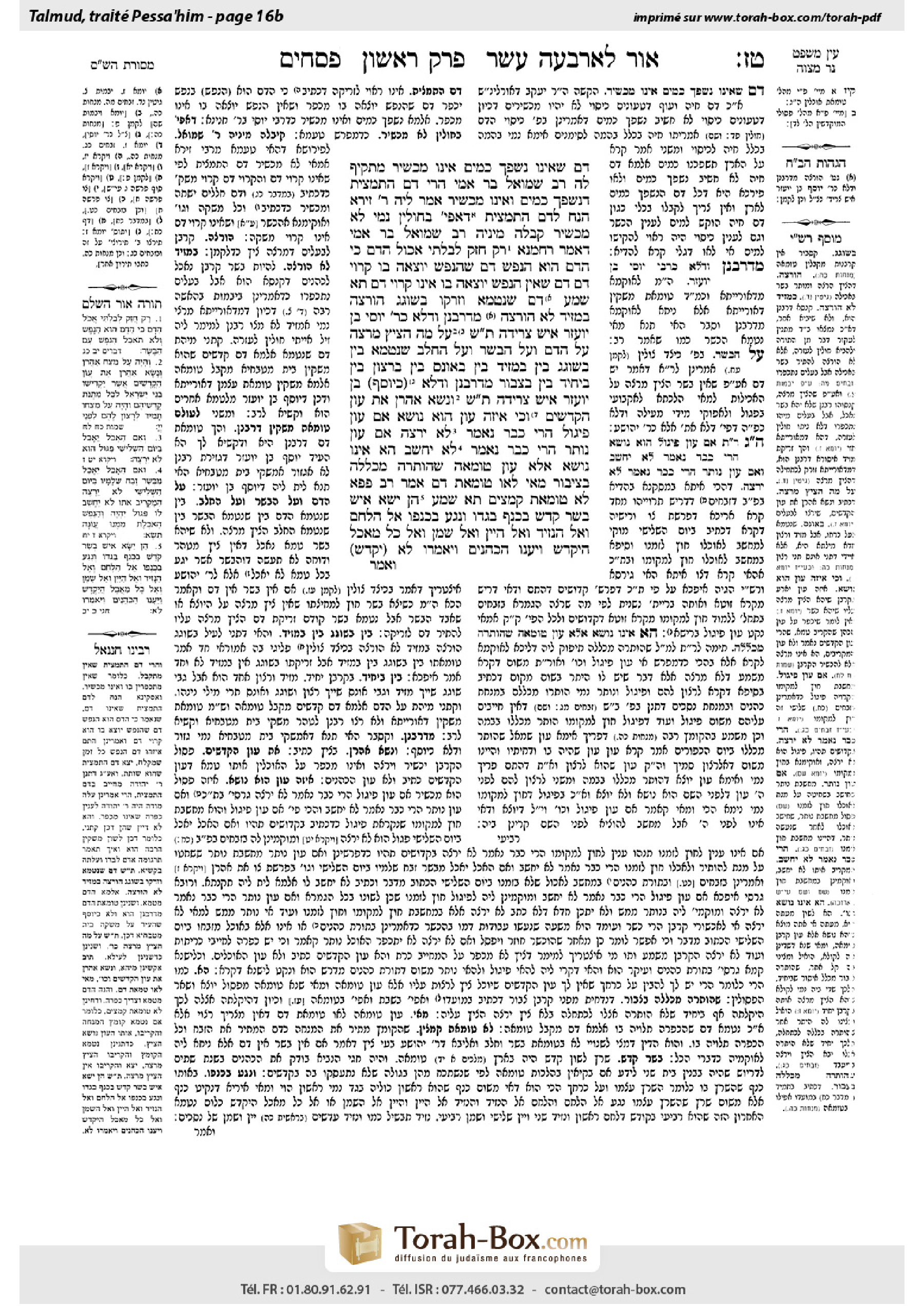
Pesachim 16b: Talmud study for Daf Yomi
Daf Yomi is the daily study of one Talmud folio. Explore 37 tractates with scans, Hebrew text, Sefaria English and AI-generated French translations where annotated.
Passage selection and English or AI-generated French translation are available where the scan has annotations. Daf Study is independent of Torah-Box and Sefaria.
Browse Pesachim · פסחים · All tractatesPesachim 16b text and translations
This page of Pesachim includes the Aramaic text, an English translation and an AI-generated French translation, alongside the scan above.
פסחים י״ו ב · Aramaic and Hebrew text
דָּם שֶׁאֵינוֹ נִשְׁפָּךְ כַּמַּיִם — אֵינוֹ מַכְשִׁיר. מַתְקֵיף לַהּ רַב שְׁמוּאֵל בַּר אַמֵּי: הֲרֵי דַּם הַתַּמְצִית — דְּנִשְׁפָּךְ כַּמַּיִם, וְאֵינוֹ מַכְשִׁיר!
אֲמַר לֵיהּ רַבִּי זֵירָא: הַנַּח לְדַם הַתַּמְצִית, דַּאֲפִילּוּ בְּחוּלִּין נָמֵי לָא מַכְשִׁיר.
קַבְּלַהּ מִינֵּיהּ רַב שְׁמוּאֵל בַּר אַמֵּי, דְּאָמַר רַחֲמָנָא: ״רַק חֲזַק לְבִלְתִּי אֲכֹל הַדָּם כִּי הַדָּם הוּא הַנָּפֶשׁ״, דָּם שֶׁהַנֶּפֶשׁ יוֹצְאָה בּוֹ — קָרוּי דָּם, דָּם שֶׁאֵין הַנֶּפֶשׁ יוֹצְאָה בּוֹ — אֵינוֹ קָרוּי דָּם.
תָּא שְׁמַע: דָּם שֶׁנִּטְמָא וּזְרָקוֹ, בְּשׁוֹגֵג — הוּרְצָה, בְּמֵזִיד — לֹא הוּרְצָה. מִדְּרַבָּנַן, וּדְלָא כְּרַבִּי יוֹסֵי בֶּן יוֹעֶזֶר אִישׁ צְרֵידָה.
תָּא שְׁמַע: עַל מָה הַצִּיץ מְרַצֶּה — עַל הַדָּם וְעַל הַבָּשָׂר וְעַל הַחֵלֶב שֶׁנִּטְמָא, בֵּין בְּשׁוֹגֵג בֵּין בְּמֵזִיד, בֵּין בְּאוֹנֶס בֵּין בְּרָצוֹן, בֵּין בְּיָחִיד בֵּין בְּצִבּוּר.
מִדְּרַבָּנַן, וּדְלָא (כְּיוֹסֵף) בֶּן יוֹעֶזֶר אִישׁ צְרֵידָה.
תָּא שְׁמַע: ״וְנָשָׂא אַהֲרֹן אֶת עֲוֹן הַקֳּדָשִׁים״.
וְכִי אֵיזֶה עָוֹן הוּא נוֹשֵׂא? אִם עֲוֹן פִּיגּוּל — הֲרֵי כְּבָר נֶאֱמַר ״לֹא יֵרָצֶה״. אִם עֲוֹן נוֹתָר — הֲרֵי כְּבָר נֶאֱמַר ״לֹא יֵחָשֵׁב״.
הָא אֵינוֹ נוֹשֵׂא אֶלָּא עֲוֹן טוּמְאָה שֶׁהוּתְּרָה מִכְּלָלָהּ בְּצִיבּוּר. מַאי לָאו, טוּמְאַת דָּם? אָמַר רַב פָּפָּא: לָא, טוּמְאַת קְמָצִים.
תָּא שְׁמַע: ״הֵן יִשָּׂא אִישׁ בְּשַׂר קֹדֶשׁ בִּכְנַף בִּגְדוֹ וְנָגַע בִּכְנָפוֹ אֶל הַלֶּחֶם וְאֶל הַנָּזִיד וְאֶל הַיַּיִן וְאֶל שֶׁמֶן וְאֶל כׇּל מַאֲכָל הֲיִקְדָּשׁ וַיַּעֲנוּ הַכֹּהֲנִים וַיֹּאמְרוּ לֹא (יִקְדָּשׁ)״.
Pesachim 16b · English translation
Conversely, blood that is not poured out like water but is received in a vessel to be sprinkled on the altar does not render produce susceptible to contract impurity. Rav Shmuel bar Ami strongly objects to this: There is the blood squeezed from an animal after slaughter once the initial spurt of blood has concluded, which is poured like water, as it is unfit for sprinkling upon the altar. And nevertheless, this blood does not render produce susceptible to impurity.
Rabbi Zeira said to him: Leave aside the blood squeezed after the initial spurt, which is an exceptional case, as even from non-sacred animals it does not render produce susceptible to ritual impurity either. With regard to the halakha that blood renders produce susceptible to ritual impurity, the legal status of blood squeezed after the initial spurt is not that of blood at all.
The Gemara comments: Rav Shmuel bar Ami accepted this statement from Rabbi Zeira and cited a verse that supports it. As the Merciful One states: “Only be strong not to eat the blood; for the blood is the soul” (Deuteronomy 12:23). This verse indicates: Blood with regard to which the soul leaves the body when it is spilled is called blood; however, blood with regard to which the soul does not leave the body when it is spilled, but which is squeezed out afterward, is not called blood.
The Gemara cites an additional proof that the impurity of liquids is by Torah law. Come and hear: With regard to blood that became ritually impure, and a priest sprinkled it on the altar, the following distinction applies: If he did so unwittingly, the offering is accepted. If he sprinkled the blood intentionally, the offering is not accepted. Apparently, blood becomes ritually impure by Torah law, even if it does not transmit impurity to other items. The Gemara rejects this contention: This impurity is by rabbinic law, and this ruling is not in accordance with Rav’s explanation of the opinion of Rabbi Yosei ben Yo’ezer of Tzereida, as he maintains that sacrificial blood does not become impure at all.
The Gemara cites a proof from another mishna. Come and hear: For what does the frontplate of the High Priest atone and thereby allow the blood of the offering to be sprinkled? It atones for the blood, and for the meat, and for the fat that became impure, whether one caused it to become impure unwittingly or intentionally, whether due to circumstances beyond his control or willfully, and whether it is the offering of an individual or that of a community. Apparently, the blood of an offering can become impure.
The Gemara rejects this proof: The mishna is referring to blood that is impure by rabbinic law, and here too, it is not in accordance with the opinion of Yosei ben Yo’ezer of Tzereida, who says that consecrated blood does not become impure at all.
The Gemara cites an additional proof: Come and hear another verse written about the frontplate: “And it shall be upon Aaron’s forehead, and Aaron shall bear the sin committed with the consecrated objects, which the children of Israel shall hallow, even all their sacred gifts; and it shall be always upon his forehead, that they may be accepted before God” (Exodus 28:38).
And the Sages expounded: Which sin does it bear? If you say it atones for the sin of piggul, an offering disqualified by the intention to sacrifice or eat the offering after the permitted time, it is already stated: “And if it is eaten at all on the third day, it is piggul; it shall not be accepted” (Leviticus 19:7). If you say it atones for notar, i.e., meat of an offering left after the time that one was permitted to eat it, it is already stated: “And if any of the flesh of the sacrifice of his peace-offerings is eaten on the third day, it shall not be accepted, neither shall it be credited to he who offered it” (Leviticus 7:18).
Evidently, the frontplate bears only the sin of impurity in the offering of an individual, as in some circumstances, impurity was exempted from its general prohibition on behalf of the community. It was permitted to sacrifice communal offerings in the Temple in a state of impurity. What, does this not apply to impure blood as well? Apparently, blood can also become impure. Rav Pappa said: No, the reference is not to impure blood but to the impurity of handfuls of flour separated by the priest from a meal-offering. The handful of flour renders the meal-offering permitted to be eaten by the priests, parallel to the blood of an animal offering.
The Gemara cites an additional proof. Come and hear that which was said to the prophet Haggai: “Thus said the Lord of Hosts: Ask now the priests with regard to the Torah, saying: If a person bears hallowed flesh in the corner of his garment, and with his garment he touches bread, or stew, or wine, or oil, or any food, shall it be sacred? And the priests answered and said: No” (Haggai 2:11–12). This question is asked with regard to the flesh of a creeping animal and whether or not the substances that come into contact with it become impure.
Pesachim 16b · Traduction française (IA)
À l’inverse, le sang qui n’est pas versé comme de l’eau, mais qui est recueilli dans un récipient afin d’être aspergé sur l’autel, ne rend pas les produits susceptibles de contracter l’impureté. Rav Shmuel bar Ami s’y oppose vivement : il existe le sang qui s’écoule d’un animal après l’abattage, une fois que le jet initial a cessé. Ce sang est versé comme de l’eau, puisqu’il ne peut pas être aspergé sur l’autel. Pourtant, il ne rend pas les produits susceptibles de contracter l’impureté.
Rabbi Zeira lui dit : « Laisse de côté le sang qui s’écoule après le jet initial : c’est un cas exceptionnel, car même le sang provenant d’animaux non consacrés ne rend pas non plus les produits susceptibles de contracter l’impureté rituelle. Pour ce qui est de la halakha selon laquelle le sang rend les produits susceptibles de contracter l’impureté rituelle, le sang qui s’écoule après le jet initial n’a pas du tout le statut de sang. »
La Guemara commente : Rav Shmuel bar Ami accepta cette déclaration de Rabbi Zeira et cita un verset à l’appui. Car le Miséricordieux déclare : « Seulement, garde-toi de manger le sang, car le sang, c’est la vie » (Deutéronome 12:23). Ce verset indique que le sang dont l’écoulement entraîne le départ de l’âme du corps est appelé sang ; en revanche, le sang dont l’écoulement n’entraîne pas le départ de l’âme du corps, mais qui s’écoule par la suite, n’est pas appelé sang.
La Guemara apporte une preuve supplémentaire que l’impureté des liquides relève de la Torah. Viens et entends : au sujet du sang devenu rituellement impur qu’un prêtre a aspergé sur l’autel, la distinction suivante s’applique : s’il l’a fait par inadvertance, le sacrifice est agréé. S’il a aspergé le sang intentionnellement, le sacrifice n’est pas agréé. Il semblerait donc que le sang puisse devenir rituellement impur selon la Torah, même s’il ne transmet pas l’impureté à d’autres éléments. La Guemara rejette cette preuve : cette impureté relève d’une loi rabbinique, et cette décision ne suit pas l’explication que Rav donne de l’opinion de Rabbi Yosei ben Yo’ezer de Tzereida, selon laquelle le sang des sacrifices ne devient pas impur du tout.
La Guemara apporte une preuve tirée d’une autre Michna. Viens et entends : pour quelles fautes la lame frontale du Grand Prêtre expie-t-elle, permettant ainsi d’asperger le sang du sacrifice ? Elle expie le sang, la viande et la graisse qui sont devenus impurs, que cette impureté ait été causée par inadvertance ou intentionnellement, accidentellement ou délibérément, et qu’il s’agisse d’un sacrifice individuel ou communautaire. Il semblerait donc que le sang d’un sacrifice puisse devenir impur.
La Guemara rejette cette preuve : la Michna parle d’un sang impur selon une loi rabbinique. Ici encore, elle ne suit pas l’opinion de Yosei ben Yo’ezer de Tzereida, qui affirme que le sang consacré ne devient pas impur du tout.
La Guemara apporte une preuve supplémentaire : viens et entends un autre verset écrit au sujet de la lame frontale : « Elle sera sur le front d’Aaron, et Aaron portera la faute commise à l’égard des objets consacrés que les enfants d’Israël consacreront, ainsi que de tous leurs dons sacrés ; elle sera toujours sur son front, afin qu’ils soient agréés devant Dieu » (Exode 28:38).
Et les Sages interprétèrent : Quelle faute porte-t-elle ? Si tu dis qu’elle expie la faute de piggul, c’est-à-dire celle d’un sacrifice invalidé par l’intention de le sacrifier ou de le manger après le délai autorisé, il est déjà dit : « Si l’on en mange le troisième jour, c’est du piggul ; il ne sera pas agréé » (Lévitique 19:7). Si tu dis qu’elle expie le notar, c’est-à-dire la viande d’un sacrifice restée après le délai pendant lequel il était permis de la manger, il est déjà dit : « Si l’on mange le troisième jour de la chair du sacrifice de ses sacrifices de paix, il ne sera pas agréé et cela ne sera pas imputé à celui qui l’a offert » (Lévitique 7:18).
De toute évidence, la lame frontale ne porte que la faute d’impureté dans le cas d’un sacrifice individuel, car, dans certaines circonstances, l’impureté était exemptée de l’interdiction générale en faveur de la communauté. Il était permis d’offrir des sacrifices communautaires dans le Temple en état d’impureté. Cela ne s’applique-t-il pas aussi au sang impur ? Il semblerait donc que le sang puisse lui aussi devenir impur. Rav Pappa dit : Non, il ne s’agit pas de sang impur, mais de l’impureté des poignées de farine que le prêtre prélève d’une offrande végétale. La poignée de farine rend l’offrande végétale propre à être mangée par les prêtres, tout comme le sang d’un sacrifice animal.
La Guemara apporte une preuve supplémentaire. Viens et entends ce qui fut dit au prophète Aggée : « Ainsi parle le Seigneur des Armées : Interroge maintenant les prêtres sur la Torah, en disant : Si quelqu’un porte de la chair consacrée dans le pan de son vêtement et que son vêtement touche du pain, un mets, du vin, de l’huile ou quelque autre aliment, celui-ci sera-t-il consacré ? Les prêtres répondirent : Non » (Aggée 2:11–12). Cette question porte sur la chair d’un animal rampant et vise à savoir si les substances qui entrent en contact avec elle deviennent impures ou non.
Traduction française générée par IA à partir de l’édition anglaise de Sefaria. Vérifie toujours un passage avec le texte source.
Text from Sefaria: William Davidson Edition - Vocalized Aramaic (CC BY NC); William Davidson Edition - English (CC BY NC).