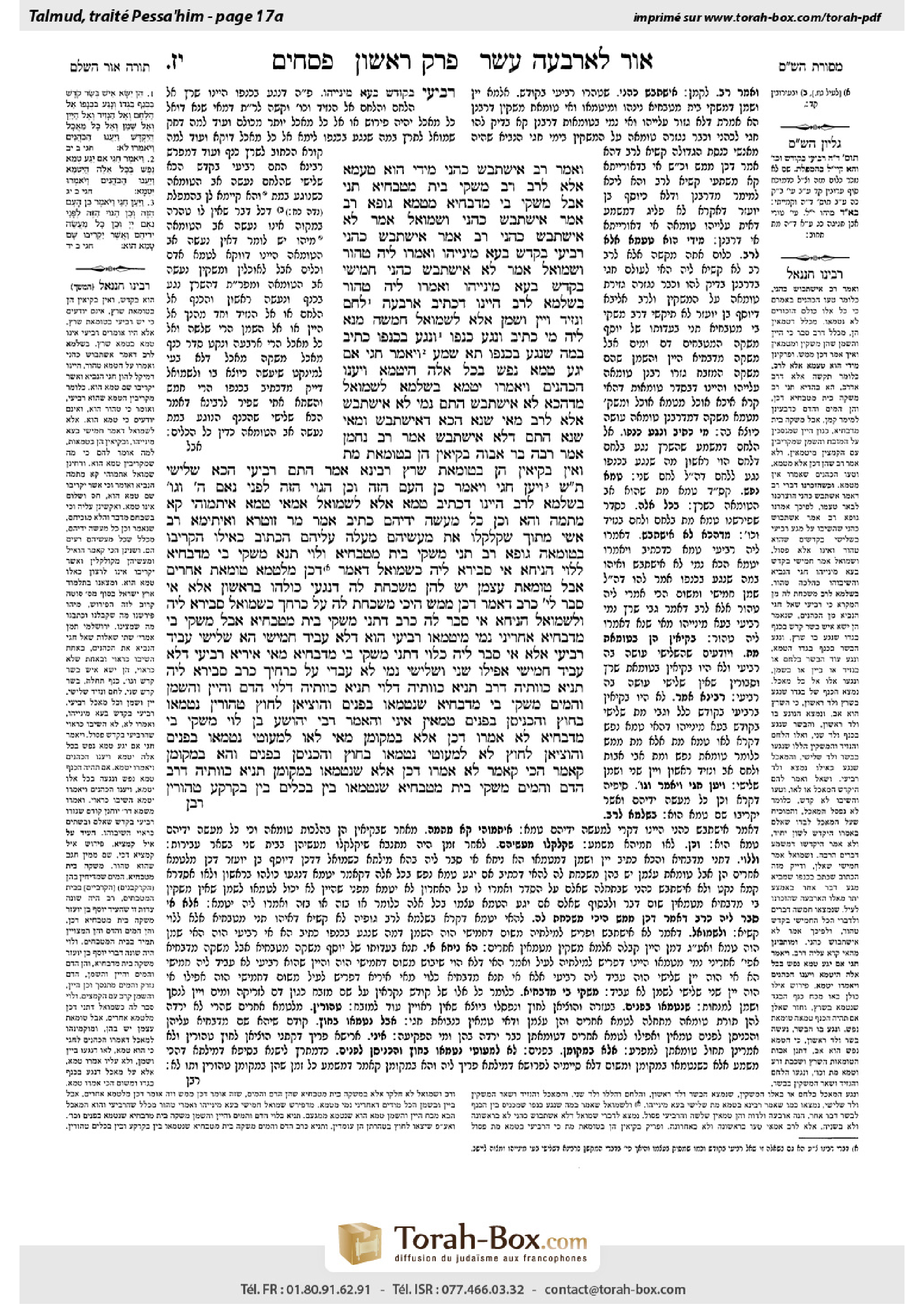
Pesachim 17a: Talmud study for Daf Yomi
Daf Yomi is the daily study of one Talmud folio. Explore 37 tractates with scans, Hebrew text, Sefaria English and AI-generated French translations where annotated.
Passage selection and English or AI-generated French translation are available where the scan has annotations. Daf Study is independent of Torah-Box and Sefaria.
Browse Pesachim · פסחים · All tractatesPesachim 17a text and translations
This page of Pesachim includes the Aramaic text, an English translation and an AI-generated French translation, alongside the scan above.
פסחים י״ז א · Aramaic and Hebrew text
וְאָמַר רַב: אִישְׁתַּבֻּשׁ כָּהֲנֵי. מִידֵּי הוּא טַעְמָא אֶלָּא לְרַב? רַב ״מַשְׁקֵי בֵּית מַטְבְּחַיָּא״ תָּנֵי, אֲבָל מַשְׁקֵי בֵּי מַדְבְּחַיָּא — מְטַמֵּא.
גּוּפָא, רַב אָמַר: אִישְׁתַּבֻּשׁ כָּהֲנֵי, וּשְׁמוּאֵל אָמַר: לָא אִישְׁתַּבֻּשׁ כָּהֲנֵי.
רַב אָמַר: אִישְׁתַּבֻּשׁ כָּהֲנֵי — רְבִיעִי בַּקֹּדֶשׁ בְּעָא מִינַּיְיהוּ, וַאֲמַרוּ לֵיהּ טָהוֹר.
ושְׁמוּאֵל אָמַר: לָא אִישְׁתַּבֻּשׁ כָּהֲנֵי — חֲמִישִׁי בַּקֹּדֶשׁ בְּעָא מִינַּיְיהוּ, וַאֲמַרוּ לֵיהּ: טָהוֹר.
בִּשְׁלָמָא לְרַב, הַיְינוּ דִּכְתִיב אַרְבְּעָה: לֶחֶם וְנָזִיד וְיַיִן וָשֶׁמֶן. אֶלָּא לִשְׁמוּאֵל, חַמְשָׁה מְנָא לֵיהּ?
מִי כְּתִיב ״וְנָגַע כְּנָפוֹ״? ״וְנָגַע בִּכְנָפוֹ״ כְּתִיב — בְּמַה שֶּׁנָּגַע בִּכְנָפוֹ.
תָּא שְׁמַע: ״וַיֹּאמֶר חַגַּי אִם יִגַּע טְמֵא נֶפֶשׁ בְּכׇל אֵלֶּה הֲיִטְמָא וַיַּעֲנוּ הַכֹּהֲנִים וַיֹּאמְרוּ יִטְמָא״. בִּשְׁלָמָא לִשְׁמוּאֵל, מִדְּהָכָא לָא אִישְׁתַּבֻּשׁ — הָתָם נָמֵי לָא אִישְׁתַּבֻּשׁ. אֶלָּא לְרַב, מַאי שְׁנָא הָכָא דְּאִישְׁתַּבֻּשׁ, וּמַאי שְׁנָא הָתָם דְּלָא אִישְׁתַּבֻּשׁ?
אָמַר רַב נַחְמָן אָמַר רַבָּה בַּר אֲבוּהּ: בְּקִיאִין הֵן בְּטוּמְאַת מֵת, וְאֵין בְּקִיאִין הֵן בְּטוּמְאַת שֶׁרֶץ.
רָבִינָא אָמַר: הָתָם רְבִיעִי, הָכָא שְׁלִישִׁי.
תָּא שְׁמַע: ״וַיַּעַן חַגַּי וַיֹּאמֶר כֵּן הָעָם הַזֶּה וְכֵן הַגּוֹי הַזֶּה לְפָנַי נְאֻם ה׳ וְגוֹ׳״. בִּשְׁלָמָא לְרַב, הַיְינוּ דִּכְתִיב ״טָמֵא״. אֶלָּא לִשְׁמוּאֵל, אַמַּאי טָמֵא?
אַיתְמוֹהֵי קָא מַתְמַהּ. וְהָא ״וְכֵן כׇּל מַעֲשֵׂה יְדֵיהֶם״ כְּתִיב! אָמַר מָר זוּטְרָא וְאִיתֵּימָא רַב אָשֵׁי: מִתּוֹךְ שֶׁקִּלְקְלוּ אֶת מַעֲשֵׂיהֶם — מַעֲלֶה עֲלֵיהֶם הַכָּתוּב כְּאִילּוּ הִקְרִיבוּ בְּטוּמְאָה.
גּוּפָא. רַב תָּנֵי ״מַשְׁקֵי בֵּית מַטְבְּחַיָּא״, וְלֵוִי תָּנֵא ״מַשְׁקֵי בֵּי מַדְבְּחַיָּא״.
לְלֵוִי, הָנִיחָא אִי סְבִירָא לֵיהּ כִּשְׁמוּאֵל, דְּאָמַר: ״דְּכַן״ מִלְּטַמֵּא טוּמְאַת אֲחֵרִים אֲבָל טוּמְאַת עַצְמָן יֵשׁ לָהֶן — מַשְׁכַּחַתְּ לַהּ דְּנָגְעִי כּוּלְּהוּ בְּרִאשׁוֹן.
אֶלָּא אִי סָבַר לֵיהּ כְּרַב, דְּאָמַר: ״דְּכַן״ מַמָּשׁ — הֵיכִי מַשְׁכַּחַתְּ לָהּ? עַל כׇּרְחָךְ כִּשְׁמוּאֵל סְבִירָא לֵיהּ.
וְלִשְׁמוּאֵל, הָנִיחָא אִי סָבַר לַהּ כְּרַב, דְּתָנֵי: ״מַשְׁקֵי בֵּית מַטְבְּחַיָּא״ אֲבָל מַשְׁקֵי בֵּי מַדְבְּחַיָּא — אַחֲרִינֵי נָמֵי מְיטַמְּאוּ, רְבִיעִי הוּא דְּלָא עָבֵיד חֲמִישִׁי, הָא שְׁלִישִׁי — עָבֵיד רְבִיעִי.
אֶלָּא אִי סָבַר לֵיהּ כְּלֵוִי, דְּתָנֵי: ״מַשְׁקֵי בֵּי מַדְבְּחַיָּא״, מַאי אִירְיָא רְבִיעִי דְּלָא עָבֵיד חֲמִישִׁי? אֲפִילּוּ שֵׁנִי וּשְׁלִישִׁי נָמֵי לָא עָבְדִי! עַל כׇּרְחָיךְ כְּרַב סְבִירָא לֵיהּ.
תַּנְיָא כְּווֹתֵיהּ דְּרַב, תַּנְיָא כְּווֹתֵיהּ דְּלֵוִי. תַּנְיָא כְּווֹתֵיהּ דְּלֵוִי: הַדָּם וְהַיַּיִן וְהַשֶּׁמֶן וְהַמַּיִם, מַשְׁקֵי בֵּי מַדְבְּחַיָּא שֶׁנִּטְמְאוּ בִּפְנִים וְהוֹצִיאָן לַחוּץ — טְהוֹרִין. נִטְמְאוּ בַּחוּץ וְהִכְנִיסָן בִּפְנִים — טְמֵאִין.
אִינִי?! וְהָאָמַר רַבִּי יְהוֹשֻׁעַ בֶּן לֵוִי: מַשְׁקֵי בֵּי מַדְבְּחַיָּא לֹא אָמְרוּ דְּכַן אֶלָּא בִּמְקוֹמָן. מַאי לָאו — לְמַעוֹטֵי נִטְמְאוּ בִּפְנִים וְהוֹצִיאָן לַחוּץ! לָא, לְמַעוֹטֵי נִטְמְאוּ בַּחוּץ וְהִכְנִיסָן בִּפְנִים.
וְהָא ״בִּמְקוֹמָן״ קָאָמַר! הָכִי קָאָמַר: לֹא אָמְרוּ דְּכַן — אֶלָּא שֶׁנִּטְמְאוּ בִּמְקוֹמָן.
תַּנְיָא כְּווֹתֵיהּ דְּרַב: הַדָּם וְהַמַּיִם מַשְׁקֵי בֵּית מַטְבְּחַיָּא שֶׁנִּטְמְאוּ בֵּין בְּכֵלִים בֵּין בְּקַרְקַע — טְהוֹרִין.
Pesachim 17a · English translation
And Rav said: The priests erred in this regard, as those substances are actually impure. This source indicates that along with the meat, the stew, wine, and oil, which are liquids, also become ritually impure. The Gemara rejects this proof. This difficulty is reasonable only according to Rav, and Rav teaches that the testimony of Yosei ben Yo’ezer was that the liquids of the slaughterhouse, blood and water associated with the slaughter of offerings, do not become ritually impure. However, Rav agrees that the liquids of the chamber of the altar, wine and oil that accompany the offering on the altar, can become impure. The rabbinic decree that liquids can become impure is not in effect with regard to the liquids of the Temple slaughterhouse, but it is in effect with regard to the liquids offered on the altar. Therefore, the liquids listed by Haggai can become impure and transmit impurity by rabbinic law.
Apropos Rav’s statement with regard to Haggai’s exchange with the priests, the Gemara discusses the matter itself. Rav said: The priests erred, as they should have said the oil is rendered impure. And Shmuel said: The priests did not err.
The Gemara elaborates: Rav said that the priests erred, as Haggai raised the dilemma before them whether or not consecrated items become impure with fourth-degree ritual impurity. The question in the verse pertains to the following case: One is carrying a dead creeping animal in the corner of his garment and bread comes into contact with it, conferring upon the bread first-degree ritual impurity status; and stew comes in contact with the bread, conferring upon the stew second-degree ritual impurity status; and wine comes in contact with the stew, conferring upon the wine third-degree ritual impurity status; and oil comes into contact with the wine. The question is: In that case, does the wine confer upon the oil fourth-degree ritual impurity? And when the priests said to him that it is pure, they erred. In fact, the oil is disqualified with fourth-degree ritual impurity, because it is a consecrated item.
And Shmuel said: The priests did not err, as Haggai raised the dilemma before them whether or not consecrated items become impure with fifth-degree ritual impurity. According to Shmuel’s explanation, the case is as follows: The corner of the garment comes into contact with a dead creeping animal, conferring upon the garment first-degree ritual impurity status; bread comes into contact with the garment, conferring upon the bread second-degree ritual impurity status; stew comes in contact with the bread, conferring upon the stew third-degree ritual impurity status; and wine comes in contact with the stew, conferring upon the wine fourth-degree ritual impurity status; and oil comes into contact with the wine. In that case, does the wine confer upon the oil fifth-degree ritual impurity? And the priests correctly said to him that the oil is pure.
The Gemara analyzes this dispute: Granted, according to the opinion of Rav, that is the reason that it is four items that are written in the dilemma raised in the verse: Bread, stew, wine, and oil, as the dilemma pertains to fourth-degree ritual impurity. However, according to Shmuel, from where does he learn that the dilemma involves five items?
The Gemara explains Shmuel’s opinion. Is it written in the verse: And its corner touched the bread, indicating that the primary source of impurity that was in the corner of the garment touched the bread? It is actually written in the verse: “And it touched the corner of his garment,” meaning the bread came into contact with that which touched the primary source of ritual impurity that was in the corner of his garment. The bread came into contact with the corner of the garment, not with the primary source of impurity itself. Accordingly, the garment assumes first-degree ritual impurity status, which confers upon the bread second-degree ritual impurity status, which confers upon the stew third-degree ritual impurity status, which confers upon the wine fourth-degree ritual impurity status. Since the wine cannot confer fifth-degree ritual impurity status upon the oil, the oil remains pure.
The Gemara cites proof from the subsequent verse. Come and hear: “And Haggai said: If one who is impure with impurity imparted by a corpse touches any of these, shall he be impure? And the priests answered and said: He shall be impure” (Haggai 2:13). Granted, according to Shmuel, from the fact that here, with regard to a dead creeping animal, the priests did not err, as Shmuel maintains that the dilemma was with regard to fifth-degree ritual impurity, there too they did not err. However, according to Rav, what is different here, concerning the impurity of a creeping animal, such that the priests erred, and what is different there, with regard to impurity imparted by a corpse, such that they did not err?
Rav Naḥman said that Rabba bar Avuh said: The priests of Haggai’s era were experts with regard to the severe ritual impurity imparted by a corpse, as they knew that the impurity of a dead body confers upon a consecrated item fourth-degree ritual impurity status. However, they were not experts with regard to the lesser impurity of a creeping animal.
Ravina said that the distinction between the cases is different. There, the first dilemma addressed fourth-degree ritual impurity, whereas here, the dilemma addressed third-degree ritual impurity. Haggai’s second dilemma does not begin with contact with an item that came into contact with a corpse; rather, it begins with contact with the corpse itself. Since a corpse is the ultimate primary source of impurity, the fourth item is impure with third-degree ritual impurity. The priests knew that halakha.
Come and hear a resolution to this matter from the next verse: “And Haggai answered and said: So is this people, and so is this nation before me, said God; and so is all the work of their hands; and that which they offer there is impure” (Haggai 2:14). Granted, according to the opinion of Rav that the priests erred, that is the reason that it is written: “That which they offer there is impure,” as the priests’ lack of familiarity with the halakhot of impurity increase the likelihood that all of their Temple service is ritually impure. However, according to Shmuel, why does the verse say that their offerings are ritually impure?
The Gemara answers: According to Shmuel, this is not a statement. Rather, the verse is a rhetorical question expressing bewilderment: Is all the Temple service of the priests really impure? Apparently, they are familiar with the halakhot of impurity. The Gemara raises a difficulty: But isn’t it written in that verse: “And so is all the work of their hands,” which is a statement, not a question? Mar Zutra, and some say it was Rav Ashi, said: Since they corrupted their deeds by sinning in general, the verse ascribes to them wrongdoing as if they sacrificed offerings in a state of impurity.
Apropos the two versions of Yosei ben Yo’ezer’s testimony that the liquids in the Temple are ritually pure, the Gemara addresses the matter itself. Rav teaches that Yosei ben Yo’ezer spoke of the liquids of the slaughterhouse, blood and water, and Levi taught that this halakha applies to the liquids of the altar, which include the wine of libations and oil of meal-offerings in addition to blood and water.
The Gemara comments: According to the opinion of Levi, this works out well if he holds in accordance with the opinion of Shmuel, who said that Yosei ben Yo’ezer testified that the liquids are ritually pure in the sense that they do not transmit impurity to other items but they themselves can become impure. In that case, you can find a scenario for Haggai’s second question; all the substances mentioned made contact with an object with first-degree ritual impurity status. Levi can explain that the prophet’s dilemma is not in a case where the different items came into contact with each other, as he is of the opinion that liquids do not transmit impurity. Rather, the stew, wine, and oil each came in contact with an object with first-degree impurity, in accordance with Shmuel’s opinion that consecrated liquids themselves can become impure. Accordingly, the priests answered that these objects are impure.
However, if Levi holds in accordance with the opinion of Rav that the liquids are actually ritually pure, under what circumstances can a scenario in which wine and oil, liquids offered on the altar, can become ritually impure be found? Rather, perforce you must say that he holds in accordance with the opinion of Shmuel with regard to the meaning of the term pure in this context.
The Gemara continues: And according to Shmuel, this works out well if he holds in accordance with the opinion of Rav, who taught that the decree to which Yosei ben Yo’ezer testified was issued with regard to the liquids of the slaughterhouse, but the other liquids of the altar transmit impurity as well. If that is Shmuel’s opinion he can explain Haggai’s dilemma, as it is only an item with fourth-degree impurity status that does not render another item impure with fifth-degree ritual impurity. However, an item with third-degree impurity status renders another item impure with fourth-degree ritual impurity.
However, if he holds in accordance with the opinion of Levi, who taught that the liquids of the altar, including wine and oil, do not transmit impurity, why does Haggai specifically state that a liquid with fourth-degree impurity status does not render another liquid impure with fifth-degree ritual impurity? Even if these liquids had first- or second-degree ritual impurity status, they do not render another item impure with second- and third-degree ritual impurity, as Levi maintains that consecrated liquids do not transmit impurity at all. Rather, perforce he holds in accordance with the opinion of Rav with regard to the object of Yosei ben Yo’ezer’s decree.
The Gemara cites a source in support of each version, as it was taught in a baraita in accordance with the opinion of Rav, and it was taught in a baraita in accordance with the opinion of Levi. The Gemara elaborates: It was taught in a baraita in accordance with the opinion of Levi: With regard to the blood, the wine, the oil, and the water, in the case of all liquids of the altar that became ritually impure inside the Temple and one took them outside, they are pure in the sense that they do not transmit impurity to other objects. This is because when they were within the Temple confines that more stringent form of impurity did not take effect. However, if they became impure outside the Temple and one took them inside the Temple, they are impure even in terms of transmitting impurity to other items, as they too retain their prior level of impurity.
The Gemara raises a difficulty: Is that so? Didn’t Rabbi Yehoshua ben Levi say: With regard to the liquids of the altar, the Sages said they are ritually pure only in their place. What, does this statement not come to exclude liquids that became impure inside the Temple and one took them outside, as in that case once they left the Temple they would be retroactively impure in terms of transmitting impurity? This contradicts the Gemara’s previous assertion. The Gemara responds: No, the statement comes to exclude liquids that became impure outside the Temple and one brought them inside.
The Gemara raises a difficulty: Didn’t Rabbi Yehoshua ben Levi say: In their place, indicating that these liquids are pure in terms of transmitting impurity only if they remain inside the Temple? The Gemara answers that this is what Rabbi Yehoshua ben Levi is saying: The Sages said they are pure only with regard to those liquids that became impure in their place, not with regard to those that became impure elsewhere and were brought into the Temple. In any case, the language of the baraita clearly indicates that the legal status of wine and oil is like that of other sacred liquids, in accordance with the opinion of Levi.
And it was taught in a baraita in accordance with the opinion of Rav: The blood and the water, the liquids of the slaughterhouse, that became ritually impure, whether they were in vessels or on the ground, are pure.
Pesachim 17a · Traduction française (IA)
Et Rav a dit : Les prêtres se sont trompés à cet égard, car ces substances sont en réalité impures. Cette source indique qu’avec la viande, le ragoût, le vin et l’huile, qui sont des liquides, deviennent eux aussi rituellement impurs. La Guemara rejette cette preuve. Cette difficulté ne se pose que selon Rav, qui enseigne que le témoignage de Yosei ben Yo’ezer portait sur les liquides de l’abattoir, le sang et l’eau associés à l’abattage des offrandes, qui ne deviennent pas rituellement impurs. Rav reconnaît cependant que les liquides de la chambre de l’autel, le vin et l’huile qui accompagnent l’offrande sur l’autel, peuvent devenir impurs. Le décret rabbinique selon lequel les liquides peuvent devenir impurs ne s’applique pas aux liquides de l’abattoir du Temple, mais il s’applique aux liquides offerts sur l’autel. Par conséquent, les liquides énumérés par Haggaï peuvent devenir impurs et transmettre l’impureté selon la loi rabbinique.
À propos de la déclaration de Rav concernant l’échange de Haggaï avec les prêtres, la Guemara examine la question elle-même. Rav a dit : Les prêtres se sont trompés, car ils auraient dû dire que l’huile est rendue impure. Shmuel a dit : Les prêtres ne se sont pas trompés.
La Guemara précise : Rav a dit que les prêtres se sont trompés, car Haggaï leur a soumis la question de savoir si les objets consacrés deviennent impurs au quatrième degré d’impureté rituelle. La question du verset porte sur le cas suivant : quelqu’un porte un reptile mort dans le coin de son vêtement, et du pain entre en contact avec celui-ci, conférant au pain le statut d’impureté rituelle de premier degré ; puis du ragoût entre en contact avec le pain, conférant au ragoût le statut d’impureté rituelle de deuxième degré ; puis du vin entre en contact avec le ragoût, conférant au vin le statut d’impureté rituelle de troisième degré ; enfin, de l’huile entre en contact avec le vin. La question est la suivante : dans ce cas, le vin confère-t-il à l’huile l’impureté rituelle de quatrième degré ? Lorsque les prêtres lui ont répondu que l’huile était pure, ils se sont trompés. En réalité, l’huile est disqualifiée par l’impureté de quatrième degré, car c’est un objet consacré.
Shmuel a dit : Les prêtres ne se sont pas trompés, car Haggaï leur a soumis la question de savoir si les objets consacrés deviennent impurs au cinquième degré d’impureté rituelle. Selon l’explication de Shmuel, le cas est le suivant : le coin du vêtement entre en contact avec un reptile mort, conférant au vêtement le statut d’impureté rituelle de premier degré ; du pain entre en contact avec le vêtement, conférant au pain le statut d’impureté rituelle de deuxième degré ; du ragoût entre en contact avec le pain, conférant au ragoût le statut d’impureté rituelle de troisième degré ; puis du vin entre en contact avec le ragoût, conférant au vin le statut d’impureté rituelle de quatrième degré ; enfin, de l’huile entre en contact avec le vin. Dans ce cas, le vin confère-t-il à l’huile l’impureté rituelle de cinquième degré ? Les prêtres lui ont répondu à juste titre que l’huile était pure.
La Guemara analyse ce désaccord : il est compréhensible que, selon Rav, quatre éléments soient mentionnés dans la question posée par le verset — le pain, le ragoût, le vin et l’huile — puisque la question porte sur l’impureté rituelle de quatrième degré. Cependant, selon Shmuel, d’où apprend-il que la question concerne cinq éléments ?
La Guemara explique l’opinion de Shmuel. Le verset dit-il : « Et son coin toucha le pain », ce qui indiquerait que la source première d’impureté qui se trouvait dans le coin du vêtement a touché le pain ? Il dit en réalité : « Et il toucha le coin de son vêtement », ce qui signifie que le pain est entré en contact avec ce qui avait touché la source première d’impureté rituelle qui se trouvait dans le coin de son vêtement. Le pain est entré en contact avec le coin du vêtement, et non avec la source première d’impureté elle-même. En conséquence, le vêtement acquiert le statut d’impureté rituelle de premier degré, qui confère au pain celui d’impureté rituelle de deuxième degré, lequel confère au ragoût celui d’impureté rituelle de troisième degré, lequel confère au vin celui d’impureté rituelle de quatrième degré. Puisque le vin ne peut pas conférer à l’huile l’impureté rituelle de cinquième degré, l’huile reste pure.
La Guemara apporte une preuve du verset suivant. Viens et entends : « Et Haggaï dit : Si quelqu’un qui est impur d’une impureté transmise par un cadavre touche l’une de ces choses, sera-t-il impur ? Les prêtres répondirent et dirent : Il sera impur » (Haggaï 2,13). Il est compréhensible que, selon Shmuel, puisque dans le cas du reptile mort les prêtres ne se sont pas trompés — Shmuel soutenant que la question portait sur l’impureté rituelle de cinquième degré —, ils ne se soient pas trompés non plus dans ce cas. Cependant, selon Rav, qu’est-ce qui distingue le cas de l’impureté d’un reptile, où les prêtres se sont trompés, de celui de l’impureté transmise par un cadavre, où ils ne se sont pas trompés ?
Rav Naḥman a dit au nom de Rabba bar Avuh : Les prêtres de l’époque de Haggaï étaient experts en matière d’impureté rituelle grave transmise par un cadavre, car ils savaient que l’impureté d’un cadavre confère à un objet consacré le statut d’impureté rituelle de quatrième degré. En revanche, ils n’étaient pas experts en matière d’impureté moins grave transmise par un reptile.
Ravina a dit que la distinction entre les cas est différente. Dans le premier cas, la question portait sur l’impureté rituelle de quatrième degré, tandis qu’ici, elle portait sur l’impureté rituelle de troisième degré. La deuxième question de Haggaï ne commence pas par le contact avec un objet qui avait été en contact avec un cadavre ; elle commence par le contact avec le cadavre lui-même. Puisqu’un cadavre est la source première d’impureté par excellence, le quatrième élément est impur au troisième degré d’impureté rituelle. Les prêtres connaissaient cette halakha.
Viens et entends une résolution de cette question dans le verset suivant : « Et Haggaï répondit et dit : Tel est ce peuple, telle est cette nation devant moi, dit Dieu ; tel est aussi tout le travail de leurs mains ; et ce qu’ils offrent là est impur » (Haggaï 2,14). Il est compréhensible que, selon Rav, qui affirme que les prêtres se sont trompés, le verset dise : « Ce qu’ils offrent là est impur », car la méconnaissance par les prêtres des lois de l’impureté accroît la probabilité que tout leur service au Temple soit rituellement impur. Cependant, selon Shmuel, pourquoi le verset dit-il que leurs offrandes sont rituellement impures ?
La Guemara répond : Selon Shmuel, il ne s’agit pas d’une affirmation. Le verset est plutôt une question rhétorique exprimant la perplexité : tout le service des prêtres au Temple serait-il vraiment impur ? Apparemment, ils connaissent les lois de l’impureté. La Guemara soulève une difficulté : mais n’est-il pas écrit dans ce verset : « Et tel est aussi tout le travail de leurs mains », ce qui est une affirmation, et non une question ? Mar Zutra — et certains disent que c’était Rav Ashi — a dit : Puisqu’ils ont corrompu leur conduite en péchant de manière générale, le verset leur impute une faute, comme s’ils avaient offert des sacrifices alors qu’ils étaient en état d’impureté.
À propos des deux versions du témoignage de Yosei ben Yo’ezer selon lesquelles les liquides du Temple sont rituellement purs, la Guemara examine la question elle-même. Rav enseigne que Yosei ben Yo’ezer parlait des liquides de l’abattoir, le sang et l’eau ; Levi enseigne que cette halakha s’applique aux liquides de l’autel, qui comprennent le vin des libations et l’huile des offrandes de farine, en plus du sang et de l’eau.
La Guemara fait remarquer : selon l’opinion de Levi, cela s’accorde bien s’il est du même avis que Shmuel, qui a dit que Yosei ben Yo’ezer avait témoigné que les liquides sont rituellement purs en ce sens qu’ils ne transmettent pas l’impureté à d’autres objets, mais qu’ils peuvent eux-mêmes devenir impurs. Dans ce cas, on peut trouver un scénario correspondant à la deuxième question de Haggaï : toutes les substances mentionnées sont entrées en contact avec un objet ayant le statut d’impureté rituelle de premier degré. Levi peut expliquer que la question du prophète ne porte pas sur un cas où les différents éléments sont entrés en contact les uns avec les autres, puisqu’il considère que les liquides ne transmettent pas l’impureté. Le ragoût, le vin et l’huile sont plutôt entrés chacun en contact avec un objet ayant une impureté de premier degré, conformément à l’opinion de Shmuel selon laquelle les liquides consacrés peuvent eux-mêmes devenir impurs. En conséquence, les prêtres ont répondu que ces objets étaient impurs.
Cependant, si Levi est du même avis que Rav, selon lequel les liquides sont réellement purs, dans quelles circonstances peut-on trouver un cas où le vin et l’huile, des liquides offerts sur l’autel, deviennent rituellement impurs ? Il faut donc nécessairement dire qu’il est du même avis que Shmuel quant au sens du terme « pur » dans ce contexte.
La Guemara poursuit : selon Shmuel, cela s’accorde bien s’il est du même avis que Rav, qui a enseigné que le décret dont Yosei ben Yo’ezer avait témoigné concernait les liquides de l’abattoir, tandis que les autres liquides de l’autel transmettent aussi l’impureté. Si telle est l’opinion de Shmuel, il peut expliquer la question de Haggaï, car seul un objet ayant le statut d’impureté de quatrième degré ne rend pas un autre objet impur au cinquième degré d’impureté rituelle. En revanche, un objet ayant le statut d’impureté de troisième degré rend un autre objet impur au quatrième degré d’impureté rituelle.
Cependant, s’il est du même avis que Levi, qui a enseigné que les liquides de l’autel, y compris le vin et l’huile, ne transmettent pas l’impureté, pourquoi Haggaï précise-t-il qu’un liquide ayant le statut d’impureté de quatrième degré ne rend pas un autre liquide impur au cinquième degré d’impureté rituelle ? Même si ces liquides avaient un statut d’impureté rituelle de premier ou de deuxième degré, ils ne rendraient pas un autre objet impur au deuxième ou au troisième degré d’impureté rituelle, puisque Levi soutient que les liquides consacrés ne transmettent absolument pas l’impureté. Il faut donc nécessairement qu’il soit du même avis que Rav quant aux liquides visés par le décret de Yosei ben Yo’ezer.
La Guemara cite une source à l’appui de chacune des versions : une baraïta a été enseignée conformément à l’opinion de Rav, et une autre conformément à celle de Levi. La Guemara précise : voici ce qui a été enseigné dans une baraïta conformément à l’opinion de Levi : pour le sang, le vin, l’huile et l’eau, tous les liquides de l’autel qui sont devenus rituellement impurs à l’intérieur du Temple et qu’on a emportés à l’extérieur sont purs, en ce sens qu’ils ne transmettent pas l’impureté à d’autres objets. En effet, tant qu’ils se trouvaient dans l’enceinte du Temple, cette forme plus rigoureuse d’impureté ne s’appliquait pas. En revanche, s’ils sont devenus impurs à l’extérieur du Temple et qu’on les a apportés à l’intérieur, ils sont impurs même en ce qui concerne la transmission de l’impureté à d’autres objets, car ils conservent eux aussi leur niveau d’impureté antérieur.
La Guemara soulève une difficulté : en est-il ainsi ? Rabbi Yehoshua ben Levi n’a-t-il pas dit : À propos des liquides de l’autel, les Sages ont dit qu’ils sont rituellement purs uniquement à l’endroit où ils se trouvent ? Cette déclaration ne vise-t-elle pas à exclure les liquides qui sont devenus impurs à l’intérieur du Temple et qu’on a emportés à l’extérieur, auquel cas, dès leur sortie du Temple, ils seraient rétroactivement impurs au regard de la transmission de l’impureté ? Cela contredit l’affirmation précédente de la Guemara. La Guemara répond : Non, cette déclaration vise à exclure les liquides qui sont devenus impurs à l’extérieur du Temple et qu’on a apportés à l’intérieur.
La Guemara soulève une difficulté : Rabbi Yehoshua ben Levi n’a-t-il pas dit « à l’endroit où ils se trouvent », indiquant que ces liquides sont purs quant à la transmission de l’impureté uniquement s’ils restent à l’intérieur du Temple ? La Guemara répond que voici ce que Rabbi Yehoshua ben Levi veut dire : les Sages ont dit qu’ils sont purs uniquement pour les liquides qui sont devenus impurs à l’endroit où ils se trouvent, et non pour ceux qui sont devenus impurs ailleurs et qu’on a apportés dans le Temple. Quoi qu’il en soit, la formulation de la baraïta indique clairement que le statut du vin et de l’huile est identique à celui des autres liquides consacrés, conformément à l’opinion de Levi.
Et voici ce qui a été enseigné dans une baraïta conformément à l’opinion de Rav : le sang et l’eau, les liquides de l’abattoir, qui sont devenus rituellement impurs, sont purs, qu’ils se soient trouvés dans des récipients ou sur le sol.
Traduction française générée par IA à partir de l’édition anglaise de Sefaria. Vérifie toujours un passage avec le texte source.
Text from Sefaria: William Davidson Edition - Vocalized Aramaic (CC BY NC); William Davidson Edition - English (CC BY NC).