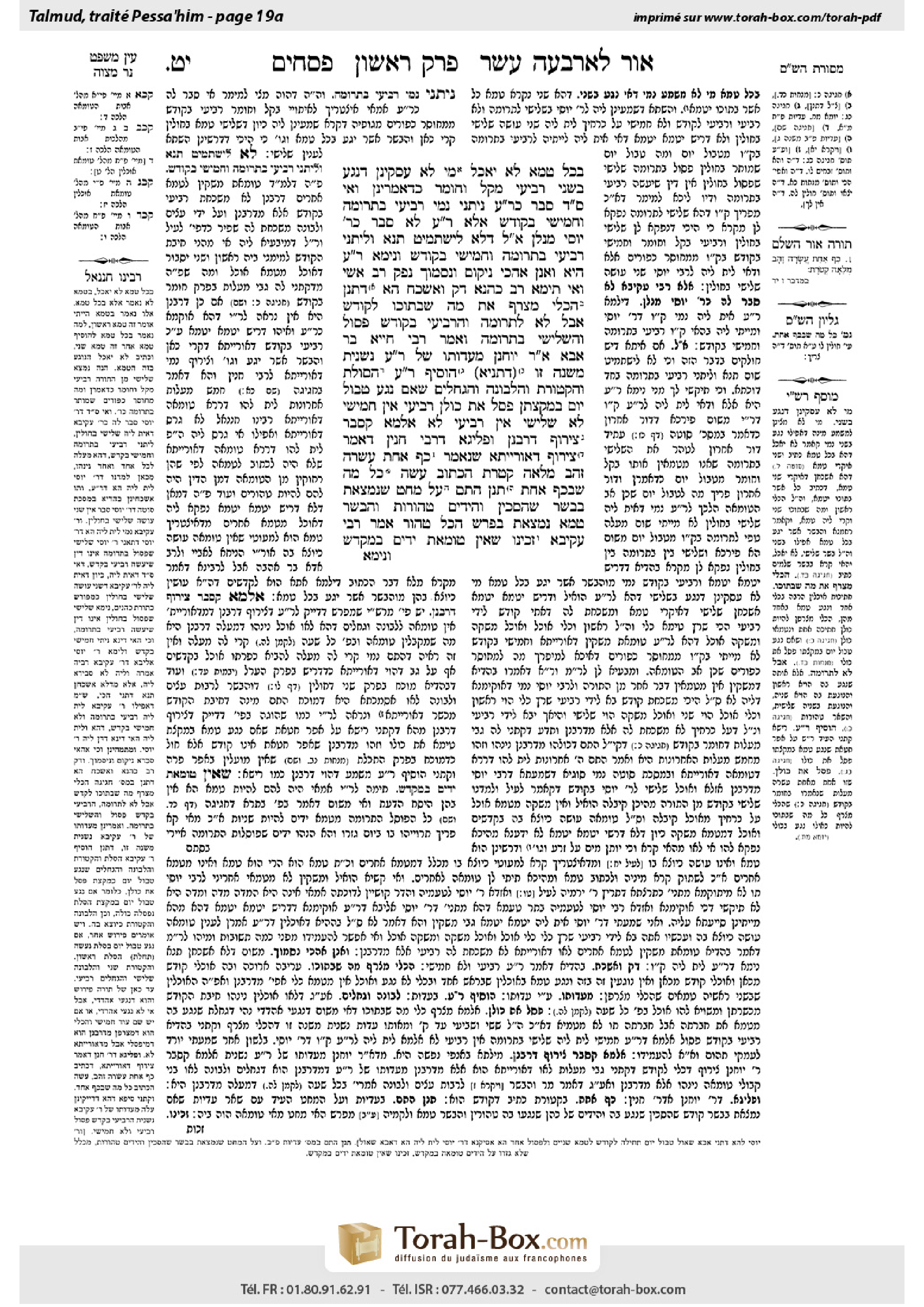
Pesachim 19a: Talmud study for Daf Yomi
Daf Yomi is the daily study of one Talmud folio. Explore 37 tractates with scans, Hebrew text, Sefaria English and AI-generated French translations where annotated.
Passage selection and English or AI-generated French translation are available where the scan has annotations. Daf Study is independent of Torah-Box and Sefaria.
Browse Pesachim · פסחים · All tractatesPesachim 19a text and translations
This page of Pesachim includes the Aramaic text, an English translation and an AI-generated French translation, alongside the scan above.
פסחים י״ט א · Aramaic and Hebrew text
בְּכׇל טָמֵא לֹא יֵאָכֵל״, מִי לָא עָסְקִינַן דְּנָגַע בְּשֵׁנִי. רְבִיעִי מִקַּל וָחוֹמֶר, כִּדְאָמְרִינַן.
וְאִי סָלְקָא דַעְתָּךְ סָבַר כְּרַבִּי עֲקִיבָא, נִיתְנֵי נָמֵי: רְבִיעִי בַּתְּרוּמָה וַחֲמִישִׁי בַּקּוֹדֶשׁ.
אֶלָּא רַבִּי עֲקִיבָא לָא סָבַר כְּרַבִּי יוֹסֵי מְנָלַן?
אֲמַר לֵיהּ: דְּלָא לִישְׁתְּמִיט תַּנָּא וְלִיתְנֵי רְבִיעִי בַּתְּרוּמָה וַחֲמִישִׁי בַּקּוֹדֶשׁ, וְנֵימָא רַבִּי עֲקִיבָא הִיא. וַאֲנַן אַהָכִי נֵיקוּם וְנִסְמוֹךְ?!
נְפַק רַב אָשֵׁי, וְאִי תֵּימָא רַב כָּהֲנָא, דַּק וְאַשְׁכַּח הָא דִּתְנַן: הַכְּלִי מְצָרֵף אֶת מַה שֶּׁבְּתוֹכוֹ לַקּוֹדֶשׁ, אֲבָל לֹא לַתְּרוּמָה. וְהָרְבִיעִי בַּקּוֹדֶשׁ פָּסוּל, וְהַשְּׁלִישִׁי בַּתְּרוּמָה.
וְאָמַר רַבִּי חִיָּיא בַּר אַבָּא אָמַר רַבִּי יוֹחָנָן: מֵעֵדוּתוֹ שֶׁל רַבִּי עֲקִיבָא נִשְׁנֵית מִשְׁנָה זוֹ. (דְּתַנְיָא:) הוֹסִיף רַבִּי עֲקִיבָא הַסּוֹלֶת וְהַקְּטוֹרֶת וְהַלְּבוֹנָה וְהַגֶּחָלִים, שֶׁאִם נָגַע טְבוּל יוֹם בְּמִקְצָתָן פָּסַל אֶת כּוּלָּן.
רְבִיעִי אִין, חֲמִישִׁי לָא. שְׁלִישִׁי אִין, רְבִיעִי לָא.
אַלְמָא קָסָבַר: צֵירוּף דְּרַבָּנַן. וּפְלִיגָא דְּרַבִּי חָנִין, דְּאָמַר: צֵירוּף דְּאוֹרָיְיתָא, שֶׁנֶּאֱמַר: ״כַּף אַחַת עֲשָׂרָה זָהָב מְלֵאָה קְטֹרֶת״, הַכָּתוּב עָשָׂה כׇּל מַה שֶּׁבַּכַּף אַחַת.
תְּנַן הָתָם: עַל מַחַט שֶׁנִּמְצֵאת בַּבָּשָׂר, שֶׁהַסַּכִּין וְהַיָּדַיִם — טְהוֹרוֹת, וְהַבָּשָׂר טָמֵא. נִמְצֵאת בַּפֶּרֶשׁ — הַכֹּל טָהוֹר. אָמַר רַבִּי עֲקִיבָא: זָכִינוּ שֶׁאֵין טוּמְאַת יָדַיִם בַּמִּקְדָּשׁ.
Pesachim 19a · English translation
any impure thing shall not be eaten” (Leviticus 7:19). Are we not dealing even with a case where meat touched an object that was ritually impure with second-degree ritual impurity? And nevertheless, the verse states explicitly that it is impure and assumes third-degree ritual impurity status. No other source is needed to teach that consecrated objects can assume third-degree ritual impurity status. Therefore, fourth-degree impurity status can be derived by means of the a fortiori inference, as we stated above.
The Gemara returns to its previous point: And if it enters your mind that Rabbi Yosei holds in accordance with the opinion of Rabbi Akiva that non-sacred objects can assume third-degree impurity status, let him also teach the halakha of the fourth degree of impurity with regard to teruma, and the fifth degree with regard to consecrated items, on the basis of that same a fortiori inference. The fact that he does not extend the a fortiori inference to include these halakhot proves that Rabbi Yosei does not agree with Rabbi Akiva’s opinion on this issue.
However, with regard to the fact that Rabbi Akiva does not hold in accordance with the opinion of Rabbi Yosei, from where do we derive this? Perhaps he accepts Rabbi Yosei’s a fortiori inference and holds that teruma assumes fourth-degree impurity status and consecrated items assume fifth-degree impurity status.
Rav Kahana said to Rav Ashi that there is indirect proof that this is the case. As it is not possible to avoid finding at least one tanna who teaches fourth-degree impurity with regard to teruma and fifth-degree impurity with regard to consecrated items, and says that this is the opinion of Rabbi Akiva, who derived it from the a fortiori inference of Rabbi Yosei. In response to this claim, the Gemara asks: And will we stand and rely on that proof? Can proof for Rabbi Akiva’s opinion be cited from the fact that no such tanna was found? Perhaps there is some source for that halakha.
Rav Ashi, and some say it was Rav Kahana, left the study hall to examine this matter. He analyzed the issue and found proof positive that Rabbi Akiva does not hold that there is fifth-degree impurity with regard to consecrated items. He proved this from that which we learned in a mishna: A vessel joins that which is in it into a single unit. For example, if there are fruits in a vessel between which there is no contact and one of them became ritually impure, all of the fruits are impure, as they are joined by the vessel. This principle applies with regard to consecrated property, but not with regard to teruma. And the fourth degree of impurity disqualifies consecrated items but does not transmit impurity, while third-degree impurity disqualifies teruma.
And Rabbi Ḥiyya bar Abba said that Rabbi Yoḥanan said: It is from the testimony of Rabbi Akiva that this mishna is taught, as it was taught in a baraita: Rabbi Akiva added in his testimony with regard to the fine flour, the incense, the frankincense, and the coals on the altar, which are not foods and do not ordinarily become impure, that if a person who immersed during that day, who disqualifies consecrated items, touches some of them, he disqualifies all of them, as the vessel joins them into one unit.
This baraita, which is the opinion of Rabbi Akiva, states that with regard to fourth-degree impurity, yes, consecrated objects assume that status; however, with regard to fifth-degree impurity, no, consecrated objects do not assume that status. With regard to third-degree impurity, yes, teruma assumes that status; however, with regard to fourth-degree impurity, no, teruma does not assume that status.
The Gemara comments: Apparently, Rabbi Yoḥanan holds that joining in a single vessel, of frankincense, incense, or coals, is a halakha by rabbinic law, not by Torah law, as the ritual impurity of frankincense and coals is by rabbinic law. And Rabbi Yoḥanan disputes that statement of Rabbi Ḥanin, who said: Joining in a vessel is a halakha by Torah law, as it is stated: “One golden spoon of ten shekels, filled with incense” (Numbers 7:20). The verse rendered everything in the spoon, i.e., all the incense, as one entity.
Apropos ritual purity and impurity in the Temple, the Gemara cites that we learned in a mishna there: The Sages testified about the case of a needle that was found in the meat of an animal that was led through water, that the knife and the hands that touched the needle are ritually pure but the meat is impure, as the needle might have been impure. If the needle was found in the secretions of the animal’s stomach, everything is pure, as secretions do not transfer impurity to the meat. Rabbi Akiva said: We were privileged to learn a novel halakha from here, which is that there is no impurity of hands in the Temple as in this case the hands did not become impure upon contact with the needle.
Pesachim 19a · Traduction française (IA)
« Toute chose impure ne sera pas mangée » (Lévitique 7:19). Ne sommes-nous pas même dans un cas où la viande a touché un objet atteint d’une impureté rituelle de deuxième degré ? Pourtant, le verset affirme explicitement qu’elle est impure et lui confère le statut de troisième degré d’impureté rituelle. Aucune autre source n’est nécessaire pour enseigner que les objets consacrés peuvent atteindre le troisième degré d’impureté rituelle. On peut donc déduire le statut de quatrième degré d’impureté au moyen du raisonnement a fortiori, comme nous l’avons dit plus haut.
La Guemara revient à son point précédent : si tu penses que Rabbi Yosei est d’accord avec Rabbi Akiva, selon qui les objets profanes peuvent atteindre le troisième degré d’impureté, qu’il enseigne également la halakha du quatrième degré d’impureté pour la terouma et du cinquième degré pour les objets consacrés, sur la base de ce même raisonnement a fortiori. Le fait qu’il n’étende pas le raisonnement a fortiori à ces halakhot prouve que Rabbi Yosei n’est pas d’accord avec Rabbi Akiva sur cette question.
Toutefois, d’où déduisons-nous que Rabbi Akiva n’est pas d’accord avec Rabbi Yosei ? Peut-être accepte-t-il le raisonnement a fortiori de Rabbi Yosei et considère-t-il que la terouma atteint le quatrième degré d’impureté et les objets consacrés, le cinquième degré.
Rav Kahana dit à Rav Ashi qu’il existe une preuve indirecte que c’est bien le cas. En effet, il est impossible qu’on ne trouve pas au moins un tanna qui enseigne le quatrième degré d’impureté pour la terouma et le cinquième degré pour les objets consacrés, et qui affirme que telle est l’opinion de Rabbi Akiva, qui l’a déduite du raisonnement a fortiori de Rabbi Yosei. En réponse à cet argument, la Guemara demande : Allons-nous donc nous en tenir à cette preuve ? Peut-on établir l’opinion de Rabbi Akiva en invoquant le fait qu’on n’a trouvé aucun tanna de ce genre ? Peut-être existe-t-il une source pour cette halakha.
Rav Ashi — et certains disent qu’il s’agissait de Rav Kahana — sortit de la salle d’étude pour examiner la question. Il l’analysa et trouva une preuve concluante que, selon Rabbi Akiva, les objets consacrés n’atteignent pas le cinquième degré d’impureté. Il le démontra à partir de ce que nous avons appris dans une Michna : un récipient rassemble en un tout les éléments qu’il contient. Par exemple, si un récipient contient des fruits qui ne se touchent pas et que l’un d’eux devient rituellement impur, tous les fruits le deviennent, car le récipient les rassemble. Ce principe s’applique aux objets consacrés, mais pas à la terouma. Le quatrième degré d’impureté disqualifie les objets consacrés sans transmettre l’impureté, tandis que le troisième degré d’impureté disqualifie la terouma.
Et Rabbi Ḥiyya bar Abba dit au nom de Rabbi Yoḥanan : cette Michna est fondée sur le témoignage de Rabbi Akiva, comme on l’enseigne dans une baraïta : Rabbi Akiva ajouta à son témoignage que, pour la fleur de farine, l’encens, l’oliban et les charbons de l’autel — qui ne sont pas des aliments et ne deviennent habituellement pas impurs —, si une personne qui s’est immergée ce jour-là, laquelle disqualifie les objets consacrés, en touche une partie, elle les disqualifie tous, car le récipient les rassemble en un tout.
Cette baraïta, qui expose l’opinion de Rabbi Akiva, enseigne que les objets consacrés atteignent bien le quatrième degré d’impureté, mais non le cinquième. De même, la terouma atteint bien le troisième degré d’impureté, mais non le quatrième.
La Guemara fait remarquer : il semble que, selon Rabbi Yoḥanan, le fait que l’oliban, l’encens ou les charbons soient rassemblés dans un même récipient relève d’une halakha rabbinique, et non de la Torah, puisque l’impureté rituelle de l’oliban et des charbons relève de la loi rabbinique. Rabbi Yoḥanan contredit ainsi l’affirmation de Rabbi Ḥanin, qui a dit que le rassemblement dans un récipient relève d’une halakha de la Torah, comme il est dit : « Une cuillère d’or de dix sicles, remplie d’encens » (Nombres 7:20). Le verset a fait de tout ce qui se trouvait dans la cuillère, c’est-à-dire de tout l’encens, une seule entité.
À propos de la pureté et de l’impureté rituelles dans le Temple, la Guemara cite ce que nous avons appris dans une Michna, là-bas : les Sages ont témoigné au sujet d’une aiguille trouvée dans la viande d’un animal qui avait été conduit dans l’eau : le couteau et les mains qui ont touché l’aiguille sont rituellement purs, mais la viande est impure, car l’aiguille a pu être impure. Si l’aiguille a été trouvée dans les sécrétions de l’estomac de l’animal, tout est pur, car les sécrétions ne transmettent pas l’impureté à la viande. Rabbi Akiva dit : Nous avons eu le privilège d’apprendre ici une halakha nouvelle : les mains ne contractent pas d’impureté dans le Temple, puisque, dans ce cas, elles ne sont pas devenues impures au contact de l’aiguille.
Traduction française générée par IA à partir de l’édition anglaise de Sefaria. Vérifie toujours un passage avec le texte source.
Text from Sefaria: William Davidson Edition - Vocalized Aramaic (CC BY NC); William Davidson Edition - English (CC BY NC).