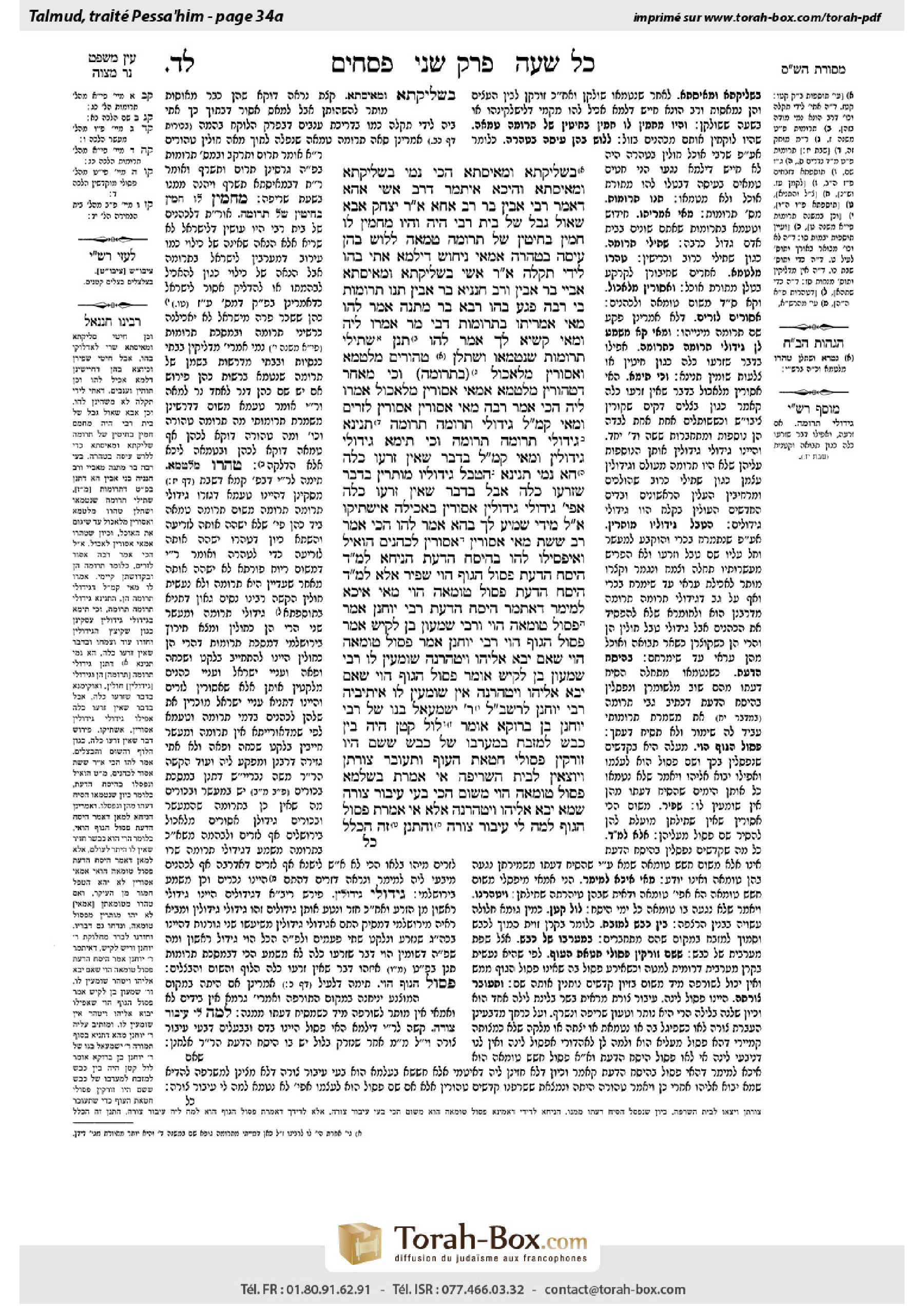
Pesachim 34a: Talmud study for Daf Yomi
Daf Yomi is the daily study of one Talmud folio. Explore 37 tractates with scans, Hebrew text, Sefaria English and AI-generated French translations where annotated.
Passage selection and English or AI-generated French translation are available where the scan has annotations. Daf Study is independent of Torah-Box and Sefaria.
Browse Pesachim · פסחים · All tractatesPesachim 34a text and translations
This page of Pesachim includes the Aramaic text, an English translation and an AI-generated French translation, alongside the scan above.
פסחים ל״ד א · Aramaic and Hebrew text
בִּשְׁלִיקָתָא וּמְאִיסָתָא, הָכִי נָמֵי בִּשְׁלִיקָתָא וּמְאִיסָתָא. וְהֵיכָא אִיתְּמַר דְּרַב אָשֵׁי? אַהָא דְּאָמַר רַבִּי אָבִין בַּר רַב אַחָא אָמַר רַבִּי יִצְחָק: אַבָּא שָׁאוּל גַּבָּל שֶׁל בֵּית רַבִּי הָיָה, וְהָיוּ מְחַמִּין לוֹ חַמִּין בְּחִיטִּין שֶׁל תְּרוּמָה טְמֵאָה לָלוּשׁ בָּהֶן עִיסָּה בְּטׇהֳרָה. אַמַּאי? נֵיחוּשׁ דִּילְמָא אָתֵי בְּהוּ לִידֵי תַקָּלָה! אָמַר רַב אָשֵׁי: בִּשְׁלִיקָתָא וּמְאִיסָתָא.
אַבָּיֵי בַּר אָבִין וְרַב חֲנַנְיָא בַּר אָבִין תָּנוּ תְּרוּמוֹת בֵּי רַבָּה. פְּגַע בְּהוּ רָבָא בַּר מַתְנָה, אֲמַר לְהוּ: מַאי אָמְרִיתוּ בִּתְרוּמוֹת דְּבֵי מָר? אֲמַרוּ לֵיהּ: וּמַאי קַשְׁיָא לָךְ? אֲמַר לְהוּ, תְּנַן: שְׁתִילֵי תְרוּמוֹת שֶׁנִּטְמְאוּ וּשְׁתָלָן — טְהוֹרִים מִלְּטַמֵּא, וַאֲסוּרִין מִלֶּאֱכוֹל (בִּתְרוּמָה). וְכִי מֵאַחַר דִּטְהוֹרִין מִלְּטַמֵּא, אַמַּאי אֲסוּרִין מִלֶּאֱכוֹל?
אֲמַרוּ לֵיהּ, הָכִי אָמַר רַבָּה: מַאי אֲסוּרִין — אֲסוּרִין לְזָרִים. וּמַאי קָא מַשְׁמַע לַן: גִּידּוּלֵי תְרוּמָה — תְּרוּמָה? תְּנֵינָא: גִּידּוּלֵי תְרוּמָה — תְּרוּמָה!
וְכִי תֵּימָא גִּידּוּלֵי גִידּוּלִין, וּמַאי קָא מַשְׁמַע לַן — בְּדָבָר שֶׁאֵין זַרְעוֹ כָּלֶה. הָא נָמֵי תְּנֵינָא: הַטֶּבֶל — גִּידּוּלָיו מוּתָּרִין, בְּדָבָר שֶׁזַּרְעוֹ כָּלֶה. אֲבָל בְּדָבָר שֶׁאֵין זַרְעוֹ כָּלֶה — אֲפִילּוּ גִּידּוּלֵי גִידּוּלִין אֲסוּרִין בַּאֲכִילָה. אִישְׁתִּיקוּ.
אֲמַרוּ לֵיהּ: מִידֵּי שְׁמִיעַ לָךְ בְּהָא? אֲמַר לְהוּ, הָכִי אָמַר רַב שֵׁשֶׁת: מַאי אֲסוּרִין — אֲסוּרִין לְכֹהֲנִים, הוֹאִיל וְאִיפְּסִילוּ לְהוּ בְּהֶיסַּח הַדַּעַת.
הָנִיחָא לְמַאן דְּאָמַר הֶיסַּח הַדַּעַת פְּסוּל הַגּוּף הָוֵי — שַׁפִּיר, אֶלָּא לְמַאן דְּאָמַר הֶיסַּח הַדַּעַת פְּסוּל טוּמְאָה הָוֵי — מַאי אִיכָּא לְמֵימַר?!
דְּאִתְּמַר: הֶיסַּח הַדַּעַת, רַבִּי יוֹחָנָן אָמַר: פְּסוּל טוּמְאָה הָוֵי, וְרַבִּי שִׁמְעוֹן בֶּן לָקִישׁ אָמַר: פְּסוּל הַגּוּף הָוֵי.
רַבִּי יוֹחָנָן אָמַר פְּסוּל טוּמְאָה הָוֵי: שֶׁאִם יָבֹא אֵלִיָּהוּ וִיטַהֲרֶנָּה — שׁוֹמְעִין לוֹ. רַבִּי שִׁמְעוֹן בֶּן לָקִישׁ אוֹמֵר פְּסוּל הַגּוּף הָוֵי: שֶׁאִם יָבֹא אֵלִיָּהוּ וִיטַהֲרֶנָּה — אֵין שׁוֹמְעִין לוֹ.
אֵיתִיבֵיהּ רַבִּי יוֹחָנָן לְרַבִּי שִׁמְעוֹן בֶּן לָקִישׁ, רַבִּי יִשְׁמָעֵאל בְּנוֹ שֶׁל רַבִּי יוֹחָנָן בֶּן בְּרוֹקָא אוֹמֵר: לוּל קָטָן הָיָה בֵּין כֶּבֶשׁ לַמִּזְבֵּחַ בְּמַעֲרָבוֹ שֶׁל כֶּבֶשׁ, שֶׁשָּׁם הָיוּ זוֹרְקִין פְּסוּלֵי חַטַּאת הָעוֹף, וּתְעוּבַּר צוּרָתָן, וְיוֹצְאִין לְבֵית הַשְּׂרֵיפָה. אִי אָמְרַתְּ בִּשְׁלָמָא פְּסוּל טוּמְאָה הָוֵי, מִשּׁוּם הָכִי בָּעֵי עִיבּוּר צוּרָה, שֶׁמָּא יָבֹא אֵלִיָּהוּ וִיטַהֲרֶנָּה. אֶלָּא אִי אָמְרַתְּ פְּסוּל הַגּוּף, לְמָה לִי עִיבּוּר צוּרָה? וְהָתְנַן, זֶה הַכְּלָל:
Pesachim 34a · English translation
This is referring to boiled and repulsive wheat, i.e., wheat that one boiled and then placed in a repulsive area, in which case he need not be concerned that this wheat will accidentally be eaten; so too here, it is referring to boiled and repulsive wheat. The Gemara asks: Where was Rav Ashi’s explanation stated? It was stated with regard to this: As Rabbi Avin bar Rav Aḥa said that Rabbi Yitzḥak said: Abba Shaul was the dough kneader of Rabbi Yehuda HaNasi’s house, and they would heat water for him, to make dough, with wheat of ritually impure teruma, which was purchased from priests at a low price, in order to knead dough in ritual purity. The Gemara asks: Why did they do this? Let us be concerned lest they encounter a stumbling block by accidentally eating this wheat. With regard to this Rav Ashi said that it was only done when the wheat was boiled and repulsive and could only be used for lighting a fire.
After mentioning ways in which impure teruma was used, the Gemara mentions other halakhot pertaining to this issue. Abaye bar Avin and Rav Ḥananya bar Avin taught the tractate of Terumot in the school of Rabba. Rava bar Mattana met them and said to them: What novel idea can you say has been taught with regard to Terumot in the school of our Master, Rabba? They said to him: What is difficult for you? There must be some issue troubling you that has caused you to ask this question. He said to them: The following statement that we learned in the mishna in Terumot is unclear: Saplings of teruma that became ritually impure and were planted are pure such that they do not impart ritual impurity once they have been planted, but they are prohibited to be eaten as teruma. The question arises: If they do not impart ritual impurity, why is it prohibited to eat them? If their impurity has been eliminated then it should be permitted to eat them, like other ritually pure teruma.
Abaye bar Avin and Rav Ḥananya bar Avin said to Rava bar Mattana: This is what Rabba said in explaining this mishna: What does it mean that they are prohibited to be eaten? It means that they are prohibited to be eaten by non-priests, but a priest may eat them. Once these saplings are planted, they lose their ritual impurity but retain their status as teruma. Rava bar Mattana challenged this answer: If this is the case, what is the mishna teaching us with this statement? Is it teaching us that growths of teruma are considered teruma? It is unnecessary to teach this principle, as we already learned: Growths of teruma, i.e., produce that grows from teruma that was planted in the ground, are considered teruma. Why, then, is it necessary to teach this principle again?
And if you say as follows: This case is referring to the growths of growths of teruma, i.e., plants that grew from the original growths of teruma, and what is it teaching us? It is teaching that an item whose seed does not disintegrate when planted in the ground maintains its teruma status. While most seeds will disintegrate, other plants, such as onions and garlic, merely continue growing when planted. In that case, this mishna would be informing us that even the growths of growths of such plants retain their teruma status. However, we already learned that as well. As the mishna states: With regard to untithed produce [tevel], its growths, the produce that grows from it, are permitted in the case of items whose seed disintegrates; however, in the case of items where the seed does not disintegrate, it is prohibited to eat even the growths of growths unless they are tithed. There would be no need for the mishna to teach us this halakha a second time. They were silent and did not have an answer to this question.
They said to Rava bar Mattana: Have you heard something in this regard? He said to them: This is what Rav Sheshet said: What is the meaning of the word prohibited in this context? It means that it is prohibited for priests, since it has been disqualified for them due to the diversion of attention. Teruma and other consecrated property must be guarded, and when one fails to do so, it is treated as though it were impure. Therefore, these teruma saplings are treated as though they have become impure once the priest diverts attention from them, and they remain prohibited to him even after another generation grows from them.
The Gemara asks: Granted, according to the one who says that a diversion of attention constitutes an inherent disqualification, it works out well. According to this opinion, a diversion of attention does not disqualify teruma due to a concern that it became impure. Instead, there is an independent rabbinic decree rendering teruma that has not been watched impure even when this teruma could not possibly have become impure. According to this opinion, one can understand why this growth may not be eaten by a priest. But according to the one who says that a diversion of attention is a disqualification due to a concern about ritual impurity, what is there to say? It is stated in the mishna that by planting these saplings they become pure, even if they were certainly ritually impure prior to being planted. If this is the case with regard to teruma that is certainly impure, all the more so should it apply to a case where there is only a chance that the teruma is ritually impure.
Apropos the discussion of diversion of attention, the Gemara cites a dispute between amora’im with regard to this issue, as it was stated: What is the nature of the disqualification of diversion of attention? Rabbi Yoḥanan said: It is a disqualification due to a concern about ritual impurity that may have been contracted while one’s attention was diverted. And Rabbi Shimon ben Lakish said: It is an inherent disqualification.
The Gemara discusses the ramifications of this dispute: According to Rabbi Yoḥanan, who said it is a disqualification due to a concern about ritual impurity, if Elijah comes and renders it ritually pure then we will listen to him, because it was treated as impure only due to a doubt with regard to its actual status. However, according to Rabbi Shimon ben Lakish, who said that it is an inherent disqualification, even if Elijah comes and renders it pure we will not listen to him. The reason for this is that Rabbi Shimon ben Lakish believes that this decree is unrelated to the question of whether the object actually became impure.
Rabbi Yoḥanan raised an objection to the opinion of Rabbi Shimon ben Lakish based on what is taught in the Tosefta: Rabbi Yishmael, son of Rabbi Yoḥanan ben Beroka, says: There was a small gap between the ramp and the altar on the western side of the ramp, where they would throw disqualified birds that had been designated as sin-offerings. If birds became disqualified for any reason, such as a diversion of attention, they were left there until their form decayed, i.e., until the next morning, at which point they would be definitively disqualified due to remaining in the Temple overnight and could be taken out to the place designated for burning. Granted, if you say that a diversion of attention is a disqualification due to a concern for ritual impurity, for this reason it requires decay of form to ensure that the bird is certainly disqualified. Currently the bird is disqualified only due to uncertainty, and Elijah may come and render it ritually pure. However, if you say that it is an inherent disqualification, then why do I need to leave it until it has decay of form? It should be definitively disqualified once there has been a diversion of attention. But didn’t we learn in the mishna that this is the principle:
Pesachim 34a · Traduction française (IA)
Cela fait référence à du blé bouilli et répugnant, c’est-à-dire du blé que l’on a fait bouillir puis placé dans un endroit répugnant, de sorte qu’il n’y a pas lieu de craindre qu’il soit mangé par inadvertance. De même ici, il s’agit de blé bouilli et répugnant. La Guemara demande : Où l’explication de Rav Ashi a-t-elle été donnée ? Elle a été donnée à propos de ce qui suit : Rabbi Avin bar Rav Aḥa a dit au nom de Rabbi Yitzḥak : Abba Shaul était le pétrisseur de la maison de Rabbi Yehuda HaNasi, et l’on chauffait pour lui de l’eau destinée à la préparation de la pâte avec du blé de terouma rituellement impur, acheté aux prêtres à bas prix, afin de pétrir la pâte en état de pureté rituelle. La Guemara demande : Pourquoi faisaient-ils cela ? Ne faut-il pas craindre qu’ils trébuchent et mangent ce blé par inadvertance ? À ce sujet, Rav Ashi a dit que cela ne se faisait que lorsque le blé avait été bouilli et rendu répugnant, de sorte qu’il ne pouvait servir qu’à alimenter un feu.
Après avoir mentionné les usages de la terouma impure, la Guemara évoque d’autres halakhot relatives à cette question. Abaye bar Avin et Rav Ḥananya bar Avin étudiaient le traité Teroumot à l’école de Rabba. Rava bar Mattana les rencontra et leur dit : Quelle nouveauté avez-vous entendue au sujet des Teroumot à l’école de notre maître Rabba ? Ils lui répondirent : Qu’est-ce qui te pose difficulté ? Il doit y avoir une question qui te préoccupe et t’a poussé à nous interroger. Il leur dit : La déclaration suivante, que nous avons apprise dans la Michna de Teroumot, n’est pas claire : Les jeunes plants de terouma qui sont devenus rituellement impurs puis ont été plantés sont purs, en ce qu’ils ne transmettent plus l’impureté rituelle une fois plantés, mais il est interdit de les manger comme terouma. La question se pose : S’ils ne transmettent pas l’impureté rituelle, pourquoi est-il interdit de les manger ? Si leur impureté a été éliminée, il devrait être permis de les manger, comme toute autre terouma rituellement pure.
Abaye bar Avin et Rav Ḥananya bar Avin dirent à Rava bar Mattana : Voici ce que Rabba a dit pour expliquer cette Michna : Que signifie « il est interdit de les manger » ? Cela signifie qu’il est interdit aux non-prêtres de les manger, mais qu’un prêtre peut les consommer. Une fois plantés, ces jeunes plants perdent leur impureté rituelle, mais conservent leur statut de terouma. Rava bar Mattana contesta cette réponse : Si c’est le cas, que nous enseigne la Michna par cette déclaration ? Nous enseigne-t-elle que les pousses de terouma sont considérées comme de la terouma ? Il n’est pas nécessaire d’enseigner ce principe, car nous avons déjà appris que les pousses de terouma, c’est-à-dire les produits qui poussent à partir de terouma plantée en terre, sont considérées comme de la terouma. Pourquoi donc est-il nécessaire de nous enseigner à nouveau ce principe ?
Et si tu dis que le cas concerne les pousses des pousses de terouma, c’est-à-dire des plantes qui ont poussé à partir des premières pousses de terouma, que nous enseigne-t-on alors ? Que tout élément dont la graine ne se désagrège pas une fois plantée en terre conserve son statut de terouma. La plupart des graines se désagrègent, mais d’autres plantes, comme les oignons et l’ail, continuent simplement à pousser lorsqu’on les plante. La Michna nous apprendrait alors que même les pousses des pousses de ces plantes conservent leur statut de terouma. Cependant, nous avons déjà appris cela aussi. En effet, la Michna énonce que, pour les produits non soumis à la dîme [tevel], leurs pousses, c’est-à-dire les produits qui en résultent, sont permises lorsque la graine se désagrège ; mais lorsque la graine ne se désagrège pas, il est interdit de manger même les pousses des pousses tant qu’elles n’ont pas été soumises à la dîme. Il n’est donc pas nécessaire que la Michna nous enseigne cette halakha une seconde fois. Ils gardèrent le silence et ne trouvèrent pas de réponse à cette question.
Ils dirent à Rava bar Mattana : As-tu entendu quelque chose à ce sujet ? Il leur répondit : Voici ce que Rav Sheshet a dit : Que signifie ici le mot « interdit » ? Cela signifie qu’il est interdit aux prêtres d’en manger, car l’objet a été disqualifié à leur égard en raison d’un défaut de surveillance. La terouma et les autres biens consacrés doivent être gardés ; lorsqu’on ne le fait pas, ils sont traités comme s’ils étaient impurs. Par conséquent, ces jeunes plants de terouma sont considérés comme devenus impurs dès que le prêtre détourne son attention d’eux, et ils lui restent interdits même après qu’une nouvelle génération a poussé à partir d’eux.
La Guemara demande : Cela se comprend selon celui qui dit que le défaut de surveillance constitue une disqualification intrinsèque. Selon cette opinion, le défaut de surveillance ne disqualifie pas la terouma par crainte qu’elle soit devenue impure. Il s’agit plutôt d’un décret rabbinique indépendant qui rend impure une terouma qui n’a pas été surveillée, même lorsqu’il est impossible qu’elle soit devenue impure. Selon cette opinion, on comprend pourquoi un prêtre ne peut pas manger cette pousse. Mais, selon celui qui dit que le défaut de surveillance entraîne une disqualification par crainte d’impureté rituelle, que peut-on répondre ? La Michna dit que ces jeunes plants deviennent purs lorsqu’on les plante, même s’ils étaient certainement rituellement impurs avant d’être plantés. S’il en est ainsi pour une terouma certainement impure, à plus forte raison cela devrait s’appliquer à un cas où il existe seulement une possibilité que la terouma soit rituellement impure.
À propos de la discussion sur le défaut de surveillance, la Guemara rapporte une controverse entre des amoraïm sur cette question. En effet, il a été enseigné : Quelle est la nature de la disqualification due au défaut de surveillance ? Rabbi Yoḥanan a dit : Il s’agit d’une disqualification due à la crainte qu’une impureté rituelle ait été contractée pendant que l’on avait détourné son attention. Rabbi Shimon ben Lakish a dit : Il s’agit d’une disqualification intrinsèque.
La Guemara examine les conséquences de cette controverse. Selon Rabbi Yoḥanan, qui dit qu’il s’agit d’une disqualification due à la crainte d’une impureté rituelle, si Élie vient et déclare l’objet rituellement pur, nous l’écouterons, car il n’a été traité comme impur qu’en raison d’un doute sur son statut réel. En revanche, selon Rabbi Shimon ben Lakish, qui dit qu’il s’agit d’une disqualification intrinsèque, même si Élie vient et le déclare pur, nous ne l’écouterons pas. La raison en est que Rabbi Shimon ben Lakish estime que ce décret ne dépend pas de la question de savoir si l’objet est réellement devenu impur.
Rabbi Yoḥanan souleva une objection contre l’opinion de Rabbi Shimon ben Lakish en s’appuyant sur ce qui est enseigné dans la Tosefta : Rabbi Yishmael, fils de Rabbi Yoḥanan ben Beroka, dit : Il y avait un petit espace entre la rampe et l’autel, du côté ouest de la rampe, où l’on jetait les oiseaux disqualifiés qui avaient été désignés comme sacrifices expiatoires. Si des oiseaux étaient disqualifiés pour quelque raison que ce soit, par exemple à cause d’un défaut de surveillance, on les y laissait jusqu’à ce que leur forme se décompose, c’est-à-dire jusqu’au lendemain matin ; à ce moment-là, ils étaient définitivement disqualifiés parce qu’ils étaient restés toute la nuit dans le Temple, et pouvaient être emportés vers l’endroit prévu pour leur incinération. C’est compréhensible si tu dis que le défaut de surveillance entraîne une disqualification par crainte d’impureté rituelle : c’est pour cette raison qu’il faut attendre que la forme se décompose, afin de s’assurer que l’oiseau est certainement disqualifié. Pour l’instant, l’oiseau n’est disqualifié qu’en raison d’un doute, et Élie pourrait venir et le déclarer rituellement pur. En revanche, si tu dis qu’il s’agit d’une disqualification intrinsèque, pourquoi faut-il le laisser jusqu’à ce que sa forme se décompose ? Il devrait être définitivement disqualifié dès que l’attention a été détournée. Mais n’avons-nous pas appris dans la Michna le principe suivant :
Traduction française générée par IA à partir de l’édition anglaise de Sefaria. Vérifie toujours un passage avec le texte source.
Text from Sefaria: William Davidson Edition - Vocalized Aramaic (CC BY NC); William Davidson Edition - English (CC BY NC).