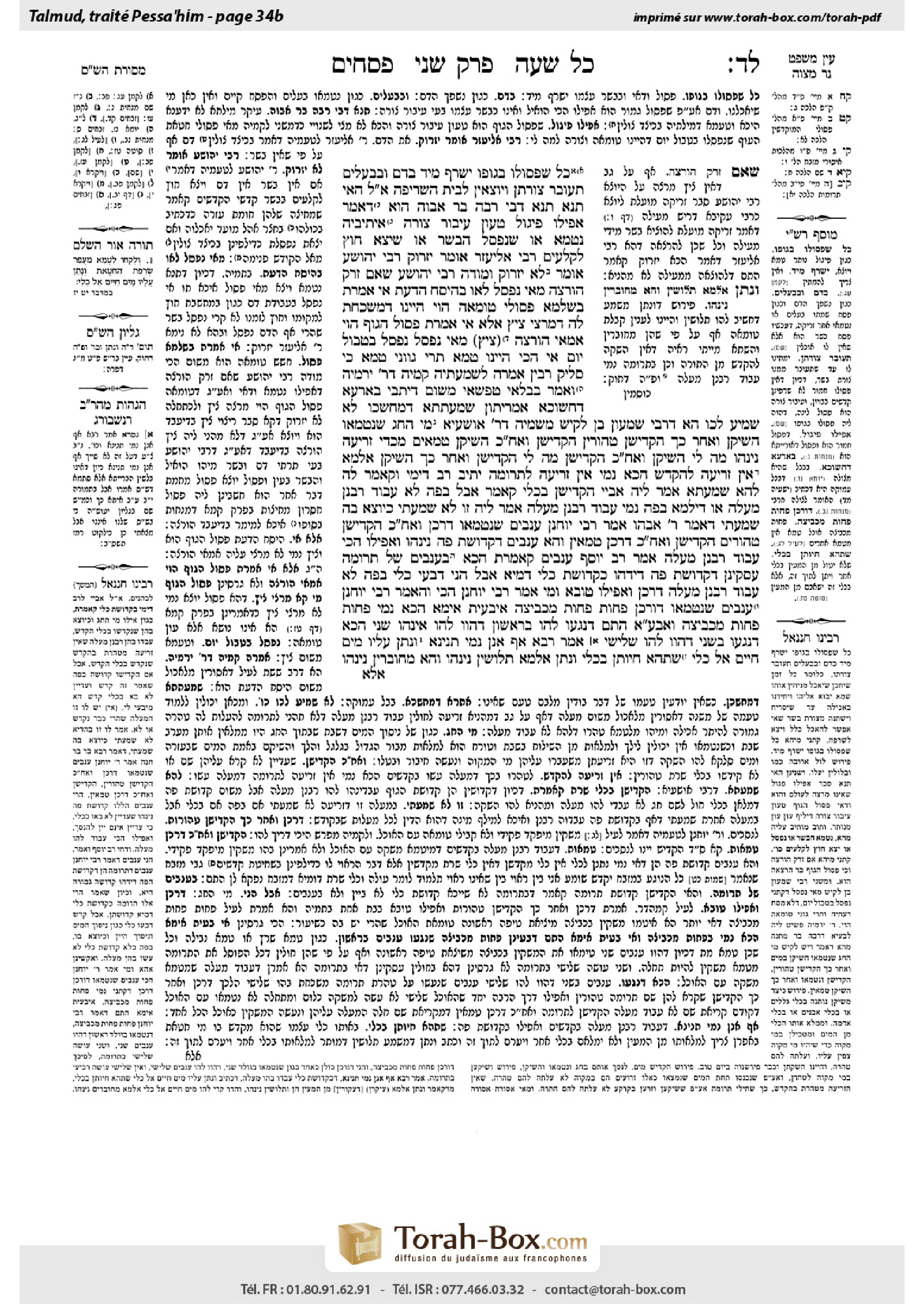
Pesachim 34b: Talmud study for Daf Yomi
Daf Yomi is the daily study of one Talmud folio. Explore 37 tractates with scans, Hebrew text, Sefaria English and AI-generated French translations where annotated.
Passage selection and English or AI-generated French translation are available where the scan has annotations. Daf Study is independent of Torah-Box and Sefaria.
Browse Pesachim · פסחים · All tractatesPesachim 34b text and translations
This page of Pesachim includes the Aramaic text, an English translation and an AI-generated French translation, alongside the scan above.
פסחים ל״ד ב · Aramaic and Hebrew text
כׇּל שֶׁפְּסוּלוֹ בְּגוּפוֹ — יִשָּׂרֵף מִיָּד. בַּדָּם וּבַבְּעָלִים — תְּעוּבַּר צוּרָתָן וְיוֹצְאִין לְבֵית הַשְּׂרֵיפָה. אֲמַר לֵיהּ: הַאי תַּנָּא, תַּנָּא דְּבֵי רַבָּה בַּר אֲבוּהּ הוּא, דְּאָמַר: אֲפִילּוּ פִּיגּוּל טָעוּן עִיבּוּר צוּרָה.
אֵיתִיבֵיהּ: נִטְמָא אוֹ שֶׁנִּפְסַל הַבָּשָׂר, אוֹ שֶׁיָּצָא חוּץ לַקְּלָעִים, רַבִּי אֱלִיעֶזֶר אוֹמֵר: יִזְרוֹק, רַבִּי יְהוֹשֻׁעַ אוֹמֵר: לֹא יִזְרוֹק. וּמוֹדֶה רַבִּי יְהוֹשֻׁעַ שֶׁאִם זָרַק — הוּרְצָה.
מַאי נִפְסַל — לָאו בְּהֶיסַּח הַדַּעַת? אִי אָמְרַתְּ בִּשְׁלָמָא פְּסוּלֵי טוּמְאָה הָוֵי, הַיְינוּ דְּמַשְׁכַּחַתְּ לַהּ דִּמְרַצֵּי צִיץ. אֶלָּא אִי אָמְרַתְּ פְּסוּל הַגּוּף הָוֵי, אַמַּאי הוּרְצָה (צִיץ)?
מַאי נִפְסַל, נִפְסַל בִּטְבוּל יוֹם. אִי הָכִי, הַיְינוּ טָמֵא! תְּרֵי גַּוְונֵי טָמֵא.
כִּי סְלֵיק רָבִין, אַמְרַהּ לִשְׁמַעְתֵּיהּ קַמֵּיהּ דְּרַבִּי יִרְמְיָה, וַאֲמַר: בַּבְלָאֵי טַפְשָׁאֵי, מִשּׁוּם דְּיָתְבִי בְּאַרְעָא דַחֲשׁוֹכָא אָמְרִיתוּן שְׁמַעְתָּתָא דִּמְחַשְּׁכוּ. לָא שְׁמִיעַ לְכוּ הָא דְּרַבִּי שִׁמְעוֹן בֶּן לָקִישׁ מִשְּׁמֵיהּ דְּרַבִּי אוֹשַׁעְיָא:
מֵי הַחַג שֶׁנִּטְמְאוּ, הִשִּׁיקָן וְאַחַר כָּךְ הִקְדִּישָׁן — טְהוֹרִין, הִקְדִּישָׁן וְאַחַר כָּךְ הִשִּׁיקָן — טְמֵאִים.
מִכְּדֵי זְרִיעָה נִינְהוּ, מָה לִי הִשִּׁיקָן וְאַחַר כָּךְ הִקְדִּישָׁן, מָה לִי הִקְדִּישָׁן וְאַחַר כָּךְ הִשִּׁיקָן? אַלְמָא: אֵין זְרִיעָה לְהֶקְדֵּשׁ. הָכָא נָמֵי, אֵין זְרִיעָה לִתְרוּמָה.
יָתֵיב רַב דִּימִי וְקָאָמַר לַהּ לְהָא שְׁמַעְתָּא. אֲמַר לֵיהּ אַבָּיֵי: הִקְדִּישָׁן בִּכְלִי קָאָמַר, אֲבָל בַּפֶּה לָא עֲבוּד רַבָּנַן מַעֲלָה. אוֹ דִילְמָא בַּפֶּה נָמֵי עֲבוּד רַבָּנַן מַעֲלָה?
אֲמַר לֵיהּ: זוֹ לֹא שָׁמַעְתִּי, כַּיּוֹצֵא בָּהּ שָׁמַעְתִּי. דְּאָמַר רַבִּי אֲבָהוּ אָמַר רַבִּי יוֹחָנָן: עֲנָבִים שֶׁנִּטְמְאוּ, דְּרָכָן וְאַחַר כָּךְ הִקְדִּישָׁן — טְהוֹרִים. הִקְדִּישָׁן וְאַחַר כָּךְ דְּרָכָן — טְמֵאִין. וְהָא עֲנָבִים דִּקְדוּשַּׁת פֶּה נִינְהוּ, וַאֲפִילּוּ הָכִי עֲבוּד רַבָּנַן מַעֲלָה.
אָמַר רַב יוֹסֵף: עֲנָבִים קָאָמְרַתְּ? הָכָא בַּעֲנָבִים שֶׁל תְּרוּמָה עָסְקִינַן, דִּקְדוּשַּׁת פֶּה דִּידְהוּ — כִּקְדוּשַּׁת כְּלִי דָּמְיָא. אֲבָל הָנֵי דְּבָעֵי כְּלִי, בַּפֶּה לָא עֲבוּד רַבָּנַן מַעֲלָה.
דְּרָכָן — וַאֲפִילּוּ טוּבָא?! וּמִי אָמַר רַבִּי יוֹחָנָן הָכִי, וְהָאָמַר רַבִּי יוֹחָנָן: עֲנָבִים שֶׁנִּטְמְאוּ — דּוֹרְכָן פָּחוֹת פָּחוֹת מִכְּבֵיצָה!
אִיבָּעֵית אֵימָא: הָכָא נָמֵי פָּחוֹת פָּחוֹת מִכְּבֵיצָה. וְאִיבָּעֵית אֵימָא: הָתָם דְּנָגְעוּ לְהוּ בְּרִאשׁוֹן, דְּהָווּ לְהוּ אִינְהוּ שֵׁנִי. הָכָא דְּנָגְעוּ בְּשֵׁנִי, דְּהָווּ לְהוּ שְׁלִישִׁי.
אָמַר רָבָא, אַף אֲנַן נָמֵי תְּנֵינָא: ״וְנָתַן עָלָיו מַיִם חַיִּים אֶל כֶּלִי״ — שֶׁתְּהֵא חִיּוּתָן בִּכְלִי. ״וְנָתַן״, אַלְמָא תְּלוּשִׁין נִינְהוּ. וְהָא מְחוּבָּרִין נִינְהוּ!
Pesachim 34b · English translation
Any offering that has a disqualification in the body of the animal, i.e., it has a definite disqualification with regard to the meat itself, should be burned immediately. If it has a disqualification in the blood of the animal, e.g., if the blood was spilled, or a disqualification of its owner, e.g., if the owner became impure, then it should be left until its form is decayed and taken out to the place designated for burning. Rabbi Shimon ben Lakish said to him: This tanna, Rabbi Yishmael, son of Rabbi Yoḥanan ben Beroka, is of the same opinion as the tanna who taught in the school of Rabba bar Avuh, who said: Even piggul, an offering that was invalidated due to inappropriate intent while being offered, requires decay of form. Even with regard to an inherent disqualification in the meat of the offering, where the Torah says explicitly that the offering should be burned, as is the case with regard to piggul, the animal should be set aside until the next day, when its form has decayed.
Rabbi Yoḥanan raised a further objection to the opinion of Rabbi Shimon ben Lakish based on another baraita, where it is taught: If the meat became impure or disqualified, or if it was taken out of the walls that delineate its permitted area, Rabbi Eliezer says: He sprinkles the blood of these offerings nonetheless, as in his opinion the blood may be sprinkled regardless of the status of the meat of the offering. Rabbi Yehoshua says: He does not sprinkle the blood unless the meat is fit to be brought as an offering. And Rabbi Yehoshua concedes that if the blood was sprinkled, the offering is accepted.
The Gemara clarifies: To what type of disqualification is the baraita referring? Is it not disqualification on account of a diversion of attention? It cannot be a case where it was disqualified due to impurity or being taken outside of the walls, since these are mentioned explicitly. Granted, if you say that a diversion of attention is a disqualification based on a concern about ritual impurity, this is how you can find a case that the offering is accepted because the frontplate atones for cases where there is a disqualification related to ritual impurity. But if you say that it is an inherent disqualification, why is the offering accepted according to Rabbi Yehoshua, given that it is a disqualified offering?
Rabbi Shimon ben Lakish rejects this interpretation of the baraita: No, this is not a case where the offering was disqualified due to a diversion of attention. In what way was the offering disqualified? It was disqualified due to contact with one who immersed himself during the day. One who immersed himself during the day invalidates items due to ritual impurity. Although these items themselves are invalidated, they cannot in turn render other items ritually impure. The Gemara asks: If that is so, this is the same as the disqualification of ritual impurity. What, then, is the difference between this disqualification and that of ritual impurity previously mentioned by the baraita? The Gemara answers that two types of ritual impurity are mentioned here: One type of impurity can also impart impurity to other objects, and a second type can invalidate another object but will not impart impurity.
When Ravin ascended to Eretz Yisrael, he stated this halakha of Rav Sheshet before Rabbi Yirmeya. And Rabbi Yirmeya said: Foolish Babylonians! Because you dwell in a dark land, you state halakhot that are dim. Have you not heard this statement of Rabbi Shimon ben Lakish in the name of Rabbi Oshaya?
Rabbi Shimon ben Lakish said in the name of Rabbi Oshaya: With regard to the water used for the water libation during the festival of Sukkot which was drawn over the course of the day in order to be poured the next day and consequently became impure, the following distinction applies: If it was brought into contact with a ritual bath of pure water and was then consecrated, it is ritually pure. However, if it was consecrated and was then brought into contact with the ritual bath, it is ritually impure.
The question arises: Since this type of purification is similar to planting, as when the impure water came in contact with the water of the ritual bath, it is considered as though the water was planted in the ground and thereby purified, what does it matter if it was brought into contact and then consecrated or consecrated and then brought into contact? Apparently planting is not effective with regard to consecrated items, i.e., such items are not purified through this process. Therefore, here too, planting is not effective with regard to teruma. Despite the fact that planting is generally effective in removing the impure status of the water, the Sages imposed higher standards with regard to consecrated items. Similarly, the Sages imposed higher standards for removing the teruma status of the plants. One can explain that the produce grown from teruma mentioned in the baraita remains prohibited for non-priests because it is still considered teruma.
Rav Dimi sat and said this halakha that was stated by Rav Oshaya with regard to principle of bringing liquid into contact with a ritual bath. Abaye said to him: Did Rav Oshaya state his ruling that bringing a liquid into contact with a ritual bath is not effective for consecrated items with regard to a case where he consecrated the water by placing it in a sacred vessel, but if he consecrated it through speech then the Sages did not impose a higher standard, in which case the water can be purified by being brought into contact with a ritual bath? Or perhaps the Sages imposed a higher standard in a case where one consecrates it through speech as well?
Rav Dimi said to him: I did not hear the halakha with regard to this case; however, I heard the halakha with regard to a similar case. As Rabbi Abbahu said that Rabbi Yoḥanan said: With regard to grapes that became ritually impure, if one trod on them and afterward consecrated them, they are pure. According to this opinion, the wine inside the grape does not become impure from the grape itself. However, if he consecrated the grapes and afterward pressed them, they are impure, because the halakha is especially stringent with regard consecrated items. And yet with regard to grapes which are only consecrated through speech, as the wine/grapes offered on the altar are not brought in a sacred vessel, even so, the Sages imposed a higher standard such that these grapes become impure after they have been consecrated.
Rav Yosef said: This case does not serve as a proof since you spoke of grapes, and here we are dealing with grapes of teruma, whose consecration through speech is comparable to consecration in a sacred vessel, as teruma cannot be consecrated by being placed in a sacred vessel. However, with regard to those items that require a sacred vessel in order to be fully consecrated, such as water used for a libation, the Sages did not impose a higher standard in a case where one consecrated it through speech. Therefore, this case cannot be used to resolve Abaye’s question.
The Gemara asks about Rabbi Yoḥanan’s statement with regard to wine pressed from impure grapes: The phrase if one tread upon them is stated without qualification, indicating that the wine is ritually pure even if he pressed many grapes at once. And did Rabbi Yoḥanan actually say this? Didn’t Rabbi Yoḥanan say: With regard to grapes that became ritually impure grapes, one should tread on them less than an egg-bulk at a time. When there is less than an egg-bulk of grapes, they do not impart ritual impurity.
The Gemara answers: If you wish, say this answer: Here, too, it is to be understood that one must tread on less than an egg-bulk at a time. And if you wish, say this answer instead: There, where the Gemara requires less than an egg-bulk, it is a case where the grapes came into contact with an item that was impure with first-degree ritual impurity, such that they became impure with second-degree ritual impurity. When a liquid touches an object that is impure with second-degree ritual impurity, it becomes impure by rabbinic decree with first-degree ritual impurity. Therefore, in that case one must be careful to tread only on less than an egg-bulk at a time. Here, it is speaking of a case where they came into contact with an item that was impure with second-degree ritual impurity, such that they became impure with third-degree ritual impurity. In that case, the liquid that comes out of the grapes would not become ritually impure at all.
Rava said: We, too, have learned that the Sages created higher standards with regard to consecrated items. As it was taught that the verse says with regard to the red heifer: “And for the impure they shall take the ashes of the burning of the sin-offering, and he shall put flowing water into a vessel” (Numbers 19:17), which teaches that the flowing water from the spring should flow directly into the vessel in which it will be sanctified. On the other hand, the verse says “and he shall put,” meaning that the water should be poured into the vessel. Apparently the water is detached, but it is clearly attached to the spring, as it was previously stated that the water must flow directly into the vessel.
Pesachim 34b · Traduction française (IA)
Tout sacrifice qui présente une invalidité dans le corps de l’animal, c’est-à-dire une invalidité certaine touchant la viande elle-même, doit être brûlé immédiatement. Si l’invalidité concerne le sang de l’animal, par exemple si le sang a été répandu, ou son propriétaire, par exemple si celui-ci est devenu impur, il faut alors le laisser jusqu’à ce que son aspect se soit altéré, puis le sortir et le conduire au lieu destiné à la combustion. Rabbi Shimon ben Lakish lui dit : Ce tanna, Rabbi Yishmael, fils de Rabbi Yoḥanan ben Beroka, partage l’avis du tanna qui enseignait dans l’école de Rabba bar Avuh et disait : Même le piggul, c’est-à-dire un sacrifice invalidé par une intention inadéquate au cours de son offrande, doit être laissé jusqu’à ce que son aspect se soit altéré. Même lorsqu’il s’agit d’une invalidité inhérente à la viande du sacrifice, pour laquelle la Torah dit explicitement que le sacrifice doit être brûlé, comme dans le cas du piggul, l’animal doit être mis de côté jusqu’au lendemain, lorsque son aspect se sera altéré.
Rabbi Yoḥanan souleva une autre objection contre l’avis de Rabbi Shimon ben Lakish, en s’appuyant sur une autre baraïta, où il est enseigné : Si la viande est devenue impure ou invalide, ou si elle a été emportée hors des limites de la zone où elle est permise, Rabbi Eliezer dit : On asperge néanmoins le sang de ces sacrifices, car, selon lui, le sang peut être aspergé quel que soit l’état de la viande du sacrifice. Rabbi Yehoshua dit : On n’asperge pas le sang à moins que la viande ne soit apte à être offerte en sacrifice. Rabbi Yehoshua admet toutefois que si le sang a été aspergé, le sacrifice est agréé.
La Guemara précise : De quel type d’invalidité la baraïta parle-t-elle ? Ne s’agit-il pas d’une invalidité due à un détournement de l’attention ? Il ne peut s’agir d’un cas où le sacrifice a été invalidé par l’impureté ou par son transport hors des limites, puisque ces cas sont mentionnés explicitement. Certes, si l’on dit que le détournement de l’attention entraîne une invalidité fondée sur la crainte d’une impureté rituelle, on peut comprendre que le sacrifice soit agréé, car le front d’or du Grand Prêtre expie les cas d’invalidité liés à l’impureté rituelle. Mais si l’on dit qu’il s’agit d’une invalidité inhérente, pourquoi le sacrifice est-il agréé selon Rabbi Yehoshua, puisqu’il s’agit d’un sacrifice invalide ?
Rabbi Shimon ben Lakish rejette cette interprétation de la baraïta : Non, il ne s’agit pas d’un cas où le sacrifice a été invalidé à cause d’un détournement de l’attention. De quelle manière le sacrifice a-t-il été invalidé ? Il l’a été par contact avec une personne qui s’est immergée rituellement pendant la journée. Une personne qui s’est immergée pendant la journée rend des objets invalides en raison de l’impureté rituelle. Bien que ces objets soient eux-mêmes invalidés, ils ne peuvent pas à leur tour rendre d’autres objets rituellement impurs. La Guemara demande : Si c’est ainsi, cela revient au même que l’invalidité due à l’impureté rituelle. Quelle est donc la différence entre cette invalidité et celle due à l’impureté rituelle mentionnée précédemment dans la baraïta ? La Guemara répond que deux types d’impureté rituelle sont mentionnés ici : un type d’impureté peut également transmettre l’impureté à d’autres objets, tandis qu’un second type peut rendre un autre objet invalide sans lui transmettre l’impureté.
Lorsque Ravin monta en terre d’Israël, il exposa cette halakha de Rav Sheshet devant Rabbi Yirmeya. Rabbi Yirmeya dit : Sots de Babyloniens ! Parce que vous habitez un pays obscur, vous énoncez des halakhot obscures. N’avez-vous pas entendu cette déclaration de Rabbi Shimon ben Lakish au nom de Rabbi Oshaya ?
Rabbi Shimon ben Lakish dit au nom de Rabbi Oshaya : Concernant l’eau destinée à la libation d’eau pendant la fête de Soukkot, puisée au cours de la journée pour être versée le lendemain et qui est devenue impure, la distinction suivante s’applique : si elle a été mise en contact avec l’eau pure d’un bain rituel, puis consacrée, elle est rituellement pure. En revanche, si elle a été consacrée puis mise en contact avec l’eau du bain rituel, elle est rituellement impure.
La question se pose : Puisque ce procédé de purification s’apparente à la plantation — car, lorsque l’eau impure est entrée en contact avec l’eau du bain rituel, c’est comme si elle avait été plantée dans la terre et ainsi purifiée —, qu’importe qu’elle ait été mise en contact avec cette eau puis consacrée, ou consacrée puis mise en contact avec elle ? Apparemment, la plantation n’est pas opérante pour les objets consacrés, c’est-à-dire que ceux-ci ne sont pas purifiés par ce procédé. De même, ici, la plantation n’est pas opérante pour la terouma. Bien que la plantation suffise généralement à éliminer le statut d’impureté de l’eau, les Sages ont imposé des exigences plus strictes pour les objets consacrés. De même, les Sages ont imposé des exigences plus strictes pour faire perdre aux plantes leur statut de terouma. On peut expliquer que les produits qui ont poussé à partir de la terouma, mentionnés dans la baraïta, restent interdits aux non-prêtres parce qu’ils sont encore considérés comme de la terouma.
Rav Dimi était assis et exposait cette halakha de Rav Oshaya concernant le principe de la mise en contact d’un liquide avec l’eau d’un bain rituel. Abaye lui dit : Rav Oshaya a-t-il énoncé sa décision selon laquelle la mise en contact d’un liquide avec l’eau d’un bain rituel n’est pas opérante pour les objets consacrés dans le cas où l’on a consacré l’eau en la plaçant dans un récipient sacré, tandis que, si on l’a consacrée par la parole, les Sages n’ont pas imposé d’exigence supplémentaire et l’eau peut donc être purifiée par sa mise en contact avec l’eau d’un bain rituel ? Ou bien les Sages ont-ils également imposé une exigence supplémentaire lorsqu’on la consacre par la parole ?
Rav Dimi lui dit : Je n’ai pas entendu la halakha concernant ce cas ; cependant, j’ai entendu la halakha concernant un cas semblable. Rabbi Abbahu a dit au nom de Rabbi Yoḥanan : À propos de raisins devenus rituellement impurs, si on les a foulés puis consacrés, ils sont purs. Selon cet avis, le vin contenu dans les raisins ne devient pas impur à cause des raisins eux-mêmes. Toutefois, si l’on a consacré les raisins puis les a pressés, ils sont impurs, car la halakha est particulièrement stricte à l’égard des objets consacrés. Et pourtant, en ce qui concerne des raisins consacrés uniquement par la parole, puisque le vin ou les raisins offerts sur l’autel ne sont pas placés dans un récipient sacré, les Sages ont tout de même imposé une exigence supplémentaire, de sorte que ces raisins deviennent impurs après avoir été consacrés.
Rav Yosef dit : Ce cas ne constitue pas une preuve, puisque vous avez parlé de raisins, alors qu’ici il s’agit de raisins de terouma, dont la consécration par la parole est comparable à une consécration dans un récipient sacré, car la terouma ne peut pas être consacrée en étant placée dans un récipient sacré. Cependant, pour les objets qui nécessitent un récipient sacré afin d’être pleinement consacrés, comme l’eau destinée à une libation, les Sages n’ont pas imposé d’exigence supplémentaire lorsqu’on les a consacrés par la parole. Ce cas ne peut donc pas servir à trancher la question d’Abaye.
La Guemara interroge la déclaration de Rabbi Yoḥanan concernant le vin pressé à partir de raisins impurs : l’expression « si on les a foulés » est énoncée sans restriction, ce qui indique que le vin est rituellement pur même si l’on a foulé de nombreux raisins à la fois. Rabbi Yoḥanan a-t-il réellement dit cela ? N’a-t-il pas dit : À propos de raisins devenus rituellement impurs, il faut les fouler par quantités inférieures au volume d’un œuf. Une quantité de raisins inférieure au volume d’un œuf ne transmet pas l’impureté rituelle.
La Guemara répond : Si tu veux, dis ceci : ici aussi, il faut comprendre qu’on doit les fouler par quantités inférieures au volume d’un œuf. Et si tu veux, donne plutôt cette réponse : là, où la Guemara exige une quantité inférieure au volume d’un œuf, il s’agit d’un cas où les raisins sont entrés en contact avec un objet impur au premier degré d’impureté rituelle, de sorte qu’ils sont devenus impurs au second degré. Lorsqu’un liquide touche un objet impur au second degré d’impureté rituelle, il devient impur au premier degré par décret rabbinique. C’est pourquoi, dans ce cas, il faut veiller à ne fouler qu’une quantité inférieure au volume d’un œuf à la fois. Ici, il s’agit d’un cas où les raisins sont entrés en contact avec un objet impur au second degré d’impureté rituelle, de sorte qu’ils sont devenus impurs au troisième degré. Dans ce cas, le liquide qui sort des raisins ne deviendrait pas du tout rituellement impur.
Rava dit : Nous aussi, nous avons appris que les Sages ont imposé des exigences plus strictes pour les objets consacrés. En effet, il est enseigné que le verset dit à propos de la vache rousse : « Pour l’impur, on prendra les cendres du sacrifice expiatoire consumé, et l’on mettra de l’eau vive dans un récipient » (Nombres 19,17), ce qui enseigne que l’eau vive de la source doit couler directement dans le récipient où elle sera sanctifiée. D’un autre côté, le verset dit « et l’on mettra », ce qui signifie que l’eau doit être versée dans le récipient. Apparemment, l’eau est détachée, tout en étant clairement reliée à la source, puisqu’il a été dit précédemment qu’elle doit couler directement dans le récipient.
Traduction française générée par IA à partir de l’édition anglaise de Sefaria. Vérifie toujours un passage avec le texte source.
Text from Sefaria: William Davidson Edition - Vocalized Aramaic (CC BY NC); William Davidson Edition - English (CC BY NC).