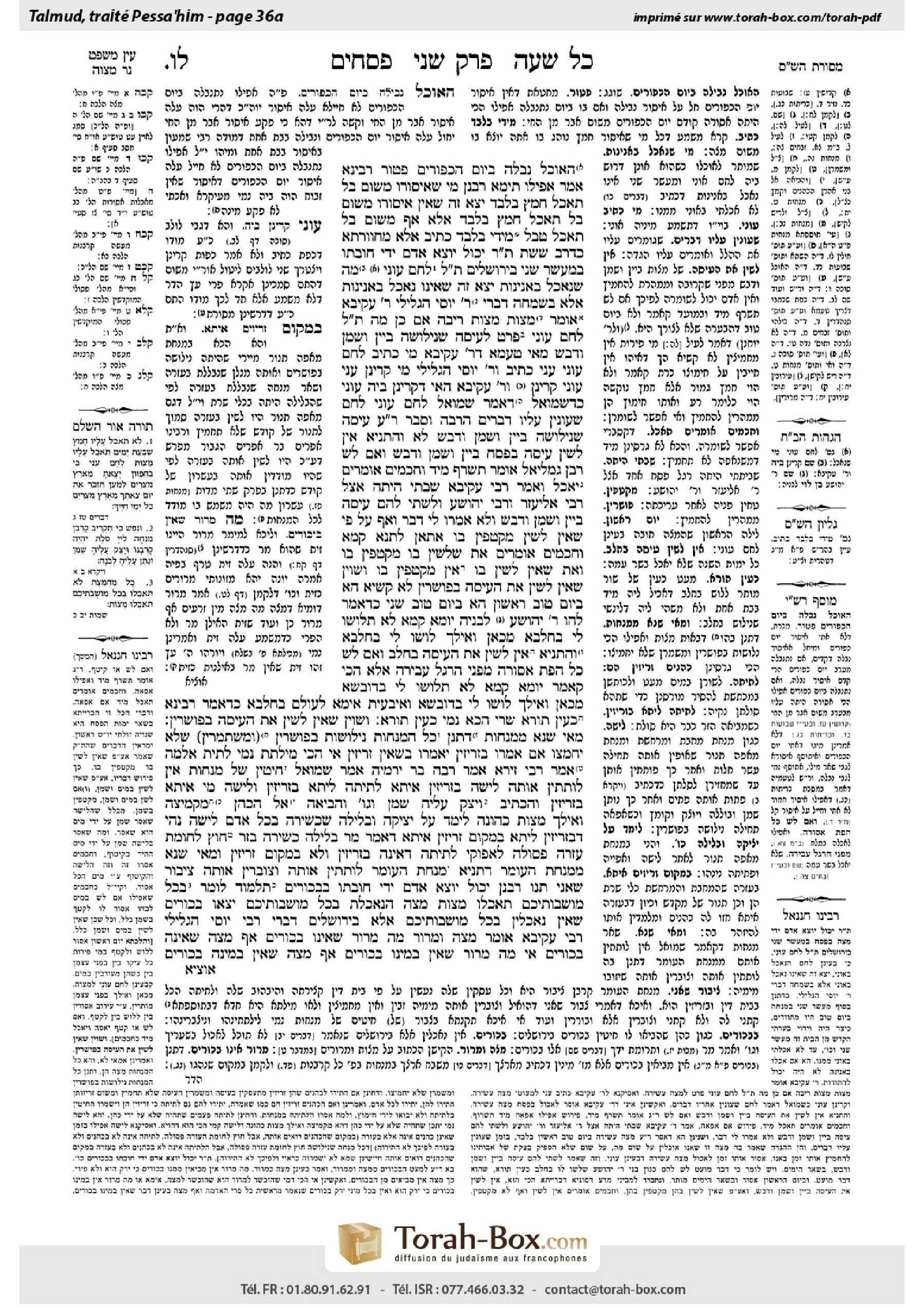
Pesachim 36a: Talmud study for Daf Yomi
Daf Yomi is the daily study of one Talmud folio. Explore 37 tractates with scans, Hebrew text, Sefaria English and AI-generated French translations where annotated.
Passage selection and English or AI-generated French translation are available where the scan has annotations. Daf Study is independent of Torah-Box and Sefaria.
Browse Pesachim · פסחים · All tractatesPesachim 36a text and translations
This page of Pesachim includes the Aramaic text, an English translation and an AI-generated French translation, alongside the scan above.
פסחים ל״ו א · Aramaic and Hebrew text
הָאוֹכֵל נְבֵלָה בְּיוֹם הַכִּפּוּרִים — פָּטוּר.
רָבִינָא אָמַר, אֲפִילּוּ תֵּימָא רַבָּנַן: מִי שֶׁאִיסּוּרוֹ מִשּׁוּם ״בַּל תֹּאכַל חָמֵץ״ בִּלְבַד. יָצָא זֶה שֶׁאֵין אִיסּוּרוֹ מִשּׁוּם ״בַּל תֹּאכַל חָמֵץ״ בִּלְבַד, אֶלָּא אַף מִשּׁוּם ״בַּל תֹּאכַל טֶבֶל״.
מִידֵּי ״בִּלְבַד״ כְּתִיב? אֶלָּא מְחַוַּורְתָּא כִּדְרַב שֵׁשֶׁת.
תָּנוּ רַבָּנַן: יָכוֹל יוֹצֵא אָדָם יְדֵי חוֹבָתוֹ בְּמַעֲשֵׂר שֵׁנִי בִּירוּשָׁלַיִם, תַּלְמוּד לוֹמַר: ״לֶחֶם עוֹנִי״, מָה שֶׁנֶּאֱכָל בָּאֲנִינוּת. יָצָא זֶה שֶׁאֵינוֹ נֶאֱכָל בַּאֲנִינוּת, אֶלָּא בְּשִׂמְחָה — דִּבְרֵי רַבִּי יוֹסֵי הַגְּלִילִי.
רַבִּי עֲקִיבָא אוֹמֵר: ״מַצּוֹת״ ״מַצּוֹת״ רִיבָּה. אִם כֵּן, מָה תַּלְמוּד לוֹמַר ״לֶחֶם עוֹנִי״? פְּרָט לְעִיסָּה שֶׁנִּילּוֹשָׁה בְּיַיִן וְשֶׁמֶן וּדְבַשׁ.
מַאי טַעְמָא דְּרַבִּי עֲקִיבָא: מִי כְּתִיב ״לֶחֶם עוֹנִי״? ״עָנִי״ כְּתִיב.
וְרַבִּי יוֹסֵי הַגְּלִילִי: מִי קָרֵינַן ״עָנִי״! ״עוֹנִי״ קָרֵינַן. וְרַבִּי עֲקִיבָא: הַאי דְּקָרֵינַן בֵּיהּ ״עוֹנִי״, כְּדִשְׁמוּאֵל. דְּאָמַר שְׁמוּאֵל: ״לֶחֶם עוֹנִי״ — לֶחֶם שֶׁעוֹנִין עָלָיו דְּבָרִים הַרְבֵּה.
וְסָבַר רַבִּי עֲקִיבָא עִיסָּה שֶׁנִּילּוֹשָׁה בְּיַיִן וְשֶׁמֶן וּדְבַשׁ לָא? וְהָתַנְיָא: אֵין לָשִׁין עִיסָּה בַּפֶּסַח בְּיַיִן וְשֶׁמֶן וּדְבַשׁ. וְאִם לָשׁ, רַבָּן גַּמְלִיאֵל אוֹמֵר: תִּשָּׂרֵף מִיָּד, וַחֲכָמִים אוֹמְרִים: יֵאָכֵל. וְאָמַר רַבִּי עֲקִיבָא: שַׁבַּתִּי הָיְתָה אֵצֶל רַבִּי אֱלִיעֶזֶר וְרַבִּי יְהוֹשֻׁעַ, וְלַשְׁתִּי לָהֶם עִיסָּה בְּיַיִן וְשֶׁמֶן וּדְבַשׁ, וְלֹא אָמְרוּ לִי דָּבָר.
וְאַף עַל פִּי שֶׁאֵין לָשִׁין, מְקַטְּפִין בּוֹ — אֲתָאן לְתַנָּא קַמָּא. וַחֲכָמִים אוֹמְרִים: אֵת שֶׁלָּשִׁין בּוֹ — מְקַטְּפִין בּוֹ. וְאֶת שֶׁאֵין לָשִׁין בּוֹ — אֵין מְקַטְּפִין בּוֹ. וְשָׁוִין שֶׁאֵין לָשִׁין אֶת הָעִיסָּה בְּפוֹשְׁרִין!
לָא קַשְׁיָא: הָא — בְּיוֹם טוֹב רִאשׁוֹן. הָא — בְּיוֹם טוֹב שֵׁנִי.
כְּדַאֲמַר לְהוּ רַבִּי יְהוֹשֻׁעַ לִבְנֵיהּ: יוֹמָא קַמָּא לָא תְּלוּשׁוּ לִי בַּחֲלָבָא, מִכָּאן וְאֵילָךְ לוּשׁוּ לִי בַּחֲלָבָא. וְהָתַנְיָא: אֵין לָשִׁין אֶת הָעִיסָּה בְּחָלָב, וְאִם לָשׁ — כׇּל הַפַּת אֲסוּרָה, מִפְּנֵי הֶרְגֵּל עֲבֵירָה. אֶלָּא הָכִי קָאָמַר: יוֹמָא קַמָּא לָא תְּלוּשׁוּ לִי בְּדוּבְשָׁא, מִכָּאן וְאֵילָךְ — לוּשׁוּ לִי בְּדוּבְשָׁא.
וְאִיבָּעֵית אֵימָא: לְעוֹלָם בַּחֲלָבָא, כְּדַאֲמַר רָבִינָא: כְּעֵין תּוֹרָא — שְׁרֵי. הָכָא נָמֵי כְּעֵין תּוֹרָא.
וְשָׁוִין שֶׁאֵין לָשִׁין אֶת הָעִיסָּה בְּפוֹשְׁרִין. מַאי שְׁנָא מִמְּנָחוֹת, דִּתְנַן: כׇּל הַמְּנָחוֹת נִילּוֹשׁוֹת בְּפוֹשְׁרִין, (וּמִשְׁתַּמְּרִין) שֶׁלֹּא יֶחְמְצוּ. אִם אָמְרוּ בִּזְרִיזִין, יֹאמְרוּ בְּשֶׁאֵין זְרִיזִין?
אִי הָכִי, מִילְתָּת נָמֵי לָתֵית! אַלְּמָה אָמַר רַבִּי זֵירָא אָמַר רַבָּה בַּר יִרְמְיָה אָמַר שְׁמוּאֵל: חִיטִּין שֶׁל מְנָחוֹת אֵין לוֹתְתִין אוֹתָהּ! לִישָׁה בִּזְרִיזִין אִיתָא, לְתִיתָה לֵיתָא בִּזְרִיזִין.
וְלִישָׁה מִי אִיתָא בִּזְרִיזִין? וְהָכְתִיב: ״וְיָצַק עָלֶיהָ שֶׁמֶן וְגוֹ׳ וֶהֱבִיאָהּ אֶל הַכֹּהֵן״ — מִקְּמִיצָה וְאֵילָךְ מִצְוַת כְּהוּנָּה, לִימֵּד עַל יְצִיקָה וּבְלִילָה שֶׁכְּשֵׁירָה בְּכׇל אָדָם!
לִישָׁה, נְהִי דְּבִזְרִיזִין לֵיתָא, בִּמְקוֹם זְרִיזִין אִיתָא. דְּאָמַר מָר: בְּלִילָה כְּשֵׁירָה בְּזָר, חוּץ לְחוֹמַת עֲזָרָה — פְּסוּלָה. לְאַפּוֹקֵי לְתִיתָה — דְּאֵינָהּ בִּזְרִיזִין, וְלָא בִּמְקוֹם זְרִיזִין.
וּמַאי שְׁנָא מִמִּנְחַת הָעוֹמֶר? דְּתַנְיָא: מִנְחַת הָעוֹמֶר לוֹתְתִין אוֹתָהּ וְצוֹבְרִין אוֹתָהּ! צִיבּוּר שָׁאנֵי.
תָּנוּ רַבָּנַן: יָכוֹל יוֹצֵא אָדָם יְדֵי חוֹבָתוֹ בְּבִכּוּרִים? תַּלְמוּד לוֹמַר: ״בְּכֹל מוֹשְׁבוֹתֵיכֶם תֹּאכְלוּ מַצּוֹת״ — מַצָּה הַנֶּאֱכֶלֶת בְּכׇל מוֹשְׁבוֹתֵיכֶם, יָצְאוּ בִּכּוּרִים שֶׁאֵין נֶאֱכָלִין בְּכׇל מוֹשְׁבוֹתֵיכֶם אֶלָּא בִּירוּשָׁלַיִם, דִּבְרֵי רַבִּי יוֹסֵי הַגְּלִילִי.
רַבִּי עֲקִיבָא אוֹמֵר: מַצָּה וּמָרוֹר; מָה מָרוֹר שֶׁאֵינוֹ בִּכּוּרִים, אַף מַצָּה שֶׁאֵינָהּ בִּכּוּרִים. אִי: מָה מָרוֹר שֶׁאֵין בְּמִינוֹ בִּכּוּרִים, אַף מַצָּה שֶׁאֵין בְּמִינָהּ בִּכּוּרִים!
Pesachim 36a · English translation
One who unwittingly eats an unslaughtered animal carcass on Yom Kippur is exempt from bringing a sin-offering to atone for this consumption. The prohibition against eating on Yom Kippur does not apply to the already prohibited meat of an animal carcass, which means only the prohibition against eating an unslaughtered animal carcass is violated by this act.
Ravina said: Even if you say that this baraita is in accordance with the Rabbis, who maintain that a prohibition can take effect where another prohibition already exists, it can be explained as follows: One fulfills his obligation to eat matza with food whose prohibition is solely due to the commandment: Do not eat leavened bread, which excludes this grain, which is forbidden not only due to the prohibition: Do not eat leavened bread, but also due to the prohibition: Do not eat untithed produce.
The Gemara raises a difficulty against this explanation: Is the word: Only, written in the baraita? This word, which is critical for Ravina’s explanation, does not appear in the baraita at all. Rather, it is clear that this must be explained in accordance with the explanation of Rav Sheshet, who maintains that the baraita should be attributed to Rabbi Shimon.
The Sages taught: I might have thought that a person can fulfill his obligation to eat matza on Passover with matza of second tithe in Jerusalem. Therefore, the verse states: “You shall eat no leavened bread with it; seven days you shall eat with it matza, the bread of affliction [leḥem oni]” (Deuteronomy 16:3), oni with the letter ayin, i.e., poor man’s bread. As this is similar to the phrase: Bread of acute mourning [leḥem oni], oni with an alef, it can be inferred that this mitzva must be fulfilled with matza that can be eaten during a period of acute mourning, on the day one’s close relative has died. This excludes this second tithe, which cannot be eaten during a period of acute mourning but only in a state of joy, as the Torah states: “I have not eaten from it in my acute mourning” (Deuteronomy 26:14). This is the statement of Rabbi Yosei HaGelili.
Rabbi Akiva says: The repetition of matzot matzot serves to amplify, and teaches that all types of matza may be eaten on Passover. The baraita asks: If so, what is the meaning when the verse states leḥem oni, poor man’s bread? The baraita answers: This phrase excludes dough that was kneaded with wine, oil, or honey, which is not classified as poor man’s bread and therefore cannot be used for this mitzva.
The Gemara asks: What is the reason of Rabbi Akiva? The Gemara explains: Is it written in the consonantal text leḥem oni with a vav? That would allude to the comparison of matza to food eaten by an onen, an acute mourner, as onen is also spelled with a vav. Actually, it is written leḥem oni without a vav, meaning poor man’s bread.
And Rabbi Yosei HaGelili could respond: Do we vocalize the word as ani, as would be appropriate for a phrase meaning a poor man’s bread? In fact, we vocalize it oni, which means oppression, affliction, or mourning. And Rabbi Akiva could retort: The fact that we vocalize the word as oni is in accordance with a statement of Shmuel. As Shmuel said: The expression leḥem oni means bread over which many matters are recited [onin], an allusion to the Passover Seder, at which one recites the Haggadah and eats matza.
The Gemara asks: And does Rabbi Akiva maintain with regard to dough that was kneaded with wine, oil, or honey, that it may not be used for matza? But wasn’t it taught in a baraita: One may not knead dough on Passover with wine, oil, or honey? And if one kneaded dough in this manner, Rabban Gamliel says: The dough must be burned immediately, as it is leavened faster than other types of dough. And the Rabbis say that although it is leavened quickly, one can still prevent it from being leavened, and if he does so it may be eaten. And Rabbi Akiva said: It was my Shabbat to serve before Rabbi Eliezer and Rabbi Yehoshua during Passover (Rav Yehuda ben Rav Binyamin HaRofeh), and I kneaded for them dough with wine, oil, and honey, and they said nothing to me by way of objection.
The baraita continues: And although one may not knead dough with these ingredients, one may spread these substances on the surface of the dough. The Gemara comments: With regard to this latter statement, we have come back to the opinion of the first tanna, who said that one may not knead bread with wine, oil, or honey. And the Rabbis say: With regard to dough into which one may knead wine, oil, or honey, one may likewise spread them on the dough, whereas concerning dough into which one may not knead these ingredients, one may not spread them on the dough either. And everyone agrees that one may not knead the dough with warm water, as this will cause it to be leavened quickly. In any case, it is evident from here that Rabbi Akiva himself prepared matza with wine, oil, and honey.
The Gemara answers: This is not difficult, as this statement of Rabbi Akiva’s, which maintains that one does not fulfill his obligation with matza prepared with wine, oil, and honey, is referring to the first day of the Festival, during which there is a special commandment to eat matza. However, that second baraita, in which Rabbi Akiva states that he prepared this type of dough himself, pertains to the second day of Passover, when no special requirement to eat matza is in effect. On the second day, there is no mitzva to eat matza. It is only forbidden to own or eat leavened bread; consequently, so-called rich, or enhanced matza, prepared from fruit juices, is permitted.
The Gemara adds that this is as Rabbi Yehoshua said to his sons: On the first night of Passover, do not knead for me dough with milk, but from the first night onward, knead my dough for me with milk. The Gemara raises a difficulty: But wasn’t it taught in a baraita: Throughout the whole year one may not knead dough with milk, and if he kneaded dough with milk, the entire bread is prohibited, due to the fact that one will become accustomed to sin, by unwittingly eating it with meat? Rather, this is what he is saying: On the first night of Passover do not knead me dough with honey; however, from then onward, knead me dough with honey.
And if you wish, say instead that actually Rabbi Yehoshua said: With milk, as Ravina said: If this bread, kneaded with milk, is prepared in the shape of an ox’s eye, it is permitted. In other words, if one forms this dough in a unique shape, e.g., the eye of an ox, one may eat it, as it is clearly distinguishable from ordinary bread. Therefore, there is no concern that it will be eaten with meat. Here too, the baraita is speaking about a case where he told them to prepare this matza in the shape of an ox’s eye.
It was incidentally mentioned in the previous baraita: And everyone agrees that one may not knead dough with warm water. The Gemara asks: In what way is this case different from that of meal-offerings? As we learned in a mishna: All meal-offerings are kneaded with warm water and are watched so that they will not be leavened. The Gemara explains that there is a distinction between these two cases: If they say it is permitted for diligent priests to bake with warm water, shall they also say the same with regard to those who are not diligent? The priests are diligent and expert in the Temple service and are able to take extreme care, but not everyone can be relied upon to guard the dough unfailingly.
The Gemara raises a difficulty: If so, if we rely on the diligence of the priests, let them also soak the grains in water to help them remove the husks. Why did Rabbi Zeira say that Rabba bar Yirmeya said that Shmuel said: With regard to the wheat used in the meal-offerings, one may not soak it? The Gemara answers: The kneading of the dough is performed by diligent priests; however, the act of soaking is not performed by diligent priests. Instead, this soaking is performed outside of the Temple confines by less reliable non-priests.
The Gemara asks: And with regard to kneading, is it performed only by diligent priests? But isn’t it written: “And when any one brings a meal-offering to the Lord, his offering shall be of fine flour; and he shall pour oil upon it, and place frankincense upon it. And he shall bring it to Aaron’s sons the priests; and he shall take from it his handful of its fine flour, and of its oil, together with all its frankincense” (Leviticus 2:1–2). These verses indicate that from the scooping of a handful and onward, the mitzva must be performed by members of the priesthood. This teaches about the pouring of the oil and the stirring of the mixture that they are valid even if they are performed by any person, even a non-priest.
The Gemara answers: With regard to kneading, although it is not performed by diligent priests, it is nevertheless performed in the place of the diligent. Kneading may be carried out by a non-priest, but it must still be performed in the Temple courtyard. As the Master said: Mixing is valid if performed by a non-priest; however, if it is conducted outside the walls of the courtyard, it, the meal offering, is disqualified. This serves to exclude soaking, which is neither performed by the diligent nor performed in the place of the diligent.
The Gemara asks: And in what way is this case different from that of the omer meal-offering, which must also be guarded from leavening? As it was taught in a baraita: With regard to the omer offering, one soaks it and gathers it, without concern that it will become leavened. The Gemara answers: An act performed by the community is different, as the Great Sanhedrin supervises these operations, and those executing them no doubt proceed with great caution.
The Sages taught in another baraita: I might have thought that one can fulfill his obligation by eating matza prepared from the wheat of first fruits; therefore, the verse states: “In all of your habitations you shall eat matzot” (Exodus 12:20). This verse indicates that one fulfills his obligation only with matza that may be eaten “in all of your habitations.” This expression excludes first fruits, which may not be eaten in all of your habitations, but only in Jerusalem. This is the statement of Rabbi Yosei HaGelili.
Rabbi Akiva says: That verse is not the source for this halakha; rather, the fact that one cannot fulfill his obligation with matza of first fruits is derived from the juxtaposition of matza and bitter herbs: Just as bitter herbs are not first fruits, as they are not included in the seven species to which the mitzva of first fruits applies, so too matza may not be from first fruits. If you will claim: Just as bitter herbs are from a species that are not brought as first fruits, so too matza must be prepared from a species that are not brought as first fruits, e.g., spelt,
Pesachim 36a · Traduction française (IA)
Celui qui mange par inadvertance la carcasse d’un animal qui n’a pas été abattu rituellement le jour de Yom Kippour est dispensé d’apporter un sacrifice expiatoire pour cette consommation. L’interdiction de manger le jour de Yom Kippour ne s’applique pas à la viande déjà interdite d’une carcasse ; cet acte ne transgresse donc que l’interdiction de manger la carcasse d’un animal qui n’a pas été abattu rituellement.
Ravina dit : Même si tu dis que cette baraïta est conforme à l’opinion des Sages, qui soutiennent qu’une interdiction peut s’appliquer alors qu’une autre interdiction existe déjà, on peut l’expliquer ainsi : on accomplit son obligation de manger de la matsa avec un aliment qui n’est interdit que par le commandement : « Ne mange pas de pain levé », ce qui exclut ce grain, interdit non seulement par le commandement : « Ne mange pas de pain levé », mais aussi par l’interdiction de consommer des produits non prélevés.
La Guemara soulève une difficulté contre cette explication : Le mot « uniquement » figure-t-il dans la baraïta ? Ce mot, essentiel à l’explication de Ravina, n’apparaît pas du tout dans la baraïta. Il est donc clair qu’il faut plutôt expliquer la baraïta conformément à l’explication de Rav Chéchet, qui soutient qu’elle doit être attribuée à Rabbi Chimon.
Les Sages ont enseigné : J’aurais pu penser qu’une personne peut accomplir son obligation de manger de la matsa à Pessa’h avec de la matsa provenant de la seconde dîme à Jérusalem. C’est pourquoi le verset dit : « Tu ne mangeras pas de pain levé avec cela ; pendant sept jours, tu mangeras avec cela de la matsa, le pain d’affliction [leḥem oni] » (Deutéronome 16:3), oni étant écrit avec la lettre ayin, c’est-à-dire « pain du pauvre ». Comme cette expression ressemble à « pain du deuil aigu [leḥem oni] », oni étant écrit avec un alef, on peut en déduire que cette mitsva doit être accomplie avec une matsa que l’on peut manger pendant le deuil aigu, le jour où un proche parent vient de mourir. Cela exclut la seconde dîme, que l’on ne peut pas consommer pendant le deuil aigu, mais seulement dans la joie, comme le dit la Torah : « Je n’en ai pas mangé pendant mon deuil aigu » (Deutéronome 26:14). Telle est l’opinion de Rabbi Yossei HaGelili.
Rabbi Akiva dit : La répétition de matsot matsot sert à élargir la règle et enseigne que toutes les sortes de matsa peuvent être consommées à Pessa’h. La baraïta demande : Si c’est ainsi, que signifie l’expression leḥem oni, « pain d’affliction », dans le verset ? La baraïta répond : Cette expression exclut la pâte pétrie avec du vin, de l’huile ou du miel, qui n’est pas considérée comme du pain d’affliction et ne peut donc pas servir à accomplir cette mitsva.
La Guemara demande : Quelle est la raison de Rabbi Akiva ? Le texte consonantique écrit-il leḥem oni avec un vav ? Cela ferait allusion à la comparaison entre la matsa et la nourriture consommée par un onen, une personne en deuil aigu, car onen s’écrit lui aussi avec un vav. En réalité, leḥem oni est écrit sans vav et signifie « pain du pauvre ».
Rabbi Yossei HaGelili pourrait répondre : Prononçons-nous ce mot ani, comme il conviendrait pour une expression signifiant « pain du pauvre » ? En fait, nous le prononçons oni, ce qui signifie oppression, affliction ou deuil. Rabbi Akiva pourrait répliquer : Le fait que nous prononcions le mot oni est conforme à une déclaration de Chmouel. Car Chmouel a dit : L’expression leḥem oni signifie « le pain sur lequel on récite [onin] de nombreuses choses », allusion au Séder de Pessa’h, au cours duquel on récite la Haggada et l’on mange de la matsa.
La Guemara demande : Rabbi Akiva soutient-il donc que la pâte pétrie avec du vin, de l’huile ou du miel ne peut pas servir à faire de la matsa ? N’a-t-on pas enseigné dans une baraïta : On ne doit pas pétrir de pâte à Pessa’h avec du vin, de l’huile ou du miel. Si quelqu’un pétrit la pâte de cette manière, Rabban Gamliel dit : Il faut la brûler immédiatement, car elle lève plus vite que les autres sortes de pâte. Les Sages disent que, bien qu’elle lève rapidement, on peut encore empêcher qu’elle ne lève ; si on y parvient, on peut la manger. Rabbi Akiva dit : « C’était mon tour, le Chabbat, de servir Rabbi Eliezer et Rabbi Yehoshoua pendant Pessa’h (Rav Yehouda ben Rav Binyamin HaRofeh), et j’ai pétri pour eux de la pâte avec du vin, de l’huile et du miel ; ils ne m’ont rien dit pour s’y opposer. »
La baraïta poursuit : Bien qu’on ne puisse pas pétrir la pâte avec ces ingrédients, on peut en étaler à sa surface. La Guemara fait remarquer : Par cette dernière déclaration, nous en revenons à l’opinion du premier tanna, qui a dit qu’on ne peut pas pétrir de pâte avec du vin, de l’huile ou du miel. Les Sages disent : Pour une pâte que l’on peut pétrir avec du vin, de l’huile ou du miel, on peut également en étaler dessus ; mais pour une pâte que l’on ne peut pas pétrir avec ces ingrédients, on ne peut pas non plus les étaler dessus. Tous s’accordent à dire qu’on ne peut pas pétrir la pâte avec de l’eau tiède, car elle lèverait rapidement. Quoi qu’il en soit, il ressort de là que Rabbi Akiva lui-même a préparé de la matsa avec du vin, de l’huile et du miel.
La Guemara répond : Il n’y a pas de difficulté, car cette déclaration de Rabbi Akiva, selon laquelle on n’accomplit pas son obligation avec de la matsa préparée avec du vin, de l’huile et du miel, se rapporte au premier jour de la fête, où il existe une mitsva particulière de manger de la matsa. En revanche, cette seconde baraïta, dans laquelle Rabbi Akiva déclare avoir lui-même préparé ce type de pâte, concerne le deuxième jour de Pessa’h, où il n’existe aucune obligation particulière de manger de la matsa. Le deuxième jour, il n’y a pas de mitsva de manger de la matsa. Il est seulement interdit de posséder ou de manger du pain levé ; la matsa dite « enrichie », préparée avec des jus de fruits, est donc permise.
La Guemara ajoute que c’est ce que Rabbi Yehoshoua a dit à ses fils : « La première nuit de Pessa’h, ne me pétrissez pas de pâte avec du lait ; mais, à partir de la nuit suivante, pétrissez-moi de la pâte avec du lait. » La Guemara soulève une difficulté : N’a-t-on pas enseigné dans une baraïta : Toute l’année, on ne doit pas pétrir de pâte avec du lait ; si quelqu’un en pétrit, tout le pain est interdit, car on pourrait prendre l’habitude de fauter en le mangeant par inadvertance avec de la viande ? Il faut plutôt comprendre qu’il disait ceci : « La première nuit de Pessa’h, ne me pétrissez pas de pâte avec du miel ; mais, à partir de là, pétrissez-moi de la pâte avec du miel. »
Et si tu préfères, dis plutôt qu’en réalité Rabbi Yehoshoua a dit : « Avec du lait », comme l’a dit Ravina : si ce pain pétri avec du lait est façonné en forme d’œil de bœuf, il est permis. Autrement dit, si l’on donne à cette pâte une forme particulière, par exemple celle d’un œil de bœuf, on peut la manger, car elle se distingue clairement du pain ordinaire. On ne craint donc pas qu’elle soit consommée avec de la viande. Ici aussi, la baraïta parle d’un cas où il leur a demandé de préparer cette matsa en forme d’œil de bœuf.
Il a été mentionné incidemment dans la baraïta précédente que tous s’accordent à dire qu’on ne peut pas pétrir de pâte avec de l’eau tiède. La Guemara demande : En quoi ce cas diffère-t-il de celui des offrandes de farine ? Comme nous l’avons appris dans une Michna : Toutes les offrandes de farine sont pétries avec de l’eau tiède et surveillées afin qu’elles ne lèvent pas. La Guemara explique qu’il existe une différence entre les deux cas : Si l’on autorise des prêtres vigilants à pétrir avec de l’eau tiède, autorisera-t-on aussi ceux qui ne sont pas vigilants ? Les prêtres sont vigilants et experts dans le service du Temple, et peuvent prendre toutes les précautions nécessaires ; mais on ne peut pas compter sur tout le monde pour surveiller la pâte sans relâche.
La Guemara soulève une difficulté : Si c’est ainsi, si nous nous fions à la vigilance des prêtres, qu’ils fassent aussi tremper les grains dans l’eau pour faciliter l’enlèvement de leur enveloppe. Pourquoi Rabbi Zeira a-t-il dit que Rabba bar Yirmeya a dit au nom de Chmouel : « Quant au blé utilisé pour les offrandes de farine, on ne doit pas le faire tremper » ? La Guemara répond : Le pétrissage de la pâte est effectué par des prêtres vigilants ; toutefois, le trempage n’est pas effectué par des prêtres vigilants. Il est plutôt effectué hors de l’enceinte du Temple par des non-prêtres, moins dignes de confiance.
La Guemara demande : Et le pétrissage, est-il effectué uniquement par des prêtres vigilants ? N’est-il pas écrit : « Lorsqu’un homme présente au Seigneur une offrande de farine, son offrande sera de la farine fine ; il y versera de l’huile et y déposera de l’encens. Il l’apportera aux fils d’Aaron, les prêtres ; l’un d’eux en prélèvera une pleine poignée de farine fine et d’huile, avec tout l’encens » (Lévitique 2:1–2). Ces versets indiquent qu’à partir du prélèvement d’une poignée, la mitsva doit être accomplie par des membres de la prêtrise. Cela enseigne que le versement de l’huile et le mélange de la préparation sont valides même s’ils sont effectués par n’importe qui, y compris un non-prêtre.
La Guemara répond : Quant au pétrissage, bien qu’il ne soit pas effectué par des prêtres vigilants, il est néanmoins effectué à l’endroit où se trouvent les personnes vigilantes. Un non-prêtre peut pétrir, mais il doit tout de même le faire dans la cour du Temple. Car le maître a dit : Le mélange est valide s’il est effectué par un non-prêtre ; toutefois, s’il est effectué hors des murs de la cour, l’offrande de farine est invalidée. Cela exclut le trempage, qui n’est effectué ni par des personnes vigilantes ni à l’endroit où elles se trouvent.
La Guemara demande : En quoi ce cas diffère-t-il de celui de l’offrande de farine de l’omer, qui doit elle aussi être préservée du levain ? Comme il a été enseigné dans une baraïta : Pour l’offrande de l’omer, on fait tremper le grain et on le rassemble, sans craindre qu’il ne lève. La Guemara répond : Un acte accompli par la communauté est différent, car le Grand Sanhédrin supervise ces opérations, et ceux qui les exécutent agissent certainement avec une grande prudence.
Les Sages ont enseigné dans une autre baraïta : J’aurais pu penser qu’on peut accomplir son obligation en mangeant de la matsa préparée avec le blé des prémices ; c’est pourquoi le verset dit : « Dans toutes vos demeures, vous mangerez des matsot » (Exode 12:20). Ce verset indique qu’on n’accomplit son obligation qu’avec une matsa que l’on peut manger « dans toutes vos demeures ». Cette expression exclut les prémices, que l’on ne peut pas manger dans toutes ses demeures, mais seulement à Jérusalem. Telle est l’opinion de Rabbi Yossei HaGelili.
Rabbi Akiva dit : Ce verset n’est pas la source de cette halakha ; l’impossibilité d’accomplir son obligation avec de la matsa provenant des prémices se déduit plutôt du rapprochement entre la matsa et les herbes amères : de même que les herbes amères ne sont pas des prémices, puisqu’elles ne font pas partie des sept espèces auxquelles s’applique la mitsva des prémices, de même la matsa ne peut pas provenir des prémices. Si tu prétends que, de même que les herbes amères sont issues d’une espèce qui n’est pas apportée comme prémices, la matsa doit elle aussi être préparée avec une espèce qui n’est pas apportée comme prémices, par exemple l’épeautre,
Traduction française générée par IA à partir de l’édition anglaise de Sefaria. Vérifie toujours un passage avec le texte source.
Text from Sefaria: William Davidson Edition - Vocalized Aramaic (CC BY NC); William Davidson Edition - English (CC BY NC).