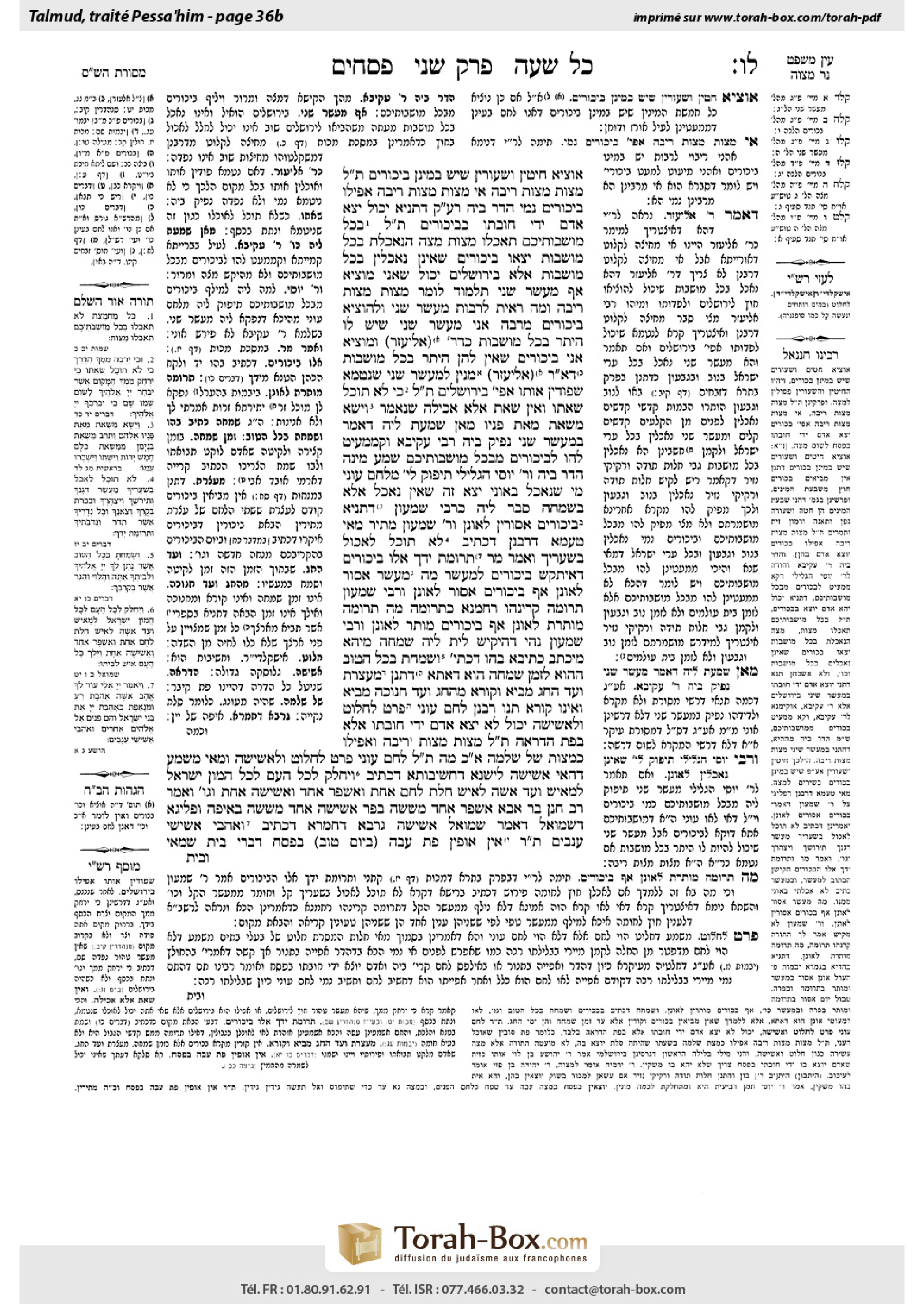
Pesachim 36b: Talmud study for Daf Yomi
Daf Yomi is the daily study of one Talmud folio. Explore 37 tractates with scans, Hebrew text, Sefaria English and AI-generated French translations where annotated.
Passage selection and English or AI-generated French translation are available where the scan has annotations. Daf Study is independent of Torah-Box and Sefaria.
Browse Pesachim · פסחים · All tractatesPesachim 36b text and translations
This page of Pesachim includes the Aramaic text, an English translation and an AI-generated French translation, alongside the scan above.
פסחים ל״ו ב · Aramaic and Hebrew text
אוֹצִיא חִיטִּין וּשְׂעוֹרִין שֶׁיֵּשׁ בְּמִינָן בִּיכּוּרִים. תַּלְמוּד לוֹמַר: ״מַצּוֹת״ ״מַצּוֹת״ רִיבָּה. אִי ״מַצּוֹת״ ״מַצּוֹת״ רִיבָּה, אֲפִילּוּ בִּיכּוּרִים נָמֵי! הֲדַר בֵּיהּ רַבִּי עֲקִיבָא.
דְּתַנְיָא: יָכוֹל יֵצֵא אָדָם יְדֵי חוֹבָתוֹ בְּבִיכּוּרִים, תַּלְמוּד לוֹמַר: ״בְּכֹל מוֹשְׁבֹתֵיכֶם תֹּאכְלוּ מַצּוֹת״ — מַצָּה הַנֶּאֱכֶלֶת בְּכׇל מוֹשָׁבוֹת, יָצְאוּ בִּיכּוּרִים שֶׁאֵינָן נֶאֱכָלִין בְּכׇל מוֹשָׁבוֹת אֶלָּא בִּירוּשָׁלַיִם. יָכוֹל שֶׁאֲנִי מוֹצִיא אַף מַעֲשֵׂר שֵׁנִי, תַּלְמוּד לוֹמַר: ״מַצּוֹת״ ״מַצּוֹת״ רִיבָּה.
וּמָה רָאִיתָ לְרַבּוֹת מַעֲשֵׂר שֵׁנִי וּלְהוֹצִיא בִּיכּוּרִים? מְרַבֶּה אֲנִי מַעֲשֵׂר שֵׁנִי שֶׁיֵּשׁ לוֹ הֶיתֵּר בְּכׇל מוֹשָׁבוֹת, כִּדְרַבִּי (אֱלִיעֶזֶר), וּמוֹצִיא אֲנִי בִּיכּוּרִים שֶׁאֵין לָהֶן הֶיתֵּר בְּכׇל מוֹשָׁבוֹת.
דְּאָמַר רַבִּי (אֱלִיעֶזֶר): מִנְיָן לְמַעֲשֵׂר שֵׁנִי שֶׁנִּטְמָא, שֶׁפּוֹדִין אוֹתוֹ אֲפִילּוּ בִּירוּשָׁלַיִם, תַּלְמוּד לוֹמַר: ״כִּי לֹא תוּכַל שְׂאֵתוֹ״.
וְאֵין ״שְׂאֵת״ אֶלָּא אֲכִילָה — שֶׁנֶּאֱמַר: ״וַיִּשָּׂא מַשְׂאֹת מֵאֵת פָּנָיו״.
מַאן שָׁמְעַתְּ לֵיהּ דְּאָמַר בְּמַעֲשֵׂר שֵׁנִי נָפֵיק בֵּיהּ? רַבִּי עֲקִיבָא, וְקָמְמַעֵיט לְהוּ לְבִיכּוּרִים ״מִבְּכֹל מוֹשְׁבֹתֵיכֶם״, שְׁמַע מִינַּהּ הֲדַר בֵּיהּ.
וְרַבִּי יוֹסֵי הַגְּלִילִי, תִּיפּוֹק לֵיהּ מִ״לֶּחֶם עוֹנִי״ — מִי שֶׁנֶּאֱכָל בְּאוֹנִי, יָצָא זֶה שֶׁאֵין נֶאֱכָל אֶלָּא בְּשִׂמְחָה?
סָבַר לֵיהּ כְּרַבִּי שִׁמְעוֹן. דְּתַנְיָא: בִּיכּוּרִים אֲסוּרִין לְאוֹנֵן, וְרַבִּי שִׁמְעוֹן מַתִּיר.
מַאי טַעְמָא דְּרַבָּנַן — דִּכְתִיב: ״לֹא תוּכַל לֶאֱכֹל בִּשְׁעָרֶיךָ״, וְאָמַר מָר: ״תְּרוּמַת יָדֶךָ״ אֵלּוּ בִּיכּוּרִים, דְּאִיתַּקַּשׁ בִּיכּוּרִים לְמַעֲשֵׂר: מָה מַעֲשֵׂר אָסוּר לְאוֹנֵן — אַף בִּיכּוּרִים אָסוּר לְאוֹנֵן.
וְרַבִּי שִׁמְעוֹן: ״תְּרוּמָה״ קְרִינְהוּ רַחֲמָנָא. כִּתְרוּמָה: מָה תְּרוּמָה מוּתֶּרֶת לְאוֹנֵן — אַף בִּיכּוּרִים מוּתָּר לְאוֹנֵן.
וְרַבִּי שִׁמְעוֹן, נְהִי דְּהֶיקֵּישׁ לֵית לֵיהּ, שִׂמְחָה מִיהָא מִיכְתָּב כְּתִיבָא בְּהוּ. דִּכְתִיב: ״וְשָׂמַחְתָּ בְכׇל הַטּוֹב״?
הָהוּא לִזְמַן שִׂמְחָה הוּא דַּאֲתָא, דִּתְנַן: מֵעֲצֶרֶת וְעַד הַחַג — מֵבִיא וְקוֹרֵא, מֵהַחַג וְעַד חֲנוּכָּה — מֵבִיא וְאֵינוֹ קוֹרֵא.
תָּנוּ רַבָּנַן: ״לֶחֶם עֹנִי״ — פְּרָט לְחָלוּט וְלַאֲשִׁישָׁה. יָכוֹל לֹא יֵצֵא אָדָם יְדֵי חוֹבָתוֹ אֶלָּא בְּפַת הַדְרָאָה? תַּלְמוּד לוֹמַר: ״מַצּוֹת״ ״מַצּוֹת״ רִיבָּה, וַאֲפִילּוּ כְּמַצּוֹת שֶׁל שְׁלֹמֹה. אִם כֵּן, מָה תַּלְמוּד לוֹמַר ״לֶחֶם עוֹנִי״ — פְּרָט לְחָלוּט וְלַאֲשִׁישָׁה.
וּמַאי מַשְׁמַע דְּהַאי אֲשִׁישָׁה לִישָּׁנָא דַחֲשִׁיבוּתָא, דִּכְתִיב: ״וַיְחַלֵּק לְכׇל הָעָם לְכׇל הֲמוֹן יִשְׂרָאֵל לְמֵאִישׁ וְעַד אִשָּׁה לְאִישׁ חַלַּת לֶחֶם אַחַת וְאֶשְׁפָּר אֶחָד וַאֲשִׁישָׁה אֶחָת וְגוֹ׳״.
וְאָמַר רַב חָנָן בַּר אַבָּא: ״אֶשְׁפָּר״ — אֶחָד מִשִּׁשָּׁה בַּפָּר, ״אֲשִׁישָׁה״ — אֶחָד מִשִּׁשָּׁה בָּאֵיפָה. ופְלִיגָא דִּשְׁמוּאֵל, דְּאָמַר שְׁמוּאֵל: ״אֲשִׁישָׁה״ — גַּרְבָּא דְחַמְרָא, דִּכְתִיב: ״וְאֹהֲבֵי אֲשִׁישֵׁי עֲנָבִים״.
תָּנוּ רַבָּנַן: אֵין אוֹפִין פַּת עָבָה (בְּיוֹם טוֹב) בַּפֶּסַח, דִּבְרֵי בֵּית שַׁמַּאי,
Pesachim 36b · English translation
I would then think this comparison excludes wheat and barley, which are from a species that are brought as first fruits and should therefore not be used for the mitzva of matza. Therefore, the verse states: “Matzot,” “matzot” (Deuteronomy 16:3, 8) to amplify and teach that any matza is acceptable for this mitzva. The Gemara asks: If the repetition of matzot matzot comes to amplify this halakha that any matza is fit for Passover use, it should also include matza prepared from first-fruit wheat. The Gemara answers: This is indeed true, and Rabbi Akiva retracted his statement. He too derives the halakha from the verse: “In all of your habitations.”
As it was taught in a baraita: I might have thought that a person can fulfill his obligation with matza from first fruit; therefore the verse states: “In all of your habitations you shall eat matzot” (Exodus 12:20). The verse indicates that one can fulfill his obligation with matza that may be eaten in all habitations. It excludes first fruits, which may not be eaten in all habitations, but only in Jerusalem. I might have thought that I should also exclude second-tithe produce as fit for matza; therefore the verse states: “Matzot,” “matzot.” As stated above, this repetition serves to amplify, and it includes second tithe in the materials that may be used in the preparation of matza.
The Gemara asks: And what did you see that led you to include second-tithe produce due to the words matzot matzot but to exclude first fruits? The Gemara explains: I include the second tithe, which has a means by which it may be permitted to be eaten in all habitations, in accordance with the opinion of Rabbi Eliezer, as will be explained. And I exclude first fruits, which do not have, under any circumstances, a manner by which it is permitted to eat them in all habitations.
The Gemara explains: As Rabbi Eliezer said: From where is it derived with regard to second-tithe produce that became ritually impure, that one may redeem it even in Jerusalem? Second-tithe produce that has been redeemed may be removed from the city. The verse states: “And if the way is too long for you, so that you are not able to carry it [se’eto], because the place is too far from you, which the Lord your God shall choose to set His name there, when the Lord your God shall bless you” (Deuteronomy 14:24).
And it is derived by means of a verbal analogy that this carrying [se’et] is nothing other than eating, as it is stated: “And portions [masot] were taken to them from before him” (Genesis 43:34). In light of this parallel language, the Gemara understands the phrase “so that you are not able se’eto” to mean: So that you are not able to eat it. Like second-tithe produce that has not yet been taken into Jerusalem, second-tithe produce in the capital that cannot be eaten due to ritual impurity can be redeemed and taken out of the city. Consequently, second tithe can indeed be considered food that may be eaten “in all of your habitations.”
The Gemara applies this discussion to the issue at hand: Who did you hear that said: One can fulfill his obligation to eat matza with second tithe? It is the opinion of Rabbi Akiva, and yet he excludes first fruits due to the expression: “In all of your habitations.” Learn from this that Rabbi Akiva retracted his opinion and accepted Rabbi Yosei HaGelili’s derivation.
The Gemara asks: And Rabbi Yosei HaGelili, why does he learn this halakha from the phrase: “In all of your habitations”? Let him derive it from the phrase: Leḥem oni (Deuteronomy 16:3). Rabbi Yosei HaGelili derives from this expression that matza must be prepared from produce that can be eaten in a state of acute mourning; that excludes this second tithe, which may be eaten only in a state of joy. This exposition should apply to first fruits as well, as they must also be eaten in a state of joy.
The Gemara explains: Rabbi Yosei HaGelili maintains in accordance with the opinion of Rabbi Shimon, who says that an acute mourner may eat first fruits. As it was taught in a baraita: First fruits are prohibited to an acute mourner, and Rabbi Shimon permits an acute mourner to eat first fruits.
The Gemara explains this dispute: What is the reason for the Rabbis’ opinion, which maintains that an acute mourner may not eat first fruits? As it is written: “You may not eat within your gates the tithe of your corn, or of your wine, or of your oil, or the firstlings of your herd or of your flock, nor any of your vows which you vow, nor your free-will offerings, nor the offering of your hand” (Deuteronomy 12:17). And the Master said: “The offering of your hand,” these are first fruits, as this verse compares first fruits to the second tithe: Just as the second tithe is prohibited to an acute mourner, as stated explicitly in the Torah, so too are first fruits prohibited to an acute mourner.
And Rabbi Shimon says in response to this contention: First fruits are called teruma by the Merciful One and therefore their status is like that of teruma: Just as teruma is permitted to an acute mourner, so too first fruits are permitted to an acute mourner.
The Gemara asks: And Rabbi Shimon, although he does not accept this juxtaposition of first fruits and second tithe, in any case the word joy is written with regard to first fruits, as it is written: “And you shall rejoice in all the good that the Lord has given you and your household” (Deuteronomy 26:11). In light of this, how can Rabbi Shimon permit an acute mourner to eat first fruits?
The Gemara answers: Rabbi Shimon does not learn from that verse that one must eat first fruits while he is personally happy; rather, it comes to teach us that first fruits should be eaten during the period of rejoicing. As we learned in a mishna: From Shavuot until Sukkot, one brings first fruits and recites the prayers of thanks to God that appear in the Torah. From Sukkot until Hanukkah one may bring first fruits, but he does not recite the portion from the Torah. This mishna states that the ideal time for bringing first fruits to the Temple is during the joyous harvest season, from which it may be inferred that this verse is not referring to personal joy of the one bringing the first fruits, but rather to the period of communal joy.
The Sages taught that the phrase poor man’s bread [leḥem oni] excludes matza that was boiled [ḥalut] in hot water after it was baked, which is considered to be a relative delicacy; and this expression also excludes matza that was baked as a large cake [ashisha]. I might have thought that a person fulfills his obligation to eat matza only with coarse [hadra’a] bread; therefore, the verse states: “Matzot,” “matzot,” which serves to amplify and include matza prepared with fine-grade flour. And in fact, one could fulfill his obligation even with matzot like those of King Solomon, which were prepared from the finest sifted flour. If so, what is the meaning when the verse states: “Poor man’s bread”? This phrase comes to exclude boiled matza and large cakes, but it does not exclude matza prepared from refined flour.
The Gemara asks: From where may it be inferred that ashisha is an expression that indicates importance? As it is written with regard to King David’s celebration after he brought the Ark of the Covenant to Jerusalem: “And he dealt among all the people, among the whole multitude of Israel, both to men and women, to every one a cake of bread, and an eshpar, and an ashisha, and all the people departed, every one to his house” (II Samuel 6:19).
And Rav Ḥanan bar Abba said: The word eshpar refers to a portion of meat equivalent to one-sixth of an ox, and the word ashisha refers to a cake prepared from one-sixth of an eipha of flour. And this interpretation disputes the opinion of Shmuel, as Shmuel said: Ashisha means a jug of wine, as it is written: “And those who love the jug [ashishei] of grapes” (Hosea 3:1).
The Sages taught: One may not bake thick bread on the Festival, on Passover, as it might be leavened before it has a chance to bake; this is the statement of Beit Shammai.
Pesachim 36b · Traduction française (IA)
J’aurais alors pu penser que cette comparaison exclut le blé et l’orge, qui appartiennent à une espèce dont on apporte les prémices et ne devraient donc pas être utilisés pour la mitsva de matsa. C’est pourquoi le verset dit : « Matzot », « matzot » (Deutéronome 16:3, 8), afin d’élargir la règle et d’enseigner que toute matsa convient à cette mitsva. La Guemara demande : Si la répétition de « matzot », « matzot » vient élargir cette halakha, selon laquelle toute matsa convient pour Pessa’h, elle devrait aussi inclure la matsa préparée avec du blé des prémices. La Guemara répond : C’est effectivement le cas, et Rabbi Akiva est revenu sur sa déclaration. Lui aussi déduit cette halakha du verset : « Dans toutes vos demeures. »
Comme il a été enseigné dans une baraïta : J’aurais pu penser qu’une personne peut s’acquitter de son obligation avec de la matsa provenant des prémices ; c’est pourquoi le verset dit : « Dans toutes vos demeures, vous mangerez des matzot » (Exode 12:20). Le verset indique qu’on peut s’acquitter de son obligation avec une matsa qui peut être mangée dans toutes les demeures. Cela exclut les prémices, qui ne peuvent être mangées dans toutes les demeures, mais seulement à Jérusalem. J’aurais pu penser qu’il fallait également exclure les produits de la seconde dîme comme pouvant servir à la préparation de la matsa ; c’est pourquoi le verset dit : « Matzot », « matzot ». Comme indiqué plus haut, cette répétition sert à élargir la règle et inclut la seconde dîme parmi les produits pouvant être utilisés pour préparer la matsa.
La Guemara demande : Qu’as-tu donc vu pour inclure les produits de la seconde dîme en raison des mots « matzot », « matzot », mais exclure les prémices ? La Guemara explique : J’inclus la seconde dîme, pour laquelle il existe un moyen de permettre qu’elle soit mangée dans toutes les demeures, conformément à l’opinion de Rabbi Eliezer, comme cela sera expliqué. Et j’exclus les prémices, pour lesquelles il n’existe, en aucune circonstance, aucun moyen de permettre qu’elles soient mangées dans toutes les demeures.
La Guemara explique : Car Rabbi Eliezer a dit : D’où déduit-on, au sujet des produits de la seconde dîme devenus rituellement impurs, qu’on peut les racheter même à Jérusalem ? Les produits de la seconde dîme qui ont été rachetés peuvent être emportés hors de la ville. Le verset dit : « Et si le chemin est trop long pour toi, si bien que tu ne peux pas le porter [se’eto], parce que le lieu est trop éloigné de toi, celui que le Seigneur ton Dieu choisira pour y faire résider Son nom, lorsque le Seigneur ton Dieu t’aura béni » (Deutéronome 14:24).
Et une analogie verbale permet de déduire que le fait de porter [se’et] n’est autre que le fait de manger, comme il est dit : « Des portions [masot] leur furent servies devant lui » (Genèse 43:34). À la lumière de cette formulation parallèle, la Guemara comprend l’expression « si bien que tu ne peux pas se’eto » ainsi : « si bien que tu ne peux pas le manger ». Comme les produits de la seconde dîme qui n’ont pas encore été introduits à Jérusalem, les produits de la seconde dîme qui s’y trouvent et ne peuvent être mangés en raison de leur impureté rituelle peuvent être rachetés et emportés hors de la ville. Par conséquent, la seconde dîme peut effectivement être considérée comme une nourriture pouvant être mangée « dans toutes vos demeures ».
La Guemara applique cette discussion à la question qui nous occupe : Qui a-t-on entendu dire qu’on peut s’acquitter de son obligation de manger de la matsa avec de la seconde dîme ? C’est l’opinion de Rabbi Akiva, et pourtant il exclut les prémices en raison de l’expression : « Dans toutes vos demeures. » Il faut en conclure que Rabbi Akiva est revenu sur son opinion et a accepté la déduction de Rabbi Yosei HaGelili.
La Guemara demande : Et Rabbi Yosei HaGelili, pourquoi déduit-il cette halakha de l’expression « Dans toutes vos demeures » ? Qu’il la déduise de l’expression leḥem oni (Deutéronome 16:3). Rabbi Yosei HaGelili déduit de cette expression que la matsa doit être préparée à partir de produits qui peuvent être mangés par une personne en deuil avant l’inhumation ; cela exclut la seconde dîme, qui ne peut être mangée que dans la joie. Cette interprétation devrait également s’appliquer aux prémices, qui doivent elles aussi être mangées dans la joie.
La Guemara explique : Rabbi Yosei HaGelili suit l’opinion de Rabbi Shimon, qui dit qu’une personne en deuil avant l’inhumation peut manger des prémices. Comme il a été enseigné dans une baraïta : Les prémices sont interdites à une personne en deuil avant l’inhumation, mais Rabbi Shimon lui permet d’en manger.
La Guemara explique cette controverse : Quelle est la raison de l’opinion des Rabbins, selon laquelle une personne en deuil avant l’inhumation ne peut pas manger de prémices ? Car il est écrit : « Tu ne mangeras pas dans tes portes la dîme de ton blé, de ton vin ou de ton huile, les premiers-nés de ton gros bétail ou de ton petit bétail, aucun de tes vœux que tu auras faits, tes offrandes volontaires ni le prélèvement de ta main » (Deutéronome 12:17). Et le Maître a dit : « Le prélèvement de ta main », ce sont les prémices, car ce verset compare les prémices à la seconde dîme : de même que la seconde dîme est interdite à une personne en deuil avant l’inhumation, comme cela est explicitement indiqué dans la Torah, de même les prémices lui sont interdites.
Et Rabbi Shimon répond à cette objection : Le Miséricordieux a appelé les prémices terouma ; leur statut est donc semblable à celui de la terouma. De même que la terouma est permise à une personne en deuil avant l’inhumation, de même les prémices lui sont permises.
La Guemara demande : Et Rabbi Shimon, même s’il n’accepte pas ce rapprochement entre les prémices et la seconde dîme, le mot « joie » apparaît néanmoins au sujet des prémices, comme il est écrit : « Tu te réjouiras de tout le bien que le Seigneur t’a donné, à toi et à ta maison » (Deutéronome 26:11). Dès lors, comment Rabbi Shimon peut-il permettre à une personne en deuil avant l’inhumation de manger des prémices ?
La Guemara répond : Rabbi Shimon ne déduit pas de ce verset qu’il faut manger les prémices en éprouvant soi-même de la joie ; le verset vient plutôt enseigner que les prémices doivent être mangées pendant la période de réjouissance. Comme nous l’avons appris dans une Michna : De Chavouot à Souccot, on apporte les prémices et on récite les prières de remerciement à Dieu qui figurent dans la Torah. De Souccot à Hanoucca, on peut apporter les prémices, mais on ne récite pas le passage de la Torah. Cette Michna indique que la période idéale pour apporter les prémices au Temple est celle de la récolte, période de réjouissance ; on peut donc en déduire que ce verset ne fait pas référence à la joie personnelle de celui qui apporte les prémices, mais plutôt à la période de réjouissance collective.
Les Sages ont enseigné que l’expression « pain de pauvre » [leḥem oni] exclut la matsa bouillie [ḥalut] dans l’eau chaude après sa cuisson, qui est considérée comme un mets relativement raffiné ; cette expression exclut également la matsa cuite sous la forme d’un grand gâteau [ashisha]. J’aurais pu penser qu’une personne ne s’acquitte de son obligation de manger de la matsa qu’avec du pain grossier [hadra’a] ; c’est pourquoi le verset dit : « Matzot », « matzot », ce qui sert à élargir la règle et à inclure la matsa préparée avec une farine fine. En fait, on pourrait même s’acquitter de son obligation avec des matzot comme celles du roi Salomon, préparées avec la farine la plus finement tamisée. Si tel est le cas, que signifie l’expression « pain de pauvre » employée par le verset ? Elle vient exclure la matsa bouillie et les grands gâteaux, mais n’exclut pas la matsa préparée avec une farine raffinée.
La Guemara demande : D’où peut-on déduire que ashisha est un terme qui désigne quelque chose d’important ? Car il est écrit au sujet de la célébration du roi David, après qu’il eut apporté l’Arche de l’Alliance à Jérusalem : « Il distribua à tout le peuple, à toute la multitude d’Israël, hommes et femmes, à chacun un gâteau de pain, un eshpar et un ashisha ; puis tout le peuple s’en alla, chacun dans sa maison » (II Samuel 6:19).
Et Rav Ḥanan bar Abba a dit : Le mot eshpar désigne une portion de viande équivalant à un sixième de bœuf, et le mot ashisha désigne un gâteau préparé avec un sixième d’épha de farine. Cette interprétation contredit l’opinion de Shmuel, car Shmuel a dit : Ashisha signifie une cruche de vin, comme il est écrit : « Et ceux qui aiment les cruches [ashishei] de raisins » (Osée 3:1).
Les Sages ont enseigné : On ne doit pas cuire de pain épais pendant la fête de Pessa’h, car il pourrait lever avant d’avoir eu le temps de cuire ; telle est l’opinion de Beit Shammaï.
Traduction française générée par IA à partir de l’édition anglaise de Sefaria. Vérifie toujours un passage avec le texte source.
Text from Sefaria: William Davidson Edition - Vocalized Aramaic (CC BY NC); William Davidson Edition - English (CC BY NC).