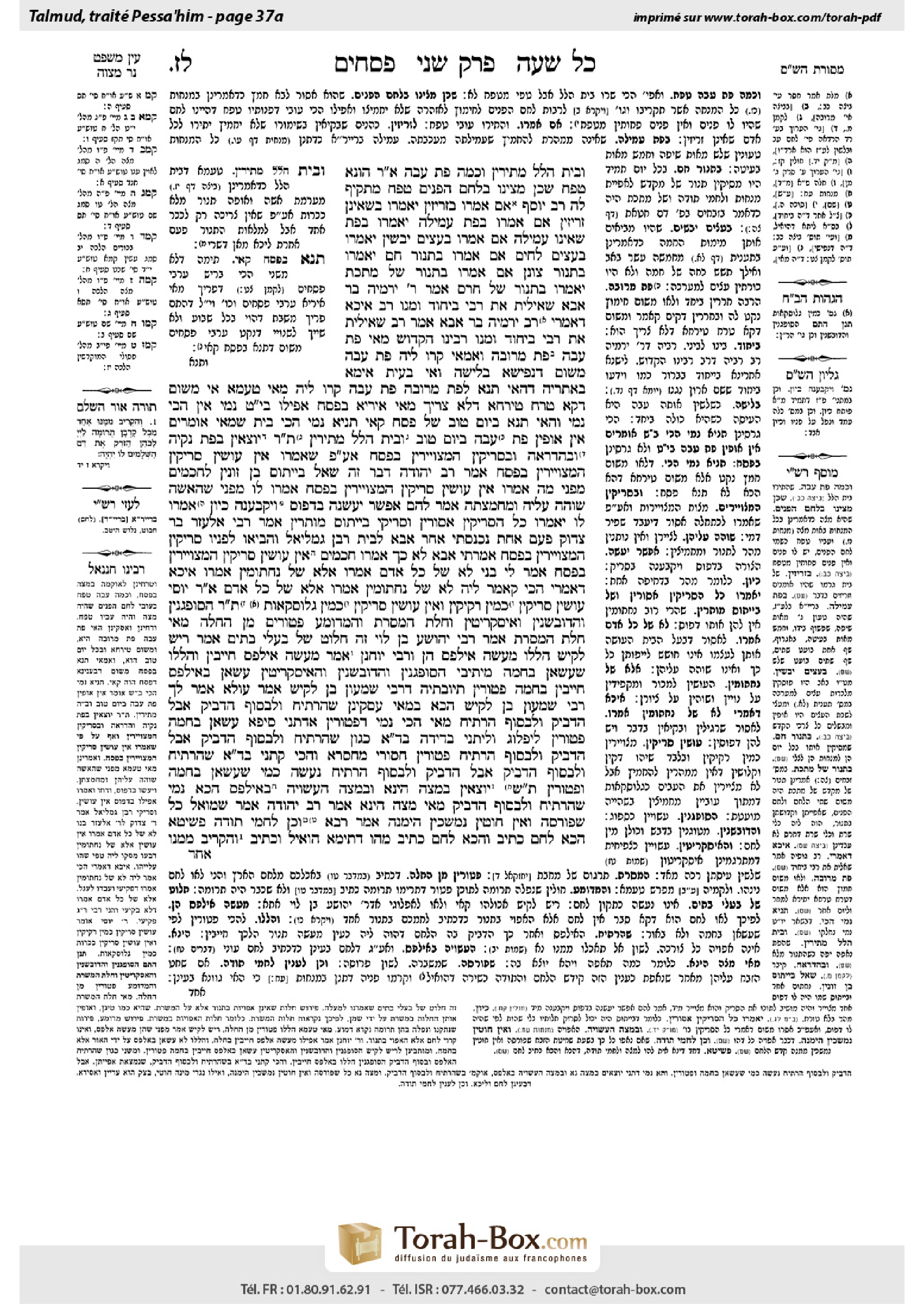
Pesachim 37a: Talmud study for Daf Yomi
Daf Yomi is the daily study of one Talmud folio. Explore 37 tractates with scans, Hebrew text, Sefaria English and AI-generated French translations where annotated.
Passage selection and English or AI-generated French translation are available where the scan has annotations. Daf Study is independent of Torah-Box and Sefaria.
Browse Pesachim · פסחים · All tractatesPesachim 37a text and translations
This page of Pesachim includes the Aramaic text, an English translation and an AI-generated French translation, alongside the scan above.
פסחים ל״ז א · Aramaic and Hebrew text
וּבֵית הִלֵּל מַתִּירִין. וְכַמָּה פַּת עָבָה? אָמַר רַב הוּנָא: טֶפַח, שֶׁכֵּן מָצִינוּ בְּלֶחֶם הַפָּנִים טֶפַח.
מַתְקֵיף לַהּ רַב יוֹסֵף: אִם אָמְרוּ בִּזְרִיזִין — יֹאמְרוּ בְּשֶׁאֵינָן זְרִיזִין? אִם אָמְרוּ בְּפַת עֲמִילָה — יֹאמְרוּ בְּפַת שֶׁאֵינָהּ עֲמִילָה?
אִם אָמְרוּ בְּעֵצִים יְבֵשִׁין — יֹאמְרוּ בְּעֵצִים לַחִים? אִם אָמְרוּ בְּתַנּוּר חַם — יֹאמְרוּ בְּתַנּוּר צוֹנֵן? אִם אָמְרוּ בְּתַנּוּר שֶׁל מַתֶּכֶת — יֹאמְרוּ בְּתַנּוּר שֶׁל חֶרֶס?
אָמַר רַב יִרְמְיָה בַּר אַבָּא: שְׁאֵילִית אֶת רַבִּי בְּיִחוּד, וּמַנּוּ: רַב. אִיכָּא דְּאָמְרִי, רַב יִרְמְיָה בַּר אַבָּא אָמַר רַב: שְׁאֵילִית אֶת רַבִּי בְּיִחוּד, וּמַנּוּ: רַבֵּינוּ הַקָּדוֹשׁ. מַאי פַּת עָבָה? פַּת מְרוּבָּה. וְאַמַּאי קָרוּ לֵיהּ פַּת עָבָה? מִשּׁוּם דִּנְפִישָׁא בְּלִישָׁה. וְאִי בָּעֵית אֵימָא, בְּאַתְרֵיהּ דְּהַאי תַּנָּא לְפַת מְרוּבָּה — פַּת עָבָה קָרוּ לֵיהּ.
מַאי טַעְמָא? אִי מִשּׁוּם דְּקָא טָרַח טִירְחָא דְּלָא צְרִיךְ, מַאי אִירְיָא בְּפֶסַח? אֲפִילּוּ בְּיוֹם טוֹב נָמֵי!
אִין הָכִי נָמֵי, וְהַאי תַּנָּא בְּיוֹם טוֹב שֶׁל פֶּסַח קָאֵי. תַּנְיָא נָמֵי הָכִי, בֵּית שַׁמַּאי אוֹמְרִים: אֵין אוֹפִין פַּת עָבָה בְּיוֹם טוֹב, וּבֵית הִלֵּל מַתִּירִין.
תָּנוּ רַבָּנַן: יוֹצְאִין בְּפַת נְקִיָּה, וּבְהַדְרָאָה, וּבִסְרִיקִין הַמְצוּיָּירִין בַּפֶּסַח, אַף עַל פִּי שֶׁאָמְרוּ אֵין עוֹשִׂין סְרִיקִין הַמְצוּיָּירִין בַּפֶּסַח. אָמַר רַב יְהוּדָה: דָּבָר זֶה שָׁאַל בַּיְיתּוֹס בֶּן זוֹנִין לַחֲכָמִים: מִפְּנֵי מָה אָמְרוּ אֵין עוֹשִׂין סְרִיקִין הַמְצוּיָּירִין בַּפֶּסַח? אָמְרוּ לוֹ: מִפְּנֵי שֶׁהָאִשָּׁה שׁוֹהָה עָלֶיהָ וּמְחַמַּצְתָּהּ.
אָמַר לָהֶם: אֶפְשָׁר יַעֲשֶׂנָּה בִּדְפוּס וְיִקְבָּעֶנָּה כֵּיוָן! אָמְרוּ לוֹ: יֹאמְרוּ כׇּל הַסְּרִיקִין — אֲסוּרִין, וּסְרִיקֵי בַּיְיתּוֹס — מוּתָּרִין.
אָמַר רַבִּי אֶלְעָזָר בַּר צָדוֹק: פַּעַם אַחַת נִכְנַסְתִּי אַחַר אַבָּא לְבֵית רַבָּן גַּמְלִיאֵל, וְהֵבִיאוּ לְפָנָיו סְרִיקִין הַמְצוּיָּירִין בַּפֶּסַח. אָמַרְתִּי: אַבָּא, לֹא כָּךְ אָמְרוּ חֲכָמִים, אֵין עוֹשִׂין סְרִיקִין הַמְצוּיָּירִין בַּפֶּסַח? אָמַר לִי: בְּנִי, לֹא שֶׁל כׇּל אָדָם אָמְרוּ, אֶלָּא שֶׁל נַחְתּוֹמִין אָמְרוּ.
אִיכָּא דְאָמְרִי, הָכִי קָאָמַר לֵיהּ: לֹא שֶׁל נַחְתּוֹמִין אָמְרוּ, אֶלָּא שֶׁל כׇּל אָדָם. אָמַר רַבִּי יוֹסֵי: עוֹשִׂין סְרִיקִין כְּמִין רְקִיקִין, וְאֵין עוֹשִׂין סְרִיקִין כְּמִין גְּלוּסְקָאוֹת.
תָּנוּ רַבָּנַן: הַסּוּפְגָּנִין וְהַדּוּבְשָׁנִין וְאִיסְקְרִיטִין וְחַלַּת הַמַּסְרֵת וְהַמְדוּמָּע — פְּטוּרִים מִן הַחַלָּה. מַאי חַלַּת הַמַּסְרֵת? אָמַר רַבִּי יְהוֹשֻׁעַ בֶּן לֵוִי: זֶה חָלוּט שֶׁל בַּעֲלֵי בָתִּים.
אָמַר רֵישׁ לָקִישׁ: הַלָּלוּ מַעֲשֵׂה אִילְפָּס הֵן. וְרַבִּי יוֹחָנָן אָמַר: מַעֲשֵׂה אִילְפָּס חַיָּיבִין. וְהַלָּלוּ שֶׁעֲשָׂאָן בַּחַמָּה.
מֵיתִיבִי: הַסּוּפְגָּנִין וְהַדּוּבְשָׁנִין וְהָאִיסְקְרִיטִין, עֲשָׂאָן בְּאִילְפָּס — חַיָּיבִין, בַּחַמָּה — פְּטוּרִין, תְּיוּבְתֵּיהּ דְּרַבִּי שִׁמְעוֹן בֶּן לָקִישׁ! אָמַר עוּלָּא: אָמַר לְךָ רַבִּי שִׁמְעוֹן בֶּן לָקִישׁ, הָכָא בְּמַאי עָסְקִינַן — שֶׁהִרְתִּיחַ וּלְבַסּוֹף הִדְבִּיק.
אֲבָל הִדְבִּיק וּלְבַסּוֹף הִרְתִּיחַ, מַאי? הָכִי נָמֵי דִּפְטוּרִין, אַדְּתָנֵי סֵיפָא: עֲשָׂאָן בַּחַמָּה פְּטוּרִין, לִיפְלוֹג וְלִיתְנֵי בְּדִידַהּ: בַּמֶּה דְּבָרִים אֲמוּרִים — כְּגוֹן שֶׁהִרְתִּיחַ וּלְבַסּוֹף הִדְבִּיק, אֲבָל הִדְבִּיק וּלְבַסּוֹף הִרְתִּיחַ — פְּטוּרִין?
חַסּוֹרֵי מְחַסְּרָא, וְהָכִי קָתָנֵי: בַּמֶּה דְּבָרִים אֲמוּרִים — שֶׁהִרְתִּיחַ וּלְבַסּוֹף הִדְבִּיק, אֲבָל הִדְבִּיק וּלְבַסּוֹף הִרְתִּיחַ — נַעֲשָׂה כְּמִי שֶׁעֲשָׂאָן בַּחַמָּה, וּפְטוּרִין.
תָּא שְׁמַע: יוֹצְאִין בְּמַצָּה הִינָא וּבְמַצָּה הָעֲשׂוּיָה בְּאִילְפָּס. הָכָא נָמֵי, שֶׁהִרְתִּיחַ וּלְבַסּוֹף הִדְבִּיק.
מַאי מַצָּה הִינָא? אָמַר רַב יְהוּדָה אָמַר שְׁמוּאֵל: כׇּל שֶׁפּוֹרְסָהּ וְאֵין חוּטִין נִמְשָׁכִין הֵימֶנָּה. אָמַר רָבָא: וְכֵן לַחְמֵי תוֹדָה. פְּשִׁיטָא, הָכָא ״לֶחֶם״ כְּתִיב, וְהָכָא ״לֶחֶם״ כְּתִיב!
מַהוּ דְּתֵימָא, הוֹאִיל וּכְתִיב ״וְהִקְרִיב מִמֶּנּוּ
Pesachim 37a · English translation
And Beit Hillel permit one to bake bread in this manner. The Gemara asks: And how much thickness is required for the matza to be considered thick bread? Rav Huna said: This category includes matza that is a handbreadth thick. The proof is as we found by the shewbread, which could not be leavened and which was a handbreadth thick.
Rav Yosef strongly objects to this explanation: If the Sages said that it is permitted to bake bread a handbreadth thick for the shewbread, which was prepared by diligent priests who ensured that the dough did not become leavened, will they say the same with regard to other people who are not as diligent? Furthermore, if they said this with regard to well-kneaded bread, will they say the same with regard to bread that is not well kneaded?
Rav Yosef continues: If they said that bread a handbreadth thick is permitted in a case where the bread was cooked with dry wood, which was brought to the Temple during the dry summer months, as the heat generated from this type of wood would cause the bread to cook quickly before it leavened, will they say the same with regard to ordinary people who cook with moist wood? If they said this with regard to a hot oven in the Temple, will they also say it is permitted with regard to a cool oven? Finally, if they said so with regard to the shewbread, which was baked in a metal oven that could be heated quickly, will they say the same with regard to a clay oven? Clearly, these two cases are different, and no comparison can be drawn between the shewbread and ordinary matza.
Rabbi Yirmeya bar Abba said: I asked my special Rabbi, and who is this? Rav. Some say that Rabbi Yirmeya bar Abba said that Rav said: I asked my special Rabbi, and who is this? Our holy Rabbi, Rabbi Yehuda HaNasi: What is the meaning of the expression: Pat ava? He explained that it means: A large quantity of bread, a large batch of dough prepared in one session. And why did they call it: Pat ava, thick bread? It is referred to by this name due to the fact that it requires a large amount of kneading. And if you wish, say instead that in the place where this tanna lived, a large quantity of bread was simply called pat ava, thick bread.
The Gemara asks: What is the reason for this prohibition against preparing a large batch? If the reason is due to the unnecessary exertion that is required to knead a large amount of dough, which is an improper activity on a Festival, why discuss particularly the application of this halakha to Passover? The same halakha should apply also to other Festivals.
The Gemara answers: Yes, it is indeed so; it is prohibited to prepare a large quantity of dough during any Festival. And while this tanna was referring to the festival of Passover, he incidentally mentioned a halakha that actually applies to other Festivals as well. The Gemara comments: That opinion was also taught in a baraita, which states that Beit Shammai say: One may not bake pat ava on a Festival, and Beit Hillel permit baking bread in this manner on a Festival.
The Sages taught: One fulfills the obligation to eat matza on Passover with fine bread, with coarse bread, and after the fact with matza shaped in figures, although they said that one should not bake matza shaped in figures on Passover ab initio. Rav Yehuda said that Baitos ben Zonin asked the Sages about this matter: Why did the Sages say that one may not prepare matza shaped in figures on Passover ab initio? They said to him: The reason is because a woman will tarry over it as she prepares the bread, so that she can form the figure before it is baked, and she will thereby cause it to become leavened.
He said to them: It is possible for a woman to prepare this matza with a mold, and she could set it immediately, without delaying the baking process. They said to him: People would fail to understand the distinction, and they would say that all shaped matza is prohibited, and yet Baitos’ shaped matza is permitted. Consequently, the Sages rejected this distinction, and prohibited all forms of matza shaped in figures on Passover.
Rabbi Elazar bar Tzadok said: Once I followed my father, Rabbi Tzadok, into Rabban Gamliel’s home, and they brought before him matza shaped in figures on Passover. I said: Father, didn’t the Sages say that one may not prepare matza shaped in figures on Passover? He said to me: My son, they did not say this prohibition for the matza of all ordinary people; rather, they said so in regard to the matza of bakers, who are under pressure to enhance the appearance of their products in order to increase sales. The dough could leaven, since bakers might take too much time to ensure that the shape of their matza is exactly right.
Some say that this is what Rabbi Tzadok said to his son: The Sages did not say that this practice is prohibited with regard to the matza of bakers, who are expert and efficient in their work and will do it quickly, but rather this prohibition applies to the matza of all ordinary people. According to both versions of this exchange, it is permitted to eat this matza after the fact. Rabbi Yosei said: One may prepare matzot shaped as thin wafers, but one may not prepare matzot shaped as thick loaves, as the latter is more likely to be leavened.
The Sages taught: Sponge-like cakes, honey cakes, spiced cakes [eskeritin], pan-fried bread [ḥallat hamasret], and bread prepared from a mixture of permitted grain and teruma, their owners are all exempt from ḥalla. The Gemara clarifies these obscure terms. What is pan-fried bread? Rabbi Yehoshua ben Levi said: This is boiled bread baked by ordinary homeowners in a deep frying pan.
Reish Lakish said: These dishes are pot-boiled stew [ilpas], not bread. Since this food is prepared in a pot and not in an oven, it has been boiled rather than baked, and its owner is therefore exempt from ḥalla. And Rabbi Yoḥanan said: Even the owner of bread prepared like a pot-boiled stew is obligated in ḥalla, but the owners of these pan-fried breads and the other baked goods listed are exempt, as these breads were baked in the sun. Since they were not baked over a fire, they are not classified as bread with regard to the mitzva of ḥalla.
The Gemara raises an objection to the statement of Rabbi Shimon ben Lakish statement from a baraita: With regard to sponge-cakes, honey cakes, or spiced cakes, if one prepared them in a pot, he is obligated to separate ḥalla. However, if he prepared them in the sun, he is exempt from this mitzva. This is a conclusive refutation of the opinion of Rabbi Shimon ben Lakish. Ulla said: Rabbi Shimon ben Lakish could have said to you: With what are we dealing here? We are dealing with a case where one heated the pot over the fire and afterward pasted the dough to the sides of the hot pot. This is considered like baking in an oven, and one is therefore obligated to separate ḥalla from the dough.
The Gemara asks: However, if one pasted the dough to the sides of the pot and afterward heated it, what is the halakha? So too, you will say that is he is exempt from the mitzva of ḥalla? If so, rather than teach in the latter clause of that baraita that the owner of the bread is exempt if it was baked in the sun, let the tanna distinguish and teach this halakha within the presentation of this case itself: In what case is this statement, that one who prepares this bread in a pot is obligated to separate ḥalla, said? For example, when one heated the pot and afterward pasted the bread to its sides; but if he placed the bread in the pot and then boiled it, he is exempt. Why didn’t the baraita formulate the halakha in this manner?
The Gemara answers: The text of the baraita is incomplete and is teaching the following: In what case is this statement said? In a case where one heated the pot and afterward pasted the bread to its sides. However, if one placed the bread inside the pot and afterward boiled it, it is considered as though it had been cooked in the sun, and he is exempt from separating ḥalla.
Come and hear a difficulty from a baraita: One can fulfill the obligation to eat matza with half-baked matza and pot-boiled matza. Apparently, dough baked in a pot is classified as bread. The Gemara answers: Here too, the baraita is referring to a case where one heated the pot like an oven, and afterward he pasted the dough to the sides of the pot.
The Gemara asks: What is half-baked matza? Rav Yehuda said that Shmuel said: This refers to any matza that is sufficiently baked so that when it is broken no strands of dough emerge from its sides. Rava said: And likewise the loaves of the thanks-offering may be used if they have been baked to this extent. The Gemara asks: It is obvious that this is the case, as here, with regard to matza, “bread” is written, and there, with regard to the loaves of the thanks-offering, “bread” is also written (Leviticus 7:13). Since both loaves are called bread, it is obvious that the same criteria should apply to both cases.
The Gemara rejects this assertion: This statement is necessary, lest you say the following: Since it is written with regard to a thanks-offering: “And he shall present from it
Pesachim 37a · Traduction française (IA)
Et Beit Hillel permettent de cuire du pain de cette manière. La Guemara demande : Quelle épaisseur la matsa doit-elle avoir pour être considérée comme du pain épais ? Rav Houna a dit : Cette catégorie comprend les matsot d’un téfaḥ d’épaisseur. La preuve en est ce que nous avons appris au sujet des pains de proposition, qui ne pouvaient pas lever et qui avaient un téfaḥ d’épaisseur.
Rav Yossef s’oppose vivement à cette explication : Si les Sages ont dit qu’il est permis de cuire un pain d’un téfaḥ d’épaisseur pour les pains de proposition, préparés par des prêtres zélés qui veillaient à ce que la pâte ne lève pas, diront-ils la même chose pour les autres personnes, qui ne sont pas aussi zélées ? De plus, s’ils l’ont dit à propos d’un pain bien pétri, le diront-ils aussi à propos d’un pain qui ne l’est pas ?
Rav Yossef poursuit : S’ils ont dit qu’un pain d’un téfaḥ d’épaisseur est permis dans le cas où il était cuit avec du bois sec, apporté au Temple pendant les mois d’été, car la chaleur dégagée par ce bois faisait cuire le pain rapidement, avant qu’il ne lève, diront-ils la même chose pour les gens ordinaires qui cuisent avec du bois humide ? S’ils l’ont dit à propos d’un four chaud au Temple, diront-ils aussi que cela est permis avec un four froid ? Enfin, s’ils l’ont dit à propos des pains de proposition, cuits dans un four en métal qui pouvait être chauffé rapidement, diront-ils la même chose à propos d’un four en terre ? Ces deux cas sont manifestement différents, et l’on ne peut établir aucune comparaison entre les pains de proposition et la matsa ordinaire.
Rabbi Yirmeya bar Abba a dit : J’ai interrogé mon maître particulier — et qui était-ce ? Rav. Certains disent que Rabbi Yirmeya bar Abba a dit que Rav avait dit : J’ai interrogé mon maître particulier — et qui était-ce ? Notre saint maître, Rabbi Yehouda HaNassi : Que signifie l’expression « pat ava » ? Il expliqua qu’elle désigne une grande quantité de pain, c’est-à-dire une grande fournée de pâte préparée en une seule fois. Et pourquoi l’appelle-t-on « pat ava », pain épais ? On lui donne ce nom parce qu’il nécessite un pétrissage important. Et si tu préfères, dis plutôt qu’à l’endroit où vivait ce tanna, une grande quantité de pain était simplement appelée « pat ava », pain épais.
La Guemara demande : Quelle est la raison de cette interdiction de préparer une grande fournée ? Si elle est due à l’effort inutile qu’exige le pétrissage d’une grande quantité de pâte, activité inappropriée pendant un jour de fête, pourquoi parler précisément de l’application de cette halakha à Pessa’h ? La même halakha devrait aussi s’appliquer aux autres fêtes.
La Guemara répond : Oui, c’est bien le cas ; il est interdit de préparer une grande quantité de pâte pendant n’importe quelle fête. Bien que ce tanna parlât de la fête de Pessa’h, il a mentionné incidemment une halakha qui s’applique en réalité également aux autres fêtes. La Guemara fait remarquer que cette opinion a aussi été enseignée dans une baraïta : Beit Chammaï disent qu’on ne peut pas cuire de « pat ava » pendant un jour de fête, tandis que Beit Hillel permettent de cuire du pain de cette manière pendant un jour de fête.
Les Sages ont enseigné : On s’acquitte de l’obligation de manger de la matsa à Pessa’h avec du pain fin, du pain grossier et, a posteriori, avec de la matsa façonnée en figures, bien qu’ils aient dit qu’il ne faut pas cuire a priori de matsa façonnée en figures à Pessa’h. Rav Yehouda a dit que Baitos ben Zonin demanda aux Sages à ce sujet : Pourquoi les Sages ont-ils dit qu’on ne peut pas préparer a priori de matsa façonnée en figures à Pessa’h ? Ils lui répondirent : C’est parce qu’une femme s’attardera à la préparer afin de façonner la figure avant la cuisson, et la pâte risque ainsi de lever.
Il leur dit : Une femme peut préparer cette matsa à l’aide d’un moule et la mettre immédiatement à cuire, sans retarder la cuisson. Ils lui répondirent : Les gens ne comprendraient pas la distinction et diraient que toute matsa façonnée est interdite, alors que celle de Baitos est permise. Les Sages ont donc rejeté cette distinction et interdit toutes les formes de matsa façonnée en figures à Pessa’h.
Rabbi Elazar bar Tsadok a dit : Un jour, j’accompagnai mon père, Rabbi Tsadok, chez Rabban Gamliel, et on lui apporta de la matsa façonnée en figures à Pessa’h. Je dis : Père, les Sages n’ont-ils pas dit qu’on ne peut pas préparer de matsa façonnée en figures à Pessa’h ? Il me répondit : Mon fils, ils n’ont pas énoncé cette interdiction pour la matsa de tout un chacun ; ils l’ont énoncée au sujet de la matsa des boulangers, qui sont pressés d’améliorer l’apparence de leurs produits afin d’augmenter leurs ventes. La pâte risquait de lever, car les boulangers pouvaient prendre trop de temps pour s’assurer que la forme de leur matsa soit parfaite.
Certains disent que voici ce que Rabbi Tsadok dit à son fils : Les Sages n’ont pas déclaré cette pratique interdite pour la matsa des boulangers, qui sont experts et efficaces dans leur travail et la façonnent rapidement ; cette interdiction s’applique plutôt à la matsa de tout un chacun. Selon les deux versions de cet échange, il est permis de manger cette matsa a posteriori. Rabbi Yossi a dit : On peut préparer des matsot en forme de galettes minces, mais on ne peut pas préparer des matsot en forme de pains épais, car ces dernières risquent davantage de lever.
Les Sages ont enseigné : Les gâteaux spongieux, les gâteaux au miel, les gâteaux épicés [eskeritin], le pain cuit à la poêle [ḥallat hamasret] et le pain préparé avec un mélange de céréales autorisées et de terouma : leurs propriétaires sont tous dispensés de la mitsva de prélever la halakha. La Guemara précise ces termes obscurs. Qu’est-ce que le pain cuit à la poêle ? Rabbi Yehoshoua ben Levi a dit : Il s’agit du pain bouilli, cuit par les particuliers dans une poêle profonde.
Rech Lakich a dit : Ces préparations sont des ragoûts cuits dans une marmite [ilpas], et non du pain. Comme cette nourriture est préparée dans une marmite et non dans un four, elle a été bouillie plutôt que cuite au four ; son propriétaire est donc dispensé de prélever la halakha. Rabbi Yoḥanan a dit : Même le propriétaire d’un pain préparé comme un ragoût cuit dans une marmite est tenu de prélever la halakha, mais les propriétaires de ces pains cuits à la poêle et des autres produits cuits énumérés sont dispensés, car ces pains ont été cuits au soleil. Comme ils n’ont pas été cuits au-dessus d’un feu, ils ne sont pas considérés comme du pain pour la mitsva de prélever la halakha.
La Guemara soulève une objection à l’affirmation de Rabbi Chimon ben Lakich à partir d’une baraïta : Pour les gâteaux spongieux, les gâteaux au miel ou les gâteaux épicés, si on les a préparés dans une marmite, on est tenu de prélever la halakha. En revanche, si on les a préparés au soleil, on est dispensé de cette mitsva. Cela réfute de manière concluante l’opinion de Rabbi Chimon ben Lakich. Oulla a dit : Rabbi Chimon ben Lakich aurait pu te répondre : De quoi s’agit-il ici ? D’un cas où l’on a chauffé la marmite sur le feu, puis collé la pâte aux parois de la marmite brûlante. Cela équivaut à une cuisson au four, et l’on est donc tenu de prélever la halakha sur la pâte.
La Guemara demande : Cependant, si l’on a collé la pâte aux parois de la marmite, puis qu’on l’a chauffée, quelle est la halakha ? Dirais-tu aussi qu’on est dispensé de la mitsva de prélever la halakha ? Si tel est le cas, au lieu d’enseigner dans la dernière partie de cette baraïta que le propriétaire du pain est dispensé lorsqu’il a été cuit au soleil, que le tanna distingue et enseigne cette halakha dans l’exposé même du cas : dans quel cas affirme-t-on que celui qui prépare ce pain dans une marmite est tenu de prélever la halakha ? Par exemple, lorsqu’on a chauffé la marmite, puis collé le pain à ses parois ; mais si l’on a mis le pain dans la marmite, puis qu’on l’a fait bouillir, on en est dispensé. Pourquoi la baraïta n’a-t-elle pas formulé la halakha de cette manière ?
La Guemara répond : Le texte de la baraïta est incomplet et enseigne ce qui suit : Dans quel cas affirme-t-on cela ? Lorsqu’on a chauffé la marmite, puis collé le pain à ses parois. Cependant, si l’on a mis le pain dans la marmite, puis qu’on l’a fait bouillir, cela revient à le cuire au soleil, et l’on est dispensé de prélever la halakha.
Viens et entends une difficulté tirée d’une baraïta : On peut s’acquitter de l’obligation de manger de la matsa avec de la matsa mi-cuite et de la matsa cuite dans une marmite. Il semble donc que la pâte cuite dans une marmite soit considérée comme du pain. La Guemara répond : Ici aussi, la baraïta parle d’un cas où l’on a chauffé la marmite comme un four, puis collé la pâte aux parois de la marmite.
La Guemara demande : Qu’est-ce que la matsa mi-cuite ? Rav Yehouda a dit au nom de Chmouel : Il s’agit de toute matsa suffisamment cuite pour qu’aucun fil de pâte ne sorte de ses bords lorsqu’on la casse. Rava a dit : De même, les pains de l’offrande de remerciement peuvent être utilisés s’ils ont été cuits à ce point. La Guemara demande : Cela va de soi, car ici, au sujet de la matsa, il est écrit « pain », et là, au sujet des pains de l’offrande de remerciement, il est également écrit « pain » (Lévitique 7:13). Puisque les deux sortes de pains sont appelées « pain », il est évident que les mêmes critères doivent s’appliquer dans les deux cas.
La Guemara rejette cette affirmation : Cette déclaration est nécessaire, de peur que tu ne dises ce qui suit : Puisqu’il est écrit au sujet de l’offrande de remerciement : « Et il en présentera
Traduction française générée par IA à partir de l’édition anglaise de Sefaria. Vérifie toujours un passage avec le texte source.
Text from Sefaria: William Davidson Edition - Vocalized Aramaic (CC BY NC); William Davidson Edition - English (CC BY NC).