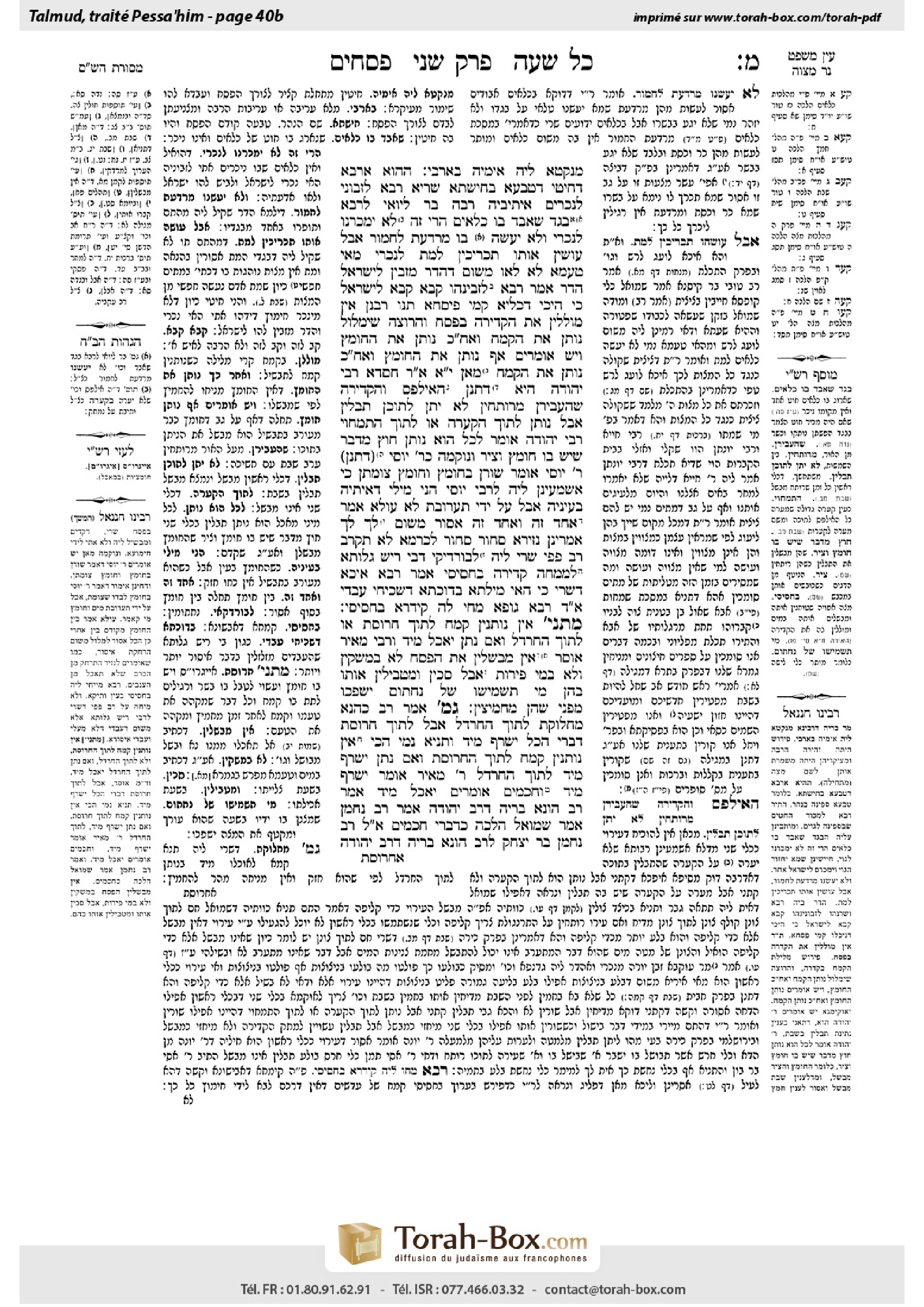
Pesachim 40b: Talmud study for Daf Yomi
Daf Yomi is the daily study of one Talmud folio. Explore 37 tractates with scans, Hebrew text, Sefaria English and AI-generated French translations where annotated.
Passage selection and English or AI-generated French translation are available where the scan has annotations. Daf Study is independent of Torah-Box and Sefaria.
Browse Pesachim · פסחים · All tractatesPesachim 40b text and translations
This page of Pesachim includes the Aramaic text, an English translation and an AI-generated French translation, alongside the scan above.
פסחים מ׳ ב · Aramaic and Hebrew text
מְנַקְּטָא לֵיהּ אִימֵּיהּ בְּאַרְבֵי.
הָהוּא אַרְבָּא דְחִיטֵּי דִּטְבַעָא בְּחִישְׁתָּא, שַׁרְיָא רָבָא לְזַבּוֹנֵי לְגוֹיִם.
אֵיתִיבֵיהּ רַבָּה בַּר לֵיוַאי לְרָבָא: בֶּגֶד שֶׁאָבַד בּוֹ כִּלְאַיִם — הֲרֵי זֶה לֹא יִמְכְּרֶנּוּ לְגוֹי, וְלֹא יַעֲשֶׂה בּוֹ מַרְדַּעַת לַחֲמוֹר. אֲבָל עוֹשִׂין אוֹתוֹ תַּכְרִיכִין לְמֵת.
לְגוֹי מַאי טַעְמָא לָא — לָאו מִשּׁוּם דַּהֲדַר מְזַבֵּין לְיִשְׂרָאֵל?
הֲדַר אָמַר רָבָא: לְזַבִּינְהוּ קַבָּא קַבָּא לְיִשְׂרָאֵל, כִּי הֵיכִי דְּכָלְיָא קַמֵּי פִּיסְחָא.
תָּנוּ רַבָּנַן: אֵין מוֹלְלִין אֶת הַקְּדֵירָה בַּפֶּסַח. וְהָרוֹצֶה שֶׁיִּמְלוֹל — נוֹתֵן אֶת הַקֶּמַח וְאַחַר כָּךְ נוֹתֵן אֶת הַחוֹמֶץ. וְיֵשׁ אוֹמְרִים: אַף נוֹתֵן אֶת הַחוֹמֶץ וְאַחַר כָּךְ נוֹתֵן אֶת הַקֶּמַח.
מַאן יֵשׁ אוֹמְרִים?
אָמַר רַב חִסְדָּא: רַבִּי יְהוּדָה הִיא, דִּתְנַן: הָאִילְפָּס וְהַקְּדֵירָה שֶׁהֶעֱבִירָן מְרוּתָּחִין — לֹא יִתֵּן לְתוֹכָן תַּבְלִין, אֲבָל נוֹתֵן לְתוֹךְ הַקְּעָרָה אוֹ לְתוֹךְ הַתַּמְחוּי. רַבִּי יְהוּדָה אוֹמֵר: לַכֹּל הוּא נוֹתֵן, חוּץ מִדָּבָר שֶׁיֵּשׁ בּוֹ חוֹמֶץ וָצִיר.
וְנוֹקְמַהּ כְּרַבִּי יוֹסֵי, (דִּתְנַן) רַבִּי יוֹסֵי אוֹמֵר: שׁוֹרָן בְּחוֹמֶץ, וְחוֹמֶץ צוֹמְתָן!
כִּי אַשְׁמְעִינַן לֵיהּ לְרַבִּי יוֹסֵי, הָנֵי מִילֵּי דְּאִיתֵיהּ בְּעֵינֵיהּ, אֲבָל עַל יְדֵי תַּעֲרוֹבֶת — לָא.
עוּלָּא אָמַר: אֶחָד זֶה וְאֶחָד זֶה — אָסוּר, מִשּׁוּם: ״לֵךְ לֵךְ אָמְרִינַן נְזִירָא, סְחוֹר סְחוֹר, לְכַרְמָא לָא תִּקְרַב״.
רַב פַּפִּי שָׁרֵי לֵיהּ לְבוּרְדִּיקִי דְּבֵי רֵישׁ גָּלוּתָא לְמִמְחֵה קְדֵירָה בַּחֲסִיסֵי. אָמַר רָבָא: אִיכָּא דְּשָׁרֵי כִּי הַאי מִילְּתָא בְּדוּכְתָּא דִּשְׁכִיחִי עָבְדִי? אִיכָּא דְאָמְרִי: רָבָא גּוּפָא מָחֵי לֵהּ קִידְרָא בַּחֲסִיסֵי.
מַתְנִי׳ אֵין נוֹתְנִין קֶמַח לְתוֹךְ חֲרוֹסֶת אוֹ לְתוֹךְ הַחַרְדָּל. וְאִם נָתַן — יֵאָכֵל מִיָּד, וְרַבִּי מֵאִיר אוֹסֵר.
אֵין מְבַשְּׁלִין אֶת הַפֶּסַח לֹא בְּמַשְׁקִין וְלֹא בְּמֵי פֵירוֹת, אֲבָל סָכִין וּמַטְבִּילִין אוֹתוֹ בָּהֶן.
מֵי תַשְׁמִישׁוֹ שֶׁל נַחְתּוֹם — יִשָּׁפְכוּ, מִפְּנֵי שֶׁהֵן מַחְמִיצִין.
גְּמָ׳ אָמַר רַב כָּהֲנָא: מַחֲלוֹקֶת לְתוֹךְ הַחַרְדָּל, אֲבָל לְתוֹךְ חֲרוֹסֶת — דִּבְרֵי הַכֹּל יִשָּׂרֵף מִיָּד.
וְתַנְיָא נָמֵי הָכִי: אֵין נוֹתְנִין קֶמַח לְתוֹךְ הַחֲרוֹסֶת, וְאִם נָתַן — יִשָּׂרֵף מִיָּד. לְתוֹךְ הַחַרְדָּל, רַבִּי מֵאִיר אוֹמֵר: יִשָּׂרֵף מִיָּד, וַחֲכָמִים אוֹמְרִים: יֵאָכֵל מִיָּד. אָמַר רַב הוּנָא בְּרֵיהּ דְּרַב יְהוּדָה אָמַר רַב נַחְמָן אָמַר שְׁמוּאֵל: הֲלָכָה כְּדִבְרֵי חֲכָמִים. אֲמַר לֵיהּ רַב נַחְמָן בַּר יִצְחָק לְרַב הוּנָא בְּרֵיהּ דְּרַב יְהוּדָה:
Pesachim 40b · English translation
that his mother would bring him wheat in a trough. In other words, she would guard the wheat grains from when they were harvested by placing them in vessels and guarding them until Passover.
The Gemara relates that there was a certain boat carrying wheat, which capsized before Passover in the Ḥishta River. Rava permitted its owners to sell the recovered grain to gentiles before Passover.
Rabba bar Levai raised an objection to the opinion of Rava from a baraita: With regard to a garment in which diverse kinds, a prohibited mixture of wool and linen, has been lost, i.e., a wool garment into which a linen thread was sewn or vice versa, one may not sell it to a gentile; and one may not even fashion it into a saddlecloth for a donkey. It is prohibited to do so lest one remove a piece of this garment and sew it onto his own clothing. However, one may fashion it into a shroud for a dead body, as there is no concern that he will remove it from the dead.
The Gemara clarifies this issue: What is the reason that one may not sell it to a gentile? Is it not due to the concern that the gentile will resell it to a Jew? Since the mixture of wool and linen is not visible, it is possible for a Jew to use this cloth unawares. The same concern applies to grain: It is not apparent that the grain that capsized in the river is prohibited. It should therefore be prohibited to sell this wheat to gentiles, lest they resell it to Jews.
Rava reconsidered and then said: He should sell this wheat one kav at a time, i.e., in small measures, each to a different Jew, but not to any one Jew in large quantities, so that all of this wheat will be used before Passover. By selling it in this manner, all the grain will be used quickly and no one will unwittingly eat these leavened grains on Passover.
The Sages taught: One may not stir flour into a pot of food on Passover to absorb the foam that has accumulated during the cooking process. And one who wishes to stir flour should add the flour and afterward add vinegar, which will prevent the flour from becoming leavened. And some say: One may even add vinegar and afterward add the flour, as vinegar prevents flour from becoming leavened even after the flour is diluted in water.
The Gemara asks: Who is the tanna whose opinion is introduced by the phrase some say?
Rav Ḥisda said: It is the opinion of Rabbi Yehuda, as we learned in a mishna: With regard to a stew pot or a pot of food that one removed from the fire when it was seething, one may not add spices to them on Shabbat. However, one may add spices to a dish or to the large plate into which the food is poured from the pot. Rabbi Yehuda says: One may add spices to any food that has been removed from the fire, except to a dish that contains vinegar or brine, as this food is considered as though it were still seething, due to the pungency of the vinegar or brine. Since Rabbi Yehuda maintains that vinegar has the same effect as boiling, he would agree that vinegar, like boiling water, prevents flour from becoming leavened.
The Gemara asks: And let us establish the opinion of: Some say, in accordance with the opinion of Rabbi Yosei. As we learned in a mishna: Rabbi Yosei says, with regard to wheat grains that were soaked in water: One should soak them in vinegar, and this vinegar will cause the wheat to contract and prevent it from becoming leavened.
The Gemara answers: When we learn the opinion of Rabbi Yosei, this applies only to a situation where the vinegar is in its pure, unadulterated form, in which case its pungency prevents the wheat from becoming leavened. However, if the vinegar is added by means of a mixture, no, Rabbi Yosei’s statement does not apply to a case of this kind.
Ulla said: In both of these cases, whether the vinegar is added first or afterward, its use is prohibited, as one must avoid scenarios that might lead to a prohibition, as per the well-known adage: Go around, go around, and do not approach the vineyard, they say to the nazirite. Since a nazirite is prohibited from drinking wine and eating grapes, it is preferable for him to avoid a vineyard entirely. A similar principle applies to other prohibitions.
The Gemara relates: Rav Pappi permitted the cooks [burdikei] of the household of the Exilarch to mash roasted grains into a pot of food, to dissolve the accumulated foam. Rava said: Is there anyone who permits this matter in a place where servants are found? Servants are unlikely to be careful with regard to these prohibitions. They will use raw flour for this purpose, which will lead to a violation of the prohibition against leavened bread on Passover. Some say that Rava himself would add roasted grains into his own pot.
MISHNA: One may not add flour to ḥaroset, a seasoned, pungent food, or to mustard, to dull the sharp taste. In both cases, the pungency of these foods might accelerate the leavening of the flour. And if one added flour to either of these, the mixture may be eaten immediately before it is leavened; and Rabbi Meir prohibits this, lest the food be leavened immediately.
The mishna continues: One may not boil the Paschal lamb in ordinary liquids or in fruit juices, as the Torah explicitly states that it must be roasted. However, one may baste it while it is roasting and dip it into liquid while eating it.
The tanna further states: Water that has been used by a baker for cooling his hands or washing dishes should be poured out, because this water leavens the dough, as the water probably contains a small quantity of flour and dough.
GEMARA: Rav Kahana said: The dispute between Rabbi Meir and the Rabbis concerns a case where one adds flour to mustard, which is extremely pungent and will not leaven the flour immediately. But in a case where flour is added to the less pungent ḥaroset, which will leaven the flour quickly, everyone agrees that the mixture must be burned immediately.
And that opinion was also taught in a baraita: One may not add flour to ḥaroset, and if one did add flour it should be burned immediately. With regard to flour that was added to mustard, Rabbi Meir says: It should be burned immediately, and the Rabbis say: It should be eaten immediately, before it is leavened. Rav Huna, son of Rav Yehuda, said that Rav Naḥman said that Shmuel said: The halakha is in accordance with the opinion of the Rabbis concerning this issue. Rav Naḥman bar Yitzḥak said to Rav Huna, son of Rav Yehuda:
Pesachim 40b · Traduction française (IA)
que sa mère lui apporterait du blé dans une auge. Autrement dit, elle protégeait les grains de blé dès leur récolte, en les plaçant dans des récipients et en les gardant ainsi jusqu’à Pessa’h.
La Guemara rapporte qu’un bateau transportant du blé fit naufrage dans le fleuve Ḥishta avant Pessa’h. Rava autorisa ses propriétaires à vendre le grain récupéré à des non-Juifs avant Pessa’h.
Rabba bar Levai objecta à l’avis de Rava en citant une baraïta : au sujet d’un vêtement dans lequel se trouve un mélange d’espèces, c’est-à-dire un mélange interdit de laine et de lin — un vêtement de laine dans lequel on a cousu un fil de lin, ou inversement —, on ne peut pas le vendre à un non-Juif ; on ne peut même pas le transformer en couverture de selle pour un âne. Cela est interdit, de crainte qu’il n’en retire un morceau pour le coudre sur son propre vêtement. Toutefois, on peut en faire un linceul pour un mort, car on ne craint pas qu’on le retire au défunt.
La Guemara précise la question : pourquoi ne peut-on pas le vendre à un non-Juif ? N’est-ce pas par crainte que celui-ci ne le revende à un Juif ? Comme le mélange de laine et de lin n’est pas visible, un Juif pourrait utiliser ce tissu sans s’en rendre compte. La même crainte s’applique au blé : il n’est pas manifeste que le blé qui a fait naufrage dans le fleuve est interdit. Il faudrait donc interdire de vendre ce blé à des non-Juifs, de crainte qu’ils ne le revendent à des Juifs.
Rava revint sur sa décision et dit alors : qu’on vende ce blé par kav, c’est-à-dire en petites quantités, un kav à la fois et à des Juifs différents, mais pas en grande quantité à un seul Juif, afin que tout ce blé soit utilisé avant Pessa’h. Vendu de cette manière, tout le grain sera utilisé rapidement et personne ne mangera à son insu ces grains levés à Pessa’h.
Les Sages ont enseigné : pendant Pessa’h, on ne peut pas incorporer de farine dans une marmite de nourriture pour absorber la mousse qui s’est accumulée pendant la cuisson. Celui qui souhaite incorporer de la farine doit l’ajouter, puis ajouter du vinaigre, ce qui empêchera la farine de lever. Certains disent : on peut même ajouter le vinaigre avant la farine, car le vinaigre empêche la farine de lever, même après qu’elle a été diluée dans l’eau.
La Guemara demande : quel est le tanna dont l’avis est introduit par la formule « certains disent » ?
Rav Ḥisda dit : c’est l’avis de Rabbi Yehuda, comme nous l’avons appris dans une Michna : au sujet d’un pot de ragoût ou d’une marmite de nourriture qu’on a retirés du feu alors qu’ils bouillonnaient, on ne peut pas y ajouter d’épices pendant Chabbat. Toutefois, on peut ajouter des épices à un plat ou au grand plat dans lequel on verse la nourriture de la marmite. Rabbi Yehuda dit : on peut ajouter des épices à tout aliment retiré du feu, sauf à un plat qui contient du vinaigre ou de la saumure, car, en raison de l’acidité du vinaigre ou de la saumure, on considère que cet aliment bout encore. Puisque Rabbi Yehuda estime que le vinaigre a le même effet que l’ébullition, il serait d’accord pour dire que le vinaigre, comme l’eau bouillante, empêche la farine de lever.
La Guemara demande : ne pourrait-on pas attribuer l’avis de « certains disent » à Rabbi Yosei ? En effet, nous avons appris dans une Michna : Rabbi Yosei dit, au sujet des grains de blé qui ont été trempés dans l’eau : on doit les faire tremper dans du vinaigre, qui les fera se contracter et les empêchera de lever.
La Guemara répond : l’avis de Rabbi Yosei ne s’applique que lorsque le vinaigre est pur, sans mélange ; dans ce cas, son acidité empêche le blé de lever. En revanche, si le vinaigre est ajouté à un mélange, non, la déclaration de Rabbi Yosei ne s’applique pas à un tel cas.
Oula dit : dans les deux cas, que le vinaigre soit ajouté avant ou après, son emploi est interdit, car il faut éviter les situations susceptibles de conduire à une transgression, conformément à l’adage bien connu : « Fais le tour, fais le tour, mais n’approche pas de la vigne », dit-on au nazir. Puisqu’un nazir n’a pas le droit de boire du vin ni de manger du raisin, il est préférable qu’il évite complètement les vignes. Un principe semblable s’applique aux autres interdictions.
La Guemara rapporte que Rav Pappi autorisa les cuisiniers [burdikei] de la maison de l’exilarque à écraser des grains grillés dans une marmite de nourriture afin d’y dissoudre la mousse accumulée. Rava dit : « Y a-t-il quelqu’un qui autorise cela dans un endroit où se trouvent des serviteurs ? » Les serviteurs ne sont guère susceptibles de prendre garde à ces interdictions. Ils utiliseront de la farine crue à cette fin, ce qui entraînera une transgression de l’interdiction du levain à Pessa’h. Certains disent que Rava lui-même ajoutait des grains grillés dans sa propre marmite.
MICHNA : On ne peut ajouter de farine au ḥaroset, un aliment assaisonné et piquant, ni à la moutarde, pour en atténuer le goût fort. Dans les deux cas, le caractère piquant de ces aliments pourrait accélérer la fermentation de la farine. Si quelqu’un a ajouté de la farine à l’un ou à l’autre, le mélange peut être consommé immédiatement, avant qu’il ne fermente ; Rabbi Meir l’interdit, de crainte que l’aliment ne fermente aussitôt.
La Michna poursuit : on ne peut pas faire bouillir l’agneau pascal dans des liquides ordinaires ni dans des jus de fruits, car la Torah écrite indique explicitement qu’il doit être rôti. Toutefois, on peut l’enduire pendant qu’il rôtit et le tremper dans un liquide au moment de le manger.
Le tanna ajoute : l’eau dont un boulanger s’est servi pour se rafraîchir les mains ou laver des ustensiles doit être jetée, car elle fait fermenter la pâte ; elle contient probablement une petite quantité de farine et de pâte.
GUEMARA : Rav Kahana dit : le désaccord entre Rabbi Meir et les Sages concerne le cas où l’on ajoute de la farine à la moutarde, qui est extrêmement piquante et ne fait pas lever la farine immédiatement. Mais lorsque la farine est ajoutée au ḥaroset, qui est moins piquant et fait rapidement lever la farine, tous s’accordent à dire que le mélange doit être brûlé immédiatement.
Cet avis a également été enseigné dans une baraïta : on ne peut pas ajouter de farine au ḥaroset et, si quelqu’un en a ajouté, il faut la brûler immédiatement. Quant à la farine ajoutée à la moutarde, Rabbi Meir dit qu’il faut la brûler immédiatement, tandis que les Sages disent qu’il faut la consommer immédiatement, avant qu’elle ne fermente. Rav Huna, fils de Rav Yehuda, dit que Rav Naḥman a dit au nom de Shmuel : la halakha est conforme à l’avis des Sages sur cette question. Rav Naḥman bar Yitzḥak dit à Rav Huna, fils de Rav Yehuda :
Traduction française générée par IA à partir de l’édition anglaise de Sefaria. Vérifie toujours un passage avec le texte source.
Text from Sefaria: William Davidson Edition - Vocalized Aramaic (CC BY NC); William Davidson Edition - English (CC BY NC).