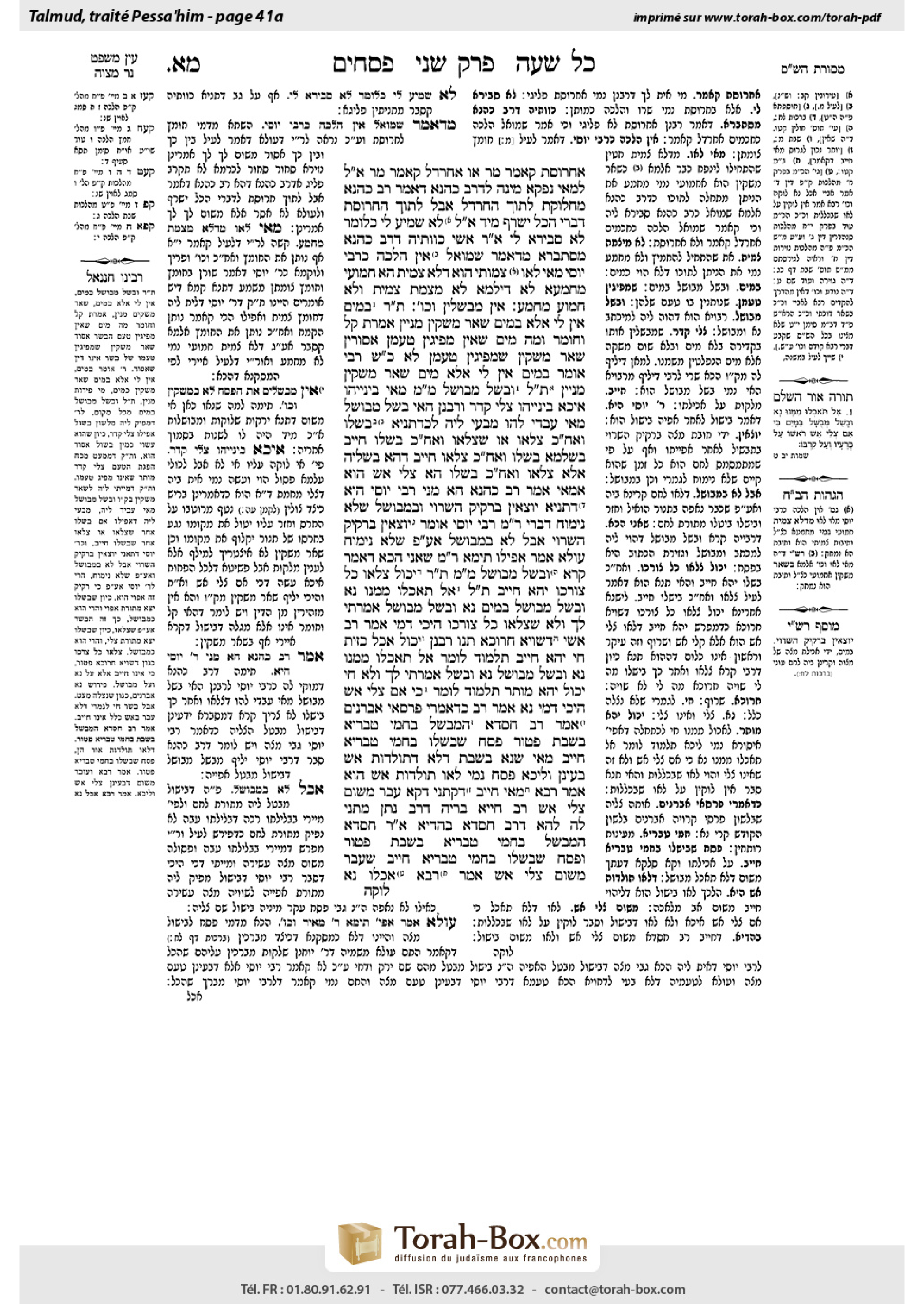
Pesachim 41a: Talmud study for Daf Yomi
Daf Yomi is the daily study of one Talmud folio. Explore 37 tractates with scans, Hebrew text, Sefaria English and AI-generated French translations where annotated.
Passage selection and English or AI-generated French translation are available where the scan has annotations. Daf Study is independent of Torah-Box and Sefaria.
Browse Pesachim · פסחים · All tractatesPesachim 41a text and translations
This page of Pesachim includes the Aramaic text, an English translation and an AI-generated French translation, alongside the scan above.
פסחים מ״א א · Aramaic and Hebrew text
אַחֲרוֹסֶת קָאָמַר מָר, אוֹ אַחַרְדָּל קָאָמַר מָר? אֲמַר לֵיהּ: לְמַאי נָפְקָא מִינַּהּ?
לִדְרַב כָּהֲנָא. דְּאָמַר רַב כָּהֲנָא: מַחֲלוֹקֶת לְתוֹךְ הַחַרְדָּל, אֲבָל לְתוֹךְ הַחֲרוֹסֶת — דִּבְרֵי הַכֹּל יִשָּׂרֵף מִיָּד.
אֲמַר לֵיהּ: לָא שְׁמִיעַ לִי, כְּלוֹמַר לָא סְבִירָא לִי.
אָמַר רַב אָשֵׁי: כְּווֹתֵיהּ דְּרַב כָּהֲנָא מִסְתַּבְּרָא, מִדְּאָמַר שְׁמוּאֵל: אֵין הֲלָכָה כְּרַבִּי יוֹסֵי. מַאי לָאו? צַמּוֹתֵי הוּא דְּלָא צָמֵית, הָא חַמּוֹעֵי מְחַמְּעָא.
לָא, דִּילְמָא לָא מִצְמָת צָמֵית, וְלָא חַמּוֹעֵי מְחַמַּע.
אֵין מְבַשְּׁלִין וְכוּ׳. תָּנוּ רַבָּנַן: ״בְּמַיִם״ — אֵין לִי אֶלָּא בְּמַיִם, שְׁאָר מַשְׁקִין מִנַּיִין?
אָמַרְתָּ, קַל וָחוֹמֶר: וּמָה מַיִם שֶׁאֵין מְפִיגִין טַעְמָן — אֲסוּרִין, שְׁאָר מַשְׁקִין שֶׁמְּפִיגִין טַעְמָן — לֹא כׇּל שֶׁכֵּן!
רַבִּי אוֹמֵר: ״בְּמַיִם״ — אֵין לִי אֶלָּא מַיִם, שְׁאָר מַשְׁקִין מִנַּיִין? תַּלְמוּד לוֹמַר: ״וּבָשֵׁל מְבֻשָּׁל״, מִכׇּל מָקוֹם.
מַאי בֵּינַיְיהוּ? אִיכָּא בֵּינַיְיהוּ צְלִי קֵדָר.
וְרַבָּנַן, הַאי ״בָּשֵׁל מְבֻשָּׁל״ מַאי עָבְדִי לְהוּ? מִבְּעֵי לֵיהּ לְכִדְתַנְיָא: בִּשְּׁלוֹ וְאַחַר כָּךְ צְלָאוֹ, אוֹ שֶׁצְּלָאוֹ וְאַחַר כָּךְ בִּשְּׁלוֹ — חַיָּיב.
בִּשְׁלָמָא בִּשְּׁלוֹ וְאַחַר כָּךְ צְלָאוֹ חַיָּיב, דְּהָא בַּשְּׁלֵיהּ. אֶלָּא צְלָאוֹ וְאַחַר כָּךְ בִּשְּׁלוֹ, הָא צְלִי אֵשׁ הוּא, אַמַּאי?
אָמַר רַב כָּהֲנָא: הָא מַנִּי — רַבִּי יוֹסֵי הִיא. דְּתַנְיָא: יוֹצְאִין בְּרָקִיק הַשָּׁרוּי וּבִמְבוּשָּׁל שֶׁלֹּא נִימּוֹחַ, דִּבְרֵי רַבִּי מֵאִיר. רַבִּי יוֹסֵי אוֹמֵר: יוֹצְאִין בְּרָקִיק הַשָּׁרוּי, אֲבָל לֹא בִּמְבוּשָּׁל, אַף עַל פִּי שֶׁלֹּא נִימּוֹחַ.
עוּלָּא אָמַר: אֲפִילּוּ תֵּימָא רַבִּי מֵאִיר, שָׁאנֵי הָכָא דְּאָמַר קְרָא: ״וּבָשֵׁל מְבֻשָּׁל״, מִכׇּל מָקוֹם.
תָּנוּ רַבָּנַן: יָכוֹל צְלָאוֹ כׇּל צוֹרְכּוֹ יְהֵא חַיָּיב — תַּלְמוּד לוֹמַר: ״אַל תֹּאכְלוּ מִמֶּנּוּ נָא וּבָשֵׁל מְבֻשָּׁל בַּמָּיִם״. נָא וּבָשֵׁל מְבֻשָּׁל אָמַרְתִּי לְךָ, וְלֹא שֶׁצְּלָאוֹ כׇּל צוֹרְכּוֹ.
הֵיכִי דָּמֵי? אָמַר רַב אָשֵׁי: דְּשַׁוְּיֵא חֲרוֹכָא.
תָּנוּ רַבָּנַן: יָכוֹל אָכַל כְּזַיִת חַי יְהֵא חַיָּיב — תַּלְמוּד לוֹמַר: ״אַל תֹּאכְלוּ מִמֶּנּוּ נָא וּבָשֵׁל מְבֻשָּׁל״. נָא וּבָשֵׁל אָמַרְתִּי לְךָ, וְלֹא חַי.
יָכוֹל יְהֵא מוּתָּר — תַּלְמוּד לוֹמַר: ״כִּי אִם צְלִי אֵשׁ״. הֵיכִי דָּמֵי נָא? אָמַר רַב: כִּדְאָמְרִי פָּרְסָאֵי: אֲבַרְנִים.
אָמַר רַב חִסְדָּא: הַמְבַשֵּׁל בְּחַמֵּי טְבֶרְיָא בְּשַׁבָּת — פָּטוּר. פֶּסַח שֶׁבִּשְּׁלוֹ בְּחַמֵּי טְבֶרְיָא — חַיָּיב.
מַאי שְׁנָא בְּשַׁבָּת דְּלָא? דְּתוֹלְדוֹת אֵשׁ בָּעֵינַן, וְלֵיכָּא. פֶּסַח נָמֵי, לָאו תּוֹלְדוֹת אֵשׁ הוּא!
אָמַר רָבָא: מַאי ״חַיָּיב״ דְּקָתָנֵי — דְּקָא עָבַר מִשּׁוּם ״צָלִי אֵשׁ״.
רַב חִיָּיא בְּרֵיהּ דְּרַב נָתָן מַתְנֵי לַהּ לְהָא דְּרַב חִסְדָּא בְּהֶדְיָא. אָמַר רַב חִסְדָּא: הַמְבַשֵּׁל בְּחַמֵּי טְבֶרְיָא בְּשַׁבָּת — פָּטוּר, וּפֶסַח שֶׁבִּשְּׁלוֹ בְּחַמֵּי טְבֶרְיָא — חַיָּיב, שֶׁעָבַר מִשּׁוּם ״צְלִי אֵשׁ״.
אָמַר רָבָא: אֲכָלוֹ נָא —
Pesachim 41a · English translation
Did the Master say this statement with regard to ḥaroset, or did the Master say it with regard to mustard? He said to him: What is the practical difference whether he was referring to ḥaroset or mustard? Both of these are mentioned together, and the same halakha applies to both.
He said to him: There is a difference with regard to that which was stated by Rav Kahana, as Rav Kahana said: The dispute between Rabbi Meir and the Rabbis concerns a case in which flour was added to mustard. However, if flour was added to ḥaroset, everyone agrees that it must be burned immediately. Rav Naḥman bar Yitzḥak was asking Rav Huna, son of Rav Yehuda, whether he disagrees with Rav Kahana and maintains that the Rabbis dispute the halakha in the case of ḥaroset as well.
He said to him: I did not hear about this statement; that is to say, I do not hold in accordance with it. I do not distinguish between these two cases, as in my opinion the Rabbis permit one to eat even this ḥaroset.
Rav Ashi said: It is reasonable to rule in accordance with the opinion of Rav Kahana, from the fact that Shmuel said that the halakha is not in accordance with the opinion of Rabbi Yosei, who maintains that vinegar will prevent grain from becoming leavened. What, isn’t it correct to infer from here that vinegar added to flour does not shrink the grain and will even leaven it? According to this explanation, food that contains vinegar, e.g., ḥaroset, is likely to be leavened immediately, as claimed by Rav Kahana.
The Gemara rejects this interpretation: No, this is no proof, as perhaps Shmuel meant that, according to the opinion of the Rabbis, vinegar will neither cause the wheat to shrink nor leaven it. Consequently, this statement cannot serve as a proof of the opinion of the Rabbis with regard to ḥaroset.
The mishna taught that one may not boil the Paschal lamb in liquid. To explain this issue, the Gemara cites a baraita that interprets the verse: “You shall not eat it partially roasted, nor boiled in any way in water, but roasted with fire; its head with its legs, and with the innards in it” (Exodus 12:9). The Sages taught: “In water”; I have derived nothing other than the prohibition against boiling the Paschal lamb in water. From where do I know that it is likewise prohibited to boil it in other liquids?
You said that this can be derived by means of an a fortiori inference: And just as water, which does not temper the taste of the food boiled in it, is prohibited for boiling the Paschal lamb, with regard to other liquids, which do temper the taste of the food boiled in them, is it not all the more so that it is prohibited to boil the Paschal lamb in them?
Rabbi Yehuda HaNasi provides a different derivation and says: From the phrase “In water,” I have derived nothing other than the prohibition against boiling the Paschal lamb in water. From where do I learn that it is likewise prohibited to boil it in other liquids? The verse states: “Nor boiled in any way,” which means: In any case, i.e., boiling the Paschal lamb in any type of liquid is prohibited.
The Gemara asks: What is the practical difference between these two derivations? The Gemara answers: The practical difference between them is with regard to meat that is roasted in a pot without the addition of any liquid, but is cooked in its own juices. According to Rabbi Yehuda HaNasi, it is prohibited to prepare the Paschal lamb in this manner, as this is considered boiling, whereas the Rabbis maintain that an action is classified as boiling only if one adds liquid to the meat.
The Gemara asks: And the Rabbis, with regard to that phrase, “boiled in any way,” what do they do with it? The Gemara answers: It is required for that which was taught in a baraita: If one boiled the Paschal lamb and afterward roasted it, or roasted it and afterward boiled it, he is liable to receive lashes for boiling the Paschal lamb.
The Gemara asks: Granted, if one boiled the Paschal lamb and afterward roasted it, he is liable, as he boiled it first and is punished for this act. However, if he roasted it and afterward boiled it, and it is a food that has been roasted by fire, why is he liable?
Rav Kahana said: In accordance with whose opinion is this baraita? It is in accordance with the opinion of Rabbi Yosei, who maintains that boiling after roasting nullifies the previous act of roasting. As it was taught in a baraita: One can fulfill his obligation to eat matza with a wafer that has been soaked in water or with a boiled wafer that has not yet dissolved; this is the statement of Rabbi Meir. Rabbi Yosei says: One can fulfill his obligation with a wafer that has been soaked in a cooked dish but not with a boiled wafer, even if it has not dissolved. Evidently, Rabbi Yosei maintains that food that was initially baked and subsequently boiled is no longer categorized as baked, and the same presumably applies to meat that was roasted and then boiled.
Ulla said: Even if you say that the halakha with regard to boiled matza is in accordance with the opinion of Rabbi Meir, there is no difficulty, as the cases of matza and the Paschal lamb are dissimilar in this regard. Here, with regard to the Paschal lamb, it is different, as the verse states: “Nor boiled in any way,” which indicates that it is prohibited to boil it in any case. No restriction of this kind is stated with regard to matza.
The Sages taught: I might have thought that if one roasted the Paschal lamb fully, he should be liable. Therefore, the verse states: “You shall not eat it partially roasted, nor boiled in any way in water” (Exodus 12:9). This verse teaches that I, God, said to you that the Paschal lamb is prohibited if it is partially roasted or boiled in any way, but not if it is fully roasted. One who roasts the Paschal lamb fully has not violated a prohibition.
The Gemara asks: What are the circumstances of this case that render it necessary for a verse to teach that roasting the Paschal lamb fully is not a violation of a prohibition? Rav Ashi said: This is referring to a situation where one burned it. The verse indicates that even one who entirely burns the Paschal lamb does not violate this prohibition.
The Sages taught: I might have thought that one who ate an olive-bulk portion of the Paschal sacrifice raw should be liable for violating a prohibition. Therefore, the verse states: “You shall not eat it partially roasted [na], nor boiled in any way in water.” This verse teaches that I, God, said to you that it is prohibited to eat the Paschal lamb partially roasted or boiled, but there is no prohibition against eating it raw.
I might have thought that it is permitted to eat it raw ab initio. Therefore, the verse states: “But roasted with fire” (Exodus 12:9). This teaches that the mitzva is to roast the Paschal lamb with fire, ab initio. The Gemara asks: What are the circumstances of cooking that are defined as na, partially roasted? Rav said: As the Persians say: Avarnim, half roasted.
Rav Ḥisda said: One who cooks food in the hot springs of Tiberias on Shabbat is exempt. One violates the Shabbat prohibition of cooking only if he uses a fire. In the case of a Paschal lamb that was cooked, i.e., boiled, in the hot springs of Tiberias, one is liable for boiling the offering.
The Gemara asks: What is different with regard to Shabbat, that one is not punished for cooking in this manner? The reason is that a fire, or a fire derivative, is required for an act to be defined as cooking on Shabbat, but there is no fire here, as the hot springs are not generated by fire. If so, with regard to the Paschal lamb as well, it is not a fire derivative, and it should not be considered boiling with regard to this prohibition either.
Rava said: What is the meaning of the word liable that Rav Ḥisda taught? It means that in doing so one violated the positive mitzva, due to that which is written: “Roasted with fire.” In other words, one who boils the Paschal lamb in the hot springs of Tiberias did not in fact violate the prohibition of boiling the Paschal lamb, but he has also not fulfilled the positive mitzva to roast the offering.
Rav Ḥiyya, son of Rav Natan, teaches this interpretation of Rav Ḥisda’s statement explicitly, i.e., that Rav Ḥisda himself said: One who cooks in the hot springs of Tiberias on Shabbat is exempt, and with regard to a Paschal lamb that was cooked in the hot springs of Tiberias, one is liable to receive punishment for this act. In doing so, he violated a positive mitzva, due to that which is written: “Roasted with fire.”
Rava said: One who ate the Paschal lamb partially roasted,
Pesachim 41a · Traduction française (IA)
Le Maître a-t-il dit cela au sujet du ḥaroset, ou au sujet de la moutarde ? Il lui répondit : Quelle différence pratique y a-t-il à savoir s’il parlait du ḥaroset ou de la moutarde ? Les deux sont mentionnés ensemble, et la même halakha s’applique à l’un comme à l’autre.
Il lui répondit : La différence porte sur ce qu’a enseigné Rav Kahana, car Rav Kahana a dit : La controverse entre Rabbi Meïr et les Sages concerne le cas où l’on a ajouté de la farine à de la moutarde. En revanche, si l’on a ajouté de la farine au ḥaroset, tous conviennent qu’il faut le brûler immédiatement. Rav Naḥman bar Yitzḥak demandait à Rav Huna, fils de Rav Yehuda, s’il contestait Rav Kahana et estimait que les Sages discutent également de la halakha dans le cas du ḥaroset.
Il lui répondit : Je n’ai pas entendu cet enseignement, c’est-à-dire que je ne souscris pas à cette opinion. Je ne distingue pas entre ces deux cas, car, à mon avis, les Sages permettent de manger même ce ḥaroset.
Rav Ashi dit : Il est raisonnable de trancher conformément à l’opinion de Rav Kahana, puisque Shmuel a dit que la halakha n’est pas conforme à l’opinion de Rabbi Yosei, qui soutient que le vinaigre empêche le grain de fermenter. N’est-il pas juste d’en déduire que le vinaigre ajouté à la farine ne fait pas rétrécir le grain et le fait même fermenter ? Selon cette explication, un aliment contenant du vinaigre, par exemple le ḥaroset, est susceptible de fermenter immédiatement, comme l’affirme Rav Kahana.
La Guemara rejette cette interprétation : Non, cela ne prouve rien, car Shmuel voulait peut-être dire que, selon l’opinion des Sages, le vinaigre ne fait ni rétrécir le blé ni fermenter la pâte. Par conséquent, cet enseignement ne peut servir de preuve quant à l’opinion des Sages au sujet du ḥaroset.
La Michna a enseigné qu’on ne peut pas faire bouillir l’agneau pascal dans un liquide. Pour expliquer ce point, la Guemara cite une baraïta qui interprète le verset : « Vous ne le mangerez pas à moitié rôti, ni bouilli de quelque manière que ce soit dans l’eau, mais rôti au feu ; sa tête avec ses jambes, et ses entrailles avec lui » (Exode 12,9). Les Sages ont enseigné : « Dans l’eau » ; je n’en ai déduit que l’interdiction de faire bouillir l’agneau pascal dans l’eau. Comment savoir qu’il est également interdit de le faire bouillir dans d’autres liquides ?
Tu as dit qu’on peut le déduire par un raisonnement a fortiori : si l’eau, qui n’altère pas le goût des aliments qu’on y fait bouillir, est interdite pour faire bouillir l’agneau pascal, à plus forte raison est-il interdit de le faire bouillir dans d’autres liquides, qui, eux, altèrent le goût des aliments qu’on y fait cuire.
Rabbi Yehuda HaNasi propose une autre déduction et dit : De l’expression « dans l’eau », je n’ai déduit que l’interdiction de faire bouillir l’agneau pascal dans l’eau. Comment savoir qu’il est également interdit de le faire bouillir dans d’autres liquides ? Le verset dit : « Ni bouilli de quelque manière que ce soit », ce qui signifie : dans tous les cas, c’est-à-dire qu’il est interdit de faire bouillir l’agneau pascal dans n’importe quel type de liquide.
La Guemara demande : Quelle différence pratique y a-t-il entre ces deux déductions ? La Guemara répond : La différence porte sur la viande placée dans une marmite sans ajout de liquide, mais cuite dans son propre jus. Selon Rabbi Yehuda HaNasi, il est interdit de préparer l’agneau pascal de cette manière, car cela est considéré comme le faire bouillir, tandis que les Sages estiment que l’on ne parle de cuisson par ébullition que si l’on ajoute du liquide à la viande.
La Guemara demande : Et les Sages, que font-ils de l’expression « bouilli de quelque manière que ce soit » ? La Guemara répond : Elle est nécessaire pour l’enseignement d’une baraïta : si quelqu’un a fait bouillir l’agneau pascal puis l’a rôti, ou s’il l’a rôti puis l’a fait bouillir, il est passible de flagellation pour avoir fait bouillir l’agneau pascal.
Il est compréhensible que celui qui a fait bouillir l’agneau pascal puis l’a rôti soit passible, puisqu’il l’a d’abord fait bouillir et qu’il est puni pour cet acte. Mais s’il l’a rôti puis l’a fait bouillir, alors qu’il s’agit d’un aliment rôti au feu, pourquoi est-il passible ?
Rav Kahana dit : Selon l’opinion de qui cette baraïta a-t-elle été enseignée ? Selon celle de Rabbi Yosei, qui soutient que faire bouillir un aliment après l’avoir rôti annule le rôtissage antérieur. En effet, il a été enseigné dans une baraïta : On peut s’acquitter de son obligation de manger de la matsa avec une galette trempée dans l’eau ou avec une galette bouillie qui ne s’est pas encore désagrégée ; telle est l’opinion de Rabbi Meïr. Rabbi Yosei dit : On peut s’acquitter de son obligation avec une galette trempée dans un plat cuit, mais pas avec une galette bouillie, même si elle ne s’est pas désagrégée. Il apparaît donc que, selon Rabbi Yosei, un aliment d’abord cuit au four puis bouilli n’est plus considéré comme cuit au four ; on peut supposer qu’il en va de même pour la viande rôtie puis bouillie.
Ulla dit : Même si tu dis que la halakha concernant la matsa bouillie est conforme à l’opinion de Rabbi Meïr, il n’y a pas de difficulté, car la matsa et l’agneau pascal diffèrent sur ce point. Dans le cas de l’agneau pascal, c’est différent, puisque le verset dit : « Ni bouilli de quelque manière que ce soit », ce qui indique qu’il est interdit de le faire bouillir dans tous les cas. Aucune restriction de ce genre n’est formulée au sujet de la matsa.
Les Sages ont enseigné : J’aurais pu penser que celui qui rôtit complètement l’agneau pascal est passible. Le verset dit donc : « Vous ne le mangerez pas à moitié rôti, ni bouilli de quelque manière que ce soit dans l’eau » (Exode 12,9). Ce verset enseigne que Moi, Dieu, vous ai dit que l’agneau pascal est interdit s’il est à moitié rôti ou bouilli de quelque manière que ce soit, mais non s’il est complètement rôti. Celui qui rôtit complètement l’agneau pascal n’a transgressé aucune interdiction.
La Guemara demande : Dans quelles circonstances est-il nécessaire qu’un verset enseigne que rôtir complètement l’agneau pascal ne constitue pas une transgression ? Rav Ashi dit : Cela concerne le cas où quelqu’un l’a brûlé. Le verset indique que même celui qui brûle entièrement l’agneau pascal ne transgresse pas cette interdiction.
Les Sages ont enseigné : J’aurais pu penser que celui qui mange un volume d’olive de l’offrande pascale crue est passible pour avoir transgressé une interdiction. Le verset dit donc : « Vous ne le mangerez pas à moitié rôti [na], ni bouilli de quelque manière que ce soit dans l’eau. » Ce verset enseigne que Moi, Dieu, vous ai dit qu’il est interdit de manger l’agneau pascal à moitié rôti ou bouilli, mais qu’il n’est pas interdit de le manger cru.
J’aurais pu penser qu’il est permis de le manger cru a priori. Le verset dit donc : « Mais rôti au feu » (Exode 12,9). Cela enseigne que la mitsva consiste, a priori, à rôtir l’agneau pascal au feu. La Guemara demande : Quel degré de cuisson est défini comme na, c’est-à-dire à moitié rôti ? Rav dit : C’est ce que les Perses appellent avarnim, « à moitié rôti ».
Rav Ḥisda dit : Celui qui cuit un aliment dans les sources chaudes de Tibériade pendant Chabbat est exempt. On ne transgresse l’interdiction de cuire pendant Chabbat que si l’on utilise le feu. En revanche, celui qui fait cuire, c’est-à-dire bouillir, une offrande pascale dans les sources chaudes de Tibériade est passible pour avoir fait bouillir l’offrande.
La Guemara demande : En quoi le Chabbat diffère-t-il, de sorte qu’on n’est pas puni pour avoir cuit de cette manière ? C’est parce qu’un feu, ou un dérivé du feu, est nécessaire pour qu’un acte soit considéré comme une cuisson pendant Chabbat ; or, ici, il n’y a pas de feu, puisque les sources chaudes ne sont pas produites par le feu. Dans ce cas, pour l’agneau pascal également, il ne s’agit pas d’un dérivé du feu et cela ne devrait donc pas non plus être considéré comme une ébullition au regard de cette interdiction.
Rava dit : Que signifie le mot « passible » dans l’enseignement de Rav Ḥisda ? Cela signifie qu’en agissant ainsi, on a transgressé la mitsva positive, comme l’indique ce qui est écrit : « Rôti au feu. » Autrement dit, celui qui fait bouillir l’agneau pascal dans les sources chaudes de Tibériade n’a en réalité pas transgressé l’interdiction de faire bouillir l’agneau pascal, mais il n’a pas non plus accompli la mitsva positive de rôtir l’offrande.
Rav Ḥiyya, fils de Rav Natan, enseigne explicitement cette interprétation de l’enseignement de Rav Ḥisda, c’est-à-dire que Rav Ḥisda lui-même a dit : Celui qui cuit dans les sources chaudes de Tibériade pendant Chabbat est exempt ; quant à celui qui fait cuire un agneau pascal dans les sources chaudes de Tibériade, il est passible d’une peine pour cet acte. Ce faisant, il a transgressé une mitsva positive, comme l’indique ce qui est écrit : « Rôti au feu. »
Rava dit : Celui qui a mangé l’agneau pascal à moitié rôti,
Traduction française générée par IA à partir de l’édition anglaise de Sefaria. Vérifie toujours un passage avec le texte source.
Text from Sefaria: William Davidson Edition - Vocalized Aramaic (CC BY NC); William Davidson Edition - English (CC BY NC).