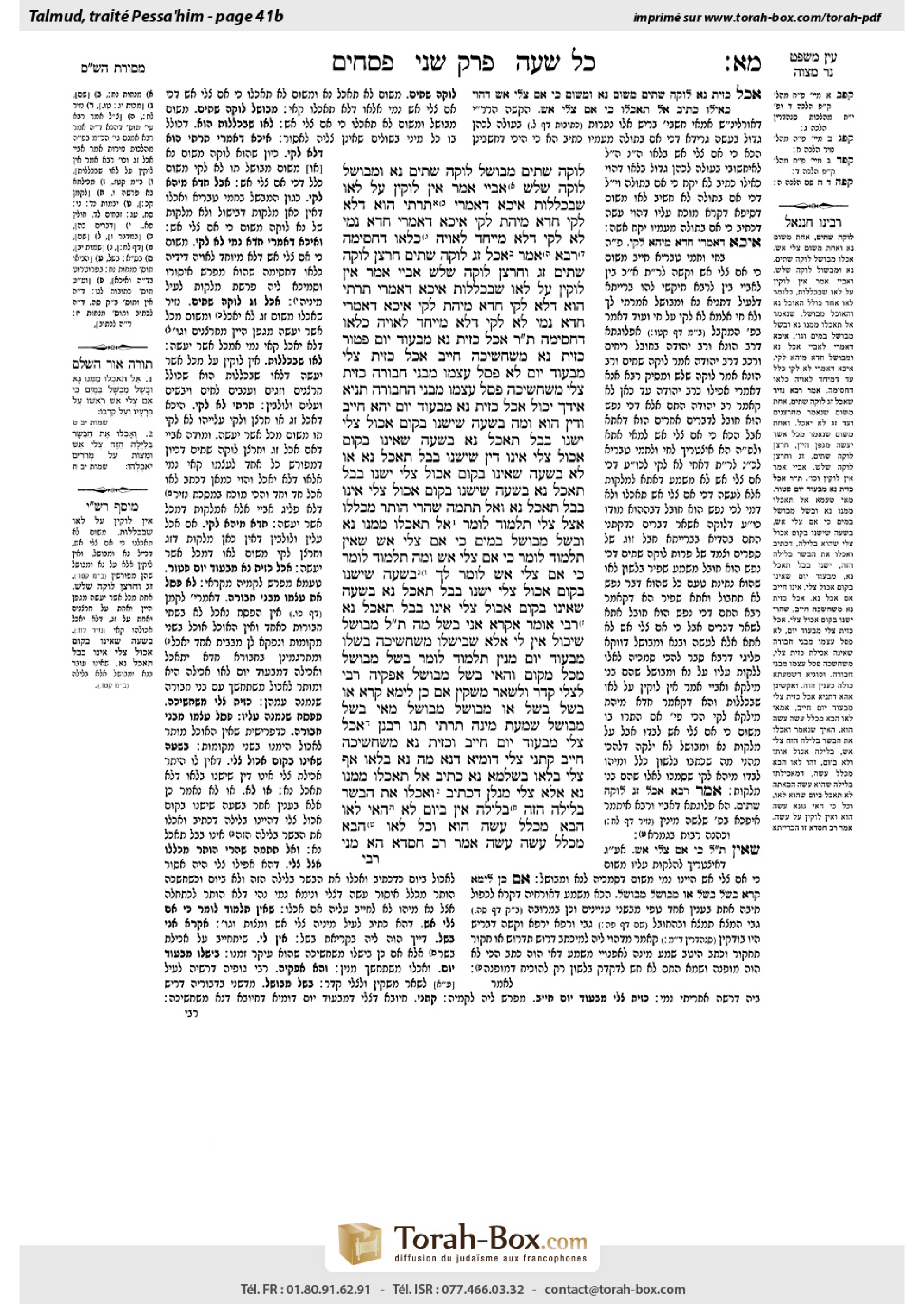
Pesachim 41b: Talmud study for Daf Yomi
Daf Yomi is the daily study of one Talmud folio. Explore 37 tractates with scans, Hebrew text, Sefaria English and AI-generated French translations where annotated.
Passage selection and English or AI-generated French translation are available where the scan has annotations. Daf Study is independent of Torah-Box and Sefaria.
Browse Pesachim · פסחים · All tractatesPesachim 41b text and translations
This page of Pesachim includes the Aramaic text, an English translation and an AI-generated French translation, alongside the scan above.
פסחים מ״א ב · Aramaic and Hebrew text
לוֹקֶה שְׁתַּיִם. מְבוּשָּׁל — לוֹקֶה שְׁתַּיִם. נָא וּמְבוּשָּׁל — לוֹקֶה שָׁלֹשׁ.
אַבָּיֵי אָמַר: אֵין לוֹקִין עַל לָאו שֶׁבִּכְלָלוֹת.
אִיכָּא דְּאָמְרִי: תַּרְתֵּי הוּא דְּלָא לָקֵי, חֲדָא מִיהַת לָקֵי.
אִיכָּא דְּאָמְרִי: חֲדָא נָמֵי לָא לָקֵי, דְּלָא מְיַיחַד לָאוֵיהּ כְּלָאו דַּחֲסִימָה.
רָבָא אָמַר: אָכַל זָג — לוֹקֶה שְׁתַּיִם. חַרְצָן — לוֹקֶה שְׁתַּיִם. זָג וְחַרְצָן — לוֹקֶה שָׁלֹשׁ.
אַבָּיֵי אָמַר: אֵין לוֹקִין עַל לָאו שֶׁבִּכְלָלוֹת. אִיכָּא דְּאָמְרִי: תַּרְתֵּי הוּא דְּלָא לָקֵי, חֲדָא מִיהַת לָקֵי. אִיכָּא דְּאָמְרִי: חֲדָא נָמֵי לָא לָקֵי, דְּלָא מְיַיחַד לָאוֵיהּ כְּלָאו דַּחֲסִימָה.
תָּנוּ רַבָּנַן: אָכַל כְּזַיִת נָא מִבְּעוֹד יוֹם — פָּטוּר; כְּזַיִת נָא מִשֶּׁחָשֵׁיכָה — חַיָּיב. אָכַל כְּזַיִת צָלִי מִבְּעוֹד יוֹם — לֹא פָּסַל עַצְמוֹ מִבְּנֵי חֲבוּרָה; כְּזַיִת צָלִי מִשֶּׁחָשֵׁיכָה — פָּסַל עַצְמוֹ מִבְּנֵי הַחֲבוּרָה.
תַּנְיָא אִידַּךְ: יָכוֹל אָכַל כְּזַיִת נָא מִבְּעוֹד יוֹם יְהֵא חַיָּיב, וְדִין הוּא: וּמָה בְּשָׁעָה שֶׁיֶּשְׁנוֹ בְּקוּם אֱכוֹל צָלִי — יֶשְׁנוֹ בְּבַל תֹּאכַל נָא. בְּשָׁעָה שֶׁאֵינוֹ בְּקוּם אֱכוֹל צָלִי — אֵינוֹ דִּין שֶׁיֶּשְׁנוֹ בְּבַל תֹּאכַל נָא?
אוֹ לֹא: בְּשָׁעָה שֶׁאֵינוֹ בְּקוּם אֱכוֹל צָלִי — יֶשְׁנוֹ בְּבַל תֹּאכַל נָא, בְּשָׁעָה שֶׁיֶּשְׁנוֹ בְּקוּם אֱכוֹל צָלִי — אֵינוֹ בְּבַל תֹּאכַל נָא.
וְאַל תִּתְמַהּ, שֶׁהֲרֵי הוּתַּר מִכְּלָלוֹ אֵצֶל צָלִי.
תַּלְמוּד לוֹמַר: ״אַל תֹּאכְלוּ מִמֶּנּוּ נָא וּבָשֵׁל מְבֻשָּׁל בַּמָּיִם כִּי אִם צְלִי אֵשׁ״, שֶׁאֵין תַּלְמוּד לוֹמַר ״כִּי אִם צְלִי אֵשׁ״, וּמָה תַּלְמוּד לוֹמַר ״כִּי אִם צְלִי אֵשׁ״? לוֹמַר לָךְ: בְּשָׁעָה שֶׁיֶּשְׁנוֹ בְּקוּם אֱכוֹל צָלִי — יֶשְׁנוֹ בְּבַל תֹּאכַל נָא, בְּשָׁעָה שֶׁאֵינוֹ בְּקוּם אֱכוֹל צָלִי — אֵינוֹ בְּבַל תֹּאכַל נָא.
רַבִּי אוֹמֵר: אֶקְרָא אֲנִי ״בָּשֵׁל״, מָה תַּלְמוּד לוֹמַר ״מְבֻשָּׁל״? שֶׁיָּכוֹל אֵין לִי אֶלָּא שֶׁבִּישְּׁלוֹ מִשֶּׁחָשֵׁיכָה, בִּשְּׁלוֹ מִבְּעוֹד יוֹם מִנַּיִן — תַּלְמוּד לוֹמַר ״בָּשֵׁל מְבֻשָּׁל״ מִכׇּל מָקוֹם.
וְהַאי ״בָּשֵׁל מְבֻשָּׁל״ אַפְּקֵיהּ רַבִּי לִצְלִי קֵדָר וְלִשְׁאָר מַשְׁקִין!
אִם כֵּן — לֵימָא קְרָא אוֹ ״בָּשֵׁל בָּשֵׁל״, אוֹ ״מְבֻשָּׁל מְבֻשָּׁל״. מַאי ״בָּשֵׁל מְבֻשָּׁל״? שָׁמְעַתְּ מִינַּהּ תַּרְתֵּי.
תָּנוּ רַבָּנַן: אָכַל צָלִי מִבְּעוֹד יוֹם — חַיָּיב, וּכְזַיִת נָא מִשֶּׁחָשֵׁיכָה — חַיָּיב.
קָתָנֵי צָלִי דּוּמְיָא דְּנָא: מָה נָא בְּלָאו, אַף צָלִי בְּלָאו.
בִּשְׁלָמָא נָא, כְּתִיב: ״אַל תֹּאכְלוּ מִמֶּנּוּ נָא״, אֶלָּא צָלִי מְנָלַן?
דִּכְתִיב: ״וְאָכְלוּ אֶת הַבָּשָׂר בַּלַּיְלָה הַזֶּה״. בַּלַּיְלָה — אִין, בַּיּוֹם — לָא.
הַאי לָאו הַבָּא מִכְּלַל עֲשֵׂה הוּא, וְכׇל לָאו הַבָּא מִכְּלַל עֲשֵׂה — עֲשֵׂה!
אָמַר רַב חִסְדָּא: הָא מַנִּי
Pesachim 41b · English translation
he receives two sets of lashes, for violating the prohibitions: “You shall not eat it partially roasted” (Exodus 12:9) and: “You shall only eat it…roasted with fire” (Exodus 12:9). One who ate it boiled receives two sets of lashes, for the prohibitions: “Nor shall it be boiled in any way in water” (Exodus 12:9), and “You shall only eat it…roasted with fire.” One who ate the Paschal lamb after it had been partially roasted and then boiled receives three sets of lashes, for eating the Paschal lamb partially roasted, for eating it boiled, and for failing to eat it roasted.
Abaye said: One does not receive lashes for a prohibition stated in general terms. The prohibition inferred from the verse "You shall only eat it...roasted in fire" includes many types of cooking, and one is not punished with lashes for violating this mitzva, as it is a general prohibition that includes meat cooked in several different ways.
Some say that Abaye said: It is two sets of lashes that he does not receive, as the mitzva that the Paschal lamb be roasted with fire does not add to the specific prohibitions against eating it partially roasted or cooked. However, at any rate one set of lashes he does receive. Therefore, one who prepared a Paschal lamb without properly cooking it but without roasting it is punished with lashes for failing to roast it “with fire.”
Some say that one does not receive even one set of lashes for violating this prohibition, as the prohibition he transgressed is not specific to one matter, like the prohibition against muzzling. The principle that one is liable to receive lashes for violating a prohibition is derived from the juxtaposition of the mitzva: “You shall not muzzle an ox while it treads out the corn” (Deuteronomy 25:4) with the verses that deal with lashes. It is inferred from this juxtaposition that one is not liable to receive lashes for violating prohibitions that are dissimilar to that of muzzling, e.g., a prohibition that is not specific to one matter.
The Gemara cites a parallel dispute with regard to a different halakha. Rava said: If a nazirite ate a grape skin he receives two sets of lashes, as the verse states: “All the days that he is a nazirite he shall eat nothing that is made of the grapevine; from pressed grapes to a grape pit he shall not eat” (Numbers 6:4). He receives two sets of lashes, one for eating food that grew on a grapevine and one for consuming the skin of a grape. Likewise, if he ate a grape pit he receives two sets of lashes, one for eating a grape pit and the other for eating a grape product. If he ate a grape skin and a grape pit he receives three sets of lashes, one for eating the grape skin, one for eating the grape pit, and the third for eating a grape product.
Abaye said: As with regard to the Paschal lamb, one does not receive lashes for a prohibition stated in general terms. Some say that according to Abaye, it is two sets of lashes that he does not receive; however, at any rate one set of lashes he does receive. And some say: One does not receive even one set of lashes for transgressing this prohibition, as the prohibition he transgressed is not specific to one matter, like the prohibition against muzzling.
The Sages taught: If one ate a partially roasted olive-bulk of the Paschal lamb while it was still day on the fourteenth of Nisan, he is exempt. If he ate a partially roasted olive-bulk after dark, he is liable to receive lashes. If he ate a roasted olive-bulk of the Paschal lamb while it was still day on the fourteenth of Nisan, he has not disqualified himself from his group. Once he has started eating the offering, he may not leave the group he joined that arranged to partake together of a single Paschal lamb. Nevertheless, this case is different, as he began eating before the obligation to eat the Paschal lamb went into effect, and therefore he has not disqualified himself from his group by eating the Paschal lamb of another group. However, if he ate a roasted olive-bulk after dark, when he is obligated to eat the Paschal lamb, he disqualifies himself from the group he had joined.
It was taught in another baraita: I might have thought that one who eats a partially roasted olive-bulk of the Paschal lamb while it was still day is liable to receive lashes. And this is a logical derivation by means of an a fortiori inference: If at the time when one is included in the mitzva to arise and eat the roasted Paschal lamb, he is also included in the prohibition not to eat it partially roasted, then at a time when one is not included in the mitzva to arise and eat the roasted Paschal lamb, isn’t it right that he should be included in the prohibition not to eat it partially roasted?
Or perhaps this is not the case, as the opposite can be stated: At the time when one is not included in the mitzva to arise and eat the roasted Paschal lamb, he is included in the prohibition not to eat it partially roasted. However, at a time when one is included in the mitzva to arise and eat the roasted Paschal lamb, he is not included in the prohibition not to eat it partially roasted, as the prohibition applies only before one is permitted to eat the Paschal lamb.
The Gemara adds: And do not be confounded by this suggestion, as the prohibition against eating from the Paschal lamb is relaxed because of special circumstances with regard to roasted meat. Before nightfall of the fifteenth of Nisan it is prohibited to eat the Paschal lamb regardless of how it was prepared, but once it grows dark it is permitted to eat it roasted. Perhaps the relaxation of this prohibition indicates that one who eats a partially roasted Paschal lamb after nightfall also does not violate a transgression.
Therefore, the verse states: “You shall not eat it partially roasted, nor boiled in any way [bashel mevushal] in water, but roasted with fire” (Exodus 12:9). As there is no need for the verse to state: “Roasted with fire,” since the previous verse already said: “On this night you shall eat the meat roasted with fire” (Exodus 12:8), what then is the meaning when the second verse states: “Roasted with fire”? This verse comes to tell you that at the time when one is included in the mitzva to arise and eat the roasted Paschal lamb, he is also included in the prohibition not to eat it partially roasted, whereas at a time when one is not included in the mitzva to arise and eat the roasted Paschal lamb, he is not included in the prohibition not to eat it partially roasted either.
Rabbi Yehuda HaNasi says: I could have simply read “boiled [bashel],” as this word suffices to teach that eating a boiled Paschal lamb is prohibited after dark. What is the meaning when the verse states the seemingly superfluous word mevushal, which also means boiled? These two words together are translated as “boiled in any way.” As I might have thought that I have only derived that this prohibition applies when it was boiled after dark, when the obligation to eat the Paschal lamb is in effect. From where do I derive that one is liable if he boils it while it was still day? The verse states the inclusive phrase bashel mevushal, which teaches that this prohibition applies in any case.
The Gemara asks: But Rabbi Yehuda HaNasi himself derived from the expression “bashel mevushal” the prohibition against roasting the meat of the Paschal lamb in a pot, i.e., cooking the meat in a pot without the addition of liquids, and the prohibition against boiling it with other liquids. How can he derive another halakha from this same phrase?
The Gemara answers: If so, i.e., if this verse is referring only to the matter of cooking meat with other liquids or without any liquids, let the verse say either “bashel bashel” or “mevushal mevushal,” and one halakha would be derived from the extraneous word. What is derived from the varied wording “bashel mevushal”? Learn from this verse two halakhot, one with regard to the manner of the cooking of the Paschal lamb, and the other concerning the time of its cooking.
The Sages taught: If one ate from a roasted Paschal lamb when it was still day, he is liable to receive lashes, and likewise if one ate after dark an olive-bulk that was partially roasted, he is liable to receive lashes.
This baraita taught that the case of roasted meat is similar to the case of partially roasted meat: Just as one who consumes partially roasted meat is in violation of a prohibition, so too, one who consumes this roasted meat while it is still day is in violation of a prohibition.
The Gemara asks: Granted, with regard to partially roasted meat, it is written: “You shall not eat it partially roasted” (Exodus 12:9). However, with regard to meat that has been roasted, from where do we derive that one who eats it before the proper time has committed a transgression?
The Gemara answers: As it is written: “And they shall eat the meat on that night, roasted with fire, and matzot; with bitter herbs they shall eat it” (Exodus 12:8). The Gemara derives from this verse: At night, yes, the Paschal lamb may be eaten; however, by day, no, it may not be eaten in any manner.
The Gemara asks: This is a prohibition that comes by inference from a positive mitzva, i.e., it is not stated in the Torah in the form of a prohibition. There is a principle that every prohibition that comes by inference from a positive mitzva is classified as a positive mitzva. One who transgresses a mitzva of this kind is considered to have transgressed a positive mitzva, not a prohibition.
The Gemara answers that Rav Ḥisda said: In accordance with whose opinion is this baraita?
Pesachim 41b · Traduction française (IA)
Il reçoit deux séries de flagellations pour avoir transgressé les interdictions suivantes : « Vous ne le mangerez pas à demi-cuit » (Exode 12,9) et « Vous ne le mangerez que… rôti au feu » (Exode 12,9). Celui qui l’a mangé bouilli reçoit deux séries de flagellations pour avoir transgressé les interdictions suivantes : « Il ne sera pas non plus bouilli dans l’eau, de quelque manière que ce soit » (Exode 12,9) et « Vous ne le mangerez que… rôti au feu ». Celui qui a mangé l’agneau pascal après qu’il a été partiellement rôti puis bouilli reçoit trois séries de flagellations : pour l’avoir mangé partiellement rôti, pour l’avoir mangé bouilli et pour ne pas l’avoir mangé rôti.
Abayé a dit : On ne reçoit pas de flagellations pour avoir transgressé une interdiction formulée en termes généraux. L’interdiction déduite du verset « Vous ne le mangerez que… rôti au feu » englobe plusieurs modes de cuisson ; on ne reçoit donc pas de flagellations pour avoir transgressé cette mitsva, car il s’agit d’une interdiction générale qui inclut la viande préparée de différentes manières.
Selon certains, Abayé a dit : Il ne reçoit pas deux séries de flagellations, car la mitsva imposant que l’agneau pascal soit rôti au feu ne s’ajoute pas aux interdictions spécifiques de le manger partiellement rôti ou cuit. Toutefois, il reçoit au moins une série de flagellations. Ainsi, celui qui a préparé un agneau pascal sans le cuire correctement et sans le rôtir reçoit des flagellations pour ne pas l’avoir rôti « au feu ».
Selon certains, on ne reçoit même pas une seule série de flagellations pour avoir transgressé cette interdiction, car elle ne porte pas sur un cas précis, contrairement à l’interdiction de museler. Le principe selon lequel on est passible de flagellations pour avoir transgressé une interdiction est déduit du rapprochement entre la mitsva « Tu ne muselleras pas le bœuf quand il foule le grain » (Deutéronome 25,4) et les versets qui traitent des flagellations. Ce rapprochement enseigne qu’on n’est pas passible de flagellations pour avoir transgressé des interdictions qui ne sont pas comparables à celle de museler, par exemple une interdiction qui ne porte pas sur un cas précis.
La Guemara cite un désaccord parallèle à propos d’une autre halakha. Rava a dit : Si un nazir a mangé une peau de raisin, il reçoit deux séries de flagellations, car le verset dit : « Tous les jours où il est nazir, il ne mangera rien de ce qui provient de la vigne ; du raisin pressé jusqu’au pépin, il n’en mangera pas » (Nombres 6,4). Il reçoit deux séries de flagellations : l’une pour avoir mangé un aliment provenant de la vigne, l’autre pour avoir consommé la peau d’un raisin. S’il a mangé un pépin de raisin, il reçoit également deux séries de flagellations : l’une pour avoir mangé un pépin de raisin, l’autre pour avoir consommé un produit de la vigne. S’il a mangé la peau et le pépin d’un raisin, il reçoit trois séries de flagellations : l’une pour avoir mangé la peau du raisin, l’autre pour avoir mangé le pépin, et la troisième pour avoir consommé un produit de la vigne.
Abayé a dit : Comme pour l’agneau pascal, on ne reçoit pas de flagellations pour avoir transgressé une interdiction formulée en termes généraux. Selon certains, Abayé estime qu’il ne reçoit pas deux séries de flagellations ; toutefois, il en reçoit au moins une. Selon d’autres, on ne reçoit même pas une seule série de flagellations pour avoir transgressé cette interdiction, car elle ne porte pas sur un cas précis, contrairement à l’interdiction de museler.
Les Sages ont enseigné : Si quelqu’un a mangé un volume d’olive d’agneau pascal partiellement rôti alors qu’il faisait encore jour le quatorze Nissan, il est quitte. S’il en a mangé un volume d’olive après la tombée de la nuit, il est passible de flagellations. Si quelqu’un a mangé un volume d’olive d’agneau pascal rôti alors qu’il faisait encore jour le quatorze Nissan, il ne s’est pas disqualifié de son groupe. Une fois qu’il a commencé à manger le sacrifice, il ne peut pas quitter le groupe qu’il a rejoint et qui s’est organisé pour consommer ensemble un seul agneau pascal. Toutefois, ce cas est différent, car il a commencé à manger avant que l’obligation de manger l’agneau pascal entre en vigueur ; il ne s’est donc pas disqualifié de son groupe en mangeant l’agneau pascal d’un autre groupe. En revanche, s’il a mangé un volume d’olive d’agneau pascal rôti après la tombée de la nuit, alors qu’il est tenu de manger l’agneau pascal, il se disqualifie du groupe qu’il avait rejoint.
Il a été enseigné dans une autre baraïta : J’aurais pu penser que celui qui mange un volume d’olive d’agneau pascal partiellement rôti alors qu’il fait encore jour est passible de flagellations. C’est là une déduction logique par a fortiori : si, au moment où l’on est soumis à la mitsva de se lever et de manger l’agneau pascal rôti, on est également soumis à l’interdiction de le manger partiellement rôti, alors, au moment où l’on n’est pas soumis à la mitsva de se lever et de manger l’agneau pascal rôti, n’est-il pas d’autant plus évident que l’on soit soumis à l’interdiction de le manger partiellement rôti ?
Ou peut-être n’en est-il pas ainsi, car on peut soutenir l’inverse : au moment où l’on n’est pas soumis à la mitsva de se lever et de manger l’agneau pascal rôti, on est soumis à l’interdiction de le manger partiellement rôti. En revanche, au moment où l’on est soumis à la mitsva de se lever et de manger l’agneau pascal rôti, on n’est pas soumis à l’interdiction de le manger partiellement rôti, puisque cette interdiction ne s’applique qu’avant qu’il soit permis de manger l’agneau pascal.
La Guemara ajoute : Ne soyez pas troublés par cette proposition : l’interdiction de manger l’agneau pascal est assouplie, dans des circonstances particulières, en ce qui concerne la viande rôtie. Avant la tombée de la nuit du quinze Nissan, il est interdit de manger l’agneau pascal, quelle que soit la manière dont il a été préparé ; mais, dès la tombée de la nuit, il est permis de le manger rôti. Peut-être cet assouplissement de l’interdiction indique-t-il que celui qui mange un agneau pascal partiellement rôti après la tombée de la nuit ne commet pas non plus de transgression.
C’est pourquoi le verset dit : « Vous ne le mangerez pas partiellement rôti, ni bouilli de quelque manière que ce soit [bashel mevushal] dans l’eau, mais rôti au feu » (Exode 12,9). Puisqu’il n’était pas nécessaire que le verset précise « rôti au feu », car le verset précédent disait déjà : « Cette nuit-là, vous mangerez la viande rôtie au feu » (Exode 12,8), que vient donc nous enseigner le second verset en répétant « rôti au feu » ? Ce verset vient t’enseigner qu’au moment où l’on est soumis à la mitsva de se lever et de manger l’agneau pascal rôti, on est également soumis à l’interdiction de le manger partiellement rôti ; en revanche, au moment où l’on n’est pas soumis à cette mitsva, on n’est pas non plus soumis à l’interdiction de le manger partiellement rôti.
Rabbi Yehouda HaNassi dit : J’aurais pu simplement lire « bouilli [bashel] », car ce mot suffit à enseigner qu’il est interdit de manger un agneau pascal bouilli après la tombée de la nuit. Que signifie alors le mot apparemment superflu mevushal, qui signifie lui aussi « bouilli » ? Ces deux mots réunis se traduisent par « bouilli de quelque manière que ce soit ». J’aurais pu penser que j’avais seulement appris que cette interdiction s’applique lorsqu’il a été bouilli après la tombée de la nuit, moment où l’obligation de manger l’agneau pascal est en vigueur. D’où apprend-on qu’on est passible de flagellations si on le fait bouillir alors qu’il fait encore jour ? Le verset emploie l’expression inclusive bashel mevushal, qui enseigne que cette interdiction s’applique dans tous les cas.
La Guemara demande : Mais Rabbi Yehouda HaNassi lui-même a déduit de l’expression « bashel mevushal » l’interdiction de cuire la viande de l’agneau pascal dans une marmite sans ajouter de liquide, ainsi que l’interdiction de la faire bouillir avec d’autres liquides. Comment peut-il déduire une autre halakha de cette même expression ?
La Guemara répond : Si c’est le cas, c’est-à-dire si ce verset ne traite que de la cuisson de la viande avec d’autres liquides ou sans aucun liquide, que le verset dise « bashel bashel » ou « mevushal mevushal » ; une halakha serait alors déduite du mot superflu. Que faut-il donc déduire de la formulation variée « bashel mevushal » ? Apprends de ce verset deux halakhot : l’une concernant le mode de cuisson de l’agneau pascal, l’autre concernant le moment où il est cuit.
Les Sages ont enseigné : Si quelqu’un a mangé de l’agneau pascal rôti alors qu’il faisait encore jour, il est passible de flagellations. De même, s’il a mangé après la tombée de la nuit un volume d’olive de viande partiellement rôtie, il est passible de flagellations.
Cette baraïta enseigne que le cas de la viande rôtie est comparable à celui de la viande partiellement rôtie : de même que celui qui consomme de la viande partiellement rôtie transgresse une interdiction, de même celui qui consomme cette viande rôtie alors qu’il fait encore jour transgresse une interdiction.
La Guemara demande : Il est certes écrit, à propos de la viande partiellement rôtie : « Vous ne le mangerez pas partiellement rôti » (Exode 12,9). Mais, en ce qui concerne la viande rôtie, d’où déduit-on que celui qui la mange avant le moment approprié commet une transgression ?
La Guemara répond : Car il est écrit : « Ils mangeront la viande cette nuit-là, rôtie au feu, ainsi que des matsot ; ils la mangeront avec des herbes amères » (Exode 12,8). La Guemara déduit de ce verset : la nuit, oui, l’agneau pascal peut être mangé ; mais le jour, non, il ne peut être mangé d’aucune manière.
La Guemara demande : Il s’agit d’une interdiction déduite par inférence d’une mitsva positive, c’est-à-dire qu’elle n’est pas formulée dans la Torah sous la forme d’une interdiction. Or, selon un principe, toute interdiction déduite par inférence d’une mitsva positive est considérée comme une mitsva positive. Celui qui transgresse une mitsva de cette sorte est réputé avoir transgressé une mitsva positive, et non une interdiction.
La Guemara répond que Rav Ḥisda a dit : Selon l’opinion de qui cette baraïta est-elle ?
Traduction française générée par IA à partir de l’édition anglaise de Sefaria. Vérifie toujours un passage avec le texte source.
Text from Sefaria: William Davidson Edition - Vocalized Aramaic (CC BY NC); William Davidson Edition - English (CC BY NC).