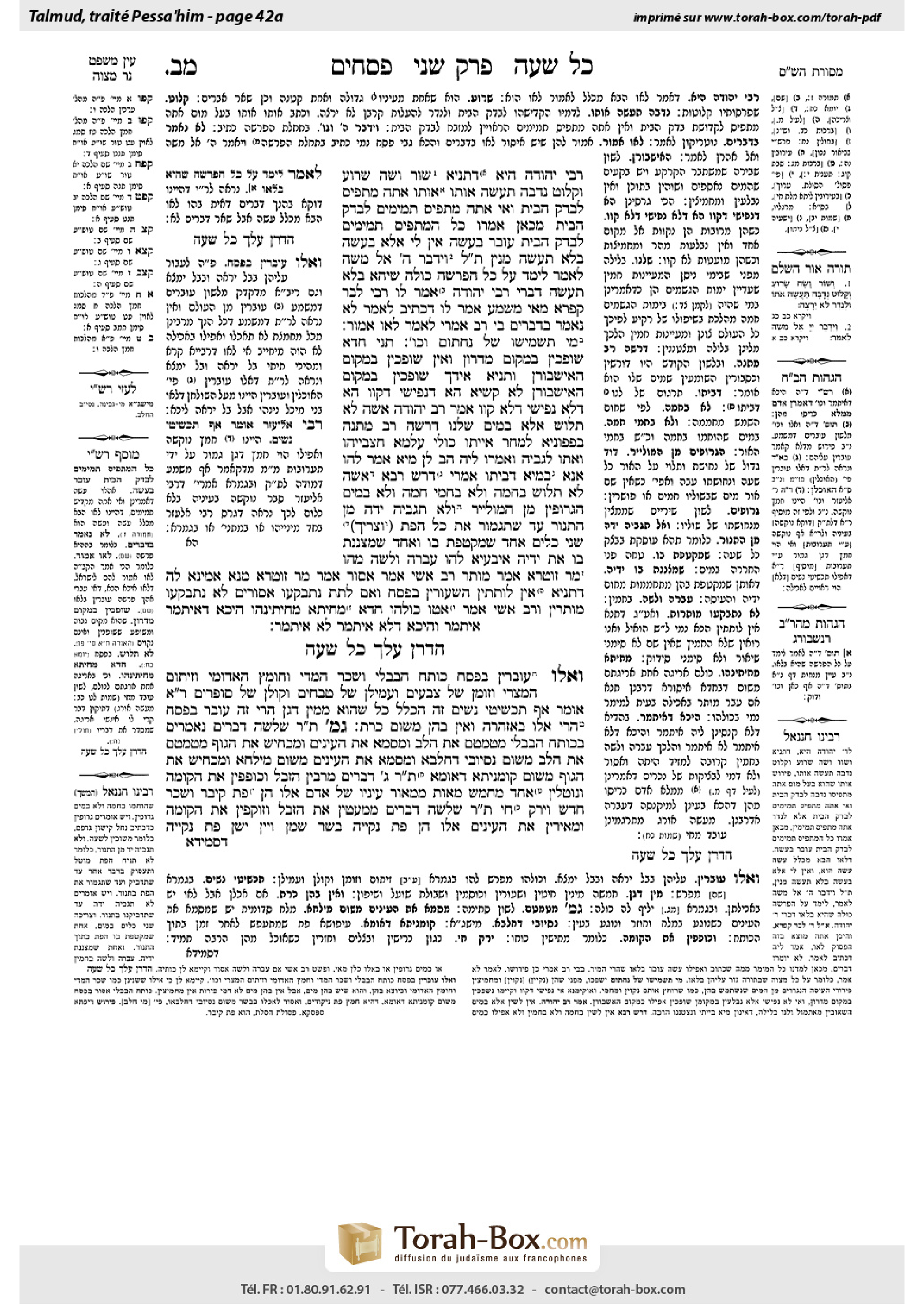
Pesachim 42a: Talmud study for Daf Yomi
Daf Yomi is the daily study of one Talmud folio. Explore 37 tractates with scans, Hebrew text, Sefaria English and AI-generated French translations where annotated.
Passage selection and English or AI-generated French translation are available where the scan has annotations. Daf Study is independent of Torah-Box and Sefaria.
Browse Pesachim · פסחים · All tractatesPesachim 42a text and translations
This page of Pesachim includes the Aramaic text, an English translation and an AI-generated French translation, alongside the scan above.
פסחים מ״ב א · Aramaic and Hebrew text
רַבִּי יְהוּדָה הִיא, דְּתַנְיָא: ״שׁוֹר וָשֶׂה שָׂרוּעַ וְקָלוּט נְדָבָה תַּעֲשֶׂה אֹתוֹ״. אוֹתוֹ אַתָּה מַתְפִּיס לְבֶדֶק הַבַּיִת, וְאִי אַתָּה מַתְפִּיס תְּמִימִים לְבֶדֶק הַבַּיִת. מִכָּאן אָמְרוּ: כׇּל הַמַּתְפִּיס תְּמִימִים לְבֶדֶק הַבַּיִת עוֹבֵר בַּעֲשֵׂה.
אֵין לִי אֶלָּא בַּעֲשֵׂה, בְּלֹא תַעֲשֶׂה מִנַּיִן? תַּלְמוּד לוֹמַר: ״וַיְדַבֵּר ה׳ אֶל מֹשֶׁה לֵּאמֹר״, לִימֵּד עַל כׇּל הַפָּרָשָׁה כּוּלָּהּ שֶׁיְּהֵא בְּלֹא תַעֲשֶׂה, דִּבְרֵי רַבִּי יְהוּדָה.
אָמַר לוֹ רַבִּי לְבַר קַפָּרָא: מַאי מַשְׁמַע?
אָמַר לוֹ: דִּכְתִיב ״לֵאמֹר״ — לֹא נֶאֱמַר בַּדְּבָרִים.
בֵּי רַב אָמְרִי: ״לֵאמֹר״ — לָאו אֱמוֹר.
מֵי תַשְׁמִישׁוֹ שֶׁל נַחְתּוֹם וְכוּ׳. תָּנֵי חֲדָא: שׁוֹפְכִין בִּמְקוֹם מִדְרוֹן, וְאֵין שׁוֹפְכִין בִּמְקוֹם הָאֶישְׁבּוֹרֶן. וְתַנְיָא אִידַּךְ: שׁוֹפְכִין בִּמְקוֹם הָאֶישְׁבּוֹרֶן!
לָא קַשְׁיָא: הָא — דִּנְפִישִׁי, דִּקְווּ. הָא — דְּלָא נְפִישִׁי, דְּלָא קְווּ.
אָמַר רַב יְהוּדָה: אִשָּׁה לֹא תָּלוּשׁ אֶלָּא בְּמַיִם שֶׁלָּנוּ.
דַּרְשַׁהּ רַב מַתְנָה בְּפַפּוֹנְיָא. לְמָחָר אַיְיתוֹ כּוּלֵּי עָלְמָא חַצְבַיְיהוּ וַאֲתוֹ לְגַבֵּיהּ, וַאֲמַרוּ לֵיהּ: הַב לַן מַיָּא. אֲמַר לְהוּ: אֲנָא בְּמַיָּא דְּבִיתוּ אֲמַרִי.
דָּרֵשׁ רָבָא: אִשָּׁה לֹא תָּלוּשׁ בַּחַמָּה, וְלֹא בְּחַמֵּי חַמָּה, וְלֹא בַּמַּיִם הַגְּרוּפִין מִן הַמּוּלְיָיר, וְלֹא תַּגְבִּיהַּ יָדָהּ מִן הַתַּנּוּר עַד שֶׁתִּגְמוֹר אֶת כׇּל הַפַּת. וְצָרִיךְ שְׁנֵי כֵלִים — אֶחָד שֶׁמְּקַטֶּפֶת בּוֹ, וְאֶחָד שֶׁמְּצַנֶּנֶת בּוֹ אֶת יָדֶיהָ.
אִיבַּעְיָא לְהוּ: עָבְרָה וְלָשָׁה, מַהוּ? מָר זוּטְרָא אָמַר: מוּתָּר, רַב אָשֵׁי אָמַר: אָסוּר.
אָמַר מָר זוּטְרָא: מְנָא אָמֵינָא לַהּ? דְּתַנְיָא: אֵין לוֹתְתִין הַשְּׂעוֹרִין בַּפֶּסַח. וְאִם לָתַת, נִתְבַּקְּעוּ — אֲסוּרִים, לֹא נִתְבַּקְּעוּ — מוּתָּרִין.
וְרַב אָשֵׁי אָמַר: אַטּוּ כּוּלְּהוּ חֲדָא מְחִיתָא מְחִיתִינְהוּ?! הֵיכָא דְּאִיתְּמַר — אִיתְּמַר, וְהֵיכָא דְּלָא אִיתְּמַר — לָא אִיתְּמַר.
הָדְרָן עֲלָךְ כׇּל שָׁעָה
מַתְנִי׳ וְאֵלּוּ עוֹבְרִין בַּפֶּסַח: כּוּתָּח הַבַּבְלִי, וְשֵׁכָר הַמָּדִי, וְחוֹמֶץ הָאֲדוֹמִי, וְזֵיתוֹם הַמִּצְרִי, וְזוֹמָן שֶׁל צַבָּעִים, וַעֲמִילָן שֶׁל טַבָּחִים, וְקוֹלָן שֶׁל סוֹפְרִים.
רַבִּי אֱלִיעֶזֶר אוֹמֵר: אַף תַּכְשִׁיטֵי נָשִׁים.
זֶה הַכְּלָל: כׇּל שֶׁהוּא מִמִּין דָּגָן — הֲרֵי זֶה עוֹבֵר בַּפֶּסַח. הֲרֵי אֵלּוּ בָּאַזְהָרָה, וְאֵין בָּהֶן מִשּׁוּם כָּרֵת.
גְּמָ׳ תָּנוּ רַבָּנַן, שְׁלֹשָׁה דְּבָרִים נֶאֱמָרִים בְּכוּתָּח הַבַּבְלִי: מְטַמְטֵם אֶת הַלֵּב, וּמְסַמֵּא אֶת הָעֵינַיִם, וּמַכְחִישׁ אֶת הַגּוּף.
מְטַמְטֵם אֶת הַלֵּב — מִשּׁוּם נַסְיוּבֵי דַחֲלָבָא. וּמְסַמֵּא אֶת הָעֵינַיִם — מִשּׁוּם מִילְחָא. וּמַכְחִישׁ אֶת הַגּוּף — מִשּׁוּם קוֹמָנִיתָא דְאוּמָא.
תָּנוּ רַבָּנַן: שְׁלֹשָׁה דְּבָרִים מַרְבִּין הַזֶּבֶל, וְכוֹפְפִין אֶת הַקּוֹמָה, וְנוֹטְלִין אֶחָד מֵחֲמֵשׁ מֵאוֹת מִמְּאוֹר עֵינָיו שֶׁל אָדָם, אֵלּוּ הֵן: פַּת קִיבָּר, וְשֵׁכָר חָדָשׁ, וְיָרָק חַי.
תָּנוּ רַבָּנַן: שְׁלֹשָׁה דְּבָרִים מְמַעֲטִין אֶת הַזֶּבֶל, וְזוֹקְפִין אֶת הַקּוֹמָה, וּמְאִירִין אֶת הָעֵינַיִם, אֵלּוּ הֵן: פַּת נְקִיָּיה, בָּשָׂר שָׁמֵן, וְיַיִן יָשָׁן. פַּת נְקִיָּיה —
Pesachim 42a · English translation
It is in accordance with the opinion of Rabbi Yehuda, as it was taught in a baraita: “Either a bull or a lamb that has anything too long or too short, you may offer it as a free-will offering [to the Temple treasury]; but for a vow [as a sacrifice] it shall not be accepted” (Leviticus 22:23). From here we learn that it, i.e., a blemished animal, you may consecrate for maintaining the Temple, but you may not consecrate unblemished animals for maintaining the Temple. In other words, any animal fit to be sacrificed as an offering may not be consecrated for maintaining the Temple but only as an offering. From here the Sages stated: Whoever consecrates unblemished animals for maintaining the Temple transgresses a positive mitzva.
From here I have only derived that he violates a positive mitzva; from where do I derive that he also transgresses a prohibition? The verse states at the beginning of that passage: “And the Lord spoke to Moses saying” (Leviticus 22:17). This introductory statement teaches with regard to the entire portion that a prohibition applies to it. This is the statement of Rabbi Yehuda.
The baraita adds that Rabbi Yehuda HaNasi said to Bar Kappara: From where may it be inferred that this is the case? How does Rabbi Yehuda derive his statement that a prohibition applies to the entire portion from the phrase “And the Lord spoke to Moses saying”?
He said to him: As it is written: “Saying [leimor].” Rabbi Yehuda expounds this term as though it read: Say no [lo emor]. In other words, the word no, an expression of prohibition, is stated with regard to the subsequent matters, which means that these mitzvot are categorized as prohibitions.
In the school of Rav they say a slightly different explanation: The term: Saying, can be expounded as if it were written lav emor, meaning: Say a prohibition. In other words, the verse indicates that Moses was instructed to inform the Jewish people of a prohibition. This teaches that any mitzva introduced by the word leimor should be treated as a prohibition. Since the halakhot of the Paschal lamb are preceded by the phrase: “And the Lord spoke to Moses and to Aaron in the Land of Egypt saying” (Exodus 12:1), it can be inferred that the subsequent mitzvot are also prohibitions.
We learned in the mishna: Water that has been used by a baker for cooling his hands or washing dishes must be poured out, as it contains a small, undefined quantity of leavened dough. It was taught in one baraita: One may pour out this water in a place with an incline, and he may not pour it out in a level place where the water collects. And it was taught in another baraita: One may even pour out this water in a level place where the water collects.
The Gemara resolves this contradiction: This is not difficult. This baraita, which states that it is prohibited to pour out this water in a level place, is referring to a large amount of water that will collect in one place. Since there is a large amount of water, the flour in the water will not be absorbed into the ground but will leaven. Conversely, that baraita, which states that it is permitted to pour out the water in a level place, is referring to a situation where there was not a large amount of water, so that it will not collect. Instead, this water will be absorbed into the ground before the dough leavens.
Rav Yehuda said: A woman may knead matza dough only with water that rested, i.e., water that was left indoors overnight to cool. If water is added to dough immediately after it was drawn, when it is still lukewarm, the dough will leaven at a faster rate.
The Gemara relates: Rav Mattana taught this halakha in Paphunya. On the next day, the eve of Passover, everyone brought their jugs to him and said to him: Give us water. They misunderstood his expression mayim shelanu, water that rested, as the near homonym mayim shelanu, our water, i.e., water that belongs to the Sage, and they therefore came to take water from his house. He said to them: I say and meant: Water that rested [devitu] in the house overnight.
Rava taught: A woman may not knead dough for matza in the sun, nor with water that has been heated by the sun, nor with water collected [hagerufin] in an urn heated by coals [mulyar] And in addition, she may not remove her hand from the oven, i.e., interrupt her baking, until she finishes forming all the loaves from the dough, so that it should not become leavened in the interim. And she requires two vessels, one in which she mixes the water into the dough and one in which she cools her hands so that the heat from her hands does not cause the dough to leaven.
A dilemma was raised before the Sages: If she transgressed and kneaded the dough with warm water, what is the halakha? Mar Zutra said: It is permitted after the fact. Rav Ashi said: It is forbidden.
Mar Zutra said: From where do I say my opinion on this issue? As it was taught in a baraita: One may not soak barley on Passover, and if one soaked barley and it split, the barley is forbidden. If it did not split, the barley is permitted. This case indicates that even if one violates the principles established by the Sages with regard to adding water to flour on Passover, the product is forbidden only after the fact if it actually leavened.
And Rav Ashi said in response: Is that to say that all of them are woven in the same act of weaving? In other words, is the halakha identical in all cases? Where it was stated that the Sages did not punish the violator by rendering his food prohibited, it was stated; and where it was not stated that they refrained from punishing the violator, it was not stated. It is therefore possible that the Sages rendered dough kneaded with warm water forbidden, to punish the woman who prepared it in this manner.
MISHNA: And for possessing these one transgresses [overin] the prohibitions of: It shall not be seen, and: It shall not be found, on Passover, although not all of them are considered food: Babylonian kutaḥ, a dip with a sharp flavor that contains flour; Median beer; Edomite vinegar; Egyptian zitom, a type of beer; dyers’ broth [zoman]; bakers’ well-worked dough; and kolan of soferim.
Rabbi Eliezer says: The same prohibition also applies to women’s adornments, i.e., cosmetics, that contain leaven.
This is the principle: If one possesses any substance that is derived from a type of grain that became leavened, although it is not actually bread, one transgresses the prohibitions of: It shall not be seen, and: It shall not be found, on Passover. These substances are included in the warning, i.e., the biblical prohibition of possessing leaven, but there is no element of karet if one eats them.
GEMARA: Since the mishna mentions kutaḥ, the Gemara cites a baraita where kutaḥ is discussed. The Sages taught that three things were said with regard to kutaḥ: It blocks the heart, it blinds the eyes, and it weakens the body.
The Gemara explains each statement: It blocks the heart due to the whey. Whey was added to kutaḥ and was considered to be an inferior type of food. It blinds the eyes due to the salt in it, which can be dangerous if it enters the eyes. And it weakens the body due to the mold in the bread, as one of the ingredients of kutaḥ was crumbs from dough that had become leavened to the point that they were nearly spoiled.
After mentioning this baraita, the Gemara continues to discuss the nutritional effects of other foods. The Sages taught: Three things increase one’s waste, lower one’s stature, and take one five-hundredth of a person’s vision if he eats them regularly. And they are: Bread from coarse flour, new beer, and raw vegetables.
Similarly, the Sages taught in another baraita: Three things decrease one’s waste, straighten one’s stature, and improve one’s vision, and they are: Bread from fine flour, fatty meat, and aged wine. The Gemara explains: Fine bread
Pesachim 42a · Traduction française (IA)
Cela correspond à l’opinion de Rabbi Yehuda, comme il a été enseigné dans une baraïta : « Un taureau ou un agneau qui a un membre trop long ou trop court, tu peux l’offrir en offrande volontaire [au trésor du Temple] ; mais il ne sera pas accepté pour un vœu [comme sacrifice] » (Lévitique 22:23). Nous apprenons de là que cet animal, c’est-à-dire un animal présentant un défaut, tu peux le consacrer à l’entretien du Temple, mais tu ne peux pas consacrer des animaux sans défaut à l’entretien du Temple. Autrement dit, tout animal apte à être offert en sacrifice ne peut être consacré à l’entretien du Temple, mais seulement comme offrande. C’est de là que les Sages ont enseigné : Quiconque consacre des animaux sans défaut à l’entretien du Temple transgresse une mitsva positive.
Jusqu’ici, j’ai seulement déduit qu’il transgresse une mitsva positive ; d’où déduis-je qu’il transgresse également une interdiction ? Le verset dit au début de ce passage : « L’Éternel parla à Moïse en disant » (Lévitique 22:17). Cette introduction enseigne qu’une interdiction s’applique à tout le passage. Telle est l’opinion de Rabbi Yehuda.
La baraïta ajoute que Rabbi Yehuda HaNassi dit à Bar Kappara : D’où peut-on déduire que c’est le cas ? Comment Rabbi Yehuda déduit-il de l’expression « L’Éternel parla à Moïse en disant » qu’une interdiction s’applique à tout le passage ?
Il lui répondit : Comme il est écrit : « en disant [leimor] ». Rabbi Yehuda interprète ce terme comme s’il était écrit : « dis non » [lo emor]. Autrement dit, le mot « non », expression d’une interdiction, est énoncé à propos des sujets qui suivent, ce qui signifie que ces mitsvot sont classées comme des interdictions.
À l’académie de Rav, on donne une explication légèrement différente : le terme « en disant » peut être interprété comme s’il était écrit lav emor, ce qui signifie : « énonce une interdiction ». Autrement dit, le verset indique que Moïse reçut l’ordre d’informer le peuple juif d’une interdiction. Cela enseigne que toute mitsva introduite par le mot leimor doit être considérée comme une interdiction. Puisque les halakhot de l’agneau pascal sont précédées par la phrase : « L’Éternel parla à Moïse et à Aaron dans le pays d’Égypte, en disant » (Exode 12:1), on peut déduire que les mitsvot qui suivent sont également des interdictions.
Nous avons appris dans la Michna : L’eau dont le boulanger s’est servi pour se rafraîchir les mains ou laver la vaisselle doit être déversée, car elle contient une petite quantité indéterminée de pâte levée. Une baraïta enseigne : On peut déverser cette eau dans un endroit en pente, mais non dans un endroit plat où elle s’accumule. Une autre baraïta enseigne : On peut même déverser cette eau dans un endroit plat où elle s’accumule.
La Guemara résout cette contradiction : Il n’y a pas de difficulté. Cette baraïta, qui dit qu’il est interdit de déverser cette eau dans un endroit plat, parle d’une grande quantité d’eau qui s’accumulera au même endroit. Comme il y a beaucoup d’eau, la farine qu’elle contient ne sera pas absorbée par le sol et lèvera. En revanche, cette baraïta, qui dit qu’il est permis de déverser l’eau dans un endroit plat, parle d’une quantité d’eau peu importante, qui ne s’accumulera donc pas. Au contraire, cette eau sera absorbée par le sol avant que la pâte ne lève.
Rav Yehuda a dit : Une femme ne peut pétrir la pâte à matsa qu’avec de l’eau qui a reposé, c’est-à-dire de l’eau laissée à l’intérieur toute la nuit afin de refroidir. Si l’on ajoute à la pâte de l’eau juste après l’avoir puisée, alors qu’elle est encore tiède, la pâte lèvera plus rapidement.
La Guemara rapporte : Rav Mattana enseigna cette halakha à Paphunya. Le lendemain, la veille de Pessa'h, tout le monde lui apporta ses cruches et lui dit : Donne-nous de l’eau. Ils avaient mal compris son expression mayim shelanu, « l’eau qui a reposé », la confondant avec l’expression presque homonyme mayim shelanu, « notre eau », c’est-à-dire l’eau appartenant au Sage ; ils étaient donc venus prendre de l’eau chez lui. Il leur dit : Je disais et voulais dire : de l’eau qui a reposé [devitu] dans la maison pendant la nuit.
Rava enseigna : Une femme ne doit pas pétrir la pâte à matsa au soleil, ni avec de l’eau chauffée par le soleil, ni avec de l’eau recueillie [hagerufin] dans une urne chauffée par des braises [mulyar]. En outre, elle ne doit pas retirer sa main du four, c’est-à-dire interrompre la cuisson, avant d’avoir fini de façonner tous les pains avec la pâte, afin qu’elle ne lève pas entre-temps. Elle a besoin de deux récipients : l’un pour mélanger l’eau à la pâte, l’autre pour y rafraîchir ses mains, afin que la chaleur de ses mains ne fasse pas lever la pâte.
Une question fut posée aux Sages : Si elle a transgressé et pétri la pâte avec de l’eau tiède, quelle est la halakha ? Mar Zutra a dit : Après coup, c’est permis. Rav Ashi a dit : C’est interdit.
Mar Zutra a dit : D’où tiens-je mon opinion sur cette question ? D’une baraïta qui enseigne : On ne doit pas faire tremper de l’orge pendant Pessa'h ; si quelqu’un a fait tremper de l’orge et qu’elle s’est fendue, elle est interdite. Si elle ne s’est pas fendue, elle est permise. Ce cas indique que même si l’on enfreint les principes établis par les Sages concernant l’ajout d’eau à la farine pendant Pessa'h, le produit n’est interdit après coup que s’il a effectivement levé.
Et Rav Ashi répondit : Est-ce à dire que tous ces cas sont tissés de la même façon ? Autrement dit, la halakha est-elle identique dans tous les cas ? Là où il a été dit que les Sages n’ont pas puni le contrevenant en rendant sa nourriture interdite, cela a été dit ; là où il n’a pas été dit qu’ils s’abstenaient de punir le contrevenant, cela n’a pas été dit. Il est donc possible que les Sages aient rendu interdite la pâte pétrie avec de l’eau tiède, afin de punir la femme qui l’a préparée de cette manière.
MICHNA : Pour posséder ces produits, on transgresse [overin] les interdictions « Il ne sera pas vu » et « Il ne sera pas trouvé » pendant Pessa'h, bien qu’ils ne soient pas tous considérés comme des aliments : le koutaḥ babylonien, une sauce au goût piquant qui contient de la farine ; la bière mède ; le vinaigre édomite ; le zitom égyptien, une sorte de bière ; le bouillon des teinturiers [zoman] ; la pâte bien travaillée des boulangers ; et le kolan des scribes.
Rabbi Eliezer dit : La même interdiction s’applique également aux parures des femmes, c’est-à-dire aux cosmétiques qui contiennent du levain.
Voici le principe : Si quelqu’un possède une substance issue d’une espèce de céréale qui a fermenté, bien qu’il ne s’agisse pas à proprement parler de pain, il transgresse les interdictions « Il ne sera pas vu » et « Il ne sera pas trouvé » pendant Pessa'h. Ces substances sont incluses dans l’avertissement, c’est-à-dire dans l’interdiction biblique de posséder du levain, mais leur consommation n’entraîne pas la peine de karet.
GUEMARA : Puisque la Michna mentionne le koutaḥ, la Guemara cite une baraïta où il en est question. Les Sages enseignèrent que trois choses furent dites au sujet du koutaḥ : il obstrue le cœur, il rend aveugle et il affaiblit le corps.
La Guemara explique chacune de ces affirmations : il obstrue le cœur à cause du petit-lait. On ajoutait du petit-lait au koutaḥ, et celui-ci était considéré comme un aliment de qualité inférieure. Il rend aveugle à cause du sel qu’il contient, lequel peut être dangereux s’il entre dans les yeux. Et il affaiblit le corps à cause de la moisissure du pain, car l’un des ingrédients du koutaḥ était constitué de miettes de pâte qui avait fermenté au point d’être presque avariée.
Après avoir mentionné cette baraïta, la Guemara poursuit en évoquant les effets nutritionnels d’autres aliments. Les Sages enseignèrent : Trois choses augmentent les déjections, diminuent la stature et font perdre à une personne un cinq-centième de sa vue si elle en mange régulièrement. Ce sont : le pain de farine grossière, la bière nouvelle et les légumes crus.
De même, les Sages enseignèrent dans une autre baraïta : Trois choses diminuent les déjections, redressent la stature et améliorent la vue. Ce sont : le pain de farine fine, la viande grasse et le vin vieux. La Guemara explique : Le pain fin
Traduction française générée par IA à partir de l’édition anglaise de Sefaria. Vérifie toujours un passage avec le texte source.
Text from Sefaria: William Davidson Edition - Vocalized Aramaic (CC BY NC); William Davidson Edition - English (CC BY NC).