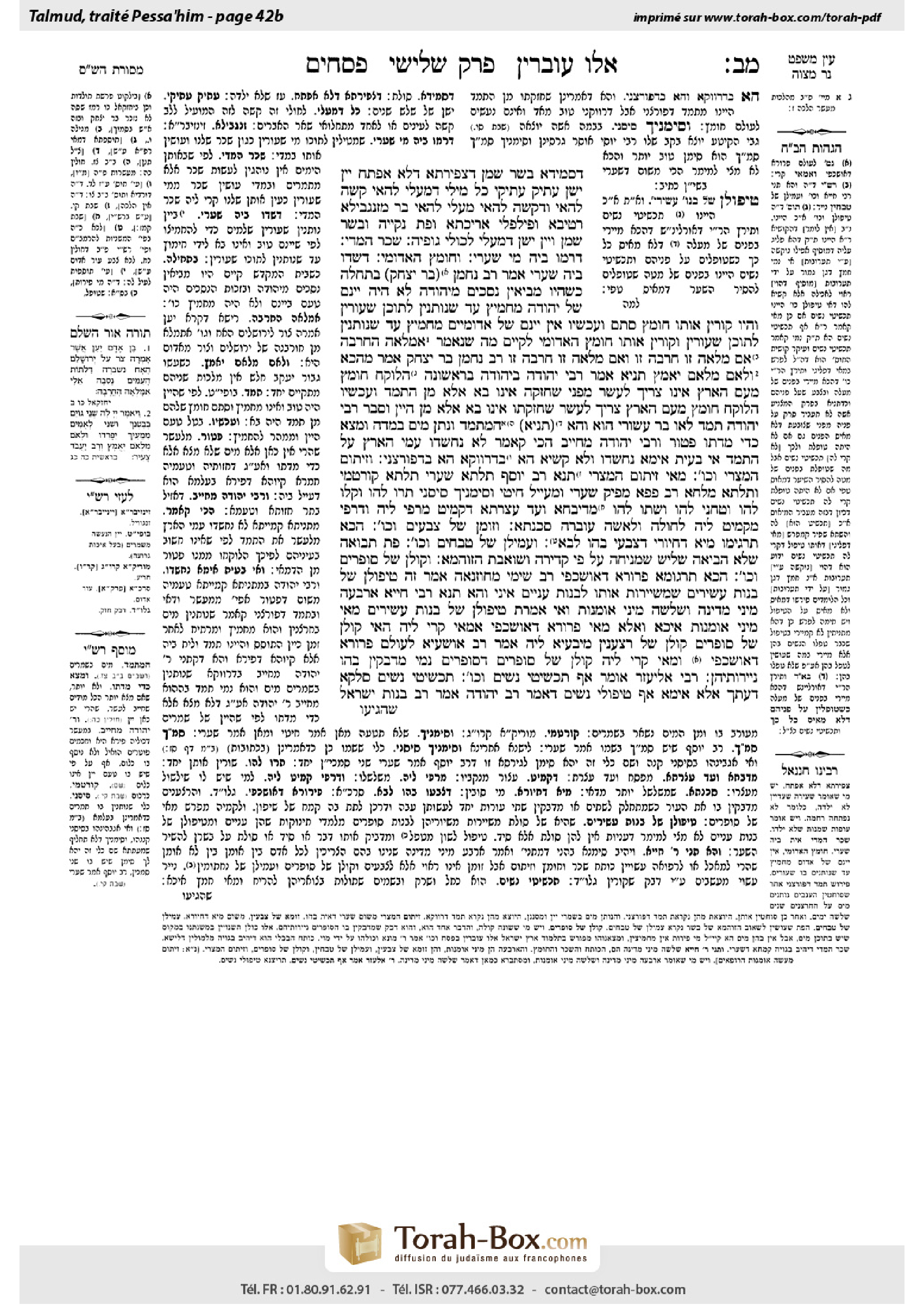
Pesachim 42b: Talmud study for Daf Yomi
Daf Yomi is the daily study of one Talmud folio. Explore 37 tractates with scans, Hebrew text, Sefaria English and AI-generated French translations where annotated.
Passage selection and English or AI-generated French translation are available where the scan has annotations. Daf Study is independent of Torah-Box and Sefaria.
Browse Pesachim · פסחים · All tractatesPesachim 42b text and translations
This page of Pesachim includes the Aramaic text, an English translation and an AI-generated French translation, alongside the scan above.
פסחים מ״ב ב · Aramaic and Hebrew text
דִּסְמִידָא, בָּשָׂר שָׁמֵן — דִּצְפִירְתָּא דְּלָא אִפְּתַח, יַיִן יָשָׁן — עַתִּיק עַתִּיקֵי.
כׇּל מִילֵּי דִּמְעַלֵּי לְהַאי — קָשֵׁה לְהַאי, וּדְקָשֵׁה לְהַאי — מְעַלֵּי לְהַאי, בַּר מִזַּנְגְּבִילָא רַטִּיבָא, וּפִילְפְּלֵי אֲרִיכְתָּא, וּפַת נְקִיָּיה, וּבָשָׂר שָׁמֵן, וְיַיִן יָשָׁן — דִּמְעַלֵּי לְכוּלֵּי גּוּפֵיהּ.
שֵׁכָר הַמָּדִי. דְּרָמוּ בֵּיהּ מֵי שְׂעָרֵי.
וְחוֹמֶץ הָאֲדוֹמִי. דְּשָׁדוּ בֵּיהּ שְׂעָרֵי.
אָמַר רַב נַחְמָן (בַּר יִצְחָק): בַּתְּחִלָּה כְּשֶׁהָיוּ מְבִיאִין נְסָכִים מִיְּהוּדָה, לֹא הָיָה יֵינָם שֶׁל יְהוּדָה מַחְמִיץ, עַד שֶׁנּוֹתְנִין לְתוֹכָן שְׂעוֹרִין. וְהָיוּ קוֹרִין אוֹתוֹ חוֹמֶץ סְתָם.
וְעַכְשָׁיו אֵין יֵינָם שֶׁל אֲדוֹמִיִּים מַחְמִיץ עַד שֶׁנּוֹתְנִין לְתוֹכָן שְׂעוֹרִין, וְקוֹרִין אוֹתוֹ חוֹמֶץ הָאֲדוֹמִי, לְקַיֵּים מַה שֶּׁנֶּאֱמַר: ״אִמָּלְאָה הָחֳרָבָה״, אִם מְלֵאָה זוֹ — חֲרֵבָה זוֹ, וְאִם מְלֵאָה זוֹ — חֲרֵבָה זוֹ. רַב נַחְמָן בַּר יִצְחָק אָמַר, מֵהָכָא: ״וּלְאֹם מִלְּאֹם יֶאֱמָץ״.
תַּנְיָא, אָמַר רַבִּי יְהוּדָה: בִּיהוּדָה, בָּרִאשׁוֹנָה הַלּוֹקֵחַ חוֹמֶץ מֵעַם הָאָרֶץ — אֵינוֹ צָרִיךְ לְעַשֵּׂר, מִפְּנֵי שֶׁחֲזָקָה אֵינוֹ בָּא אֶלָּא מִן הַתֶּמֶד. וְעַכְשָׁיו, הַלּוֹקֵחַ חוֹמֶץ מֵעַם הָאָרֶץ — צָרִיךְ לְעַשֵּׂר, שֶׁחֶזְקָתוֹ אֵינוֹ בָּא אֶלָּא מִן הַיַּיִן.
וְסָבַר רַבִּי יְהוּדָה: תֶּמֶד לָאו בַּר עַשּׂוֹרֵי הוּא? וְהָא (תְּנַן): הַמְתַמֵּד וְנָתַן מַיִם בַּמִּדָּה, וּמָצָא כְּדֵי מִדָּתוֹ — פָּטוּר, וְרַבִּי יְהוּדָה מְחַיֵּיב?
הָכִי קָאָמַר: לֹא נֶחְשְׁדוּ עַמֵּי הָאָרֶץ עַל הַתֶּמֶד. אִי בָּעֵית אֵימָא: נֶחְשְׁדוּ, וְלָא קַשְׁיָא: הָא — בְּדִרְווֹקָא, הָא — בִּדְפוּרְצָנֵי.
וְזֵיתוֹם הַמִּצְרִי וְכוּ׳. מַאי זֵיתוֹם הַמִּצְרִי?
תָּנָא רַב יוֹסֵף: תְּלָתָא שְׂעָרֵי, תְּלָתָא קוּרְטְמֵי, וּתְלָתָא מִלְחָא.
רַב פָּפָּא מַפֵּיק שְׂעָרֵי וּמְעַיֵּיל חִיטֵּי, וְסִימָנָיךְ סִיסָנֵי.
תָּרוּ לְהוּ וְקָלוּ לְהוּ וְטָחֲנִי לְהוּ וְשָׁתוּ לְהוּ מִדִּיבְחָא וְעַד עֲצַרְתָּא. דִּקְמִיט מְרַפֵּי לֵיהּ, וְדִרְפֵי מְקַמֵּיט לֵיהּ, לְחוֹלֶה וּלְאִשָּׁה עוּבָּרָה סַכַּנְתָּא.
וְזוֹמָן שֶׁל צַבָּעִים וְכוּ׳. הָכָא תַּרְגִּימוּ: מַיָּא דְּחִיוָּרֵי דְּצָבְעִי בְּהוּ לִבָּא.
וַעֲמִילָן שֶׁל טַבָּחִים וְכוּ׳. פַּת תְּבוּאָה שֶׁלֹּא הֵבִיאָה שְׁלִישׁ, שֶׁמַּנִּיחָהּ עַל פִּי קְדֵירָה וְשׁוֹאֶבֶת הַזּוּהֲמָא.
וְקוֹלָן שֶׁל סוֹפְרִים וְכוּ׳. הָכָא תַּרְגּוּמָא: פֵּרוּרָא דְאוּשְׁכָּפֵי.
רַב שִׁימִי מָחוֹזְנָאָה אָמַר: זֶה טִיפּוּלָן שֶׁל בְּנוֹת עֲשִׁירִים, שֶׁמְּשַׁיְּירוֹת אוֹתוֹ לִבְנוֹת עֲנִיִּים.
אִינִי? וְהָא תָּנֵא רַבִּי חִיָּיא: אַרְבָּעָה מִינֵי מְדִינָה, וּשְׁלֹשָׁה מִינֵי אוּמָּנוּת. וְאִי אָמְרַתְּ טִיפּוּלָן שֶׁל בְּנוֹת עֲשִׁירִים, מַאי מִינֵי אוּמָּנוּת אִיכָּא?
וְאֶלָּא מַאי, פֵּרוּרָא דְאוּשְׁכָּפֵי? אַמַּאי קָרֵי לֵיהּ הַאי קוֹלָן שֶׁל סוֹפְרִים? קוֹלָן שֶׁל רַצְעָנִין מִיבַּעְיָא לֵיהּ! אָמַר רַב אוֹשַׁעְיָא: לְעוֹלָם פֵּרוּרָא דְאוּשְׁכָּפֵי, וּמַאי קָרֵי לֵיהּ קוֹלָן שֶׁל סוֹפְרִים? דְּסוֹפְרִים נָמֵי מְדַבְּקִין בְּהוּ נְיָירוֹתֵיהֶן.
רַבִּי אֱלִיעֶזֶר אוֹמֵר אַף תַּכְשִׁיטֵי נָשִׁים וְכוּ׳. תַּכְשִׁיטֵי נָשִׁים סָלְקָא דַּעְתָּךְ? אֶלָּא אֵימָא: אַף טִיפּוּלֵי נָשִׁים. דְּאָמַר רַב יְהוּדָה אָמַר רַב: בְּנוֹת יִשְׂרָאֵל
Pesachim 42b · English translation
is made from refined flour; fatty meat refers to meat from a goat that has not yet given birth; and aged wine refers to wine that has been aged significantly, for at least three years.
The Gemara states a general principle: Any food or medical treatment that is effective in healing this sickness or this limb is deleterious for that one. And any food or treatment that is deleterious for this one is effective in healing that one, except for moist ginger, long peppers, and bread made of refined flour, and fatty meat, and aged wine, which are effective to heal all limbs of the body.
The Gemara returns to its discussion of the details mentioned in the mishna. Why is Median beer prohibited during Passover? It is because the Medians place barley water into it.
And Edomite vinegar is prohibited because the Edomites place barley into it.
Rav Naḥman bar Yitzḥak said: Initially, when the Temple stood and they would bring wine libations from Judea, the wine would be blessed and would be preserved without any additives. The wine of Judea would not turn to vinegar unless they placed barley into it to achieve this effect. And they would call this vinegar to which barley had been added ordinary vinegar, since wine would not become vinegar without this additive.
And now, after the destruction of the Temple, Edomite wine does not turn to vinegar unless one places barley into it. This is called Edomite vinegar, to fulfill that which is stated with regard to Tyre, and the same applies to other enemies of the Jewish people: “Because Tyre has said against Jerusalem: Aha, she is broken that was the gate of the peoples; she is turned unto me; I shall be filled with her that is laid waste” (Ezekiel 26:2). The Sages expound: If this one, Jerusalem, is full, then that one, her enemy, is laid waste; and if this enemy is full, then she, Jerusalem, is laid waste. Therefore, when the Jewish people fall, their enemies can achieve the success that was once attained by the Jews. Rav Naḥman bar Yitzḥak said: This notion can be derived from here, where the verse states regarding Esau and Jacob: “The one people shall be stronger than the other people” (Genesis 25:23), meaning that when one nation gains power, the other is weakened, because they cannot both be strong at the same time.
It was taught in a baraita that Rabbi Yehuda said: In Judea, initially, one who would purchase vinegar from an am ha’aretz, i.e., one who is not scrupulous in matters of ritual purity and tithes and is therefore suspect of not having tithed his fruit properly, would not need to tithe it due to the fact that it can be assumed that ordinary vinegar was made only from temed, a liquid produced from grape remnants. After filtering the wine from the stems, seeds, and skins, water was poured over these remnants. The liquid was then drained off and allowed to ferment until it became vinegar. This liquid was called temed, and it is not necessary to tithe it. Vinegar was produced in this way because the wine of that time was so strong that it did not turn to vinegar on its own. But now, one who purchases vinegar from an am ha’aretz must tithe it, as the wine nowadays turns to vinegar quickly, and the presumption is that vinegar comes only from wine.
The Gemara asks: But does Rabbi Yehuda hold that temed is not subject to tithing? Wasn’t it taught in a mishna: With regard to one who produces temed and adds a measured amount of water and afterward finds a corresponding amount of liquid to that which he measured, he is exempt from tithing this temed because it is clear that the grape produce added only flavor and did not add to the volume of the temed. And Rabbi Yehuda obligates one to tithe the temed even in that case. If this is so, how can Rabbi Yehuda permit a person to purchase temed from an am ha’aretz? According to his opinion in this baraita, temed must be tithed.
The Gemara answers: This is what Rabbi Yehuda is saying: One is required to tithe temed; however, amei ha’aretz are not suspected of failing to tithe temed. Because temed is so inexpensive, the assumption is that amei ha’aretz are not sparing with it and are willing to tithe it. If you wish, say instead that even if amei ha’aretz are suspected of failing to tithe temed, and this is not difficult for the following reason: This mishna is referring to a case where the temed was produced with dregs that contain some amount of wine, and therefore Rabbi Yehuda says that a person is required to tithe it. That baraita is referring to a case where the temed was produced with grape pits; because it is assumed that no wine is mixed into the temed, Rabbi Yehuda states that one is exempt from tithing it.
It is stated in the mishna that Egyptian zitom is considered leavened food. The Gemara asks: What is Egyptian zitom?
Rav Yosef taught from a baraita: It is one-third barley, one-third safflower, and one-third salt.
Rav Pappa removes barley from the list of ingredients and includes wheat; he maintains that Egyptian zitom was made with wheat rather than barley. The Gemara comments: Your mnemonic to remember which Sage expressed which version is the word sisanei, meaning a twig basket. Sisanei contains the letter samekh twice, which can help one remember that Rav Yosef, whose name contains a samekh, says that Egyptian zitom is made from se’orim, barley, a word that contains the letter sin, which makes the same sound as samekh.
The Gemara describes how Egyptian zitom is prepared: Those who prepare it soak the ingredients together, and then they roast them and grind them together. They drink the mixture from Passover to Shavuot. This drink relaxes the bowels of one who is constipated, and it constipates one whose bowel movements are loose. However, it is dangerous for a sick person or a pregnant woman to drink this mixture.
It was taught in the mishna that dyers’ broth is considered leavened. The Gemara explains: Here, in Babylonia, they interpreted that this is bran water [maya deḥivri] that people use to dye leather.
It was further stated in the mishna that bakers’ well-worked dough is also considered leavened. The Gemara explains the nature of this substance: It is bread made from grain that was harvested before it was one-third ripe and then made into a loaf. This loaf was placed on top of a pot to draw out the filth from the broth.
It was further taught in the mishna that the kolan of soferim, kolan of soferim, is considered leavened. The Gemara explains: Here, in Babylonia, they interpreted that this expression is referring to shoemakers’ glue that is made from flour.
Rav Shimi from Ḥozna’a said: This is the depilatory paste of the daughters of the wealthy, of which they would leave a remnant for the daughters of the poor. It was the common practice for women to remove hair from different parts of their bodies by applying various pastes, some of which contained flour. The kolan of soferim mentioned in the mishna was such a substance. It was given this name because wealthy young women would give the paste [kolan] to poor young women whose fathers were schoolteachers [soferim], so that the poor women could utilize it as well.
The Gemara asks: Is that so? But didn’t Rabbi Ḥiyya teach a mnemonic by noting that the mishna lists four items that are used by the ordinary people of the state, i.e., kutaḥ, beer, vinegar, and zitom, and three items of artisans, i.e., dyers’ broth, kolan of soferim, and bakers’ well-worked dough? And if you say that kolan of soferim is the depilatory paste of the daughters of the wealthy, then what artisanship is there in that? According to this interpretation, that substance does not belong on the list of artisans’ items.
The Gemara answers with another question: Rather what, will you say that this is referring to shoemakers’ glue? If so, why did the authors of the mishna call it bookmakers’ glue [kolan shel soferim]? It should have been called shoemakers’ glue [kolan shel ratzanin]. Rav Oshaya said: Actually, one should explain that kolan is referring to shoemakers’ glue; and why is it called bookmakers’ glue? The reason is that bookmakers also use it to attach their pages. During the time of the mishna, this paste was referred to as bookmakers’ glue.
It is stated in the mishna: Rabbi Eliezer says that women’s adornments are also prohibited as leavened food. The Gemara asks: Could it enter your mind to say that adornments made from silver, gold, or woven materials contain leaven? Rather, say instead that this means: Even women’s cosmetics or other items used by women to enhance their skin are prohibited if they contain leavened ingredients. As Rav Yehuda said that Rav said: With regard to the Jewish women
Pesachim 42b · Traduction française (IA)
est faite de farine fine ; la viande grasse désigne la viande d’une chèvre qui n’a pas encore mis bas ; et le vin vieux désigne un vin qui a longuement vieilli, pendant au moins trois ans.
La Guemara énonce un principe général : tout aliment ou traitement médical efficace pour soigner cette maladie ou ce membre est nuisible pour l’autre. Et tout aliment ou traitement nuisible pour l’un est efficace pour soigner l’autre, à l’exception du gingembre frais, des poivres longs, du pain fait de farine fine, de la viande grasse et du vin vieux, qui sont efficaces pour soigner tous les membres du corps.
La Guemara revient aux détails mentionnés dans la Michna. Pourquoi la bière médique est-elle interdite pendant Pessa’h ? Parce que les Mèdes y mettent de l’eau d’orge.
Et le vinaigre édomite est interdit parce que les Édomites y mettent de l’orge.
Rav Naḥman bar Yitzḥak a dit : Auparavant, lorsque le Temple existait et qu’on apportait des libations de vin de Judée, le vin était béni et se conservait sans aucun ajout. Le vin de Judée ne se transformait pas en vinaigre, à moins qu’on y mette de l’orge pour obtenir cet effet. On appelait ce vinaigre auquel on avait ajouté de l’orge du vinaigre ordinaire, car le vin ne devenait pas vinaigre sans cet ajout.
Et maintenant, après la destruction du Temple, le vin édomite ne se transforme pas en vinaigre, à moins qu’on y mette de l’orge. On l’appelle vinaigre édomite, conformément à ce qui est dit au sujet de Tyr, et la même chose s’applique aux autres ennemis du peuple juif : « Parce que Tyr a dit contre Jérusalem : “Ah ! elle est brisée, la porte des peuples ; elle s’est tournée vers moi ; je serai comblée de ses ruines” » (Ézéchiel 26, 2). Les Sages interprètent ainsi : si celle-ci, Jérusalem, est comblée, alors celle-là, son ennemie, est dévastée ; et si cette ennemie est comblée, alors elle, Jérusalem, est dévastée. Ainsi, lorsque le peuple juif décline, ses ennemis peuvent connaître le succès autrefois atteint par les Juifs. Rav Naḥman bar Yitzḥak a dit : Cette idée peut se déduire de ce passage, où il est dit au sujet d’Ésaü et de Jacob : « Un peuple sera plus fort que l’autre peuple » (Genèse 25, 23), ce qui signifie que lorsqu’une nation gagne en puissance, l’autre s’affaiblit, car elles ne peuvent pas être fortes toutes deux en même temps.
Il a été enseigné dans une baraïta que Rabbi Yehuda a dit : En Judée, auparavant, celui qui achetait du vinaigre à un am ha’aretz, c’est-à-dire à quelqu’un qui n’est pas scrupuleux en matière de pureté rituelle et de dîmes, et dont on peut donc soupçonner qu’il n’a pas correctement prélevé les dîmes sur ses fruits, n’avait pas besoin d’en prélever la dîme. En effet, on pouvait supposer que le vinaigre ordinaire était produit uniquement à partir de temed, un liquide obtenu à partir des résidus de raisin. Après avoir filtré le vin pour en retirer les tiges, les pépins et les peaux, on versait de l’eau sur ces résidus. Le liquide était ensuite égoutté et laissé à fermenter jusqu’à devenir du vinaigre. Ce liquide s’appelait temed, et il n’est pas nécessaire d’en prélever la dîme. On produisait le vinaigre ainsi parce que le vin de cette époque était si fort qu’il ne se transformait pas en vinaigre de lui-même. Mais aujourd’hui, celui qui achète du vinaigre à un am ha’aretz doit en prélever la dîme, car de nos jours le vin se transforme rapidement en vinaigre, et l’on présume que le vinaigre provient uniquement du vin.
La Guemara demande : Mais Rabbi Yehuda considère-t-il que le temed n’est pas soumis à la dîme ? N’a-t-il pas été enseigné dans une Michna : celui qui produit du temed, ajoute une quantité d’eau mesurée, puis trouve une quantité de liquide correspondant à celle qu’il a mesurée, est exempt de prélever la dîme sur ce temed, car il est clair que le produit du raisin n’a fait qu’ajouter de la saveur, sans augmenter le volume du temed. Or Rabbi Yehuda oblige à prélever la dîme sur le temed même dans ce cas. Si tel est le cas, comment Rabbi Yehuda peut-il permettre à quelqu’un d’acheter du temed à un am ha’aretz ? Selon son opinion exprimée dans cette baraïta, le temed doit être soumis à la dîme.
La Guemara répond : Voici ce que dit Rabbi Yehuda : on est tenu de prélever la dîme sur le temed ; toutefois, on ne soupçonne pas les amei ha’aretz de ne pas prélever la dîme sur le temed. Comme le temed est si bon marché, on suppose que les amei ha’aretz ne lésinent pas à son sujet et sont disposés à en prélever la dîme. Si tu le souhaites, dis plutôt que même si l’on soupçonne les amei ha’aretz de ne pas prélever la dîme sur le temed, il n’y a pas de difficulté, pour la raison suivante : cette Michna parle d’un cas où le temed a été produit avec des lies contenant une certaine quantité de vin ; Rabbi Yehuda dit donc qu’on est tenu d’en prélever la dîme. Cette baraïta parle d’un cas où le temed a été produit avec des pépins de raisin ; comme on suppose qu’aucun vin n’est mêlé au temed, Rabbi Yehuda affirme qu’on est exempt d’en prélever la dîme.
La Michna indique que le zitom égyptien est considéré comme un aliment levé. La Guemara demande : Qu’est-ce que le zitom égyptien ?
Rav Yosef a enseigné d’après une baraïta : il est composé d’un tiers d’orge, d’un tiers de carthame et d’un tiers de sel.
Rav Pappa retire l’orge de la liste des ingrédients et y ajoute du blé ; selon lui, le zitom égyptien était préparé avec du blé plutôt qu’avec de l’orge. La Guemara fait remarquer : le moyen mnémotechnique pour se rappeler quel Sage a donné quelle version est le mot sisanei, qui signifie « panier en branches ». Sisanei contient deux fois la lettre samekh, ce qui peut aider à se souvenir que Rav Yosef, dont le nom contient un samekh, dit que le zitom égyptien est fait de se’orim, c’est-à-dire d’orge, mot qui contient la lettre sin, dont le son est identique à celui du samekh.
La Guemara décrit la préparation du zitom égyptien : ceux qui le préparent font tremper ensemble les ingrédients, puis les font griller et les broient ensemble. On boit ce mélange entre Pessa’h et Chavouot. Cette boisson facilite le transit d’une personne constipée et constipe une personne qui a des selles liquides. Toutefois, il est dangereux pour un malade ou une femme enceinte de boire ce mélange.
La Michna enseigne que le bouillon des teinturiers est considéré comme levé. La Guemara explique : ici, en Babylonie, on a interprété qu’il s’agit de l’eau de son [maya deḥivri] dont les gens se servent pour teindre le cuir.
La Michna enseigne également que la pâte bien travaillée des boulangers est considérée comme levée. La Guemara explique de quoi il s’agit : c’est du pain fait avec du grain récolté avant d’avoir atteint le tiers de sa maturité, puis façonné en miche. Cette miche était placée sur une marmite afin d’absorber les impuretés du bouillon.
La Michna enseigne encore que le kolan des soferim, kolan des soferim, est considéré comme levé. La Guemara explique : ici, en Babylonie, on a interprété cette expression comme désignant la colle des cordonniers, faite à partir de farine.
Rav Shimi de Ḥozna’a a dit : Il s’agit de la pâte dépilatoire des filles de riches, dont elles laissaient un reste aux filles de pauvres. Les femmes avaient coutume d’enlever les poils de différentes parties de leur corps en appliquant diverses pâtes, dont certaines contenaient de la farine. Le kolan des soferim mentionné dans la Michna était une substance de ce genre. Elle portait ce nom parce que les jeunes femmes riches donnaient la pâte [kolan] aux jeunes femmes pauvres dont les pères étaient maîtres d’école [soferim], afin que celles-ci puissent également l’utiliser.
La Guemara demande : Est-ce vraiment le cas ? Rabbi Ḥiyya n’a-t-il pas enseigné un moyen mnémotechnique en faisant remarquer que la Michna énumère quatre produits utilisés par les gens ordinaires du pays, à savoir le kutaḥ, la bière, le vinaigre et le zitom, et trois produits d’artisans, à savoir le bouillon des teinturiers, le kolan des soferim et la pâte bien travaillée des boulangers ? Et si tu dis que le kolan des soferim est la pâte dépilatoire des filles de riches, quel rapport cela a-t-il avec un métier artisanal ? Selon cette interprétation, cette substance n’a pas sa place dans la liste des produits d’artisans.
La Guemara répond par une autre question : que diras-tu alors ? Qu’il s’agit de la colle des cordonniers ? Dans ce cas, pourquoi les auteurs de la Michna l’ont-ils appelée colle des relieurs [kolan shel soferim] ? Elle aurait dû être appelée colle des cordonniers [kolan shel ratzanin]. Rav Oshaya a dit : En réalité, il faut expliquer que le kolan désigne la colle des cordonniers ; et pourquoi l’appelle-t-on colle des relieurs ? Parce que les relieurs s’en servent également pour fixer leurs pages. À l’époque de la Michna, cette pâte était appelée colle des relieurs.
La Michna indique que Rabbi Eliezer dit que les parures des femmes sont également interdites comme aliments levés. La Guemara demande : Peut-on imaginer que des parures faites d’argent, d’or ou de matériaux tissés contiennent du levain ? Il faut plutôt comprendre qu’il s’agit de produits cosmétiques pour femmes, ou d’autres produits dont elles se servent pour embellir leur peau, qui sont interdits s’ils contiennent des ingrédients levés. En effet, Rav Yehuda a dit au nom de Rav : Au sujet des femmes juives
Traduction française générée par IA à partir de l’édition anglaise de Sefaria. Vérifie toujours un passage avec le texte source.
Text from Sefaria: William Davidson Edition - Vocalized Aramaic (CC BY NC); William Davidson Edition - English (CC BY NC).