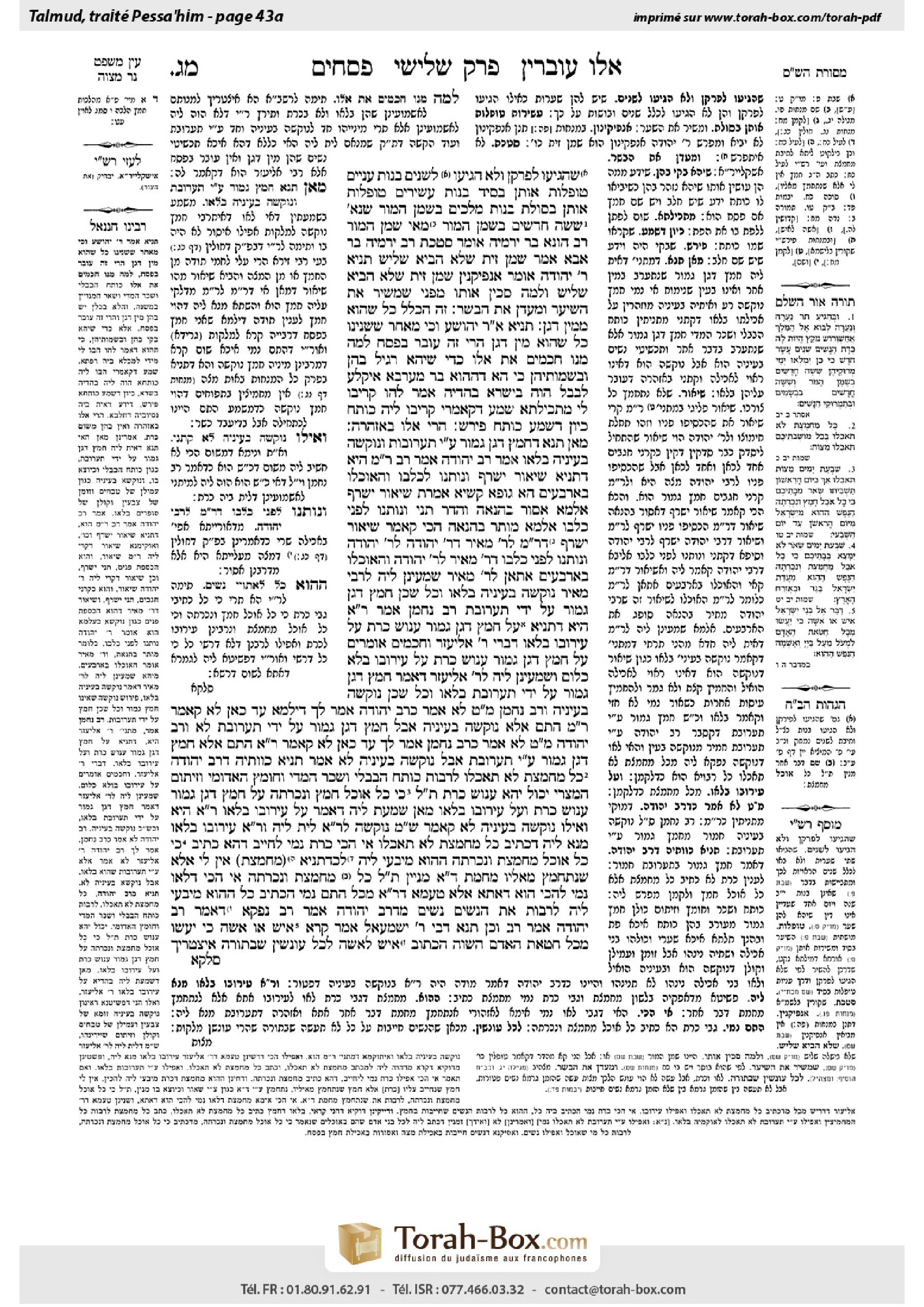
Pesachim 43a: Talmud study for Daf Yomi
Daf Yomi is the daily study of one Talmud folio. Explore 37 tractates with scans, Hebrew text, Sefaria English and AI-generated French translations where annotated.
Passage selection and English or AI-generated French translation are available where the scan has annotations. Daf Study is independent of Torah-Box and Sefaria.
Browse Pesachim · פסחים · All tractatesPesachim 43a text and translations
This page of Pesachim includes the Aramaic text, an English translation and an AI-generated French translation, alongside the scan above.
פסחים מ״ג א · Aramaic and Hebrew text
שֶׁהִגִּיעוּ לְפִרְקָן, וְלֹא הִגִּיעוּ לְשָׁנִים, בְּנוֹת עֲנִיִּים — טוֹפְלוֹת אוֹתָן בְּסִיד, בְּנוֹת עֲשִׁירִים — טוֹפְלוֹת אוֹתָן בְּסוֹלֶת, בְּנוֹת מְלָכִים — בְּשֶׁמֶן הַמּוֹר, שֶׁנֶּאֱמַר: ״שִׁשָּׁה חֳדָשִׁים בְּשֶׁמֶן הַמּוֹר״.
מַאי ״שֶׁמֶן הַמּוֹר״? רַב הוּנָא בַּר יִרְמְיָה אוֹמֵר: סְטָכַת. רַב יִרְמְיָה בַּר אַבָּא אָמַר: שֶׁמֶן זַיִת שֶׁלֹּא הֵבִיא שְׁלִישׁ.
תַּנְיָא רַבִּי יְהוּדָה אוֹמֵר: אַנְפִּיקְנִין — שֶׁמֶן זַיִת שֶׁלֹּא הֵבִיא שְׁלִישׁ, וְלָמָּה סָכִין אוֹתוֹ? מִפְּנֵי שֶׁמַּשִּׁיר אֶת הַשֵּׂיעָר וּמְעַדֵּן אֶת הַבָּשָׂר.
זֶה הַכְּלָל כׇּל שֶׁהוּא מִמִּין דָּגָן. תַּנְיָא, אָמַר רַבִּי יְהוֹשֻׁעַ: וְכִי מֵאַחַר שֶׁשָּׁנִינוּ כֹּל שֶׁהוּא מִין דָּגָן הֲרֵי זֶה עוֹבֵר בְּפֶסַח, לָמָּה מָנוּ חֲכָמִים אֶת אֵלּוּ? כְּדֵי שֶׁיְּהֵא רָגִיל בָּהֶן וּבִשְׁמוֹתֵיהֶן.
כִּי הָא דְּהָהוּא בַּר מַעְרְבָא אִיקְּלַע לְבָבֶל, הֲוָה בִּישְׂרָא בַּהֲדֵיהּ, אֲמַר לְהוּ: קָרִיבוּ לִי מַתְכִּילְתָּא. שְׁמַע דְּקָאָמְרִי: קָרִיבוּ לֵיהּ כּוּתָּח. כֵּיוָן דִּשְׁמַע כּוּתָּח — פֵּירַשׁ.
הֲרֵי אֵלּוּ בְּאַזְהָרָה.
מַאן תַּנָּא דְּחָמֵץ דָּגָן גָּמוּר עַל יְדֵי תַּעֲרוֹבוֹת, וְנוּקְשֶׁה בְּעֵינֵיהּ בְּלָאו?
אָמַר רַב יְהוּדָה אָמַר רַב: רַבִּי מֵאִיר הִיא, דְּתַנְיָא: שִׂיאוּר — יִשָּׂרֵף, וְנוֹתְנוֹ לְכַלְבּוֹ, וְהָאוֹכְלוֹ — בְּאַרְבָּעִים.
הָא גוּפָא קַשְׁיָא, אָמְרַתְּ ״שִׂיאוּר יִשָּׂרֵף״, אַלְמָא אָסוּר בַּהֲנָאָה, וַהֲדַר תָּנֵי: וְנוֹתְנוֹ לִפְנֵי כַּלְבּוֹ, אַלְמָא מוּתָּר בַּהֲנָאָה!
הָכִי קָאָמַר: שִׂיאוּר יִשָּׂרֵף — דְּרַבִּי מֵאִיר לְרַבִּי מֵאִיר, דְּרַבִּי יְהוּדָה לְרַבִּי יְהוּדָה. וְנוֹתְנוֹ לִפְנֵי כַּלְבּוֹ — דְּרַבִּי מֵאִיר לְרַבִּי יְהוּדָה.
וְהָאוֹכְלוֹ בְּאַרְבָּעִים — אֲתָאן לְרַבִּי מֵאִיר.
שָׁמְעִינַן לֵיהּ לְרַבִּי מֵאִיר נוּקְשֶׁה בְּעֵינֵיהּ — בְּלָאו. וְכׇל שֶׁכֵּן חָמֵץ דָּגָן גָּמוּר עַל יְדֵי תַּעֲרוֹבֶת.
רַב נַחְמָן אָמַר: רַבִּי אֱלִיעֶזֶר הִיא, דְּתַנְיָא: עַל חָמֵץ דָּגָן גָּמוּר — עָנוּשׁ כָּרֵת, עַל עֵירוּבוֹ — בְּלָאו, דִּבְרֵי רַבִּי אֱלִיעֶזֶר. וַחֲכָמִים אוֹמְרִים: עַל חָמֵץ דָּגָן גָּמוּר — עָנוּשׁ כָּרֵת, עַל עֵירוּבוֹ — בְּלֹא כְּלוּם. וְשָׁמְעִינַן לֵיהּ לְרַבִּי אֱלִיעֶזֶר דְּאָמַר חָמֵץ דָּגָן גָּמוּר עַל יְדֵי תַּעֲרוֹבֶת — בְּלָאו, וְכׇל שֶׁכֵּן נוּקְשֶׁה בְּעֵינֵיהּ.
וְרַב נַחְמָן, מַאי טַעְמָא לָא אָמַר כְּרַב יְהוּדָה?
אָמַר לָךְ: דִּילְמָא עַד כָּאן לָא קָאָמַר רַבִּי מֵאִיר הָתָם אֶלָּא נוּקְשֶׁה בְּעֵינֵיהּ, אֲבָל חָמֵץ דָּגָן גָּמוּר עַל יְדֵי תַּעֲרוֹבֶת — לָא.
וְרַב יְהוּדָה מַאי טַעְמָא לָא אָמַר כְּרַב נַחְמָן?
אָמַר לָךְ: עַד כָּאן לָא קָאָמַר רַבִּי אֱלִיעֶזֶר הָתָם אֶלָּא חָמֵץ דָּגָן גָּמוּר עַל יְדֵי תַּעֲרוֹבֶת. אֲבָל נוּקְשֶׁה בְּעֵינֵיהּ — לָא אָמַר.
תַּנְיָא כְּווֹתֵיהּ דְּרַב יְהוּדָה: ״כׇּל מַחְמֶצֶת לֹא תֹאכֵלוּ״ — לְרַבּוֹת כּוּתָּח הַבַּבְלִי וְשֵׁכָר הַמָּדִי וְחוֹמֶץ הָאֲדוֹמִי וְזֵיתוֹם הַמִּצְרִי. יָכוֹל יְהֵא עָנוּשׁ כָּרֵת? תַּלְמוּד לוֹמַר: ״כִּי כׇּל אֹכֵל חָמֵץ וְנִכְרְתָה״, עַל חָמֵץ דָּגָן גָּמוּר — עָנוּשׁ כָּרֵת, וְעַל עֵירוּבוֹ — בְּלָאו.
מַאן שָׁמְעַתְּ לֵיהּ דְּאָמַר עַל עֵירוּבוֹ בְּלָאו? רַבִּי אֱלִיעֶזֶר הִיא, וְאִילּוּ נוּקְשֶׁה בְּעֵינֵיהּ לָא קָאָמַר. שְׁמַע מִינַּהּ: נוּקְשֶׁה לְרַבִּי אֱלִיעֶזֶר לֵית לֵיהּ.
וְרַבִּי אֱלִיעֶזֶר, עֵירוּבוֹ בְּלָאו מְנָא לֵיהּ? דִּכְתִיב: ״כׇּל מַחְמֶצֶת לֹא תֹאכֵלוּ״.
אִי הָכִי, כָּרֵת נָמֵי לְחַיֵּיב, דְּהָא כְּתִיב: ״כִּי כׇּל אֹכֵל מַחְמֶצֶת וְנִכְרְתָה״!
הַהוּא מִיבְּעֵי לֵיהּ לְכִדְתַנְיָא, (״מַחְמֶצֶת״) אֵין לִי אֶלָּא שֶׁנִּתְחַמֵּץ מֵאֵלָיו, מֵחֲמַת דָּבָר אַחֵר מִנַּיִין? תַּלְמוּד לוֹמַר: ״כׇּל ... מַחְמֶצֶת וְנִכְרְתָה״.
אִי הָכִי, דְּלָאו נָמֵי לְהָכִי הוּא דַּאֲתָא!
אֶלָּא: טַעְמָא דְּרַבִּי אֱלִיעֶזֶר מִ״כׇּל״.
הָתָם נָמֵי, הָכְתִיב ״כׇּל״? הַהוּא מִיבְּעֵי לֵיהּ — לְרַבּוֹת אֶת הַנָּשִׁים.
נָשִׁים מִדְּרַב יְהוּדָה אָמַר רַב נָפְקָא, דְּאָמַר רַב יְהוּדָה אָמַר רַב, וְכֵן תָּנָא דְּבֵי רַבִּי יִשְׁמָעֵאל: אָמַר קְרָא ״אִישׁ אוֹ אִשָּׁה כִּי יַעֲשׂוּ מִכׇּל חַטֹּאת הָאָדָם״, הִשְׁוָה הַכָּתוּב אִישׁ לְאִשָּׁה לְכׇל עוֹנָשִׁין שֶׁבַּתּוֹרָה.
אִיצְטְרִיךְ,
Pesachim 43a · English translation
who reached physical maturity, but had not yet reached the age of majority, and women who sought to remove hair for cosmetic purposes: They would smear daughters of the poor with lime; they would smear daughters of the wealthy with fine flour; they would smear daughters of kings with shemen hamor, as it was stated: “For so were the days of their anointing filled, six months with shemen hamor” (Esther 2:12).
The Gemara asks: What is shemen hamor? Rav Huna bar Ḥiyya said: Setaket. Rav Yirmeya bar Abba said: It is olive oil extracted from an olive that has not yet reached a third of its growth; the acidic oil is effective as a depilatory.
It was taught in a baraita: Rabbi Yehuda says that anpiknin is olive oil from an olive that has not reached a third of its growth. And why is it spread on the body? It is due to the fact that it removes [mashir] the hair and pampers the skin.
The mishna states: This is the principle: One violates these prohibitions on Passover with anything that is prepared from a type of grain. It was taught in a baraita that Rabbi Yehoshua said: Now that we learned that by possessing anything that is a type of grain one violates the prohibition against leaven during Passover, why did the Sages list these items individually? They could have simply stated the principle. The baraita explains that the Sages provided a list of prohibited foods so that one would become familiar with these items and with their names, so that it would become widely known that these foods contain a small quantity of grain.
The Gemara cites an incident that underscores the significance of familiarity with the names of foods: As in this case of that man from the West, Eretz Yisrael, who visited Babylonia, and had meat with him, he said to his hosts: Bring me a dip with which to eat my bread. He heard them saying: Bring him kutaḥ. Since he heard the word kutaḥ, he stopped eating, as he knew that kutaḥ contains milk and may not be eaten with meat. This incident underscores that it is advantageous for one to familiarize himself with the names and ingredients of different foods, so that he will be aware of the nature of the food even if he does not recognize it.
It is stated in the mishna: These substances are included in the prohibition but are not punishable by karet.
The Gemara asks: Who is the tanna who maintains that both full-fledged, leavened grain bread in a mixture, and hardened leaven, in its pure, unadulterated form, which is not suitable for consumption, are both included in a prohibition?
The Gemara answers that Rav Yehuda said that Rav said: It is the opinion of Rabbi Meir, as it was taught in a baraita: Leavening dough, i.e., dough that is at the beginning of the leavening process and is presently hardened leaven, must be burned, or one gives it to his dog. And one who eats it is flogged with forty lashes.
Before analyzing the contents of the baraita, the Gemara addresses an apparent contradiction within the baraita. This baraita itself is difficult. You said that leavening dough must be burned; apparently it is prohibited to derive benefit from hardened leaven. And then it teaches: Or one gives it to his dog; apparently, it is permitted to derive benefit from the leaven.
The Gemara answers that this is what the baraita is saying: Leavening dough must be burned, i.e., leavening dough as defined by Rabbi Meir must be burned in accordance with the opinion of Rabbi Meir, who maintains that leavening dough is full-fledged leaven. Alternatively, the baraita may be explained as referring to leavening dough as defined by Rabbi Yehuda, in accordance with the opinion of Rabbi Yehuda that it is prohibited to derive benefit from leavening dough. Each tanna maintains that it is prohibited to derive benefit from any dough classified as leavening dough by his definition. When the baraita says that one gives it to his dog, it means: Leavening dough as defined by Rabbi Meir, is only hardened leaven according to Rabbi Yehuda, and therefore one may feed it to his dog. Rabbi Yehuda maintains that it is permitted to derive benefit from this type of leaven.
With regard to the final statement of the baraita, that one who eats leavening dough is flogged with forty lashes, we have once again arrived at the opinion of Rabbi Meir. Rabbi Meir holds that one who eats this leavening dough, from which it is permitted to derive benefit according to Rabbi Yehuda, is flogged with forty lashes.
According to this explanation of the baraita, we have learned that Rabbi Meir maintains that hardened leaven in its pure, unadulterated form, is included in a prohibition, and one who eats this leaven is flogged. And all the more so, one who eats full-fledged, leavened grain bread in a mixture is flogged but does not receive karet, as he is not eating the leaven in and of itself. Nevertheless, the prohibition against eating leavened bread on Passover applies in that case.
Rav Naḥman said: The mishna is in accordance with the opinion of Rabbi Eliezer, as it was taught in a baraita: For eating full-fledged, leavened grain bread one is punishable by karet, whereas for eating a mixture that contains leaven one is punished merely for violating a prohibition. This is the statement of Rabbi Eliezer. And the Rabbis say: For eating full-fledged, leavened grain bread one is punishable by karet; however, for eating leaven in its mixture one is not punished at all. And we learned according to Rabbi Eliezer, who said that full-fledged, leavened grain bread in a mixture is included in a prohibition, and that is true all the more so with regard to hardened leaven in its pure, unadulterated form.
The Gemara asks: And what is the reason that Rav Naḥman did not state his opinion in accordance with the explanation of Rav Yehuda, that the mishna is in accordance with Rabbi Meir’s ruling?
The Gemara answers that Rav Naḥman could have said to you that the following distinction applies: Perhaps Rabbi Meir stated his opinion only there, with regard to hardened leaven in its pure, unadulterated form; however, with regard to full-fledged, leavened grain bread in a mixture, no, one is punished not with mere lashes but with karet.
The Gemara asks: And what is the reason that Rav Yehuda did not state his opinion in accordance with the explanation of Rav Naḥman, that the mishna is in accordance with Rabbi Eliezer’s ruling?
The Gemara answers that Rav Yehuda could have said to you: Rabbi Eliezer stated his opinion only there, with regard to full-fledged, leavened grain bread in a mixture that it is included in the prohibition. However, with regard to hardened leaven in its pure, unadulterated form, he did not state his ruling and perhaps Rabbi Eliezer maintains that it is permitted to eat hardened leaven.
The Gemara notes that it was taught in a baraita in accordance with the opinion of Rav Yehuda, who said that the halakha is in accordance with Rabbi Meir’s opinion: “You shall eat nothing leavened; in all your dwellings you shall eat matzot” (Exodus 12:20). The Sages taught: This verse comes to include Babylonian kutaḥ, Median beer, Edomite vinegar, and Egyptian zitom. I might have thought that one who eats any of these items will be punishable by karet. Therefore, the verse states: “For whoever eats leavened bread…that soul shall be cut off from Israel” (Exodus 12:15), from which the Sages derived: For eating full-fledged, leavened grain bread one is punished with karet, but for eating its mixture one is only in violation of a prohibition.
The Gemara analyzes the above statement: Whom did you hear that said that for eating a mixture which contains leaven one is in violation of a prohibition? It is Rabbi Eliezer. However, the baraita is not stating the halakha of hardened leaven in its pure, unadulterated form. This baraita lists only items that contain leaven in a mixture, but not other substances whose legal status is that of hardened leaven, e.g., broth, worked dough, and glue. Learn from this that Rabbi Eliezer is not of the opinion that hardened leaven is prohibited.
The Gemara asks: And Rabbi Eliezer, from where does he derive the halakha that leaven in its mixture is included in a prohibition? The Gemara answers that he derives it as it is written: “You shall eat nothing leavened.”
The Gemara challenges this derivation: If so, if the expression: Anything leavened, includes leaven in a mixture, let one also be liable to receive karet for eating leaven in a mixture. As it is written: “Seven days no leaven shall be found in your houses; for whosoever eats anything [kol] leavened, that soul shall be cut off from the people of Israel, whether he is a sojourner or one born in the land” (Exodus 12:19). Apparently, one is punished with karet for eating anything that contains leaven.
The Gemara answers that Rabbi Eliezer needs that phrase: Anything leavened, in order to derive for that which was taught in a baraita: From the phrase: Anything leavened, I have derived only that an item that became leavened on its own is prohibited. However, from where do I derive that one is punished with karet for eating an item that became leavened due to a different factor? The verse states: “Whosoever eats anything [kol] leavened…shall be cut off,” indicating that food that became leavened due to a different factor is considered leavened bread.
The Gemara asks: If so, if the phrase: Anything leavened, is referring to food that became leavened by means of something else, then when this same phrase appears with regard to the prohibition, I should explain that it comes for that purpose as well. Consequently, there should be no violation for eating a mixture that contains leaven, as apparently, the phrase: Anything leavened, does not refer to that case at all.
Rather, the reason for the opinion of Rabbi Eliezer is that he derives this halakha from the term anything [kol]. He does not derive his opinion from the term leavened; he bases his ruling on the inclusive term anything.
The Gemara raises a difficulty: There, too, in the verse that mentions the punishment of karet, isn’t it written: “For whosoever [kol] eats anything leavened, that soul shall be cut off”? The Gemara answers: Rabbi Eliezer requires that term to include women who are also punishable by karet for eating leavened bread.
The Gemara asks: Is this source necessary to derive this halakha? The fact that women may not eat leavened bread is derived from the statement that Rav Yehuda said that Rav said. As Rav Yehuda said that Rav said, and similarly, the Sage in the school of Rabbi Yishmael taught: The verse said: “Speak to the children of Israel: A man or woman, when they commit any of the sins of men, to commit a trespass against the Lord, and that soul shall be guilty” (Numbers 5:6). The Torah rendered a man equal to a woman for all punishments of the Torah. Since the punishment of karet for eating leavened bread on Passover is included in this general principle, there is no need for a separate source to include women.
The Gemara answers: Nonetheless, it is necessary to cite a source that men and women are equal specifically with regard to the punishment of karet for eating leavened bread,
Pesachim 43a · Traduction française (IA)
qui avaient atteint la maturité physique, mais pas encore l’âge de la majorité, ainsi que les femmes qui cherchaient à s’épiler pour des raisons esthétiques : on enduisait les filles des pauvres de chaux, celles des riches de farine fine et celles des rois de shemen hamor, comme il est dit : « Car les jours de leur onction furent ainsi accomplis : six mois avec du shemen hamor » (Esther 2, 12).
La Guemara demande : Qu’est-ce que le shemen hamor ? Rav Houna bar Ḥiyya dit : du setaket. Rav Yirmeya bar Abba dit : c’est de l’huile d’olive extraite d’une olive qui n’a pas encore atteint le tiers de sa croissance ; cette huile acide est efficace comme dépilatoire.
Il a été enseigné dans une baraïta : Rabbi Yehouda dit que l’anpiknin est de l’huile d’olive provenant d’une olive qui n’a pas atteint le tiers de sa croissance. Et pourquoi l’étale-t-on sur le corps ? Parce qu’elle enlève [mashir] les poils et adoucit la peau.
La Michna énonce ce principe : on transgresse ces interdictions à Pessa’h avec tout ce qui est préparé à partir d’une espèce de céréale. Il a été enseigné dans une baraïta que Rabbi Yehoshoua a dit : Puisque nous avons appris que le fait de posséder quoi que ce soit qui soit d’une espèce de céréale fait transgresser l’interdiction relative au levain à Pessa’h, pourquoi les Sages ont-ils énuméré ces aliments séparément ? Ils auraient pu simplement énoncer le principe. La baraïta explique que les Sages ont dressé une liste des aliments interdits afin qu’on se familiarise avec eux et leurs noms, et que l’on sache largement que ces aliments contiennent une petite quantité de céréales.
La Guemara cite un incident qui souligne l’importance de connaître les noms des aliments : un homme venu de l’Ouest, c’est-à-dire d’Eretz Israël, se rendit en Babylonie avec de la viande. Il dit à ses hôtes : « Apportez-moi une sauce pour manger mon pain. » Il les entendit dire : « Apportez-lui du kutaḥ. » En entendant le mot kutaḥ, il cessa de manger, car il savait que le kutaḥ contient du lait et ne peut être consommé avec de la viande. Cet incident montre qu’il est utile de connaître les noms et les ingrédients des différents aliments, afin d’en connaître la nature même lorsqu’on ne les reconnaît pas.
La Michna énonce : ces substances sont comprises dans l’interdiction, mais ne sont pas passibles de karet.
La Guemara demande : Quel est le tanna qui soutient que le pain véritablement levé, composé de céréales et présent dans un mélange, ainsi que le levain durci, sous sa forme pure et non mélangée, impropre à la consommation, sont tous deux compris dans une interdiction ?
La Guemara répond que Rav Yehouda a dit au nom de Rav : c’est l’opinion de Rabbi Meïr, comme il a été enseigné dans une baraïta : la pâte en cours de fermentation, c’est-à-dire la pâte au début du processus de fermentation qui est alors du levain durci, doit être brûlée ou donnée à son chien. Celui qui en mange reçoit quarante coups de fouet.
Avant d’analyser le contenu de la baraïta, la Guemara relève une contradiction apparente en son sein. Cette baraïta pose elle-même une difficulté. Tu as dit que la pâte en cours de fermentation doit être brûlée ; cela semble indiquer qu’il est interdit de tirer profit du levain durci. Puis elle enseigne : « Ou bien on la donne à son chien » ; cela semble indiquer qu’il est permis de tirer profit du levain.
La Guemara répond que voici ce que dit la baraïta : la pâte en cours de fermentation doit être brûlée, c’est-à-dire que la pâte en cours de fermentation selon la définition de Rabbi Meïr doit être brûlée, conformément à l’opinion de Rabbi Meïr, qui considère qu’il s’agit de véritable levain. On peut aussi expliquer que la baraïta parle de la pâte en cours de fermentation selon la définition de Rabbi Yehouda, conformément à l’opinion de Rabbi Yehouda, selon laquelle il est interdit d’en tirer profit. Chaque tanna considère qu’il est interdit de tirer profit de toute pâte qui répond à sa définition de la pâte en cours de fermentation. Lorsque la baraïta dit qu’on la donne à son chien, cela signifie que la pâte en cours de fermentation selon la définition de Rabbi Meïr n’est que du levain durci selon Rabbi Yehouda ; on peut donc la donner à son chien. Rabbi Yehouda considère qu’il est permis de tirer profit de ce type de levain.
En ce qui concerne la dernière déclaration de la baraïta, selon laquelle celui qui mange de la pâte en cours de fermentation reçoit quarante coups de fouet, nous retrouvons l’opinion de Rabbi Meïr. Rabbi Meïr estime que celui qui mange cette pâte en cours de fermentation, dont Rabbi Yehouda permet de tirer profit, reçoit quarante coups de fouet.
Selon cette explication de la baraïta, nous avons appris que Rabbi Meïr considère que le levain durci, sous sa forme pure et non mélangée, est compris dans une interdiction, et que celui qui en mange reçoit des coups de fouet. À plus forte raison, celui qui mange du pain véritablement levé, composé de céréales et présent dans un mélange, reçoit des coups de fouet, mais n’est pas passible de karet, puisqu’il ne mange pas le levain en tant que tel. Néanmoins, l’interdiction de manger du pain levé à Pessa’h s’applique dans ce cas.
Rav Naḥman dit : la Michna est conforme à l’opinion de Rabbi Eliezer, comme il a été enseigné dans une baraïta : celui qui mange du pain véritablement levé, composé de céréales, est passible de karet, tandis que celui qui mange un mélange contenant du levain est seulement puni pour avoir transgressé une interdiction. Telle est la déclaration de Rabbi Eliezer. Les Sages disent : celui qui mange du pain véritablement levé, composé de céréales, est passible de karet ; en revanche, celui qui mange du levain dans un mélange n’est pas puni du tout. Nous avons donc appris, conformément à Rabbi Eliezer, que le pain véritablement levé, composé de céréales et présent dans un mélange, est compris dans une interdiction ; cela vaut à plus forte raison pour le levain durci sous sa forme pure et non mélangée.
La Guemara demande : Pourquoi Rav Naḥman n’a-t-il pas formulé son opinion conformément à l’explication de Rav Yehouda, selon laquelle la Michna suit la décision de Rabbi Meïr ?
La Guemara répond que Rav Naḥman aurait pu te dire que la distinction suivante s’applique : peut-être Rabbi Meïr n’a-t-il exprimé son opinion que là, au sujet du levain durci sous sa forme pure et non mélangée ; mais, concernant le pain véritablement levé, composé de céréales et présent dans un mélange, il en va autrement : celui qui en mange est passible de karet, et non simplement de coups de fouet.
La Guemara demande : Pourquoi Rav Yehouda n’a-t-il pas formulé son opinion conformément à l’explication de Rav Naḥman, selon laquelle la Michna suit la décision de Rabbi Eliezer ?
La Guemara répond que Rav Yehouda aurait pu te dire : Rabbi Eliezer n’a exprimé son opinion que là, en disant que le pain véritablement levé, composé de céréales et présent dans un mélange, est compris dans l’interdiction. En revanche, il n’a pas énoncé de décision au sujet du levain durci sous sa forme pure et non mélangée ; peut-être Rabbi Eliezer considère-t-il qu’il est permis de manger du levain durci.
La Guemara relève qu’une baraïta a été enseignée conformément à l’opinion de Rav Yehouda, qui a dit que la halakha suit l’opinion de Rabbi Meïr : « Vous ne mangerez rien de levé ; dans toutes vos demeures, vous mangerez des matsot » (Exode 12, 20). Les Sages ont enseigné : ce verset vient inclure le kutaḥ babylonien, la bière mède, le vinaigre édomite et le zitom égyptien. J’aurais pu penser que celui qui mange l’un de ces aliments est passible de karet. C’est pourquoi le verset dit : « Car quiconque mange du pain levé… cette personne sera retranchée d’Israël » (Exode 12, 15). Les Sages en déduisent que celui qui mange du pain véritablement levé, composé de céréales, est puni de karet, mais que celui qui mange un mélange qui en contient ne fait que transgresser une interdiction.
La Guemara analyse la déclaration précédente : De qui a-t-on entendu qu’il disait que celui qui mange un mélange contenant du levain transgresse une interdiction ? De Rabbi Eliezer. Or, la baraïta n’énonce pas la halakha concernant le levain durci sous sa forme pure et non mélangée. Elle dresse la liste des seuls aliments qui contiennent du levain dans un mélange, et non d’autres substances ayant le statut juridique de levain durci, comme le bouillon, la pâte travaillée et la colle. Déduis-en que Rabbi Eliezer ne considère pas que le levain durci soit interdit.
La Guemara demande : Et d’où Rabbi Eliezer déduit-il la halakha selon laquelle le levain présent dans un mélange est compris dans une interdiction ? La Guemara répond qu’il la déduit de ce qui est écrit : « Vous ne mangerez rien de levé. »
La Guemara conteste cette déduction : dans ce cas, si l’expression « rien de levé » inclut le levain présent dans un mélange, pourquoi celui qui mange du levain dans un mélange ne serait-il pas également passible de karet ? Car il est écrit : « Pendant sept jours, qu’on ne trouve pas de levain dans vos maisons ; car quiconque [kol] mange quelque chose de levé, cette personne sera retranchée du peuple d’Israël, qu’il soit étranger ou né dans le pays » (Exode 12, 19). Il semble donc que l’on soit puni de karet pour avoir mangé tout aliment qui contient du levain.
La Guemara répond que Rabbi Eliezer a besoin de l’expression « rien de levé » pour déduire l’enseignement d’une baraïta : de l’expression « rien de levé », je n’ai déduit que l’interdiction d’un aliment qui a fermenté de lui-même. Mais d’où déduis-je que celui qui mange un aliment ayant fermenté sous l’effet d’un autre facteur est passible de karet ? Le verset dit : « Quiconque mange quelque chose [kol] de levé… sera retranché », ce qui indique qu’un aliment ayant fermenté sous l’effet d’un autre facteur est considéré comme du pain levé.
La Guemara demande : Dans ce cas, si l’expression « rien de levé » désigne un aliment qui a fermenté sous l’effet d’autre chose, alors, lorsque cette même expression apparaît au sujet de l’interdiction, ne devrais-je pas lui donner également ce sens ? Par conséquent, manger un mélange contenant du levain ne devrait entraîner aucune transgression, puisque l’expression « rien de levé » ne désignerait apparemment pas du tout ce cas.
La raison de l’opinion de Rabbi Eliezer est plutôt qu’il déduit cette halakha du terme « tout » [kol]. Il ne fonde pas son opinion sur le terme « levé » ; il s’appuie sur le terme inclusif « tout ».
La Guemara soulève une difficulté : là aussi, dans le verset qui mentionne la peine de karet, n’est-il pas écrit : « Car quiconque [kol] mange quelque chose de levé, cette personne sera retranchée » ? La Guemara répond que Rabbi Eliezer a besoin de ce terme pour inclure les femmes, qui sont elles aussi passibles de karet lorsqu’elles mangent du pain levé.
La Guemara demande : Cette source est-elle nécessaire pour déduire cette halakha ? L’interdiction faite aux femmes de manger du pain levé se déduit de la déclaration de Rav Yehouda au nom de Rav. Rav Yehouda a dit au nom de Rav, et de même, le Sage de l’école de Rabbi Yishmaël a enseigné : le verset dit : « Parle aux enfants d’Israël : lorsqu’un homme ou une femme commet l’un des péchés des hommes, en commettant une infidélité envers le Seigneur, cette personne sera coupable » (Nombres 5, 6). La Torah a mis l’homme et la femme sur un pied d’égalité pour toutes les peines prévues par la Torah. Puisque la peine de karet pour avoir mangé du pain levé à Pessa’h relève de ce principe général, aucune source distincte n’est nécessaire pour inclure les femmes.
La Guemara répond : néanmoins, il faut citer une source établissant l’égalité des hommes et des femmes spécifiquement quant à la peine de karet pour avoir mangé du pain levé,
Traduction française générée par IA à partir de l’édition anglaise de Sefaria. Vérifie toujours un passage avec le texte source.
Text from Sefaria: William Davidson Edition - Vocalized Aramaic (CC BY NC); William Davidson Edition - English (CC BY NC).