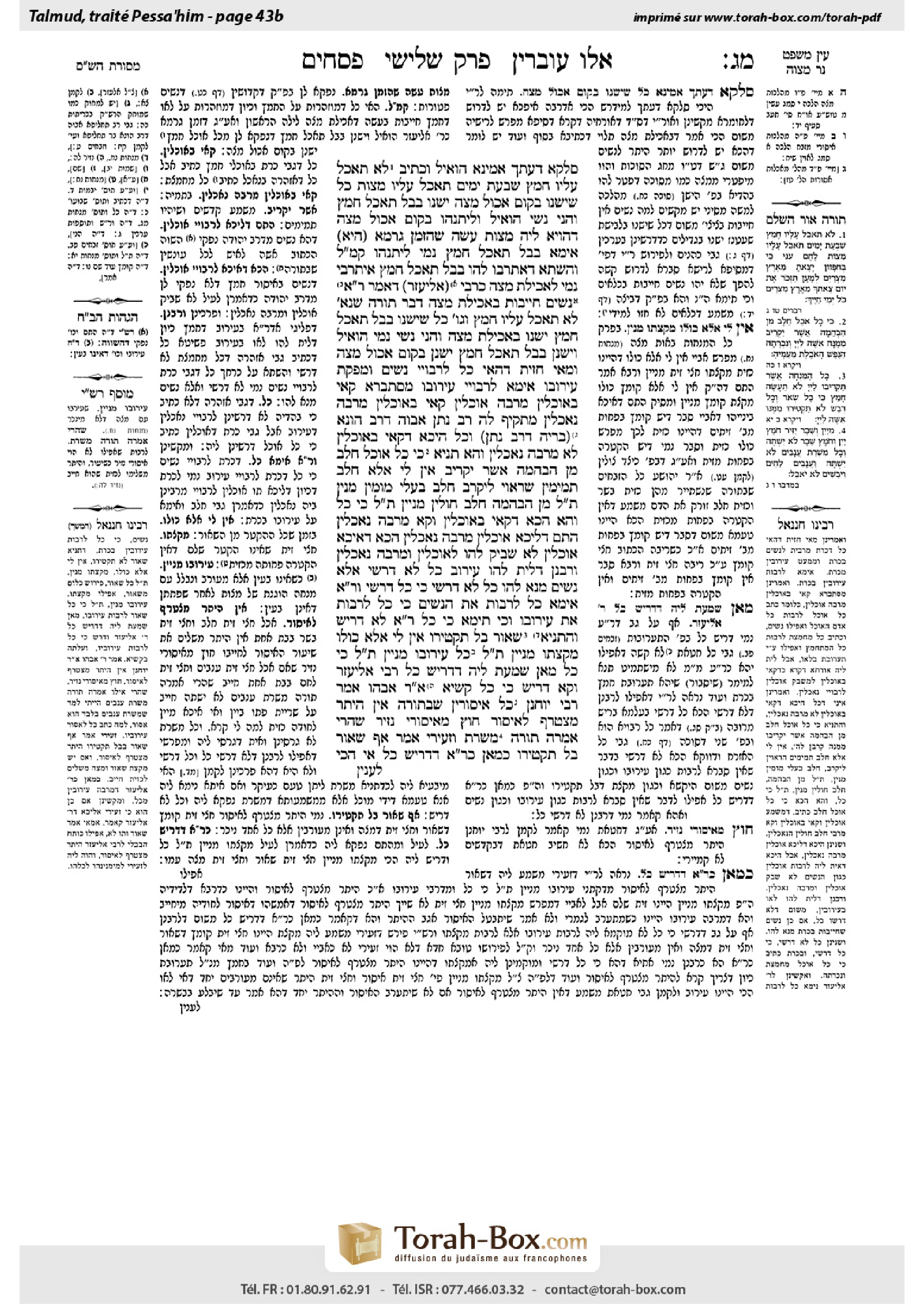
Pesachim 43b: Talmud study for Daf Yomi
Daf Yomi is the daily study of one Talmud folio. Explore 37 tractates with scans, Hebrew text, Sefaria English and AI-generated French translations where annotated.
Passage selection and English or AI-generated French translation are available where the scan has annotations. Daf Study is independent of Torah-Box and Sefaria.
Browse Pesachim · פסחים · All tractatesPesachim 43b text and translations
This page of Pesachim includes the Aramaic text, an English translation and an AI-generated French translation, alongside the scan above.
פסחים מ״ג ב · Aramaic and Hebrew text
סָלְקָא דַּעְתָּךְ אָמֵינָא: הוֹאִיל וּכְתִיב ״לֹא תֹאכַל עָלָיו חָמֵץ שִׁבְעַת יָמִים תֹּאכַל עָלָיו מַצּוֹת״, כֹּל שֶׁיֶּשְׁנוֹ בְּקוּם אֱכוֹל מַצָּה — יֶשְׁנוֹ בְּבַל תֹּאכַל חָמֵץ, וְהָנֵי נְשֵׁי, הוֹאִיל וְלֵיתַנְהוּ בְּקוּם אֱכוֹל מַצָּה, דְּהָוְיָא לַיהּ מִצְוַת עֲשֵׂה שֶׁהַזְּמַן גְּרָמָא (הִיא) — אֵימָא בְּבַל תֹּאכַל חָמֵץ נָמֵי לֵיתַנְהוּ, קָא מַשְׁמַע לַן.
וְהַשְׁתָּא דְּאִתְרַבּוּ לְהוּ בְּבַל תֹּאכַל חָמֵץ — אִיתְרַבִּי נָמֵי לַאֲכִילַת מַצָּה, כְּרַבִּי (אֱלִיעֶזֶר). דְּאָמַר רַבִּי אֱלִיעֶזֶר: נָשִׁים חַיָּיבוֹת בַּאֲכִילַת מַצָּה דְּבַר תּוֹרָה, שֶׁנֶּאֱמַר: ״לֹא תֹאכַל עָלָיו חָמֵץ וְגוֹ׳״, כֹּל שֶׁיֶּשְׁנוֹ בְּבַל תֹּאכַל חָמֵץ — יֶשְׁנוֹ בַּאֲכִילַת מַצָּה. וְהָנֵי נְשֵׁי נָמֵי, הוֹאִיל וְיׇשְׁנָן בְּבַל תֹּאכַל חָמֵץ — יֶשְׁנָן בְּקוּם אֱכוֹל מַצָּה.
וּמַאי חָזֵית דְּהַאי ״כׇּל״ לְרַבּוֹיֵי נָשִׁים, וּמַפְּקַתְּ עֵירוּבוֹ? אֵימָא: לְרַבּוֹיֵי עֵירוּבוֹ!
מִסְתַּבְּרָא, קָאֵי בְּאוֹכְלִין מְרַבֵּה אוֹכְלִין. קָאֵי בְּאוֹכְלִין מְרַבֵּה נֶאֱכָלִין?
מַתְקֵיף לַהּ רַב נָתָן אֲבוּהּ דְּרַב הוּנָא (בְּרֵיהּ דְּרַב נָתָן): וְכׇל הֵיכָא דְּקָאֵי בְּאוֹכְלִין לָא מְרַבֵּה נֶאֱכָלִין? וְהָא תַּנְיָא: ״כִּי כׇּל אֹכֵל חֵלֶב מִן הַבְּהֵמָה אֲשֶׁר יַקְרִיב״, אֵין לִי אֶלָּא חֵלֶב תְּמִימִין שֶׁרָאוּי לִיקְרַב, חֵלֶב בַּעֲלֵי מוּמִין מִנַּיִן? תַּלְמוּד לוֹמַר: ״מִן הַבְּהֵמָה״. חֵלֶב חוּלִּין מִנַּיִין? תַּלְמוּד לוֹמַר: ״כִּי כׇּל״. וְהָא הָכָא דְּקָאֵי בְּאוֹכְלִין, וְקָא מְרַבֵּה נֶאֱכָלִין!
הָתָם דְּלֵיכָּא אוֹכְלִין — מְרַבֵּה נֶאֱכָלִין. הָכָא דְּאִיכָּא אוֹכְלִין — לָא שָׁבֵיק לְהוּ לְאוֹכְלִין וּמְרַבֵּה נֶאֱכָלִין.
וְרַבָּנַן דְּלֵית לְהוּ עֵירוּב, ״כׇּל״ לָא דָּרְשִׁי. אֶלָּא נָשִׁים מְנָא לְהוּ?
״כׇּל״ — לָא דָּרְשִׁי, ״כִּי כׇּל״ — דָּרְשִׁי.
וְרַבִּי אֱלִיעֶזֶר, אֵימָא: ״כׇּל״ — לְרַבּוֹת אֶת הַנָּשִׁים, ״כִּי כׇּל״ — לְרַבּוֹת אֶת עֵירוּבוֹ!
וְכִי תֵּימָא ״כִּי כׇּל״ רַבִּי אֱלִיעֶזֶר לָא דָּרֵישׁ, וְהָתַנְיָא: שְׂאֹר בַּל תַּקְטִירוּ — אֵין לִי אֶלָּא כּוּלּוֹ, מִקְצָתוֹ מִנַּיִין? תַּלְמוּד לוֹמַר: ״כׇּל״. עֵירוּבוֹ מִנַּיִין? תַּלְמוּד לוֹמַר: ״כִּי כׇּל״. מַאן שָׁמְעַתְּ לֵיהּ דְּדָרֵישׁ ״כׇּל״ — רַבִּי אֱלִיעֶזֶר, וְקָא דָּרֵישׁ ״כִּי כׇּל״!
קַשְׁיָא.
אָמַר רַבִּי אֲבָהוּ אָמַר רַבִּי יוֹחָנָן: כׇּל אִיסּוּרִין שֶׁבַּתּוֹרָה — אֵין הֶיתֵּר מִצְטָרֵף לְאִיסּוּר, חוּץ מֵאִיסּוּרֵי נָזִיר, שֶׁהֲרֵי אָמְרָה תּוֹרָה ״מִשְׁרַת״.
וּזְעֵירִי אָמַר: אַף שְׂאוֹר בַּל תַּקְטִירוּ.
כְּמַאן? כְּרַבִּי אֱלִיעֶזֶר, דְּדָרֵישׁ ״כׇּל״.
אִי הָכִי
Pesachim 43b · English translation
as it could enter your mind to say that since it is written: “You shall eat no leavened bread with it; seven days you shall eat with it matzot” (Deuteronomy 16:3), one might have thought that anyone included in the obligation to eat matza is also included in the prohibition against eating leavened bread. And these women, since they are excluded from the obligation to eat matza, as it is a time-bound, positive mitzva from which they are exempt as a rule, I might say they are also excluded from the prohibition against eating leavened bread. Therefore, the verse teaches us that women are also prohibited from eating leavened bread.
The Gemara comments: And now that women have been included in the prohibition against eating leavened bread, they should also be included in the obligation to eat matza, even though it is a time-bound, positive mitzva, in accordance with the opinion of Rabbi Eliezer. As Rabbi Eliezer said: Women are obligated to eat matza by Torah law, as it is stated: “You shall eat no leavened bread with it; seven days you shall eat with it matzot” (Deuteronomy 16:3). These two commandments are juxtaposed to teach that anyone included in the prohibition against eating leavened bread is also included in the obligation to eat matza. And these women too, since they are included in the prohibition against eating leavened bread, they are also included in the obligation to eat matza.
The Gemara questions this derivation: What did you see that led you to understand that the term anything [kol] comes to include women and to exclude leaven in its mixture? On the contrary, say that it comes to include in the punishment of karet one who eats its mixture.
The Gemara answers: It is reasonable to explain that the verse comes to include women since the verse is dealing with those who are obligated in the mitzva not to eat leavened bread, it includes those who eat, as the verse says: “For anyone who eats leavened bread…shall be cut off.” It stands to reason that the expression: Anyone [kol] includes additional people who are punishable by karet, not additional types of leaven. Would a verse that is dealing with those who may not eat leaven come to include additional types of foods that may not be eaten?
Rav Natan, father of Rav Huna, son of Rav Natan, strongly objects to this: And anywhere that a verse is dealing with those who eat, does it necessarily not come to include additional types of food in the prohibition? Wasn’t it taught in a baraita: “For anyone who eats the fat of the domesticated animal, of which men present an offering of fire to God, the soul that eats it shall be cut off from its people” (Leviticus 7:25)? The Sages interpreted this verse: I have derived from this verse that the prohibition applies only to the fats of unblemished animals that are fit to be sacrificed. From where is it derived that it is also prohibited to eat the fats of blemished animals, which may not be offered as sacrifices? The verse states: “Of the domesticated animal.” From where is it derived that it is prohibited to eat the fats of non-sacred animals? The verse states: “For anyone who eats the fat.” Rav Natan explains his objection: Here, isn’t the verse dealing with those who eat fats, and nevertheless, its superfluous phrases come to include types of foods that may not be eaten.
The Gemara answers: There, in the verse concerning prohibited fats, where there are no additional people who eat of it to include, as the prohibition already applies to everyone, the superfluous expression comes to include additional foods. Here, in the verse that deals with leavened bread, where there are people who eat of it who can be included, namely women, the verse does not exclude people who eat and include foods that are eaten. Generally, there should be a connection between the content of a verse and that which is derived from it. Only when no other derivation is possible is a less related matter derived.
The Gemara explains: And the Rabbis, who are not of the opinion that leaven in a mixture is included in the prohibition, do not interpret that the term: Anything [kol], comes to include other matters; neither with regard to leaven in a mixture nor with regard to karet. The Gemara asks: However, in that case, from where do they derive that it is prohibited for women to eat leavened bread?
The Gemara answers: Although they do not derive a halakha from the term: Anything, they derive a halakha from the expression: For anyone [ki kol], in the verse: “For anyone who eats leaven.”
The Gemara asks: And if indeed the phrase: For anyone, is a more inclusive expression than the simple word anything, then according to Rabbi Eliezer, another halakha could also be derived from here. Say that the phrase: Anyone who eats leaven, comes to include the women, and the phrase: For anyone who eats, comes to include leaven in its mixture. According to Rabbi Eliezer, then, one would be punishable by karet for eating leaven in a mixture.
And lest you say that Rabbi Eliezer does not derive a halakha from the phrase: For anyone [ki kol], as he does not consider this an inclusive expression, the result would be another contradiction. Wasn’t it taught in another baraita: “For no [ki kol] leaven nor any honey shall be offered as a burnt-offering before God” (Leviticus 2:11)? Had the verse stated only: You shall not offer leaven, I would have derived nothing other than the halakha that it is prohibited to sacrifice an entire piece of leaven. From where is it derived that it is also prohibited to sacrifice part of it? The verse states: “No [kol] leaven,” indicating that it is prohibited to sacrifice even part of it. From where is it derived that it is prohibited to sacrifice leaven in a mixture? The verse states: “For no [ki kol] leaven.” The Gemara analyzes this statement: Whom did you hear who derives halakhot from the term: Kol? It is Rabbi Eliezer, and nevertheless, he derives additional details from the expression: Ki kol.
The Gemara concludes: This matter remains difficult, as no satisfactory explanation has been found for why Rabbi Eliezer does not derive from the expression ki kol that leaven in a mixture is also prohibited.
After discussing leaven in a mixture, the Gemara states a more general principle. Rabbi Abbahu said that Rabbi Yoḥanan said: With regard to all prohibitions of the Torah, a permitted substance does not join together with a prohibited substance. If one eats a permitted food with a prohibited food, and together they constitute the minimum prohibited measure, he is exempt from punishment for this act of consumption. This principle applies to all halakhot except for the prohibitions of a nazirite, who is liable for eating a mixture of that kind, as the Torah said with regard to a nazirite: “He shall abstain from wine and strong drink; he shall drink no vinegar of wine, or vinegar of strong drink, nor shall he drink anything soaked in grapes” (Numbers 6:3). This verse indicates that a nazirite is prohibited from consuming not only wine and vinegar, but also any food that was soaked in these liquids.
And Ze’eiri said: Permitted and prohibited substances also combine with regard to the prohibition against offering leaven on the altar, as it states: “For no [kol] leaven and no [kol] honey shall be offered as a burnt-offering before the Lord” (Leviticus 2:11). This indicates that one is also liable for sacrificing leaven in a mixture (Tosafot) in addition to the liability for sacrificing pure leaven.
The Gemara asks: In accordance with whose opinion did Ze’eiri issue his ruling? It is in accordance with the opinion of Rabbi Eliezer, who derives from the term kol that any mixture that contains any amount of a prohibited substance is not nullified.
The Gemara raises a difficulty: If so,
Pesachim 43b · Traduction française (IA)
Car on aurait pu penser que, puisqu’il est écrit : « Tu ne mangeras pas avec lui de pain levé ; pendant sept jours, tu mangeras avec lui des matsot » (Deutéronome 16, 3), toute personne tenue de manger de la matsa est également soumise à l’interdiction de manger du pain levé. Or ces femmes, puisqu’elles sont dispensées de l’obligation de manger de la matsa — celle-ci étant une mitsva positive liée à un temps déterminé, dont elles sont généralement exemptées —, on aurait pu penser qu’elles sont également dispensées de l’interdiction de manger du pain levé. Le verset nous enseigne donc que les femmes ont elles aussi l’interdiction de manger du pain levé.
La Guemara fait remarquer : dès lors que les femmes sont incluses dans l’interdiction de manger du pain levé, elles devraient également être soumises à l’obligation de manger de la matsa, bien qu’il s’agisse d’une mitsva positive liée à un temps déterminé, conformément à l’opinion de Rabbi Eliezer. En effet, Rabbi Eliezer a dit que les femmes sont tenues par la Torah de manger de la matsa, comme il est écrit : « Tu ne mangeras pas avec lui de pain levé ; pendant sept jours, tu mangeras avec lui des matsot » (Deutéronome 16, 3). Ces deux commandements sont juxtaposés pour enseigner que toute personne soumise à l’interdiction de manger du pain levé est également soumise à l’obligation de manger de la matsa. Ces femmes aussi, puisqu’elles sont incluses dans l’interdiction de manger du pain levé, sont donc soumises à l’obligation de manger de la matsa.
La Guemara conteste cette déduction : Qu’est-ce qui vous a amenés à comprendre que le terme « tout » [kol] vient inclure les femmes et exclure le levain présent dans un mélange ? Au contraire, dites qu’il vient inclure dans la peine de karet celui qui en mange dans un mélange.
La Guemara répond : Il est raisonnable d’expliquer que le verset vient inclure les femmes, car il traite de ceux qui sont soumis à la mitsva de ne pas manger de pain levé ; il inclut donc des personnes qui en mangent, comme le dit le verset : « Car quiconque mange du pain levé… sera retranché. » Il est logique que l’expression « quiconque » [kol] inclue des personnes supplémentaires passibles de karet, et non des types supplémentaires de levain. Un verset qui traite de ceux qui ne doivent pas manger de levain viendrait-il inclure des types supplémentaires d’aliments interdits ?
Rav Natan, père de Rav Houna, fils de Rav Natan, s’y oppose vivement : Un verset qui traite de ceux qui mangent ne vient-il donc jamais inclure des types supplémentaires d’aliments dans l’interdiction ? N’a-t-on pas enseigné dans une baraïta : « Quiconque mange la graisse d’un animal domestique, dont les hommes présentent une offrande consumée par le feu à Dieu, l’âme qui en mange sera retranchée de son peuple » (Lévitique 7, 25) ? Les Sages ont interprété ce verset ainsi : j’ai déduit de ce verset que l’interdiction ne s’applique qu’aux graisses d’animaux sans défaut, aptes à être offerts en sacrifice. D’où déduit-on qu’il est également interdit de manger les graisses d’animaux présentant un défaut, qui ne peuvent pas être offerts en sacrifice ? Le verset dit : « d’un animal domestique ». D’où déduit-on qu’il est interdit de manger les graisses d’animaux non consacrés ? Le verset dit : « quiconque mange la graisse ». Rav Natan explique son objection : Ici, le verset ne traite-t-il pas de ceux qui mangent des graisses ? Et pourtant, ses expressions superflues viennent inclure des types d’aliments qui ne peuvent être mangés.
La Guemara répond : Là, dans le verset concernant les graisses interdites, puisqu’il n’y a pas de personnes supplémentaires à inclure parmi ceux qui en mangent — l’interdiction s’appliquant déjà à tous —, l’expression superflue vient inclure des aliments supplémentaires. Ici, dans le verset qui traite du pain levé, puisqu’il y a des personnes qui en mangent et qui peuvent être incluses, à savoir les femmes, le verset n’exclut pas les personnes qui en mangent pour inclure des aliments. En règle générale, le contenu d’un verset doit être en rapport avec ce qu’on en déduit. Ce n’est que lorsqu’aucune autre déduction n’est possible qu’on tire une conclusion moins directement liée.
La Guemara explique : Quant aux Rabbins, qui ne pensent pas que le levain présent dans un mélange soit inclus dans l’interdiction, ils ne donnent pas au terme « tout » [kol] le sens d’une inclusion d’autres éléments, ni pour le levain présent dans un mélange ni en ce qui concerne la peine de karet. La Guemara demande : Dans ce cas, d’où déduisent-ils qu’il est interdit aux femmes de manger du pain levé ?
La Guemara répond : bien qu’ils ne déduisent pas de halakha du terme « tout », ils en déduisent une de l’expression « car quiconque » [ki kol], dans le verset : « Car quiconque mange du levain. »
La Guemara demande : Et si, effectivement, l’expression « car quiconque » est plus inclusive que le simple mot « tout », alors, selon Rabbi Eliezer, on pourrait également en déduire une autre halakha. Disons que l’expression « quiconque mange du levain » vient inclure les femmes, et que l’expression « car quiconque mange » vient inclure le levain présent dans un mélange. Selon Rabbi Eliezer, celui qui mange du levain dans un mélange serait donc passible de karet.
Et si tu dis que Rabbi Eliezer ne déduit pas de halakha de l’expression « car quiconque » [ki kol], parce qu’il ne la considère pas comme une expression inclusive, il en résulterait une autre contradiction. N’a-t-on pas enseigné dans une autre baraïta : « Car aucun [ki kol] levain ni aucun miel ne sera offert en holocauste devant Dieu » (Lévitique 2, 11) ? Si le verset avait seulement dit : « Tu n’offriras pas de levain », j’aurais uniquement déduit qu’il est interdit d’offrir un morceau entier de levain. D’où déduit-on qu’il est également interdit d’en offrir une partie ? Le verset dit : « Aucun [kol] levain », ce qui indique qu’il est interdit d’en offrir même une partie. D’où déduit-on qu’il est interdit d’offrir du levain présent dans un mélange ? Le verset dit : « Car aucun [ki kol] levain. » La Guemara analyse cette affirmation : Qui as-tu entendu déduire des halakhot du terme « kol » ? Rabbi Eliezer ; et pourtant, il déduit des précisions supplémentaires de l’expression « ki kol ».
La Guemara conclut : cette difficulté demeure, car aucune explication satisfaisante n’a été trouvée pour expliquer pourquoi Rabbi Eliezer ne déduit pas de l’expression « ki kol » que le levain présent dans un mélange est également interdit.
Après avoir discuté du levain présent dans un mélange, la Guemara énonce un principe plus général. Rabbi Abbahou a dit au nom de Rabbi Yoḥanan : Pour toutes les interdictions de la Torah, une substance permise ne s’ajoute pas à une substance interdite. Si quelqu’un mange un aliment permis avec un aliment interdit, et que leur quantité totale constitue la mesure minimale interdite, il est exempt de punition pour cette consommation. Ce principe s’applique à toutes les halakhot, à l’exception des interdictions qui concernent le nazir : celui-ci est passible de punition s’il consomme un mélange de ce type. En effet, la Torah dit au sujet du nazir : « Il s’abstiendra de vin et de boisson forte ; il ne boira pas de vinaigre de vin ni de vinaigre de boisson forte, et il ne boira rien de macéré dans le raisin » (Nombres 6, 3). Ce verset indique que le nazir n’a pas seulement l’interdiction de consommer du vin et du vinaigre, mais aussi tout aliment qui a macéré dans ces liquides.
Et Ze’eiri a dit : les substances permises et interdites s’additionnent également au regard de l’interdiction d’offrir du levain sur l’autel, comme il est dit : « Car aucun [kol] levain ni aucun [kol] miel ne sera offert en holocauste devant le Seigneur » (Lévitique 2, 11). Cela indique que l’on est également passible de punition pour avoir offert du levain présent dans un mélange (Tosafot), en plus de la peine encourue pour avoir offert du levain pur.
La Guemara demande : Selon l’opinion de qui Ze’eiri a-t-il rendu sa décision ? Selon celle de Rabbi Eliezer, qui déduit du terme « kol » que tout mélange contenant la moindre quantité d’une substance interdite n’est pas annulé.
La Guemara soulève une difficulté : si tel est le cas,
Traduction française générée par IA à partir de l’édition anglaise de Sefaria. Vérifie toujours un passage avec le texte source.
Text from Sefaria: William Davidson Edition - Vocalized Aramaic (CC BY NC); William Davidson Edition - English (CC BY NC).