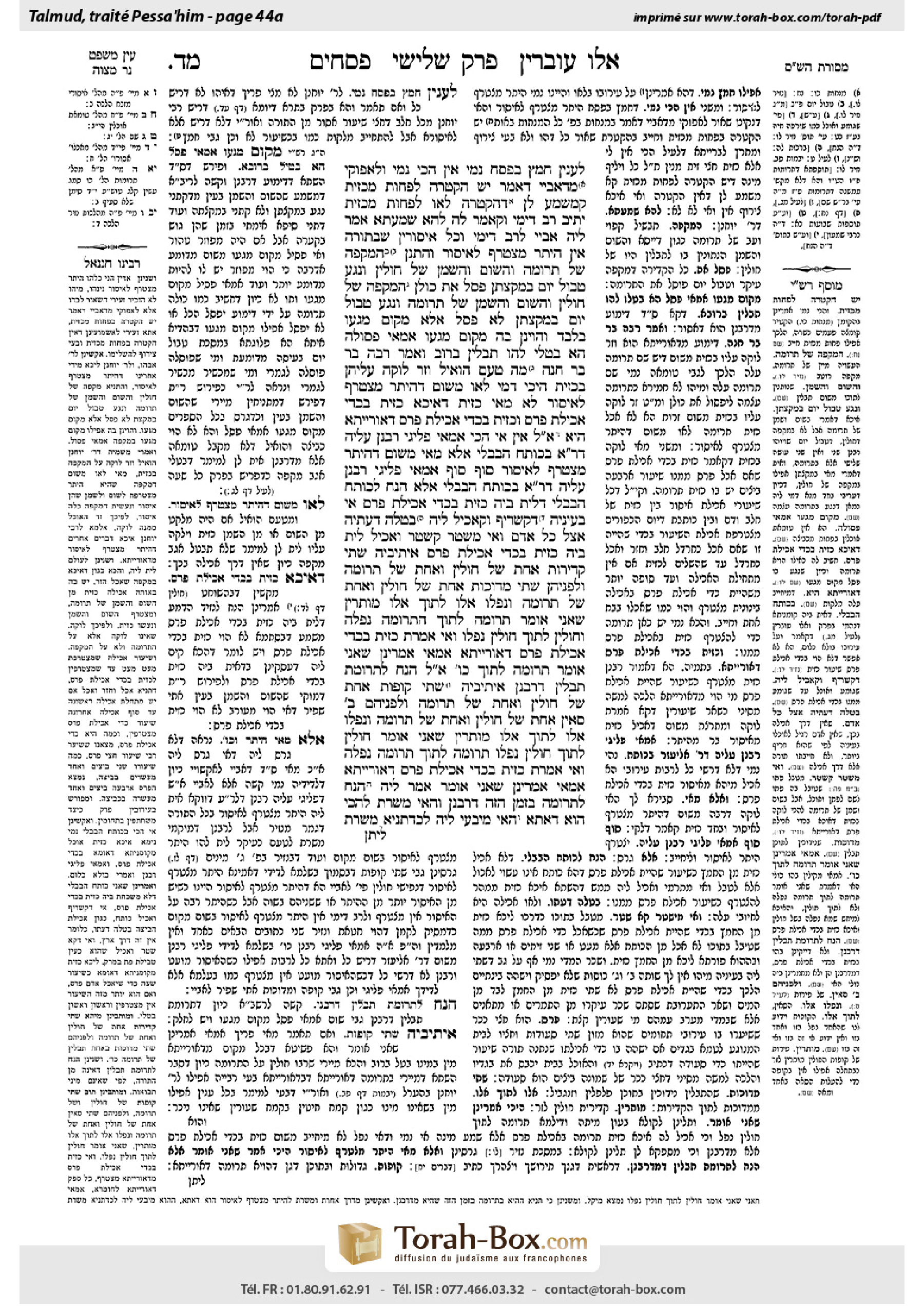
Pesachim 44a: Talmud study for Daf Yomi
Daf Yomi is the daily study of one Talmud folio. Explore 37 tractates with scans, Hebrew text, Sefaria English and AI-generated French translations where annotated.
Passage selection and English or AI-generated French translation are available where the scan has annotations. Daf Study is independent of Torah-Box and Sefaria.
Browse Pesachim · פסחים · All tractatesPesachim 44a text and translations
This page of Pesachim includes the Aramaic text, an English translation and an AI-generated French translation, alongside the scan above.
פסחים מ״ד א · Aramaic and Hebrew text
לְעִנְיַן חָמֵץ בַּפֶּסַח נָמֵי.
אִין הָכִי נָמֵי. וּלְאַפּוֹקֵי מִדְּאַבַּיֵּי דְּאָמַר: יֵשׁ הַקְטָרָה לְפָחוֹת מִכְּזַיִת, קָמַשְׁמַע לַן דְּהַקְטָרָה לָאו לְפָחוֹת מִכְּזַיִת.
יָתֵיב רַב דִּימִי וְקָאָמַר לַהּ לְהָא שְׁמַעְתָּא. אֲמַר לֵיהּ אַבָּיֵי לְרַב דִּימִי: וְכׇל אִיסּוּרִין שֶׁבַּתּוֹרָה אֵין הֶיתֵּר מִצְטָרֵף לְאִיסּוּר?
וְהָתְנַן: הַמִּקְפָּה שֶׁל תְּרוּמָה וְהַשּׁוּם וְהַשֶּׁמֶן שֶׁל חוּלִּין, וְנָגַע טְבוּל יוֹם בְּמִקְצָתָן — פָּסַל אֶת כּוּלָּן. הַמִּקְפָּה שֶׁל חוּלִּין וְהַשּׁוּם וְהַשֶּׁמֶן שֶׁל תְּרוּמָה, וְנָגַע טְבוּל יוֹם בְּמִקְצָתָן — לֹא פָּסַל אֶלָּא מְקוֹם מַגָּעוֹ בִּלְבַד.
וְהָוֵינַן בַּהּ: מְקוֹם מַגָּעוֹ אַמַּאי פְּסוּלָה? הָא בָּטְלִי לְהוּ תַּבְלִין בְּרוֹב! וְאָמַר רַבָּה בַּר בַּר חָנָה: מַה טַּעַם — הוֹאִיל וְזָר לוֹקֶה עֲלֵיהֶן בִּכְזַיִת. הֵיכִי דָּמֵי, לָאו מִשּׁוּם דְּהֶיתֵּר מִצְטָרֵף לְאִיסּוּר?
לָא, מַאי כְּזַיִת — דְּאִיכָּא כְּזַיִת בִּכְדֵי אֲכִילַת פְּרָס.
וּכְזַיִת בִּכְדֵי אֲכִילַת פְּרָס דְּאוֹרָיְיתָא הִיא? אֲמַר לֵיהּ: אִין.
אִי הָכִי, אַמַּאי פְּלִיגִי רַבָּנַן עֲלֵיהּ דְּרַבִּי אֱלִיעֶזֶר בְּכוּתָּח הַבַּבְלִי?
אֶלָּא מַאי, מִשּׁוּם דְּהֶיתֵּר מִצְטָרֵף לְאִיסּוּר? סוֹף סוֹף אַמַּאי פְּלִיגִי רַבָּנַן עֲלֵיהּ דְּרַבִּי אֱלִיעֶזֶר בְּכוּתָּח הַבַּבְלִי? אֶלָּא: הַנַּח לְכוּתָּח הַבַּבְלִי דְּלֵית בֵּיהּ כְּזַיִת בִּכְדֵי אֲכִילַת פְּרָס. אִי בְּעֵינֵיהּ דְּקָשָׂרֵיף וְקָאָכֵיל לֵיהּ, בָּטְלָה דַּעְתֵּיהּ אֵצֶל כׇּל אָדָם. וְאִי מִשְׁטָר קָשָׁטַר וְאָכֵיל — לֵית בֵּיהּ כְּזַיִת בִּכְדֵי אֲכִילַת פְּרָס.
אֵיתִיבֵיהּ: שְׁתֵּי קְדֵירוֹת, אַחַת שֶׁל חוּלִּין וְאַחַת שֶׁל תְּרוּמָה, וְלִפְנֵיהֶן שְׁתֵּי מְדוֹכוֹת, אַחַת שֶׁל חוּלִּין וְאַחַת שֶׁל תְּרוּמָה, וְנָפְלוּ אֵלּוּ לְתוֹךְ אֵלּוּ — מוּתָּרִין. שֶׁאֲנִי אוֹמֵר: תְּרוּמָה לְתוֹךְ הַתְּרוּמָה נָפְלָה, וְחוּלִּין לְתוֹךְ חוּלִּין נָפְלוּ,
וְאִי אָמְרַתְּ כְּזַיִת בִּכְדֵי אֲכִילַת פְּרָס דְּאוֹרָיְיתָא, אַמַּאי אָמְרִינַן ״שֶׁאֲנִי אוֹמֵר תְּרוּמָה לְתוֹךְ כּוּ׳״? אֲמַר לֵיהּ: הַנַּח לִתְרוּמַת תַּבְלִין דְּרַבָּנַן.
אֵיתִיבֵיהּ: שְׁתֵּי קוּפּוֹת, אַחַת שֶׁל חוּלִּין וְאַחַת שֶׁל תְּרוּמָה, וְלִפְנֵיהֶם שְׁנֵי סְאִין, אַחַת שֶׁל חוּלִּין וְאַחַת שֶׁל תְּרוּמָה, וְנָפְלוּ אֵלּוּ לְתוֹךְ אֵלּוּ — מוּתָּרִין, שֶׁאֲנִי אוֹמֵר: חוּלִּין לְתוֹךְ חוּלִּין נָפְלוּ, תְּרוּמָה לְתוֹךְ תְּרוּמָה נָפְלָה. וְאִי אָמְרַתְּ כְּזַיִת בִּכְדֵי אֲכִילַת פְּרָס דְּאוֹרָיְיתָא — אַמַּאי אָמְרִינַן ״שֶׁאֲנִי אוֹמֵר״?
אֲמַר לֵיהּ: הַנַּח לִתְרוּמָה בַּזְּמַן הַזֶּה דְּרַבָּנַן.
וְהַאי ״מִשְׁרַת״ לְהָכִי הוּא דַּאֲתָא? הַאי מִיבְּעֵי לֵיהּ לְכִדְתַנְיָא: ״מִשְׁרַת״ —
Pesachim 44a · English translation
with regard to the matter of leavened bread on Passover one should also be liable for eating a prohibited substance joined together with a permitted substance.
The Gemara answers: Yes, indeed it is so, and the prohibition mentioned by Ze’eiri against sacrificing leaven in offerings was only to exclude the statement of Abaye, who said: There is significance to offering less than an olive-bulk of leaven on the altar, and one is flogged for sacrificing an offering of that kind. By noting that one is liable because permitted substances combine with prohibited substances, the baraita teaches us that an offering of less than an olive-bulk is not considered an offering, and therefore sacrificing it is not punishable by lashes.
Rav Dimi sat and stated this halakha that a permitted substance does not join together with a prohibited substance to constitute the requisite measure, except in the case of a nazirite. Abaye said to Rav Dimi: And is it true that with regard to all other prohibitions in the Torah, a permitted substance does not join together with a prohibited substance?
But didn’t we learn in a mishna: With regard to thick soup prepared with teruma produce whose garlic and oil are of non-sacred produce, and one who immersed himself during that day touched some of the ingredients, he disqualified all the contents of the pot, as they are subsumed within the teruma soup. However, if the thick soup was prepared with non-sacred produce and the garlic and the oil were of teruma, and one who immersed himself during that day touched some of them, he disqualifies only the ingredients in the place that he touched.
Abaye continues. And we discussed this issue: Why are the ingredients in the place that he touched disqualified? The spices, i.e., the garlic or oil, are nullified by the majority. Since the major portion of the dish is composed of non-sacred produce, it should not be disqualified by contact with one who immersed himself during that day. And Rabba bar bar Ḥana said in reply: What is the reason that it becomes disqualified? It is since a non-priest is flogged for eating an olive-bulk of the soup, as anything into which teruma is mixed is considered teruma by Torah law. What are the circumstances of this ruling that a non-priest is flogged? Is it not due to the fact that the permitted substance joins together with the prohibited substance?
Rav Dimi rejects this contention: No; what is the meaning of an olive-bulk in this mishna? It means that there is sufficient teruma in the mixture that when one eats from the mixture he will consume an olive-bulk of teruma in the time it takes to eat a half-loaf of bread. In that case one is liable for punishment for eating this olive-bulk, as if he ate the teruma alone.
Abaye asked him: Is eating an olive-bulk in the time it takes to eat a half-loaf of bread prohibited by Torah law, and one is punished for it? He said to him: Yes.
Abaye asked in response: If so, why do the Rabbis disagree with Rabbi Eliezer with regard to eating Babylonian kutaḥ, a dip that contains flour, on Passover? The Rabbis maintain that one is not punished by Torah law for eating a mixture containing leaven. Although the Rabbis do not derive from the word: Anything [kol], that leaven in a mixture is prohibited, they should nonetheless hold one liable for eating an olive-bulk of a prohibited substance in the time it takes to eat a half-loaf of bread.
Rav Dimi said: Rather, what conclusion must be drawn; the reason that a non-priest is flogged for eating the teruma soup is due to the fact that a permitted substance joins together with a prohibited substance? If so, ultimately, why do the Rabbis disagree with Rabbi Eliezer with regard to eating Babylonian kutaḥ? Rather, leave Babylonian kutaḥ, as in eating that mixture there is no possibility that one will consume an olive-bulk of the leaven in the time it takes to eat a half-loaf of bread. If he eats kutaḥ in its pure, unadulterated form, by swallowing it as food, not as a dip, his intention is rendered irrelevant by the opinions of all other people. It is unusual for a person to eat a pungent dip by itself, all the more so, for him to eat it so quickly. One receives no punishment for conduct that anomalous. And if he dips other food into the kutaḥ and eats it, he will not consume an olive-bulk in the time it takes to eat a half-loaf of bread. Due to the pungency of the dip, one needs to add only a small portion to his food.
Abaye raised an objection to Rav Dimi from a baraita: With regard to two pots, one of non-sacred produce and the other one of teruma, before which were two mortars, one in which non-sacred produce was pounded, and one in which teruma produce was pounded, and the contents of these mortars fell into these pots, but it is unknown which produce fell into which pot, it is all permitted. The reason for this ruling is as I say, since there is no definitive proof to the contrary, that the teruma fell into the teruma and the non-sacred produce fell into the non-sacred produce.
Abaye explains his objection: And if you say that eating an olive-bulk of a prohibited substance in the time it takes to eat a half-loaf of bread is prohibited by Torah law, why do we say this principle: As I say that the teruma fell into the teruma, etc.? If the teruma produce fell into the pot containing non-sacred produce, one who eats from the mixture will consume an olive-bulk of teruma within the time it takes to eat a half-loaf of bread, and he will thereby violate a Torah prohibition. Rav Dimi said to him: Leave teruma separated from spices, which is teruma by rabbinic law. By Torah law one is required to separate teruma only from grain, wine and oil. The Sages are lenient with regard to teruma by rabbinic law.
Abaye raised another objection from a similar baraita: In a case where there are two baskets, one filled with non-sacred produce and the other filled with teruma, and before them were two vessels each containing a se’a of produce, one filled with non-sacred produce and the other one filled with teruma, and these, the contents of each of the baskets, fell into those, each of the se’a vessels. It is possible that the teruma fell into the non-sacred produce, and it is prohibited for non-priests to eat a mixture of teruma and non-sacred produce. Nevertheless, the contents of the se’a vessel containing the non-sacred produce are permitted, as I say that the non-sacred produce fell into the non-sacred produce and the teruma fell into the teruma. The obligation to separate teruma from grain is by Torah law, and if you say that eating an olive-bulk of forbidden food in the time it takes to eat a half-loaf of bread is prohibited by Torah law, why do we say the principle: As I say the non-sacred grain fell into the non-sacred grain? Why aren’t the Sages concerned that one might eat an olive-bulk of teruma in the time it takes to eat a half-loaf, which is prohibited by Torah law?
He said to him: Leave teruma in modern times, as it is in effect by rabbinic law. Once the Jewish people were exiled from their land, the halakhot of teruma and tithes apply by rabbinic law, not Torah law. This is the basis for the lenient ruling in the case of this mixture.
The Gemara returns to its discussion of Rabbi Abbahu’s statement with regard to the meaning of the word soaked in the verse: “He shall abstain from wine and strong drink; he shall drink no vinegar of wine, or vinegar of strong drink, nor shall he drink anything soaked in grapes,” and whether or not a permitted substance combines with a prohibited one. The Gemara asks: And does this word: Soaked, come to teach that mixtures are prohibited in this case? That verse is required to derive that which was taught in a baraita elsewhere: Soaked,
Pesachim 44a · Traduction française (IA)
Concernant le hamets à Pessa'h, on devrait également être passible pour avoir consommé une substance interdite mêlée à une substance permise.
La Guemara répond : Oui, c’est bien le cas. L’interdiction mentionnée par Ze’eiri de sacrifier du hamets dans le cadre des offrandes visait seulement à exclure l’opinion d’Abaye, qui disait qu’il y a lieu de prendre en compte le fait de présenter sur l’autel moins du volume d’une olive de hamets et que l’on reçoit la flagellation pour avoir sacrifié une offrande de cette sorte. En indiquant qu’on est passible parce que les substances permises s’ajoutent aux substances interdites, la baraïta nous enseigne qu’une offrande de moins du volume d’une olive n’est pas considérée comme une offrande ; par conséquent, la sacrifier n’est pas passible de flagellation.
Rav Dimi s’assit et énonça cette halakha : une substance permise ne s’ajoute pas à une substance interdite pour constituer la mesure requise, sauf dans le cas d’un nazir. Abaye dit à Rav Dimi : Est-il vrai que, pour toutes les autres interdictions de la Torah, une substance permise ne s’ajoute pas à une substance interdite ?
N’avons-nous pas appris dans une Michna : concernant une soupe épaisse préparée avec des produits de terouma, dont l’ail et l’huile sont des produits profanes, si une personne qui s’est immergée ce jour-là en touche certains ingrédients, elle rend impur tout le contenu de la marmite, car celui-ci est inclus dans la soupe de terouma. En revanche, si la soupe épaisse a été préparée avec des produits profanes, tandis que l’ail et l’huile sont de la terouma, et qu’une personne qui s’est immergée ce jour-là en touche certains ingrédients, elle ne rend impurs que les ingrédients à l’endroit qu’elle a touché.
Abaye poursuit : Nous avons discuté de cette question : pourquoi les ingrédients à l’endroit qu’elle a touché sont-ils rendus impurs ? Les épices, c’est-à-dire l’ail ou l’huile, sont annulées par la majorité. Puisque la plus grande partie du plat est constituée de produits profanes, le contact d’une personne qui s’est immergée ce jour-là ne devrait pas le rendre impur. Rabba bar bar Ḥana répondit : Pour quelle raison devient-il impur ? Parce qu’un non-prêtre reçoit la flagellation s’il mange le volume d’une olive de cette soupe, car tout ce à quoi de la terouma est mélangée est considéré comme de la terouma selon la Torah. Dans quelles circonstances un non-prêtre reçoit-il cette flagellation ? N’est-ce pas parce que la substance permise s’ajoute à la substance interdite ?
Rav Dimi rejette cette argumentation : Non. Que signifie ici, dans cette Michna, le volume d’une olive ? Cela signifie qu’il y a dans le mélange assez de terouma pour que, lorsqu’on en mange, on consomme le volume d’une olive de terouma dans le temps nécessaire pour manger un demi-pain. Dans ce cas, on est passible d’une peine pour avoir consommé ce volume, comme si l’on avait mangé la terouma seule.
Abaye lui demanda : La consommation du volume d’une olive dans le temps nécessaire pour manger un demi-pain est-elle interdite par la Torah, et est-on puni pour cela ? Il lui répondit : Oui.
Abaye demanda alors : Si c’est le cas, pourquoi les Sages ne sont-ils pas d’accord avec Rabbi Eliezer au sujet de la consommation de kutaḥ babylonien, une sauce contenant de la farine, à Pessa'h ? Les Sages soutiennent qu’on ne reçoit pas de peine selon la Torah pour avoir consommé un mélange contenant du hamets. Bien qu’ils ne déduisent pas du mot « tout » [kol] que le hamets dans un mélange est interdit, ils devraient néanmoins rendre passible celui qui consomme le volume d’une olive d’une substance interdite dans le temps nécessaire pour manger un demi-pain.
Rav Dimi dit : Il faut donc plutôt en conclure que la raison pour laquelle un non-prêtre reçoit la flagellation pour avoir mangé la soupe de terouma est que la substance permise s’ajoute à la substance interdite. Si c’est le cas, pourquoi, finalement, les Sages ne sont-ils pas d’accord avec Rabbi Eliezer au sujet de la consommation de kutaḥ babylonien ? Il faut plutôt laisser de côté le kutaḥ babylonien, car il est impossible, en mangeant ce mélange, de consommer le volume d’une olive de hamets dans le temps nécessaire pour manger un demi-pain. Si quelqu’un mange le kutaḥ pur, sans le mélanger, en l’avalant comme un aliment et non comme une sauce, son intention particulière n’a pas d’importance au regard de l’opinion de tous les autres : il est inhabituel de manger seul une sauce piquante, et plus encore de la manger aussi rapidement. On ne punit pas une conduite aussi inhabituelle. Et s’il trempe un autre aliment dans le kutaḥ et le mange, il ne consommera pas le volume d’une olive dans le temps nécessaire pour manger un demi-pain. La sauce étant piquante, il suffit d’en ajouter une petite quantité à son aliment.
Abaye objecta à Rav Dimi à partir d’une baraïta : dans le cas de deux marmites, l’une contenant des produits profanes et l’autre de la terouma, devant lesquelles se trouvaient deux mortiers, l’un dans lequel on avait pilé des produits profanes et l’autre dans lequel on avait pilé des produits de terouma, si le contenu de ces mortiers tombe dans ces marmites, sans que l’on sache quels produits sont tombés dans quelle marmite, tout est permis. La raison de cette décision est, comme je le dis, qu’en l’absence de preuve certaine du contraire, la terouma est tombée dans la terouma et les produits profanes dans les produits profanes.
Abaye explique son objection : si tu dis que la consommation du volume d’une olive d’une substance interdite dans le temps nécessaire pour manger un demi-pain est interdite par la Torah, pourquoi appliquons-nous ce principe : « Je dis que la terouma est tombée dans la terouma », etc. ? Si les produits de terouma sont tombés dans la marmite contenant des produits profanes, celui qui consomme le mélange mangera le volume d’une olive de terouma dans le temps nécessaire pour manger un demi-pain, et transgressera ainsi une interdiction de la Torah. Rav Dimi lui dit : Laisse de côté la terouma issue d’épices, qui n’est de la terouma qu’en vertu d’une loi rabbinique. Selon la Torah, on n’est tenu de prélever la terouma que sur les céréales, le vin et l’huile. Les Sages se montrent indulgents pour la terouma imposée par la loi rabbinique.
Abaye souleva une autre objection à partir d’une baraïta semblable : dans le cas de deux paniers, l’un rempli de produits profanes et l’autre de terouma, devant lesquels se trouvaient deux récipients contenant chacun un séa de produits, l’un rempli de produits profanes et l’autre de terouma, si le contenu de chacun de ces paniers tombe dans chacun de ces récipients d’un séa, il est possible que la terouma soit tombée dans les produits profanes, mélange qu’il est interdit aux non-prêtres de consommer. Néanmoins, le contenu du récipient d’un séa contenant les produits profanes est permis, car je dis que les produits profanes sont tombés dans les produits profanes et la terouma dans la terouma. L’obligation de prélever la terouma sur les céréales relève de la Torah ; si tu dis que la consommation du volume d’une olive d’un aliment interdit dans le temps nécessaire pour manger un demi-pain est interdite par la Torah, pourquoi appliquons-nous le principe : « Je dis que les céréales profanes sont tombées dans les céréales profanes » ? Pourquoi les Sages ne craignent-ils pas qu’on consomme le volume d’une olive de terouma dans le temps nécessaire pour manger un demi-pain, ce qui est interdit par la Torah ?
Il lui dit : Laisse de côté la terouma à l’époque actuelle, car elle relève de la loi rabbinique. Depuis que le peuple juif a été exilé de son pays, les lois de la terouma et des dîmes s’appliquent en vertu de la loi rabbinique, et non de la Torah. C’est le fondement de la décision indulgente concernant ce mélange.
La Guemara revient à son examen de la déclaration de Rabbi Abbahu concernant le sens du mot « macéré » dans le verset : « Il s’abstiendra de vin et de boisson forte ; il ne boira ni vinaigre de vin ni vinaigre de boisson forte, et il ne boira rien de macéré dans le raisin », et la question de savoir si une substance permise s’ajoute ou non à une substance interdite. La Guemara demande : Le mot « macéré » vient-il enseigner que les mélanges sont interdits dans ce cas ? Ce verset est nécessaire pour déduire ce qui a été enseigné dans une baraïta ailleurs : « Macéré »,
Traduction française générée par IA à partir de l’édition anglaise de Sefaria. Vérifie toujours un passage avec le texte source.
Text from Sefaria: William Davidson Edition - Vocalized Aramaic (CC BY NC); William Davidson Edition - English (CC BY NC).