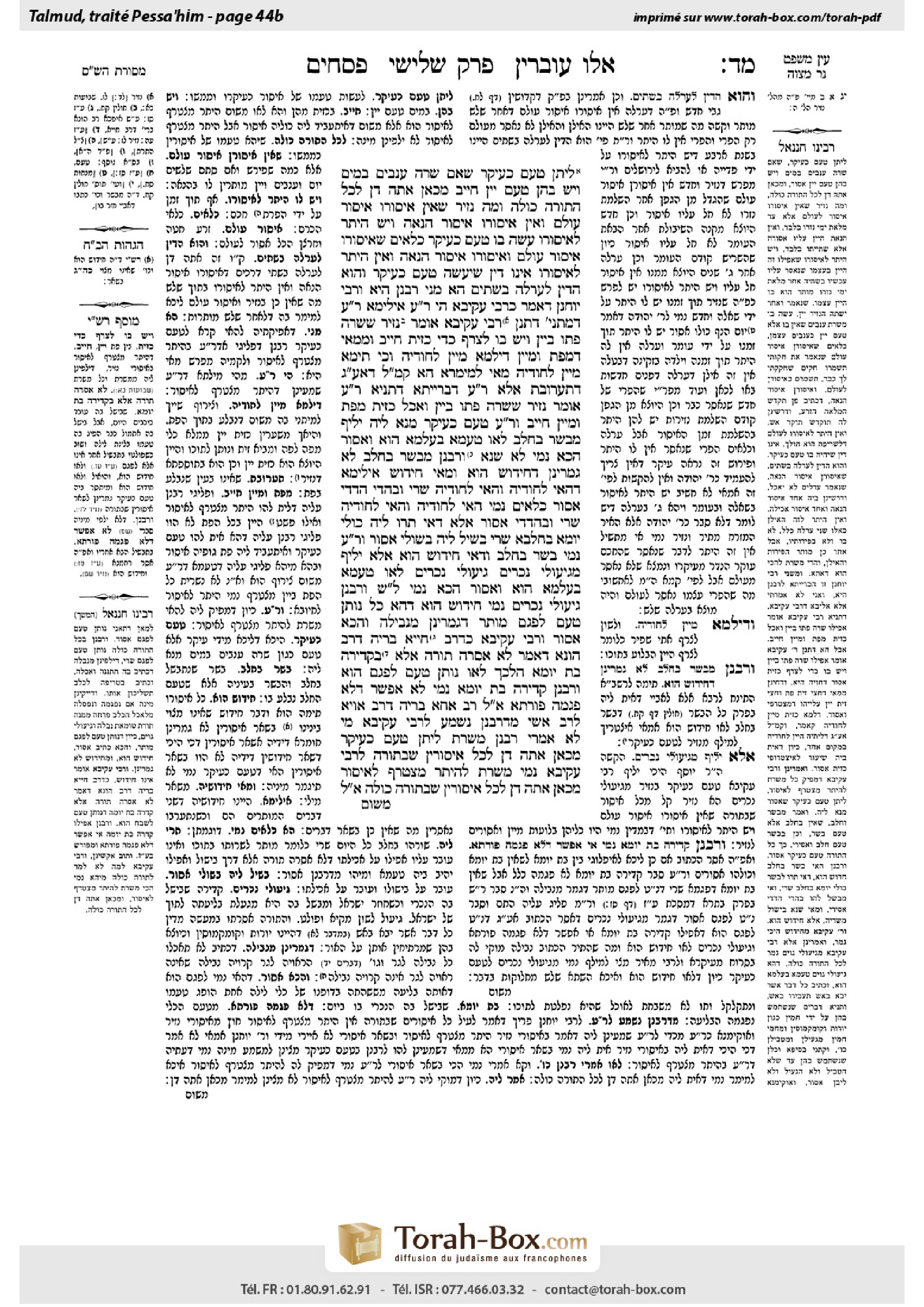
Pesachim 44b: Talmud study for Daf Yomi
Daf Yomi is the daily study of one Talmud folio. Explore 37 tractates with scans, Hebrew text, Sefaria English and AI-generated French translations where annotated.
Passage selection and English or AI-generated French translation are available where the scan has annotations. Daf Study is independent of Torah-Box and Sefaria.
Browse Pesachim · פסחים · All tractatesPesachim 44b text and translations
This page of Pesachim includes the Aramaic text, an English translation and an AI-generated French translation, alongside the scan above.
פסחים מ״ד ב · Aramaic and Hebrew text
לִיתֵּן טַעַם כְּעִיקָּר. שֶׁאִם שָׁרָה עֲנָבִים בְּמַיִם, וְיֵשׁ בָּהֶן טַעַם יַיִן — חַיָּיב.
מִכָּאן אַתָּה דָּן לְכׇל הַתּוֹרָה כּוּלָּהּ: וּמָה נָזִיר שֶׁאֵין אִיסּוּרוֹ אִיסּוּר עוֹלָם, וְאֵין אִיסּוּרוֹ אִיסּוּר הֲנָאָה, וְיֵשׁ הֶיתֵּר לְאִיסּוּרוֹ — עָשָׂה בּוֹ טַעַם כְּעִיקָּר, כִּלְאַיִם, שֶׁאִיסּוּרוֹ אִיסּוּר עוֹלָם, וְאִיסּוּרוֹ אִיסּוּר הֲנָאָה, וְאֵין הֶיתֵּר לְאִיסּוּרוֹ — אֵינוֹ דִּין שֶׁיַּעֲשֶׂה טַעַם כְּעִיקָּר?
וְהוּא הַדִּין לְעׇרְלָה בִּשְׁתַּיִם!
הָא מַנִּי רַבָּנַן הִיא, וְרַבִּי יוֹחָנָן דְּאָמַר כְּרַבִּי עֲקִיבָא.
הֵי רַבִּי עֲקִיבָא? אִילֵימָא רַבִּי עֲקִיבָא דְּמַתְנִיתִין, דִּתְנַן: רַבִּי עֲקִיבָא אוֹמֵר: נָזִיר שֶׁשָּׁרָה פִּתּוֹ בְּיַיִן, וְיֵשׁ בּוֹ לְצָרֵף כְּדֵי כְּזַיִת — חַיָּיב, וּמִמַּאי דְּמִפַּת וּמִיַּיִן? דִּילְמָא מִיַּיִן לְחוֹדֵיהּ?
וְכִי תֵּימָא: מִיַּיִן לְחוֹדֵיהּ מַאי לְמֵימְרָא? הָא קָא מַשְׁמַע לַן דְּאַף עַל גַּב דְּתַעֲרוֹבֶת.
אֶלָּא רַבִּי עֲקִיבָא דְּבָרַיְיתָא. דְּתַנְיָא, רַבִּי עֲקִיבָא אוֹמֵר: נָזִיר שֶׁשָּׁרָה פִּתּוֹ בְּיַיִן, וְאָכַל כְּזַיִת מִפַּת וּמִיַּיִן — חַיָּיב.
וְרַבִּי עֲקִיבָא טַעַם כְּעִיקָּר מְנָא לֵיהּ? יָלֵיף מִבָּשָׂר בְּחָלָב: לָאו טַעְמָא בְּעָלְמָא הוּא, וְאָסוּר? הָכָא נָמֵי לָא שְׁנָא.
וְרַבָּנַן? מִבָּשָׂר בְּחָלָב לָא גָּמְרִינַן, דְּחִידּוּשׁ הוּא.
וּמַאי חִידּוּשׁ? אִילֵּימָא דְּהַאי לְחוֹדֵיהּ וְהַאי לְחוֹדֵיהּ — שְׁרֵי, וּבַהֲדֵי הֲדָדֵי — אָסוּר, כִּלְאַיִם נָמֵי: הַאי לְחוֹדֵיהּ וְהַאי לְחוֹדֵיהּ — שְׁרֵי, וּבַהֲדָדִי — אָסוּר.
אֶלָּא: דְּאִי תָּרוּ לֵיהּ כּוּלֵּי יוֹמָא בַּחֲלָבָא — שְׁרֵי, בַּשֵּׁיל לֵיהּ בַּשּׁוֹלֵי — אָסוּר.
וְרַבִּי עֲקִיבָא נָמֵי, בָּשָׂר בְּחָלָב וַדַּאי חִידּוּשׁ הוּא?
אֶלָּא יָלֵיף מִגִּיעוּלֵי גוֹיִם: גִּיעוּלֵי גוֹיִם, לָאו טַעְמָא בְּעָלְמָא הוּא, וְאָסוּר? הָכָא נָמֵי לָא שְׁנָא.
וְרַבָּנַן, גִּיעוּלֵי גוֹיִם נָמֵי חִידּוּשׁ הוּא. דְּהָא כׇּל נוֹתֵן טַעַם לִפְגָם — מוּתָּר, דְּגָמְרִינַן מִנְּבֵילָה — וְהָכָא אָסוּר.
וְרַבִּי עֲקִיבָא כִּדְרַב חִיָּיא בְּרֵיהּ דְּרַב הוּנָא, דְּאָמַר: לֹא אָסְרָה תּוֹרָה אֶלָּא בִּקְדֵירָה בַּת יוֹמָא, הִלְכָּךְ לָאו נוֹתֵן טַעַם לִפְגָם הוּא.
וְרַבָּנַן? קְדֵירָה בַּת יוֹמָא נָמֵי, לָא אֶפְשָׁר דְּלָא פָּגְמָה פּוּרְתָּא.
אֲמַר לֵיהּ רַב אַחָא בְּרֵיהּ דְּרַב אַוְיָא לְרַב אָשֵׁי: מִדְּרַבָּנַן נִשְׁמַע לְרַבִּי עֲקִיבָא, מִי לָא אָמְרִי רַבָּנַן ״מִשְׁרַת״ לִיתֵּן טַעַם כְּעִיקָּר, מִכָּאן אַתָּה דָּן לְכׇל אִיסּוּרִין שֶׁבַּתּוֹרָה. לְרַבִּי עֲקִיבָא נָמֵי — ״מִשְׁרַת״ לְהֶיתֵּר מִצְטָרֵף לְאִיסּוּר, מִכָּאן אַתָּה דָּן לְכׇל אִיסּוּרִין שֶׁבַּתּוֹרָה כּוּלָּהּ!
אֲמַר לֵיהּ:
Pesachim 44b · English translation
comes to establish the principle that the legal status of the taste of a forbidden food is like that of its substance. This term teaches that any food that absorbs the taste of a prohibited item assumes the status of this prohibited item itself. As, in a case where one soaked grapes in water and the water has the taste of wine, a nazirite is liable for drinking this mixture, as it assumes the status of wine.
From here you derive the halakha with regard to the entire Torah; in all cases, the legal status of the taste of a forbidden food is like that of its substance. The Gemara elaborates. Just as with regard to a nazirite, whose prohibition against eating grapes is not an eternal prohibition, as he will be permitted to eat grapes once his period of naziriteship is over, and furthermore, his prohibition is not a prohibition against deriving benefit from wine, and there is dissolution for his prohibition against eating grape products by requesting a Sage to release him from his vow, nevertheless, in his case, the Torah rendered the legal status of the taste of food forbidden to him like that of its substance; with regard to a forbidden mixture of diverse kinds, whose prohibition is an eternal prohibition [issuro issur olam] and whose prohibition is a prohibition against deriving benefit, and there is no dissolution for its prohibition, is it not right that the Torah should render the legal status of the taste of its forbidden food like that of its substance?
And the same is true of fruit that grows on a tree during the first three years after it was planted [orla], on two of three counts: Although the prohibition of orla is not an eternal prohibition, as one may eat the fruit of this tree after three years have passed, it is prohibited to derive benefit from orla, and this prohibition cannot be dissolved, as the fruits that grow during the first three years remain prohibited. Therefore, based on the same a fortiori inference, the principle: The legal status of its taste is like that of its substance, should apply in this case as well. Similarly, all other prohibitions in the Torah are more severe than the case of a nazirite in one of these aspects, and therefore this principle is universal. In any case, this entire derivation presents a difficulty for Rabbi Yoḥanan, who derives a different halakha from the term: Soaked.
The Gemara answers: In accordance with whose opinion is the previously cited derivation? It is in accordance with the opinion of the Rabbis, who derive this halakha from the term: Soaked. However, Rabbi Yoḥanan, who said that a permitted substance joins together with a prohibited substance, holds in accordance with the opinion of Rabbi Akiva.
The Gemara asks: To which statement of Rabbi Akiva is the Gemara referring? If you say it is referring to the opinion of Rabbi Akiva in the following mishna, as we learned: Rabbi Akiva says, with regard to a nazirite who soaked his bread in wine, and the bread and the wine contain enough to join together to constitute an olive-bulk, that he is liable; from where do we know that Rabbi Akiva means an amount of an olive-bulk taken from the bread and the wine together? Perhaps he meant that the measure is calculated from the wine alone?
The Gemara asks: And lest you say that if this amount is from the wine alone, what purpose is there to state this halakha, this statement comes to teach us that even though the prohibited item is in a mixture, one is nonetheless liable for consuming it. Since this mishna can be explained as referring to an olive-bulk from wine alone, it cannot be cited as proof for Rabbi Akiva’s opinion with regard to the combination of a permitted substance with a prohibited substance.
The Gemara states: Rather, Rabbi Yoḥanan holds in accordance with the opinion of Rabbi Akiva in the baraita, as it was taught in a baraita that Rabbi Akiva says: A nazirite who soaked his bread in wine and ate an olive-bulk of the mixture from the bread and the wine is liable. This baraita indicates that according to Rabbi Akiva, a permitted substance joins together with a prohibited substance.
The Gemara asks: And Rabbi Akiva, from where does he derive the principle: The legal status of the taste is like that of the substance itself? The Gemara answers: He derives this principle from the prohibition of meat cooked in milk. In that case, there is merely the taste of the milk absorbed by the meat, and the mixture is nonetheless forbidden. Here, too, in the case of other prohibitions, it is no different, and the same principle applies.
The Gemara asks: And the Rabbis, why don’t they derive this principle from meat cooked in milk? The Gemara answers: The Rabbis claim that from meat in milk we do not derive other prohibitions, as that prohibition is a novelty.
The Gemara asks: And what is the novelty in that prohibition? If you say that it is unique in that this meat alone and that milk alone are each permitted, and yet together they are forbidden, that characteristic is not unique to meat cooked in milk. In the case of prohibited mixtures of diverse kinds too, this element alone and that element alone are each permitted, and yet together they are prohibited.
The Gemara answers: Rather, the novelty is that if one soaks meat in milk all day, it is permitted by Torah law, despite the fact that the meat certainly absorbed some taste of the milk, whereas if one cooked the meat in milk even for a short time, the mixture is prohibited by Torah law.
The Gemara asks: And Rabbi Akiva too certainly agrees that the halakha of meat in milk is a novelty. How can he derive a general principle from this case?
Rather, he derives the principle: The legal status of the taste is like that of the substance itself from the required purging of the vessels of gentiles. In the section of the Torah that deals with the spoils of Midian (Numbers 31:21–24), it states that a vessel used by a gentile to cook food must be purged through fire and purified before it may be used by a Jew. Isn’t the purging of vessels of gentiles necessary only to cleanse them from the mere taste that was absorbed through the process of cooking? Even so, these vessels are prohibited if this cleansing was not performed. Here, too, it is no different; the same reasoning applies in all cases.
The Gemara comments: And the Rabbis do not derive this principle from this source, as they maintain that the halakha of purging vessels of gentiles is also a novelty. What is the novelty of this halakha? As in general, anything that contributes taste that renders the food tainted is permitted. If the taste added by the prohibited food does not enhance the permitted food, then as a rule it does not render the permitted substance prohibited. As we derive this principle from the halakha that an unslaughtered animal carcass that is unfit for consumption is not classified as a prohibited animal carcass and is not prohibited. However, here, with regard to the halakha of purging vessels of gentiles, the Torah states that even if they contribute taste that renders the food tainted they are prohibited. If twenty-four hours have passed since food was cooked in a pot, the assumption is that it will contribute a negative taste to any foods cooked in the pot subsequently. Nevertheless, vessels taken from gentiles remain prohibited until they are purged, even though the taste they contribute taints the food.
The Gemara asks: And how does Rabbi Akiva, who derives this principle from the required purging of the vessels of gentiles, respond to the previous claim? The Gemara explains: He holds in accordance with the opinion subsequently cited in the name of Rav Ḥiyya, son of Rav Huna, who said: The Torah prohibited unpurged vessels of gentiles only in the case of a pot that was used on that day. Therefore, it is not a case where the pot contributes taste that renders the food tainted.
The Gemara asks: And what do the Rabbis say about deriving the halakha from a pot used on that day? The Gemara answers: In their opinion, even in the case of a pot used on that day, it is impossible that the vessel does not slightly taint the food absorbed in the vessel. Consequently, the halakha of purging vessels of gentiles is indeed a novel case from which principles cannot be derived.
Rav Aḥa, son of Rav Avya, said to Rav Ashi: From the opinion of the Rabbis, let us learn the correct interpretation of the opinion of Rabbi Akiva. Don’t the Rabbis say that the term soaked teaches that the principle that the legal status of taste is like that of substance applies not only to a nazirite, but that from here you derive the halakha with regard to all prohibitions of the Torah? According to Rabbi Akiva as well, the term soaked teaches that the permitted substance joins together with the prohibited substance with regard to a nazirite, and from here you derive the halakha with regard to all prohibitions of the Torah. This explanation is contrary to the opinion of Rabbi Yoḥanan, who applies this principle only to a nazirite.
Rav Ashi said to him: This cannot serve as a proof,
Pesachim 44b · Traduction française (IA)
vient établir le principe selon lequel le statut juridique du goût d’un aliment interdit est celui de sa substance. Ce terme enseigne que tout aliment qui absorbe le goût d’un élément interdit acquiert lui-même le statut de cet élément. Ainsi, si l’on a fait tremper des raisins dans de l’eau et que celle-ci a pris le goût du vin, un nazir est passible pour avoir bu ce mélange, car celui-ci acquiert le statut du vin.
De là, tu déduis la halakha pour toute la Torah : dans tous les cas, le statut juridique du goût d’un aliment interdit est celui de sa substance. La Guemara développe : de même que, dans le cas d’un nazir, l’interdiction de consommer des raisins n’est pas éternelle, puisqu’il lui sera permis d’en manger une fois sa période de naziréat achevée ; que, de plus, son interdiction ne porte pas sur le fait de tirer profit du vin ; et qu’il est possible de faire lever l’interdiction de consommer des produits de la vigne en demandant à un Sage de le délier de son vœu, la Torah a néanmoins conféré, dans son cas, au goût d’un aliment qui lui est interdit le statut de sa substance ; à plus forte raison, dans le cas d’un mélange interdit d’espèces hétérogènes, dont l’interdiction est éternelle [issuro issur olam], qui interdit d’en tirer profit et qui ne peut être levée, la Torah devrait-elle conférer au goût de l’aliment interdit le statut de sa substance ?
Il en va de même des fruits qui poussent sur un arbre pendant les trois premières années suivant sa plantation [orla], sous deux des trois aspects : bien que l’interdiction de l’orla ne soit pas éternelle, puisqu’on peut manger les fruits de cet arbre après trois ans, il est interdit de tirer profit de l’orla et cette interdiction ne peut être levée, car les fruits qui poussent durant les trois premières années restent interdits. Par conséquent, selon le même raisonnement a fortiori, le principe selon lequel le goût a le statut de la substance devrait également s’appliquer dans ce cas. De même, toutes les autres interdictions de la Torah sont plus sévères que le cas du nazir selon l’un de ces aspects ; ce principe est donc universel. Quoi qu’il en soit, toute cette déduction pose une difficulté à Rabbi Yoḥanan, qui tire une autre halakha du terme « trempé ».
La Guemara répond : De qui est l’avis sur lequel repose la déduction citée précédemment ? De celui des Rabbins, qui déduisent cette halakha du terme « trempé ». Rabbi Yoḥanan, en revanche, qui a dit qu’une substance permise s’ajoute à une substance interdite, suit l’avis de Rabbi Akiva.
La Guemara demande : À quelle déclaration de Rabbi Akiva la Guemara fait-elle référence ? Si tu dis qu’elle fait référence à l’avis de Rabbi Akiva dans la Michna suivante, comme nous l’avons appris : Rabbi Akiva dit, au sujet d’un nazir qui a trempé son pain dans du vin, que si le pain et le vin contiennent ensemble un volume d’une olive, il est passible ; d’où savons-nous que Rabbi Akiva veut dire que les quantités du pain et du vin s’additionnent ? Peut-être voulait-il dire que la mesure se calcule à partir du vin seul ?
La Guemara demande : Et si tu dis que, si cette quantité provient du vin seul, quel est l’intérêt d’énoncer cette halakha ? Cette déclaration vient nous enseigner que même lorsque l’élément interdit se trouve dans un mélange, on est néanmoins passible pour l’avoir consommé. Puisque cette Michna peut s’expliquer comme faisant référence à un volume d’une olive de vin seul, elle ne peut être invoquée comme preuve de l’avis de Rabbi Akiva sur l’addition d’une substance permise à une substance interdite.
La Guemara affirme : Rabbi Yoḥanan suit plutôt l’avis de Rabbi Akiva dans la baraïta, car il a été enseigné dans une baraïta que Rabbi Akiva dit : un nazir qui a trempé son pain dans du vin et a mangé un volume d’une olive du mélange formé par le pain et le vin est passible. Cette baraïta indique que, selon Rabbi Akiva, une substance permise s’ajoute à une substance interdite.
La Guemara demande : Et d’où Rabbi Akiva déduit-il le principe selon lequel le goût a le statut de la substance elle-même ? La Guemara répond : Il déduit ce principe de l’interdiction de la viande cuite dans le lait. Dans ce cas, il n’y a que le goût du lait absorbé par la viande, et pourtant le mélange est interdit. Il en va de même pour les autres interdictions : la règle est identique.
La Guemara demande : Et pourquoi les Rabbins ne déduisent-ils pas ce principe de la viande cuite dans le lait ? La Guemara répond : Selon les Rabbins, on ne déduit pas les autres interdictions de la viande cuite dans le lait, car cette interdiction constitue une nouveauté.
La Guemara demande : Et en quoi cette interdiction constitue-t-elle une nouveauté ? Si tu dis qu’elle est particulière en ce que la viande seule et le lait seul sont permis, alors qu’ensemble ils sont interdits, cette caractéristique n’est pas propre à la viande cuite dans le lait. Dans le cas des mélanges interdits d’espèces hétérogènes aussi, chacun des éléments pris isolément est permis, mais ensemble ils sont interdits.
La Guemara répond : La nouveauté réside plutôt dans le fait que, si l’on fait tremper de la viande dans du lait toute la journée, le mélange est permis selon la Torah, bien que la viande ait certainement absorbé une partie du goût du lait, tandis que si l’on fait cuire la viande dans du lait, même brièvement, le mélange est interdit selon la Torah.
La Guemara demande : Rabbi Akiva aussi reconnaît certainement que la halakha de la viande dans le lait constitue une nouveauté. Comment peut-il déduire un principe général de ce cas ?
Il déduit plutôt le principe selon lequel le goût a le statut de la substance elle-même de l’obligation de purifier les ustensiles des non-Juifs. Dans le passage de la Torah consacré au butin de Midian (Nombres 31,21–24), il est indiqué qu’un ustensile dont un non-Juif s’est servi pour cuire des aliments doit être purifié par le feu avant de pouvoir être utilisé par un Juif. La purification des ustensiles des non-Juifs n’est-elle nécessaire que pour les débarrasser du simple goût absorbé lors de la cuisson ? Pourtant, ces ustensiles sont interdits si cette purification n’a pas été effectuée. Il en va de même ici : le même raisonnement s’applique dans tous les cas.
La Guemara fait remarquer : Les Rabbins ne déduisent pas ce principe de cette source, car ils considèrent que la halakha de la purification des ustensiles des non-Juifs constitue elle aussi une nouveauté. En quoi consiste la nouveauté de cette halakha ? En règle générale, tout ce qui communique un goût qui altère l’aliment est permis. Si le goût apporté par l’aliment interdit n’améliore pas l’aliment permis, il ne le rend généralement pas interdit. Nous déduisons ce principe de la halakha selon laquelle une carcasse d’animal non abattu rituellement, impropre à la consommation, n’est pas considérée comme une carcasse interdite et n’est pas interdite. Ici, toutefois, concernant la halakha de la purification des ustensiles des non-Juifs, la Torah indique que ces ustensiles sont interdits même s’ils communiquent un goût qui altère l’aliment. Si vingt-quatre heures se sont écoulées depuis qu’un aliment a été cuit dans une marmite, on présume qu’elle communiquera désormais un goût négatif aux aliments qui y seront cuits. Néanmoins, les ustensiles pris aux non-Juifs restent interdits jusqu’à ce qu’ils soient purifiés, même si le goût qu’ils communiquent altère l’aliment.
La Guemara demande : Et que répond Rabbi Akiva, qui déduit ce principe de l’obligation de purifier les ustensiles des non-Juifs, à l’argument précédent ? La Guemara explique : Il suit l’avis cité plus loin au nom de Rav Ḥiyya, fils de Rav Huna, qui a dit : la Torah n’a interdit les ustensiles non purifiés des non-Juifs que lorsqu’il s’agit d’une marmite qui a été utilisée le jour même. Il ne s’agit donc pas d’un cas où la marmite communique un goût qui altère l’aliment.
La Guemara demande : Et que disent les Rabbins au sujet de la déduction fondée sur une marmite utilisée le jour même ? Selon eux, même dans le cas d’une marmite utilisée le jour même, il est impossible que l’ustensile n’altère pas légèrement l’aliment qui y a été absorbé. Par conséquent, la halakha de la purification des ustensiles des non-Juifs constitue bien un cas nouveau, dont on ne peut déduire de principes.
Rav Aḥa, fils de Rav Avya, dit à Rav Ashi : Tirons de l’avis des Rabbins la bonne interprétation de l’avis de Rabbi Akiva. Les Rabbins ne disent-ils pas que le terme « trempé » enseigne que le principe selon lequel le goût a le statut de la substance s’applique non seulement au nazir, mais qu’on en déduit la halakha pour toutes les interdictions de la Torah ? Selon Rabbi Akiva aussi, le terme « trempé » enseigne qu’une substance permise s’ajoute à une substance interdite dans le cas du nazir, et qu’on en déduit la halakha pour toutes les interdictions de la Torah. Cette explication est contraire à l’avis de Rabbi Yoḥanan, qui applique ce principe au seul nazir.
Rav Ashi lui dit : Cela ne peut servir de preuve,
Traduction française générée par IA à partir de l’édition anglaise de Sefaria. Vérifie toujours un passage avec le texte source.
Text from Sefaria: William Davidson Edition - Vocalized Aramaic (CC BY NC); William Davidson Edition - English (CC BY NC).