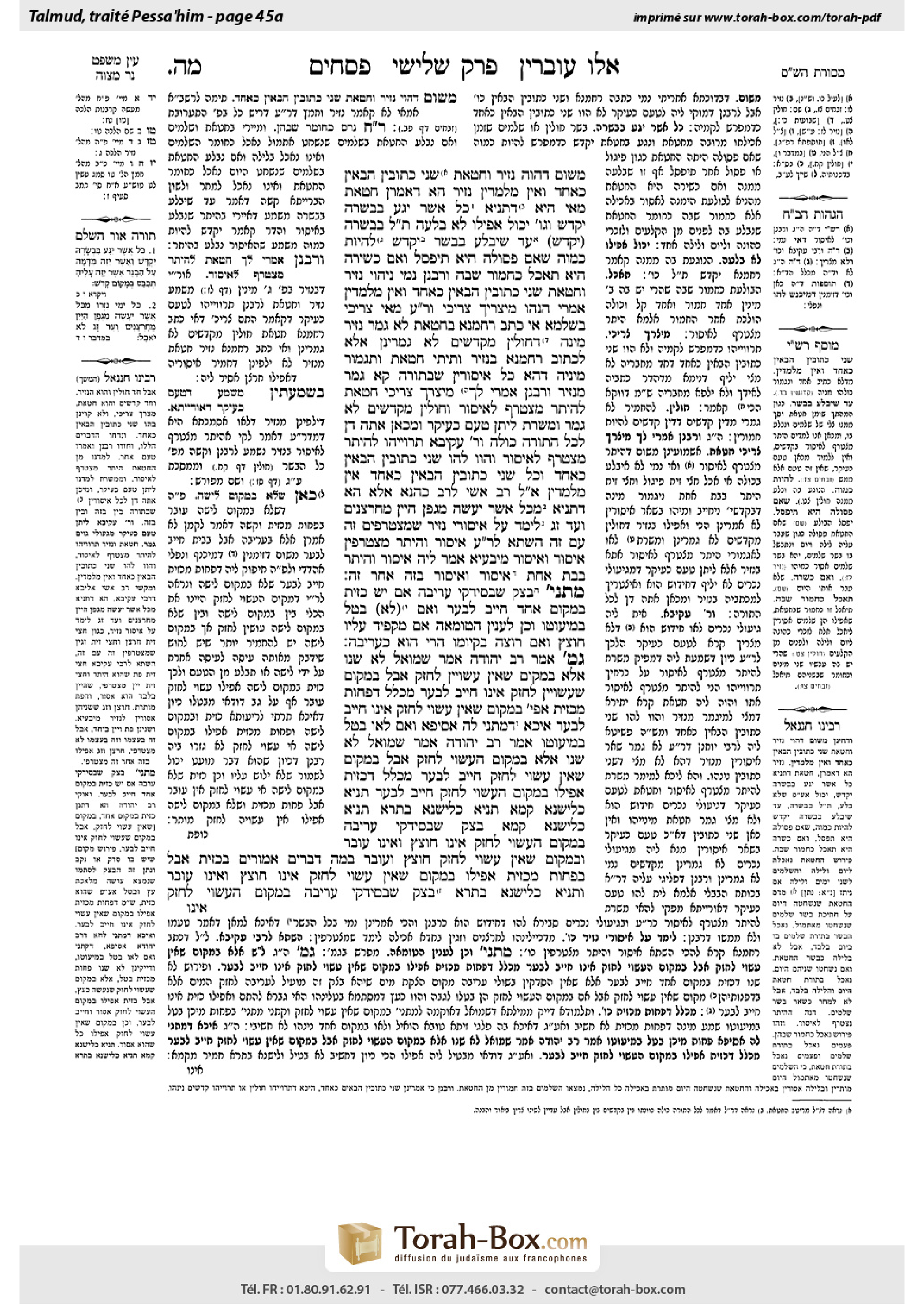
Pesachim 45a: Talmud study for Daf Yomi
Daf Yomi is the daily study of one Talmud folio. Explore 37 tractates with scans, Hebrew text, Sefaria English and AI-generated French translations where annotated.
Passage selection and English or AI-generated French translation are available where the scan has annotations. Daf Study is independent of Torah-Box and Sefaria.
Browse Pesachim · פסחים · All tractatesPesachim 45a text and translations
This page of Pesachim includes the Aramaic text, an English translation and an AI-generated French translation, alongside the scan above.
פסחים מ״ה א · Aramaic and Hebrew text
מִשּׁוּם דְּהָוֵה נָזִיר וְחַטָּאת שְׁנֵי כְתוּבִין הַבָּאִין כְּאֶחָד, וְאֵין מְלַמְּדִין.
נָזִיר, הָא דַּאֲמַרַן. חַטָּאת מַאי הִיא? דְּתַנְיָא: ״כֹּל אֲשֶׁר יִגַּע בִּבְשָׂרָהּ יִקְדָּשׁ וְגוֹ׳״, יָכוֹל אֲפִילּוּ לֹא בָּלְעָה? תַּלְמוּד לוֹמַר: ״בִּבְשָׂרָהּ (יִקְדָּשׁ)״ — עַד שֶׁיִּבָּלַע בְּבָשָׂר
״יִקְדָּשׁ״ — לִהְיוֹת כָּמוֹהָ, שֶׁאִם פְּסוּלָה הִיא — תִּיפָּסֵל, וְאִם כְּשֵׁירָה הִיא — תֵּאָכֵל כֶּחָמוּר שֶׁבָּהּ.
וְרַבָּנַן נָמֵי, נִיהְוֵי נָזִיר וְחַטָּאת שְׁנֵי כְתוּבִין הַבָּאִין כְּאֶחָד, וְאֵין מְלַמְּדִין!
אָמְרִי: הָנְהוּ מִיצְרָיךְ צְרִיכִי.
וְרַבִּי עֲקִיבָא, מַאי צְרִיכִי? בִּשְׁלָמָא אִי כְּתַב רַחֲמָנָא בְּחַטָּאת, לָא גָּמַר נָזִיר מִינַּהּ — דְּחוּלִּין מִקֳּדָשִׁים לָא גָּמְרִינַן. אֶלָּא, לִכְתּוֹב רַחֲמָנָא בְּנָזִיר, וְתֵיתֵי חַטָּאת וְתִגְמוֹר מִינֵּיהּ, דְּהָא כׇּל אִיסּוּרִין שֶׁבַּתּוֹרָה קָא גָמַר מִנָּזִיר.
וְרַבָּנַן אָמְרִי לָךְ, מִיצְרָךְ צְרִיכִי: חַטָּאת לְהֶיתֵּר מִצְטָרֵף לְאִיסּוּר, וְחוּלִּין מִקֳּדָשִׁים לָא גָּמַר, וּ״מִשְׁרַת״ — לִיתֵּן טַעַם כְּעִיקָּר, וּמִכָּאן אַתָּה דָּן לְכׇל הַתּוֹרָה כּוּלָּהּ.
וְרַבִּי עֲקִיבָא: תַּרְוַיְיהוּ לְהֶיתֵּר מִצְטָרֵף לְאִיסּוּר, וְהָווּ לְהוּ שְׁנֵי כְתוּבִין הַבָּאִין כְּאֶחָד, וְכׇל שְׁנֵי כְתוּבִין הַבָּאִין כְּאֶחָד אֵין מְלַמְּדִין.
אֲמַר לֵיהּ רַב אָשֵׁי לְרַב כָּהֲנָא, אֶלָּא הָא דְּתַנְיָא: ״מִכֹּל אֲשֶׁר יֵעָשֶׂה מִגֶּפֶן הַיַּיִן מֵחַרְצַנִּים וְעַד זָג״ — לִימֵּד עַל אִיסּוּרֵי נָזִיר שֶׁמִּצְטָרְפִים זֶה עִם זֶה. הַשְׁתָּא: לְרַבִּי עֲקִיבָא אִיסּוּר וְהֶיתֵּר מִצְטָרְפִין, אִיסּוּר וְאִיסּוּר מִיבַּעְיָא?!
אֲמַר לֵיהּ: אִיסּוּר וְהֶיתֵּר בְּבַת אַחַת, אִיסּוּר וְאִיסּוּר בָּזֶה אַחַר זֶה.
מַתְנִי׳ בָּצֵק שֶׁבְּסִידְקֵי עֲרֵיבָה, אִם יֵשׁ כְּזַיִת בְּמָקוֹם אֶחָד — חַיָּיב לְבַעֵר, וְאִם (לֹא) — בָּטֵל בְּמִיעוּטוֹ.
וְכֵן לְעִנְיַן הַטּוּמְאָה, אִם מַקְפִּיד עָלָיו — חוֹצֵץ, וְאִם רוֹצֶה בְּקִיּוּמוֹ — הֲרֵי הוּא כַּעֲרֵיבָה.
גְּמָ׳ אָמַר רַב יְהוּדָה אָמַר שְׁמוּאֵל: לֹא שָׁנוּ אֶלָּא בִּמְקוֹם שֶׁאֵין עֲשׂוּיִין לְחַזֵּק, אֲבָל בִּמְקוֹם שֶׁעֲשׂוּיִין לְחַזֵּק — אֵינוֹ חַיָּיב לְבַעֵר.
מִכְלָל דְּפָחוֹת מִכְּזַיִת — אֲפִילּוּ בִּמְקוֹם שֶׁאֵין עָשׂוּי לְחַזֵּק אֵינוֹ חַיָּיב לְבַעֵר.
אִיכָּא דְּמַתְנֵי לַהּ אַסֵּיפָא: ״וְאִם לָאו בָּטֵל בְּמִיעוּטוֹ״. אָמַר רַב יְהוּדָה אָמַר שְׁמוּאֵל: לֹא שָׁנוּ אֶלָּא בִּמְקוֹם הֶעָשׂוּי לְחַזֵּק, אֲבָל בִּמְקוֹם שֶׁאֵין עָשׂוּי לְחַזֵּק — חַיָּיב לְבַעֵר, מִכְּלָל דִּכְזַיִת — אֲפִילּוּ בִּמְקוֹם הֶעָשׂוּי לְחַזֵּק חַיָּיב לְבַעֵר.
תַּנְיָא כְּלִישָּׁנָא קַמָּא, תַּנְיָא כְּלִישָּׁנָא בָּתְרָא. תַּנְיָא כְּלִישָּׁנָא קַמָּא: בָּצֵק שֶׁבְּסִידְקֵי עֲרֵיבָה, בִּמְקוֹם הֶעָשׂוּי לְחַזֵּק — אֵינוֹ חוֹצֵץ וְאֵינוֹ עוֹבֵר. וּבִמְקוֹם שֶׁאֵין עָשׂוּי לְחַזֵּק — חוֹצֵץ וְעוֹבֵר. בַּמֶּה דְּבָרִים אֲמוּרִים? בִּכְזַיִת, אֲבָל בְּפָחוֹת מִכְּזַיִת — אֲפִילּוּ בִּמְקוֹם שֶׁאֵין עָשׂוּי לְחַזֵּק, אֵינוֹ חוֹצֵץ וְאֵינוֹ עוֹבֵר.
וְתַנְיָא כְּלִישָּׁנָא בָּתְרָא: בָּצֵק שֶׁבְּסִידְקֵי עֲרֵיבָה, בִּמְקוֹם הֶעָשׂוּי לְחַזֵּק —
Pesachim 45a · English translation
due to the fact that the halakhot of a nazirite and those of a sin-offering are two verses that come as one, i.e., to teach the same principle, and two verses that teach the same principle do not teach that principle by analogy.
The Gemara elaborates: The derivation that a permitted substance joins together with a prohibited substance in the case of a nazirite is that which we stated above. With regard to a sin-offering, what is the derivation that permitted material combines with prohibited material? As it was taught in a baraita with regard to the verse: “Anything that touches in its flesh shall become consecrated” (Leviticus 6:20). I might have thought that non-sacred meat that touched any part of a sin-offering is rendered prohibited even if it did not absorb the taste of the sin-offering it touched. Therefore, the verse states: In its flesh shall become consecrated, to teach that this meat is not consecrated until the taste of the sin-offering is absorbed within its flesh.
The baraita continues: Shall become consecrated means that its legal status becomes like that of the sin-offering itself; that is, if the sin-offering is disqualified, this meat will also be disqualified. And if the sin-offering is valid, the meat that touched it may be eaten in accordance with the more stringent standards of a sin-offering as far as when and where it may be eaten. The principle that a permitted substance joins together with a prohibited substance applies in the case of a sin-offering as well. Therefore, the principle cannot be extended to the entire Torah, as a halakha stated in two cases is not applied elsewhere.
The Gemara asks: And according to the Rabbis as well, let the cases of a nazirite and a sin-offering be considered two verses that come as one and they do not teach the principle that the legal status of taste is like that of the substance with regard to the entire Torah.
The Gemara answers that the Rabbis say: Both of these cases are necessary as they could not have been derived from each other. Therefore, they are not two verses that come as one and it is possible to derive a principle from these two halakhot.
The Gemara asks: And Rabbi Akiva, who does not derive a general principle from these verses, would respond by asking: In what way are they necessary? Granted, if the Merciful One had written this principle only with regard to a sin-offering, one would not derive the halakha of a nazirite from it, as we do not derive halakhot of non-sacred objects from those of consecrated objects. Certain stringencies and strictures apply only to consecrated property. However, let the Merciful One write this principle with regard to a nazirite, and you could bring the case of the sin-offering and derive it from the case of a nazirite, just as the application of this principle to all prohibitions in the Torah is derived from the halakha of a nazirite. Since this principle is stated in both cases unnecessarily, these are two verses that come as one, and one cannot derive a principle from them.
The Gemara asks: And the Rabbis, as they maintain that the principle that the legal status of the taste of a prohibited substance is like that of the substance itself is not limited to these two cases, they would say to you that both sources are necessary. The case of the sin-offering is necessary to derive the principle that a permitted substance joins together with a prohibited substance, as one cannot derive the halakhot of non-sacred food from consecrated property. And the term soaked, which appears in the context of the halakhot of a nazirite, teaches the principle that the legal status of taste is like that of the substance. Since both examples are necessary, they are not considered two verses that come as one, and it is therefore possible to derive a principle from them. And consequently from here you derive the halakha with regard to all of the Torah in its entirety.
The Gemara asks: And how could Rabbi Akiva respond to this claim? The Gemara answers: Rabbi Akiva would say that both cases teach the principle that a permitted substance joins together with a prohibited substance, and they are indeed two verses that come as one, to teach about the same issue. And the rule is that any two verses that come as one do not teach overarching principles.
Rav Ashi said to Rav Kahana: But with regard to that which is taught in a baraita: The verse: “He shall eat nothing that is made of the grapevine, from the grape skins to the grape seed” (Numbers 6:4), taught with regard to prohibitions of a nazirite that these substances join together. If the nazirite ate only a small amount of each substance that when joined together constitute the measure that determines liability, he is liable. Now the following question arises: According to Rabbi Akiva, who maintains that prohibited and permitted substances join together, is it necessary to teach that one prohibited substance joins together with another prohibited substance? Apparently, according to Rabbi Akiva’s opinion, this derivation is unnecessary.
Rav Kahana said to him that this derivation is necessary because the two cases are not identical: Whereas prohibited and permitted substances combine only when they are eaten simultaneously, prohibited and other prohibited substances join together even when eaten one after the other. In other words, if a nazirite eats half an olive-bulk of grape skins and then eats half an olive-bulk of grape seeds, he is liable according to Rabbi Akiva.
MISHNA: With regard to dough that is in the cracks of a kneading bowl, if there is an olive-bulk of dough in one place, one is obligated to remove it. And if the dough does not add up to this amount, it is nullified due to its insignificance.
And similarly, with regard to the halakhot of immersion to purify the bowl from ritual impurity, if one is particular about the dough that is stuck in the cracks and he plans to remove it and use it, it is a foreign substance that interposes between the kneading bowl and the water of the ritual bath, and invalidates the immersion of the bowl, leaving it ritually impure. And if he wants the dough to remain in place, its status is like that of the kneading bowl itself and is not an interposition.
GEMARA: Rav Yehuda said that Shmuel said: They taught that one is obligated to remove a combined olive-bulk of leaven only in a case where the pieces of dough are not in a position where they serve to reinforce the kneading bowl. However, in a case where they serve to reinforce the bowl and they will remain there for this purpose, he is not obligated to remove them; he may simply render them null and void.
The Gemara concludes: This proves by inference that with regard to less than an olive-bulk, even in a place where it does not serve to reinforce the bowl, one is not obligated to remove it.
Some teach the statement of Rav Yehuda with regard to the latter clause of the mishna: And if the dough is not an olive-bulk, it is nullified due to its insignificance. Rav Yehuda said that Shmuel said: They taught that one is obligated to remove less than an olive-bulk of dough in one place only in a place where it serves to reinforce the bowl; however, in a place where it does not serve to reinforce the bowl, one is obligated to remove it. This proves by inference that if there is an olive-bulk of dough in one place, even in a place where it serves to reinforce the bowl, one is obligated to remove it.
The Gemara comments: It was taught in a baraita in accordance with the first version of Rav Yehuda’s statement, and it was taught in a different baraita in accordance with the latter version of his statement. The Gemara elaborates: It was taught in a baraita in accordance with the first version of Rav Yehuda’s statement: With regard to dough that is in the cracks of a kneading bowl in a place where it is serves to reinforce the bowl, it does not interpose and invalidate the immersion for ritual impurity, and one does not violate the prohibition against having leaven in his possession during Passover. And in a case where it does not serve to reinforce the bowl, it interposes, and one violates the prohibition against having leaven in his possession on Passover. In what case is this statement said? It is in the case of an olive-bulk of dough; however, in a case where there is less than olive-bulk, even in a case where it does not serve to reinforce the bowl, it does not interpose and one does not violate a prohibition by having it in his possession.
And it was taught in a different baraita in accordance with the latter version of Rav Yehuda’s statement: With regard to dough that is in the cracks of a kneading bowl, in a place where it serves to reinforce the bowl,
Pesachim 45a · Traduction française (IA)
du fait que les halakhot du nazir et celles du sacrifice expiatoire sont deux versets qui viennent enseigner un même principe, et que deux versets enseignant un même principe ne permettent pas d’étendre ce principe par analogie.
La Guemara développe : La déduction selon laquelle une substance permise se joint à une substance interdite dans le cas du nazir est celle que nous avons énoncée plus haut. Concernant le sacrifice expiatoire, quelle déduction établit qu’une substance permise se combine avec une substance interdite ? Comme cela a été enseigné dans une baraïta à propos du verset : « Tout ce qui touchera à sa chair sera consacré » (Lévitique 6,20). J’aurais pu penser que la viande profane qui a touché n’importe quelle partie d’un sacrifice expiatoire devient interdite, même si elle n’a pas absorbé le goût du sacrifice expiatoire qu’elle a touché. C’est pourquoi le verset précise : « à sa chair sera consacré », pour enseigner que cette viande n’est consacrée que lorsque le goût du sacrifice expiatoire a été absorbé dans sa chair.
La baraïta poursuit : « Sera consacré » signifie que son statut juridique devient semblable à celui du sacrifice expiatoire lui-même ; autrement dit, si le sacrifice expiatoire est invalide, cette viande le sera également. Et si le sacrifice expiatoire est valide, la viande qui l’a touché peut être consommée selon les règles plus strictes du sacrifice expiatoire quant au moment et au lieu où elle peut l’être. Le principe selon lequel une substance permise se joint à une substance interdite s’applique aussi au sacrifice expiatoire. On ne peut donc pas étendre ce principe à toute la Torah, car une halakha énoncée dans deux cas ne s’applique pas ailleurs.
La Guemara demande : Et selon les Rabbins également, que les cas du nazir et du sacrifice expiatoire soient considérés comme deux versets qui viennent enseigner un même principe, et qu’ils n’enseignent donc pas le principe selon lequel le statut juridique du goût est celui de la substance dans toute la Torah.
La Guemara répond que les Rabbins disent : Ces deux cas sont nécessaires, car l’un ne peut pas être déduit de l’autre. Par conséquent, ils ne constituent pas deux versets qui viennent enseigner un même principe, et il est possible de déduire un principe de ces deux halakhot.
La Guemara demande : Et Rabbi Akiva, qui ne déduit pas de ces versets un principe général, répondrait en demandant : En quoi sont-ils nécessaires ? Certes, si le Miséricordieux avait énoncé ce principe seulement à propos d’un sacrifice expiatoire, on n’en aurait pas déduit la halakha du nazir, car nous ne déduisons pas les halakhot des objets profanes de celles des objets consacrés. Certaines rigueurs et restrictions ne s’appliquent qu’aux biens consacrés. Cependant, que le Miséricordieux énonce ce principe à propos du nazir, et l’on pourrait alors invoquer le cas du sacrifice expiatoire et le déduire de celui du nazir, tout comme l’application de ce principe à toutes les interdictions de la Torah est déduite de la halakha du nazir. Puisque ce principe est énoncé inutilement dans les deux cas, il s’agit de deux versets qui viennent enseigner un même principe, et l’on ne peut pas en déduire de principe général.
La Guemara demande : Et les Rabbins, puisqu’ils estiment que le principe selon lequel le statut juridique du goût d’une substance interdite est celui de la substance elle-même ne se limite pas à ces deux cas, te diraient que les deux sources sont nécessaires. Le cas du sacrifice expiatoire est nécessaire pour déduire le principe selon lequel une substance permise se joint à une substance interdite, car on ne peut pas déduire les halakhot des aliments profanes de celles des biens consacrés. Et le terme « trempé », qui apparaît dans le contexte des halakhot du nazir, enseigne le principe selon lequel le statut juridique du goût est celui de la substance. Puisque les deux exemples sont nécessaires, ils ne sont pas considérés comme deux versets venant enseigner un même principe, et il est donc possible d’en déduire un principe. Par conséquent, c’est de là que l’on déduit la halakha concernant toute la Torah.
La Guemara demande : Et comment Rabbi Akiva pourrait-il répondre à cet argument ? La Guemara répond : Rabbi Akiva dirait que les deux cas enseignent le principe selon lequel une substance permise se joint à une substance interdite ; ils sont donc bien deux versets qui viennent enseigner la même chose. Or, la règle est que deux versets qui viennent enseigner un même principe ne permettent pas d’établir de principes généraux.
Rav Ashi dit à Rav Kahana : Mais, concernant ce qui est enseigné dans une baraïta, le verset « Il ne mangera rien de ce qui vient de la vigne, depuis les peaux des raisins jusqu’aux pépins » (Nombres 6,4) enseigne, à propos des interdictions applicables au nazir, que ces substances se combinent. Si le nazir n’a mangé qu’une petite quantité de chacune de ces substances, qui, une fois réunies, atteignent la mesure déterminant la responsabilité, il est passible. Or, la question suivante se pose : selon Rabbi Akiva, qui estime que les substances interdites et permises se combinent, est-il nécessaire d’enseigner qu’une substance interdite se combine avec une autre substance interdite ? Apparemment, selon l’opinion de Rabbi Akiva, cette déduction est superflue.
Rav Kahana lui dit que cette déduction est nécessaire, car les deux cas ne sont pas identiques : les substances interdites et permises ne se combinent que lorsqu’elles sont consommées simultanément, tandis que des substances interdites se combinent même si elles sont consommées l’une après l’autre. Autrement dit, si un nazir mange une demi-mesure d’olive de peaux de raisin, puis une demi-mesure d’olive de pépins de raisin, il est passible selon Rabbi Akiva.
MICHNA : Concernant la pâte qui se trouve dans les fissures d’un pétrin, s’il y a en un seul endroit l’équivalent d’une olive de pâte, on est tenu de l’enlever. Si la pâte n’atteint pas cette quantité, elle est annulée en raison de sa quantité insignifiante.
De même, concernant les halakhot de l’immersion destinée à purifier le pétrin de l’impureté rituelle, si l’on tient à la pâte collée dans les fissures et que l’on compte l’enlever pour l’utiliser, elle constitue un corps étranger qui fait écran entre le pétrin et l’eau du bain rituel, et invalide l’immersion du pétrin, qui demeure alors impur rituellement. Mais si l’on souhaite que la pâte reste en place, son statut est celui du pétrin lui-même et elle ne fait pas écran.
GUEMARA : Rav Yehouda a dit au nom de Chmouel : Ils ont enseigné qu’on est tenu d’enlever une quantité cumulée de levain équivalant à une olive uniquement lorsque les morceaux de pâte ne se trouvent pas à un endroit où ils servent à renforcer le pétrin. En revanche, s’ils servent à renforcer le pétrin et doivent y rester à cette fin, on n’est pas tenu de les enlever ; on peut simplement les annuler.
La Guemara conclut : On peut en déduire que, pour une quantité inférieure à une olive, même à un endroit où elle ne sert pas à renforcer le pétrin, on n’est pas tenu de l’enlever.
Certains transmettent la déclaration de Rav Yehouda à propos de la seconde partie de la Michna : « Si la pâte n’atteint pas la quantité d’une olive, elle est annulée en raison de sa quantité insignifiante. » Rav Yehouda a dit au nom de Chmouel : Ils ont enseigné qu’on est tenu d’enlever une quantité de pâte inférieure à une olive en un seul endroit uniquement lorsqu’elle sert à renforcer le pétrin ; en revanche, à un endroit où elle ne sert pas à renforcer le pétrin, on est tenu de l’enlever. On peut en déduire que s’il y a en un seul endroit une quantité d’une olive de pâte, on est tenu de l’enlever même à un endroit où elle sert à renforcer le pétrin.
La Guemara fait remarquer : Une baraïta a été enseignée conformément à la première version de la déclaration de Rav Yehouda, et une autre baraïta conformément à la dernière version de sa déclaration. La Guemara développe : Une baraïta a été enseignée conformément à la première version de la déclaration de Rav Yehouda : la pâte qui se trouve dans les fissures d’un pétrin, à un endroit où elle sert à le renforcer, ne fait pas écran et n’invalide pas l’immersion destinée à purifier de l’impureté rituelle ; on ne transgresse pas non plus l’interdiction de garder du levain en sa possession pendant Pessa’h. En revanche, si elle ne sert pas à renforcer le pétrin, elle fait écran, et l’on transgresse l’interdiction de garder du levain en sa possession pendant Pessa’h. Dans quel cas cette déclaration s’applique-t-elle ? Il s’agit d’une quantité d’une olive de pâte ; en revanche, si la quantité est inférieure à une olive, même si elle ne sert pas à renforcer le pétrin, elle ne fait pas écran et l’on ne transgresse aucune interdiction en la gardant en sa possession.
Et une autre baraïta a été enseignée conformément à la dernière version de la déclaration de Rav Yehouda : la pâte qui se trouve dans les fissures d’un pétrin, à un endroit où elle sert à renforcer le pétrin,
Traduction française générée par IA à partir de l’édition anglaise de Sefaria. Vérifie toujours un passage avec le texte source.
Text from Sefaria: William Davidson Edition - Vocalized Aramaic (CC BY NC); William Davidson Edition - English (CC BY NC).