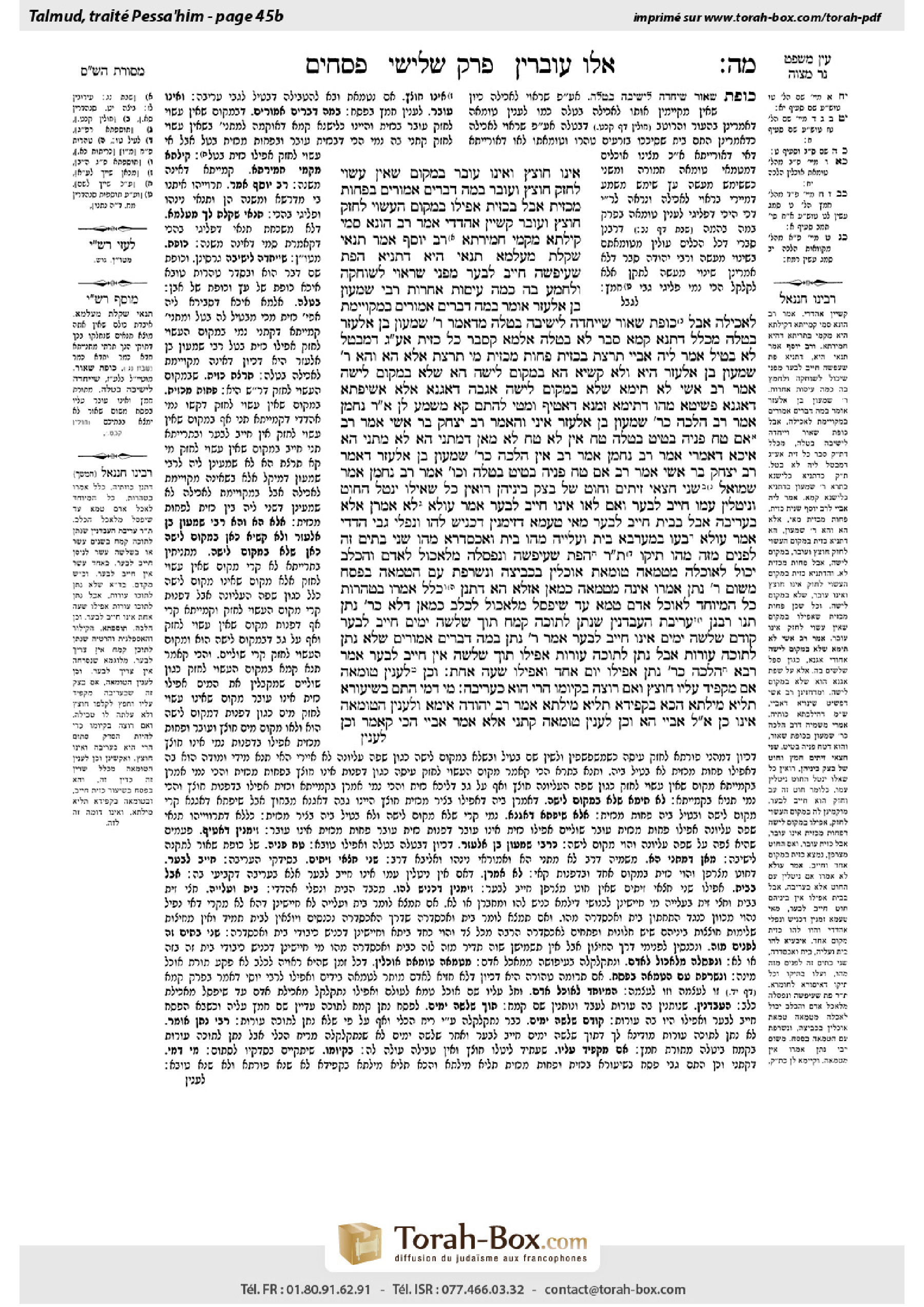
Pesachim 45b: Talmud study for Daf Yomi
Daf Yomi is the daily study of one Talmud folio. Explore 37 tractates with scans, Hebrew text, Sefaria English and AI-generated French translations where annotated.
Passage selection and English or AI-generated French translation are available where the scan has annotations. Daf Study is independent of Torah-Box and Sefaria.
Browse Pesachim · פסחים · All tractatesPesachim 45b text and translations
This page of Pesachim includes the Aramaic text, an English translation and an AI-generated French translation, alongside the scan above.
פסחים מ״ה ב · Aramaic and Hebrew text
אֵינוֹ חוֹצֵץ וְאֵינוֹ עוֹבֵר. בִּמְקוֹם שֶׁאֵין עָשׂוּי לְחַזֵּק — חוֹצֵץ וְעוֹבֵר. בַּמֶּה דְּבָרִים אֲמוּרִים — בְּפָחוֹת מִכְּזַיִת, אֲבָל בִּכְזַיִת — אֲפִילּוּ בִּמְקוֹם הֶעָשׂוּי לְחַזֵּק חוֹצֵץ וְעוֹבֵר.
קַשְׁיָין אַהֲדָדֵי. אָמַר רַב הוּנָא: סְמִי קִילְּתָא מִקַּמֵּי חֲמִירְתָּא.
רַב יוֹסֵף אָמַר: תַּנָּאֵי שָׁקְלַתְּ מֵעָלְמָא?! תַּנָּאֵי הִיא. דְּתַנְיָא: הַפַּת שֶׁעִיפְּשָׁה — חַיָּיב לְבַעֵר, מִפְּנֵי שֶׁרָאוּי לְשׁוֹחְקָהּ וּלְחַמֵּעַ בָּהּ כַּמָּה עִיסּוֹת אֲחֵרוֹת.
רַבִּי שִׁמְעוֹן בֶּן אֶלְעָזָר אוֹמֵר: בַּמֶּה דְּבָרִים אֲמוּרִים — בִּמְקוּיֶּימֶת לַאֲכִילָה, אֲבָל כּוֹפֶת שְׂאוֹר שֶׁיִּיחֲדָהּ לִישִׁיבָה — בָּטְלָה. מִדְּאָמַר רַבִּי שִׁמְעוֹן בֶּן אֶלְעָזָר בָּטְלָה, מִכְּלָל דְּתַנָּא קַמָּא סָבַר לֹא בָּטְלָה, אַלְמָא קָסָבַר: כׇּל כְּזַיִת, אַף עַל גַּב דִּמְבַטֵּל — לָא בְּטִיל.
אֲמַר לֵיהּ אַבָּיֵי: תָּרֵצְתְּ בִּכְזַיִת. פָּחוֹת מִכְּזַיִת מִי תָּרֵצְתְּ? אֶלָּא הָא וְהָא רַבִּי שִׁמְעוֹן בֶּן אֶלְעָזָר הִיא, וְלָא קַשְׁיָא: הָא — בִּמְקוֹם לִישָׁה, הָא — שֶׁלֹּא בִּמְקוֹם לִישָׁה.
אָמַר רַב אָשֵׁי: לָא תֵּימָא שֶׁלֹּא בִּמְקוֹם לִישָׁה — אַגַּבַּהּ דְאַגָּנָא, אֶלָּא אַשִּׂיפְתָּא דְאַגָּנָא.
פְּשִׁיטָא? מַהוּ דְּתֵימָא זִמְנָא דְּאָטֵיף וּמָטֵי לְהָתָם, קָא מַשְׁמַע לַן.
אָמַר רַב נַחְמָן אָמַר רַב: הֲלָכָה כְּרַבִּי שִׁמְעוֹן בֶּן אֶלְעָזָר.
אִינִי? וְהָאָמַר רַב יִצְחָק בַּר אָשֵׁי אָמַר רַב: אִם טָח פָּנֶיהָ בְּטִיט — בָּטְלָה. טָח אִין, לֹא טָח — לָא!
מַאן דְּמַתְנֵי הָא לָא מַתְנֵי הָא.
אִיכָּא דְּאָמְרִי, אָמַר רַב נַחְמָן אָמַר רַב: אֵין הֲלָכָה כְּרַבִּי שִׁמְעוֹן בֶּן אֶלְעָזָר, דְּאָמַר רַב יִצְחָק בַּר אָשֵׁי אָמַר רַב: אִם טָח פָּנֶיהָ בְּטִיט — בָּטְלָה וְכוּ׳.
אָמַר רַב נַחְמָן אָמַר שְׁמוּאֵל: שְׁנֵי חֲצָאֵי זֵיתִים וְחוּט שֶׁל בָּצֵק בֵּינֵיהֶן, רוֹאִין: כׇּל שֶׁאִילּוּ יִנָּטֵל הַחוּט וְנִיטָּלִין עִמּוֹ — חַיָּיב לְבַעֵר. וְאִם לָאו — אֵינוֹ חַיָּיב לְבַעֵר.
אָמַר עוּלָּא: לָא אֲמַרַן אֶלָּא בַּעֲרֵיבָה, אֲבָל בַּבַּיִת — חַיָּיב לְבַעֵר.
מַאי טַעְמָא, דְּזִימְנִין דְּכָנֵישׁ לְהוּ וְנָפְלִי גַּבֵּי הֲדָדֵי.
אָמַר עוּלָּא: בָּעוּ בְּמַעְרְבָא, בַּיִת וַעֲלִיָּיה מַהוּ? בַּיִת וְאַכְסַדְרָא מַהוּ? שְׁנֵי בָתִּים זֶה לִפְנִים מִזֶּה מַהוּ?
תֵּיקוּ.
תָּנוּ רַבָּנַן: הַפַּת שֶׁעִיפְּשָׁה וְנִפְסְלָה מִלֶּאֱכוֹל לָאָדָם, וְהַכֶּלֶב יָכוֹל לְאוֹכְלָהּ — מְטַמְּאָה טוּמְאַת אוֹכָלִין בִּכְבֵיצָה, וְנִשְׂרֶפֶת עִם הַטְּמֵאָה בַּפֶּסַח. מִשּׁוּם רַבִּי נָתָן אָמְרוּ: אֵינָהּ מְטַמְּאָה.
כְּמַאן אָזְלָא הָא דִּתְנַן, כְּלָל אָמְרוּ בִּטְהָרוֹת: כׇּל הַמְיוּחָד לְאוֹכֶל אָדָם — טָמֵא עַד שֶׁיִּפָּסֵל מִלֶּאֱכוֹל לְכֶלֶב. כְּמַאן — דְּלָא כְּרַבִּי נָתָן.
תָּנוּ רַבָּנַן: עֲרֵיבַת הָעַבְּדָנִין שֶׁנָּתַן לְתוֹכָהּ קֶמַח, תּוֹךְ שְׁלֹשָׁה יָמִים — חַיָּיב לְבַעֵר. קוֹדֶם שְׁלֹשָׁה יָמִים אֵינוֹ חַיָּיב לְבַעֵר. אָמַר רַבִּי נָתָן: בַּמֶּה דְּבָרִים אֲמוּרִים — שֶׁלֹּא נָתַן לְתוֹכָהּ עוֹרוֹת, אֲבָל נָתַן לְתוֹכָהּ עוֹרוֹת — אֲפִילּוּ תּוֹךְ שְׁלֹשָׁה אֵין חַיָּיב לְבַעֵר.
אָמַר רָבָא: הֲלָכָה כְּרַבִּי נָתָן, אֲפִילּוּ יוֹם אֶחָד וַאֲפִילּוּ שָׁעָה אַחַת.
וְכֵן לְעִנְיַן טוּמְאָה, אִם מַקְפִּיד עָלָיו — חוֹצֵץ, וְאִם רוֹצֶה בְּקִיּוּמוֹ — הֲרֵי הוּא כַּעֲרֵיבָה.
מִי דָּמֵי? הָתָם — בְּשִׁיעוּרָא תַּלְיָא מִילְּתָא. הָכָא — בִּקְפִידָא תַּלְיָא מִילְּתָא!
אָמַר רַב יְהוּדָה, אֵימָא: וּלְעִנְיַן הַטּוּמְאָה אֵינוֹ כֵּן.
אֲמַר לֵיהּ אַבָּיֵי: הָא ״וְכֵן לְעִנְיַן טוּמְאָה״ קָתָנֵי! אֶלָּא אָמַר אַבָּיֵי, הָכִי קָאָמַר: וְכֵן
Pesachim 45b · English translation
it does not interpose in the immersion and one does not violate the prohibition against having leaven in his possession during Passover. In a case where the dough does not serve to reinforce the bowl, it interposes in the immersion and one violates the prohibition against owning leaven on Passover. In what case is this statement said? It is in a case where the dough is less than an olive-bulk. However, if it is an olive-bulk, even in a case where it serves to reinforce the bowl it interposes in the immersion and one violates a prohibition by having it in his possession during the Festival.
The Gemara asks: In any case, these baraitot contradict each other. Rav Huna said: Delete the first, lenient baraita from before the stringent one.
Rav Yosef said: Have you removed the tanna’im from the world? It is a dispute between tanna’im. The baraita is in accordance with the ruling of another Sage and is not the result of a flawed baraita, as it was taught in a baraita: With regard to bread that grew moldy and is no longer edible, one is obligated to remove it, due to the fact that it is suitable to be ground and to leaven other dough. Apparently, one is obligated to remove even inedible leaven.
Rabbi Shimon ben Elazar says: In what case is this statement said? In a case where the bread was maintained for consumption; however, a mass of hardened leaven that one designated for the purpose of sitting upon it, not for consumption, is nullified. Rav Yosef infers from the baraita: From the fact that Rabbi Shimon ben Elazar said that this leaven is nullified, this proves by inference that the first tanna maintains that in that case, the leaven is not nullified. Apparently, the first tanna maintains that with regard to any olive-bulk of leaven, even though one renders it null and void, it is not nullified. The respective opinions of these two Sages are presented in the two conflicting baraitot with regard to dough in a bowl.
Abaye said to him: You resolved the contradiction between the baraitot with regard to an olive-bulk of leaven by establishing it as a tannaitic dispute. According to the first tanna, an olive-bulk of leaven cannot be nullified at all, whereas Rabbi Shimon ben Elazar maintains that it can be nullified. However, did you resolve the contradiction with regard to less than an olive-bulk of leaven? Rather, both this baraita and that baraita are in accordance with the opinion of Rabbi Shimon ben Elazar, and nevertheless it is not difficult. This baraita, where he prohibits the dough in a crack of the bowl, refers to a situation where the dough is in the place in the bowl where kneading takes place, as any dough he later inserts into the bowl will come into contact with the dough in the crack. However, in that case, Rabbi Shimon ben Elazar rules leniently, as the dough is not in the place in the bowl where kneading takes place.
Rav Ashi said: Do not say that dough not in the place in the bowl where kneading takes place, refers only to the area on the back of, i.e., outside the basin; rather, it also refers to the area on the edge of the basin, as dough does not come into contact with that part of the bowl.
The Gemara asks: This is obvious; why was it necessary to make that statement? The Gemara answers: Rav Ashi’s statement is necessary lest you say that dough sometimes drips there and it should therefore be considered the place in the bowl where kneading takes place. Therefore, the baraita teaches us that this is not the case, and one is not obligated to remove leavened dough from that part of the bowl.
Rav Naḥman said that Rav said: The halakha is in accordance with the opinion of Rabbi Shimon ben Elazar that a mass of leaven designated for the purpose of sitting upon is nullified.
The Gemara asks: Is that so? Didn’t Rav Yitzḥak bar Ashi say that Rav said: If one covered the surface of a mass of leaven with mortar, the leaven is nullified? The Gemara infers: If he covered it with mortar, yes, it is nullified; however, if he did not cover it with mortar, no, it is not nullified. In this statement, Rav states that a mass of leaven is nullified only if it is covered with mortar.
The Gemara answers: He who teaches this statement does not teach that statement, as there is a dispute between amora’im with regard to Rav’s opinion.
Some say an alternative version of the above statement. Rav Naḥman said that Rav said: The halakha is not in accordance with the opinion of Rabbi Shimon ben Elazar, as Rav Yitzḥak bar Ashi said that Rav said: If one covered the surface of a mass of leaven with mortar, it is nullified. This ruling indicates that if one did not cover the surface with mortar, the leavened dough is not nullified, in accordance with the opinion of the first tanna.
Rav Naḥman said that Shmuel said: With regard to two half-olive-bulk portions of leavened dough with a string of dough connecting between them, one observes: In any case that were the string taken and the portions are taken with it, one is obligated to remove the dough, as the string unites them into an olive-bulk of leaven. And if the portions are not taken with it, one is not obligated to remove them.
Ulla said: We stated this leniency that it is not necessary to remove half-olive-bulk portions of leavened dough only when the segments are in a kneading bowl, stuck separately to the sides of the bowl. However, if they are located in a house, one is obligated to remove them even in the absence of a string of dough connecting the two pieces.
What is the reason for this? It is because a person will sometimes gather them when cleaning his house and they will fall adjacent to each other. If this occurs, the two portions will form an olive-bulk of leavened dough.
Ulla said: The Sages raise a dilemma in the West, Eretz Yisrael: If one piece of leavened bread was in the main area of a house and the other piece was in the upper story, what is the halakha? If one piece is in the house and the other is in a portico, what is the halakha? Similarly, if the two segments are in two houses, one inside the other, what is the halakha?
The Gemara states: Let these dilemmas stand unresolved.
The Sages taught: With regard to bread that grew moldy and was rendered inedible for consumption by a person, but a dog can eat it, it can become impure with the ritual impurity of foods in the measure of an egg-bulk in size, as it is still considered food. If the moldy bread was ritually pure teruma, it may be burned with ritually impure teruma on Passover. Once the bread is no longer fit for human consumption, the prohibition against actively rendering it impure no longer applies. They said in the name of Rabbi Natan: It cannot become ritually impure.
The Gemara asks: In accordance with whose opinion is that which we learned in a mishna: The Sages stated a principle with regard to ritual purity: Any food that is designated as food for a person that becomes impure remains ritually impure until it is rendered unfit to be consumed by a dog. The Gemara reiterates: In accordance with whose opinion is that statement? The Gemara answers: It is not in accordance with the opinion of Rabbi Natan, as his statement indicates that food designated as food for a person is rendered ritually pure as soon as it becomes unfit to be eaten by a person.
The Sages taught: With regard to tanners’ bowls into which one placed flour in the production process of leather, if the flour was placed within three days of the start of Passover, one is obligated to remove it, as it is still considered edible leaven. However, if one added the flour prior to three days before Passover, one is not obligated to remove the contents of the bowl, as the flour will have already been rendered inedible by the odor of the vessel before the beginning of Passover, and is no longer considered edible. Rabbi Natan said: In what case is this statement said? In a case where one did not place animal hides into the bowl; however, if one placed hides into the bowl, even if Passover is within three days of when he placed the flour in the bowl, he is not obligated to remove the flour. Once the foul-smelling hides are placed in the bowl, the flour is certainly no longer edible.
Rava said: The halakha is in accordance with the opinion of Rabbi Natan with regard to this issue. Consequently, there is no set time at which the flour is considered spoiled, as it is considered inedible even one day or even one hour after hides were added to the bowl.
We learned in the mishna: And similarly, with regard to the halakhot of immersion to purify the bowl from ritual impurity, if one is particular about the dough that is stuck in the cracks and he plans to remove it and use it, it is a foreign substance that interposes between the kneading bowl and the water of the ritual bath, and invalidates the immersion of the bowl, leaving it ritually impure. And if he wants the dough to remain in place, its status is like that of the kneading bowl itself and is not an interposition.
The Gemara asks: Is it comparable? How can the mishna compare the halakhot of leaven on Passover to the halakhot of interpositions that invalidate an immersion to purify from ritual impurity? There, with regard to leaven, the matter is contingent upon the measure of the dough, as an olive-bulk of leaven is prohibited. Here, with regard to interpositions that invalidate an immersion, the matter is contingent upon whether or not one is particular about the presence of the dough. In other words, with regard to interpositions it is the attitude of the owner of the bowl that is the decisive factor, not the quantity of the dough.
The Gemara answers that Rav Yehuda said: Say that the mishna should be read: And with regard to interpositions that invalidate an immersion to purify from ritual impurity, it is not so, as it is not the quantity of the dough but the particularity of the owner that is the decisive factor.
Abaye said to him: Doesn’t the mishna teach: And similarly with regard to ritual impurity. The text of the mishna cannot be so drastically emended merely to resolve a difficulty. Rather, Abaye said: This is what the mishna is saying: And similarly
Pesachim 45b · Traduction française (IA)
cela ne fait pas obstacle à l’immersion et l’on ne transgresse pas l’interdiction de détenir du levain pendant Pessa’h. Lorsque la pâte ne sert pas à renforcer le pétrin, elle fait obstacle à l’immersion et l’on transgresse l’interdiction de posséder du levain pendant Pessa’h. Dans quel cas cette déclaration a-t-elle été faite ? Lorsque la pâte a un volume inférieur à celui d’une olive. Mais si elle a le volume d’une olive, même si elle sert à renforcer le pétrin, elle fait obstacle à l’immersion et l’on transgresse l’interdiction de la détenir pendant la fête.
La Guemara demande : Quoi qu’il en soit, ces baraïtot se contredisent. Rav Houna dit : Écarte la première baraïta, indulgente, au profit de la plus stricte.
Rav Yossef dit : As-tu fait disparaître les tannaïm du monde ? Il s’agit d’un désaccord entre tannaïm. La baraïta suit l’avis d’un autre Sage et ne résulte pas d’une baraïta erronée, comme cela a été enseigné dans une baraïta : celui qui possède du pain moisi, devenu impropre à la consommation, est tenu de l’éliminer, car il peut être moulu et servir à faire lever une autre pâte. Il apparaît donc qu’on est tenu d’éliminer même du levain impropre à la consommation.
Rabbi Chimon ben Elazar dit : Dans quel cas cette déclaration a-t-elle été faite ? Lorsque le pain a été conservé pour être consommé. En revanche, une masse de levain durci que l’on a destinée à s’asseoir dessus, et non à être consommée, est annulée. Rav Yossef déduit de la baraïta : Puisque Rabbi Chimon ben Elazar dit que ce levain est annulé, on peut en déduire que le premier tanna estime que, dans ce cas, le levain n’est pas annulé. Il apparaît que, selon le premier tanna, toute quantité de levain égale au volume d’une olive n’est pas annulée, même si on la tient pour négligeable. Les avis respectifs de ces deux Sages sont présentés dans les deux baraïtot contradictoires concernant la pâte dans un pétrin.
Abayé lui dit : Tu as résolu la contradiction entre les baraïtot concernant une quantité de levain égale au volume d’une olive en établissant qu’il s’agit d’un désaccord entre tannaïm. Selon le premier tanna, une telle quantité de levain ne peut jamais être annulée, tandis que Rabbi Chimon ben Elazar estime qu’elle peut l’être. Mais as-tu résolu la contradiction concernant une quantité de levain inférieure au volume d’une olive ? En réalité, cette baraïta comme l’autre suivent l’avis de Rabbi Chimon ben Elazar, et pourtant il n’y a pas de difficulté. Cette baraïta, qui interdit la pâte dans une fissure du pétrin, parle d’une situation où la pâte se trouve à l’endroit du pétrin où l’on pétrit, car toute pâte qu’on y mettra ensuite entrera en contact avec celle qui se trouve dans la fissure. Dans l’autre cas, Rabbi Chimon ben Elazar adopte une position indulgente, car la pâte ne se trouve pas à l’endroit du pétrin où l’on pétrit.
Rav Achi dit : Ne dis pas que la pâte qui ne se trouve pas à l’endroit du pétrin où l’on pétrit désigne uniquement la zone située au dos du pétrin, c’est-à-dire à l’extérieur de la cuve ; cela désigne aussi le rebord de la cuve, car la pâte n’entre pas en contact avec cette partie du pétrin.
La Guemara demande : Cela va de soi ; pourquoi était-il nécessaire de le préciser ? La Guemara répond : La déclaration de Rav Achi était nécessaire, de peur que tu dises que de la pâte y coule parfois et qu’il faille donc considérer cet endroit comme la zone où l’on pétrit. La baraïta nous enseigne donc que ce n’est pas le cas et qu’on n’est pas tenu d’éliminer la pâte levée de cette partie du pétrin.
Rav Na’hman dit au nom de Rav : La halakha suit l’avis de Rabbi Chimon ben Elazar, selon lequel une masse de levain destinée à servir de siège est annulée.
La Guemara demande : Est-ce bien le cas ? Rav Yits’hak bar Achi n’a-t-il pas dit au nom de Rav : si quelqu’un a recouvert la surface d’une masse de levain de mortier, le levain est annulé ? On en déduit que s’il l’a recouverte de mortier, oui, elle est annulée ; mais que s’il ne l’a pas recouverte de mortier, elle ne l’est pas. Dans cette déclaration, Rav affirme qu’une masse de levain n’est annulée que si elle est recouverte de mortier.
La Guemara répond : Celui qui transmet cette déclaration ne transmet pas l’autre, car les amoraïm sont en désaccord sur l’avis de Rav.
Certains transmettent une version différente de la déclaration précédente. Rav Na’hman dit au nom de Rav : La halakha ne suit pas l’avis de Rabbi Chimon ben Elazar, car Rav Yits’hak bar Achi a dit au nom de Rav : si quelqu’un a recouvert la surface d’une masse de levain de mortier, elle est annulée. Cette décision indique que si l’on n’a pas recouvert la surface de mortier, la pâte levée n’est pas annulée, conformément à l’avis du premier tanna.
Rav Na’hman dit au nom de Chmouel : Au sujet de deux morceaux de pâte levée ayant chacun le volume d’une demi-olive et reliés par un fil de pâte, on examine la situation : si, en retirant le fil, on emporte aussi les morceaux, on est tenu d’éliminer la pâte, car le fil les réunit pour former une quantité de levain égale au volume d’une olive. Mais si les morceaux ne sont pas emportés avec le fil, on n’est pas tenu de les éliminer.
Oulla dit : Nous avons énoncé cette règle indulgente, selon laquelle il n’est pas nécessaire d’éliminer des morceaux de pâte levée ayant chacun le volume d’une demi-olive, uniquement lorsqu’ils se trouvent dans un pétrin, collés séparément aux parois. Mais s’ils se trouvent dans une maison, on est tenu de les éliminer même en l’absence d’un fil de pâte reliant les deux morceaux.
Pour quelle raison ? Parce qu’une personne peut parfois les ramasser en nettoyant sa maison, et ils peuvent alors tomber côte à côte. Dans ce cas, les deux morceaux formeront une quantité de pâte levée égale au volume d’une olive.
Oulla dit : Les Sages d’Occident, en Erets Israël, soulèvent une question : si un morceau de pain levé se trouve dans la pièce principale d’une maison et l’autre à l’étage, quelle est la halakha ? Si l’un se trouve dans la maison et l’autre dans un portique, quelle est la halakha ? De même, si les deux morceaux se trouvent dans deux maisons, l’une à l’intérieur de l’autre, quelle est la halakha ?
La Guemara déclare : Laissons ces questions sans réponse.
Les Sages ont enseigné : Du pain qui a moisi et est devenu impropre à la consommation humaine, mais qu’un chien peut manger, peut contracter l’impureté rituelle des aliments à partir d’une quantité de la taille d’un œuf, car il est toujours considéré comme un aliment. Si le pain moisi était de la terouma rituellement pure, il peut être brûlé avec de la terouma rituellement impure pendant Pessa’h. Dès que le pain n’est plus propre à la consommation humaine, l’interdiction de le rendre délibérément impur ne s’applique plus. On a dit au nom de Rabbi Natan : il ne peut pas contracter l’impureté rituelle.
La Guemara demande : Selon l’avis de qui est l’enseignement que nous avons appris dans une Michna : « Les Sages ont énoncé un principe concernant la pureté rituelle : tout aliment destiné à la consommation humaine qui devient impur le reste jusqu’à ce qu’il devienne impropre à être mangé par un chien. » La Guemara reprend : Selon l’avis de qui cet enseignement a-t-il été formulé ? La Guemara répond : Il ne suit pas l’avis de Rabbi Natan, car sa déclaration indique qu’un aliment destiné à la consommation humaine retrouve son statut de pureté rituelle dès qu’il devient impropre à la consommation humaine.
Les Sages ont enseigné : Concernant les cuves des tanneurs dans lesquelles on a placé de la farine au cours du processus de fabrication du cuir, si la farine y a été placée dans les trois jours précédant le début de Pessa’h, on est tenu de l’éliminer, car elle est encore considérée comme du levain comestible. En revanche, si on y a ajouté la farine plus de trois jours avant Pessa’h, on n’est pas tenu d’éliminer le contenu de la cuve, car l’odeur de la cuve aura déjà rendu la farine impropre à la consommation avant le début de Pessa’h, et elle ne sera plus considérée comme comestible. Rabbi Natan dit : Dans quel cas cette déclaration a-t-elle été faite ? Lorsque l’on n’a pas placé de peaux d’animaux dans la cuve. Mais si l’on y a placé des peaux, même si Pessa’h commence dans les trois jours qui suivent l’ajout de la farine dans la cuve, on n’est pas tenu de l’éliminer. Dès que les peaux malodorantes sont placées dans la cuve, la farine n’est certainement plus comestible.
Rava dit : La halakha suit l’avis de Rabbi Natan sur cette question. Par conséquent, il n’y a pas de délai fixe au terme duquel la farine est considérée comme avariée, car elle est considérée comme impropre à la consommation dès le jour, voire l’heure, qui suit l’ajout des peaux dans la cuve.
Nous avons appris dans la Michna : De même, concernant les règles de l’immersion destinée à purifier le pétrin de l’impureté rituelle, si l’on tient à la pâte collée dans les fissures et que l’on prévoit de l’enlever pour s’en servir, elle constitue une substance étrangère qui fait obstacle entre le pétrin et l’eau du mikvé, et invalide l’immersion du pétrin, qui reste donc rituellement impur. Mais si l’on souhaite que la pâte reste en place, son statut est celui du pétrin lui-même et elle ne constitue pas un obstacle.
La Guemara demande : Peut-on comparer ces cas ? Comment la Michna peut-elle comparer les règles du levain à Pessa’h aux règles concernant les éléments qui font obstacle à une immersion destinée à purifier de l’impureté rituelle ? Dans le cas du levain, la question dépend de la quantité de pâte, car une quantité de levain égale au volume d’une olive est interdite. Ici, concernant les éléments qui font obstacle à l’immersion, la question dépend du fait que l’on tienne ou non à la présence de la pâte. Autrement dit, pour ce qui est des éléments faisant obstacle, c’est l’attitude du propriétaire du pétrin qui est déterminante, et non la quantité de pâte.
La Guemara répond que Rav Yehouda dit : Il faut lire la Michna ainsi : « Et concernant les éléments qui font obstacle à une immersion destinée à purifier de l’impureté rituelle, ce n’est pas ainsi », car le facteur déterminant n’est pas la quantité de pâte, mais le fait que le propriétaire y tienne.
Abayé lui dit : La Michna n’enseigne-t-elle pas : « Et de même, concernant l’impureté rituelle » ? On ne peut pas remanier aussi radicalement le texte de la Michna simplement pour résoudre une difficulté. Abayé dit plutôt : Voici ce que dit la Michna : « Et de même ».
Traduction française générée par IA à partir de l’édition anglaise de Sefaria. Vérifie toujours un passage avec le texte source.
Text from Sefaria: William Davidson Edition - Vocalized Aramaic (CC BY NC); William Davidson Edition - English (CC BY NC).