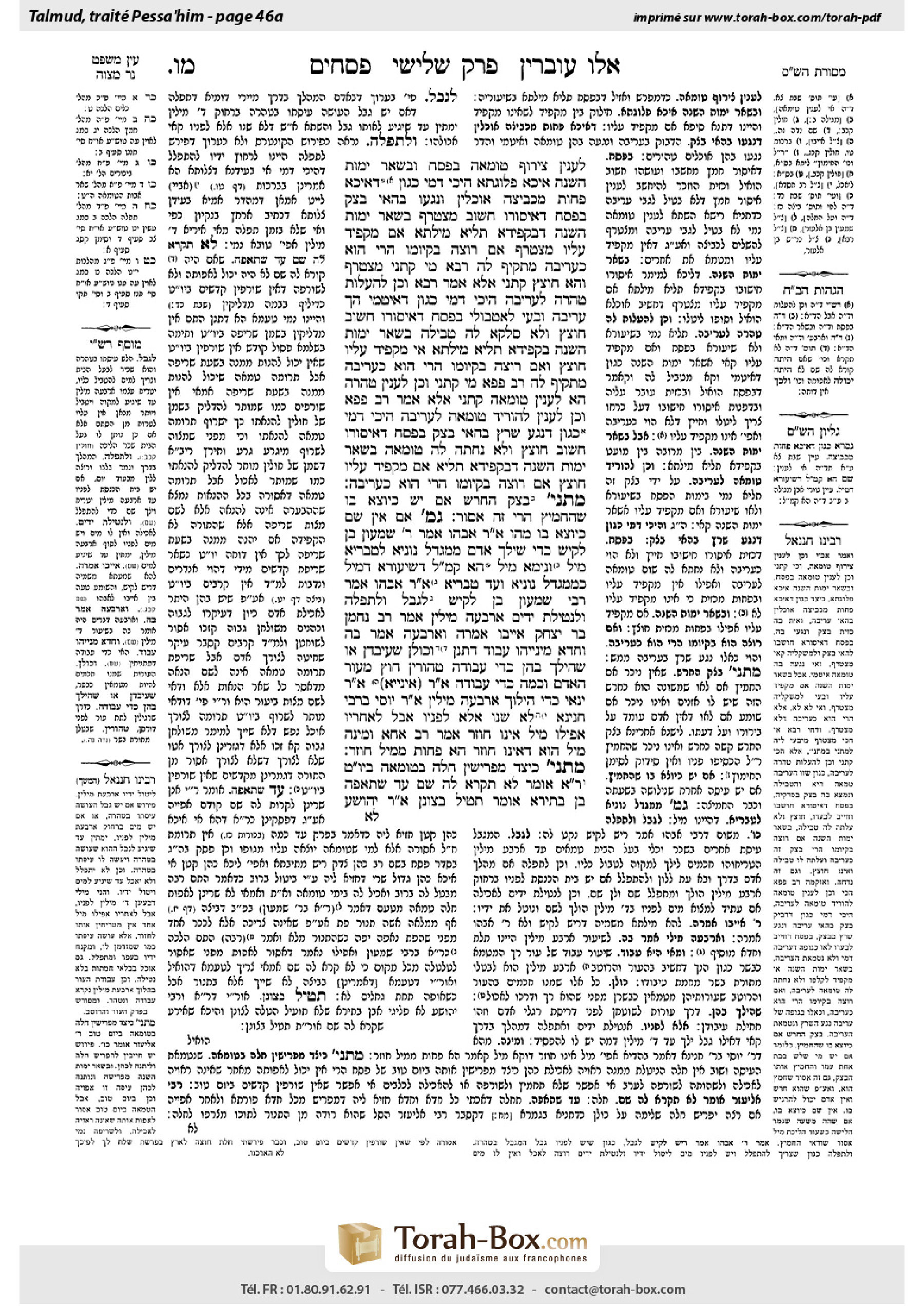
Pesachim 46a: Talmud study for Daf Yomi
Daf Yomi is the daily study of one Talmud folio. Explore 37 tractates with scans, Hebrew text, Sefaria English and AI-generated French translations where annotated.
Passage selection and English or AI-generated French translation are available where the scan has annotations. Daf Study is independent of Torah-Box and Sefaria.
Browse Pesachim · פסחים · All tractatesPesachim 46a text and translations
This page of Pesachim includes the Aramaic text, an English translation and an AI-generated French translation, alongside the scan above.
פסחים מ״ו א · Aramaic and Hebrew text
לְעִנְיַן צֵירוּף טוּמְאָה בַּפֶּסַח, וּבִשְׁאָר יְמוֹת הַשָּׁנָה אִיכָּא פְּלוּגְתָּא.
הֵיכִי דָּמֵי, כְּגוֹן דְּאִיכָּא פָּחוֹת מִכְּבֵיצָה אוֹכָלִין, וְנָגְעוּ בְּהַאי בָּצֵק. בְּפֶסַח, דְּאִיסּוּרוֹ חָשׁוּב — מִצְטָרֵף. בִּשְׁאָר יְמוֹת הַשָּׁנָה, דְּבִקְפֵידָא תַּלְיָא מִילְּתָא, אִם מַקְפִּיד עָלָיו — מִצְטָרֵף, אִם רוֹצֶה בְּקִיּוּמוֹ — הֲרֵי הוּא כַּעֲרֵיבָה.
מַתְקֵיף לַהּ רָבָא: מִי קָתָנֵי ״מִצְטָרֵף״? וְהָא ״חוֹצֵץ״ קָתָנֵי. אֶלָּא אָמַר רָבָא: וְכֵן לְהַעֲלוֹת טׇהֳרָה לַעֲרֵיבָה.
הֵיכִי דָּמֵי, כְּגוֹן דְּאִיטַּמִּי הָךְ עֲרֵיבָה, וּבָעֵי לְאַטְבּוֹלֵי. בְּפֶסַח, דְּאִיסּוּרוֹ חָשׁוּב — חוֹצֵץ, וְלָא סָלְקָא לַהּ טְבִילָה. בִּשְׁאָר יְמוֹת הַשָּׁנָה בִּקְפִידָא תַּלְיָא מִילְּתָא. אִי מַקְפִּיד עָלָיו — חוֹצֵץ, וְאִם רוֹצֶה בְּקִיּוּמוֹ — הֲרֵי הוּא כַּעֲרֵיבָה.
מַתְקֵיף לַהּ רַב פָּפָּא: מִי קָתָנֵי ״וְכֵן לְעִנְיַן טׇהֳרָה״? הָא ״לְעִנְיַן טוּמְאָה״ קָתָנֵי! אֶלָּא אָמַר רַב פָּפָּא: וְכֵן לְעִנְיַן לְהוֹרִיד טוּמְאָה לַעֲרֵיבָה.
הֵיכִי דָּמֵי, כְּגוֹן דְּנָגַע שֶׁרֶץ בְּהַאי בָּצֵק. בְּפֶסַח דְּאִיסּוּרוֹ חָשׁוּב — חוֹצֵץ, וְלָא נָחֲתָה לַהּ טוּמְאָה. בִּשְׁאָר יְמוֹת הַשָּׁנָה דְּבִקְפִידָא תַּלְיָא, אִם מַקְפִּיד עָלָיו — חוֹצֵץ, אִם רוֹצֶה בְּקִיּוּמוֹ — הֲרֵי הוּא כַּעֲרֵיבָה.
מַתְנִי׳ בָּצֵק הַחֵרֵשׁ, אִם יֵשׁ כַּיּוֹצֵא בּוֹ שֶׁהֶחְמִיץ — הֲרֵי זֶה אָסוּר.
גְּמָ׳ אִם אֵין שָׁם כַּיּוֹצֵא בּוֹ מַהוּ? אֲמַר רַבִּי אֲבָהוּ אָמַר רַבִּי שִׁמְעוֹן בֶּן לָקִישׁ: כְּדֵי שֶׁיֵּלֵךְ אָדָם מִמִּגְדַּל נוּנַיָּא לִטְבֶרְיָא מִיל.
וְנֵימָא מִיל! הָא קָא מַשְׁמַע לַן דְּשִׁיעוּרָא דְּמִיל כְּמִמִּגְדַּל נוּנַיָּא וְעַד טְבֶרְיָא.
אָמַר רַבִּי אֲבָהוּ אָמַר רַבִּי שִׁמְעוֹן בֶּן לָקִישׁ: לְגַבָּל וְלִתְפִלָּה וְלִנְטִילַת יָדַיִם — אַרְבָּעָה מִילִין.
אָמַר רַב נַחְמָן בַּר יִצְחָק: אַיְיבוּ אַמְרַהּ, וְאַרְבְּעָה אֲמַר בַּהּ, וַחֲדָא מִינַּיְיהוּ עִבּוּד. דִּתְנַן: וְכוּלָּן שֶׁעִיבְּדָן, אוֹ שֶׁהִילֵּךְ בָּהֶן כְּדֵי עֲבוֹדָה — טְהוֹרִין, חוּץ מֵעוֹר הָאָדָם. וְכַמָּה כְּדֵי עֲבוֹדָה? אָמַר רַבִּי (אִינְיָיא) אָמַר רַבִּי יַנַּאי: כְּדֵי הִילּוּךְ אַרְבָּעָה מִילִין.
אָמַר רַבִּי יוֹסֵי בְּרַבִּי חֲנִינָא: לֹא שָׁנוּ אֶלָּא לְפָנָיו, אֲבָל לְאַחֲרָיו — אֲפִילּוּ מִיל אֵינוֹ חוֹזֵר. אָמַר רַב אַחָא, וּמִינַּהּ: מִיל — הוּא דְּאֵינוֹ חוֹזֵר, הָא פָּחוֹת מִמִּיל — חוֹזֵר.
מַתְנִי׳ כֵּיצַד מַפְרִישִׁין חַלָּה בְּטוּמְאָה בְּיוֹם טוֹב?
רַבִּי אֱלִיעֶזֶר אוֹמֵר: לֹא תִּקְרָא לָהּ שֵׁם עַד שֶׁתֵּאָפֶה. בֶּן בְּתֵירָא אוֹמֵר: תָּטִיל בְּצוֹנֵן. אָמַר רַבִּי יְהוֹשֻׁעַ:
Pesachim 46a · English translation
with regard to the combination of two pieces vis-à-vis ritual impurity during Passover, when it depends upon their volume. However, during the rest of the year there is a distinction based upon whether the owner is particular about it or not.
The Gemara explains: What are the circumstances of the mishna’s case? It is a case where there is less than an egg-bulk of ritually impure food, and it touched this dough in the bowl, and then it came into contact with ritually pure food. During Passover, when the prohibition that applies to the dough causes it to be considered significant although it is a very small quantity, it combines with the first piece of food. Together they are the size of an egg-bulk, which is able to transmit the ritual impurity of foods. However, during the rest of the year, when there is no prohibition that imparts this significance to the dough, the matter is dependent on the owner’s particularity; if he is particular about it, i.e., he does not want the dough to be there, it is considered food rather than part of the bowl, and it combines with the other piece of food. However, if one prefers its continued presence in its current location, it is considered like part of the kneading bowl itself, rather than food.
Rava strongly objects to this: Was the language taught in the mishna: Combines? Didn’t the mishna teach that it interposes? Abaye’s explanation does not account for this term. Rather, Rava said that the mishna should be understood as saying: And so too with regard to purifying the kneading bowl via immersion.
The Gemara explains: What are the circumstances of the mishna’s case? It is a case where the kneading bowl became ritually impure, and one wishes to immerse it. During Passover, when the prohibition of an olive-bulk of leaven causes it to be considered significant, it interposes between the water and the kneading bowl, and the immersion is ineffective. However, during the rest of the year, the matter depends upon whether or not the owner is particular about it. If he is particular about the dough and wishes to remove it, it interposes between the water and the bowl. However, if the owner desires it to be present, it is considered like part of the kneading bowl itself, and it does not interpose between the water and the bowl.
Rav Pappa strongly objects to this: Was the language taught in the mishna: And similarly with regard to ritual purity? Didn’t the mishna teach: And similarly with regard to ritual impurity? Rather, Rav Pappa said the mishna should be understood as saying: And similarly with regard to the transfer of ritual impurity to the kneading bowl via this dough.
The Gemara explains: What are the circumstances of the mishna’s case? It is a case where the carcass of a creeping animal touched this dough. During Passover, when its prohibition causes the dough to be considered significant, it interposes between the bowl and the creeping animal, and ritual impurity does not descend to the kneading bowl, i.e., the kneading bowl does not become impure. During the rest of the year, when it depends upon whether one is particular about the presence of the dough, if he is particular about it, it interposes between the bowl and the creeping animal and prevents the bowl from becoming impure. However, if he desires it to be present, it is considered like it is part of the kneading bowl itself. Therefore, the entire bowl becomes ritually impure when the carcass of the creeping animal touches the dough.
MISHNA: Deaf dough is dough for which it is difficult to determine if it has been leavened. It is comparable to a deaf-mute, who cannot communicate. If there is dough similar to it in that water was added to both at the same time, which became leavened, the deaf dough is prohibited. Although it has not shown external signs of becoming leavened, it can be presumed that the deaf dough has also become leavened.
GEMARA: The Gemara seeks to clarify the ruling of the mishna: If there is no dough similar to it, what is the halakha? Rabbi Abbahu said that Rabbi Shimon ben Lakish said: According to the Sages, leavening occurs in the time it takes a person to walk the distance from Migdal Nunaya to Tiberias, which is a mil, two thousand cubits.
The Gemara asks about this formulation: Why is it necessary to mention the distance between these two places? Let us say that leavening begins after the time it takes a person to walk a mil. The Gemara answers: This statement incidentally teaches us that the length of a mil is the distance from Migdal Nunaya to Tiberias.
Rabbi Abbahu said that Rabbi Shimon ben Lakish said: With regard to a kneader, i.e., one who kneads dough for others and should maintain the ritual purity of the dough; and similarly, with regard to washing one’s hands for prayer (Arukh), and with regard to washing hands before eating, one must search either for a ritual bath to immerse the vessel he is using to knead the dough, or for water to purify his hands, provided that water is accessible within the time it takes to walk four mil, eight thousand cubits.
Rav Naḥman bar Yitzḥak said: Ayvu said this halakha, and he said it about four cases, as opposed to the three cases mentioned previously. And one of them pertained to the tanning of hides, which lasts for the time that it takes a person to walk four mil. As we learned in a mishna: And all types of thin, soft hides, which have the status of flesh with regard to ritual impurity because their texture is similar to flesh, that were tanned in order to be made into leather, or that one trod upon for as long as necessary for the leatherworking process, are ritually pure. They are considered to be leather and are no longer considered like the flesh of the animal, except for the skin of a human corpse, which always remains ritually impure. The Gemara asks: How much time must one tread upon a hide for the leatherworking process? Rabbi Ayvu said that Rabbi Yannai said: It is the amount of time it takes to walk four mil.
Rabbi Yosei, son of Rabbi Ḥanina, said: They taught that one must search for water to wash one’s hands before eating or prayer for the amount of time it takes to walk four mil only when the water is before him, in the direction that he is traveling. However, when it is behind him, he need not return even a mil. Rav Aḥa said: From this statement one may infer that he need not return a mil, but he must return less than one mil in order to obtain water.
MISHNA: How does one separate ḥalla in ritual impurity during the Festival day of Passover? Ordinarily, one may separate ritually pure ḥalla from dough and give it to a priest immediately so that he may eat it. Ritually impure ḥalla is unfit for a priest and must be burned, yet it is prohibited to bake or burn anything that is not fit to be eaten during the Festival day. However, it is also prohibited to wait and burn it after the Festival day, since it will become leavened in the meantime.
Rabbi Eliezer says: A woman should not designate it as ḥalla prior to baking; rather, she should refrain from doing so until it is baked. In other words, she should wait until she has baked all of the dough, and there is no risk of it becoming leavened. Only then should she separate ḥalla from it. The portion of ḥalla may then be kept until after the Festival day, when it may be burned. Ben Beteira says: She should separate the ḥalla before it is baked, and place the dough in cold water so that it will not become leavened. Rabbi Yehoshua said:
Pesachim 46a · Traduction française (IA)
en ce qui concerne la combinaison de deux morceaux au regard de l’impureté rituelle pendant Pessaḥ, lorsque celle-ci dépend de leur volume. En revanche, pendant le reste de l’année, la distinction dépend du fait que le propriétaire y attache ou non de l’importance.
La Guemara explique : dans quelles circonstances se présente le cas de la Michna ? Il s’agit d’une quantité de nourriture rituellement impure inférieure au volume d’un œuf, qui a touché cette pâte dans le bol, puis est entrée en contact avec de la nourriture rituellement pure. Pendant Pessaḥ, l’interdit qui s’applique à la pâte la rend importante, bien qu’elle soit en très petite quantité ; elle se combine donc avec le premier morceau de nourriture. Ensemble, ils atteignent le volume d’un œuf, qui permet de transmettre l’impureté rituelle aux aliments. En revanche, pendant le reste de l’année, comme aucun interdit ne confère cette importance à la pâte, la question dépend du fait que le propriétaire y attache ou non de l’importance : s’il y attache de l’importance, c’est-à-dire s’il ne veut pas que la pâte soit là, elle est considérée comme de la nourriture plutôt que comme une partie du bol, et elle se combine avec l’autre morceau de nourriture. En revanche, s’il préfère qu’elle reste à sa place, elle est considérée comme faisant partie du bol à pétrir lui-même, et non comme de la nourriture.
Rava s’y oppose vivement : la Michna dit-elle « se combine » ? Ne dit-elle pas plutôt que la pâte fait écran ? L’explication d’Abayé ne rend pas compte de ce terme. Rava dit donc que la Michna doit être comprise ainsi : et de même, en ce qui concerne la purification du bol à pétrir par immersion.
La Guemara explique : dans quelles circonstances se présente le cas de la Michna ? Le bol à pétrir est devenu rituellement impur et l’on souhaite l’immerger. Pendant Pessaḥ, l’interdit portant sur un volume d’un olive de levain le rend important ; il fait donc écran entre l’eau et le bol à pétrir, et l’immersion est inefficace. En revanche, pendant le reste de l’année, la question dépend du fait que le propriétaire y attache ou non de l’importance. S’il attache de l’importance à la pâte et souhaite l’enlever, elle fait écran entre l’eau et le bol. En revanche, si le propriétaire souhaite qu’elle soit présente, elle est considérée comme faisant partie du bol à pétrir lui-même et ne fait pas écran entre l’eau et le bol.
Rav Pappa s’y oppose vivement : la Michna dit-elle « de même, en ce qui concerne la pureté rituelle » ? Ne dit-elle pas plutôt « de même, en ce qui concerne l’impureté rituelle » ? Rav Pappa dit donc que la Michna doit être comprise ainsi : et de même, en ce qui concerne la transmission de l’impureté rituelle au bol à pétrir par l’intermédiaire de cette pâte.
La Guemara explique : dans quelles circonstances se présente le cas de la Michna ? La carcasse d’un animal rampant a touché cette pâte. Pendant Pessaḥ, l’interdit qui s’applique à la pâte lui confère de l’importance ; elle fait donc écran entre le bol et l’animal rampant, et l’impureté rituelle ne se transmet pas au bol à pétrir, c’est-à-dire que celui-ci ne devient pas impur. En revanche, pendant le reste de l’année, la question dépend du fait que l’on attache ou non de l’importance à la présence de la pâte. Si l’on y attache de l’importance, elle fait écran entre le bol et l’animal rampant et empêche le bol de devenir impur. En revanche, si l’on souhaite qu’elle soit présente, elle est considérée comme faisant partie du bol à pétrir lui-même. Par conséquent, tout le bol devient rituellement impur lorsque la carcasse de l’animal rampant touche la pâte.
MICHNA : Une pâte « sourde » est une pâte dont il est difficile de déterminer si elle a levé. Elle est comparable à un sourd-muet, qui ne peut communiquer. S’il existe une pâte semblable, à laquelle on a ajouté de l’eau en même temps qu’à la première, et qui a levé, la pâte « sourde » est interdite. Bien qu’elle ne présente aucun signe extérieur de levée, on peut présumer qu’elle a également levé.
GUEMARA : La Guemara cherche à préciser la décision de la Michna : quelle est la halakha s’il n’existe pas de pâte semblable ? Rabbi Abbahou dit au nom de Rabbi Shimon ben Lakish : selon les Sages, la pâte lève pendant le temps qu’il faut à une personne pour parcourir la distance entre Migdal Nunaya et Tibériade, soit un mil, deux mille coudées.
La Guemara interroge cette formulation : pourquoi faut-il mentionner la distance entre ces deux localités ? Ne pourrait-on pas dire que la pâte commence à lever après le temps nécessaire pour parcourir un mil ? La Guemara répond : cette déclaration nous apprend incidemment que la longueur d’un mil correspond à la distance entre Migdal Nunaya et Tibériade.
Rabbi Abbahou dit au nom de Rabbi Shimon ben Lakish : en ce qui concerne celui qui pétrit de la pâte pour autrui et doit en préserver la pureté rituelle ; et de même, en ce qui concerne le lavage des mains avant la prière (Arukh) et le lavage des mains avant de manger, il faut chercher soit un mikvé où immerger le récipient utilisé pour pétrir la pâte, soit de l’eau pour se purifier les mains, à condition que l’eau soit accessible dans le temps nécessaire pour parcourir quatre mil, soit huit mille coudées.
Rav Naḥman bar Yitzḥak dit : Ayvu a enseigné cette halakha et l’a appliquée à quatre cas, contrairement aux trois cas mentionnés précédemment. L’un d’eux concernait le tannage des peaux, qui dure le temps nécessaire pour parcourir quatre mil. En effet, nous avons appris dans une Michna : toutes les sortes de peaux fines et souples, qui ont le statut de chair au regard de l’impureté rituelle parce que leur texture est semblable à celle de la chair, et qui ont été tannées pour être transformées en cuir, ou sur lesquelles on a marché pendant toute la durée nécessaire au travail du cuir, sont rituellement pures. Elles sont considérées comme du cuir et ne sont plus assimilées à la chair de l’animal, à l’exception de la peau d’un cadavre humain, qui demeure toujours rituellement impure. La Guemara demande : combien de temps faut-il marcher sur une peau pour le travail du cuir ? Rabbi Ayvu dit au nom de Rabbi Yannai : c’est le temps nécessaire pour parcourir quatre mil.
Rabbi Yosei, fils de Rabbi Ḥanina, dit : ils ont enseigné qu’il faut chercher de l’eau pour se laver les mains avant de manger ou de prier dans le délai nécessaire pour parcourir quatre mil uniquement lorsque l’eau se trouve devant soi, dans la direction où l’on se dirige. En revanche, si elle se trouve derrière soi, il n’est pas nécessaire de revenir, même d’un mil. Rav Aḥa dit : on peut déduire de cette déclaration qu’il n’est pas nécessaire de revenir d’un mil, mais qu’il faut revenir d’une distance inférieure à un mil pour obtenir de l’eau.
MICHNA : Comment prélève-t-on la ḥalla en état d’impureté rituelle pendant le jour de fête de Pessaḥ ? Habituellement, on peut prélever de la ḥalla rituellement pure sur la pâte et la donner aussitôt à un prêtre, afin qu’il la mange. La ḥalla rituellement impure ne convient pas à un prêtre et doit être brûlée ; toutefois, il est interdit de cuire ou de brûler, pendant le jour de fête, quoi que ce soit qui ne soit pas propre à la consommation. Mais il est également interdit d’attendre la fin du jour de fête pour la brûler, car entre-temps elle lèverait.
Rabbi Eliezer dit : une femme ne doit pas désigner la ḥalla avant la cuisson ; elle doit plutôt attendre que la pâte soit cuite. Autrement dit, elle doit attendre d’avoir cuit toute la pâte, de sorte qu’il n’y ait plus de risque qu’elle lève. Ce n’est qu’alors qu’elle doit en prélever la ḥalla. La portion de ḥalla peut ensuite être conservée jusqu’à la fin du jour de fête, où elle pourra être brûlée. Ben Beteira dit : elle doit prélever la ḥalla avant la cuisson et placer la pâte dans de l’eau froide afin qu’elle ne lève pas. Rabbi Yehoshua dit :
Traduction française générée par IA à partir de l’édition anglaise de Sefaria. Vérifie toujours un passage avec le texte source.
Text from Sefaria: William Davidson Edition - Vocalized Aramaic (CC BY NC); William Davidson Edition - English (CC BY NC).