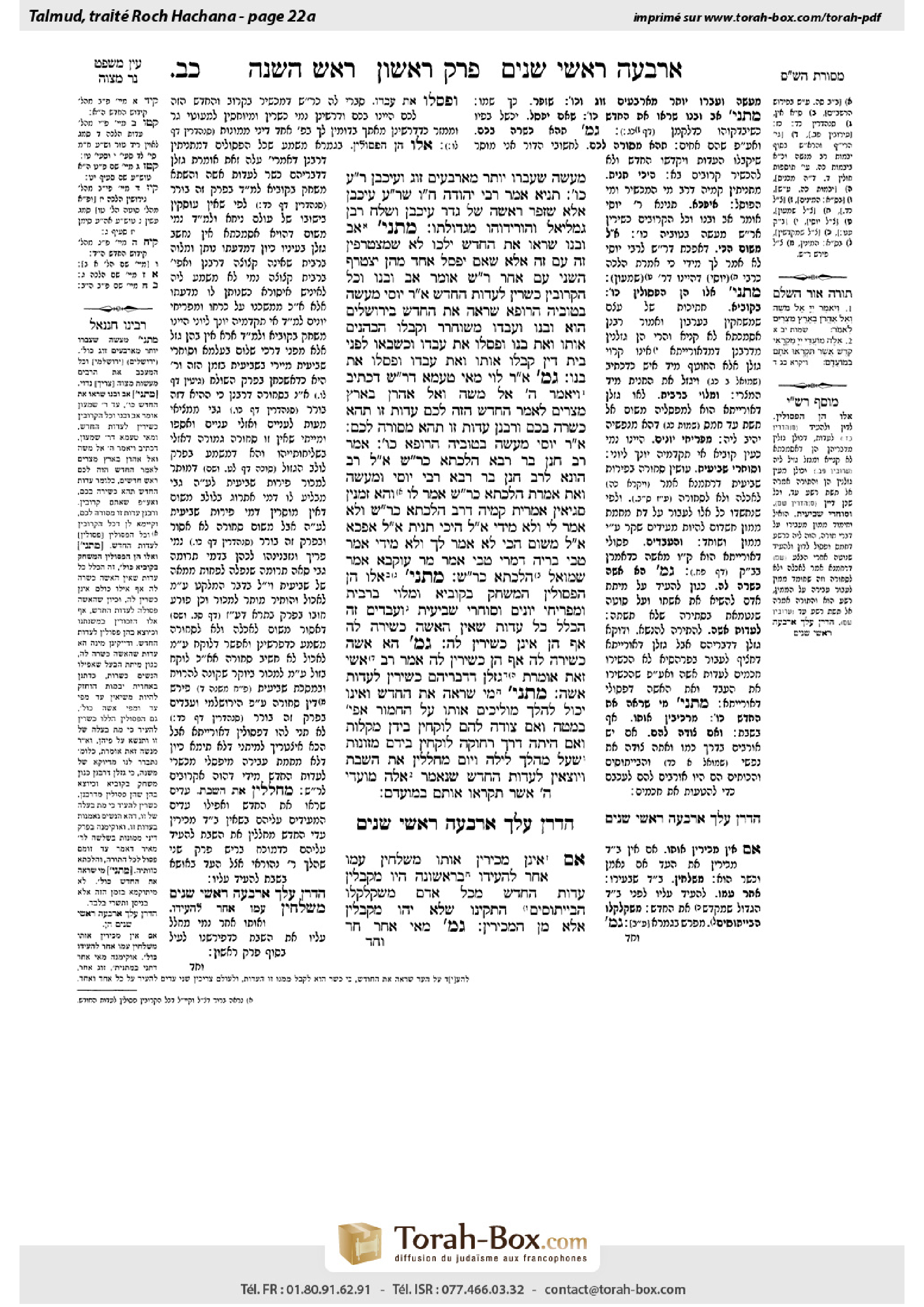
Rosh Hashanah 22a: Talmud study for Daf Yomi
Daf Yomi is the daily study of one Talmud folio. Explore 37 tractates with scans, Hebrew text, Sefaria English and AI-generated French translations where annotated.
Passage selection and English or AI-generated French translation are available where the scan has annotations. Daf Study is independent of Torah-Box and Sefaria.
Browse Rosh Hashanah · ראש השנה · All tractatesRosh Hashanah 22a text and translations
This page of Rosh Hashanah includes the Aramaic text, an English translation and an AI-generated French translation, alongside the scan above.
ראש השנה כ״ב א · Aramaic and Hebrew text
מַעֲשֶׂה שֶׁעָבְרוּ יוֹתֵר מֵאַרְבָּעִים זוּג וְעִיכְּבָן רַבִּי עֲקִיבָא כּוּ׳. תַּנְיָא, אָמַר רַבִּי יְהוּדָה: חַס וְשָׁלוֹם שֶׁרַבִּי עֲקִיבָא עִיכְּבָן. אֶלָּא שַׁזְפַּר רֹאשָׁהּ שֶׁל גֶּדֶר עִיכְּבָן, וְשִׁלַּח רַבָּן גַּמְלִיאֵל וְהוֹרִידוּהוּ מִגְּדוּלָּתוֹ.
מַתְנִי׳ אָב וּבְנוֹ שֶׁרָאוּ אֶת הַחֹדֶשׁ — יֵלְכוּ. לֹא שֶׁמִּצְטָרְפִין זֶה עִם זֶה, אֶלָּא שֶׁאִם יִפָּסֵל אֶחָד מֵהֶן — יִצְטָרֵף הַשֵּׁנִי עִם אַחֵר. רַבִּי שִׁמְעוֹן אוֹמֵר: אָב וּבְנוֹ וְכׇל הַקְּרוֹבִין כְּשֵׁרִין לְעֵדוּת הַחֹדֶשׁ.
אָמַר רַבִּי יוֹסֵי: מַעֲשֶׂה בְּטוֹבִיָּה הָרוֹפֵא שֶׁרָאָה אֶת הַחֹדֶשׁ בִּירוּשָׁלַיִם, הוּא וּבְנוֹ וְעַבְדּוֹ מְשׁוּחְרָר, וְקִבְּלוּ הַכֹּהֲנִים אוֹתוֹ וְאֶת בְּנוֹ וּפָסְלוּ אֶת עַבְדּוֹ. וּכְשֶׁבָּאוּ לִפְנֵי בֵּית דִּין — קִבְּלוּ אוֹתוֹ וְאֶת עַבְדּוֹ, וּפָסְלוּ אֶת בְּנוֹ.
גְּמָ׳ אָמַר רַבִּי לֵוִי: מַאי טַעְמָא דְּרַבִּי שִׁמְעוֹן, דִּכְתִיב: ״וַיֹּאמֶר ה׳ אֶל מֹשֶׁה וְאֶל אַהֲרֹן בְּאֶרֶץ מִצְרַיִם לֵאמֹר. הַחֹדֶשׁ הַזֶּה לָכֶם״ — עֵדוּת זוֹ תְּהֵא כְּשֵׁרָה בָּכֶם.
וְרַבָּנַן? עֵדוּת זוֹ תְּהֵא מְסוּרָה לָכֶם.
אָמַר רַבִּי יוֹסֵי מַעֲשֶׂה בְּטוֹבִיָּה הָרוֹפֵא כּוּ׳. אָמַר רַב חָנָן בַּר רָבָא: הִלְכְתָא כְּרַבִּי שִׁמְעוֹן. אֲמַר לֵיהּ רַב הוּנָא לְרַב חָנָן בַּר רָבָא: רַבִּי יוֹסֵי וּמַעֲשֶׂה, וְאַתְּ אָמְרַתְּ הִלְכְתָא כְּרַבִּי שִׁמְעוֹן?!
אָמַר לוֹ: וְהָא זִמְנִין סַגִּיאִין אֲמַרִית קַמֵּיהּ דְּרַב הִלְכְתָא כְּרַבִּי שִׁמְעוֹן וְלָא אֲמַר לִי וְלָא מִידֵּי! אֲמַר לֵיהּ: הֵיכִי תָּנֵית? אֲמַר לֵיהּ: אִפְּכָא. אֲמַר לֵיהּ: מִשּׁוּם הָכִי לָא אֲמַר לָךְ וְלָא מִידֵּי. אָמַר טָבִי בְּרֵיהּ דְּמָרִי טָבִי אָמַר מָר עוּקְבָא אָמַר שְׁמוּאֵל: הִלְכְתָא כְּרַבִּי שִׁמְעוֹן.
מַתְנִי׳ אֵלּוּ הֵן הַפְּסוּלִין: הַמְשַׂחֵק בְּקוּבְיָא, וּמַלְוֵי בְּרִבִּית, וּמַפְרִיחֵי יוֹנִים, וְסוֹחֲרֵי שְׁבִיעִית, וַעֲבָדִים. זֶה הַכְּלָל: כׇּל עֵדוּת שֶׁאֵין הָאִשָּׁה כְּשֵׁירָה לָהּ, אַף הֵן אֵינָן כְּשֵׁירִין לָהּ.
גְּמָ׳ הָא אִשָּׁה כְּשֵׁירָה לָהּ — אַף הֵן כְּשֵׁירִין לָהּ. אָמַר רַב אָשֵׁי: זֹאת אוֹמֶרֶת, גַּזְלָן דְּדִבְרֵיהֶם כְּשֵׁירִין לְעֵדוּת אִשָּׁה.
מַתְנִי׳ מִי שֶׁרָאָה אֶת הַחֹדֶשׁ וְאֵינוֹ יָכוֹל לְהַלֵּךְ — מוֹלִיכִים אוֹתוֹ עַל הַחֲמוֹר, אֲפִילּוּ בְּמִטָּה. וְאִם צוֹדֶה לָהֶם, — לוֹקְחִין בְּיָדָן מַקְלוֹת.
וְאִם הָיְתָה דֶּרֶךְ רְחוֹקָה — לוֹקְחִין בְּיָדָם מְזוֹנוֹת. שֶׁעַל מַהֲלַךְ לַיְלָה וָיוֹם, מְחַלְּלִין אֶת הַשַּׁבָּת וְיוֹצְאִין לְעֵדוּת הַחֹדֶשׁ, שֶׁנֶּאֱמַר: ״אֵלֶּה מוֹעֲדֵי ה׳ אֲשֶׁר תִּקְרְאוּ אוֹתָם בְּמוֹעֲדָם״.
הֲדַרַן עֲלָךְ אַרְבָּעָה רָאשֵׁי שָׁנִים
אִם אֵינָן מַכִּירִין אוֹתוֹ — מְשַׁלְּחִין עִמּוֹ אַחֵר לְהַעִידוֹ. בָּרִאשׁוֹנָה הָיוּ מְקַבְּלִין עֵדוּת הַחֹדֶשׁ מִכׇּל אָדָם. מִשֶּׁקִּלְקְלוּ הַבַּיְיתּוֹסִים, הִתְקִינוּ שֶׁלֹּא יְהוּ מְקַבְּלִין אֶלָּא מִן הַמַּכִּירִין.
גְּמָ׳ מַאי אַחֵר? חַד,
Rosh Hashanah 22a · English translation
§ It was taught in the mishna: There was once an incident where more than forty pairs of witnesses were passing through on their way to Jerusalem to testify about the new moon, and Rabbi Akiva detained them in Lod, telling them that there was no need for them to desecrate Shabbat for this purpose. It is taught in a baraita: Rabbi Yehuda said: Heaven forbid that Rabbi Akiva detained them, for he would certainly not have made such an error. Rather, it was that Zefer, the head of the city of Geder, detained them. And Rabban Gamliel sent and they removed him from his high office because he had acted inappropriately.
MISHNA: If a father and his son saw the new moon, they should both go to the court in Jerusalem. It is not that they can join together to give testimony, for close relatives are disqualified from testifying together, but they both go so that if one of them is disqualified, the second may join together with another witness to testify about the new moon. Rabbi Shimon says: A father and his son and all their relatives are fit to combine together as witnesses for testimony to determine the start of the month.
Rabbi Yosei said: There was an incident with Toviyya the doctor. When he saw the new moon in Jerusalem, he and his son and his freed slave all went to testify. The priests accepted him and his son as witnesses and disqualified his slave, for they ruled stringently that the month may be sanctified only on the basis of the testimony of those of Jewish lineage. And when they came before the court, they accepted him and his slave as witnesses and disqualified his son, due to the familial relationship.
GEMARA: Rabbi Levi said: What is the reason for Rabbi Shimon’s opinion permitting relatives to jointly testify about the new moon, despite the fact that relatives are generally disqualified from testifying together? It is as it is written: “And the Lord spoke to Moses and Aaron in the land of Egypt, saying: This month shall be to you the beginning of months; it shall be the first month of the year to you” (Exodus 12:1–2). The words “to you” come to teach that this testimony concerning the new moon will be valid even when it is given by you two, i.e., Moses and Aaron, who are brothers and could not ordinarily testify together.
The Gemara asks: And with regard to the Rabbis, who disagree with Rabbi Shimon and prohibit relatives from testifying together about the new moon, how do they understand this verse? The Gemara answers: They interpret the verse as follows: This testimony is given over to you and others like you. That is to say, the months are to be established by the most outstanding authorities of each generation.
§ The mishna taught: Rabbi Yosei said: There was an incident with Toviyya the doctor. When he saw the new moon in Jerusalem, he and his son and his freed slave all went to testify. Rav Ḥanan bar Rava said: The halakha is in accordance with the opinion of Rabbi Shimon. Relatives are permitted to testify together about the new moon. Rav Huna said to Rav Ḥanan bar Rava: But Rabbi Yosei, whose position is usually accepted over those of his colleagues, ruled otherwise, and also, there was an incident in which the court actually ruled against Rabbi Shimon, and yet you say that the halakha is in accordance with the opinion of Rabbi Shimon?
Rav Ḥanan bar Rava said to him: But many times I said before Rav that the halakha is in accordance with the opinion of Rabbi Shimon on this matter, and never did he say anything to me to indicate that he disagreed. Rav Huna said to him: How did you teach the mishna? Rav Ḥanan bar Rava said to him: With the opposite attributions, that is say, the position that is attributed in the mishna to Rabbi Yosei, I would teach in the name of Rabbi Shimon. Rav Huna said to him: Due to that reason, he never said anything to you, for according to your version you ruled correctly. Tavi, son of Mari Tavi, said that Mar Ukva said that Shmuel said: The halakha is in accordance with the opinion of Rabbi Shimon.
MISHNA: The following are unfit to give testimony, as they are considered thieves and robbers: One who plays with dice [kubbiyya] or other games of chance for money; and those who lend money with interest; and those who race pigeons and place wagers on the outcome; and merchants who deal in produce of the Sabbatical Year, which may be eaten, but may not be an object of commerce; and slaves. This is the principle: Any testimony for which a woman is unfit, these too are unfit. Although in certain cases a woman’s testimony is accepted, e.g., to testify to the death of someone’s husband, in the majority of cases her testimony is not valid.
GEMARA: This implies that any testimony for which a woman is fit, these too are fit. Rav Ashi said: That is to say, one who is regarded as a robber by rabbinic law, i.e., one who illegally came into possession of money but did not actually steal it from another, is like those mentioned in the mishna. Although they are generally unfit to give testimony, they are fit to give testimony to enable a woman to remarry.
MISHNA: With regard to one who saw the new moon but is unable to go to Jerusalem by foot because he is sick or has difficulty walking, others may bring him on a donkey or even in a bed, even on Shabbat if necessary. And if the witnesses are concerned that bandits may be lying in wait for them along the road, they may take clubs or other weapons in their hands, even on Shabbat.
And if it was a long journey to Jerusalem, they may take sustenance with them, although it is ordinarily prohibited to carry on Shabbat, since for a distance of a walk of a night and a day, the witnesses may desecrate Shabbat and go out to give testimony to determine the start of the month. This is as it is stated: “These are the Festivals of the Lord, sacred gatherings, which you shall declare in their seasons” (Leviticus 23:4). This teaches that, in all cases, the Festivals must be fixed at their proper times, even if it entails the transgression of Torah prohibitions.
MISHNA: If the members of the Great Sanhedrin in Jerusalem are not familiar with that one who saw the new moon, i.e., that he is a valid witness, the members of his local court of twenty-three send another with him to testify about him. The mishna adds: Initially, the court would accept testimony to determine the start of the month from any person, as all are presumed to be qualified witnesses, absent any disqualifying factors. However, when the Boethusians, a sect whose members had their own opinions with regard to the establishment of the Festivals, corrupted the process by sending false witnesses to testify about the new moon, the Sages instituted that they would accept this testimony only from those men familiar to the Sanhedrin as valid witnesses.
GEMARA: The Gemara asks: What is the meaning of the statement in the mishna that another would be sent along to testify with regard to the qualification of the witness to the new moon? If it means that one other individual would be sent,
Rosh Hashanah 22a · Traduction française (IA)
§ Il est enseigné dans la Michna : Il arriva une fois que plus de quarante paires de témoins se rendaient à Jérusalem pour témoigner au sujet de la nouvelle lune, et Rabbi Akiva les retint à Lod, leur disant qu’il n’était pas nécessaire qu’ils profanent le Chabbat à cette fin. Une baraïta enseigne : Rabbi Yehuda dit : À Dieu ne plaise que Rabbi Akiva les ait retenus, car il n’aurait certainement pas commis une telle erreur. En réalité, c’est Zefer, le chef de la ville de Geder, qui les retint. Rabban Gamliel envoya des hommes et le destitua de sa haute fonction, car il avait agi de manière inappropriée.
MICHNA : Si un père et son fils ont vu la nouvelle lune, ils doivent tous deux se rendre auprès du tribunal de Jérusalem. Non pas pour témoigner ensemble, car les proches parents ne sont pas habilités à témoigner ensemble, mais ils s’y rendent tous deux afin que, si l’un d’eux est disqualifié, l’autre puisse s’associer à un autre témoin pour témoigner au sujet de la nouvelle lune. Rabbi Shimon dit : Un père et son fils, ainsi que tous leurs proches, peuvent s’associer comme témoins pour déterminer le début du mois.
Rabbi Yosei dit : Il arriva une fois que Toviyya le médecin, après avoir vu la nouvelle lune à Jérusalem, se rendit pour témoigner avec son fils et son esclave affranchi. Les prêtres acceptèrent son témoignage et celui de son fils, et disqualifièrent son esclave, car ils statuèrent avec rigueur que le mois ne pouvait être sanctifié que sur la base du témoignage de personnes de lignée juive. Lorsqu’ils comparurent devant le tribunal, celui-ci accepta son témoignage et celui de son esclave, et disqualifia son fils en raison de leur lien de parenté.
GUEMARA : Rabbi Levi dit : Quelle est la raison de l’opinion de Rabbi Shimon, qui permet à des proches parents de témoigner ensemble au sujet de la nouvelle lune, alors que les proches parents ne sont généralement pas habilités à témoigner ensemble ? C’est ainsi qu’il est écrit : « L’Éternel parla à Moïse et à Aaron dans le pays d’Égypte, en disant : Ce mois sera pour vous le commencement des mois ; il sera pour vous le premier des mois de l’année » (Exode 12, 1-2). Les mots « pour vous » viennent enseigner que ce témoignage au sujet de la nouvelle lune est valable même lorsqu’il est rendu par vous deux, c’est-à-dire Moïse et Aaron, qui sont frères et ne pourraient normalement pas témoigner ensemble.
La Guemara demande : Et comment les rabbins, qui sont en désaccord avec Rabbi Shimon et interdisent aux proches parents de témoigner ensemble au sujet de la nouvelle lune, comprennent-ils ce verset ? La Guemara répond : Ils interprètent le verset ainsi : ce témoignage vous est confié, à vous et à d’autres comme vous. Autrement dit, les mois doivent être fixés par les autorités les plus éminentes de chaque génération.
§ La Michna enseignait : Rabbi Yosei dit : Il arriva une fois que Toviyya le médecin, après avoir vu la nouvelle lune à Jérusalem, se rendit pour témoigner avec son fils et son esclave affranchi. Rav Ḥanan bar Rava dit : La halakha suit l’opinion de Rabbi Shimon. Des proches parents sont autorisés à témoigner ensemble au sujet de la nouvelle lune. Rav Huna lui dit : Pourtant, Rabbi Yosei, dont l’opinion prévaut généralement sur celle de ses collègues, a statué autrement ; de plus, il y eut un cas où le tribunal statua effectivement contre Rabbi Shimon. Et malgré cela, tu dis que la halakha suit l’opinion de Rabbi Shimon ?
Rav Ḥanan bar Rava lui dit : Pourtant, j’ai dit de nombreuses fois devant Rav que la halakha suit l’opinion de Rabbi Shimon sur cette question, et jamais il ne m’a rien dit qui indique son désaccord. Rav Huna lui dit : Comment enseignais-tu la Michna ? Rav Ḥanan bar Rava lui dit : J’en enseignais les attributions inverses, c’est-à-dire que j’attribuais à Rabbi Shimon l’opinion qui, dans la Michna, est attribuée à Rabbi Yosei. Rav Huna lui dit : C’est pour cette raison qu’il ne t’a jamais rien dit, car, selon ta version, tu enseignais la bonne opinion. Tavi, fils de Mari Tavi, dit que Mar Ukva dit au nom de Shmuel : La halakha suit l’opinion de Rabbi Shimon.
MICHNA : Sont inaptes à témoigner, car ils sont considérés comme des voleurs et des brigands : celui qui joue aux dés [kubbiyya] ou à d’autres jeux de hasard pour de l’argent ; ceux qui prêtent de l’argent à intérêt ; ceux qui font courir des pigeons et misent sur l’issue de la course ; les commerçants qui font le commerce des produits de l’année sabbatique, lesquels peuvent être consommés mais ne peuvent faire l’objet d’un commerce ; et les esclaves. Voici le principe : tous ceux qui sont inaptes à rendre un témoignage pour lequel une femme est inapte le sont également. Bien que, dans certains cas, le témoignage d’une femme soit accepté, par exemple pour attester la mort du mari d’une personne, dans la majorité des cas, son témoignage n’est pas valable.
GUEMARA : Cela implique que tous ceux qui sont aptes à rendre un témoignage pour lequel une femme est apte le sont également. Rav Ashi dit : Cela signifie qu’une personne considérée comme un voleur selon le droit rabbinique, c’est-à-dire quelqu’un qui est entré illégalement en possession d’argent sans l’avoir effectivement volé à autrui, est assimilée aux personnes mentionnées dans la Michna. Bien qu’elles soient généralement inaptes à témoigner, elles sont aptes à témoigner afin de permettre à une femme de se remarier.
MICHNA : Celui qui a vu la nouvelle lune mais ne peut se rendre à pied à Jérusalem parce qu’il est malade ou qu’il a du mal à marcher peut être conduit par d’autres sur un âne ou même dans une litière, au besoin même le Chabbat. Et si les témoins craignent que des brigands ne les attendent en embuscade sur le chemin, ils peuvent prendre des bâtons ou d’autres armes, même le Chabbat.
Et si le trajet jusqu’à Jérusalem est long, ils peuvent emporter des provisions, bien qu’il soit ordinairement interdit de transporter des objets le Chabbat, car les témoins peuvent profaner le Chabbat et partir témoigner pour déterminer le début du mois lorsqu’il faut parcourir la distance d’une journée et d’une nuit de marche. C’est ce qui est énoncé : « Voici les fêtes de l’Éternel, les saintes convocations, que vous proclamerez en leur temps fixé » (Lévitique 23, 4). Cela enseigne qu’en toute circonstance, les fêtes doivent être fixées à leur temps propre, même si cela entraîne la transgression d’interdits de la Torah.
MICHNA : Si les membres du Grand Sanhédrin de Jérusalem ne connaissent pas la personne qui a vu la nouvelle lune, c’est-à-dire s’ils ne savent pas qu’elle est un témoin valable, les membres de son tribunal local de vingt-trois juges en envoient un autre avec elle pour témoigner en sa faveur. La Michna ajoute : À l’origine, le tribunal acceptait le témoignage visant à déterminer le début du mois de n’importe quelle personne, car tous étaient présumés être des témoins aptes, en l’absence de tout facteur disqualifiant. Cependant, lorsque les Boéthusiens, une secte dont les membres avaient leurs propres opinions concernant la fixation des fêtes, faussèrent la procédure en envoyant de faux témoins pour témoigner au sujet de la nouvelle lune, les Sages instituèrent que ce témoignage ne serait accepté que de personnes que le Sanhédrin connaissait comme des témoins valables.
GUEMARA : La Guemara demande : Que signifie, dans la Michna, l’affirmation selon laquelle une autre personne serait envoyée avec le témoin de la nouvelle lune pour attester qu’il est apte à témoigner ? S’il s’agit d’envoyer une autre personne,
Traduction française générée par IA à partir de l’édition anglaise de Sefaria. Vérifie toujours un passage avec le texte source.
Text from Sefaria: William Davidson Edition - Vocalized Aramaic (CC BY NC); William Davidson Edition - English (CC BY NC).