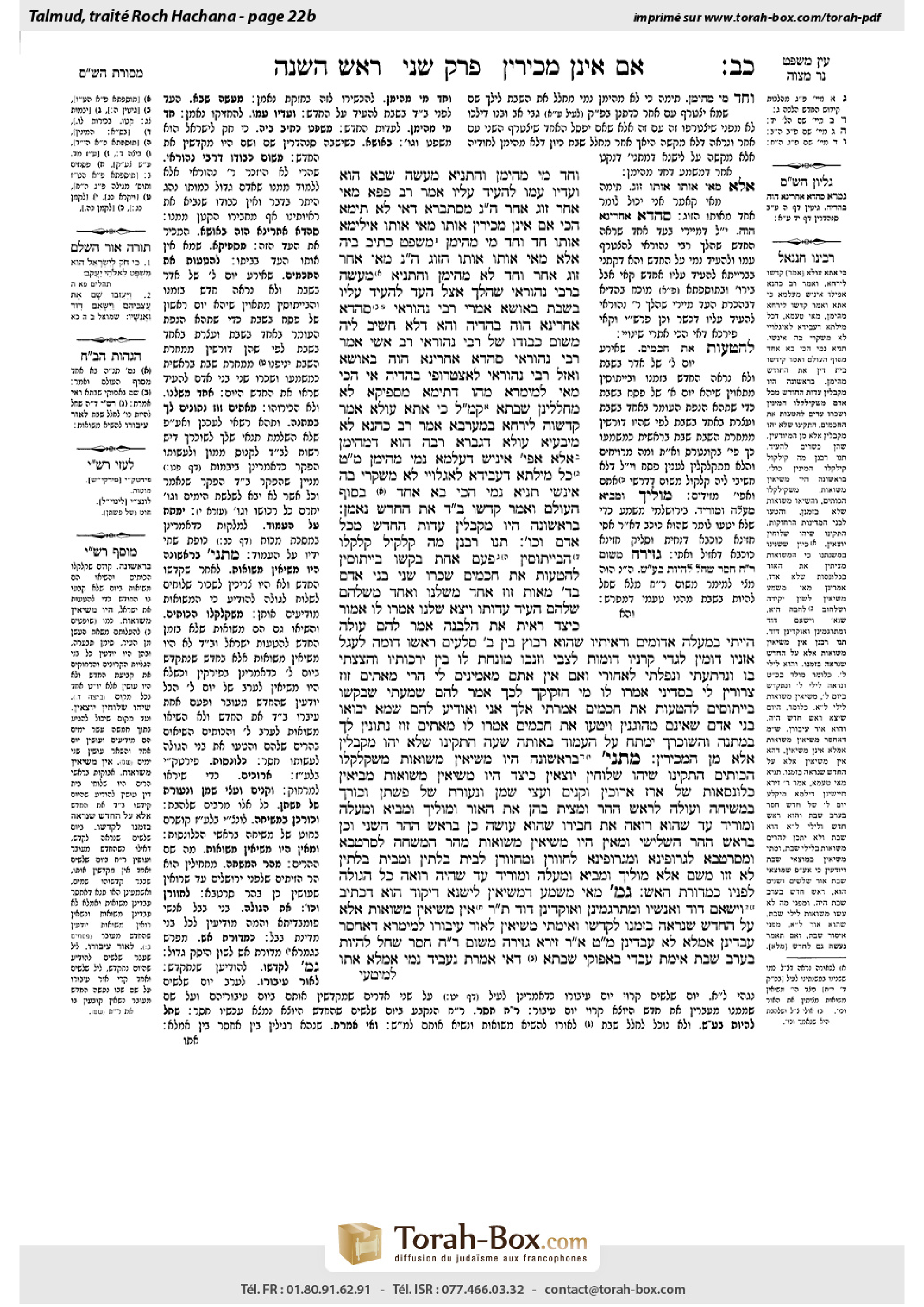
Rosh Hashanah 22b: Talmud study for Daf Yomi
Daf Yomi is the daily study of one Talmud folio. Explore 37 tractates with scans, Hebrew text, Sefaria English and AI-generated French translations where annotated.
Passage selection and English or AI-generated French translation are available where the scan has annotations. Daf Study is independent of Torah-Box and Sefaria.
Browse Rosh Hashanah · ראש השנה · All tractatesRosh Hashanah 22b text and translations
This page of Rosh Hashanah includes the Aramaic text, an English translation and an AI-generated French translation, alongside the scan above.
ראש השנה כ״ב ב · Aramaic and Hebrew text
וְחַד מִי מְהֵימַן?! וְהָתַנְיָא: מַעֲשֶׂה שֶׁבָּא הוּא וְעֵדָיו עִמּוֹ לְהָעִיד עָלָיו! אָמַר רַב פָּפָּא: מַאי ״אַחֵר״ — זוּג אַחֵר.
הָכִי נָמֵי מִסְתַּבְּרָא, דְּאִי לָא תֵּימָא הָכִי — ״אִם אֵינָן מַכִּירִין אוֹתוֹ״, מַאי ״אוֹתוֹ״? אִילֵּימָא ״אוֹתוֹ״ חַד — וְחַד מִי מְהֵימַן? ״מִשְׁפָּט״ כְּתִיב בֵּיהּ. אֶלָּא מַאי ״אוֹתוֹ״ — אוֹתוֹ הַזּוּג, הָכִי נָמֵי: מַאי ״אַחֵר״ — זוּג אַחֵר.
וְחַד לָא מְהֵימַן? וְהָתַנְיָא: מַעֲשֶׂה בְּרַבִּי נְהוֹרַאי שֶׁהָלַךְ אֵצֶל הָעֵד לְהָעִיד עָלָיו בְּשַׁבָּת בְּאוּשָׁא!
אָמְרִי: רַבִּי נְהוֹרַאי סָהֲדָא אַחֲרִינָא הֲוָה בַּהֲדֵיהּ, וְהָא דְּלָא חָשֵׁיב לֵיהּ — מִשּׁוּם כְּבוֹדוֹ שֶׁל רַבִּי נְהוֹרַאי. רַב אָשֵׁי אָמַר: רַבִּי נְהוֹרַאי סָהֲדָא אַחֲרִינָא הֲוָה בְּאוּשָׁא, וַאֲזַל רַבִּי נְהוֹרַאי לְאִצְטְרוֹפֵי בַּהֲדֵיהּ.
אִי הָכִי, מַאי לְמֵימְרָא? מַהוּ דְּתֵימָא: מִסְּפֵיקָא לָא מְחַלְּלִינַן שַׁבְּתָא, קָא מַשְׁמַע לַן.
כִּי אֲתָא עוּלָּא, אָמַר: קַדְּשׁוּהּ לְיַרְחָא בְּמַעְרְבָא. אָמַר רַב כָּהֲנָא: לָא מִיבַּעְיָא עוּלָּא, דְּגַבְרָא רַבָּה הוּא, דִּמְהֵימַן. אֶלָּא אֲפִילּוּ אִינִישׁ דְּעָלְמָא נָמֵי מְהֵימַן. מַאי טַעְמָא? כֹּל מִילְּתָא דַּעֲבִידָא לְאִגַּלּוֹיֵי — לָא מְשַׁקְּרִי בַּהּ אִינָשֵׁי. תַּנְיָא נָמֵי הָכִי: בָּא אֶחָד בְּסוֹף הָעוֹלָם וְאָמַר קִדְּשׁוּ בֵּית דִּין אֶת הַחֹדֶשׁ — נֶאֱמָן.
בָּרִאשׁוֹנָה הָיוּ מְקַבְּלִין עֵדוּת הַחֹדֶשׁ מִכׇּל אָדָם וְכוּ׳. תָּנוּ רַבָּנַן: מָה קִלְקוּל קִלְקְלוּ הַבַּיְיתּוֹסִין? פַּעַם אַחַת בִּקְּשׁוּ בַּיְיתּוֹסִין לְהַטְעוֹת אֶת חֲכָמִים, שָׂכְרוּ שְׁנֵי בְּנֵי אָדָם בְּאַרְבַּע מֵאוֹת זוּז, אֶחָד מִשֶּׁלָּנוּ, וְאֶחָד מִשֶּׁלָּהֶם.
שֶׁלָּהֶם — הֵעִיד עֵדוּתוֹ וְיָצָא. שֶׁלָּנוּ, אָמְרוּ לוֹ: אֱמוֹר כֵּיצַד רָאִיתָ אֶת הַלְּבָנָה! אָמַר לָהֶם: עוֹלֶה הָיִיתִי בְּמַעֲלֵה אֲדוּמִּים, וּרְאִיתִיו שֶׁהוּא רָבוּץ בֵּין שְׁנֵי סְלָעִים, רֹאשׁוֹ דּוֹמֶה לְעֵגֶל, אׇזְנָיו דּוֹמִין לִגְדִי, קַרְנָיו דּוֹמוֹת לִצְבִי, וּזְנָבוֹ מוּנַּחַת לוֹ בֵּין יַרְכוֹתָיו, וְהֵצַצְתִּי בּוֹ וְנִרְתַּעְתִּי וְנָפַלְתִּי לַאֲחוֹרַי. וְאִם אֵין אַתֶּם מַאֲמִינִים לִי — הֲרֵי מָאתַיִם זוּז צְרוּרִין לִי בִּסְדִינִי.
אָמְרוּ לוֹ: מִי הִזְקִיקְךָ לְכָךְ? אָמַר לָהֶם: שָׁמַעְתִּי שֶׁבִּקְּשׁוּ בַּיְיתּוֹסִים לְהַטְעוֹת אֶת חֲכָמִים, אָמַרְתִּי: אֵלֵךְ אֲנִי וְאוֹדִיעַ לָהֶם, שֶׁמָּא יָבוֹאוּ בְּנֵי אָדָם שֶׁאֵינָם מְהוּגָּנִין וְיַטְעוּ אֶת חֲכָמִים.
אָמְרוּ לוֹ: מָאתַיִם זוּז — נְתוּנִין לְךָ בְּמַתָּנָה, וְהַשּׂוֹכֶרְךָ יִמָּתַח עַל הָעַמּוּד. בְּאוֹתָהּ שָׁעָה הִתְקִינוּ שֶׁלֹּא יְהוּ מְקַבְּלִין אֶלָּא מִן הַמַּכִּירִין.
מַתְנִי׳ בָּרִאשׁוֹנָה הָיוּ מַשִּׂיאִין מַשּׂוּאוֹת. מִשֶּׁקִּלְקְלוּ הַכּוּתִים, הִתְקִינוּ שֶׁיְּהוּ שְׁלוּחִין יוֹצְאִין.
כֵּיצַד הָיוּ מַשִּׂיאִין מַשּׂוּאוֹת? מְבִיאִין כְּלוֹנְסָאוֹת שֶׁל אֶרֶז אֲרוּכִּין, וְקָנִים, וַעֲצֵי שֶׁמֶן, וּנְעוֹרֶת שֶׁל פִּשְׁתָּן. וְכוֹרֵךְ בִּמְשִׁיחָה וְעוֹלֶה לְרֹאשׁ הָהָר וּמַצִּית בָּהֶן אֶת הָאוּר. וּמוֹלִיךְ וּמֵבִיא וּמַעֲלֶה וּמוֹרִיד, עַד שֶׁהוּא רוֹאֶה אֶת חֲבֵירוֹ שֶׁהוּא עוֹשֶׂה כֵּן בְּרֹאשׁ הָהָר הַשֵּׁנִי, וְכֵן בְּרֹאשׁ הָהָר הַשְּׁלִישִׁי.
וּמֵאַיִן הָיוּ מַשִּׂיאִין מַשּׂוּאוֹת? מֵהַר הַמִּשְׁחָה לְסַרְטְבָא, וּמִסַּרְטְבָא לִגְרוֹפִינָא, וּמִגְּרוֹפִינָא לְחַוְורָן, וּמֵחַוְורָן לְבֵית בִּלְתִּין, וּמִבֵּית בִּלְתִּין לֹא זָזוּ מִשָּׁם, אֶלָּא מוֹלִיךְ וּמֵבִיא וּמַעֲלֶה וּמוֹרִיד עַד שֶׁהָיָה רוֹאֶה כׇּל הַגּוֹלָה לְפָנָיו כִּמְדוּרַת הָאֵשׁ.
גְּמָ׳ מַאי מַשְׁמַע דְּ״מַשִּׂיאִין״ לִישָּׁנָא דִּיקוֹד הוּא? דִּכְתִיב: ״וַיִּשָּׂאֵם דָּוִד וַאֲנָשָׁיו״, וּמְתַרְגְּמִינַן: וְאוֹקְדִינֻן דָּוִד.
תָּנוּ רַבָּנַן: אֵין מַשִּׂיאִין מַשּׂוּאוֹת אֶלָּא עַל הַחֹדֶשׁ שֶׁנִּרְאָה בִּזְמַנּוֹ לְקַדְּשׁוֹ. וְאֵימָתַי מַשִּׂיאִין — לְאוֹר עִיבּוּרוֹ.
לְמֵימְרָא דְּאַחָסֵר עָבְדִינַן, אַמָּלֵא לָא עָבְדִינַן. מַאי טַעְמָא? אָמַר רַבִּי זֵירָא: גְּזֵירָה מִשּׁוּם רֹאשׁ חֹדֶשׁ חָסֵר שֶׁחָל לִהְיוֹת בְּעֶרֶב שַׁבָּת. אֵימַת עָבְדִי — בְּאַפּוֹקֵי שַׁבְּתָא. דְּאִי אָמְרַתְּ נַעֲבֵיד נָמֵי אֲמַלֵּא — אָתוּ
Rosh Hashanah 22b · English translation
but is one witness deemed credible? Isn’t it taught in a baraita: There was an incident in which one potential witness came to testify, and his witnesses were with him, as they came to testify about him? The use of the plural indicates that two witnesses are required to establish someone as a valid eyewitness. Rav Pappa said: What is the meaning of the term: Another? It means another pair of witnesses.
The Gemara comments: This too stands to reason, for if you do not say so, then the opening statement of the mishna: If the members of the Great Sanhedrin are not familiar with that one, is problematic. What is the meaning of the term: That one? If we say it is referring to that one witness, is one witness deemed credible? The word: Judgment, is written with regard to the establishment of the New Moon and Rosh HaShana: “For it is a statute for Israel, a judgment of the God of Israel” (Psalms 81:5), and judgments require two witnesses. Rather, what is the meaning of the term: That one? That pair of witnesses. So too here, what is the meaning of the term: Another? Another pair of witnesses.
The Gemara asks: And is one witness not deemed credible to testify about the eyewitness who saw the new moon? Isn’t it taught in a baraita: There was an incident involving Rabbi Nehorai, who went with the witness to testify about him on Shabbat in Usha? Apparently, Rabbi Nehorai offered his testimony alone.
The Sages say in explanation of this incident: In fact, two witnesses are necessary, and in the case of Rabbi Nehorai there was another witness with him. And the fact that he was not mentioned is due to the honor of Rabbi Nehorai, so as not to indicate that the other was his equal. Rav Ashi said: In the incident involving Rabbi Nehorai, there was already another witness waiting in Usha and Rabbi Nehorai went to join him.
The Gemara asks: If so, what is the purpose of stating this incident at all? The Gemara answers: Lest you say that in a case of uncertainty one does not desecrate Shabbat, i.e., perhaps the witness in Usha would not be present that day, which would mean that Rabbi Nehorai desecrated Shabbat for no reason. Therefore, the Tosefta teaches us that for the important purpose of the New Moon, Shabbat may be desecrated even in a doubtful case.
§ When Ulla came from Eretz Yisrael to Babylonia, he said: They sanctified the New Moon on a certain date in the West, Eretz Yisrael. Although Ulla was the only witness, his testimony was accepted. Rav Kahana said: It is not necessary to say that Ulla, who is a great man, is deemed credible with regard to such testimony. Rather, even an ordinary person is deemed credible in this case, and there is no need for two witnesses. What is the reason for this? With regard to any matter that is likely to be revealed, people do not lie about it. The Gemara comments that this is also taught in a baraita: If one person comes from the other end of the world and says: The court sanctified the new month, he is deemed credible. There is no need for two witnesses.
The mishna taught: Initially, they would accept testimony to determine the start of the month from any person, and this continued until the Boethusians began to corrupt the process. The Sages taught a baraita that describes the decisive incident: What was the manner of the corruption in which the Boethusians engaged? Once, the Boethusians tried to mislead the Sages with regard to the day of the new moon. They hired two people for four hundred dinars to testify falsely that they had seen the new moon on the thirtieth day of the month. One of them was from our own, i.e., a member of the Pharisees and the Sages of Israel, and the other was one of theirs.
When they went in to testify, their witness submitted his testimony that he had seen the new moon, and then he left. When our witness came to testify, they said to him, in the customary manner: Say how you saw the moon. He said to them: I was ascending in Ma’ale Adumim and I saw that the new moon was crouched between two rocks. Its head was like that of a calf, its ears were like those of a kid, its horns were like those of a deer, and its tail was lying between its thighs. And I looked at it and was frightened and I fell backward. And if you do not believe me that this is what I saw, there are two hundred dinars wrapped in my cloak that were paid to me to deliver this testimony.
Realizing that the testimony of the first witness was also false, the Sages said to him: Who persuaded you to act in this manner? He said to them: I heard that the Boethusians were seeking to mislead the Sages, and I said to myself: I will go and hire myself out to give false testimony, and I will inform the Sages of the truth, lest unworthy people come and mislead the Sages.
The Sages said to him: The two hundred dinars that you received from the Boethusians are given to you as a gift. Although you did not carry out your mission, the court is authorized to declare the money ownerless and award it to you. And the one who hired you shall be stretched out on the post for flogging. At that time the Sages instituted that they would accept testimony about the new moon only from those men who were familiar to the Great Sanhedrin as qualified witnesses.
MISHNA: Initially, after the court sanctified the new month they would light torches on the mountaintops, from one peak to another, to signal to the community in Babylonia that the month had been sanctified. After the Samaritans [Kutim] corrupted and ruined this method by lighting torches at the wrong times to confuse the Jews, the Sages instituted that messengers should go out to the Diaspora and inform them of the start of the month.
The mishna asks: How would they light the torches during that earlier period? They would bring items that burn well, e.g., long poles of cedar, reeds, pinewood, and beaten flax, and tie them together with a string. And someone would then ascend to the top of the mountain and light the torch on fire with them, and wave it back and forth and up and down, until he would see his colleague doing likewise on the top of the second mountain. In this manner he would know that the next messenger had received the message and passed it on. And similarly, the second torchbearer would wait for a signal from the one on the top of the third mountain, and so on. In this manner the message would reach the Diaspora.
And from which mountains would they light the torches? They would transmit the message from the Mount of Olives in Jerusalem to Sartava, and from Sartava to Gerofina, and from Gerofina to Ḥavran, and from Ḥavran to Beit Baltin. And from Beit Baltin they would not move to light torches in any other predetermined location. Rather, the one who was appointed for this task would wave the torch back and forth and up and down, until he would see the entire Diaspora before him alight like one large bonfire, as they would light torches to continue transmitting the message from place to place all the way to the farthest reaches of the Diaspora.
GEMARA: The mishna taught that they would light torches [masi’in]. The Gemara asks: From where may it be inferred that the term masi’in is an expression of burning? As it is written: “Vayisa’em David and his men” (II Samuel 5:21), and we translate the verse as: And David and his men burned them.
The Sages taught in a baraita: Torches were lit only for a new month whose moon was seen at its proper time, i.e., on the thirtieth day of the outgoing month, to sanctify the upcoming New Moon on that date and declare the previous month as containing twenty-nine days. In this case, the thirtieth day would be declared the first day of the following month. And when would they light the torches? It was on the eve of its additional day, the one that would have been added had it been a full, thirty-day month, i.e., on the eve of the thirty-first day of the outgoing month.
The Gemara asks: Is this to say that for the conclusion of a deficient month of twenty-nine days one performs the sequence of lighting torches, but for a full month one does not perform it? What is the reason for this? Rabbi Zeira said: This is a rabbinic decree that was instituted due to the case of a New Moon following a deficient, twenty-nine-day month that occurs on Shabbat eve. In that case, when do they perform the lighting? At the conclusion of Shabbat, as it is prohibited to light a fire on Friday night. The reason for the decree is that if you say that one performs the lighting of torches for a full, thirty-day month as well, people might come
Rosh Hashanah 22b · Traduction française (IA)
Mais un seul témoin est-il jugé digne de foi ? N’est-il pas enseigné dans une baraïta : « Un jour, un témoin potentiel vint déposer, accompagné de ses témoins, qui venaient témoigner à son sujet » ? L’emploi du pluriel indique qu’il faut deux témoins pour établir qu’une personne est un témoin oculaire qualifié. Rav Pappa dit : Que signifie le terme « un autre » ? Il désigne une autre paire de témoins.
La Guemara fait remarquer : Cela aussi est logique, car, si l’on ne dit pas cela, le début de la Michna pose problème : « Si les membres du Grand Sanhédrin ne connaissent pas cette personne ». Que signifie le terme « cette personne » ? Si l’on dit qu’il désigne ce témoin, un seul témoin est-il jugé digne de foi ? Le mot « jugement » est écrit à propos de la sanctification du nouveau mois et de Roch Hachana : « Car c’est un décret pour Israël, un jugement du Dieu de Jacob » (Psaumes 81,5), et les jugements requièrent deux témoins. Que signifie donc le terme « cette personne » ? Cette paire de témoins. De même ici, que signifie le terme « un autre » ? Une autre paire de témoins.
La Guemara demande : Un seul témoin n’est-il donc pas jugé digne de foi pour témoigner au sujet du témoin oculaire qui a vu la nouvelle lune ? N’est-il pas enseigné dans une baraïta : « Un jour, Rabbi Nehorai accompagna le témoin pour déposer à son sujet le Chabbat, à Oucha » ? Il semblerait donc que Rabbi Nehorai ait témoigné seul.
Les Sages expliquent cet épisode : En réalité, deux témoins sont nécessaires et, dans le cas de Rabbi Nehorai, un autre témoin était avec lui. Le fait que ce dernier ne soit pas mentionné tient au respect dû à Rabbi Nehorai, afin de ne pas laisser entendre que l’autre lui était égal. Rav Ashi dit : Dans l’épisode de Rabbi Nehorai, un autre témoin attendait déjà à Oucha, et Rabbi Nehorai était allé le rejoindre.
La Guemara demande : Si c’est ainsi, pourquoi mentionner cet épisode ? La Guemara répond : De peur que tu ne dises que, dans un cas d’incertitude, on ne profane pas le Chabbat, car peut-être le témoin ne serait-il pas présent à Oucha ce jour-là, auquel cas Rabbi Nehorai aurait profané le Chabbat sans raison. La Tossefta nous enseigne donc que, pour l’importante mitsva de la sanctification du nouveau mois, on peut profaner le Chabbat même en cas de doute.
§ Quand Oula arriva d’Erets Israël en Babylonie, il dit : « Ils ont sanctifié le nouveau mois à telle date, en Occident », c’est-à-dire en Erets Israël. Bien qu’Oula fût le seul témoin, son témoignage fut accepté. Rav Kahana dit : Il n’est pas nécessaire de préciser qu’Oula, qui est un grand homme, est jugé digne de foi pour un tel témoignage. Même une personne ordinaire est jugée digne de foi dans ce cas, et deux témoins ne sont pas nécessaires. Pour quelle raison ? On ne ment pas sur une affaire susceptible d’être révélée. La Guemara fait remarquer que cela est également enseigné dans une baraïta : « Si quelqu’un vient de l’autre bout du monde et dit : “Le tribunal a sanctifié le nouveau mois”, il est jugé digne de foi. » Deux témoins ne sont pas nécessaires.
La Michna enseignait : Au début, ils acceptaient le témoignage de toute personne pour déterminer le début du mois, et cela continua jusqu’à ce que les Boéthusiens commencent à fausser la procédure. Les Sages enseignèrent dans une baraïta qui décrit l’incident décisif : En quoi consistait la falsification à laquelle se livraient les Boéthusiens ? Un jour, les Boéthusiens tentèrent d’induire les Sages en erreur au sujet du jour de la nouvelle lune. Ils engagèrent deux hommes pour quatre cents dinars afin qu’ils témoignent faussement avoir vu la nouvelle lune le trentième jour du mois. L’un d’eux était des nôtres, c’est-à-dire un membre des Pharisiens et des Sages d’Israël, et l’autre était l’un des leurs.
Lorsqu’ils entrèrent pour témoigner, leur témoin déposa qu’il avait vu la nouvelle lune, puis il partit. Quand notre témoin vint déposer, on lui dit, selon l’usage : « Raconte comment tu as vu la lune. » Il leur dit : « Je montais à Ma’ale Adumim et j’ai vu la nouvelle lune accroupie entre deux rochers. Sa tête était comme celle d’un veau, ses oreilles comme celles d’un chevreau, ses cornes comme celles d’un cerf, et sa queue reposait entre ses cuisses. Je l’ai regardée, j’ai été effrayé et je suis tombé à la renverse. Et si vous ne me croyez pas lorsque je dis que c’est ce que j’ai vu, il y a deux cents dinars enveloppés dans mon manteau, qu’on m’a payés pour déposer ainsi. »
Comprenant que le témoignage du premier témoin était lui aussi faux, les Sages lui dirent : « Qui t’a persuadé d’agir ainsi ? » Il leur répondit : « J’ai entendu dire que les Boéthusiens cherchaient à induire les Sages en erreur, et je me suis dit : “Je vais aller me faire engager pour fournir un faux témoignage, et j’informerai les Sages de la vérité, de peur que des gens indignes ne viennent les induire en erreur.” »
Les Sages lui dirent : « Les deux cents dinars que tu as reçus des Boéthusiens te sont accordés en cadeau. Bien que tu n’aies pas accompli ta mission, le tribunal est habilité à déclarer cet argent sans propriétaire et à te l’attribuer. Quant à celui qui t’a engagé, qu’on l’étende sur le poteau pour le fouetter. » À cette époque, les Sages instituèrent qu’ils n’accepteraient de témoignage au sujet de la nouvelle lune que de la part d’hommes que le Grand Sanhédrin connaissait comme témoins qualifiés.
MICHNA : Au début, après que le tribunal avait sanctifié le nouveau mois, on allumait des torches au sommet des montagnes, d’un sommet à l’autre, pour signaler à la communauté de Babylonie que le mois avait été sanctifié. Après que les Samaritains [Kutim] eurent corrompu et ruiné cette méthode en allumant les torches au mauvais moment afin de semer la confusion parmi les Juifs, les Sages instituèrent l’envoi de messagers dans la Diaspora pour les informer du début du mois.
La Michna demande : Comment allumaient-ils les torches à cette époque ? Ils apportaient des matières qui brûlent bien, par exemple de longues perches de cèdre, des roseaux, du bois de pin et du lin cardé, puis les attachaient ensemble avec une corde. Quelqu’un montait ensuite au sommet de la montagne et allumait avec ces matières la torche, qu’il faisait osciller d’avant en arrière et de haut en bas jusqu’à ce qu’il voie son compagnon faire de même au sommet de la deuxième montagne. Il savait ainsi que le messager suivant avait reçu le message et l’avait transmis. De même, le deuxième porteur de torche attendait un signal de celui qui se trouvait au sommet de la troisième montagne, et ainsi de suite. De cette façon, le message parvenait à la Diaspora.
Et de quelles montagnes allumaient-ils les torches ? Ils transmettaient le message depuis le mont des Oliviers, à Jérusalem, jusqu’à Sartava, de Sartava à Gerofina, de Gerofina à Ḥavran, et de Ḥavran à Beit Baltin. Depuis Beit Baltin, ils ne se déplaçaient pas pour allumer des torches en d’autres lieux prédéterminés. Celui qui était chargé de cette tâche faisait plutôt osciller sa torche d’avant en arrière et de haut en bas, jusqu’à ce qu’il voie toute la Diaspora s’embraser devant lui comme un immense brasier, tandis que l’on allumait des torches pour continuer à transmettre le message de lieu en lieu, jusqu’aux confins les plus éloignés de la Diaspora.
GUEMARA : La Michna enseignait qu’ils allumaient des torches [masi’in]. La Guemara demande : D’où déduit-on que le terme masi’in exprime l’idée de brûler ? Car il est écrit : « Vayisa’em David et ses hommes » (II Samuel 5,21), et nous traduisons ce verset ainsi : « David et ses hommes les brûlèrent. »
Les Sages enseignèrent dans une baraïta : On n’allumait des torches que pour un nouveau mois dont la lune avait été vue au moment prévu, c’est-à-dire le trentième jour du mois qui s’achevait, afin de sanctifier le nouveau mois à cette date et de déclarer que le mois précédent avait compté vingt-neuf jours. Dans ce cas, le trentième jour était déclaré premier jour du mois suivant. Et quand allumaient-ils les torches ? La veille du jour supplémentaire, celui qui aurait été ajouté si le mois avait été complet, c’est-à-dire la veille du trente et unième jour du mois qui s’achevait.
La Guemara demande : Cela signifie-t-il qu’on allume les torches à la fin d’un mois déficitaire de vingt-neuf jours, mais pas à la fin d’un mois complet ? Pour quelle raison ? Rabbi Zeira dit : Il s’agit d’un décret rabbinique institué à cause du cas où le nouveau mois suivant un mois déficitaire de vingt-neuf jours tombe la veille du Chabbat. Dans ce cas, quand procède-t-on à l’allumage ? À la fin du Chabbat, car il est interdit d’allumer un feu le vendredi soir. La raison de ce décret est que, si l’on disait qu’on allume également des torches pour un mois complet de trente jours, les gens pourraient
Traduction française générée par IA à partir de l’édition anglaise de Sefaria. Vérifie toujours un passage avec le texte source.
Text from Sefaria: William Davidson Edition - Vocalized Aramaic (CC BY NC); William Davidson Edition - English (CC BY NC).