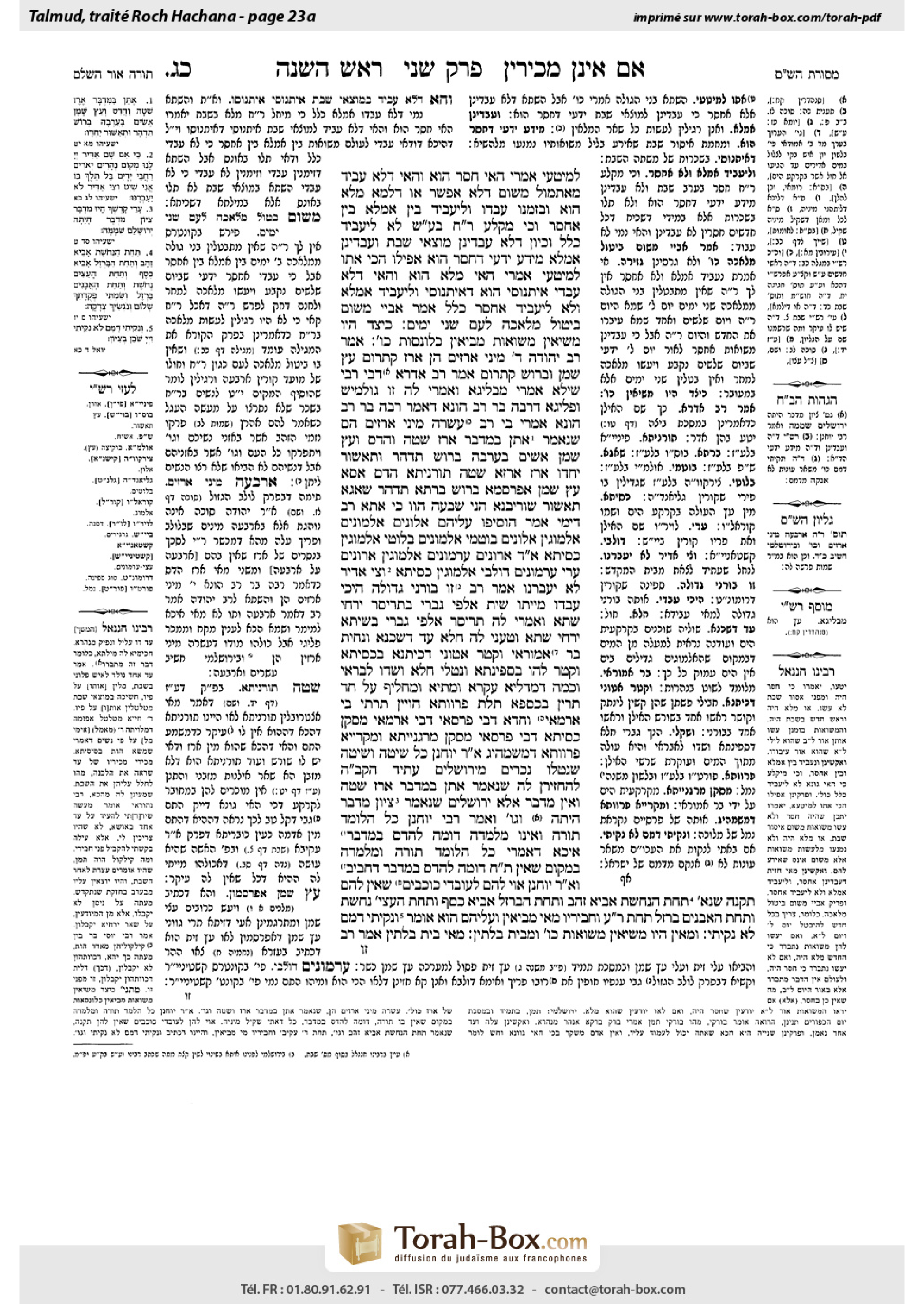
Rosh Hashanah 23a: Talmud study for Daf Yomi
Daf Yomi is the daily study of one Talmud folio. Explore 37 tractates with scans, Hebrew text, Sefaria English and AI-generated French translations where annotated.
Passage selection and English or AI-generated French translation are available where the scan has annotations. Daf Study is independent of Torah-Box and Sefaria.
Browse Rosh Hashanah · ראש השנה · All tractatesRosh Hashanah 23a text and translations
This page of Rosh Hashanah includes the Aramaic text, an English translation and an AI-generated French translation, alongside the scan above.
ראש השנה כ״ג א · Aramaic and Hebrew text
לְמִיטְעֵי, אָמְרִי: הַאי חָסֵר הוּא, וְהַאי דְּלָא עֲבִיד מֵאֶתְמוֹל, מִשּׁוּם דְּלָא אֶפְשָׁר. אוֹ דִלְמָא מָלֵא הוּא, וּבִזְמַנּוֹ עֲבַדוּ.
וְלֶיעְבֵּיד בֵּין אַמָּלֵא בֵּין אַחָסֵר, וְכִי מִקְּלַע רֹאשׁ חֹדֶשׁ בְּעֶרֶב שַׁבָּת לָא לֶיעְבֵּיד כְּלָל. וְכֵיוָן דְּלָא עָבְדִינַן מוֹצָאֵי שַׁבָּת וְעָבְדִינַן אַמָּלֵא — מִידָּע יָדְעִי דְּחָסֵר הוּא!
אֲפִילּוּ הָכִי אָתוּ לְמִיטְעֵי, אָמְרִי: הַאי מָלֵא הוּא, וְהַאי דְּלָא עָבְדִי — אִיתְּנוֹסֵי הוּא דְּאִיתְּנוּסי.
וְלֶיעְבֵּיד אַמָּלֵא, וְלָא לֶיעְבֵּיד אַחָסֵר כְּלָל! אָמַר אַבָּיֵי: מִשּׁוּם בִּיטּוּל מְלָאכָה לָעָם שְׁנֵי יָמִים.
כֵּיצַד הָיוּ מַשִּׂיאִין מַשּׂוּאוֹת — מְבִיאִין כְּלוֹנְסוֹת כּוּ׳. אָמַר רַב יְהוּדָה, אַרְבָּעָה מִינֵי אֲרָזִים הֵן: אֶרֶז, קַתְרוֹם, עֵץ שֶׁמֶן, וּבְרוֹשׁ. קַתְרוֹם, אָמַר רַב: אַדְרָא. דְּבֵי רַבִּי שֵׁילָא אָמְרִי: מַבְלִיגָא, וְאָמְרִי לַהּ זוֹ גּוּלְמֵישׁ.
וּפְלִיגָא דְּרַבָּה בַּר רַב הוּנָא. דְּאָמַר רַבָּה בַּר רַב הוּנָא, אָמְרִי בֵּי רַב: עֲשָׂרָה מִינֵי אֲרָזִים הֵם, שֶׁנֶּאֱמַר: ״אֶתֵּן בַּמִּדְבָּר אֶרֶז שִׁטָּה וַהֲדַס וְעֵץ שָׁמֶן אָשִׂים בָּעֲרָבָה בְּרוֹשׁ תִּדְהָר וּתְאַשּׁוּר יַחְדָּו״. אֶרֶז — אַרְזָא, שִׁטָּה — תּוּרְנִיתָא, הֲדַס — אַסָּא, עֵץ שֶׁמֶן — אֲפַרְסְמָא, בְּרוֹשׁ — בְּרָתָא, תִּדְהָר — שָׁאגָא, תְּאַשּׁוּר — שׁוּרִיבְנָא.
הָנֵי שִׁבְעָה הָווּ! כִּי אֲתָא רַב דִּימִי, אָמַר: הוֹסִיפוּ עֲלֵיהֶם אַלּוֹנִים, אַלְמוֹנִים, אַלְמוּגִּין. אַלּוֹנִים — בּוּטְמֵי, אַלְמוֹנִים — בָּלוּטֵי, אַלְמוּגִּין — כְּסִיתָא. אִיכָּא דְּאָמְרִי: אַרוּנִּים, עַרְמוֹנִים, אַלְמוּגִּין. אַרוּנִּים — עָרֵי, עַרְמוֹנִים — דּוּלְבֵי, אַלְמוּגִּין — כְּסִיתָא.
״וְצִי אַדִּיר לֹא יַעַבְרֶנּוּ״ — אָמַר רַב: זוֹ בּוּרְנִי גְּדוֹלָה.
הֵיכִי עָבְדִי? מַיְיתוּ שֵׁית אַלְפֵי גַּבְרֵי בִּתְרֵיסַר יַרְחֵי שַׁתָּא, וְאָמְרִי לַהּ תְּרֵיסַר אַלְפֵי גַּבְרֵי בְּשִׁיתָּא יַרְחֵי שַׁתָּא, וְטָעֲנִי לַהּ חָלָא עַד דְּשָׁכְנָא. וְנָחֵית בַּר אָמוֹרַאי וְקָטַר אֲטוּנֵי דְכִיתָּנָא בִּכְסִיתָא, וְקָטַר לְהוּ בִּסְפִינְתָּא. וְנָטְלִי חָלָא וְשָׁדוּ לְבָרַאי, וְכַמָּה דְּמִדַּלְיָא — עָקְרָא וּמַתְיָא.
וּמַחְלֵיף עַל חַד תְּרֵין בְּכַסְפָּא. תְּלָת פַּרְווֹתָא הָוְיָין: תַּרְתֵּי בֵּי רוֹמָאֵי וַחֲדָא דְּבֵי פָרְסָאֵי. דְּבֵי רוֹמָאֵי מַסְּקָן כְּסִיתָא, דְּבֵי פָרְסָאֵי מַסְּקָן מַרְגָּנְיָיתָא, וּמִקַּרְיָיא: פַּרְווֹתָא דְמַשְׁמְהִיג.
אָמַר רַבִּי יוֹחָנָן: כׇּל שִׁיטָּה וְשִׁיטָּה שֶׁנָּטְלוּ גּוֹיִם מִירוּשָׁלַיִם, עָתִיד הַקָּדוֹשׁ בָּרוּךְ הוּא לְהַחֲזִירָן לָהּ, שֶׁנֶּאֱמַר: ״אֶתֵּן בַּמִּדְבָּר אֶרֶז שִׁטָּה״, וְאֵין מִדְבָּר אֶלָּא יְרוּשָׁלַיִם, שֶׁנֶּאֱמַר: ״צִיּוֹן מִדְבָּר הָיְתָה וְגוֹ׳״.
וְאָמַר רַבִּי יוֹחָנָן: כׇּל הַלּוֹמֵד תּוֹרָה וְאֵינוֹ מְלַמְּדָהּ, דּוֹמֶה לַהֲדַס בַּמִּדְבָּר. אִיכָּא דְאָמְרִי: כׇּל הַלּוֹמֵד תּוֹרָה וּמְלַמְּדָהּ בִּמְקוֹם שֶׁאֵין תַּלְמִידֵי חֲכָמִים — דּוֹמֶה לַהֲדַס בַּמִּדְבָּר, דְּחַבִּיב.
וְאָמַר רַבִּי יוֹחָנָן: אוֹי לָהֶם לַגּוֹיִם, שֶׁאֵין לָהֶם תַּקָּנָה, שֶׁנֶּאֱמַר: ״תַּחַת הַנְּחֹשֶׁת אָבִיא זָהָב וְתַחַת הַבַּרְזֶל אָבִיא כֶסֶף וְתַחַת הָעֵצִים נְחֹשֶׁת וְתַחַת הָאֲבָנִים בַּרְזֶל״. תַּחַת רַבִּי עֲקִיבָא וַחֲבֵירָיו מַאי מְבִיאִין! וַעֲלֵיהֶם הוּא אוֹמֵר: ״וְנִקֵּיתִי דָּמָם לֹא נִקֵּיתִי״.
וּמֵאַיִן הָיוּ מַשִּׂיאִין מַשּׂוּאוֹת כּוּ׳ וּמִבֵּית בִּלְתִּין. מַאי בֵּית בִּלְתִּין? אָמַר רַב:
Rosh Hashanah 23a · English translation
to err. They will be unsure how to interpret the lighting of the torches, as they will say: Perhaps this month is deficient, i.e., of twenty-nine days, and the reason that the torch sequence was not performed yesterday, on Shabbat eve, is due to the fact that it was impossible to do so on Shabbat. Or perhaps it is a full, thirty-day month, and they are performing the sequence at its proper time. Therefore, the Sages instituted that the torches should be lit only after deficient months, and the absence of this signal means that the month was a full one.
The Gemara suggests: And let them perform the ceremony both for a full, thirty-day month and for a deficient one, and when the New Moon occurs on Shabbat eve, in which case they would have to light the torches after Shabbat, let them not perform it at all. And since the torches are not lit this month at the conclusion of Shabbat, and one normally performs the sequence for a full month, people will know that the month is deficient. In this manner, it should be possible to light the torches for all the months, with this one exception.
The Gemara answers: Even so, people might come to err, as they will say: This month is indeed full, and the reason that they are not performing the ceremony is that they were subject to circumstances beyond their control. Therefore, there might still be confusion as to the date of the New Moon that month.
The Gemara asks: And let them perform the ceremony of torches only for a full, thirty-day month, and not perform it for a deficient month at all, in which case there will never be room for error. Abaye said: This cannot be done, because this would lead to a two-day suspension of work for the people, as it was customary to refrain from certain types of work on the New Moon. After a full month there will always be a suspension of work for two days, as the people must abstain from work on the thirtieth of the month in case it is declared the New Moon. However, if the torches are lit for a deficient month, then at least in that case people could return to work the following day. Therefore, the Sages instituted that the torches are lit only for a deficient month.
§ The mishna taught: How would they light the torches? They would bring long poles [kelonsot] of cedar and other materials that burn well, tie them all together, and set them on fire. Rav Yehuda said that there are four types of cedar: Cedar, katrom, pinewood, and cypress. With regard to the identification of the tree called katrom, Rav said: This is the addera tree. In the school of Rabbi Sheila, they say: This is the mavliga tree. And some say it is the gulmish tree.
The Gemara comments: And this opinion of Rav Yehuda disagrees with that of Rabba bar Rav Huna. As Rabba bar Rav Huna said that they say in the school of Rav: There are ten species of cedar, as it is stated: “I will plant in the wilderness the cedar, the acacia tree and myrtle and the pine tree; I will set in the desert cypress, the plane tree, and the larch together” (Isaiah 41:19). The seven species mentioned in this verse are all types of cedars. The Gemara proceeds to identify these trees by their Aramaic names: Cedar is arza, acacia is tornita, myrtle is asa, pine tree is afarsema, cypress is berata, maple is shaga, and box tree is shorivna.
The Gemara asks: Even if we count all the names in the verse, these are only seven, not ten. When Rav Dimi came from Eretz Israel to Babylonia, he said: They added to them three more types of cedar: Terebinth, oak, and coral wood. The Gemara identifies them: Terebinth is the tree called butmei, oak is balutei, and coral wood is kasita. There are those who say that the additional three types are: Bay tree, plane tree, and coral wood. And their Aramaic names are as follows: Bay tree is arei, plane is dulvei, and coral wood is kasita.
§ Apropos coral, the Gemara cites a relevant verse: “Neither shall a tzi adir be able to cross it” (Isaiah 33:21), i.e., it will not be able to traverse the river that will issue forth from the Temple in the future. What is this tzi adir? Rav said: This is a great ship [burnei] used to collect coral from the sea.
The Gemara explains: How do they perform this collection of coral? They bring six thousand men to work for twelve months of the year, and some say they bring twelve thousand men for six months of the year. And they load the ship with sand until it sinks to the bottom of the sea. A diver descends and ties flax ropes around the coral and ties the other ends of the ropes to the boat. And then they take the sand and cast it overboard, and the boat rises once again to the surface. And as it rises, it uproots and brings the coral with it.
The Gemara comments: And this coral is so precious that it is exchanged for twice its weight in silver. The Gemara further notes: There are three ports in those places. Two belong to the Romans [Armai], and one belongs to the Persians. In the one belonging to the Romans, they raise up coral, whereas in the one belonging to the Persians, they raise up pearls. And the Persian ports are called royal ports.
With regard to the aforementioned verse, Rabbi Yoḥanan said: Each and every acacia tree that the gentiles took from Jerusalem will be returned to the city by the Holy One, Blessed be He, as it is stated: “I will plant in the wilderness the cedar, the acacia tree and myrtle and the oil tree; I will set in the desert cypress, the plane tree and the larch together” (Isaiah 41:19). And the term wilderness is referring to nothing other than Jerusalem, as it is stated: “Zion is become a wilderness, Jerusalem a desolation” (Isaiah 64:9).
And Rabbi Yoḥanan also said: Anyone who studies Torah but does not teach it to others is likened to a myrtle in the wilderness. The myrtle has a pleasant fragrance, but there is nobody to enjoy it in the wilderness. There are those who say a different version of this statement: Anyone who studies Torah and teaches it to others in a place where there are no other Torah scholars is likened to a myrtle in the wilderness, which is especially precious and thoroughly enjoyed by those who find it.
And Rabbi Yoḥanan further said: Woe to the nations of the world, as they have no remedy for the sins they committed against the Jewish people, as it is stated: “For brass I will bring gold, and for iron I will bring silver, and for wood brass, and for stones iron” (Isaiah 60:17). For all things there is a remedy, as one can always exchange them for an item of equivalent or greater value. However, for Rabbi Akiva and his colleagues, whom the nations put to death, what can one bring to atone for their sin? And with regard to them it is stated: And I will hold them as innocent, but for their blood I will not hold them innocent (see Joel 4:21).
§ The mishna states: And from which mountains would they light the torches? From the Mount of Olives to Sartava, and from Sartava to Gerofina, and from Gerofina to Ḥavran, and from Ḥavran to Beit Baltin. And from Beit Baltin they would not light torches in any other pre-established places. The Gemara asks: What is this place called Beit Baltin? Rav said:
Rosh Hashanah 23a · Traduction française (IA)
se tromper. Ils ne sauraient pas comment interpréter l’allumage des torches, car ils diraient : Peut-être ce mois est-il déficient, c’est-à-dire qu’il compte vingt-neuf jours, et si la séquence des torches n’a pas été exécutée hier, à la veille de Chabbat, c’est parce qu’il était impossible de le faire pendant Chabbat. Ou peut-être est-ce un mois complet de trente jours, et la séquence est exécutée au moment prévu. Les Sages instituèrent donc que les torches ne soient allumées qu’après les mois déficients ; l’absence de ce signal signifie que le mois était complet.
La Guemara propose : Qu’ils exécutent la cérémonie aussi bien pour un mois complet de trente jours que pour un mois déficient et, lorsque la nouvelle lune tombe à la veille de Chabbat, auquel cas ils devraient allumer les torches après Chabbat, qu’ils ne l’exécutent pas du tout. Puisque les torches ne sont pas allumées ce mois-là à la fin de Chabbat, alors que la séquence est normalement exécutée pour un mois complet, les gens sauront que le mois est déficient. Ainsi, il devrait être possible d’allumer les torches tous les mois, à cette seule exception près.
La Guemara répond : Malgré cela, les gens pourraient se tromper, car ils diraient : Ce mois est bien complet, et s’ils n’exécutent pas la cérémonie, c’est parce qu’ils en ont été empêchés par des circonstances indépendantes de leur volonté. Il pourrait donc encore y avoir confusion quant à la date de la nouvelle lune ce mois-là.
La Guemara demande : Qu’ils exécutent la cérémonie des torches uniquement pour un mois complet de trente jours et qu’ils ne l’exécutent jamais pour un mois déficient ; ainsi, il n’y aura jamais de risque d’erreur. Abaye dit : Cela n’est pas possible, car cela entraînerait pour les gens deux jours d’interruption du travail, puisqu’il était d’usage de s’abstenir de certains travaux à la nouvelle lune. Après un mois complet, il y aura toujours deux jours d’interruption du travail, car les gens doivent s’abstenir de travailler le trentième jour du mois, au cas où il serait déclaré nouvelle lune. Cependant, si les torches sont allumées pour un mois déficient, les gens peuvent au moins reprendre le travail le lendemain dans ce cas-là. Les Sages instituèrent donc que les torches ne soient allumées que pour un mois déficient.
§ La Michna enseignait : Comment allumaient-ils les torches ? Ils apportaient de longues perches [kelonsot] en cèdre et d’autres matériaux qui brûlent bien, les attachaient ensemble et y mettaient le feu. Rav Yehouda dit qu’il existe quatre sortes de cèdres : le cèdre, le katrom, le pin et le cyprès. Quant à l’identification de l’arbre appelé katrom, Rav dit : C’est l’arbre addera. À l’école de Rabbi Sheila, on dit : C’est l’arbre mavliga. Certains disent que c’est l’arbre gulmish.
La Guemara fait remarquer que cette opinion de Rav Yehouda est en désaccord avec celle de Rabba bar Rav Houna. En effet, Rabba bar Rav Houna dit qu’à l’école de Rav, on enseigne qu’il existe dix espèces de cèdres, comme il est dit : « Je planterai dans le désert le cèdre, l’acacia, le myrte et le pin ; je mettrai dans la steppe le cyprès, le platane et le mélèze, ensemble » (Isaïe 41:19). Les sept espèces mentionnées dans ce verset sont toutes des sortes de cèdres. La Guemara identifie ces arbres par leurs noms araméens : le cèdre est l’arza, l’acacia le tornita, le myrte l’asa, le pin l’afarsema, le cyprès la berata, l’érable le shaga et le buis le shorivna.
La Guemara demande : Même si l’on compte tous les noms du verset, il n’y en a que sept, et non dix. Lorsque Rav Dimi vint d’Eretz Israël en Babylonie, il dit : On leur ajouta trois autres sortes de cèdres : le térébinthe, le chêne et le bois de corail. La Guemara les identifie : le térébinthe est l’arbre appelé butmei, le chêne est le balutei et le bois de corail est le kasita. Certains disent que les trois espèces supplémentaires sont le laurier, le platane et le bois de corail. Leurs noms araméens sont les suivants : le laurier est l’arei, le platane le dulvei et le bois de corail le kasita.
§ À propos du corail, la Guemara cite un verset pertinent : « Aucun tzi adir ne pourra le traverser » (Isaïe 33:21), c’est-à-dire qu’il ne pourra pas traverser le fleuve qui jaillira du Temple à l’avenir. Que désigne ce tzi adir ? Rav dit : C’est un grand navire [burnei] utilisé pour recueillir du corail dans la mer.
La Guemara explique : Comment recueille-t-on le corail ? On fait travailler six mille hommes pendant douze mois de l’année ; certains disent qu’on fait travailler douze mille hommes pendant six mois de l’année. On charge le navire de sable jusqu’à ce qu’il coule au fond de la mer. Un plongeur descend, attache des cordes de lin autour du corail et fixe les autres extrémités des cordes au bateau. Puis on prend le sable et on le jette par-dessus bord, et le bateau remonte à la surface. En remontant, il déracine le corail et le ramène avec lui.
La Guemara fait remarquer que ce corail est si précieux qu’on l’échange contre le double de son poids en argent. La Guemara note également qu’il y a trois ports dans ces régions. Deux appartiennent aux Romains [Armai] et un aux Perses. Dans celui qui appartient aux Romains, on remonte du corail, tandis que dans celui qui appartient aux Perses, on remonte des perles. Les ports perses sont appelés ports royaux.
À propos du verset cité précédemment, Rabbi Yoḥanan dit : Chaque acacia que les nations ont emporté de Jérusalem y sera ramené par le Saint, béni soit-Il, comme il est dit : « Je planterai dans le désert le cèdre, l’acacia, le myrte et l’olivier ; je mettrai dans la steppe le cyprès, le platane et le mélèze, ensemble » (Isaïe 41:19). Or, le terme « désert » ne désigne rien d’autre que Jérusalem, comme il est dit : « Sion est devenue un désert, Jérusalem une désolation » (Isaïe 64:9).
Rabbi Yoḥanan dit également : Quiconque étudie la Torah mais ne l’enseigne pas aux autres est comparé à un myrte dans le désert. Le myrte a un parfum agréable, mais personne ne peut en profiter dans le désert. Certains transmettent une version différente de cette déclaration : Quiconque étudie la Torah et l’enseigne aux autres dans un lieu où il n’y a pas d’autres érudits en Torah est comparé à un myrte dans le désert, particulièrement précieux et dont ceux qui le trouvent profitent pleinement.
Rabbi Yoḥanan dit encore : Malheur aux nations du monde, car elles n’ont aucun moyen d’expier les péchés qu’elles ont commis contre le peuple juif, comme il est dit : « Au lieu du cuivre, j’apporterai de l’or, et au lieu du fer, j’apporterai de l’argent ; au lieu du bois, du cuivre, et au lieu des pierres, du fer » (Isaïe 60:17). Pour toute chose, il existe un remède, car on peut toujours l’échanger contre un objet de valeur équivalente ou supérieure. Mais pour Rabbi Akiva et ses compagnons, que les nations ont mis à mort, que peut-on apporter pour expier leur péché ? À leur sujet, il est dit : « Je les tiendrai pour innocents, mais je ne tiendrai pas pour innocent le sang qu’ils ont versé » (voir Joël 4:21).
§ La Michna énonce : De quelles montagnes allumaient-ils les torches ? Du mont des Oliviers à Sartava, de Sartava à Gerofina, de Gerofina à Ḥavran, et de Ḥavran à Beit Baltin. Depuis Beit Baltin, ils n’allumaient des torches en aucun autre endroit préétabli. La Guemara demande : Quel est cet endroit appelé Beit Baltin ? Rav dit :
Traduction française générée par IA à partir de l’édition anglaise de Sefaria. Vérifie toujours un passage avec le texte source.
Text from Sefaria: William Davidson Edition - Vocalized Aramaic (CC BY NC); William Davidson Edition - English (CC BY NC).