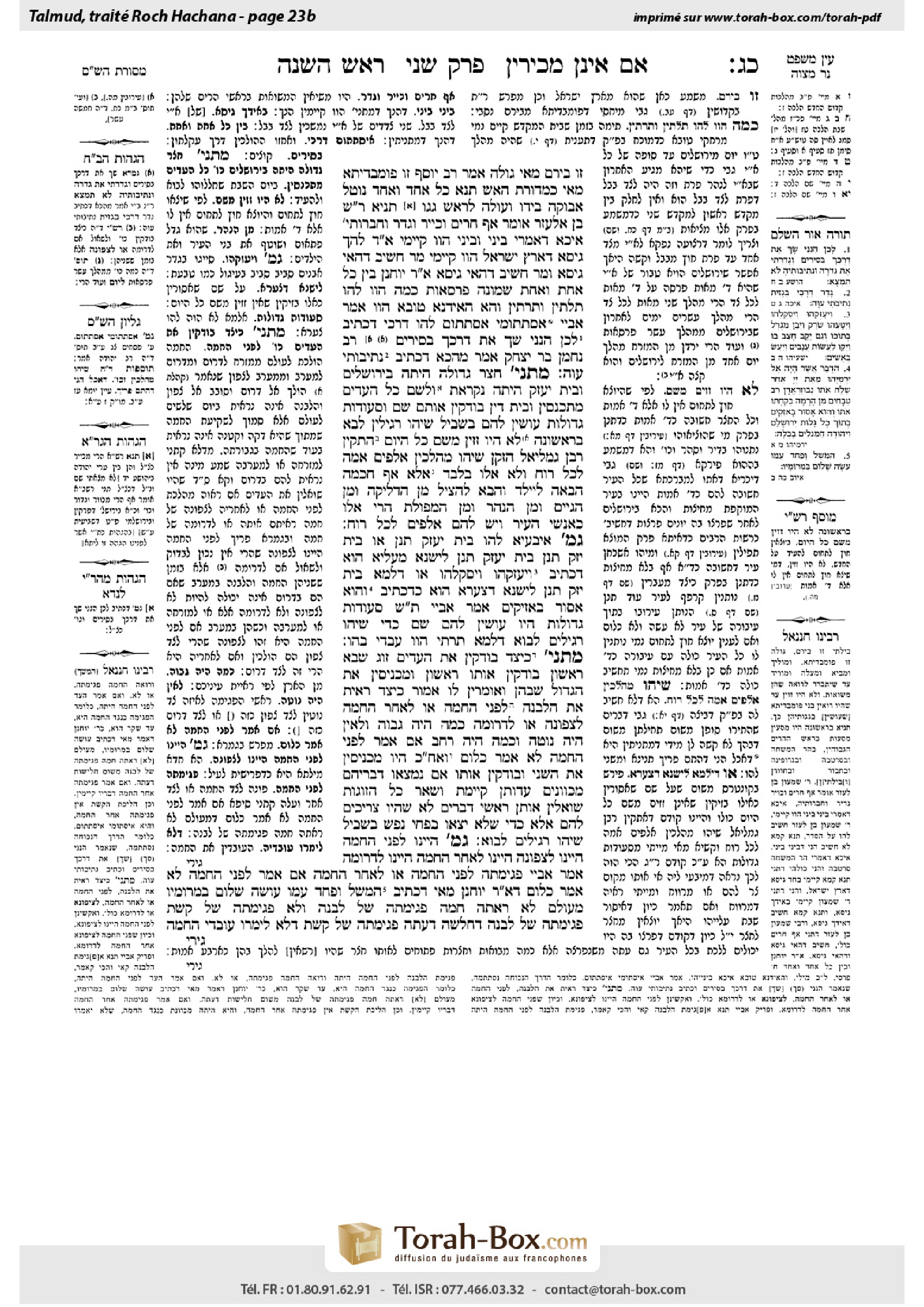
Rosh Hashanah 23b: Talmud study for Daf Yomi
Daf Yomi is the daily study of one Talmud folio. Explore 37 tractates with scans, Hebrew text, Sefaria English and AI-generated French translations where annotated.
Passage selection and English or AI-generated French translation are available where the scan has annotations. Daf Study is independent of Torah-Box and Sefaria.
Browse Rosh Hashanah · ראש השנה · All tractatesRosh Hashanah 23b text and translations
This page of Rosh Hashanah includes the Aramaic text, an English translation and an AI-generated French translation, alongside the scan above.
ראש השנה כ״ג ב · Aramaic and Hebrew text
זוֹ בֵּירָם.
מַאי גּוֹלָה? אָמַר רַב יוֹסֵף: זוֹ פּוּמְבְּדִיתָא. מַאי כִּמְדוּרַת הָאֵשׁ? תָּנָא: כׇּל אֶחָד וְאֶחָד נוֹטֵל אֲבוּקָה בְּיָדוֹ וְעוֹלֶה לְרֹאשׁ גַּגּוֹ.
תַּנְיָא, רַבִּי שִׁמְעוֹן בֶּן אֶלְעָזָר אוֹמֵר: אַף חָרִים וּכְיָיר וּגְדֹר וְחַבְרוֹתֶיהָ. אִיכָּא דְּאָמְרִי: בֵּינֵי וּבֵינֵי הֲווֹ קָיְימִי. אִיכָּא דְּאָמְרִי: לְהָךְ גִּיסָא דְּאֶרֶץ יִשְׂרָאֵל הֲווֹ קָיְימִי. מָר חָשֵׁיב דְּהַאי גִּיסָא, וּמָר חָשֵׁיב דְּהַאי גִּיסָא.
אָמַר רַבִּי יוֹחָנָן: בֵּין כׇּל אַחַת וְאַחַת שְׁמוֹנֶה פַּרְסָאוֹת. כַּמָּה הָווּ לְהוּ? תְּלָתִין וְתַרְתֵּין, וְהָא הָאִידָּנָא טוּבָא הָווּ! אָמַר אַבָּיֵי: אִסְתַּתּוֹמֵי אִסְתַּתּוּם לְהוּ דַּרְכֵי.
דִּכְתִיב: ״לָכֵן הִנְנִי שָׂךְ אֶת דַּרְכֵּךְ בַּסִּירִים״, רַב נַחְמָן בַּר יִצְחָק אָמַר מֵהָכָא, דִּכְתִיב: ״נְתִיבוֹתַי עִוָּה״.
מַתְנִי׳ חָצֵר גְּדוֹלָה הָיְתָה בִּירוּשָׁלַיִם וּבֵית יַעְזֵק הָיְתָה נִקְרֵאת, וּלְשָׁם כׇּל הָעֵדִים מִתְכַּנְּסִין. וּבֵית דִּין בּוֹדְקִין אוֹתָם שָׁם. וּסְעוּדוֹת גְּדוֹלוֹת עוֹשִׂין לָהֶם, בִּשְׁבִיל שֶׁיְּהוּ רְגִילִין לָבֹא.
בָּרִאשׁוֹנָה לֹא הָיוּ זָזִין מִשָּׁם כׇּל הַיּוֹם. הִתְקִין רַבָּן גַּמְלִיאֵל הַזָּקֵן שֶׁיְּהוּ מְהַלְּכִין אַלְפַּיִם אַמָּה לְכׇל רוּחַ.
וְלֹא אֵלּוּ בִּלְבַד, אֶלָּא אַף חֲכָמָה הַבָּאָה לְיַילֵּד, וְהַבָּא לְהַצִּיל מִן הַדְּלֵיקָה וּמִן הַגַּיִיס וּמִן הַנָּהָר וּמִן הַמַּפּוֹלֶת — הֲרֵי אֵלּוּ כְּאַנְשֵׁי הָעִיר, וְיֵשׁ לָהֶם אַלְפַּיִם לְכׇל רוּחַ.
גְּמָ׳ אִיבַּעְיָא לְהוּ: ״בֵּית יַעְזֵק״ תְּנַן, אוֹ ״בֵּית יָזֵק״ תְּנַן? ״בֵּית יַעְזֵק״ תְּנַן — לִישָּׁנָא מְעַלְּיָא הוּא, דִּכְתִיב: ״וַיְעַזְּקֵהוּ וַיְסַקְּלֵהוּ״, אוֹ דִלְמָא ״בֵּית יָזֵק״ תְּנַן — לִישָּׁנָא דְצַעֲרָא הוּא, כְּדִכְתִיב: ״וְהוּא אָסוּר בָּאזִיקִּים״?
אָמַר אַבָּיֵי, תָּא שְׁמַע: סְעוּדוֹת גְּדוֹלוֹת הָיוּ עוֹשִׂין לָהֶם שָׁם, כְּדֵי שֶׁיְּהוּ רְגִילִים לָבוֹא. דִּלְמָא תַּרְתֵּי הֲווֹ עָבְדִי בְּהוּ.
מַתְנִי׳ כֵּיצַד בּוֹדְקִין אֶת הָעֵדִים? זוּג שֶׁבָּא רִאשׁוֹן — בּוֹדְקִין אוֹתוֹ רִאשׁוֹן. וּמַכְנִיסִין אֶת הַגָּדוֹל שֶׁבָּהֶן, וְאוֹמְרִין לוֹ, אֱמוֹר כֵּיצַד רָאִיתָ אֶת הַלְּבָנָה: לִפְנֵי הַחַמָּה, אוֹ לְאַחַר הַחַמָּה? לִצְפוֹנָהּ, אוֹ לִדְרוֹמָהּ? כַּמָּה הָיָה גָּבוֹהַּ, וּלְאַיִן הָיָה נוֹטֶה, וְכַמָּה הָיָה רָחָב. אִם אָמַר לִפְנֵי הַחַמָּה — לֹא אָמַר כְּלוּם.
וְאַחַר כָּךְ הָיוּ מַכְנִיסִין אֶת הַשֵּׁנִי וּבוֹדְקִין אוֹתוֹ. אִם נִמְצְאוּ דִּבְרֵיהֶם מְכֻוּוֹנִים — עֵדוּתָן קַיֶּימֶת. וּשְׁאָר כׇּל הַזּוּגוֹת, שׁוֹאֲלִין אוֹתָן רָאשֵׁי דְבָרִים. לֹא שֶׁהָיוּ צְרִיכִים לָהֶם, אֶלָּא כְּדֵי שֶׁלֹּא יֵצְאוּ בְּפַחֵי נֶפֶשׁ, בִּשְׁבִיל שֶׁיְּהוּ רְגִילִים לָבוֹא.
גְּמָ׳ הַיְינוּ לִפְנֵי הַחַמָּה, הַיְינוּ לִצְפוֹנָהּ; הַיְינוּ לְאַחַר הַחַמָּה, הַיְינוּ לִדְרוֹמָהּ! אָמַר אַבָּיֵי: פְּגִימָתָהּ — לִפְנֵי הַחַמָּה, אוֹ לְאַחַר הַחַמָּה? אִם אָמַר לִפְנֵי הַחַמָּה — לָא אָמַר כְּלוּם.
דְּאָמַר רַבִּי יוֹחָנָן, מַאי דִּכְתִיב: ״הַמְשֵׁל וָפַחַד עִמּוֹ עוֹשֶׂה שָׁלוֹם בִּמְרוֹמָיו״, מֵעוֹלָם לֹא רָאֲתָה חַמָּה פְּגִימָתָהּ שֶׁל לְבָנָה, וְלֹא פְּגִימָתָהּ שֶׁל קֶשֶׁת. פְּגִימָתָהּ שֶׁל לְבָנָה — דְּחָלְשָׁה דַּעְתַּהּ. פְּגִימָתָהּ שֶׁל קֶשֶׁת — דְּלָא לֵימְרוּ עוֹבְדֵי הַחַמָּה
Rosh Hashanah 23b · English translation
This is the town called Biram.
§ The mishna taught: He would wave the torch back and forth and up and down, until he would see the entire Diaspora before him alight like one large bonfire. The Gemara asks: What is the meaning in this context of the term Diaspora, which certainly cannot be referring to the entire Diaspora across the world? Rav Yosef said: This is referring to the city of Pumbedita in Babylonia. The Gemara further asks. What is the meaning of the phrase: Like one large bonfire? It is taught in a baraita: Each and every individual would take a torch in his hand and ascend to the top of his roof and light it. In this manner, the entire city would present the appearance of a large bonfire.
It is taught in a baraita that Rabbi Shimon ben Elazar says: Torches were also lit at Ḥarim, and Kayar and Geder, and its neighboring places. There are those who say that the places added by Rabbi Shimon ben Elazar are located between the places mentioned in the mishna, whereas there are those who say that they are located on the other side of Eretz Yisrael, on the side nearer Babylonia. The Sage in the mishna enumerates the places found on one side of Eretz Yisrael, whereas the Sage in the baraita enumerates the places found on the other side.
Rabbi Yoḥanan said: Between each and every one of the stations there was a distance of eight parasangs. The Gemara asks: How many parasangs are these in total? Thirty-two parasangs. The Gemara further asks: Isn’t the distance from the Mount of Olives to Beit Baltin now much greater than thirty-two parasangs? Abaye said: The direct routes have become blocked, and therefore people nowadays must use indirect routes, making the journey much longer.
The Gemara provides a source for this claim. As it is written: “Therefore, behold, I will hedge up your way with thorns, and make a wall against her, that she shall not find her paths” (Hosea 2:8). Rav Naḥman bar Yitzḥak said: It is derived from here, as it is written: “He has made my paths crooked” (Lamentations 3:9), which indicates that over the course of the exile the routes have become longer.
MISHNA: There was a large courtyard in Jerusalem, which was called Beit Ya’zek. And there all the witnesses coming to testify about the new moon would gather, and the court of seventy-one judges would examine them there. And they would prepare great feasts for them, so that they would be willing and accustomed to coming and submitting their testimony.
Initially, when witnesses would arrive on Shabbat from a distant place, they would not move from there all day, as they had left their Shabbat limit, and it was consequently prohibited for them to walk more than four cubits in any direction once they had completed their mission. Concerned that this limitation would discourage witnesses from coming, Rabban Gamliel the Elder instituted that the witnesses be permitted to walk two thousand cubits in each direction.
The mishna continues: And not only these witnesses are granted two thousand cubits from their new place, but this applies also to a midwife who comes to deliver a child, and one who comes to rescue Jews from a fire, from an invasion of gentile troops, from a flooding river, or from the collapse of a building. All these are considered like the inhabitants of the city where they arrive, and therefore they have two thousand cubits in each direction.
GEMARA: A dilemma was raised before the Sages: What is the correct reading of the mishna? Did we learn: Beit Ya’zek, or did we learn: Beit Yazek? The Gemara explains the difference between these two versions. Did we learn: Beit Ya’zek, which is an lofty term, indicating that it was a fine place where the witnesses had a pleasant experience, as it is written: “And he dug it [vaye’azzekehu] and cleared it of stones” (Isaiah 5:2), which shows that the root a-z-k denotes improvement? Or perhaps we learned: Beit Yazek, which is a term of distress, reflecting the fact that the witnesses who arrived there on Shabbat were not permitted to move from there all day, as it is written: “And he was bound with chains [bazikim]” (Jeremiah 40:1).
Abaye said: Come and hear the mishna: They would prepare great feasts for them there, so that they would be accustomed to come and submit their testimony. This indicates that the witnesses were made welcome, in accordance with the name Beit Ya’zek. The Gemara rejects this argument: Perhaps they performed two practices for them, i.e., they provided feasts but they also restricted their movement. Therefore, there is no proof from the mishna for this version of the name.
MISHNA: How do they examine the witnesses who come to testify about the new moon? They deal with them in order, as the pair of witnesses that arrives first they examine first. They bring in the greater of the two witnesses, and they say to him: Say how you saw the moon. Was it in front of the sun or behind the sun? To its north or to its south? How high was the moon over the horizon, and in which direction did it tilt? And how wide was it? If, for example, he said that he saw the moon in front of the sun, he has not said anything of substance, as this is impossible and therefore he is either mistaken or lying.
And after they finish hearing the first witness’s testimony, they would bring in the second witness and examine him in a similar manner. If their statements match, their testimony is accepted and the court sanctifies the New Moon. And the court then asks all the other pairs of witnesses certain general matters, without probing into all the details. They do this not because they require the additional testimony, but so that the witnesses should not leave disappointed, and so that the witnesses should be accustomed to coming to testify, and will not hesitate to come the next time, when they might be needed.
GEMARA: The Gemara asks: In front of the sun is the same as to its north, and behind the sun is the same as to its south. Why would the court ask the witnesses both sets of questions? Abaye said: The first question does not refer to the moon’s position relative to the sun, but to the concave side of the moon, whether it was before the sun, pointing toward it, or behind the sun, pointing away from it. If he said that it was before the sun, he has said nothing.
As Rabbi Yoḥanan said: What is the meaning of that which is written: “Dominion and fear are with Him, He makes peace in His high places” (Job 25:2)? It means that the sun has never seen the concave side of the new moon, nor has it ever seen the concave side of a rainbow, both of which always face away from the sun. It has never seen the concave side of the moon, as the moon would be distressed by a sense of inadequacy if its concave side faced the sun. Therefore the sun sees only the full roundness of its convex side. In this way He makes peace in His high places between the sun and the moon. Furthermore, the sun has never seen the concave side of a rainbow, so that the worshippers of the sun not say, as though the sun is a god,
Rosh Hashanah 23b · Traduction française (IA)
C’est la ville appelée Biram.
§ La Michna enseigne : Il agitait la torche de côté et d’autre, puis de haut en bas, jusqu’à voir toute la Diaspora s’embraser devant lui, comme un grand brasier. La Guemara demande : Que signifie ici le terme « Diaspora », qui ne peut certainement pas désigner toute la Diaspora à travers le monde ? Rav Yosef dit : Il s’agit de la ville de Pumbedita, en Babylonie. La Guemara demande encore : Que signifie l’expression « comme un grand brasier » ? Une baraïta enseigne : Chaque personne prenait une torche à la main, montait sur le toit de sa maison et l’allumait. Ainsi, toute la ville avait l’apparence d’un grand brasier.
Une baraïta enseigne que Rabbi Shimon ben Elazar dit : On allumait aussi des torches à Ḥarim, à Kayar et à Geder, ainsi que dans les localités voisines. Selon certains, les lieux que Rabbi Shimon ben Elazar ajoute se trouvaient entre ceux mentionnés dans la Michna ; selon d’autres, ils se trouvaient de l’autre côté d’Eretz Yisrael, du côté le plus proche de la Babylonie. Le Sage de la Michna énumère les lieux situés d’un côté d’Eretz Yisrael, tandis que le Sage de la baraïta énumère ceux qui se trouvent de l’autre côté.
Rabbi Yoḥanan dit : La distance entre chaque station était de huit parasanges. La Guemara demande : Combien cela fait-il de parasanges au total ? Trente-deux parasanges. La Guemara demande encore : La distance entre le mont des Oliviers et Beit Baltin n’est-elle pas aujourd’hui bien supérieure à trente-deux parasanges ? Abaye dit : Les voies directes sont devenues impraticables ; de nos jours, les gens doivent donc emprunter des chemins détournés, ce qui allonge considérablement le trajet.
La Guemara apporte une source à cette affirmation. Car il est écrit : « C’est pourquoi, voici, je vais barrer ton chemin avec des épines, et je dresserai un mur contre elle, afin qu’elle ne trouve pas ses sentiers » (Osée 2:8). Rav Naḥman bar Yitzḥak dit : On le déduit d’ici, car il est écrit : « Il a rendu mes chemins tortueux » (Lamentations 3:9), ce qui indique qu’au cours de l’exil, les itinéraires se sont allongés.
MICHNA : Il y avait à Jérusalem une grande cour appelée Beit Ya’zek. Tous les témoins qui venaient témoigner au sujet de la nouvelle lune s’y rassemblaient, et le tribunal de soixante et onze juges les y examinait. On leur préparait de grands festins afin qu’ils soient disposés à venir présenter leur témoignage et qu’ils en prennent l’habitude.
Au début, lorsque des témoins arrivaient le Chabbat depuis un lieu éloigné, ils ne bougeaient pas de là de toute la journée, car ils avaient dépassé leur limite de Chabbat ; une fois leur mission accomplie, il leur était donc interdit de parcourir plus de quatre coudées dans n’importe quelle direction. Craignant que cette restriction ne décourage les témoins de venir, Rabban Gamliel l’Ancien décréta qu’ils seraient autorisés à parcourir deux mille coudées dans chaque direction.
La Michna poursuit : Ces témoins ne sont pas les seuls à bénéficier de deux mille coudées depuis leur nouvel emplacement ; cela s’applique également à une sage-femme venue aider à un accouchement, ainsi qu’à toute personne venue sauver des Juifs d’un incendie, d’une invasion de troupes non juives, d’un fleuve en crue ou de l’effondrement d’un bâtiment. Tous sont considérés comme les habitants de la ville où ils arrivent et ont donc droit à deux mille coudées dans chaque direction.
GUEMARA : Les Sages soulevèrent un dilemme : Quelle est la lecture correcte de la Michna ? Avons-nous appris « Beit Ya’zek » ou « Beit Yazek » ? La Guemara explique la différence entre ces deux versions. Avons-nous appris « Beit Ya’zek », terme de bon augure indiquant qu’il s’agissait d’un lieu agréable où les témoins passaient un bon moment, comme il est écrit : « Il la bêcha [vaye’azzekehu] et en retira les pierres » (Isaïe 5:2), ce qui montre que la racine a-z-k dénote une amélioration ? Ou bien avons-nous appris « Beit Yazek », terme évoquant la détresse, qui reflète le fait que les témoins arrivés là le Chabbat n’avaient pas le droit de bouger de toute la journée, comme il est écrit : « Il était lié avec des chaînes [bazikim] » (Jérémie 40:1).
Abaye dit : Viens et écoute la Michna : « On leur préparait là de grands festins », afin qu’ils prennent l’habitude de venir présenter leur témoignage. Cela indique que les témoins étaient bien accueillis, ce qui concorde avec le nom Beit Ya’zek. La Guemara rejette cet argument : Peut-être faisait-on deux choses pour eux, c’est-à-dire qu’on leur servait des festins tout en limitant leurs déplacements. La Michna ne fournit donc aucune preuve en faveur de cette version du nom.
MICHNA : Comment interroge-t-on les témoins qui viennent témoigner au sujet de la nouvelle lune ? On les examine dans l’ordre : on interroge d’abord la paire de témoins arrivée la première. On fait entrer le plus important des deux témoins et on lui dit : « Raconte comment tu as vu la lune. Était-elle devant le soleil ou derrière lui ? Au nord ou au sud de celui-ci ? À quelle hauteur la lune se trouvait-elle au-dessus de l’horizon, et dans quelle direction était-elle inclinée ? Quelle était sa largeur ? » Si, par exemple, il dit avoir vu la lune devant le soleil, il n’a rien dit de valable, car c’est impossible : il se trompe donc ou ment.
Après avoir fini d’entendre la déposition du premier témoin, on faisait entrer le second et on l’interrogeait de la même manière. Si leurs déclarations concordaient, leur témoignage était accepté et le tribunal sanctifiait la nouvelle lune. Le tribunal posait ensuite certaines questions générales à toutes les autres paires de témoins, sans approfondir tous les détails. Il ne le faisait pas parce qu’il avait besoin de leurs témoignages supplémentaires, mais pour que les témoins ne repartent pas déçus et qu’ils prennent l’habitude de venir témoigner, sans hésiter à revenir la fois suivante, lorsqu’on pourrait avoir besoin d’eux.
GUEMARA : La Guemara demande : « Devant le soleil » revient au même que « au nord de celui-ci », et « derrière le soleil » au même que « au sud de celui-ci ». Pourquoi le tribunal posait-il les deux séries de questions aux témoins ? Abaye dit : La première question ne porte pas sur la position de la lune par rapport au soleil, mais sur le côté concave de la lune : était-il tourné vers le soleil ou à l’opposé de celui-ci ? S’il dit qu’il était tourné vers le soleil, il n’a rien dit.
Comme l’a dit Rabbi Yoḥanan : Que signifie ce qui est écrit : « La domination et la crainte sont avec Lui ; Il établit la paix dans Ses hauteurs » (Job 25:2) ? Cela signifie que le soleil n’a jamais vu le côté concave de la nouvelle lune ni celui d’un arc-en-ciel, car ces deux côtés sont toujours tournés à l’opposé du soleil. Le soleil n’a jamais vu le côté concave de la lune, car celle-ci serait affligée d’un sentiment d’infériorité si son côté concave était tourné vers le soleil. Le soleil ne voit donc que la pleine rondeur de son côté convexe. Ainsi, Il établit la paix dans Ses hauteurs entre le soleil et la lune. En outre, le soleil n’a jamais vu le côté concave d’un arc-en-ciel, afin que les adorateurs du soleil ne disent pas, comme si le soleil était un dieu,
Traduction française générée par IA à partir de l’édition anglaise de Sefaria. Vérifie toujours un passage avec le texte source.
Text from Sefaria: William Davidson Edition - Vocalized Aramaic (CC BY NC); William Davidson Edition - English (CC BY NC).