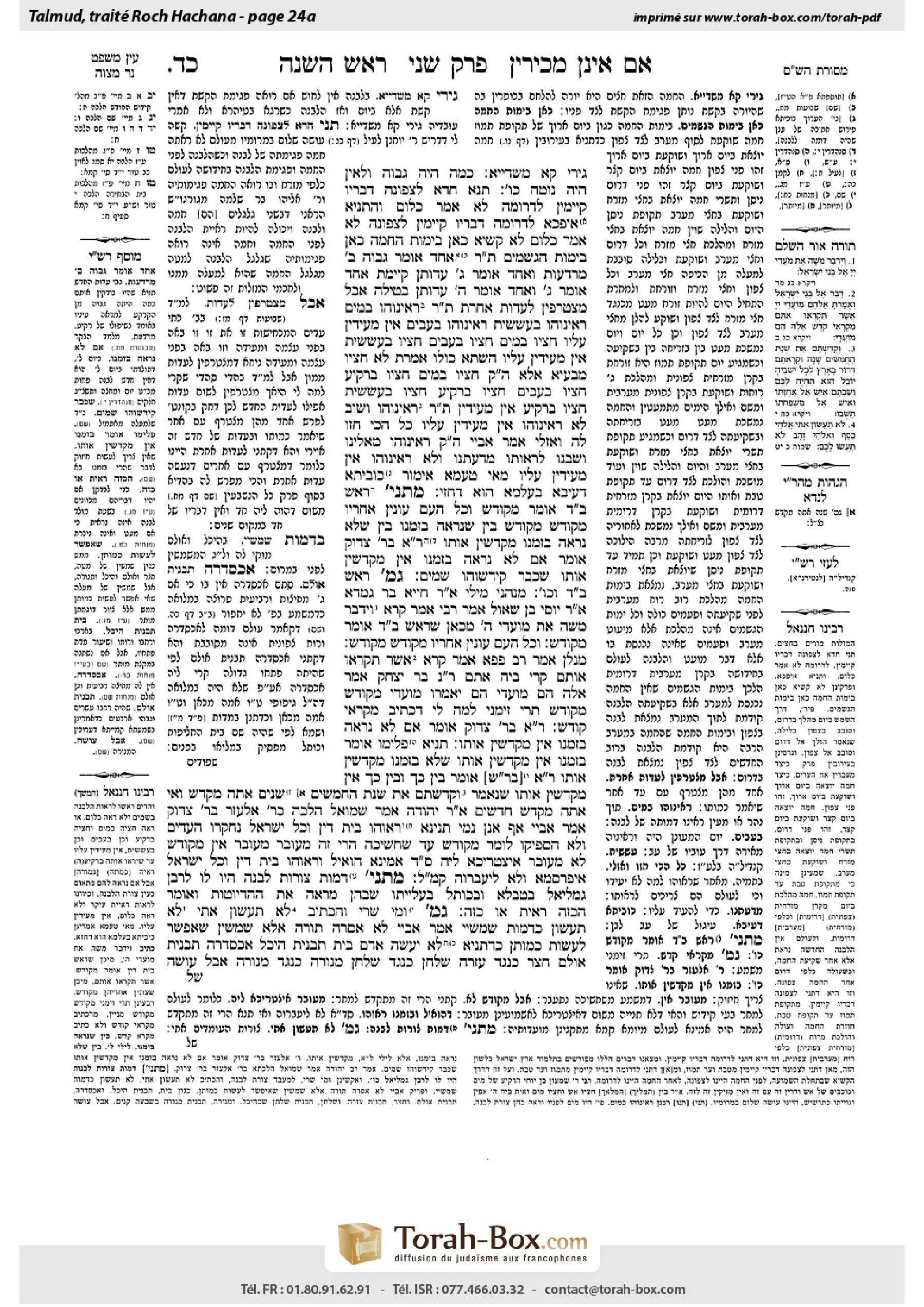
Rosh Hashanah 24a: Talmud study for Daf Yomi
Daf Yomi is the daily study of one Talmud folio. Explore 37 tractates with scans, Hebrew text, Sefaria English and AI-generated French translations where annotated.
Passage selection and English or AI-generated French translation are available where the scan has annotations. Daf Study is independent of Torah-Box and Sefaria.
Browse Rosh Hashanah · ראש השנה · All tractatesRosh Hashanah 24a text and translations
This page of Rosh Hashanah includes the Aramaic text, an English translation and an AI-generated French translation, alongside the scan above.
ראש השנה כ״ד א · Aramaic and Hebrew text
גִּירֵי קָא מְשַׁדְּיָיא.
כַּמָּה הָיָה גָּבוֹהַּ, וּלְאַיִן הָיָה נוֹטֶה כּוּ׳. תָּנָא חֲדָא: לִצְפוֹנָהּ — דְּבָרָיו קַיָּימִין, לִדְרוֹמָהּ — לֹא אָמַר כְּלוּם. וְהָתַנְיָא אִיפְּכָא: לִדְרוֹמָהּ — דְּבָרָיו קַיָּימִין, לִצְפוֹנָהּ — לֹא אָמַר כְּלוּם.
לָא קַשְׁיָא: כָּאן, בִּימוֹת הַחַמָּה. כָּאן, בִּימוֹת הַגְּשָׁמִים.
תָּנוּ רַבָּנַן: אֶחָד אוֹמֵר גָּבוֹהַּ שְׁתֵּי מַרְדְּעוֹת, וְאֶחָד אוֹמֵר שָׁלֹשׁ — עֵדוּתָן קַיֶּימֶת. אֶחָד אוֹמֵר שָׁלֹשׁ, וְאֶחָד אוֹמֵר חָמֵשׁ — עֵדוּתָן בְּטֵילָה. אֲבָל מִצְטָרְפִין לְעֵדוּת אַחֶרֶת.
תָּנוּ רַבָּנַן: רְאִינוּהוּ בְּמַיִם, רְאִינוּהוּ בַּעֲשָׁשִׁית, רְאִינוּהוּ בֶּעָבִים — אֵין מְעִידִין עָלָיו. חֶצְיוֹ בְּמַיִם, חֶצְיוֹ בֶּעָבִים, חֶצְיוֹ בַּעֲשָׁשִׁית — אֵין מְעִידִין עָלָיו.
הַשְׁתָּא כּוּלּוֹ אָמְרַתְּ לָא, חֶצְיוֹ מִבַּעְיָא?! אֶלָּא הָכִי קָאָמַר: חֶצְיוֹ בְּמַיִם חֶצְיוֹ בָּרָקִיעַ, חֶצְיוֹ בֶּעָבִים חֶצְיוֹ בָּרָקִיעַ, חֶצְיוֹ בַּעֲשָׁשִׁית חֶצְיוֹ בָּרָקִיעַ — אֵין מְעִידִין.
תָּנוּ רַבָּנַן: רְאִינוּהוּ וְשׁוּב לֹא רְאִינוּהוּ — אֵין מְעִידִין עָלָיו. כׇּל הָכִי חָזוּ לֵהּ וְאָזְלִי?!
אָמַר אַבָּיֵי, הָכִי קָאָמַר: רְאִינוּהוּ מֵאֵלֵינוּ, וְשַׁבְנוּ לִרְאוֹתוֹ מִדַּעְתֵּנוּ, וְלֹא רְאִינוּהוּ — אֵין מְעִידִין עָלָיו, מַאי טַעְמָא — אֵימוֹר כּוֹבִיתָא דְעֵיבָא בְּעָלְמָא הוּא דְּחָזֵי.
מַתְנִי׳ רֹאשׁ בֵּית דִּין אוֹמֵר: ״מְקוּדָּשׁ״, וְכׇל הָעָם עוֹנִין אַחֲרָיו: ״מְקוּדָּשׁ מְקוּדָּשׁ״. בֵּין שֶׁנִּרְאָה בִּזְמַנּוֹ, בֵּין שֶׁלֹּא נִרְאָה בִּזְמַנּוֹ — מְקַדְּשִׁין אוֹתוֹ.
רַבִּי אֶלְעָזָר בְּרַבִּי צָדוֹק אוֹמֵר: אִם לֹא נִרְאָה בִּזְמַנּוֹ — אֵין מְקַדְּשִׁין אוֹתוֹ, שֶׁכְּבָר קִידְּשׁוּהוּ שָׁמַיִם.
גְּמָ׳ רֹאשׁ בֵּית דִּין וְכוּ׳. מְנָהָנֵי מִילֵּי? אָמַר רַבִּי חִיָּיא בַּר גַּמְדָּא אָמַר רַבִּי יוֹסֵי בֶּן שָׁאוּל אָמַר רַבִּי: אָמַר קְרָא ״וַיְדַבֵּר מֹשֶׁה אֶת מוֹעֲדֵי ה׳״ — מִכָּאן שֶׁרֹאשׁ בֵּית דִּין אוֹמֵר ״מְקוּדָּשׁ״.
וְכׇל הָעָם עוֹנִין אַחֲרָיו ״מְקוּדָּשׁ מְקוּדָּשׁ״. מְנָלַן? אָמַר רַב פָּפָּא: אָמַר קְרָא ״אֲשֶׁר תִּקְרְאוּ אוֹתָם״, קְרִי בֵּיהּ אַתֶּם. רַב נַחְמָן בַּר יִצְחָק אָמַר: ״אֵלֶּה הֵם מוֹעֲדָי״, הֵם יֹאמְרוּ מוֹעֲדָי.
״מְקוּדָּשׁ מְקוּדָּשׁ״ תְּרֵי זִימְנֵי לְמָה לִי? דִּכְתִיב: ״מִקְרָאֵי קוֹדֶשׁ״.
רַבִּי אֶלְעָזָר בְּרַבִּי צָדוֹק אוֹמֵר: אִם לֹא נִרְאָה בִּזְמַנּוֹ — אֵין מְקַדְּשִׁין אוֹתוֹ. תַּנְיָא, פְּלֵימוֹ אוֹמֵר: בִּזְמַנּוֹ — אֵין מְקַדְּשִׁין אוֹתוֹ, שֶׁלֹּא בִּזְמַנּוֹ — מְקַדְּשִׁין אוֹתוֹ.
רַבִּי אֶלְעָזָר בְּרַבִּי שִׁמְעוֹן אוֹמֵר: בֵּין כָּךְ וּבֵין כָּךְ אֵין מְקַדְּשִׁין אוֹתוֹ, שֶׁנֶּאֱמַר: ״וְקִדַּשְׁתֶּם אֵת שְׁנַת הַחֲמִשִּׁים״ — שָׁנִים אַתָּה מְקַדֵּשׁ, וְאִי אַתָּה מְקַדֵּשׁ חֳדָשִׁים. אָמַר רַב יְהוּדָה אָמַר שְׁמוּאֵל: הֲלָכָה כְּרַבִּי אֶלְעָזָר בְּרַבִּי צָדוֹק.
אָמַר אַבָּיֵי, אַף אֲנַן נָמֵי תְּנֵינָא: רָאוּהוּ בֵּית דִּין וְכׇל יִשְׂרָאֵל, נֶחְקְרוּ הָעֵדִים וְלֹא הִסְפִּיקוּ לוֹמַר ״מְקוּדָּשׁ״ עַד שֶׁחָשֵׁיכָה — הֲרֵי זֶה מְעוּבָּר. מְעוּבָּר — אִין, מְקוּדָּשׁ — לָא.
מְעוּבָּר אִיצְטְרִיכָא לֵיהּ, סָלְקָא דַּעְתָּךְ אָמֵינָא: הוֹאִיל וְרָאוּהוּ בֵּית דִּין וְכׇל יִשְׂרָאֵל, אִיפַּרְסְמָא וְלָא לִיעְבְּרוּהּ, קָא מַשְׁמַע לַן.
מַתְנִי׳ דְּמוּת צוּרוֹת לְבָנָה הָיוּ לוֹ לְרַבָּן גַּמְלִיאֵל בְּטַבְלָא וּבְכוֹתֶל בַּעֲלִיָּיתוֹ, שֶׁבָּהֶן מַרְאֶה אֶת הַהֶדְיוֹטוֹת, וְאוֹמֵר: הֲכָזֶה רָאִיתָ אוֹ כָּזֶה.
גְּמָ׳ וּמִי שְׁרֵי? וְהָכְתִיב: ״לֹא תַעֲשׂוּן אִתִּי״ — לֹא תַּעֲשׂוּן כִּדְמוּת שַׁמָּשַׁיי.
אָמַר אַבָּיֵי: לָא אָסְרָה תּוֹרָה אֶלָּא שַׁמָּשִׁין שֶׁאֶפְשָׁר לַעֲשׂוֹת כְּמוֹתָן, כִּדְתַנְיָא: לֹא יַעֲשֶׂה אָדָם בַּיִת תַּבְנִית הֵיכָל, אַכְסַדְרָה תַּבְנִית אוּלָם, חָצֵר כְּנֶגֶד עֲזָרָה, שֻׁלְחָן כְּנֶגֶד שֻׁלְחָן, מְנוֹרָה כְּנֶגֶד מְנוֹרָה. אֲבָל עוֹשֶׂה
Rosh Hashanah 24a · English translation
that the sun is shooting arrows at those who deny its divinity, using the rainbow as its bow. The concave side of the rainbow always faces away from the sun, so that it does not look like a bow held by the sun.
§ The mishna taught that the examination of the witnesses included the following questions: How high was the moon over the horizon, and in which direction did it tilt? It was taught in one baraita: If the witness testifies that he saw the moon to the north of the sun, his statement is valid. However, if he says that he saw it to its south, he has not said anything of significance, as this is impossible. The Gemara asks: Isn’t the opposite taught in a different baraita: If he testifies that he saw the moon to the south of the sun, his statement is valid. However, if he says he saw it to its north, he has not said anything.
The Gemara answers: This is not difficult. Here, in the second baraita mentioned above, it is referring to the summer, when the moon is to the south of the sun; there, in the first baraita mentioned above, it is referring to the rainy season, when the moon is to the north of the sun.
The Sages taught in a baraita: If one witness says that he saw the moon two plow handles high above the horizon, and the other one says it was three plow handles high, their testimony is valid, as a small discrepancy of this kind is reasonable. However, if one says that he saw the moon three plow handles above the horizon, and the other one says it was five plow handles high, their testimony is void, as that discrepancy is unacceptable. However, this does not mean that the witnesses themselves are disqualified, as either of them may join with another testimony, i.e., he may combine his account with that of another witness who testifies likewise.
The Sages taught in another baraita that if the witnesses say: We did not actually see the moon, but we saw it reflected in the water, or we saw it reflected in a glass lantern, or we saw it through thin clouds, they may not testify about it, as only a direct sighting of the moon is acceptable. If they say: We saw half of the moon’s reflection in the water, or we saw half of it through the clouds, or we saw half of it in a lantern, they still may not testify about it.
The Gemara analyzes this baraita: Now, if when one sees the entire moon in this manner, you said that this is not valid testimony, is it necessary to teach that one may not testify when he sees only half of it? Rather, this is what the baraita is saying: If the witnesses saw half of the moon’s reflection in water and half of it directly in the sky, or half of it through the clouds and half of it in the sky, or half of it in a lantern and half of it in the sky, although they saw half of the moon directly, they may not testify about it until they see the entire moon in the sky.
The Sages taught in another baraita that if the witnesses say: One moment we saw the new moon, but we did not see it again, they may not testify about it. The Gemara asks: Must they go on watching it to such an extent, i.e., why should they have to see it for a long period of time?
Abaye said that this is what the baraita is saying: If the witnesses say: We saw the moon on our own accord, i.e., by chance, without looking for it, and then we returned to look for it on purpose, to deliver precise testimony about it, but we did not see it again, they may not testify about it. What is the reason? Because one can say that the first time it was merely a small round white cloud that they saw, which they mistook for the moon, and that is why when they looked for it again they could not find it.
MISHNA: After the witnesses have been examined and their testimony accepted, the head of the court says: It is sanctified. And all the people respond after him: It is sanctified; it is sanctified. Whether the moon was seen at its anticipated time, on the thirtieth day of the previous month, or whether it was not seen at its anticipated time, in which case witnesses are not necessary to establish the following day as the New Moon, the court sanctifies it and formally proclaims the day as the New Moon.
Rabbi Elazar, son of Rabbi Tzadok, says: If the new moon was not seen at its anticipated time, the court does not sanctify the New Moon on the following day, as the celestial court in Heaven has already sanctified it, precluding the need for the additional sanctification by the earthly court.
GEMARA: The mishna teaches that the head of the court says: It is sanctified. The Gemara asks: From where are these matters, that the court must sanctify the New Moon, derived? Rabbi Ḥiyya bar Gamda said that Rabbi Yosei ben Shaul said that Rabbi Yehuda HaNasi said that the verse states: “And Moses declared to the children of Israel the appointed seasons of the Lord” (Leviticus 23:44). From here it is derived that the head of the court says: It is sanctified, as it is evident from the verse that Moses, whose status was equivalent to that of the head of the Great Sanhedrin, declared the appointed times of the Festivals and New Moons in a formal manner.
§ The mishna further teaches that after the head of the court says: It is sanctified, all the people respond after him: It is sanctified; it is sanctified. The Gemara asks: From where do we derive this? Rav Pappa said that the verse states: “Which you shall proclaim them [otam] to be sacred convocations” (Leviticus 23:2). Instead of otam, read into the verse: You [atem], as though the verse stated: Which you shall proclaim, you. This superfluous word you teaches that the month must be proclaimed not only by the head of the court, but also by you, the people. Rav Naḥman bar Yitzḥak said that it is derived from the phrase: “These are [hem] My appointed seasons” (Leviticus 23:2). The term hem can also mean: They, which indicates that they, the people, should likewise say and announce My appointed seasons.
The Gemara further asks: Why do I need the people to declare: It is sanctified; it is sanctified, twice? The Gemara answers that the reason is that it is written: “Sacred convocations” (Leviticus 23:2) in the plural, which indicates that they must announce it twice.
§ The mishna taught that Rabbi Elazar, son of Rabbi Tzadok, says: If the new moon was not seen at its anticipated time, the court does not sanctify the New Moon on the following day. The Gemara cites other opinions in this regard: It is taught in a baraita that the Sage Palaimo says: If the new moon was seen at its anticipated time, the court does not sanctify the New Moon, as the new moon appeared as expected and there is no need for any special sanctification. However, if the new moon was seen not at its anticipated time, the court must sanctify the New Moon.
The baraita continues: Rabbi Elazar, son of Rabbi Shimon, says: In either case, the court does not sanctify the New Moon formally, as it is stated: “And you shall sanctify the fiftieth year” (Leviticus 25:10), from which it is derived: You must formally sanctify years in court, but you do not have to formally sanctify months, as they are sanctified automatically by Heaven. Rather, it is enough merely to announce to the public that a certain day was established as the New Moon. Rabbi Yehuda said that Shmuel said: The halakha is in accordance with the opinion of Rabbi Elazar, son of Rabbi Tzadok, that if the new moon was seen at its anticipated time, the court sanctifies the new month; however, if it was not seen at its anticipated time, they do not sanctify it.
Abaye said: We, too, learn in a mishna: If the court and all of the Jewish people saw the new moon, and the witnesses were interrogated, but the court did not manage to say: Sanctified, before nightfall, the previous month is rendered a full, thirty-day month. This indicates that full, yes; i.e., in this case, it is necessary to extend the previous month. However, sanctified, no; there is no need to formally sanctify the month, as the New Moon does not occur on its anticipated date in this case.
The Gemara rejects this argument: There is no proof from here, as it was necessary for the mishna to mention that the month is rendered a full, thirty-day month. The reason is that it might enter your mind to say that since the court and the entire Jewish people saw the new moon, it has become public knowledge and therefore there is no need to render the previous month a full, thirty-day month. Consequently, the mishna teaches us that even in this case the previous month must be extended. Nevertheless, it is still possible that the New Moon must be formally sanctified on the following day.
MISHNA: Rabban Gamliel had a diagram of the different forms of the moon drawn on a tablet that hung on the wall of his attic, which he would show to the laymen who came to testify about the new moon but were unable to describe adequately what they had seen. And he would say to them: Did you see a form like this or like this?
GEMARA: The Gemara asks: And is it permitted to create these types of forms? Isn’t it written: “You shall not make with Me gods of silver, or gods of gold” (Exodus 20:20), which is interpreted as teaching: You shall not make images of My attendants, i.e., those celestial bodies that were created to serve God, including the sun and the moon?
§ Abaye said: The Torah prohibited only the images of those attendants with regard to which it is possible to reproduce an item in their likeness. Since it is impossible for anyone to reproduce the sun and the moon, the prohibition does not apply to these objects. As it is taught in a baraita: A person may not construct a house in the exact form of the Sanctuary, nor a portico in the exact form of the Entrance Hall of the Sanctuary, nor a courtyard corresponding to the Temple courtyard, nor a table corresponding to the table in the Temple, nor a candelabrum corresponding to the candelabrum in the Temple. However, one may fashion
Rosh Hashanah 24a · Traduction française (IA)
que le soleil décoche des flèches contre ceux qui nient sa divinité, en utilisant l’arc-en-ciel comme arc. La face concave de l’arc-en-ciel est toujours tournée à l’opposé du soleil, de sorte qu’il ne ressemble pas à un arc tenu par le soleil.
§ La Michna enseignait que l’interrogatoire des témoins comportait les questions suivantes : À quelle hauteur la lune se trouvait-elle au-dessus de l’horizon, et dans quelle direction était-elle inclinée ? Une baraïta enseigne : Si le témoin déclare avoir vu la lune au nord du soleil, sa déposition est valable. En revanche, s’il dit l’avoir vue au sud du soleil, il n’a rien dit de pertinent, car cela est impossible. La Guemara demande : Une autre baraïta n’enseigne-t-elle pas le contraire ? Si le témoin déclare avoir vu la lune au sud du soleil, sa déposition est valable. En revanche, s’il dit l’avoir vue au nord, il n’a rien dit.
La Guemara répond : Il n’y a pas de contradiction. Ici, dans la seconde baraïta mentionnée plus haut, il s’agit de l’été, lorsque la lune se trouve au sud du soleil ; là, dans la première baraïta mentionnée plus haut, il s’agit de la saison des pluies, lorsque la lune se trouve au nord du soleil.
Les Sages ont enseigné dans une baraïta : Si un témoin dit avoir vu la lune à une hauteur de deux manches de charrue au-dessus de l’horizon, et que l’autre dit qu’elle était à trois manches de charrue de hauteur, leur témoignage est valable, car un léger écart de ce genre est plausible. En revanche, si l’un dit l’avoir vue à trois manches de charrue au-dessus de l’horizon, et que l’autre dit qu’elle était à cinq manches de charrue de hauteur, leur témoignage est invalide, car cet écart est inacceptable. Toutefois, cela ne signifie pas que les témoins eux-mêmes sont récusés : chacun d’eux peut être associé à un autre témoignage, c’est-à-dire que son récit peut être corroboré par celui d’un autre témoin qui dépose dans le même sens.
Les Sages ont enseigné dans une autre baraïta que si les témoins disent : « Nous n’avons pas vu la lune directement, mais nous l’avons vue reflétée dans l’eau, ou dans une lanterne de verre, ou à travers de minces nuages », ils ne peuvent pas en témoigner, car seule une observation directe de la lune est recevable. S’ils disent : « Nous avons vu la moitié du reflet de la lune dans l’eau, ou la moitié de la lune à travers les nuages, ou la moitié de celle-ci dans une lanterne », ils ne peuvent toujours pas en témoigner.
La Guemara analyse cette baraïta : Si l’on a dit que le témoignage n’est pas valable lorsque quelqu’un voit ainsi la lune entière, est-il nécessaire d’enseigner qu’on ne peut pas témoigner lorsqu’on n’en voit que la moitié ? Voici plutôt ce que dit la baraïta : Si les témoins ont vu la moitié du reflet de la lune dans l’eau et l’autre moitié directement dans le ciel, ou la moitié à travers les nuages et l’autre moitié dans le ciel, ou la moitié dans une lanterne et l’autre moitié dans le ciel, ils ne peuvent pas en témoigner, bien qu’ils aient vu directement la moitié de la lune, tant qu’ils n’ont pas vu la lune entière dans le ciel.
Les Sages ont enseigné dans une autre baraïta que si les témoins disent : « À un moment, nous avons vu la nouvelle lune, mais nous ne l’avons plus revue », ils ne peuvent pas en témoigner. La Guemara demande : Doivent-ils donc continuer à l’observer aussi longtemps ? Autrement dit, pourquoi faudrait-il qu’ils la voient pendant une longue période ?
Abayé a dit que voici ce que dit la baraïta : Si les témoins disent : « Nous avons vu la lune par hasard, sans la chercher, puis nous avons recommencé à la chercher intentionnellement afin de déposer avec précision à son sujet, mais nous ne l’avons plus revue », ils ne peuvent pas en témoigner. Pour quelle raison ? On peut dire que la première fois, ce qu’ils ont vu n’était qu’un petit nuage blanc et rond, qu’ils ont pris pour la lune ; c’est pourquoi, lorsqu’ils l’ont cherchée à nouveau, ils ne l’ont pas trouvée.
MICHNA : Après que les témoins ont été interrogés et que leur témoignage a été accepté, le chef du tribunal déclare : « Elle est sanctifiée. » Et tout le peuple répond après lui : « Elle est sanctifiée ; elle est sanctifiée. » Que la lune ait été vue au moment prévu, le trentième jour du mois précédent, ou qu’elle n’ait pas été vue à ce moment-là — auquel cas aucun témoin n’est nécessaire pour établir le lendemain comme jour de la nouvelle lune —, le tribunal la sanctifie et proclame officiellement ce jour comme jour de la nouvelle lune.
Rabbi Elazar, fils de Rabbi Tsadok, dit : Si la nouvelle lune n’a pas été vue au moment prévu, le tribunal ne sanctifie pas le jour de la nouvelle lune le lendemain, car le tribunal céleste, dans les Cieux, l’a déjà sanctifié, rendant ainsi superflue toute sanctification supplémentaire par le tribunal terrestre.
GUEMARA : La Michna enseigne que le chef du tribunal dit : « Il est sanctifié. » La Guemara demande : D’où déduit-on que le tribunal doit sanctifier la nouvelle lune ? Rabbi Ḥiyya bar Gamda a dit que Rabbi Yosei ben Shaul a dit que Rabbi Yehuda HaNasi a dit que le verset déclare : « Moïse déclara aux enfants d’Israël les fêtes fixées par le Seigneur » (Lévitique 23:44). On en déduit que le chef du tribunal dit : « Il est sanctifié », car le verset montre que Moïse, dont le statut équivalait à celui du chef du Grand Sanhédrin, proclama officiellement les dates fixées des fêtes et des nouvelles lunes.
§ La Michna enseigne également qu’après que le chef du tribunal dit : « Il est sanctifié », tout le peuple répète après lui : « Il est sanctifié ; il est sanctifié. » La Guemara demande : D’où le déduisons-nous ? Rav Pappa a dit que le verset déclare : « Que vous proclamerez [otam] comme convocations sacrées » (Lévitique 23:2). Au lieu de otam, lisons dans le verset : vous [atem], comme s’il disait : « Que vous proclamerez, vous. » Ce mot superflu, « vous », enseigne que le mois doit être proclamé non seulement par le chef du tribunal, mais aussi par vous, le peuple. Rav Naḥman bar Yitzḥak a dit que cela se déduit de l’expression : « Ce sont [hem] Mes fêtes fixées » (Lévitique 23:2). Le terme hem peut aussi signifier « ils », ce qui indique qu’eux aussi, le peuple, doivent dire et annoncer Mes fêtes fixées.
La Guemara demande en outre : Pourquoi le peuple doit-il proclamer deux fois : « Il est sanctifié ; il est sanctifié » ? La Guemara répond que la raison en est qu’il est écrit au pluriel : « Convocations sacrées » (Lévitique 23:2), ce qui indique qu’ils doivent l’annoncer deux fois.
§ La Michna enseigne que Rabbi Elazar, fils de Rabbi Tzadok, dit : Si la nouvelle lune n’a pas été aperçue à la date prévue, le tribunal ne sanctifie pas la nouvelle lune le lendemain. La Guemara cite d’autres avis à ce sujet : Il est enseigné dans une baraïta que le sage Palaimo dit : Si la nouvelle lune a été aperçue à la date prévue, le tribunal ne la sanctifie pas, car elle est apparue comme prévu et aucune sanctification particulière n’est nécessaire. En revanche, si la nouvelle lune a été aperçue à une date imprévue, le tribunal doit la sanctifier.
La baraïta poursuit : Rabbi Elazar, fils de Rabbi Shimon, dit : Dans les deux cas, le tribunal ne sanctifie pas officiellement la nouvelle lune, car il est dit : « Vous sanctifierez la cinquantième année » (Lévitique 25:10). On en déduit qu’il faut sanctifier officiellement les années au tribunal, mais qu’il n’est pas nécessaire de sanctifier officiellement les mois, car ils sont sanctifiés automatiquement par le Ciel. Il suffit plutôt d’annoncer au public qu’un certain jour a été fixé comme nouvelle lune. Rabbi Yehuda a dit au nom de Shmuel : La halakha suit l’avis de Rabbi Elazar, fils de Rabbi Tzadok : si la nouvelle lune a été aperçue à la date prévue, le tribunal sanctifie le nouveau mois ; en revanche, si elle n’a pas été aperçue à la date prévue, il ne le sanctifie pas.
Abaye a dit : Nous aussi, nous l’apprenons dans une Michna : Si le tribunal et tout le peuple juif ont aperçu la nouvelle lune, et que les témoins ont été interrogés, mais que le tribunal n’a pas réussi à dire : « Sanctifié », avant la tombée de la nuit, le mois précédent devient un mois complet de trente jours. Cela indique que le mois est complet, oui, c’est-à-dire que, dans ce cas, il faut prolonger le mois précédent ; mais qu’il soit sanctifié, non : il n’est pas nécessaire de sanctifier officiellement le mois, car la nouvelle lune n’apparaît pas dans ce cas à la date prévue.
La Guemara rejette cet argument : On ne peut en tirer aucune preuve, car il était nécessaire que la Michna mentionne que le mois devient un mois complet de trente jours. En effet, on pourrait penser que, puisque le tribunal et tout le peuple juif ont aperçu la nouvelle lune, celle-ci est désormais connue de tous et qu’il n’est donc pas nécessaire de prolonger le mois précédent jusqu’à trente jours. Par conséquent, la Michna nous enseigne que, même dans ce cas, il faut prolonger le mois précédent. Il reste néanmoins possible que la nouvelle lune doive être officiellement sanctifiée le lendemain.
MICHNA : Rabban Gamliel avait fait dessiner sur une tablette accrochée au mur de son grenier un schéma des différentes formes de la lune. Il le montrait aux gens du peuple qui venaient témoigner au sujet de la nouvelle lune, mais qui étaient incapables de décrire correctement ce qu’ils avaient vu. Il leur disait : « Avez-vous vu une forme comme celle-ci ou comme celle-là ? »
GUEMARA : La Guemara demande : Est-il permis de fabriquer de telles formes ? N’est-il pas écrit : « Vous ne ferez pas avec Moi des dieux d’argent ni des dieux d’or » (Exode 20:20), verset interprété comme enseignant : Vous ne ferez pas d’images de ceux qui Me servent, c’est-à-dire des corps célestes créés pour servir Dieu, notamment le soleil et la lune ?
§ Abaye a dit : La Torah n’interdit que les images de ceux qui servent Dieu et dont il est possible de reproduire la forme. Puisqu’il est impossible à quiconque de reproduire la forme du soleil et de la lune, l’interdiction ne s’applique pas à ces astres. Car il est enseigné dans une baraïta : Une personne ne peut construire une maison ayant exactement la forme du Sanctuaire, ni un portique ayant exactement la forme du vestibule du Sanctuaire, ni une cour correspondant à celle du Temple, ni une table correspondant à celle du Temple, ni un candélabre correspondant à celui du Temple. Toutefois, on peut façonner
Traduction française générée par IA à partir de l’édition anglaise de Sefaria. Vérifie toujours un passage avec le texte source.
Text from Sefaria: William Davidson Edition - Vocalized Aramaic (CC BY NC); William Davidson Edition - English (CC BY NC).