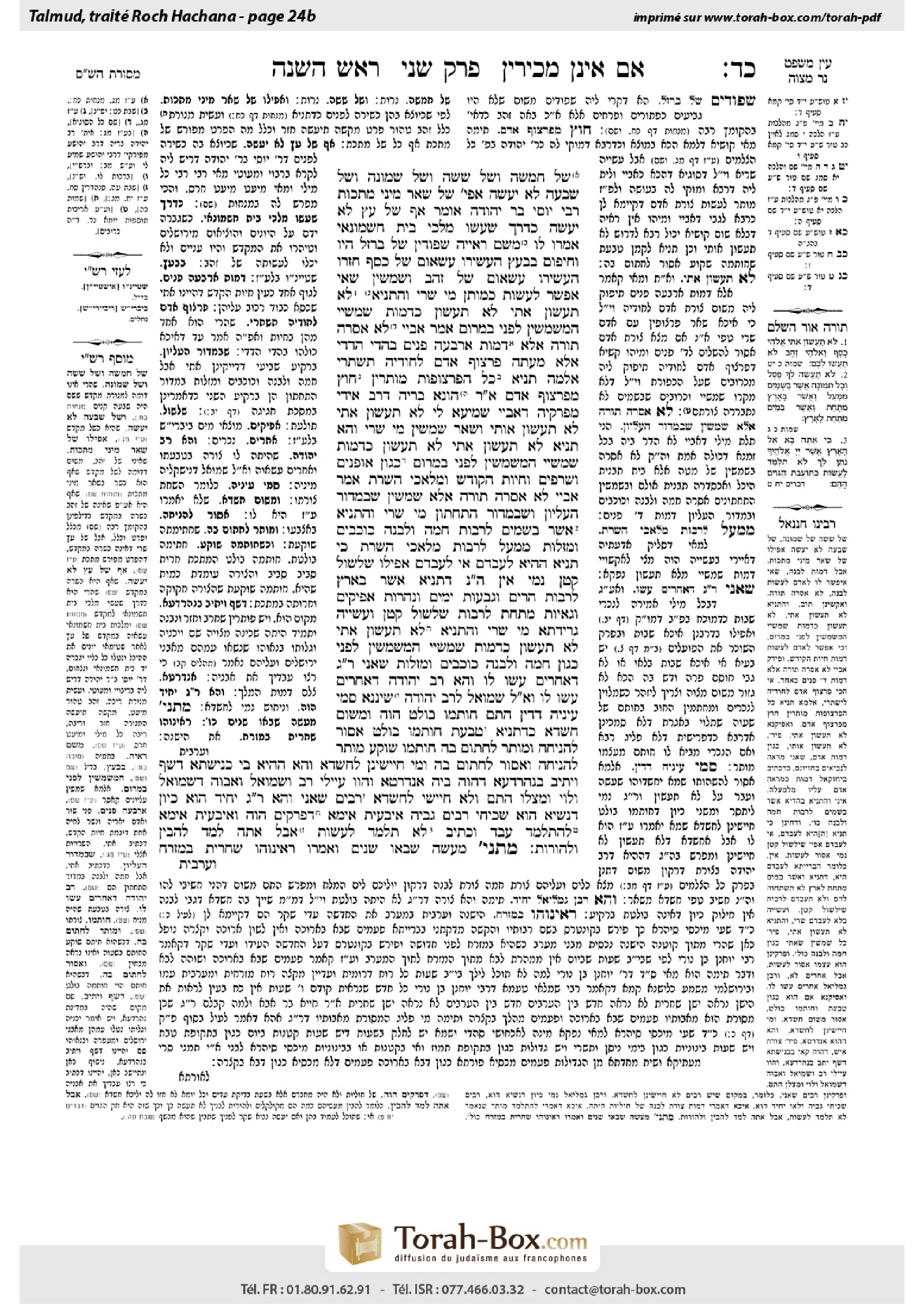
Rosh Hashanah 24b: Talmud study for Daf Yomi
Daf Yomi is the daily study of one Talmud folio. Explore 37 tractates with scans, Hebrew text, Sefaria English and AI-generated French translations where annotated.
Passage selection and English or AI-generated French translation are available where the scan has annotations. Daf Study is independent of Torah-Box and Sefaria.
Browse Rosh Hashanah · ראש השנה · All tractatesRosh Hashanah 24b text and translations
This page of Rosh Hashanah includes the Aramaic text, an English translation and an AI-generated French translation, alongside the scan above.
ראש השנה כ״ד ב · Aramaic and Hebrew text
שֶׁל חֲמִשָּׁה וְשֶׁל שִׁשָּׁה וְשֶׁל שְׁמוֹנָה. וְשֶׁל שִׁבְעָה — לֹא יַעֲשֶׂה, אֲפִילּוּ שֶׁל שְׁאָר מִינֵי מַתָּכוֹת. רַבִּי יוֹסֵי בַּר יְהוּדָה אוֹמֵר: אַף שֶׁל עֵץ לֹא יַעֲשֶׂה, כְּדֶרֶךְ שֶׁעָשׂוּ מַלְכֵי בֵּית חַשְׁמוֹנַאי.
אָמְרוּ לוֹ: מִשָּׁם רְאָיָיה?! שַׁפּוּדִין שֶׁל בַּרְזֶל הָיוּ וְחִיפּוּם בְּבַעַץ. הֶעֱשִׁירוּ — עֲשָׂאוּם שֶׁל כֶּסֶף, חָזְרוּ הֶעֱשִׁירוּ — עֲשָׂאוּם שֶׁל זָהָב.
וְשַׁמָּשִׁין שֶׁאִי אֶפְשָׁר לַעֲשׂוֹת כְּמוֹתָן מִי שְׁרֵי? וְהָתַנְיָא: ״לֹא תַעֲשׂוּן אִתִּי״ — לֹא תַּעֲשׂוּן כִּדְמוּת שַׁמָּשַׁיי הַמְשַׁמְּשִׁין לְפָנַי בַּמָּרוֹם! אָמַר אַבָּיֵי: לֹא אָסְרָה תּוֹרָה אֶלָּא דְּמוּת אַרְבָּעָה פָּנִים בַּהֲדֵי הֲדָדֵי.
אֶלָּא מֵעַתָּה פַּרְצוּף אָדָם לְחוֹדֵיהּ תִּשְׁתְּרֵי? אַלְּמָה תַּנְיָא: כׇּל הַפַּרְצוּפוֹת מוּתָּרִין חוּץ מִפַּרְצוּף אָדָם! אָמַר רַב הוּנָא בְּרֵיהּ דְּרַב אִידִי: מִפִּרְקֵיהּ דְּאַבָּיֵי שְׁמִיעָא לִי: ״לֹא תַעֲשׂוּן אִתִּי״ — לֹא תַּעֲשׂוּן אוֹתִי.
וּשְׁאָר שַׁמָּשִׁין מִי שְׁרֵי? וְהָא תַּנְיָא ״לֹא תַעֲשׂוּן אִתִּי״ — לֹא תַּעֲשׂוּן כִּדְמוּת שַׁמָּשַׁיי הַמְּשַׁמְּשִׁין לְפָנַי בַּמָּרוֹם, כְּגוֹן אוֹפַנִּים וּשְׂרָפִים וְחַיּוֹת הַקּוֹדֶשׁ וּמַלְאֲכֵי הַשָּׁרֵת! אָמַר אַבָּיֵי: לֹא אָסְרָה תּוֹרָה אֶלָּא שַׁמָּשִׁין שֶׁבַּמָּדוֹר הָעֶלְיוֹן.
וְשֶׁבַּמָּדוֹר הַתַּחְתּוֹן מִי שְׁרֵי? וְהָתַנְיָא: ״אֲשֶׁר בַּשָּׁמַיִם״ — לְרַבּוֹת חַמָּה וּלְבָנָה כּוֹכָבִים וּמַזָּלוֹת, ״מִמַּעַל״ — לְרַבּוֹת מַלְאֲכֵי הַשָּׁרֵת! כִּי תַּנְיָא הָהִיא — לְעׇבְדָם.
אִי לְעׇבְדָם, אֲפִילּוּ שִׁלְשׁוּל קָטָן נָמֵי! אִין הָכִי נָמֵי, דְּתַנְיָא: ״אֲשֶׁר בָּאָרֶץ״ — לְרַבּוֹת הָרִים וּגְבָעוֹת יַמִּים וּנְהָרוֹת אֲפִיקִים וְגֵאָיוֹת, ״מִתַּחַת״ — לְרַבּוֹת שִׁלְשׁוּל קָטָן.
וַעֲשִׂיָּיה גְּרֵידְתָּא מִי שְׁרֵי? וְהָתַנְיָא: ״לֹא תַעֲשׂוּן אִתִּי״ — לֹא תַּעֲשׂוּן כִּדְמוּת שַׁמָּשַׁיי הַמְשַׁמְּשִׁין לְפָנַי, כְּגוֹן חַמָּה וּלְבָנָה כּוֹכָבִים וּמַזָּלוֹת.
שָׁאנֵי רַבָּן גַּמְלִיאֵל, דַּאֲחֵרִים עָשׂוּ לוֹ. וְהָא רַב יְהוּדָה, דַּאֲחֵרִים עָשׂוּ לוֹ, וַאֲמַר לֵיהּ שְׁמוּאֵל לְרַב יְהוּדָה: שִׁינָּנָא, סַמִּי עֵינֵיהּ דְּדֵין!
הָתָם, חוֹתָמוֹ בּוֹלֵט הֲוָה, וּמִשּׁוּם חֲשָׁדָא. כִּדְתַנְיָא: טַבַּעַת, חוֹתָמוֹ בּוֹלֵט — אָסוּר לְהַנִּיחָהּ וּמוּתָּר לַחְתּוֹם בָּהּ. חוֹתָמוֹ שׁוֹקֵעַ — מוּתָּר לְהַנִּיחָהּ וְאָסוּר לַחְתּוֹם בָּהּ.
וּמִי חָיְישִׁינַן לַחֲשָׁדָא? וְהָא הָהִיא בֵּי כְנִישְׁתָּא דְּשַׁף וִיתֵיב בִּנְהַרְדְּעָא, דַּהֲוָה בֵּיהּ אִנְדְּרָטָא, וַהֲווֹ עָיְילִי רַב וּשְׁמוּאֵל וַאֲבוּהּ דִּשְׁמוּאֵל וְלֵוִי וּמְצַלּוּ הָתָם, וְלָא חָיְישִׁי לַחֲשָׁדָא! רַבִּים שָׁאנֵי.
וְהָא רַבָּן גַּמְלִיאֵל יָחִיד הוּא? כֵּיוָן דְּנָשִׂיא הוּא — שְׁכִיחִי רַבִּים גַּבֵּיהּ. אִיבָּעֵית אֵימָא: דִּפְרָקִים הֲוָה.
וְאִיבָּעֵית אֵימָא: לְהִתְלַמֵּד עֲבַד, וּכְתִיב: ״לֹא תִּלְמַד לַעֲשׂוֹת״ — אֲבָל אַתָּה לָמֵד לְהָבִין וּלְהוֹרוֹת.
מַתְנִי׳ מַעֲשֶׂה שֶׁבָּאוּ שְׁנַיִם וְאָמְרוּ: רְאִינוּהוּ שַׁחֲרִית בַּמִּזְרָח,
Rosh Hashanah 24b · English translation
a candelabrum of five or of six or of eight lamps. But one may not fashion a candelabrum with seven lamps even if he constructs it from other kinds of metal rather than gold, as in exigent circumstances the candelabrum in the Temple may be fashioned from other metals. Rabbi Yosei bar Yehuda says: Also, one may not fashion a candelabrum of wood, in the manner that the kings of the Hasmonean monarchy fashioned it. When they first purified the Temple they had to prepare the candelabrum out of wood, as no other material was available. Since this candelabrum is fit for the Temple, it is prohibited to fashion one of this kind for oneself.
The other Sages said to Rabbi Yosei bar Yehuda: From there you seek to bring a proof? There the branches of the candelabrum were comprised of spits [shippudin] of iron and they covered them with tin. Later, when they grew richer and could afford a candelabrum of higher-quality material, they fashioned them from silver. When they grew even richer, they fashioned them from gold. Still, Abaye proves from this baraita that the prohibition against forming an image applies only to items that can be reconstructed in an accurate manner. Since this is not possible in the case of the moon, Rabban Gamliel’s forms were permitted.
The Gemara asks: And is it really permitted to form images of those attendants concerning which it is impossible to reproduce their likeness? Isn’t it taught in a baraita that the verse: “You shall not make with Me gods of silver” (Exodus 20:19), comes to teach: You shall not make images of My attendants that serve before Me on high. Apparently, this includes the sun and the moon. Abaye said: This does not include the sun and the moon, as the Torah prohibited only the fashioning of an image of all four faces of the creatures of the Heavenly Chariot together (see Ezekiel, chapter 1). However, all other images, which are not the likeness of the ministering angels, are permitted.
The Gemara raises a difficulty: However, if that is so, let the fashioning of an image of a human face [partzuf ] alone be permitted. Why, then, is it taught in a baraita: All faces are permitted for ornamental purposes, except for the face of a person? Rav Huna, son of Rav Idi, said: From a lecture of Abaye I heard that there is a different reason why one may not form an image of a human face, as the verse states: “You shall not make with Me [iti]” (Exodus 20:19). This can be read as: You shall not make Me [oti]. Since man is created in the image of God, it is prohibited to form an image of a human being.
The Gemara asks: And is it permitted to form images of other attendants? Isn’t it taught in another baraita that the verse: “You shall not make with Me gods of silver” (Exodus 20:19), teaches that you shall not make images of My attendants that serve before Me on high, for example, ofanim and seraphim and the sacred ḥayyot and the ministering angels. Abaye said: The Torah prohibited only those attendants that are found in the upper Heaven, i.e., the supreme angels in the highest firmament, but not the celestial bodies, e.g., the sun and the moon, despite the fact that they too are located in heaven.
The Gemara raises another difficulty: And is it permitted to form images of those bodies found in the lower heaven? Isn’t it taught in a baraita: “You shall not make for yourself any graven image, nor any manner of likeness, of anything that is in heaven above, or that is in the earth beneath, or that is in the water under the earth” (Exodus 20:3). The phrase “that is in heaven” comes to include the sun, the moon, the stars, and the constellations. The term “above” serves to include the ministering angels. Apparently, it is prohibited to form an image even of the celestial bodies found in the lower Heaven. The Gemara answers: When that baraita is taught, it is in reference to the prohibition against worshipping them. However, there is no prohibition against forming an image in their likeness.
The Gemara asks: If that baraita is referring to the prohibition against worshipping them, then even a tiny worm should also be prohibited. The Gemara answers: Yes, it is indeed so, as it is taught in the same baraita with regard to the continuation of the verse, “in the earth” comes to include mountains and hills, seas and rivers, streams and valleys; “beneath” comes to include a tiny worm. If so, it is indeed possible to explain that the entire baraita is referring to the prohibition against idol worship.
The Gemara raises yet another objection: And is the mere fashioning of images of the celestial bodies permitted? Isn’t it taught in another baraita: “You shall not make with Me gods of silver” (Exodus 20:19). This verse teaches that you shall not make images of My attendants that serve before Me, for example the sun, the moon, the stars and the constellations. This is explicit proof that it is prohibited to form images of the sun and the moon; consequently, the solution proposed by Abaye is rejected, leaving the difficulty with Rabban Gamliel’s diagram unresolved.
The Gemara proposes an alternative resolution: The case of Rabban Gamliel is different, as others, i.e., gentiles, fashioned those images for him, and it is prohibited only for a Jew to fashion such images; there is no prohibition against having them in one’s possession. The Gemara raises a difficulty: But there is the case of Rav Yehuda, as others fashioned for him a seal in the form of a human being, and Shmuel said to Rav Yehuda, who was his student: Sharp-witted one, blind this one’s eyes, i.e., disfigure the image, as it is prohibited even to have the image of a human being in one’s possession.
The Gemara answers: There, in the case of Rav Yehuda, his was a protruding seal, i.e., the image projected from the ring, and Shmuel prohibited it due to the potential suspicion that he had an object of idol worship in his hand. As it is taught in a baraita: With regard to a ring, if its seal protrudes it is prohibited to place it on one’s finger, due to the suspicion of idol worship, but it is permitted to seal objects with it. In this case, the act of sealing creates an image that is sunken below the surface, which is not prohibited. However, if its seal is sunken, it is permitted to place it on one’s finger, but it is prohibited to seal objects with it, as that creates a protruding image.
The Gemara asks: And are we concerned about arousing suspicion in a case of this kind? But what about that certain synagogue that had been destroyed in Eretz Yisrael and its stones were relocated and it was rebuilt so that it sat in Neharde’a, and there was a statue [andarta] of the king in it. And nevertheless Rav and Shmuel and Shmuel’s father and Levi would all enter and pray there and they were not concerned about arousing suspicion. The Gemara answers: When many Jews are present it is different, as a large group is not suspected of having idolatrous intentions. Rather, it is assumed that the statue is there exclusively for purposes of ornamentation.
The Gemara asks: But isn’t Rabban Gamliel an individual? According to this reasoning, his images of the moon should have been prohibited, as they would have aroused suspicion. The Gemara answers: Since he is the Nasi, the head of the Great Sanhedrin, many people were always found with him, and therefore there was no room for suspicion. The Gemara suggests an alternative answer: If you wish, say that these images were not whole; rather, they were formed from pieces of images that had to be put together. Only complete images are prohibited.
The Gemara suggests yet another answer: If you wish, say: Rabban Gamliel did this to teach himself, which is not prohibited, as it is written: “You shall not learn to do after the abominations of those nations” (Deuteronomy 18:9), which indicates: However, you may learn to understand and to teach. In other words, it is permitted to do certain things for the sake of Torah study which would otherwise be prohibited.
MISHNA: There was an incident in which two witnesses came to testify about the new moon, and they said: We saw the waning moon in the morning in the east,
Rosh Hashanah 24b · Traduction française (IA)
un chandelier à cinq, six ou huit branches. Mais il est interdit de fabriquer un chandelier à sept branches, même si on le fabrique dans un autre métal que l’or, car, en cas de nécessité, le chandelier du Temple peut être fabriqué dans d’autres métaux. Rabbi Yosei bar Yehouda dit : Il est également interdit de fabriquer un chandelier en bois, comme l’ont fait les rois de la dynastie hasmonéenne. Lorsqu’ils purifièrent le Temple pour la première fois, ils durent fabriquer le chandelier en bois, faute de disposer d’un autre matériau. Puisque ce chandelier convient au Temple, il est interdit d’en fabriquer un de ce type pour soi-même.
Les autres Sages dirent à Rabbi Yosei bar Yehouda : C’est de là que tu prétends tirer une preuve ? Là-bas, les branches du chandelier étaient faites de broches [shippudin] en fer, qu’ils recouvrirent d’étain. Plus tard, lorsqu’ils s’enrichirent et purent s’offrir un chandelier dans un matériau de meilleure qualité, ils le fabriquèrent en argent. Lorsqu’ils s’enrichirent encore davantage, ils le fabriquèrent en or. Pourtant, Abaye prouve à partir de cette baraïta que l’interdiction de façonner une image ne s’applique qu’aux objets qu’il est possible de reproduire fidèlement. Puisque cela est impossible dans le cas de la lune, les représentations de Rabban Gamliel étaient permises.
La Guemara demande : Est-il vraiment permis de façonner des représentations de ces serviteurs dont il est impossible de reproduire la ressemblance ? N’est-il pas enseigné dans une baraïta que le verset « Tu ne feras pas avec Moi de dieux d’argent » (Exode 20, 19) vient enseigner : « Tu ne feras pas de représentations de Mes serviteurs qui sont à Mon service là-haut. » Apparemment, cela inclut le soleil et la lune. Abaye dit : Cela n’inclut pas le soleil et la lune, car la Torah n’a interdit que de façonner une représentation réunissant les quatre visages des créatures du Char céleste (voir Ézéchiel, chapitre 1). En revanche, toutes les autres représentations, qui ne sont pas à l’image des anges de service, sont permises.
La Guemara soulève une difficulté : Mais, si tel est le cas, la fabrication d’une représentation du seul visage humain [partzuf] devrait être permise. Pourquoi, alors, enseigne-t-on dans une baraïta : « Tous les visages sont permis à des fins ornementales, à l’exception du visage humain » ? Rav Houna, fils de Rav Idi, dit : J’ai entendu lors d’un enseignement d’Abaye qu’il y a une autre raison pour laquelle il est interdit de façonner une représentation d’un visage humain : le verset dit « Tu ne feras pas avec Moi [iti] » (Exode 20, 19). On peut lire cela comme : « Tu ne Me feras pas [oti]. » Puisque l’homme a été créé à l’image de Dieu, il est interdit de façonner une représentation d’un être humain.
La Guemara demande : Est-il permis de façonner des représentations d’autres serviteurs ? N’est-il pas enseigné dans une autre baraïta que le verset « Tu ne feras pas avec Moi de dieux d’argent » (Exode 20, 19) enseigne qu’il est interdit de faire des représentations de Mes serviteurs qui sont à Mon service là-haut, par exemple des ofanim, des séraphins, des saintes ḥayot et des anges de service ? Abaye dit : La Torah n’a interdit que ces serviteurs qui se trouvent dans le Ciel supérieur, c’est-à-dire les anges suprêmes du firmament le plus élevé, mais pas les corps célestes, tels que le soleil et la lune, bien qu’ils se trouvent eux aussi dans le ciel.
La Guemara soulève une autre difficulté : Est-il permis de façonner des représentations de ces corps qui se trouvent dans le ciel inférieur ? N’est-il pas enseigné dans une baraïta : « Tu ne te feras aucune idole ni aucune représentation de ce qui est dans les cieux en haut, de ce qui est sur la terre en bas ou de ce qui est dans les eaux sous la terre » (Exode 20, 3). L’expression « ce qui est dans les cieux » vient inclure le soleil, la lune, les étoiles et les constellations. Le terme « en haut » sert à inclure les anges de service. Apparemment, il est donc interdit de façonner même une représentation des corps célestes qui se trouvent dans le ciel inférieur. La Guemara répond : Cette baraïta, lorsqu’elle est enseignée, porte sur l’interdiction de les adorer. Il n’y a toutefois pas d’interdiction de façonner une représentation à leur image.
La Guemara demande : Si cette baraïta porte sur l’interdiction de les adorer, alors même un petit ver devrait être interdit. La Guemara répond : Oui, c’est bien le cas, car la même baraïta enseigne, au sujet de la suite du verset, que « sur la terre » vient inclure les montagnes et les collines, les mers et les fleuves, les ruisseaux et les vallées ; « en bas » vient inclure un petit ver. Si tel est le cas, il est effectivement possible d’expliquer que toute la baraïta porte sur l’interdiction du culte des idoles.
La Guemara soulève encore une autre objection : La simple fabrication de représentations des corps célestes est-elle permise ? N’est-il pas enseigné dans une autre baraïta : « Tu ne feras pas avec Moi de dieux d’argent » (Exode 20, 19). Ce verset enseigne qu’il est interdit de faire des représentations de Mes serviteurs qui sont à Mon service, par exemple le soleil, la lune, les étoiles et les constellations. Voilà une preuve explicite qu’il est interdit de façonner des représentations du soleil et de la lune ; par conséquent, la solution proposée par Abaye est rejetée et la difficulté concernant le diagramme de Rabban Gamliel demeure sans réponse.
La Guemara propose une autre résolution : Le cas de Rabban Gamliel est différent, car d’autres personnes, c’est-à-dire des non-Juifs, fabriquèrent ces représentations pour lui ; seul un Juif a l’interdiction de fabriquer de telles représentations. Il n’est pas interdit de les posséder. La Guemara soulève une difficulté : Mais il y a le cas de Rav Yehouda, pour qui d’autres personnes fabriquèrent un sceau en forme d’être humain, et Shmuel dit à Rav Yehouda, qui était son élève : « Homme perspicace, aveugle les yeux de celui-ci », c’est-à-dire défigure cette image, car il est interdit même de posséder une représentation d’un être humain.
La Guemara répond : Là-bas, dans le cas de Rav Yehouda, son sceau était en relief, c’est-à-dire que l’image ressortait de la bague, et Shmuel l’interdit en raison du risque qu’on soupçonne Rav Yehouda de tenir un objet destiné au culte des idoles. En effet, il est enseigné dans une baraïta : S’agissant d’une bague, si son sceau est en relief, il est interdit de la porter au doigt, par crainte du culte des idoles, mais il est permis de s’en servir pour sceller des objets. Dans ce cas, le scellement crée une image en creux, sous la surface, ce qui n’est pas interdit. En revanche, si son sceau est en creux, il est permis de porter la bague au doigt, mais il est interdit de s’en servir pour sceller des objets, car cela crée une image en relief.
La Guemara demande : Se préoccupe-t-on donc de susciter des soupçons dans un cas de ce genre ? Mais qu’en est-il de cette synagogue qui avait été détruite en terre d’Israël, dont les pierres furent transportées et servirent à reconstruire une synagogue à Neharde’a, où se trouvait une statue [andarta] du roi ? Pourtant, Rav, Shmuel, le père de Shmuel et Levi y entraient tous pour prier, sans craindre de susciter des soupçons. La Guemara répond : La situation est différente lorsqu’un grand nombre de Juifs sont présents, car on ne soupçonne pas un grand groupe d’avoir des intentions idolâtres. On suppose plutôt que la statue s’y trouve uniquement à des fins ornementales.
La Guemara demande : Mais Rabban Gamliel n’est-il pas un particulier ? Selon ce raisonnement, ses représentations de la lune auraient dû être interdites, car elles auraient suscité des soupçons. La Guemara répond : Puisqu’il est le Nassi, le chef du Grand Sanhédrin, de nombreuses personnes se trouvaient toujours avec lui ; il n’y avait donc pas lieu de le soupçonner. La Guemara propose une autre réponse : Si tu le souhaites, dis que ces représentations n’étaient pas complètes ; elles étaient plutôt constituées de morceaux qu’il fallait assembler. Seules les représentations complètes sont interdites.
La Guemara propose encore une autre réponse : Si tu le souhaites, dis que Rabban Gamliel faisait cela pour s’instruire, ce qui n’est pas interdit, comme il est écrit : « Tu n’apprendras pas à agir selon les abominations de ces nations » (Deutéronome 18, 9), ce qui indique : « Cependant, tu peux apprendre afin de comprendre et d’enseigner. » Autrement dit, il est permis d’accomplir certaines choses à des fins d’étude de la Torah, même si elles seraient autrement interdites.
MICHNA : Il arriva que deux témoins vinrent témoigner au sujet de la nouvelle lune et dirent : « Nous avons vu la lune décroissante le matin, à l’est. »
Traduction française générée par IA à partir de l’édition anglaise de Sefaria. Vérifie toujours un passage avec le texte source.
Text from Sefaria: William Davidson Edition - Vocalized Aramaic (CC BY NC); William Davidson Edition - English (CC BY NC).