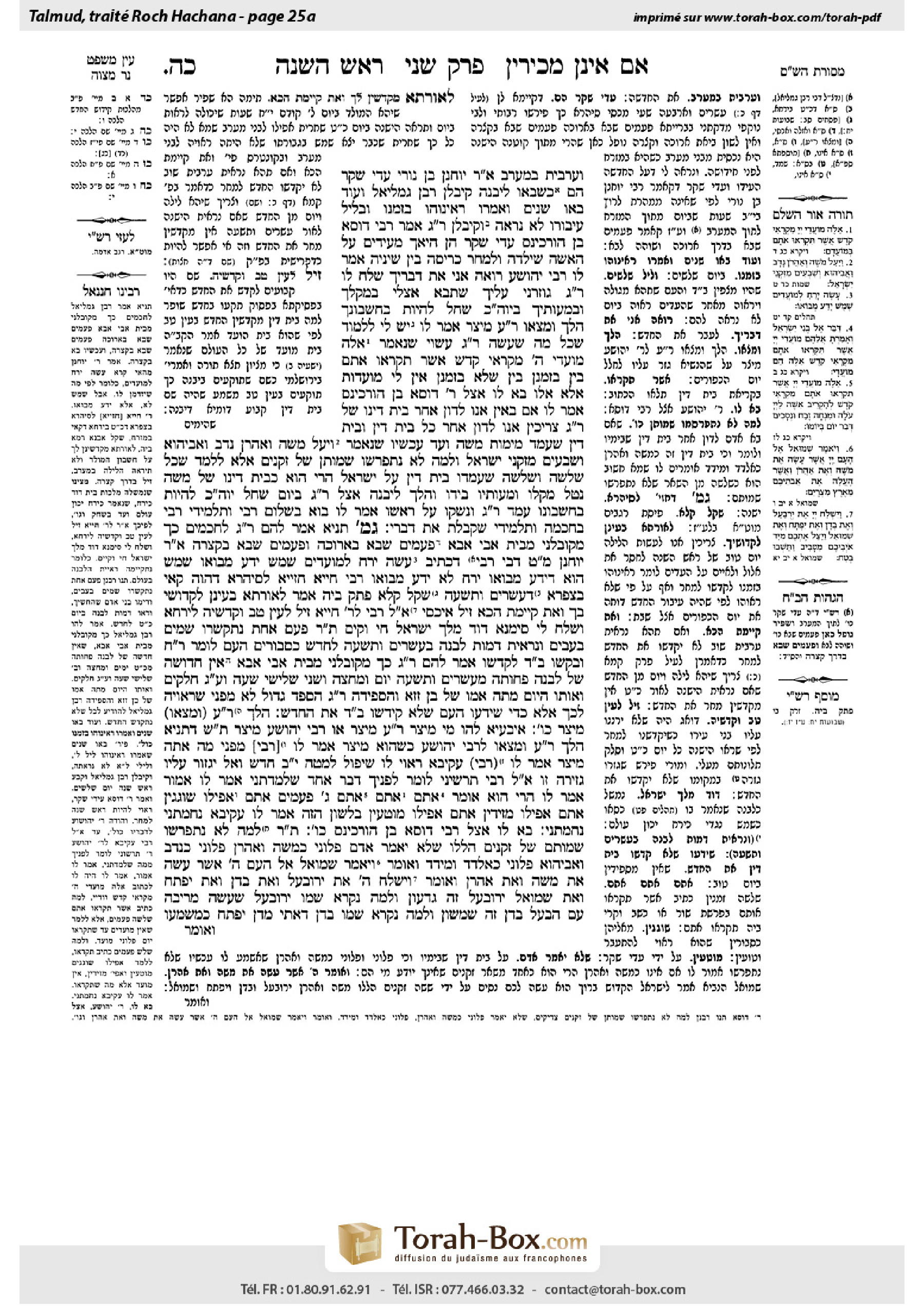
Rosh Hashanah 25a: Talmud study for Daf Yomi
Daf Yomi is the daily study of one Talmud folio. Explore 37 tractates with scans, Hebrew text, Sefaria English and AI-generated French translations where annotated.
Passage selection and English or AI-generated French translation are available where the scan has annotations. Daf Study is independent of Torah-Box and Sefaria.
Browse Rosh Hashanah · ראש השנה · All tractatesRosh Hashanah 25a text and translations
This page of Rosh Hashanah includes the Aramaic text, an English translation and an AI-generated French translation, alongside the scan above.
ראש השנה כ״ה א · Aramaic and Hebrew text
וְעַרְבִית בַּמַּעֲרָב. אָמַר רַבִּי יוֹחָנָן בֶּן נוּרִי: עֵדֵי שֶׁקֶר הֵם. כְּשֶׁבָּאוּ לְיַבְנֶה קִיבְּלָן רַבָּן גַּמְלִיאֵל.
וְעוֹד, בָּאוּ שְׁנַיִם וְאָמְרוּ: רְאִינוּהוּ בִּזְמַנּוֹ, וּבְלֵיל עִיבּוּרוֹ לֹא נִרְאָה, וְקִיבְּלָן רַבָּן גַּמְלִיאֵל.
אָמַר רַבִּי דּוֹסָא בֶּן הוֹרְכִּינָס: עֵדֵי שֶׁקֶר הֵן, הֵיאַךְ מְעִידִים עַל הָאִשָּׁה שֶׁיָּלְדָה וּלְמָחָר כְּרֵיסָהּ בֵּין שִׁינֶּיהָ? אָמַר לוֹ רַבִּי יְהוֹשֻׁעַ: רוֹאֶה אֲנִי אֶת דְּבָרֶיךָ. שָׁלַח לוֹ רַבָּן גַּמְלִיאֵל: גּוֹזְרַנִי עָלֶיךָ שֶׁתָּבֹא אֶצְלִי בְּמַקֶּלְךָ וּבִמְעוֹתֶיךָ בְּיוֹם הַכִּפּוּרִים שֶׁחָל לִהְיוֹת בְּחֶשְׁבּוֹנֶךָ.
הָלַךְ וּמְצָאוֹ רַבִּי עֲקִיבָא מֵיצֵר, אָמַר לוֹ: יֵשׁ לִי לִלְמוֹד שֶׁכׇּל מַה שֶּׁעָשָׂה רַבָּן גַּמְלִיאֵל עָשׂוּי, שֶׁנֶּאֱמַר: ״אֵלֶּה מוֹעֲדֵי ה׳ מִקְרָאֵי קֹדֶשׁ אֲשֶׁר תִּקְרְאוּ אֹתָם״, בֵּין בִּזְמַנָּן בֵּין שֶׁלֹּא בִּזְמַנָּן — אֵין לִי מוֹעֲדוֹת אֶלָּא אֵלּוּ.
בָּא לוֹ אֵצֶל רַבִּי דּוֹסָא בֶּן הוֹרְכִּינָס, אָמַר לוֹ: אִם בָּאִין אָנוּ לָדוּן אַחַר בֵּית דִּינוֹ שֶׁל רַבָּן גַּמְלִיאֵל, צְרִיכִין אָנוּ לָדוּן אַחַר כׇּל בֵּית דִּין וּבֵית דִּין שֶׁעָמַד מִימוֹת מֹשֶׁה וְעַד עַכְשָׁיו. שֶׁנֶּאֱמַר: ״וַיַּעַל מֹשֶׁה וְאַהֲרֹן נָדָב וַאֲבִיהוּא וְשִׁבְעִים מִזִּקְנֵי יִשְׂרָאֵל״, וְלָמָּה לֹא נִתְפָּרְשׁוּ שְׁמוֹתָן שֶׁל זְקֵנִים? אֶלָּא לְלַמֵּד שֶׁכׇּל שְׁלֹשָׁה וּשְׁלֹשָׁה שֶׁעָמְדוּ בֵּית דִּין עַל יִשְׂרָאֵל — הֲרֵי הוּא כְּבֵית דִּינוֹ שֶׁל מֹשֶׁה.
נָטַל מַקְלוֹ וּמְעוֹתָיו בְּיָדוֹ, וְהָלַךְ לְיַבְנֶה אֵצֶל רַבָּן גַּמְלִיאֵל בַּיּוֹם שֶׁחָל יוֹם הַכִּפּוּרִים לִהְיוֹת בְּחֶשְׁבּוֹנוֹ. עָמַד רַבָּן גַּמְלִיאֵל וּנְשָׁקוֹ עַל רֹאשׁוֹ, אָמַר לוֹ: בּוֹא בְּשָׁלוֹם רַבִּי וְתַלְמִידִי! רַבִּי — בְּחׇכְמָה, וְתַלְמִידִי — שֶׁקִּבַּלְתָּ אֶת דְּבָרַי.
גְּמָ׳ תַּנְיָא, אָמַר לָהֶם רַבָּן גַּמְלִיאֵל לַחֲכָמִים: כָּךְ מְקוּבְּלַנִי מִבֵּית אֲבִי אַבָּא — פְּעָמִים שֶׁבָּא בַּאֲרוּכָּה וּפְעָמִים שֶׁבָּא בִּקְצָרָה.
אָמַר רַבִּי יוֹחָנָן: מַאי טַעְמָא דְּבֵי רַבִּי, דִּכְתִיב: ״עָשָׂה יָרֵחַ לְמוֹעֲדִים שֶׁמֶשׁ יָדַע מְבוֹאוֹ״ — שֶׁמֶשׁ הוּא דְּיָדַע מְבוֹאוֹ, יָרֵחַ לֹא יָדַע מְבוֹאוֹ.
רַבִּי חִיָּיא חַזְיֵיא לְסֵיהֲרָא דַּהֲוָה קָאֵי בְּצַפְרָא דְּעֶשְׂרִים וְתִשְׁעָה. שְׁקַל קָלָא פְּתַק בֵּיהּ, אֲמַר: לְאוּרְתָּא בָּעֵינַן לְקַדּוֹשֵׁי בָּךְ, וְאַתְּ קָיְימַתְּ הָכָא?! זִיל אִיכַּסִּי. אֲמַר לֵיהּ רַבִּי לְרַבִּי חִיָּיא: זִיל לְעֵין טָב וְקַדְּשֵׁיהּ לְיַרְחָא, וּשְׁלַח לִי סִימָנָא: ״דָּוִד מֶלֶךְ יִשְׂרָאֵל חַי וְקַיָּם״.
תָּנוּ רַבָּנַן: פַּעַם אַחַת נִתְקַשְּׁרוּ שָׁמַיִם בְּעָבִים, וְנִרְאֵית דְּמוּת לְבָנָה בְּעֶשְׂרִים וְתִשְׁעָה לַחֹדֶשׁ. כִּסְבוּרִים הָעָם לוֹמַר רֹאשׁ חֹדֶשׁ, וּבִקְּשׁוּ בֵּית דִּין לְקַדְּשׁוֹ. אָמַר לָהֶם רַבָּן גַּמְלִיאֵל: כָּךְ מְקוּבְּלַנִי מִבֵּית אֲבִי אַבָּא — אֵין חִדּוּשָׁהּ שֶׁל לְבָנָה פְּחוּתָה מֵעֶשְׂרִים וְתִשְׁעָה יוֹם וּמֶחֱצָה וּשְׁנֵי שְׁלִישֵׁי שָׁעָה וְשִׁבְעִים וּשְׁלֹשָׁה חֲלָקִים.
וְאוֹתוֹ הַיּוֹם מֵתָה אִמּוֹ שֶׁל בֶּן זָזָא, וְהִסְפִּידָהּ רַבָּן גַּמְלִיאֵל הֶסְפֵּד גָּדוֹל. לֹא מִפְּנֵי שֶׁרְאוּיָה לְכָךְ, אֶלָּא כְּדֵי שֶׁיֵּדְעוּ הָעָם שֶׁלֹּא קִידְּשׁוּ בֵּית דִּין אֶת הַחֹדֶשׁ.
הָלַךְ רַבִּי עֲקִיבָא וּמְצָאוֹ מֵיצֵר כּוּ׳. אִיבַּעְיָא לְהוּ: מִי מֵיצֵר? רַבִּי עֲקִיבָא מֵיצֵר, אוֹ רַבִּי יְהוֹשֻׁעַ מֵיצֵר? תָּא שְׁמַע, דְּתַנְיָא: הָלַךְ רַבִּי עֲקִיבָא וּמְצָאוֹ לְרַבִּי יְהוֹשֻׁעַ כְּשֶׁהוּא מֵיצֵר, אָמַר לוֹ: [רַבִּי] מִפְּנֵי מָה אַתָּה מֵיצֵר? אָמַר לוֹ: רַבִּי עֲקִיבָא, רָאוּי לוֹ שֶׁיִּפּוֹל לַמִּטָּה שְׁנֵים עָשָׂר חֹדֶשׁ, וְאַל יִגְזוֹר עָלָיו גְּזֵירָה זוֹ.
אָמַר לוֹ: רַבִּי, תַּרְשֵׁינִי לוֹמַר לְפָנֶיךָ דָּבָר אֶחָד שֶׁלִּמַּדְתַּנִי. אָמַר לוֹ: אֱמוֹר. אָמַר לוֹ: הֲרֵי הוּא אוֹמֵר ״אֹתָם״ ״אֹתָם״ ״אֹתָם״ שָׁלֹשׁ פְּעָמִים.
״אַתֶּם״ — אֲפִילּוּ שׁוֹגְגִין, ״אַתֶּם״ — אֲפִילּוּ מְזִידִין, ״אַתֶּם״ — אֲפִילּוּ מוּטְעִין. בַּלָּשׁוֹן הַזֶּה אָמַר לוֹ: עֲקִיבָא נִחַמְתַּנִי, נִחַמְתַּנִי.
בָּא לוֹ אֵצֶל רַבִּי דּוֹסָא בֶּן הוֹרְכִּינָס כּוּ׳. תָּנוּ רַבָּנַן: לָמָּה לֹא נִתְפָּרְשׁוּ שְׁמוֹתָם שֶׁל זְקֵנִים הַלָּלוּ? שֶׁלֹּא יֹאמַר אָדָם: פְּלוֹנִי כְּמֹשֶׁה וְאַהֲרֹן? פְּלוֹנִי כְּנָדָב וַאֲבִיהוּא? פְּלוֹנִי כְּאֶלְדָּד וּמֵידָד?
וְאוֹמֵר: ״וַיֹּאמֶר שְׁמוּאֵל אֶל הָעָם ה׳ אֲשֶׁר עָשָׂה אֶת מֹשֶׁה וְאֶת אַהֲרֹן״. וְאוֹמֵר: ״וַיִּשְׁלַח ה׳ אֶת יְרוּבַּעַל וְאֶת בְּדָן וְאֶת יִפְתָּח וְאֶת שְׁמוּאֵל״. ״יְרוּבַּעַל״ — זֶה גִּדְעוֹן, וְלָמָּה נִקְרָא שְׁמוֹ יְרוּבַּעַל — שֶׁעָשָׂה מְרִיבָה עִם הַבַּעַל. ״בְּדָן״ — זֶה שִׁמְשׁוֹן, וְלָמָּה נִקְרָא שְׁמוֹ בְּדָן — דְּאָתֵי מִדָּן. יִפְתָּח — כְּמַשְׁמָעוֹ.
Rosh Hashanah 25a · English translation
and that same day we saw the new moon in the evening in the west. Rabbi Yoḥanan ben Nuri said: They are false witnesses, as it is impossible to see the new moon so soon after the last sighting of the waning moon. However, when they arrived in Yavne, Rabban Gamliel accepted them as witnesses without concern.
And there was another incident in which two witnesses came and said: We saw the new moon at its anticipated time, i.e., on the night of the thirtieth day of the previous month; however, on the following night, i.e., the start of the thirty-first, which is often the determinant of a full, thirty-day month, it was not seen. And nevertheless Rabban Gamliel accepted their testimony and established the New Moon on the thirtieth day.
Rabbi Dosa ben Horkinas disagreed and said: They are false witnesses; how can witnesses testify that a woman gave birth and the next day her belly is between her teeth, i.e., she is obviously still pregnant? If the new moon was already visible at its anticipated time, how could it not be seen a day later? Rabbi Yehoshua said to him: I see the logic of your statement; the New Moon must be established a day later. Upon hearing that Rabbi Yehoshua had challenged his ruling, Rabban Gamliel sent a message to him: I decree against you that you must appear before me with your staff and with your money on the day on which Yom Kippur occurs according to your calculation; according to my calculation, that day is the eleventh of Tishrei, the day after Yom Kippur.
Rabbi Akiva went and found Rabbi Yehoshua distressed that the head of the Great Sanhedrin was forcing him to desecrate the day that he maintained was Yom Kippur. In an attempt to console him, Rabbi Akiva said to Rabbi Yehoshua: I can learn from a verse that everything that Rabban Gamliel did in sanctifying the month is done, i.e., it is valid. As it is stated: “These are the appointed seasons of the Lord, sacred convocations, which you shall proclaim in their season” (Leviticus 23:4). This verse indicates that whether you have proclaimed them at their proper time or whether you have declared them not at their proper time, I have only these Festivals as established by the representatives of the Jewish people.
Rabbi Yehoshua then came to Rabbi Dosa ben Horkinas, who said to him: If we come to debate and question the rulings of the court of Rabban Gamliel, we must debate and question the rulings of every court that has stood from the days of Moses until now. As it is stated: “Then Moses went up, and Aaron, Nadav and Avihu, and seventy of the Elders of Israel” (Exodus 24:9). But why were the names of these seventy Elders not specified? Rather, this comes to teach that every set of three judges that stands as a court over the Jewish people has the same status as the court of Moses. Since it is not revealed who sat on that court, apparently it is enough that they were official judges in a Jewish court.
When Rabbi Yehoshua heard that even Rabbi Dosa ben Horkinas maintained that they must submit to Rabban Gamliel’s decision, he took his staff and his money in his hand, and went to Yavne to Rabban Gamliel on the day on which Yom Kippur occurred according to his own calculation. Upon seeing him, Rabban Gamliel stood up and kissed him on his head. He said to him: Come in peace, my teacher and my student. You are my teacher in wisdom, as Rabbi Yehoshua was wiser than anyone else in his generation, and you are my student, as you accepted my statement, despite your disagreement.
GEMARA: It is taught in a baraita that Rabban Gamliel said to the Sages, in explanation of his opinion that it is possible for the new moon to be visible so soon after the last sighting of the waning moon: This is the tradition that I received from the house of my father’s father: Sometimes the moon comes by a long path and sometimes it comes by a short one.
Rabbi Yoḥanan said: What is the reason for the opinion of the house of Rabbi Yehuda HaNasi, i.e., the house of the heads of the Great Sanhedrin, the source of Rabban Gamliel’s ruling? As it is written: “Who appointed the moon for seasons; the sun knows its going down” (Psalms 104:19). This verse indicates that it is only the sun that knows its going down, i.e., its seasons and the times that it shines are the same every year. In contrast, the moon does not know its going down, as its course is not identical every month.
§ The Gemara relates that Rabbi Ḥiyya once saw the waning moon standing in the sky on the morning of the twenty-ninth of the month. He took a clump of earth and threw it at the moon, saying: This evening we need to sanctify you, i.e., the new moon must be visible tonight so that we may declare the thirtieth of the month as the New Moon, and you are still standing here? Go and cover yourself for now, so that the new moon will be seen only after nightfall. The Gemara further relates that Rabbi Yehuda HaNasi once said to Rabbi Ḥiyya: Go to a place called Ein Tav and sanctify the New Moon there, and send me a sign that you have sanctified it. The sign is: David, king of Israel, lives and endures.
The Sages taught in a baraita: Once the sky was covered with clouds, and the form of the moon was visible on the twenty-ninth of the month. The people thought to say that the day was the New Moon, and the court sought to sanctify it. However, Rabban Gamliel said to them: This is the tradition that I received from the house of my father’s father: The monthly cycle of the renewal of the moon takes no less than twenty-nine and a half days, plus two-thirds of an hour, plus seventy-three of the 1,080 subsections of an hour.
The baraita continues: And on that day the mother of the Sage ben Zaza died, and Rabban Gamliel delivered a great eulogy on her behalf. He did this not because she was worthy of this honor; rather, he eulogized her so that the people would know that the court had not sanctified the month, as eulogies are prohibited on the New Moon.
§ The mishna taught that Rabbi Akiva went and found him distressed that the head of the Great Sanhedrin was forcing him to desecrate the day that he maintained was Yom Kippur. A dilemma was raised before the Sages: Who was distressed? Was Rabbi Akiva distressed or was Rabbi Yehoshua distressed? The Gemara answers: Come and hear, as it is taught in a baraita: Rabbi Akiva went and found Rabbi Yehoshua in a state of distress, and he said to him: My teacher, for what reason are you distressed? Rabbi Yehoshua said to him: Rabbi Akiva, it is fitting for one to fall sick in bed for twelve months, rather than to have this decree issued against him that he should have to desecrate Yom Kippur.
Rabbi Akiva said to him: My teacher, allow me to say before you one matter that you yourself once taught me. He said to him: Speak. He said to him: It states with respect to the Festivals: “The appointed seasons of the Lord, which you shall proclaim them [otam] to be sacred convocations (Leviticus 23:2). And it is written: “These are the appointed seasons of the Lord, sacred convocations; you shall proclaim them [otam] in their season” (Leviticus 23:4). And it is written: “These are the appointed seasons of the Lord; you shall proclaim them [otam] to be sacred convocations” (Leviticus 23:37). Three times the verses use the term: Them [otam], which can also be read as you [atem], in plural.
This comes to teach: You [atem] are authorized to determine the date of the new month, even if you unwittingly establish the New Moon on the wrong day; you, even if you do so intentionally; you, even if you are misled by false witnesses. In all cases, once the court establishes the day as the New Moon, it is sanctified, and God grants His consent. After hearing this, Rabbi Yehoshua said to him in these words: Akiva, you have consoled me; you have consoled me.
§ The mishna taught that Rabbi Yehoshua next came to Rabbi Dosa ben Horkinas, who proved to him that the court of Rabban Gamliel has the same legal status as the court of Moses. The Sages taught in a baraita: Why were the names of these seventy Elders who sat together with Moses on his court not specified? The reason is so that a person not say: Is so-and-so the judge in my time, like Moses and Aaron? Is so-and-so like Nadav and Avihu? Is so-and-so like Eldad and Medad? Therefore, the names of the other elders were not specified, so that there is no way of knowing the qualifications of the elders in the time of Moses to compare them to later judges.
And similarly it says: “And Samuel said to the people: It is the Lord Who made Moses and Aaron” (I Samuel 12:6). And it says further: “And the Lord sent Jerubaal and Bedan and Jephthah and Samuel” (I Samuel 12:11). The Gemara explains: Jerubaal, this is Gideon. And why is he called Jerubaal? The reason is that he waged a quarrel against Baal. Bedan, this is Samson. And why is he called Bedan? As he came from the tribe of Dan. Jephthah, in accordance with its regular meaning, i.e., this is referring to Jephthah himself and is not a nickname.
Rosh Hashanah 25a · Traduction française (IA)
et ce même jour, nous avons vu la nouvelle lune le soir, à l’ouest. Rabbi Yoḥanan ben Nuri dit : « Ce sont de faux témoins, car il est impossible de voir la nouvelle lune si peu de temps après la dernière observation de la lune décroissante. » Cependant, lorsqu’ils arrivèrent à Yavné, Rabban Gamliel les accepta comme témoins sans hésiter.
Il y eut un autre incident : deux témoins vinrent et dirent : « Nous avons vu la nouvelle lune à la date prévue », c’est-à-dire dans la nuit du trentième jour du mois précédent. Cependant, la nuit suivante, au début du trente et unième jour, qui est souvent déterminante pour établir qu’un mois compte trente jours complets, on ne la vit pas. Malgré cela, Rabban Gamliel accepta leur témoignage et fixa le début du mois au trentième jour.
Rabbi Dosa ben Horkinas s’y opposa et dit : « Ce sont de faux témoins. Comment des témoins peuvent-ils déclarer qu’une femme a accouché alors que, le lendemain, son ventre lui arrive aux dents », c’est-à-dire qu’elle est manifestement encore enceinte ? Si la nouvelle lune était déjà visible à la date prévue, comment pouvait-elle ne pas être vue un jour plus tard ? Rabbi Yehoshua lui dit : « Je trouve ton raisonnement juste ; le début du mois doit être fixé un jour plus tard. » Ayant appris que Rabbi Yehoshua avait contesté sa décision, Rabban Gamliel lui fit parvenir ce message : « Je décrète que tu dois te présenter devant moi avec ton bâton et ton argent le jour où tombe Yom Kippour selon ton calcul ; selon mon calcul, ce jour est le onze Tishri, le lendemain de Yom Kippour. »
Rabbi Akiva alla trouver Rabbi Yehoshua, affligé de ce que le chef du Grand Sanhédrin le forçait à profaner le jour qu’il tenait pour Yom Kippour. Pour tenter de le consoler, Rabbi Akiva lui dit : « Je peux déduire d’un verset que tout ce que Rabban Gamliel a fait en sanctifiant le mois est valide. Car il est dit : “Voici les solennités de l’Éternel, les saintes convocations, que vous proclamerez en leur temps” (Lévitique 23:4). Ce verset indique que, que vous les ayez proclamées au moment voulu ou non, les fêtes sont établies par les représentants du peuple juif. »
Rabbi Yehoshua se rendit alors chez Rabbi Dosa ben Horkinas, qui lui dit : « Si nous en venons à débattre des décisions du tribunal de Rabban Gamliel et à les contester, nous devons débattre des décisions de tous les tribunaux qui ont siégé depuis l’époque de Moïse jusqu’à présent et les contester. Car il est dit : “Moïse monta, ainsi qu’Aaron, Nadav et Avihou, et soixante-dix des anciens d’Israël” (Exode 24:9). Mais pourquoi les noms de ces soixante-dix anciens n’ont-ils pas été précisés ? C’est pour enseigner que tout groupe de trois juges constituant un tribunal du peuple juif a le même statut que le tribunal de Moïse. Puisque l’identité des membres de ce tribunal n’est pas révélée, il apparaît qu’il suffit qu’ils aient été des juges officiellement nommés au sein d’un tribunal juif. »
Lorsque Rabbi Yehoshua apprit que même Rabbi Dosa ben Horkinas estimait qu’ils devaient se soumettre à la décision de Rabban Gamliel, il prit son bâton et son argent et se rendit à Yavné, auprès de Rabban Gamliel, le jour où tombait Yom Kippour selon son propre calcul. En le voyant, Rabban Gamliel se leva et l’embrassa sur la tête. Il lui dit : « Entre en paix, mon maître et mon disciple. Tu es mon maître en sagesse, car Rabbi Yehoshua était plus sage que quiconque de sa génération ; et tu es mon disciple, car tu as accepté ma décision malgré ton désaccord. »
GUEMARA : Il est enseigné dans une baraïta que Rabban Gamliel dit aux Sages, pour expliquer son avis selon lequel il est possible de voir la nouvelle lune si peu de temps après la dernière observation de la lune décroissante : « Voici la tradition que j’ai reçue de la maison de mon grand-père paternel : parfois, la lune suit un parcours long et parfois, un parcours court. »
Rabbi Yoḥanan dit : « Quelle est la raison de l’avis de la maison de Rabbi Yehuda HaNasi, c’est-à-dire la maison des chefs du Grand Sanhédrin, dont découle la décision de Rabban Gamliel ? Car il est écrit : “Il a établi la lune pour marquer les saisons ; le soleil connaît son coucher” (Psaumes 104:19). Ce verset indique que seul le soleil connaît son coucher, c’est-à-dire que ses saisons et les moments où il brille sont les mêmes chaque année. En revanche, la lune ne connaît pas son coucher, car son parcours n’est pas identique chaque mois. »
§ La Guemara rapporte que Rabbi Ḥiyya vit un jour, au matin du vingt-neuvième jour du mois, la lune décroissante encore visible dans le ciel. Il prit une motte de terre et la lança vers la lune en disant : « Ce soir, nous devons te sanctifier, c’est-à-dire que la nouvelle lune doit être visible ce soir pour que nous puissions déclarer le trentième jour du mois début du nouveau mois ; et tu es encore là ? Va te cacher pour l’instant, afin que la nouvelle lune ne soit visible qu’après la tombée de la nuit. » La Guemara rapporte également que Rabbi Yehuda HaNasi dit un jour à Rabbi Ḥiyya : « Va à Ein Tav et sanctifie-y le nouveau mois, puis envoie-moi un signe indiquant que tu l’as sanctifié. Le signe est : “David, roi d’Israël, vit et demeure.” »
Les Sages ont enseigné dans une baraïta : « Un jour, le ciel était couvert de nuages et la forme de la lune était visible le vingt-neuvième jour du mois. Les gens pensèrent que c’était le jour du nouveau mois, et le tribunal voulut le sanctifier. Cependant, Rabban Gamliel leur dit : “Voici la tradition que j’ai reçue de la maison de mon grand-père paternel : le cycle mensuel de renouvellement de la lune dure au minimum vingt-neuf jours et demi, plus deux tiers d’heure, plus soixante-treize des 1 080 fractions d’une heure.” »
La baraïta poursuit : « Ce jour-là, la mère du Sage ben Zaza mourut, et Rabban Gamliel prononça un grand éloge funèbre en son honneur. Il ne le fit pas parce qu’elle méritait un tel honneur ; il fit son éloge afin que les gens sachent que le tribunal n’avait pas sanctifié le mois, car les éloges funèbres sont interdits le jour du nouveau mois. »
§ La Michna enseignait que Rabbi Akiva alla trouver Rabbi Yehoshua, affligé de ce que le chef du Grand Sanhédrin le forçait à profaner le jour qu’il tenait pour Yom Kippour. Une question fut soulevée devant les Sages : qui était affligé ? Rabbi Akiva ou Rabbi Yehoshua ? La Guemara répond : « Viens et entends, car il est enseigné dans une baraïta : Rabbi Akiva alla trouver Rabbi Yehoshua, qui était affligé, et lui dit : “Mon maître, pourquoi es-tu affligé ?” Rabbi Yehoshua lui répondit : “Rabbi Akiva, mieux vaudrait tomber malade et rester alité pendant douze mois que de se voir imposer ce décret qui l’oblige à profaner Yom Kippour.” »
Rabbi Akiva lui dit : « Mon maître, permets-moi de te dire une chose que tu m’as toi-même enseignée autrefois. » Il lui répondit : « Parle. » Rabbi Akiva dit : « Au sujet des fêtes, il est dit : “Les solennités de l’Éternel, que vous proclamerez [otam] comme saintes convocations” (Lévitique 23:2). Et il est écrit : “Voici les solennités de l’Éternel, les saintes convocations ; vous les proclamerez [otam] en leur temps” (Lévitique 23:4). Et il est écrit : “Voici les solennités de l’Éternel ; vous les proclamerez [otam] comme saintes convocations” (Lévitique 23:37). À trois reprises, les versets emploient le terme “eux” [otam], qui peut aussi se lire “vous” [atem], au pluriel. »
Cela vient enseigner : « Vous [atem] êtes habilités à fixer la date du nouveau mois, même si, par inadvertance, vous fixez le début du mois au mauvais jour ; vous, même si vous le faites intentionnellement ; vous, même si de faux témoins vous induisent en erreur. » Dans tous les cas, dès que le tribunal fixe ce jour comme début du nouveau mois, celui-ci est sanctifié et Dieu donne son assentiment. Après avoir entendu cela, Rabbi Yehoshua lui dit en ces termes : « Akiva, tu m’as consolé ; tu m’as consolé. »
§ La Michna enseignait que Rabbi Yehoshua se rendit ensuite chez Rabbi Dosa ben Horkinas, qui lui démontra que le tribunal de Rabban Gamliel a le même statut juridique que le tribunal de Moïse. Les Sages ont enseigné dans une baraïta : « Pourquoi les noms des soixante-dix anciens qui siégeaient avec Moïse dans son tribunal n’ont-ils pas été précisés ? C’est pour qu’une personne ne dise pas : “Untel est-il, à mon époque, un juge comme Moïse et Aaron ? Untel est-il comme Nadav et Avihou ? Untel est-il comme Eldad et Medad ?” C’est pourquoi les noms des autres anciens n’ont pas été précisés, afin que l’on ne puisse pas connaître les qualités des anciens de l’époque de Moïse pour les comparer à celles des juges ultérieurs. »
De même, il est dit : « Samuel dit au peuple : “C’est l’Éternel qui a établi Moïse et Aaron” » (I Samuel 12:6). Et il est également dit : « “L’Éternel envoya Jerubaal, Bedan, Jephté et Samuel” » (I Samuel 12:11). La Guemara explique : Jerubaal, c’est Gédéon. Pourquoi l’appelle-t-on Jerubaal ? Parce qu’il engagea une querelle contre Baal. Bedan, c’est Samson. Pourquoi l’appelle-t-on Bedan ? Parce qu’il était issu de la tribu de Dan. Jephté, selon le sens ordinaire du terme, désigne Jephté lui-même et non un surnom.
Traduction française générée par IA à partir de l’édition anglaise de Sefaria. Vérifie toujours un passage avec le texte source.
Text from Sefaria: William Davidson Edition - Vocalized Aramaic (CC BY NC); William Davidson Edition - English (CC BY NC).