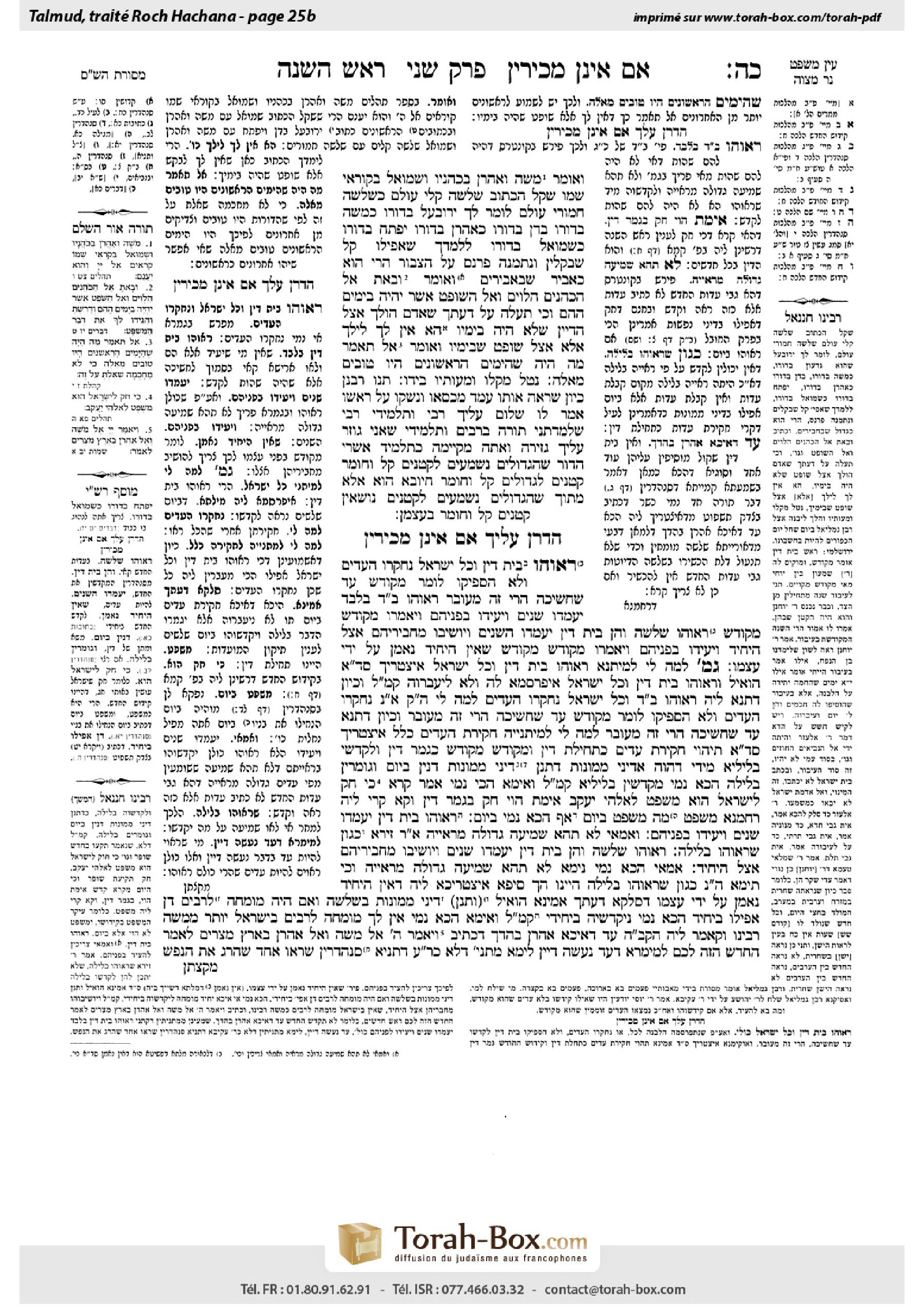
Rosh Hashanah 25b: Talmud study for Daf Yomi
Daf Yomi is the daily study of one Talmud folio. Explore 37 tractates with scans, Hebrew text, Sefaria English and AI-generated French translations where annotated.
Passage selection and English or AI-generated French translation are available where the scan has annotations. Daf Study is independent of Torah-Box and Sefaria.
Browse Rosh Hashanah · ראש השנה · All tractatesRosh Hashanah 25b text and translations
This page of Rosh Hashanah includes the Aramaic text, an English translation and an AI-generated French translation, alongside the scan above.
ראש השנה כ״ה ב · Aramaic and Hebrew text
וְאוֹמֵר: ״מֹשֶׁה וְאַהֲרֹן בְּכֹהֲנָיו וּשְׁמוּאֵל בְּקוֹרְאֵי שְׁמוֹ״, שָׁקַל הַכָּתוּב שְׁלֹשָׁה קַלֵּי עוֹלָם כִּשְׁלֹשָׁה חֲמוּרֵי עוֹלָם,
לוֹמַר לָךְ: יְרוּבַּעַל בְּדוֹרוֹ — כְּמֹשֶׁה בְּדוֹרוֹ, בְּדָן בְּדוֹרוֹ — כְּאַהֲרֹן בְּדוֹרוֹ, יִפְתָּח בְּדוֹרוֹ — כִּשְׁמוּאֵל בְּדוֹרוֹ. לְלַמֶּדְךָ: שֶׁאֲפִילּוּ קַל שֶׁבַּקַּלִּין וְנִתְמַנָּה פַּרְנָס עַל הַצִּבּוּר — הֲרֵי הוּא כְּאַבִּיר שֶׁבָּאַבִּירִים.
וְאוֹמֵר: ״וּבָאתָ אֶל הַכֹּהֲנִים הַלְוִיִּם וְאֶל הַשֹּׁפֵט אֲשֶׁר יִהְיֶה בַּיָּמִים הָהֵם״, וְכִי תַּעֲלֶה עַל דַּעְתְּךָ שֶׁאָדָם הוֹלֵךְ אֵצֶל הַדַּיָּין שֶׁלֹּא הָיָה בְּיָמָיו? הָא אֵין לְךָ לֵילֵךְ אֶלָּא אֵצֶל שׁוֹפֵט שֶׁבְּיָמָיו. וְאוֹמֵר: ״אַל תֹּאמַר מֶה הָיָה שֶׁהַיָּמִים הָרִאשׁוֹנִים הָיוּ טוֹבִים מֵאֵלֶּה״.
נָטַל מַקְלוֹ וּמְעוֹתָיו בְּיָדוֹ. תָּנוּ רַבָּנַן: כֵּיוָן שֶׁרָאָה אוֹתוֹ, עָמַד מִכִּסְּאוֹ וּנְשָׁקוֹ עַל רֹאשׁוֹ, אָמַר לוֹ: שָׁלוֹם עָלֶיךָ רַבִּי וְתַלְמִידִי! רַבִּי — שֶׁלִּמַּדְתַּנִי תּוֹרָה בָּרַבִּים, וְתַלְמִידִי — שֶׁאֲנִי גּוֹזֵר עָלֶיךָ גְּזֵירָה וְאַתָּה מְקַיְּימָהּ כְּתַלְמִיד. אַשְׁרֵי הַדּוֹר שֶׁהַגְּדוֹלִים נִשְׁמָעִים לַקְּטַנִּים, קַל וָחוֹמֶר קְטַנִּים לַגְּדוֹלִים.
קַל וָחוֹמֶר?! חִיּוּבָא הוּא! אֶלָּא: מִתּוֹךְ שֶׁהַגְּדוֹלִים נִשְׁמָעִים לַקְּטַנִּים — נוֹשְׂאִין קְטַנִּים קַל וָחוֹמֶר בְּעַצְמָן.
הֲדַרַן עֲלָךְ אִם אֵינָן מַכִּירִין
רָאוּהוּ בֵּית דִּין וְכׇל יִשְׂרָאֵל, נֶחְקְרוּ הָעֵדִים וְלֹא הִסְפִּיקוּ לוֹמַר ״מְקוּדָּשׁ״ עַד שֶׁחָשֵׁיכָה — הֲרֵי זֶה מְעוּבָּר.
רָאוּהוּ בֵּית דִּין בִּלְבַד — יַעַמְדוּ שְׁנַיִם וְיָעִידוּ בִּפְנֵיהֶם, וְיֹאמְרוּ: ״מְקוּדָּשׁ מְקוּדָּשׁ״. רָאוּהוּ שְׁלֹשָׁה וְהֵן בֵּית דִּין — יַעַמְדוּ הַשְּׁנַיִם וְיוֹשִׁיבוּ מֵחֲבֵירֵיהֶם אֵצֶל הַיָּחִיד, וְיָעִידוּ בִּפְנֵיהֶם, וְיֹאמְרוּ: ״מְקוּדָּשׁ מְקוּדָּשׁ״, שֶׁאֵין הַיָּחִיד נֶאֱמָן עַל יְדֵי עַצְמוֹ.
גְּמָ׳ לְמָה לִי לְמִיתְנֵא רָאוּהוּ בֵּית דִּין וְכׇל יִשְׂרָאֵל? אִיצְטְרִיךְ, סָלְקָא דַּעְתָּךְ אָמֵינָא: הוֹאִיל וְרָאוּהוּ בֵּית דִּין וְכׇל יִשְׂרָאֵל — אִיפַּרְסְמָא לַהּ וְלָא לִיעַבְּרוּהּ, קָא מַשְׁמַע לַן.
וְכֵיוָן דִּתְנָא לֵיהּ רָאוּהוּ בֵּית דִּין וְכׇל יִשְׂרָאֵל — נֶחְקְרוּ הָעֵדִים לְמָה לִי! הָכִי קָאָמַר: אִי נָמֵי נֶחְקְרוּ הָעֵדִים וְלֹא הִסְפִּיקוּ לוֹמַר ״מְקוּדָּשׁ״ עַד שֶׁחָשֵׁיכָה — הֲרֵי זֶה מְעוּבָּר.
וְכֵיוָן דִּתְנָא עַד שֶׁחָשֵׁיכָה הֲרֵי זֶה מְעוּבָּר — לְמָה לִי לְמִיתְנְיַיהּ חֲקִירַת הָעֵדִים כְּלָל?
אִיצְטְרִיךְ, סָלְקָא דַּעְתָּךְ אָמֵינָא: תֶּיהְוֵי חֲקִירַת עֵדִים כִּתְחִילַּת דִּין, וּ״מְקוּדָּשׁ מְקוּדָּשׁ״ כִּגְמַר דִּין, וּלְקַדְּשֵׁיהּ בְּלֵילְיָא, מִידֵּי דְּהָוֵה אַדִּינֵי מָמוֹנוֹת, דִּתְנַן: דִּינֵי מָמוֹנוֹת דָּנִין בַּיּוֹם וְגוֹמְרִין בַּלַּיְלָה — הָכָא נָמֵי מְקַדְּשִׁין בְּלֵילְיָא, קָא מַשְׁמַע לַן.
וְאֵימָא הָכִי נָמֵי? אָמַר קְרָא: ״כִּי חֹק לְיִשְׂרָאֵל הוּא מִשְׁפָּט לֵאלֹהֵי יַעֲקֹב״, אֵימַת הָוֵי ״חֹק״ — בִּגְמַר דִּין, וְקָא קָרֵי לֵיהּ רַחֲמָנָא ״מִשְׁפָּט״, מָה מִשְׁפָּט בַּיּוֹם — אַף הָכָא נָמֵי בַּיּוֹם.
רָאוּהוּ בֵּית דִּין — יַעַמְדוּ שְׁנַיִם וְיָעִידוּ בִּפְנֵיהֶם. וְאַמַּאי? לֹא תְּהֵא שְׁמִיעָה גְּדוֹלָה מֵרְאִיָּיה!
אָמַר רַבִּי זֵירָא: כְּגוֹן שֶׁרָאוּהוּ בַּלַּיְלָה.
רָאוּהוּ שְׁלֹשָׁה וְהֵן בֵּית דִּין — יַעַמְדוּ שְׁנַיִם וְיוֹשִׁיבוּ מֵחֲבֵירֵיהֶם אֵצֶל הַיָּחִיד. אַמַּאי? הָכָא נָמֵי נֵימָא: לֹא תְּהֵא שְׁמִיעָה גְּדוֹלָה מֵרְאִיָּיה! וְכִי תֵּימָא הָכָא נָמֵי — כְּגוֹן שֶׁרָאוּהוּ בַּלַּיְלָה הַיְינוּ הָךְ!
סֵיפָא אִיצְטְרִיכָא לֵיהּ, דְּאֵין הַיָּחִיד נֶאֱמָן עַל יְדֵי עַצְמוֹ. דְּסָלְקָא דַּעְתָּךְ אָמֵינָא: הוֹאִיל וּתְנַן דִּינֵי מָמוֹנוֹת בִּשְׁלֹשָׁה, וְאִם הָיָה מוּמְחֶה לְרַבִּים דָּן אֲפִילּוּ בְּיָחִיד, הָכָא נָמֵי נִיקַדְּשֵׁיהּ בִּיחִידִי — קָא מַשְׁמַע לַן.
וְאֵימָא הָכָא נָמֵי? אֵין לְךָ מוּמְחֶה לְרַבִּים בְּיִשְׂרָאֵל יוֹתֵר מִמֹּשֶׁה רַבֵּינוּ, וְקָאָמַר לֵיהּ הַקָּדוֹשׁ בָּרוּךְ הוּא: עַד דְּאִיכָּא אַהֲרֹן בַּהֲדָךְ, דִּכְתִיב: ״וַיֹּאמֶר ה׳ אֶל מֹשֶׁה וְאֶל אַהֲרֹן בְּאֶרֶץ מִצְרַיִם לֵאמֹר. הַחֹדֶשׁ הַזֶּה לָכֶם״.
לְמֵימְרָא דְּעֵד נַעֲשֶׂה דַּיָּין? לֵימָא מַתְנִיתִין דְּלָא כְּרַבִּי עֲקִיבָא, דְּתַנְיָא: סַנְהֶדְרִין שֶׁרָאוּ אֶחָד שֶׁהָרַג אֶת הַנֶּפֶשׁ —
Rosh Hashanah 25b · English translation
And it says in another verse: “Moses and Aaron among His priests, and Samuel among those who call His name; they called upon the Lord, and He answered them” (Psalms 99:6). This verse equates Samuel to Moses and Aaron. In this manner, the verse weighed three light ones of the world, i.e., it considered the three less distinguished figures of Gideon, Samson, and Jephthah as equal to three significant ones of the world, Moses, Aaron, and Samuel, three of the greatest leaders of the Jewish people.
This comes to tell you that Jerubaal in his generation is worthy of being treated like Moses in his generation; Bedan in his generation is like Aaron in his generation; and Jephthah in his generation is like Samuel in his generation. This serves to teach you that even the lightest of the light, i.e., the least distinguished individual, once he has been appointed as a leader over the community, he must be treated like the greatest of the great, and all are required to heed him and obey his rulings.
And it further says: “And you shall come to the priests, the Levites, and to the judge who shall be in those days” (Deuteronomy 17:9). But can it enter your mind that a person can go to a judge that is not alive in his days? What, then, is the meaning of the phrase “in those days”? It teaches that you need to go only to the judge in one’s days, i.e., he is authorized to judge and decide matters. And it also says: “Do not say: How was it that the former days were better than these? For it is not out of wisdom that you inquire concerning this” (Ecclesiastes 7:10). Instead, one must accept the rulings of the leaders of his generation.
§ The mishna taught: Rabbi Yehoshua took his staff and his money in his hand, and appeared before Rabban Gamliel on the day on which Yom Kippur occurred according to his calculation, as Rabban Gamliel had ordered him to do. The Sages taught in a baraita: When Rabban Gamliel saw Rabbi Yehoshua, he rose from his chair and kissed him on his head and said to him: Peace be on you, my teacher and my student. My teacher, as you have taught me Torah in public, and my student, as I issue a decree against you and you fulfill it like a student of mine. Fortunate is the generation in which the greater heed the lesser, and it is an a fortiori inference that the generation in which the lesser heed the greater is certainly fortunate as well.
The Gemara questions this last point: Is this derived by an a fortiori inference? This is incorrect, as it is an obligation for the lesser to heed those who are greater than them. Rather, Rabbi Gamliel meant the following: Since the greater heed the lesser, the lesser apply an a fortiori inference to themselves and heed the leaders of the generation.
MISHNA: If the court and all of the Jewish people saw the new moon, and the witnesses were interrogated, but the court did not manage to say: Sanctified, before nightfall, so that the thirtieth day already passed, the previous month is rendered a full, thirty-day month, and the following day is observed as the New Moon.
If the court alone saw the new moon, two members of the court should stand and testify before the others, and the court should say: Sanctified, sanctified. If three people saw the new moon, and they are themselves members of a court for this purpose, two of them should stand and seat two of their colleagues next to the individual who remains of the three, thereby forming a new court of three. The two standing judges should then testify before the three seated judges that they saw the new moon and the seated judges say: Sanctified, sanctified. This procedure is necessary because an individual is not authorized to declare the month sanctified by himself. Rather, a court of three is required.
GEMARA: The Gemara asks: Why do I need the mishna to teach: If the court and all of the Jewish people saw the new moon? Merely stating that the court saw the moon would have sufficed, since its sanctification depends on them. The Gemara answers: It was necessary for the mishna to teach that even in that case, the month is intercalated. As it might enter your mind to say that since the court and all of the Jewish people saw the new moon, it was publicized that it was the New Moon that day, and let them no longer intercalate the month. Therefore, the tanna of the mishna teaches us that even in the case where all the Jewish people saw the new moon, the New Moon must be declared by the court.
The Gemara asks further: But once the mishna states: If the court and all of the Jewish people saw the new moon, why do I need it to say: And the witnesses were interrogated? Why are witnesses necessary if the new moon was already seen by the court? The Gemara answers that this is what the tanna is saying: Alternatively, if the witnesses were interrogated, but the court had no time to say: Sanctified, before nightfall, the previous month is intercalated and rendered a full month of thirty days.
The Gemara raises another difficulty. But once the mishna taught: But the court did not manage to say: Sanctified, before nightfall, the previous month is rendered a full, thirty-day month, why do I need the mishna to teach about the interrogation of the witnesses? This halakha was already stated with regard to a case where the court itself saw the new moon.
The Gemara explains: It was necessary, as it might enter your mind to say: Let the interrogation of the witnesses be regarded as the beginning of the judicial process, and let the declaration: Sanctified, sanctified, be regarded as the conclusion of the judicial process, and let them sanctify the month at night, because the process began during the day. This process would then be just as it is in cases of monetary law, as we learned in a mishna: In cases of monetary law, although they must be adjudicated during the day, the court may judge the majority of a case during the day, and complete the trial and issue the ruling at night. Here too, one might assume that the court may sanctify the month at night, as the process began during the day. Therefore, the mishna teaches us that the court may not do so.
The Gemara raises another difficulty: Why not say that, indeed, the sanctification of the month should be treated like monetary cases? The Gemara answers: The verse states with regard to Rosh HaShana: “For this is a statute for Israel, a judgment [mishpat] of the God of Jacob” (Psalms 81:5). When does the sanctification of the month become a statute? At the end of the judicial process, and the Merciful One calls it a judgment as well, thereby teaching that just as the primary time of a judgment is during the day, here too, with regard to the sanctification of the New Moon, the process must take place during the day, and not at night.
§ The mishna continues: If the court alone saw the new moon, two members of the court should stand and testify before the others. The Gemara ponders: If the court saw the new moon, why is it necessary for two of its members to testify before the others? Hearing their testimony should not be greater than actually seeing the new moon.
The Gemara responds that Rabbi Zeira said: The mishna is addressing a case where the court saw the new moon at night. Because they saw it at night, their testimony is inadmissible at that time, as testimonies are admissible only during the day. They must therefore wait until the following day and testify as any ordinary person would.
The mishna continues: If three people saw the new moon, and they are themselves members of a court for this purpose, two of them should stand and seat two of their colleagues next to the individual who remains of the three. The Gemara asks: Why is this necessary? Here too, let us say: Hearing their testimony should not be greater than actually seeing the new moon. And if you say that here too, the mishna is addressing a case where they saw the new moon at night, this case is identical to that previous one, and there would be no need for two separate rulings.
The Gemara answers: It was necessary to teach the last clause, which states: Because an individual is not deemed credible and authorized to declare the month sanctified by himself. For it might enter your mind to say that since we learned in a baraita: Cases of monetary law are adjudicated by a court of three judges, but if a person was a publicly recognized expert, he may judge monetary matters even individually, then here too, one judge should be authorized to sanctify the month individually if he is a recognized expert. Therefore, the mishna teaches us that this is not so, and that three judges are required for the sanctification of the month.
The Gemara asks: But why not say that here too, a recognized expert can sanctify the month individually? The Gemara rejects this possibility: But certainly there was no publicly recognized expert among the Jewish people greater than our teacher Moses, and nevertheless the Holy One, Blessed be He, said to him: You may not sanctify the new month until Aaron is with you, as it is written: “And the Lord spoke to Moses and Aaron in the land of Egypt, saying, this month shall be for you the beginning of months” (Exodus 12:1–2), where the word “you” is in the plural form. And since, to avoid deadlock, a court cannot be composed of an even number of judges, another judge must be added. It is therefore apparent that three judges are required for the sanctification of the month by Torah law.
The Gemara asks: Is this to say that a witness becomes a judge, i.e., that one who witnessed an event can himself serve as a judge concerning the matter? Let us say that the mishna is not in accordance with the opinion of Rabbi Akiva, for it was taught in a baraita: If the Sanhedrin saw someone kill another person,
Rosh Hashanah 25b · Traduction française (IA)
Et il est dit dans un autre verset : « Moïse et Aaron parmi ses prêtres, et Samuel parmi ceux qui invoquent son nom ; ils invoquèrent le Seigneur, et Il leur répondit » (Psaumes 99, 6). Ce verset met Samuel sur le même plan que Moïse et Aaron. Ainsi, le verset a mis en balance trois hommes de peu d’importance dans le monde — c’est-à-dire qu’il a considéré les trois personnages les moins éminents, Gédéon, Samson et Jephté, comme égaux aux trois personnages les plus éminents du monde, Moïse, Aaron et Samuel, trois des plus grands dirigeants du peuple juif.
Cela vient t’apprendre que Yeroubaal, en sa génération, mérite d’être traité comme Moïse en sa génération ; Bedan, en sa génération, est comme Aaron en sa génération ; et Jephté, en sa génération, est comme Samuel en sa génération. Cela t’enseigne que même le moins éminent des hommes, dès lors qu’il a été nommé dirigeant de la communauté, doit être traité comme le plus grand des hommes, et que tous sont tenus de l’écouter et d’obéir à ses décisions.
Et il est encore dit : « Tu iras trouver les prêtres, les lévites et le juge qui sera en ces jours-là » (Deutéronome 17, 9). Mais peut-on imaginer qu’une personne puisse aller trouver un juge qui ne serait pas vivant à son époque ? Que signifie donc l’expression « en ces jours-là » ? Cela enseigne qu’il faut s’adresser au juge de son époque, c’est-à-dire à celui qui est habilité à juger et à trancher les affaires. Il est également dit : « Ne dis pas : “Comment se fait-il que les jours d’autrefois aient été meilleurs que ceux-ci ?” Car ce n’est pas par sagesse que tu t’enquiers de cela » (Ecclésiaste 7, 10). Il faut plutôt accepter les décisions des dirigeants de sa génération.
§ La Michna enseignait : Rabbi Yehoshua prit son bâton et son argent à la main, et se présenta devant Rabban Gamliel le jour où Yom Kippour tombait selon le calcul de celui-ci, comme Rabban Gamliel le lui avait ordonné. Les Sages enseignèrent dans une baraïta : Lorsque Rabban Gamliel vit Rabbi Yehoshua, il se leva de son siège, l’embrassa sur la tête et lui dit : « Paix à toi, mon maître et mon élève. Mon maître, car tu m’as enseigné la Torah en public ; et mon élève, car je prononce un décret contre toi et tu l’accomplis comme mon élève. Heureuse est la génération où les plus grands écoutent les plus petits ; et, a fortiori, la génération où les plus petits écoutent les plus grands est assurément heureuse elle aussi. »
La Guemara remet en question ce dernier point : Cela se déduit-il par un raisonnement a fortiori ? Ce n’est pas le cas, car les plus petits ont l’obligation d’écouter ceux qui sont plus grands qu’eux. Rabbi Gamliel voulait plutôt dire ceci : puisque les plus grands écoutent les plus petits, les plus petits en déduisent a fortiori qu’ils doivent, eux aussi, écouter les dirigeants de la génération.
MICHNA : Si le tribunal et tout le peuple juif ont vu la nouvelle lune et que les témoins ont été interrogés, mais que le tribunal n’a pas réussi à déclarer « Sanctifié » avant la tombée de la nuit, de sorte que le trentième jour était déjà passé, le mois précédent devient un mois complet de trente jours, et le lendemain est observé comme Roch Hodech.
Si le tribunal seul a vu la nouvelle lune, deux membres du tribunal doivent se lever et témoigner devant les autres, puis le tribunal doit déclarer : « Sanctifié, sanctifié. » Si trois personnes ont vu la nouvelle lune et qu’elles sont elles-mêmes membres d’un tribunal constitué à cette fin, deux d’entre elles doivent se lever et faire asseoir deux de leurs collègues à côté de la troisième, formant ainsi un nouveau tribunal de trois membres. Les deux juges debout doivent alors témoigner devant les trois juges assis qu’ils ont vu la nouvelle lune, et les juges assis déclarent : « Sanctifié, sanctifié. » Cette procédure est nécessaire, car un individu n’est pas habilité à déclarer seul le mois sanctifié. Un tribunal de trois membres est requis.
GUEMARA : La Guemara demande : Pourquoi la Michna doit-elle enseigner : « Si le tribunal et tout le peuple juif ont vu la nouvelle lune » ? Il aurait suffi de dire que le tribunal a vu la lune, puisque la sanctification du mois dépend de lui. La Guemara répond : La Michna devait enseigner que même dans ce cas, le mois est prolongé. On aurait pu penser que, puisque le tribunal et tout le peuple juif ont vu la nouvelle lune, il a été rendu public que ce jour était Roch Hodech, et qu’il ne fallait donc plus prolonger le mois. Le tanna de la Michna nous enseigne donc que même lorsque tout le peuple juif a vu la nouvelle lune, le tribunal doit déclarer Roch Hodech.
La Guemara demande encore : Mais puisque la Michna dit : « Si le tribunal et tout le peuple juif ont vu la nouvelle lune », pourquoi doit-elle ajouter : « Et les témoins ont été interrogés » ? Pourquoi faut-il des témoins si le tribunal a déjà vu la nouvelle lune ? La Guemara répond que le tanna veut dire ceci : Ou bien, les témoins ont été interrogés, mais le tribunal n’a pas eu le temps de déclarer « Sanctifié » avant la tombée de la nuit ; le mois précédent est alors prolongé et devient un mois complet de trente jours.
La Guemara soulève une autre difficulté : Mais puisque la Michna a enseigné : « Mais le tribunal n’a pas réussi à déclarer “Sanctifié” avant la tombée de la nuit, et le mois précédent devient un mois complet de trente jours », pourquoi doit-elle enseigner l’interrogatoire des témoins ? Cette halakha a déjà été énoncée à propos d’un cas où le tribunal lui-même a vu la nouvelle lune.
La Guemara explique : C’était nécessaire, car on aurait pu penser que l’interrogatoire des témoins était considéré comme le début de la procédure judiciaire, et que la déclaration « Sanctifié, sanctifié » en constituait la conclusion ; le tribunal aurait alors pu sanctifier le mois la nuit, puisque la procédure avait commencé pendant le jour. Cette procédure serait ainsi semblable à celle des affaires pécuniaires, comme nous l’avons appris dans une Michna : Dans les affaires pécuniaires, bien qu’elles doivent être jugées pendant le jour, le tribunal peut examiner la majeure partie d’une affaire pendant le jour, puis achever le procès et prononcer son jugement la nuit. Ici aussi, on aurait pu supposer que le tribunal peut sanctifier le mois la nuit, puisque la procédure a commencé pendant le jour. La Michna nous enseigne donc qu’il ne peut pas le faire.
La Guemara soulève une autre difficulté : Pourquoi ne pas dire que, de fait, la sanctification du mois doit être traitée comme les affaires pécuniaires ? La Guemara répond : À propos de Roch Hachana, le verset dit : « Car c’est une loi pour Israël, un jugement [mishpat] du Dieu de Jacob » (Psaumes 81, 5). À quel moment la sanctification du mois devient-elle une loi ? À la fin de la procédure judiciaire ; et le Miséricordieux l’appelle aussi un jugement, pour enseigner que, tout comme le moment principal d’un jugement est pendant le jour, de même, pour la sanctification de la nouvelle lune, la procédure doit avoir lieu pendant le jour et non la nuit.
§ La Michna poursuit : Si le tribunal seul a vu la nouvelle lune, deux membres du tribunal doivent se lever et témoigner devant les autres. La Guemara s’interroge : Si le tribunal a vu la nouvelle lune, pourquoi deux de ses membres doivent-ils témoigner devant les autres ? Entendre leur témoignage ne saurait avoir plus de poids que le fait d’avoir vu eux-mêmes la nouvelle lune.
La Guemara répond que Rabbi Zeira a dit : La Michna traite d’un cas où le tribunal a vu la nouvelle lune pendant la nuit. Comme ses membres l’ont vue la nuit, leur témoignage n’est pas recevable à ce moment-là, car les témoignages ne sont recevables que pendant le jour. Ils doivent donc attendre le lendemain et témoigner comme n’importe quelle personne ordinaire.
La Michna poursuit : Si trois personnes ont vu la nouvelle lune et qu’elles sont elles-mêmes membres d’un tribunal constitué à cette fin, deux d’entre elles doivent se lever et faire asseoir deux de leurs collègues à côté de la troisième. La Guemara demande : Pourquoi est-ce nécessaire ? Ici aussi, disons : entendre leur témoignage ne saurait avoir plus de poids que le fait d’avoir vu eux-mêmes la nouvelle lune. Et si tu dis qu’ici aussi, la Michna traite d’un cas où ils ont vu la nouvelle lune pendant la nuit, ce cas est identique au précédent ; il n’était donc pas nécessaire d’énoncer deux règles distinctes.
La Guemara répond : Il était nécessaire d’enseigner la dernière clause, qui dit : « Car un individu n’est pas habilité à déclarer seul le mois sanctifié. » On aurait pu penser que, puisque nous avons appris dans une baraïta que les affaires pécuniaires sont jugées par un tribunal de trois juges, mais qu’une personne ayant la qualité d’expert reconnu peut juger seule les affaires pécuniaires, ici aussi, un juge devrait être habilité à sanctifier seul le mois s’il est un expert reconnu. La Michna nous enseigne donc qu’il n’en est pas ainsi et que trois juges sont requis pour sanctifier le mois.
La Guemara demande : Mais pourquoi ne pas dire qu’ici aussi, un expert reconnu peut sanctifier le mois seul ? La Guemara rejette cette possibilité : assurément, il n’y avait parmi le peuple juif aucun expert reconnu plus éminent que Moïse notre maître ; néanmoins, le Saint, béni soit-Il, lui dit qu’il ne pouvait pas sanctifier le nouveau mois avant qu’Aaron ne soit avec lui, comme il est écrit : « Le Seigneur parla à Moïse et à Aaron dans le pays d’Égypte, en disant : Ce mois sera pour vous le commencement des mois » (Exode 12, 1-2), où le mot « vous » est au pluriel. Et puisque, afin d’éviter une impasse, un tribunal ne peut pas être composé d’un nombre pair de juges, il faut ajouter un autre juge. Il apparaît donc que, selon la Torah, trois juges sont requis pour sanctifier le mois.
La Guemara demande : Est-ce à dire qu’un témoin peut devenir juge, c’est-à-dire que celui qui a été témoin d’un événement peut lui-même siéger comme juge dans cette affaire ? Disons que la Michna ne suit pas l’opinion de Rabbi Akiva, car il a été enseigné dans une baraïta : Si le Sanhédrin a vu quelqu’un tuer une autre personne,
Traduction française générée par IA à partir de l’édition anglaise de Sefaria. Vérifie toujours un passage avec le texte source.
Text from Sefaria: William Davidson Edition - Vocalized Aramaic (CC BY NC); William Davidson Edition - English (CC BY NC).