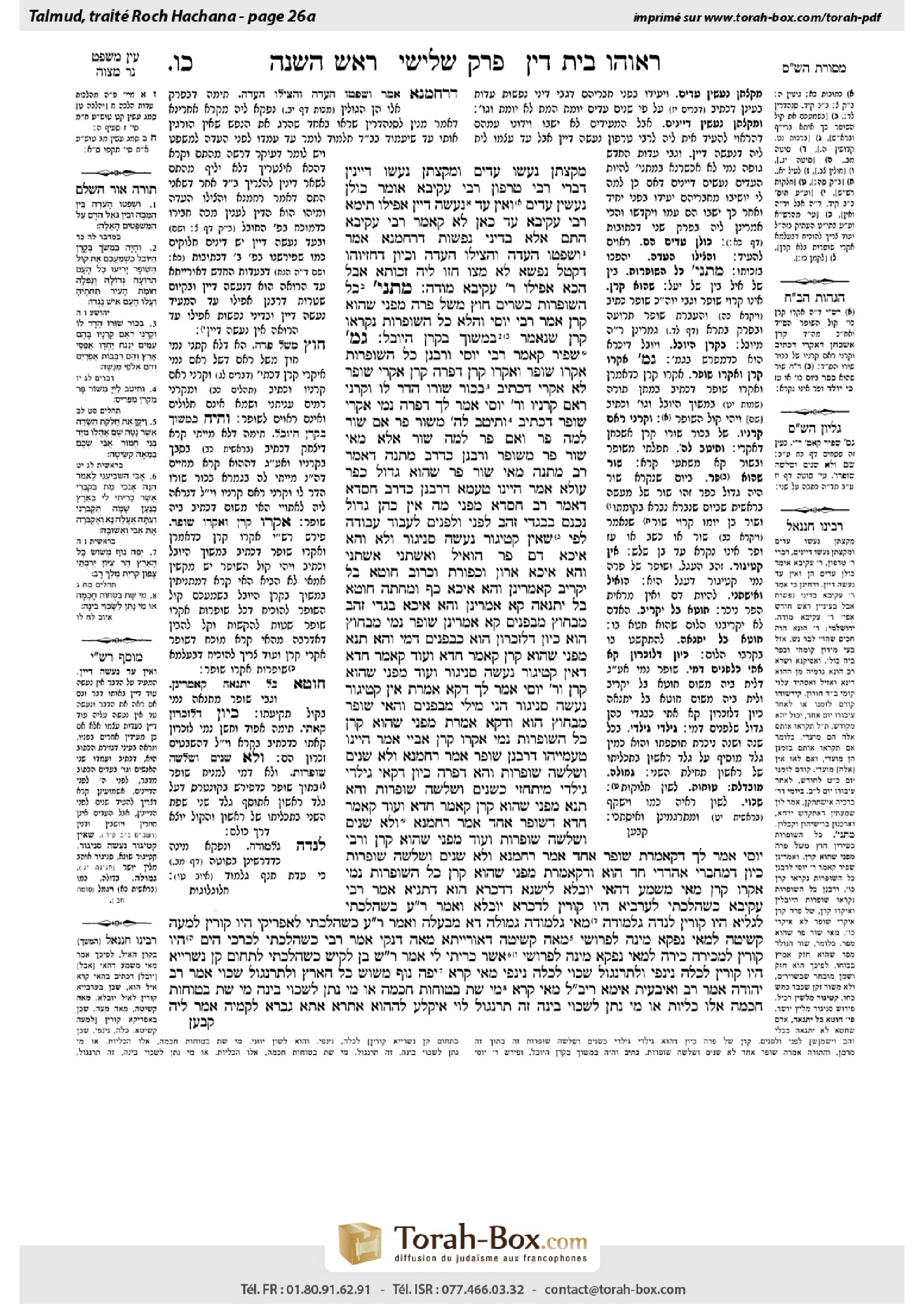
Rosh Hashanah 26a: Talmud study for Daf Yomi
Daf Yomi is the daily study of one Talmud folio. Explore 37 tractates with scans, Hebrew text, Sefaria English and AI-generated French translations where annotated.
Passage selection and English or AI-generated French translation are available where the scan has annotations. Daf Study is independent of Torah-Box and Sefaria.
Browse Rosh Hashanah · ראש השנה · All tractatesRosh Hashanah 26a text and translations
This page of Rosh Hashanah includes the Aramaic text, an English translation and an AI-generated French translation, alongside the scan above.
ראש השנה כ״ו א · Aramaic and Hebrew text
מִקְצָתָן נַעֲשׂוּ עֵדִים וּמִקְצָתָן נַעֲשׂוּ דַּיָּינִין, דִּבְרֵי רַבִּי טַרְפוֹן. רַבִּי עֲקִיבָא אוֹמֵר: כּוּלָּן נַעֲשִׂין עֵדִים, וְאֵין עֵד נַעֲשֶׂה דַּיָּין.
אֲפִילּוּ תֵּימָא רַבִּי עֲקִיבָא, עַד כָּאן לָא קָאָמַר רַבִּי עֲקִיבָא הָתָם אֶלָּא בְּדִינֵי נְפָשׁוֹת, דְּרַחֲמָנָא אָמַר: ״וְשָׁפְטוּ הָעֵדָה״ ״וְהִצִּילוּ הָעֵדָה״, וְכֵיוָן דְחַזְיוּהוּ דִּקְטַל נַפְשָׁא לָא מָצוּ חָזוּ לֵיהּ זְכוּתָא. אֲבָל הָכָא — אֲפִילּוּ רַבִּי עֲקִיבָא מוֹדֶה.
מַתְנִי׳ כׇּל הַשּׁוֹפָרוֹת כְּשֵׁרִים, חוּץ מִשֶּׁל פָּרָה — מִפְּנֵי שֶׁהוּא קֶרֶן. אָמַר רַבִּי יוֹסֵי: וַהֲלֹא כׇּל הַשּׁוֹפָרוֹת נִקְרְאוּ קֶרֶן, שֶׁנֶּאֱמַר: ״בִּמְשׁוֹךְ בְּקֶרֶן הַיּוֹבֵל״.
גְּמָ׳ שַׁפִּיר קָאָמַר רַבִּי יוֹסֵי וְרַבָּנַן: כׇּל הַשּׁוֹפָרוֹת אִקְּרוֹ שׁוֹפָר וְאִקְּרוֹ קֶרֶן. דְּפָרָה — קֶרֶן אִקְּרִי, שׁוֹפָר לָא אִקְּרִי, דִּכְתִיב: ״בְּכוֹר שׁוֹרוֹ הָדָר לוֹ וְקַרְנֵי רְאֵם קַרְנָיו״.
וְרַבִּי יוֹסֵי אָמַר לָךְ: דְּפָרָה נָמֵי אִקְּרִי שׁוֹפָר, דִּכְתִיב: ״וְתִיטַב לַה׳ מִשּׁוֹר פָּר״, אִם שׁוֹר — לָמָּה פָּר, וְאִם פָּר — לָמָּה שׁוֹר? אֶלָּא: מַאי ״שׁוֹר פָּר״ — מִשּׁוֹפָר.
וְרַבָּנַן? כִּדְרַב מַתְנָה. דְּאָמַר רַב מַתְנָה: מַאי ״שׁוֹר פָּר״ — שֶׁהוּא גָּדוֹל כְּפַר.
עוּלָּא אָמַר: הַיְינוּ טַעְמָא דְּרַבָּנַן, כִּדְרַב חִסְדָּא. דְּאָמַר רַב חִסְדָּא: מִפְּנֵי מָה אֵין כֹּהֵן גָּדוֹל נִכְנָס בְּבִגְדֵי זָהָב לִפְנַי וְלִפְנִים לַעֲבוֹד עֲבוֹדָה — לְפִי שֶׁאֵין קָטֵיגוֹר נַעֲשָׂה סָנֵיגוֹר.
וְלָא? וְהָא אִיכָּא דָּם פַּר! הוֹאִיל וְאִשְׁתַּנִּי — אִשְׁתַּנִּי.
וְהָא אִיכָּא אָרוֹן וְכַפּוֹרֶת וּכְרוּב! חוֹטֵא בַּל יַקְרִיב קָאָמְרִינַן.
וְהָא אִיכָּא כַּף וּמַחְתָּה! חוֹטֵא בַּל יִתְנָאֶה קָא אָמְרִינַן.
וְהָא אִיכָּא בִּגְדֵי זָהָב מִבַּחוּץ! מִבִּפְנִים קָא אָמְרִינַן. שׁוֹפָר נָמֵי מִבַּחוּץ הוּא! כֵּיוָן דִּלְזִכָּרוֹן הוּא — כְּבִפְנִים דָּמֵי.
וְהָא תַּנָּא ״מִפְּנֵי שֶׁהוּא קֶרֶן״ קָאָמַר! חֲדָא וְעוֹד קָאָמַר: חֲדָא — דְּאֵין קָטֵיגוֹר נַעֲשָׂה סָנֵיגוֹר, וְעוֹד — מִפְּנֵי שֶׁהוּא קֶרֶן.
וְרַבִּי יוֹסֵי? אָמַר לָךְ: דְּקָא אָמְרַתְּ אֵין קָטֵיגוֹר נַעֲשָׂה סָנֵיגוֹר — הָנֵי מִילֵּי מִבִּפְנִים, וְהַאי שׁוֹפָר מִבַּחוּץ הוּא. וּדְקָא אָמְרַתְּ מִפְּנֵי שֶׁהוּא קֶרֶן — כׇּל הַשּׁוֹפָרוֹת נָמֵי אִקְּרוֹ קֶרֶן.
אַבָּיֵי אֲמַר, הַיְינוּ טַעְמַיְיהוּ דְּרַבָּנַן: שׁוֹפָר אָמַר רַחֲמָנָא, וְלֹא שְׁנַיִם וּשְׁלֹשָׁה שׁוֹפָרוֹת. וְהָא דְּפָרָה, כֵּיוָן דְּקָאֵי גִּילְדֵי גִּילְדֵי — מִיתְחֲזֵי כִּשְׁנַיִם וּשְׁלֹשָׁה שׁוֹפָרוֹת.
וְהָא תַּנָּא ״מִפְּנֵי שֶׁהוּא קֶרֶן״ קָאָמַר! חֲדָא וְעוֹד קָאָמַר: חֲדָא — דְּשׁוֹפָר אֶחָד אָמַר רַחֲמָנָא, וְלֹא שְׁנַיִם וּשְׁלֹשָׁה שׁוֹפָרוֹת. וְעוֹד — מִפְּנֵי שֶׁהוּא קֶרֶן.
וְרַבִּי יוֹסֵי אָמַר לָךְ: דְּקָאָמְרַתְּ ״שׁוֹפָר אֶחָד אָמַר רַחֲמָנָא, וְלֹא שְׁנַיִם וּשְׁלֹשָׁה שׁוֹפָרוֹת״ — כֵּיוָן דִּמְחַבְּרִי אַהֲדָדֵי, חַד הוּא. וּדְקָאָמְרַתְּ ״מִפְּנֵי שֶׁהוּא קֶרֶן״ — כׇּל הַשּׁוֹפָרוֹת נָמֵי אִקְּרוֹ קֶרֶן.
מַאי מַשְׁמַע דְּהַאי יוֹבֵלָא לִישָּׁנָא דְּדִכְרָא הוּא? דְּתַנְיָא, אָמַר רַבִּי עֲקִיבָא: כְּשֶׁהָלַכְתִּי לַעֲרַבְיָא, הָיוּ קוֹרִין לְדִכְרָא ״יוֹבֵלָא״.
וְאָמַר רַבִּי עֲקִיבָא: כְּשֶׁהָלַכְתִּי לְגַלְיָא, הָיוּ קוֹרִין לְנִדָּה גַּלְמוּדָה. מַאי גַּלְמוּדָה — גְּמוּלָה דָּא מִבַּעְלָהּ. וְאָמַר רַבִּי עֲקִיבָא: כְּשֶׁהָלַכְתִּי לְאַפְרִיקִי, הָיוּ קוֹרִין לְמָעָה קְשִׂיטָה. לְמַאי נָפְקָא מִינַּהּ? לְפָרוֹשֵׁי ״מֵאָה קְשִׂיטָה״ דְּאוֹרָיְיתָא, מְאָה דַּנְקֵי.
אָמַר רַבִּי: כְּשֶׁהָלַכְתִּי לִכְרַכֵּי הַיָּם, הָיוּ קוֹרִין לִמְכִירָה כִּירָה. לְמַאי נָפְקָא מִינַּהּ? לְפָרוֹשֵׁי ״אֲשֶׁר כָּרִיתִי לִי״:
אָמַר רַבִּי שִׁמְעוֹן בֶּן לָקִישׁ: כְּשֶׁהָלַכְתִּי לִתְחוּם קַן נִשְׁרַיָּיא, הָיוּ קוֹרִין לַכַּלָּה נִינְפִי, וְלַתַּרְנְגוֹל שֶׂכְוִי. לַכַּלָּה נִינְפִי — מַאי קְרָא: ״יְפֵה נוֹף מְשׂוֹשׂ כׇּל הָאָרֶץ״. וְלַתַּרְנְגוֹל שֶׂכְוִי — אָמַר רַב יְהוּדָה אָמַר רַב, וְאִיבָּעֵית אֵימָא רַבִּי יְהוֹשֻׁעַ בֶּן לֵוִי: מַאי קְרָא — ״מִי שָׁת בַּטּוּחוֹת חׇכְמָה אוֹ מִי נָתַן לַשֶּׂכְוִי בִינָה״. ״מִי שָׁת בַּטּוּחוֹת חׇכְמָה״ — אֵלּוּ כְּלָיוֹת, ״אוֹ מִי נָתַן לַשֶּׂכְוִי בִינָה״ — זֶה תַּרְנְגוֹל.
לֵוִי אִיקְּלַע לְהָהוּא אַתְרָא. אֲתָא גַּבְרָא לְקַמֵּיהּ, אֲמַר לֵיהּ:
Rosh Hashanah 26a · English translation
some of them are rendered witnesses and testify before the others and some of them become judges in the case; this is the statement of Rabbi Tarfon. Rabbi Akiva says: They are all rendered witnesses, and a witness cannot become a judge. It seems therefore that the mishna contradicts Rabbi Akiva’s opinion.
The Gemara rejects this argument: You can even say that the mishna was taught in accordance with the opinion of Rabbi Akiva, but we must distinguish between the cases. Rabbi Akiva states his position there only with regard to cases of capital law, for the Merciful One says: “And the congregation shall judge…and the congregation shall save” (Numbers 35:24–25), which requires a court to search for grounds to exonerate the defendant, but once they themselves have seen him kill a person, they will be unable to find grounds to exonerate him. But here, with regard to the sighting of the new moon, even Rabbi Akiva concedes that a witness can be rendered a judge.
MISHNA: The mishna begins to discuss the primary mitzva of Rosh HaShana, sounding the shofar. All shofarot are fit for blowing except for the horn of a cow, because it is a horn [keren] and not a shofar. Rabbi Yosei said: But aren’t all shofarot called horn, as it is stated: “And it shall come to pass, that when they sound a long blast with the horn [keren] of a ram [yovel]” (Joshua 6:5), and a ram’s horn is a shofar fit for sounding on Rosh HaShana?
GEMARA: Rabbi Yosei is saying well, i.e., presents a convincing argument. Why do the Rabbis not accept it? The Gemara explains that the Rabbis counter Rabbi Yosei’s argument as follows: Indeed, all other shofarot are called shofar and they are also called keren, but that of a cow is called keren, but it is not called shofar, as it is written: “His firstborn bull, grandeur is his, and his horns [karnav] are the horns of [karnei] a wild ox” (Deuteronomy 33:17). It is therefore clear that the horns of a bull are called keren, and nowhere are they called shofar.
And how would Rabbi Yosei counter this argument? He could have said to you: The horns of a cow are also called shofar, as it is written: “And it shall please the Lord better than an ox bull [shor par] that has horns and hoofs” (Psalms 69:32). The wording of the verse is strange: If it is an ox [shor], why is it also called a bull [par], and if it is a bull [par], why is it called an ox [shor]? Rather, what is the meaning of shor par? These two words must be read as if they were one single word: Than a shofar. According to this reading, even the horn of a cow is called a shofar.
And how do the Rabbis explain the difficulty in this verse? They explain it as it was explained by Rav Mattana, as Rav Mattana said: What is the meaning of shor par? An ox [shor] that is as large as a bull [par], as the animal is called a shor from birth, but is called a par only from the age of three.
Ulla said: This is the reasoning of the Rabbis, who say that the horn of a cow is unfit for sounding on Rosh HaShana. They say this in accordance with the opinion of Rav Ḥisda, as Rav Ḥisda said: For what reason does the High Priest not enter the innermost sanctum, the Holy of Holies, with his golden garments to perform the service there on Yom Kippur? It is because a prosecutor [kateigor] cannot become an advocate [sanneigor]. Since the Jewish people committed the sin of worshipping the Golden Calf, the High Priest may not enter the Holy of Holies to atone for the Jewish people wearing golden garments, as they would bring that sin to mind.
The Gemara asks: But do we not use a cow in the Holy of Holies? But there is the blood of the bull that is brought there to be sprinkled on Yom Kippur, despite the fact that the Jewish people sinned with a calf. The Gemara answers: Since it has changed, i.e., it is not the bull itself, but only its blood, then it has changed, i.e., so it does not bring the sin of the Golden Calf to mind.
The Gemara raises another difficulty: But there is the Ark, the Ark cover, and the cherub, all of which are plated with gold. If this is problematic, why are they in the Holy of Holies? The Gemara explains: What we are saying is that a sinner seeking atonement should not bring something made of gold into the Holy of Holies, as it would bring the sin of the Golden Calf to mind.
The Gemara asks further: But there is the spoon and coal pan that are brought into the Holy of Holies, and they are made of gold. The Gemara answers: What we are saying is that a sinner seeking atonement should not adorn himself with ornaments of gold.
The Gemara raises yet another question: But there are the golden garments the High Priest wears outside the Holy of Holies. The Gemara answers: What we are saying is that a sinner should not adorn himself with gold inside the Holy of Holies, but outside there is no concern. The Gemara continues this line of questioning: If so, the shofar is also outside, since it is not brought into the Holy of Holies. The Gemara answers: Since the shofar is sounded in order to evoke God’s remembrance, it is considered as if it were sounded inside the Holy of Holies.
The Gemara asks: Is this indeed the reason that the Rabbis disqualify the use of a cow’s horn? But the tanna taught: The horn of a cow cannot be used because it is a keren. The Gemara answers: The tanna stated one reason and also another reason: One reason is that a prosecutor cannot become an advocate, and another is because it is called a keren and not a shofar.
The Gemara asks: And how would Rabbi Yosei counter these arguments? The Gemara explains: He could have said to you: That which you said, that a prosecutor cannot become an advocate, is indeed true, but this applies only inside the Holy of Holies, and the shofar is sounded outside. And with regard to that which you said, because it is a keren, all shofarot are also called keren.
Abaye said: This is the reasoning of the Rabbis: The Merciful One says to sound a single shofar, and not two or three shofarot together, but this horn of a cow, since it is comprised of layers, looks like two or three shofarot.
The Gemara asks: But the tanna taught: The horn of a cow cannot be used because it is a keren. Since the Rabbis’ reasoning appears clearly in the mishna, how can the reasoning provided by Abaye be correct? The Gemara replies: The tanna stated one reason and also another reason. One reason is that the Merciful One says to sound a single shofar, and not two or three shofarot together, and another is because it is a keren.
And Rabbi Yosei could have said to you: That which you said, that the Merciful One says in the Torah to sound a single shofar, and not two or three shofarot, is not a difficulty. Since the layers of the cow’s horn are connected to each other, it is considered a single shofar. And with regard to that which you said: Because it is a keren, all shofarot are also called keren.
§ It is taught in the mishna that Rabbi Yosei proves from a verse that a the horn of a ram [yovel] is called a keren. The Gemara asks: From where may it be inferred that this term yovel denotes the horn of a ram? The Gemara answers: As it is taught in a baraita: Rabbi Akiva said: When I went to Arabia, I heard that they called a ram yovla, and from this we can infer the meaning of the term yovel in the related language of Hebrew.
The Gemara records a series of similar statements: And Rabbi Akiva said: When I went to Galia, I heard that they called a menstruating woman galmuda, and this clarifies the meaning of that word in Scripture. It should be understood as follows: What does galmuda mean? She is separated [gemula da] from her husband, as all physical contact between a menstruating woman and her husband is forbidden. And Rabbi Akiva said: When I went to Africa, I heard that they called a ma’a, which is a certain coin, kesita. The Gemara asks: What is the practical significance of this? The Gemara answers: To explain that the words in the Torah relating to Jacob’s purchase of his field near Shechem: “And he bought the parcel of ground where he had spread his tent, from the sons of Hamor for a hundred kesita” (Genesis 33:19), denote a hundred dankei, i.e., a hundred ma’a.
Similarly, Rabbi Yehuda HaNasi said: When I went to the sea towns, I heard that they called a sale kira. And the Gemara asks: What is the practical significance of this? The Gemara answers: To explain the verse relating to Jacob’s burial plot: “In my grave which I purchased [kariti] for myself, there shall you bury me” (Genesis 50:5).
Rabbi Shimon ben Lakish said: When I went to the district of Kan Nishrayya, I heard that they called a bride ninfi and a rooster sekhvi. The Gemara explains how this information serves to clarify the meanings of biblical verses: A bride is called ninfi; what is the verse that uses a similar term? “Beautiful view [nof], the joy of the whole earth, Mount Zion” (Psalms 48:3), which therefore means beautiful like a bride. And a rooster is called sekhvi; Rav Yehuda said that Rav said: And if you wish, you can say that Rabbi Yehoshua ben Levi said this: What is the verse that employs this term? “Who has put wisdom in the inward parts? Or who has given understanding to the sekhvi” (Job 38:36), which should be understood as follows: “Who has put wisdom in the inward parts”: These are the kidneys that are hidden in the body; “or who has given understanding to the sekhvi”: This is a rooster, who knows to crow at fixed times during the night.
Incidental to the discussion of the meanings of certain words in foreign countries, it was related that Levi once happened to come to a certain place, where a man came before him to complain about what had been done to him. This man said to him:
Rosh Hashanah 26a · Traduction française (IA)
Certains sont considérés comme témoins et témoignent devant les autres, tandis que d’autres deviennent juges dans l’affaire ; telle est l’opinion de Rabbi Tarfon. Rabbi Akiva dit : Ils sont tous considérés comme témoins, et un témoin ne peut pas devenir juge. Il semble donc que la Michna contredise l’opinion de Rabbi Akiva.
La Guemara rejette cet argument : On peut même dire que la Michna a été enseignée conformément à l’opinion de Rabbi Akiva, mais il faut distinguer les cas. Rabbi Akiva n’exprime cette opinion que pour les affaires relevant du droit pénal et passibles de la peine capitale, car le Miséricordieux dit : « Et la communauté jugera… et la communauté sauvera » (Nombres 35, 24-25), ce qui exige du tribunal qu’il recherche des motifs d’acquittement de l’accusé ; or, dès lors que ses membres l’ont eux-mêmes vu tuer quelqu’un, ils ne pourront pas trouver de motifs pour l’acquitter. Mais ici, concernant l’observation de la nouvelle lune, Rabbi Akiva lui-même reconnaît qu’un témoin peut devenir juge.
MICHNA : La Michna commence à traiter de la mitsva principale de Roch Hachana : sonner du chofar. Tous les chofars conviennent pour être sonnés, à l’exception de la corne d’une vache, car c’est une corne [keren] et non un chofar. Rabbi Yossi dit : Mais tous les chofars ne sont-ils pas appelés « corne », comme il est dit : « Il arrivera que, lorsqu’ils feront retentir un long son avec la corne [keren] d’un bélier [yovel] » (Josué 6, 5) ? Or, la corne d’un bélier est un chofar qui convient pour être sonné à Roch Hachana.
GUEMARA : Rabbi Yossi a raison, c’est-à-dire qu’il présente un argument convaincant. Pourquoi les Sages ne l’acceptent-ils pas ? La Guemara explique que les Sages répondent à l’argument de Rabbi Yossi comme suit : En effet, toutes les autres cornes sont appelées « chofar » et aussi « keren », tandis que celle d’une vache est appelée « keren », mais pas « chofar », comme il est écrit : « Son premier-né est un taureau, sa majesté ; ses cornes [karnav] sont les cornes [karnei] d’un re’em » (Deutéronome 33, 17). Il est donc clair que les cornes d’un taureau sont appelées keren et ne sont appelées chofar nulle part.
Et comment Rabbi Yossi pourrait-il répondre à cet argument ? Il pourrait vous dire : Les cornes d’une vache sont elles aussi appelées chofar, comme il est écrit : « Le Seigneur agréera davantage cela qu’un bœuf-taureau [shor par] muni de cornes et de sabots » (Psaumes 69, 32). La formulation du verset est étrange : s’il s’agit d’un bœuf [shor], pourquoi est-il aussi appelé taureau [par] ? Et s’il s’agit d’un taureau [par], pourquoi est-il appelé bœuf [shor] ? Que signifie donc shor par ? Il faut lire ces deux mots comme s’ils n’en formaient qu’un seul : « plus qu’un chofar ». Selon cette lecture, même la corne d’une vache est appelée chofar.
Et comment les Sages expliquent-ils la difficulté que présente ce verset ? Ils l’expliquent comme Rav Mattana : Rav Mattana a dit : Que signifie shor par ? Un bœuf [shor] aussi grand qu’un taureau [par], car l’animal est appelé shor dès sa naissance, mais n’est appelé par qu’à partir de l’âge de trois ans.
Oulla dit : Telle est la raison des Sages, qui disent que la corne d’une vache ne convient pas pour être sonnée à Roch Hachana. Ils suivent l’opinion de Rav Hisda, car Rav Hisda a dit : Pour quelle raison le grand prêtre n’entre-t-il pas dans le sanctuaire le plus intérieur, le Saint des saints, revêtu de ses vêtements d’or, pour y accomplir le service à Yom Kippour ? Parce qu’un accusateur [kateigor] ne peut pas devenir un défenseur [sanneigor]. Puisque le peuple juif a commis le péché du veau d’or, le grand prêtre ne peut pas entrer dans le Saint des saints revêtu de vêtements d’or pour expier les fautes du peuple juif, car cela rappellerait ce péché.
La Guemara demande : Mais n’utilise-t-on pas une vache dans le Saint des saints ? En effet, le sang du taureau y est apporté pour y être aspergé à Yom Kippour, alors même que le peuple juif a péché avec un veau. La Guemara répond : Puisqu’il a subi une transformation, c’est-à-dire qu’il ne s’agit pas du taureau lui-même, mais seulement de son sang, il a subi une transformation ; il ne rappelle donc pas le péché du veau d’or.
La Guemara soulève une autre difficulté : Mais l’Arche, son couvercle et les chérubins sont tous recouverts d’or. Si cela pose problème, pourquoi se trouvent-ils dans le Saint des saints ? La Guemara explique : Ce que nous voulons dire, c’est qu’un pécheur qui cherche à obtenir l’expiation ne doit pas faire entrer dans le Saint des saints un objet en or, car cela rappellerait le péché du veau d’or.
La Guemara demande encore : Mais la cuiller et le brasier, qui sont apportés dans le Saint des saints, sont en or. La Guemara répond : Ce que nous voulons dire, c’est qu’un pécheur qui cherche à obtenir l’expiation ne doit pas se parer d’ornements en or.
La Guemara soulève encore une autre question : Mais le grand prêtre porte des vêtements d’or à l’extérieur du Saint des saints. La Guemara répond : Ce que nous voulons dire, c’est qu’un pécheur ne doit pas se parer d’or à l’intérieur du Saint des saints, mais qu’à l’extérieur, cela ne pose pas de problème. La Guemara poursuit cette série de questions : Dans ce cas, le chofar se trouve lui aussi à l’extérieur, puisqu’il n’est pas apporté dans le Saint des saints. La Guemara répond : Puisque le chofar est sonné afin d’évoquer le souvenir de Dieu, c’est comme s’il était sonné à l’intérieur du Saint des saints.
La Guemara demande : Est-ce vraiment là la raison pour laquelle les Sages déclarent que l’usage d’une corne de vache est invalide ? Pourtant, le tanna a enseigné : La corne d’une vache ne peut pas être utilisée, car c’est une keren. La Guemara répond : Le tanna a donné deux raisons : l’une est qu’un accusateur ne peut pas devenir un défenseur ; l’autre est qu’elle est appelée keren et non chofar.
La Guemara demande : Et comment Rabbi Yossi pourrait-il répondre à ces arguments ? La Guemara explique : Il pourrait vous dire : Ce que vous avez dit, à savoir qu’un accusateur ne peut pas devenir un défenseur, est vrai, mais cela ne s’applique qu’à l’intérieur du Saint des saints, alors que le chofar est sonné à l’extérieur. Quant à ce que vous avez dit, à savoir qu’il s’agit d’une keren, tous les chofars sont également appelés keren.
Abayé dit : Telle est la raison des Sages : le Miséricordieux ordonne de sonner un seul chofar, et non deux ou trois chofars ensemble ; or, cette corne de vache, puisqu’elle est constituée de couches, ressemble à deux ou trois chofars.
La Guemara demande : Pourtant, le tanna a enseigné : La corne d’une vache ne peut pas être utilisée, car c’est une keren. Puisque la raison des Sages apparaît clairement dans la Michna, comment celle donnée par Abayé peut-elle être juste ? La Guemara répond : Le tanna a donné deux raisons : l’une est que le Miséricordieux ordonne de sonner un seul chofar, et non deux ou trois chofars ensemble ; l’autre est qu’il s’agit d’une keren.
Et Rabbi Yossi pourrait vous répondre : Ce que vous avez dit, à savoir que le Miséricordieux ordonne dans la Torah de sonner un seul chofar, et non deux ou trois chofars, ne pose pas de difficulté. Puisque les couches de la corne de vache sont reliées entre elles, elle est considérée comme un seul chofar. Quant à ce que vous avez dit, à savoir qu’il s’agit d’une keren, tous les chofars sont également appelés keren.
§ La Michna enseigne que Rabbi Yossi prouve à partir d’un verset que la corne d’un bélier [yovel] est appelée keren. La Guemara demande : D’où peut-on déduire que le terme yovel désigne la corne d’un bélier ? La Guemara répond : Comme il est enseigné dans une baraïta : Rabbi Akiva a dit : Lorsque je suis allé en Arabie, j’ai entendu qu’ils appelaient un bélier yovla ; nous pouvons en déduire le sens du terme apparenté yovel en hébreu.
La Guemara rapporte une série de propos semblables : Rabbi Akiva a également dit : Lorsque je suis allé en Galie, j’ai entendu qu’ils appelaient une femme menstruée galmuda, ce qui clarifie le sens de ce mot dans l’Écriture. Il faut comprendre ainsi : que signifie galmuda ? Elle est séparée [gemula da] de son mari, car tout contact physique entre une femme menstruée et son mari est interdit. Rabbi Akiva a également dit : Lorsque je suis allé en Afrique, j’ai entendu qu’ils appelaient une ma’a, qui est une certaine pièce de monnaie, kesita. La Guemara demande : Quelle en est la portée pratique ? La Guemara répond : Cela permet d’expliquer que les mots de la Torah concernant l’achat par Jacob du terrain près de Sichem, où il avait dressé sa tente — « Il acheta aux fils de Hamor la parcelle de terrain où il avait dressé sa tente pour cent kesita » (Genèse 33, 19) — désignent cent dankei, c’est-à-dire cent ma’a.
De même, Rabbi Yehouda HaNassi a dit : Lorsque je suis allé dans les villes côtières, j’ai entendu qu’ils appelaient une vente kira. La Guemara demande : Quelle en est la portée pratique ? La Guemara répond : Cela permet d’expliquer le verset concernant le lieu de sépulture de Jacob : « Dans la tombe que j’ai achetée [kariti] pour moi, c’est là que tu m’enterreras » (Genèse 50, 5).
Rabbi Shimon ben Lakish a dit : Lorsque je suis allé dans la région de Kan Nishrayya, j’ai entendu qu’ils appelaient une fiancée ninfi et un coq sekhvi. La Guemara explique en quoi cette information permet de clarifier le sens des versets bibliques : une fiancée est appelée ninfi ; quel verset emploie un terme semblable ? « Belle par son élévation [nof], joie de toute la terre, le mont Sion » (Psaumes 48, 3), ce qui signifie donc : belle comme une fiancée. Et un coq est appelé sekhvi. Rav Yehouda a dit au nom de Rav — ou, si tu le souhaites, Rabbi Yehoshoua ben Levi a dit ceci : quel verset emploie ce terme ? « Qui a placé la sagesse dans les reins ? Ou qui a donné l’intelligence au sekhvi ? » (Job 38, 36). Il faut comprendre ainsi : « Qui a placé la sagesse dans les reins ? » Ce sont les reins, cachés à l’intérieur du corps ; « ou qui a donné l’intelligence au sekhvi ? » Il s’agit d’un coq, qui sait chanter à des heures fixes pendant la nuit.
À propos du sens de certains mots dans des pays étrangers, on rapporte que Lévi arriva un jour par hasard dans un certain endroit, où un homme vint se présenter devant lui pour se plaindre de ce qu’on lui avait fait. Cet homme lui dit :
Traduction française générée par IA à partir de l’édition anglaise de Sefaria. Vérifie toujours un passage avec le texte source.
Text from Sefaria: William Davidson Edition - Vocalized Aramaic (CC BY NC); William Davidson Edition - English (CC BY NC).