Sanhedrin 101a: Talmud study for Daf Yomi
Daf Yomi is the daily study of one Talmud folio. Explore 37 tractates with scans, Hebrew text, Sefaria English and AI-generated French translations where annotated.
Passage selection and English or AI-generated French translation are available where the scan has annotations. Daf Study is independent of Torah-Box and Sefaria.
Browse Sanhedrin · סנהדרין · All tractatesSanhedrin 101a text and translations
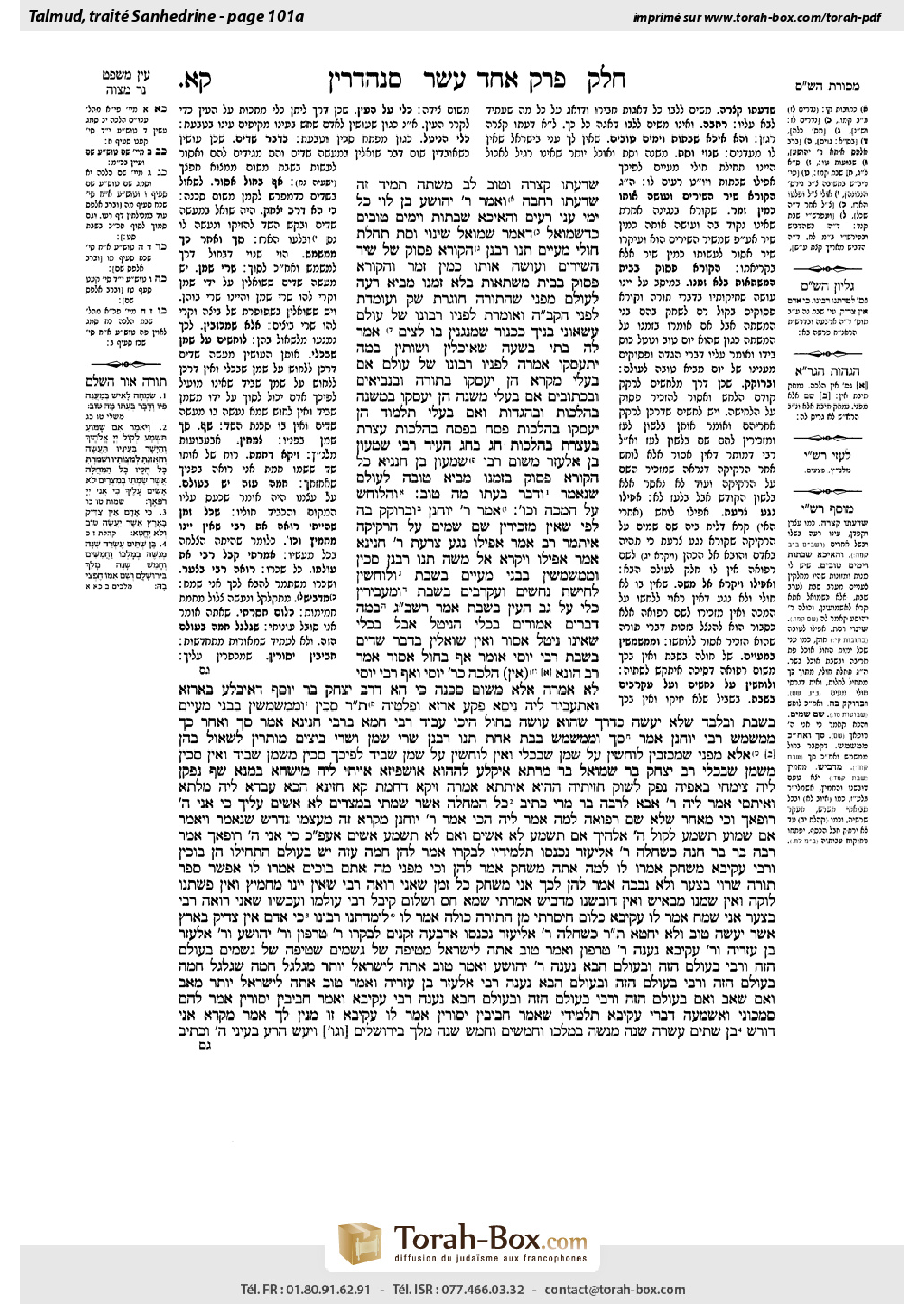
This page of Sanhedrin includes the Aramaic text, an English translation and an AI-generated French translation, alongside the scan above.
סנהדרין ק״א א · Aramaic and Hebrew text
שֶׁדַּעְתּוֹ קְצָרָה. ״וְטוֹב לֵב מִשְׁתֶּה תָמִיד״ – זֶה שֶׁדַּעְתּוֹ רְחָבָה. וְאָמַר רַבִּי יְהוֹשֻׁעַ בֶּן לֵוִי: ״כׇּל יְמֵי עָנִי רָעִים״. וְהָאִיכָּא שַׁבָּתוֹת וְיָמִים טוֹבִים? כְּדִשְׁמוּאֵל, דְּאָמַר שְׁמוּאֵל: שִׁינּוּי וֶסֶת תְּחִלַּת חוֹלִי מֵעַיִים.
תָּנוּ רַבָּנַן: הַקּוֹרֵא פָּסוּק שֶׁל שִׁיר הַשִּׁירִים וְעוֹשֶׂה אוֹתוֹ כְּמִין זֶמֶר, וְהַקּוֹרֵא פָּסוּק בְּבֵית מִשְׁתָּאוֹת בְּלֹא זְמַנּוֹ – מֵבִיא רָעָה לָעוֹלָם, מִפְּנֵי שֶׁהַתּוֹרָה חוֹגֶרֶת שַׂק וְעוֹמֶדֶת לִפְנֵי הַקָּדוֹשׁ בָּרוּךְ הוּא וְאוֹמֶרֶת לְפָנָיו: רִבּוֹנוֹ שֶׁל עוֹלָם, עֲשָׂאוּנִי בָּנֶיךָ כְּכִנּוֹר שֶׁמְּנַגְּנִין בּוֹ לֵצִים.
אָמַר לָהּ: בִּתִּי, בְּשָׁעָה שֶׁאוֹכְלִין וְשׁוֹתִין בַּמֶּה יִתְעַסְּקוּ? אָמְרָה לְפָנָיו: רִבּוֹנוֹ שֶׁל עוֹלָם, אִם בַּעֲלֵי מִקְרָא הֵן – יַעַסְקוּ בַּתּוֹרָה וּבַנְּבִיאִים וּבַכְּתוּבִים. אִם בַּעֲלֵי מִשְׁנָה הֵן – יַעַסְקוּ בַּמִּשְׁנָה, בַּהֲלָכוֹת וּבְהַגָּדוֹת. וְאִם בַּעֲלֵי תַלְמוּד הֵן – יַעַסְקוּ בְּהִלְכוֹת פֶּסַח בַּפֶּסַח, בְּהִלְכוֹת עֲצֶרֶת בָּעֲצֶרֶת, בְּהִלְכוֹת חַג בֶּחָג. הֵעִיד רַבִּי שִׁמְעוֹן בֶּן אֶלְעָזָר מִשּׁוּם רַבִּי שִׁמְעוֹן בֶּן חֲנַנְיָא: כׇּל הַקּוֹרֵא פָּסוּק בִּזְמַנּוֹ מֵבִיא טוֹבָה לָעוֹלָם, שֶׁנֶּאֱמַר: ״וְדָבָר בְּעִתּוֹ מַה טּוֹב״.
וְהַלּוֹחֵשׁ עַל הַמַּכָּה וְכוּ׳. אָמַר רַבִּי יוֹחָנָן: וּבְרוֹקֵק בָּהּ, לְפִי שֶׁאֵין מַזְכִּירִין שֵׁם שָׁמַיִם עַל הָרְקִיקָה. אִיתְּמַר: רַב אָמַר, אֲפִילּוּ ״נֶגַע צָרַעַת״. רַבִּי חֲנִינָא אָמַר: אֲפִילּוּ ״וַיִּקְרָא אֶל מֹשֶׁה״.
תָּנוּ רַבָּנַן: סָכִין וּמְמַשְׁמְשִׁין בִּבְנֵי מֵעַיִים בְּשַׁבָּת, וְלוֹחֲשִׁין לְחִישַׁת נְחָשִׁים וְעַקְרַבִּים בְּשַׁבָּת, וּמַעֲבִירִין כְּלִי עַל גַּב הָעַיִן בְּשַׁבָּת. אָמַר רַבָּן שִׁמְעוֹן בֶּן גַּמְלִיאֵל: בַּמֶּה דְּבָרִים אֲמוּרִים? בִּכְלִי הַנִּיטָּל, אֲבָל בִּכְלִי שֶׁאֵינוֹ נִיטָּל – אָסוּר. וְאֵין שׁוֹאֲלִין בִּדְבַר שֵׁדִים בְּשַׁבָּת. רַבִּי יוֹסֵי אוֹמֵר: אַף בַּחוֹל אָסוּר.
אָמַר רַב הוּנָא: (אֵין) הֲלָכָה כְּרַבִּי יוֹסֵי. וְאַף רַבִּי יוֹסֵי לֹא אֲמָרָהּ אֶלָּא מִשּׁוּם סַכָּנָה, כִּי הָא דְּרַב יִצְחָק בַּר יוֹסֵף דְּאִיבְּלַע בְּאַרְזָא, וְאִתְעֲבִיד לֵיהּ נִיסָּא – פְּקַע אַרְזָא וּפַלְטֵיהּ.
תָּנוּ רַבָּנַן: סָכִין וּמְמַשְׁמְשִׁין בִּבְנֵי מֵעַיִים בְּשַׁבָּת, וּבִלְבַד שֶׁלֹּא יַעֲשֶׂה כְּדֶרֶךְ שֶׁהוּא עוֹשֶׂה בַּחוֹל. הֵיכִי עָבֵיד? רַבִּי חָמָא בְּרַבִּי חֲנִינָא אָמַר: סָךְ וְאַחַר כָּךְ מְמַשְׁמֵשׁ. רַבִּי יוֹחָנָן אָמַר: סָךְ וּמְמַשְׁמֵשׁ בְּבַת אַחַת.
תָּנוּ רַבָּנַן: שָׂרֵי שֶׁמֶן וְשָׂרֵי בֵיצִים מוּתָּרִין לִשְׁאוֹל בָּהֶן, אֶלָּא מִפְּנֵי שֶׁמְּכַזְּבִין. לוֹחֲשִׁין עַל שֶׁמֶן שֶׁבִּכְלִי, וְאֵין לוֹחֲשִׁין עַל שֶׁמֶן שֶׁבַּיָּד. לְפִיכָךְ סָכִין מִשֶּׁמֶן שֶׁבַּיָּד, וְאֵין סָכִין מִשֶּׁמֶן שֶׁבִּכְלִי.
רַב יִצְחָק בַּר שְׁמוּאֵל בַּר מָרְתָא אִיקְּלַע לְהָהוּא אוּשְׁפִּיזָא. אַיְיתִי לֵיהּ מִישְׁחָא בְּמָנָא. שָׁף, נְפַקוּ לֵיהּ צִימְחֵי בְּאַפֵּיהּ. נְפַק לְשׁוּקָא. חֲזֵיתֵיהּ הָהִיא אִיתְּתָא, אֲמַרָה: זִיקָא דְּחֵמֶת קָא חָזֵינָא הָכָא. עֲבַדָא לֵיהּ מִלְּתָא וְאִיתַּסִּי.
אֲמַר לֵיהּ רַבִּי אַבָּא לְרַבָּה בַּר מָרִי: כְּתִיב ״כׇּל הַמַּחֲלָה אֲשֶׁר שַׂמְתִּי בְמִצְרַיִם לֹא אָשִׂים עָלֶיךָ כִּי אֲנִי ה׳ רֹפְאֶךָ״, וְכִי מֵאַחַר שֶׁלֹּא שָׂם, רְפוּאָה לָמָּה? אֲמַר לֵיהּ: הָכִי אָמַר רַבִּי יוֹחָנָן: מִקְרָא זֶה מֵעַצְמוֹ נִדְרָשׁ, שֶׁנֶּאֱמַר ״וַיֹּאמֶר אִם שָׁמוֹעַ תִּשְׁמַע לְקוֹל ה׳ אֱלֹהֶיךָ״ – אִם תִּשְׁמַע לֹא אָשִׂים, וְאִם לֹא תִּשְׁמַע אָשִׂים. אַף עַל פִּי כֵן, ״כִּי אֲנִי ה׳ רֹפְאֶךָ״.
אָמַר רַבָּה בַּר בַּר חָנָה: כְּשֶׁחָלָה רַבִּי אֱלִיעֶזֶר, נִכְנְסוּ תַּלְמִידָיו לְבַקְּרוֹ. אָמַר לָהֶן: חֵמָה עַזָּה יֵשׁ בָּעוֹלָם. הִתְחִילוּ הֵן בּוֹכִין, וְרַבִּי עֲקִיבָא מְשַׂחֵק. אָמְרוּ לוֹ: לָמָּה אַתָּה מְשַׂחֵק? אָמַר לָהֶן: וְכִי מִפְּנֵי מָה אַתֶּם בּוֹכִים? אָמְרוּ לוֹ: אֶפְשָׁר סֵפֶר תּוֹרָה שָׁרוּי בְּצַעַר וְלֹא נִבְכֶּה?
אָמַר לָהֶן: לְכָךְ אֲנִי מְשַׂחֵק, כׇּל זְמַן שֶׁאֲנִי רוֹאֶה רַבִּי שֶׁאֵין יֵינוֹ מַחְמִיץ וְאֵין פִּשְׁתָּנוֹ לוֹקֶה וְאֵין שַׁמְנוֹ מַבְאִישׁ וְאֵין דּוּבְשָׁנוֹ מַדְבִּישׁ, אָמַרְתִּי שֶׁמָּא חַס וְשָׁלוֹם קִיבֵּל רַבִּי עוֹלָמוֹ. וְעַכְשָׁיו שֶׁאֲנִי רוֹאֶה רַבִּי בְּצַעַר, אֲנִי שָׂמֵחַ. אָמַר לוֹ: עֲקִיבָא, כְּלוּם חִיסַּרְתִּי מִן הַתּוֹרָה כּוּלָּהּ? אָמַר לוֹ: לִימַּדְתָּנוּ רַבֵּינוּ, ״כִּי אָדָם אֵין צַדִּיק בָּאָרֶץ אֲשֶׁר יַעֲשֶׂה טּוֹב וְלֹא יֶחֱטָא״.
תָּנוּ רַבָּנַן: כְּשֶׁחָלָה רַבִּי אֱלִיעֶזֶר, נִכְנְסוּ אַרְבָּעָה זְקֵנִים לְבַקְּרוֹ: רַבִּי טַרְפוֹן, וְרַבִּי יְהוֹשֻׁעַ, וְרַבִּי אֶלְעָזָר בֶּן עֲזַרְיָה, וְרַבִּי עֲקִיבָא.
נַעֲנָה רַבִּי טַרְפוֹן וְאָמַר: טוֹב אַתָּה לְיִשְׂרָאֵל מִטִּיפָּה שֶׁל גְּשָׁמִים, שֶׁטִּיפָּה שֶׁל גְּשָׁמִים בָּעוֹלָם הַזֶּה, וְרַבִּי בָּעוֹלָם הַזֶּה וּבָעוֹלָם הַבָּא.
נַעֲנָה רַבִּי יְהוֹשֻׁעַ וְאָמַר: טוֹב אַתָּה לְיִשְׂרָאֵל יוֹתֵר מִגַּלְגַּל חַמָּה, שֶׁגַּלְגַּל חַמָּה בָּעוֹלָם הַזֶּה, וְרַבִּי בָּעוֹלָם הַזֶּה וּבָעוֹלָם הַבָּא.
נַעֲנָה רַבִּי אֶלְעָזָר בֶּן עֲזַרְיָה וְאָמַר: טוֹב אַתָּה לְיִשְׂרָאֵל יוֹתֵר מֵאָב וָאֵם, שֶׁאָב וָאֵם בָּעוֹלָם הַזֶּה, וְרַבִּי בָּעוֹלָם הַזֶּה וּבָעוֹלָם הַבָּא.
נַעֲנָה רַבִּי עֲקִיבָא וְאָמַר: חֲבִיבִין יִסּוּרִין. אָמַר לָהֶם: סַמְּכוּנִי וְאֶשְׁמְעָה דִּבְרֵי עֲקִיבָא תַּלְמִידִי שֶׁאָמַר חֲבִיבִין יִסּוּרִין. אָמַר לוֹ: עֲקִיבָא, זוֹ מִנַּיִן לָךְ? אָמַר: מִקְרָא אֲנִי דּוֹרֵשׁ: ״בֶּן שְׁתֵּים עֶשְׂרֵה שָׁנָה מְנַשֶּׁה בְמׇלְכוֹ וַחֲמִשִּׁים וְחָמֵשׁ שָׁנָה מָלַךְ בִּירוּשָׁלִָים [וְגוֹ׳] וַיַּעַשׂ הָרַע בְּעֵינֵי ה׳״, וּכְתִיב:
Sanhedrin 101a · English translation
one who is intolerant [da’ato ketzara] of others acting against his will. “And for the good-hearted it is always a feast”; this is referring to one who is tolerant and accepts the actions of others. And Rabbi Yehoshua ben Levi says with regard to the verse “All the days of the poor are terrible”: But aren’t there Shabbatot and Festivals, when he rests and eats festive meals? This can be explained in accordance with that statement of Shmuel, as Shmuel says: A change in routine in terms of eating and rest causes the onset of an intestinal ailment. Due to the dramatic deviation on Shabbat from the poor person’s routine he suffers.
§ The Sages taught: One who reads a verse from Song of Songs and renders it a form of secular song, and not a sacred text, and one who reads any biblical verse at a banquet house, not at its appropriate time, but merely as a song, introduces evil to the world, as the Torah girds itself with sackcloth and stands before the Holy One, Blessed be He, and says before Him: Master of the Universe, Your children have rendered me like a harp on which clowns play.
The Holy One, Blessed be He, says to the Torah: My daughter, during the time that they are eating and drinking, in what should they be engaged? The Torah says before Him: Master of the Universe, if they are masters of the Bible, let them engage in the study of the Torah, Prophets, and Writings. If they are masters of the Mishna, let them engage in the study of the Mishna, in the study of halakha, and in the study of aggada. And if they are masters of the Talmud, let them engage in the study of the halakhot of Passover on Passover, in the study of the halakhot of Shavuot on Shavuot, and in the study of the halakhot of Sukkot on Sukkot. They should not treat the Torah with contempt by using it for their own entertainment. Rabbi Shimon ben Elazar testified in the name of Rabbi Shimon ben Ḥananya: Anyone who reads a verse at its appropriate time and in the appropriate manner introduces good into the world, as it is stated: “And a word in its season, how good is it” (Proverbs 15:23).
§ The mishna teaches: And among those who have no share in the World-to-Come is one who whispers invocations over a wound. Rabbi Yoḥanan says: And that is the case only where he spits into the wound while he whispers, as one does not mention the name of Heaven over spittle, and doing so is an act of contempt for God. It was stated that Rav says: Even the verse: “When a leprous mark is in a man, then he shall be brought to the priest” (Leviticus 13:9), in which there is no mention of the name of God, may not be whispered as an invocation. Rabbi Ḥanina says: Even a verse that is unrelated to the specific illness in question, for example: “And He called to Moses” (Leviticus 1:1), may not be whispered as an invocation.
The Sages taught in a baraita: One may smear oil on and rub the intestinal area on Shabbat to ease pain, and it is not prohibited as a form of healing. One may whisper incantations of snakes and scorpions on Shabbat to ease the pain of their bite. And one may pass a cool vessel upon an infected eye on Shabbat, to soothe the inflammation. Rabban Shimon ben Gamliel says: In what case are these matters stated? They are stated in the case of a vessel that may be moved on Shabbat. But with regard to a vessel that may not be moved, it is prohibited to pass it upon the infected eye on Shabbat. And one may not consult the words of demons on Shabbat. Rabbi Yosei says: Even during the week it is prohibited to consult demons.
Rav Huna said: The halakha is in accordance with the opinion of Rabbi Yosei. The Gemara notes: And even Rabbi Yosei did not say that it is due to the Torah prohibition of witchcraft that it is prohibited during the week; rather, it is prohibited due to danger, lest the demons harm him. This could happen, as in that incident concerning Rav Yitzḥak bar Yosef, who consulted a demon and as a result was swallowed into a cedar tree, and a miracle was performed for him and the cedar split and expelled him.
The Sages taught in a baraita: One may smear oil on and rub the intestinal area on Shabbat, and it is not a forbidden form of healing, provided that he does not do so in the manner in which he does during the week. The Gemara asks: How then does one do so on Shabbat? Rabbi Ḥama, son of Rabbi Ḥanina, says: One first smears oil and afterward rubs the body. And Rabbi Yoḥanan says: One smears oil and rubs the body simultaneously.
The Sages taught in a baraita: With regard to demons of oil and demons of eggs, i.e., demons consulted by means of oil and eggs, respectively, it is permitted to consult them; but it is futile to do so, due to the fact that they deceive. One may whisper an incantation for healing over oil that is in a vessel and one may not whisper an incantation over oil that is in one’s hand. Therefore, one may smear oil on his body from oil that is brought to him in another’s hand, and there is no concern that perhaps someone whispered over it; and one may not smear oil that is brought to him in a vessel, as perhaps someone whispered over it and it will cause him harm.
The Gemara relates: Rav Yitzḥak bar Shmuel bar Marta happened to come to a certain inn, and they brought him oil in a vessel. He rubbed it on his face, and boils developed on his face. He went out to the marketplace, and a certain woman saw him and said: I see here the evil spirit of Ḥamat on your face. She performed an action, i.e., whispered an incantation, for him, and he was healed.
Rabbi Abba said to Rabba bar Mari that there is an apparent contradiction in a verse. It is written: “All the disease that I placed in Egypt I shall not place upon you, for I am the Lord, your Healer” (Exodus 15:26). And since God does not place the disease upon the Jewish people, why is healing necessary? Rabba bar Mari said to him that this is what Rabbi Yoḥanan says: This verse can be interpreted and the contradiction resolved from the contents of the verse itself, as it is stated: “And He said: If you will diligently hearken to the voice of the Lord, your God” (Exodus 15:26). If you hearken to God’s voice, I will not place the disease upon you, and if you do not hearken to God’s voice, I will place the disease upon you. Nevertheless, even if you do not hearken to the voice of God, and I place the disease upon you, know that I will heal you, “for I am the Lord, your Healer.”
§ Rabba bar bar Ḥana says: When Rabbi Eliezer fell ill, his students entered to visit him. Rabbi Eliezer said to them: There is intense wrath in the world, and it is due to that wrath of the Holy One, Blessed be He, Who is angry at His world, that I am suffering from these afflictions. His students began to cry due to their teacher’s suffering, and Rabbi Akiva was laughing. They said to him: Why are you laughing? Rabbi Akiva said to them: And for what reason are you crying? They said to him: Is it possible that Rabbi Eliezer, who is as much an exemplar of Torah as a Torah scroll, is afflicted with pain and we will not cry?
Rabbi Akiva said to them: It is for that reason that I am laughing. As long as I would see for my teacher that neither does his wine ferment and spoil, nor is his flax stricken, nor does his oil spoil, nor does his honey turn rancid, I would say to myself: Perhaps, Heaven forfend, my teacher has already received his world in reward for the mitzvot that he fulfilled, and will not receive a reward in the World-to-Come. But now that I see my teacher overcome with suffering, I am happy. He is receiving punishment in this world for the few transgressions that he might have committed, ensuring that he will receive a complete reward in the World-to-Come. Rabbi Eliezer said to him: Akiva, have I failed to fulfill any portion of the entire Torah? Rabbi Akiva said to him, you taught us, our teacher: “For there is not a righteous man upon earth who does good and sins not” (Ecclesiastes 7:20).
The Sages taught in a baraita: When Rabbi Eliezer fell ill, four Sages entered to visit him: Rabbi Tarfon, and Rabbi Yehoshua, and Rabbi Elazar ben Azarya, and Rabbi Akiva.
Rabbi Tarfon responded to the situation with words of encouragement and said: You are better for the Jewish people than a drop of rain, as a drop of rain provides benefit in this world, and my teacher provides them benefit in this world and in the World-to-Come.
Rabbi Yehoshua responded and said: You are better for the Jewish people than the sphere of the sun, as the sphere of the sun provides benefit in this world, and my teacher provides benefit in this world and in the World-to-Come.
Rabbi Elazar ben Azarya responded and said: You are better for the Jewish people than a father and mother, as a father and mother provide benefit in this world, and my teacher provides benefit in this world and in the World-to-Come.
Rabbi Akiva responded and said: Afflictions are cherished. When Rabbi Eliezer heard this he said to his attendants: Support me so I can sit and hear the statement of Akiva my student, who said: Afflictions are cherished. Rabbi Eliezer said to him: Akiva, from where do you derive this? Rabbi Akiva said: I interpret a verse in order to derive it. It is written: “Manasseh was twelve years old when he began to reign and he reigned fifty-five years in Jerusalem…And he performed that which was evil in the eyes of the Lord” (II Kings 21:1–2). And it is written:
Sanhedrin 101a · Traduction française (IA)
celui qui est intolérant [da’ato ketzara] lorsque les autres agissent contre sa volonté. « Et pour celui qui a le cœur joyeux, c’est toujours un festin » : cela désigne celui qui est tolérant et accepte les actes des autres. Rabbi Yehoshua ben Levi dit au sujet du verset « Tous les jours du pauvre sont pénibles » : mais n’y a-t-il pas les Chabbatot et les fêtes, où il se repose et prend des repas festifs ? On peut l’expliquer conformément à cette déclaration de Shmuel, car Shmuel dit : un changement dans les habitudes alimentaires et le repos provoque l’apparition d’un trouble intestinal. En raison de l’écart considérable que représente le Chabbat par rapport à sa routine, le pauvre en souffre.
§ Les Sages ont enseigné : celui qui lit un verset du Cantique des Cantiques et le transforme en chanson profane, au lieu de le traiter comme un texte sacré, ainsi que celui qui lit un verset biblique dans une salle de banquet, non au moment approprié, mais simplement comme une chanson, introduit le mal dans le monde. Car la Torah se ceint d’un sac et se tient devant le Saint, béni soit-Il, et lui dit : « Maître de l’Univers, tes enfants ont fait de moi une harpe sur laquelle jouent des bouffons. »
Le Saint, béni soit-Il, dit à la Torah : « Ma fille, pendant qu’ils mangent et boivent, à quoi devraient-ils s’adonner ? » La Torah lui répond : « Maître de l’Univers, s’ils sont versés dans la Bible, qu’ils étudient la Torah écrite, les Prophètes et les Écrits. S’ils sont versés dans la Michna, qu’ils étudient la Michna, la halakha et l’aggada. Et s’ils sont versés dans le Talmud, qu’ils étudient les halakhot de Pessa’h à Pessa’h, celles de Chavouot à Chavouot et celles de Soukkot à Soukkot. Qu’ils ne traitent pas la Torah avec mépris en s’en servant pour se divertir. » Rabbi Shimon ben Elazar a témoigné au nom de Rabbi Shimon ben Ḥananya : quiconque lit un verset au moment approprié et de la manière appropriée introduit le bien dans le monde, comme il est dit : « Une parole dite au moment opportun, comme elle est bonne ! » (Proverbes 15:23).
§ La Michna enseigne : parmi ceux qui n’ont pas de part au Monde à venir figure celui qui murmure des incantations sur une plaie. Rabbi Yoḥanan dit : c’est le cas uniquement lorsqu’il crache sur la plaie en murmurant, car on ne prononce pas le nom du Ciel au-dessus d’un crachat ; agir ainsi constitue un affront à Dieu. Il a été enseigné que Rav dit : même le verset « Lorsqu’une marque de lèpre apparaît sur un homme, il sera amené au prêtre » (Lévitique 13:9), qui ne mentionne pas le nom de Dieu, ne peut pas être murmuré comme une incantation. Rabbi Ḥanina dit : même un verset sans rapport avec la maladie en question, par exemple « Il appela Moïse » (Lévitique 1:1), ne peut pas être murmuré comme une incantation.
Les Sages ont enseigné dans une baraïta : le Chabbat, il est permis de s’enduire d’huile et de se masser la région intestinale pour apaiser une douleur, sans que cela soit interdit comme traitement. Il est permis de murmurer le Chabbat des incantations contre les serpents et les scorpions afin d’apaiser la douleur causée par leur morsure. Il est également permis de passer le Chabbat un récipient frais sur un œil infecté afin d’apaiser l’inflammation. Rabban Shimon ben Gamliel dit : dans quel cas ces dispositions ont-elles été énoncées ? Elles concernent un récipient que l’on a le droit de déplacer le Chabbat. Mais s’il s’agit d’un récipient qu’il est interdit de déplacer, il est interdit de le passer sur l’œil infecté le Chabbat. Il est interdit de consulter les paroles des démons le Chabbat. Rabbi Yosei dit : même en semaine, il est interdit de consulter les démons.
Rav Huna dit : la halakha est conforme à l’opinion de Rabbi Yosei. La Guemara précise : même Rabbi Yosei n’a pas dit que cette pratique est interdite en semaine en raison de l’interdiction de la sorcellerie par la Torah ; elle est plutôt interdite en raison du danger, de peur que les démons ne lui nuisent. Cela peut arriver, comme dans cet épisode concernant Rav Yitzḥak bar Yosef, qui consulta un démon et fut alors englouti par un cèdre. Un miracle se produisit en sa faveur : le cèdre se fendit et le rejeta.
Les Sages ont enseigné dans une baraïta : le Chabbat, il est permis de s’enduire d’huile et de se masser la région intestinale, sans que cela constitue un traitement interdit, à condition de ne pas procéder comme on le fait en semaine. La Guemara demande : comment faut-il donc procéder le Chabbat ? Rabbi Ḥama, fils de Rabbi Ḥanina, dit : on s’enduit d’abord d’huile, puis on se masse le corps. Rabbi Yoḥanan dit : on s’enduit d’huile et on se masse le corps simultanément.
Les Sages ont enseigné dans une baraïta : il est permis de consulter les démons de l’huile et les démons des œufs, c’est-à-dire les démons que l’on consulte au moyen de l’huile et des œufs, respectivement ; mais cela ne sert à rien, car ils trompent. On peut murmurer une incantation de guérison sur de l’huile qui se trouve dans un récipient, mais on ne peut pas en murmurer une sur de l’huile que l’on a dans la main. Par conséquent, on peut s’enduire le corps avec de l’huile qu’une autre personne lui apporte dans la main, sans craindre que quelqu’un ait murmuré dessus ; mais on ne peut pas s’enduire avec de l’huile qu’on lui apporte dans un récipient, car quelqu’un a peut-être murmuré dessus, ce qui lui causerait du tort.
La Guemara rapporte : Rav Yitzḥak bar Shmuel bar Marta arriva par hasard dans une certaine auberge, où on lui apporta de l’huile dans un récipient. Il s’en frotta le visage, et des furoncles lui apparurent. Il sortit sur la place du marché ; une femme le vit et dit : « Je vois sur ton visage l’esprit malfaisant de Ḥamat. » Elle accomplit un geste, c’est-à-dire qu’elle murmura une incantation pour lui, et il guérit.
Rabbi Abba dit à Rabba bar Mari qu’un verset présente une contradiction apparente. Il est écrit : « Toutes les maladies que j’ai fait venir sur l’Égypte, je ne les ferai pas venir sur toi, car je suis le Seigneur, ton guérisseur » (Exode 15:26). Puisque Dieu ne fait pas venir la maladie sur le peuple juif, pourquoi faut-il le guérir ? Rabba bar Mari lui répondit que voici ce que dit Rabbi Yoḥanan : on peut interpréter ce verset et résoudre la contradiction à partir de son propre contenu, car il est dit : « Et Il dit : Si tu écoutes attentivement la voix du Seigneur, ton Dieu » (Exode 15:26). Si tu écoutes la voix de Dieu, je ne ferai pas venir la maladie sur toi ; si tu ne l’écoutes pas, je ferai venir la maladie sur toi. Néanmoins, même si tu n’écoutes pas la voix de Dieu et que je fasse venir la maladie sur toi, sache que je te guérirai, « car je suis le Seigneur, ton guérisseur ».
§ Rabba bar bar Ḥana dit : lorsque Rabbi Eliezer tomba malade, ses élèves vinrent lui rendre visite. Rabbi Eliezer leur dit : « Une grande colère règne dans le monde, et c’est à cause de cette colère du Saint, béni soit-Il, irrité contre Son monde, que je souffre de ces afflictions. » Ses élèves se mirent à pleurer à cause des souffrances de leur maître, tandis que Rabbi Akiva riait. Ils lui demandèrent : « Pourquoi ris-tu ? » Rabbi Akiva leur demanda : « Et pourquoi pleurez-vous ? » Ils lui répondirent : « Est-il possible que Rabbi Eliezer, qui est à la Torah ce qu’un rouleau de la Torah est à la Torah, souffre et que nous ne pleurions pas ? »
Rabbi Akiva leur dit : « C’est précisément pour cette raison que je ris. Tant que je voyais que le vin de mon maître ne tournait ni ne se gâtait, que son lin n’était pas atteint, que son huile ne se détériorait pas et que son miel ne rancissait pas, je me disais : peut-être, à Dieu ne plaise, mon maître a-t-il déjà reçu sa récompense dans ce monde pour les mitsvot qu’il a accomplies et ne recevra-t-il aucune récompense dans le Monde à venir. Mais maintenant que je vois mon maître accablé de souffrances, je m’en réjouis. Il est puni dans ce monde pour les quelques fautes qu’il a pu commettre, ce qui lui garantit une récompense entière dans le Monde à venir. » Rabbi Eliezer lui dit : « Akiva, ai-je manqué à l’accomplissement d’une partie quelconque de toute la Torah ? » Rabbi Akiva lui répondit : « Notre maître, tu nous as enseigné : “Il n’y a pas sur terre de juste qui fasse le bien et ne pèche jamais” (Ecclésiaste 7:20). »
Les Sages ont enseigné dans une baraïta : lorsque Rabbi Eliezer tomba malade, quatre Sages vinrent lui rendre visite : Rabbi Tarfon, Rabbi Yehoshua, Rabbi Elazar ben Azarya et Rabbi Akiva.
Rabbi Tarfon répondit à la situation par des paroles d’encouragement et dit : « Tu es plus précieux pour le peuple juif qu’une goutte de pluie, car une goutte de pluie lui est bénéfique dans ce monde, tandis que mon maître lui est bénéfique dans ce monde et dans le Monde à venir. »
Rabbi Yehoshua répondit et dit : « Tu es plus précieux pour le peuple juif que la sphère du soleil, car la sphère du soleil lui est bénéfique dans ce monde, tandis que mon maître lui est bénéfique dans ce monde et dans le Monde à venir. »
Rabbi Elazar ben Azarya répondit et dit : « Tu es plus précieux pour le peuple juif qu’un père et une mère, car un père et une mère lui sont bénéfiques dans ce monde, tandis que mon maître lui est bénéfique dans ce monde et dans le Monde à venir. »
Rabbi Akiva répondit et dit : « Les souffrances sont précieuses. » Lorsque Rabbi Eliezer entendit cela, il dit à ses serviteurs : « Soutenez-moi afin que je puisse m’asseoir et entendre la déclaration de mon élève Akiva, qui a dit : “Les souffrances sont précieuses.” » Rabbi Eliezer lui dit : « Akiva, d’où tires-tu cela ? » Rabbi Akiva dit : « J’interprète un verset pour en tirer cette conclusion. Il est écrit : “Manassé avait douze ans lorsqu’il devint roi, et il régna cinquante-cinq ans à Jérusalem… Il fit ce qui est mal aux yeux du Seigneur” (II Rois 21:1–2). Et il est écrit : »
Traduction française générée par IA à partir de l’édition anglaise de Sefaria. Vérifie toujours un passage avec le texte source.
Text from Sefaria: William Davidson Edition - Vocalized Aramaic (CC BY NC); William Davidson Edition - English (CC BY NC).