Sanhedrin 101b: Talmud study for Daf Yomi
Daf Yomi is the daily study of one Talmud folio. Explore 37 tractates with scans, Hebrew text, Sefaria English and AI-generated French translations where annotated.
Passage selection and English or AI-generated French translation are available where the scan has annotations. Daf Study is independent of Torah-Box and Sefaria.
Browse Sanhedrin · סנהדרין · All tractatesSanhedrin 101b text and translations
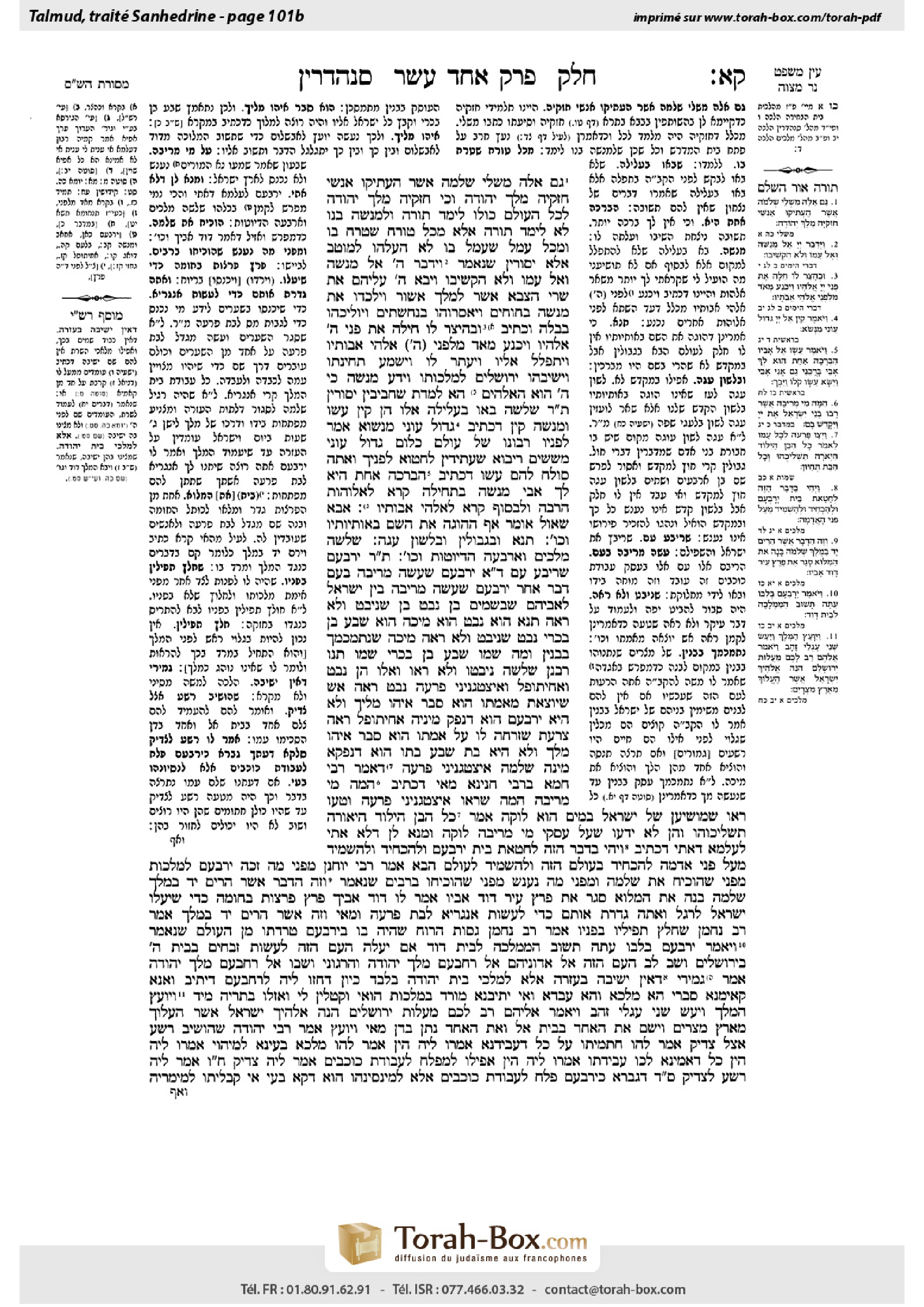
This page of Sanhedrin includes the Aramaic text, an English translation and an AI-generated French translation, alongside the scan above.
סנהדרין ק״א ב · Aramaic and Hebrew text
״גַּם אֵלֶּה מִשְׁלֵי שְׁלֹמֹה אֲשֶׁר הֶעְתִּיקוּ אַנְשֵׁי חִזְקִיָּה מֶלֶךְ יְהוּדָה״. וְכִי חִזְקִיָּה מֶלֶךְ יְהוּדָה לְכׇל הָעוֹלָם כּוּלּוֹ לִימֵּד תּוֹרָה, וְלִמְנַשֶּׁה בְּנוֹ לֹא לִימֵּד תּוֹרָה? אֶלָּא, מִכׇּל טוֹרַח שֶׁטָּרַח בּוֹ וּמִכׇּל עָמָל שֶׁעָמֵל בּוֹ, לֹא הֶעֱלָהוּ לְמוּטָב אֶלָּא יִסּוּרִין, שֶׁנֶּאֱמַר: ״וַיְדַבֵּר ה׳ אֶל מְנַשֶּׁה וְאֶל עַמּוֹ וְלֹא הִקְשִׁיבוּ. וַיָּבֵא ה׳ עֲלֵיהֶם אֶת שָׂרֵי הַצָּבָא אֲשֶׁר לְמֶלֶךְ אַשּׁוּר וַיִּלְכְּדוּ אֶת מְנַשֶּׁה בַּחֹחִים וַיַּאַסְרֻהוּ בַּנְחֻשְׁתַּיִם וַיּוֹלִיכֻהוּ בָּבֶלָה״.
וּכְתִיב: ״וּכְהָצֵר לוֹ חִלָּה אֶת פְּנֵי ה׳ אֱלֹהָיו וַיִּכָּנַע מְאֹד מִלִּפְנֵי אֱלֹהֵי אֲבוֹתָיו. וַיִּתְפַּלֵּל אֵלָיו וַיֵּעָתֶר לוֹ וַיִּשְׁמַע תְּחִנָּתוֹ וַיְשִׁיבֵהוּ יְרוּשָׁלִַים לְמַלְכוּתוֹ וַיֵּדַע מְנַשֶּׁה כִּי ה׳ הוּא הָאֱלֹהִים״. הָא לָמַדְתָּ שֶׁחֲבִיבִין יִסּוּרִין.
תָּנוּ רַבָּנַן: שְׁלֹשָׁה בָּאוּ בַּעֲלִילָה, אֵלּוּ הֵן: קַיִן, עֵשָׂו וּמְנַשֶּׁה. קַיִן, דִּכְתִיב: ״גָּדוֹל עֲוֹנִי מִנְּשׂוֹא״. אָמַר לְפָנָיו: רִבּוֹנוֹ שֶׁל עוֹלָם, כְּלוּם גָּדוֹל עֲוֹנִי מִשִּׁשִּׁים רִיבּוֹא שֶׁעֲתִידִין לַחְטוֹא לְפָנֶיךָ וְאַתָּה סוֹלֵחַ לָהֶם? עֵשָׂו, דִּכְתִיב: ״הַבְרָכָה אַחַת הִיא לָךְ אָבִי״. מְנַשֶּׁה – בַּתְּחִילָּה קָרָא לֶאֱלוֹהוֹת הַרְבֵּה, וּלְבַסּוֹף קָרָא לֵאלֹהֵי אֲבוֹתָיו.
אַבָּא שָׁאוּל אוֹמֵר: אַף הַהוֹגֶה אֶת הַשֵּׁם בְּאוֹתִיּוֹתָיו וְכוּ׳. תָּנָא: וּבַגְּבוּלִין, וּבִלְשׁוֹן עָגָה.
שְׁלֹשָׁה מְלָכִים וְאַרְבָּעָה הֶדְיוֹטוֹת וְכוּ׳. תָּנוּ רַבָּנַן: יָרׇבְעָם – שֶׁרִיבֵּעַ עָם. דָּבָר אַחֵר: יָרׇבְעָם – שֶׁעָשָׂה מְרִיבָה בָּעָם. דָּבָר אַחֵר: יָרׇבְעָם – שֶׁעָשָׂה מְרִיבָה בֵּין יִשְׂרָאֵל לַאֲבִיהֶם שֶׁבַּשָּׁמַיִם. בֶּן נְבָט – בֵּן שֶׁנִּיבַּט וְלֹא רָאָה.
תַּנָּא: הוּא נְבָט, הוּא מִיכָה, הוּא שֶׁבַע בֶּן בִּכְרִי. נְבָט – שֶׁנִּיבַּט וְלֹא רָאָה. מִיכָה – שֶׁנִּתְמַכְמֵךְ בְּבִנְיָן. וּמָה שְׁמוֹ? שֶׁבַע בֶּן בִּכְרִי שְׁמוֹ.
תָּנוּ רַבָּנַן: שְׁלֹשָׁה נִיבְּטוּ וְלֹא רָאוּ, וְאֵלּוּ הֵן – נְבָט, וַאֲחִיתוֹפֶל, וְאִיצְטַגְנִינֵי פַּרְעֹה.
נְבָט רָאָה אֵשׁ שֶׁיּוֹצֵאת מֵאַמָּתוֹ. הוּא סָבַר אִיהוּ מָלֵיךְ, וְלָא הִיא. יָרׇבְעָם הוּא דִּנְפַק מִינֵּיהּ.
אֲחִיתוֹפֶל רָאָה צָרַעַת שֶׁזָּרְחָה לוֹ עַל אַמָּתוֹ. הוּא סָבַר אִיהוּ מָלֵךְ, וְלָא הִיא. בַּת שֶׁבַע בִּתּוֹ הוּא דִּנְפַק מִינַּהּ שְׁלֹמֹה.
אִיצְטַגְנִינֵי פַּרְעֹה, דְּאָמַר רַבִּי חָמָא בְּרַבִּי חֲנִינָא: מַאי דִּכְתִיב ״הֵמָּה מֵי מְרִיבָה״? הֵמָּה שֶׁרָאוּ אִיצְטַגְנִינֵי פַּרְעֹה וְטָעוּ. רָאוּ שֶׁמּוֹשִׁיעָן שֶׁל יִשְׂרָאֵל בְּמַיִם הוּא לוֹקֶה, אָמַר: ״כׇּל הַבֵּן הַיִּלּוֹד הַיְאֹרָה תַּשְׁלִיכֻהוּ״. וְהֵן לֹא יָדְעוּ שֶׁעַל עִסְקֵי מֵי מְרִיבָה לוֹקֶה.
וּמְנָא לַן דְּלָא אָתֵי לְעָלְמָא דְּאָתֵי? דִּכְתִיב: ״וַיְהִי בַּדָּבָר הַזֶּה לְחַטַּאת בֵּית יָרׇבְעָם וּלְהַכְחִיד וּלְהַשְׁמִיד מֵעַל פְּנֵי הָאֲדָמָה״. ״לְהַכְחִיד״ – בָּעוֹלָם הַזֶּה, ״וּלְהַשְׁמִיד״ – לָעוֹלָם הַבָּא.
אָמַר רַבִּי יוֹחָנָן: מִפְּנֵי מָה זָכָה יָרׇבְעָם לַמַּלְכוּת? מִפְּנֵי שֶׁהוֹכִיחַ אֶת שְׁלֹמֹה. וּמִפְּנֵי מָה נֶעֱנַשׁ? מִפְּנֵי שֶׁהוֹכִיחוֹ בָּרַבִּים, שֶׁנֶּאֱמַר: ״וְזֶה הַדָּבָר אֲשֶׁר הֵרִים יָד בַּמֶּלֶךְ שְׁלֹמֹה בָּנָה אֶת הַמִּלּוֹא סָגַר אֶת פֶּרֶץ עִיר דָּוִד אָבִיו״. אָמַר לוֹ: דָּוִד אָבִיךָ פָּרַץ פְּרָצוֹת בַּחוֹמָה כְּדֵי שֶׁיַּעֲלוּ יִשְׂרָאֵל לָרֶגֶל, וְאַתָּה גָּדַרְתָּ אוֹתָם כְּדֵי לַעֲשׂוֹת אַנְגַּרְיָא לְבַת פַּרְעֹה.
וּמַאי ״וְזֶה אֲשֶׁר הֵרִים יָד בַּמֶּלֶךְ״? אָמַר רַב נַחְמָן: שֶׁחָלַץ תְּפִילָּיו בְּפָנָיו. אָמַר רַב נַחְמָן: גַּסּוּת הָרוּחַ שֶׁהָיָה בּוֹ בְּיָרׇבְעָם טְרָדַתּוּ מִן הָעוֹלָם, שֶׁנֶּאֱמַר: ״וַיֹּאמֶר יָרׇבְעָם בְּלִבּוֹ עַתָּה תָּשׁוּב הַמַּמְלָכָה לְבֵית דָּוִד. אִם יַעֲלֶה הָעָם הַזֶּה לַעֲשׂוֹת זְבָחִים בְּבֵית ה׳ בִּירוּשָׁלִַים וְשָׁב לֵב הָעָם הַזֶּה אֶל אֲדֹנֵיהֶם אֶל רְחַבְעָם מֶלֶךְ יְהוּדָה וַהֲרָגֻנִי וְשָׁבוּ אֶל רְחַבְעָם מֶלֶךְ יְהוּדָה״.
אֲמַר: גְּמִירִי דְּאֵין יְשִׁיבָה בַּעֲזָרָה אֶלָּא לְמַלְכֵי בֵּית יְהוּדָה בִּלְבָד. כֵּיוָן דְּחָזוּ לֵיהּ לִרְחַבְעָם דְּיָתֵיב וַאֲנָא קָאֵימְנָא, סָבְרִי: הָא מַלְכָּא וְהָא עַבְדָּא. וְאִי יָתֵיבְנָא, מוֹרֵד בַּמַּלְכוּת הוּא, וְקָטְלִין לִי וְאָזְלוּ בָּתְרֵיהּ. מִיָּד ״וַיִּוָּעַץ הַמֶּלֶךְ וַיַּעַשׂ שְׁנֵי עֶגְלֵי זָהָב וַיֹּאמֶר אֲלֵהֶם רַב לָכֶם מֵעֲלוֹת יְרוּשָׁלִַים הִנֵּה אֱלֹהֶיךָ יִשְׂרָאֵל אֲשֶׁר הֶעֱלוּךָ מֵאֶרֶץ מִצְרָיִם וַיָּשֶׂם אֶת הָאֶחָד בְּבֵית אֵל וְאֶת הָאֶחָד נָתַן בְּדָן״.
מַאי ״וַיִּוָּעַץ״? אָמַר רַבִּי יְהוּדָה: שֶׁהוֹשִׁיב רָשָׁע אֵצֶל צַדִּיק. אֲמַר לְהוּ: חָתְמִיתוּ עַל כֹּל דְּעָבֵידְנָא? אֲמַרוּ לֵיהּ: הִין. אֲמַר לְהוּ: מַלְכָּא בָּעֵינָא לְמִיהְוֵי. אֲמַרוּ לֵיהּ: הִין. כֹּל דְּאָמֵינָא לְכוּ עָבֵידְתּוּ? אֲמַרוּ לֵיהּ: הִין. אֲפִילּוּ לְמִפְלַח לַעֲבוֹדָה זָרָה? אֲמַר לֵיהּ צַדִּיק: חַס וְחָלִילָה! אֲמַר לֵיהּ רָשָׁע לְצַדִּיק: סָלְקָא דַּעְתָּךְ דְּגַבְרָא כְּיָרׇבְעָם פָּלַח לַעֲבוֹדָה זָרָה? אֶלָּא לְמֵינְסִינְהוּ הוּא דְּקָא בָּעֵי, אִי קַבְּלִיתוּ לְמֵימְרֵיהּ.
Sanhedrin 101b · English translation
“These too are the proverbs of Solomon, which the men of Hezekiah, king of Judea, copied” (Proverbs 25:1), indicating that Hezekiah taught Torah and disseminated it to the multitudes. And is it conceivable that Hezekiah, king of Judea, taught Torah to the entire world and to Manasseh his son he did not teach Torah? Rather, Hezekiah certainly taught Manasseh much Torah; nevertheless, from all his exertion to teach him and from all his toil to teach him, it was only afflictions that elevated him to the path of good, as it is stated: “And the Lord spoke to Manasseh and to his people but they would not heed. And the Lord brought upon them the captains of the army of the king of Assyria, who took Manasseh with hooks, and bound him with chains, and carried him to Babylonia” (II Chronicles 33:10–11).
And it is written thereafter: “And when he was in distress, he sought the Lord his God, and humbled himself greatly before the God of his fathers, and he prayed to Him and He was entreated of him, and He heard his supplication, and brought him back to Jerusalem into his kingdom; then Manasseh knew that the Lord He was God” (II Chronicles 33:12–13). You learned from this that afflictions are cherished.
Apropos Manasseh’s repentance, the Gemara cites that the Sages taught in a baraita: Three came with a demand, and these are they: Cain, Esau, and Manasseh. Cain came with a demand, as it is written: “My sin is too great to bear” (Genesis 4:13). Cain said before God: Master of the Universe, is my transgression greater than the transgression of the 600,000 who are destined to sin before You with the Golden Calf, and You will nevertheless forgive them? There should be atonement for my transgression as well. Esau came with a demand, as it is stated: “Have you but one blessing, my father?” (Genesis 27:38). With regard to Manasseh, initially he called to multiple gods, and his prayers were not answered, and ultimately he called to the God of his forefathers with the demand: If God does not answer my prayer, then apparently all the gods are equal to the God of my forefathers.
§ The mishna teaches: Abba Shaul says: Also among those who have no share in the World-to-Come is one who pronounces the ineffable name of God as it is written, with its letters. It is taught in a baraita: This is referring to one who pronounces the name in the outlying areas outside the Temple, and in colloquial [aga] language, for no particular purpose.
In the mishna, the tanna enumerated three kings and four commoners who have no share in the World-to-Come. The Sages taught in a baraita: Jeroboam [Yorovam] is an abbreviation for one who debased the Jewish people [riba am]. Alternatively, Yorovam is an abbreviation for one who engendered strife among the people [meriva ba’am], causing the schism between the kingdoms of Judea and Israel. Alternatively, Yorovam is an abbreviation for one who engendered strife between the Jewish people [meriva bein ha’am] and their Heavenly Father, as he instituted the worship of the golden calves (I Kings 12:28–31). He is called son of Nebat because he is the son who looked [nibat] in an effort to assess the situation but did not see the situation accurately.
It is taught in a baraita: Based on a homiletic interpretation of their names, these three biblical figures are deemed to be the same person. He is called Nebat, he is called Micah, and he is called Sheba, son of Bichri. Nebat, who looked [nibat] but did not see, believed that he was destined for greatness, and that was achieved only by his son. Micah, who was crushed [nitmakhmekh] in the building of the storage cities of Pithom and Raamses, was miraculously saved. And what is his actual name? His name is Sheba, son of Bichri.
The Sages taught in a baraita: Three looked but did not see and as a result were mistaken in their prognostications. And these are they: Nebat, and Ahithophel, and the astrologers of Pharaoh.
The Gemara elaborates: Nebat saw fire that emerges from his penis. He thought that it meant that he would rule. But that is not so. It meant that it would be Jeroboam who would emerge from him and rule.
Ahithophel saw leprosy that glowed on his penis and he thought that he would rule. But it is not so. Instead from Bathsheba his daughter, i.e., his son’s daughter, came Solomon the king.
The astrologers of Pharaoh saw and were mistaken, as Rabbi Ḥama, son of Rabbi Ḥanina, says: What is the meaning of that which is written: “These are the waters of contention” (Numbers 20:13)? These are the waters that the astrologers of Pharaoh saw, and they erred concerning them. As they saw in the stars that the savior of Israel would be stricken by water, Pharaoh said: “Every son that is born you shall cast into the river” (Exodus 1:22), assuming that any potential savior would be drowned. And they did not know that it was over matters involving the waters of Meribah that Moses would be stricken and would not be allowed to enter Eretz Yisrael.
The Gemara resumes its discussion of Jeroboam. And from where do we derive that Jeroboam does not enter into the World-to-Come? It is derived from a verse, as it is written: “And by this matter there was a sin to the house of Jeroboam, and to eradicate it and to destroy it from off the face of the earth” (I Kings 13:34). It can be interpreted to mean: To eradicate it in this world, and to destroy it for the World-to-Come.
Rabbi Yoḥanan says: For what virtue was Jeroboam privileged to ascend to monarchy? It is due to the fact that he rebuked Solomon for his sins. And for what misdeed was he punished and lost everything? It is due to the fact that he rebuked Solomon and humiliated him in public, as it is stated: “And this was the cause that he lifted his hand against the king: Solomon built the Millo, and repaired the breaches of the city of David his father” (I Kings 11:27). Jeroboam said to Solomon: David, your father, created breaches in the wall so that the Jewish people could ascend for the pilgrimage Festival, and you sealed them in order to marshal forced labor [angarya] for the daughter of Pharaoh, your wife.
And what is the meaning of the phrase “and this was the cause that he lifted his hand against the king”? Rav Naḥman says: He removed his phylacteries before Solomon, thereby demonstrating that he does not consider Solomon his superior. Rav Naḥman says: The arrogance that existed in Jeroboam drove him from the World-to-Come, as it is stated: “And Jeroboam said in his heart: Now shall the kingdom return to the house of David. If this people go up to offer sacrifices in the House of the Lord in Jerusalem, then shall the heart of this people turn again to their lord, even to Rehoboam, king of Judea, and they shall kill me and return to Rehoboam, king of Judea” (I Kings 12:26–27).
Jeroboam calculated and said: It is learned as a tradition that sitting in the Temple courtyard is permitted only for kings of the house of Judah alone. Once they see Rehoboam, who is sitting, and they see me standing, they will think: This, Rehoboam, is king, and that, Jeroboam, is the servant. And if I sit there, I will be considered a traitor against the throne, and they will kill me and follow him. Immediately, the following took place: “And the king took counsel, and made two calves of gold, and said to them: It is too much for you to ascend to Jerusalem; behold your gods, Israel, who brought you up from the land of Egypt. And he placed the one in Bethel and the other he placed in Dan” (I Kings 12:28–29).
What is the meaning of the phrase “and the king took counsel”? Rabbi Yehuda says: It means that he assembled the elders of the kingdom of Israel and seated a wicked person alongside a righteous person and consulted them. He said to the elders: Do you sign a writ of authorization for all that I am doing? They said to him: Yes. He said to them: I want to be the king. They said to him: Yes. Jeroboam said to them: Will you do everything I tell you to do? They said to him: Yes. He said to them: Even to worship idols? A righteous man said: Heaven forfend; idol worship is unacceptable. The wicked man seated alongside him said to the righteous man: Does it enter your mind that a man like Jeroboam would worship idols? Rather, he merely seeks to test those sitting here, to determine if they accept and will obey his pronouncements.
Sanhedrin 101b · Traduction française (IA)
« Ceux-ci aussi sont les proverbes de Salomon, que les hommes d’Ézéchias, roi de Judée, ont copiés » (Proverbes 25:1), ce qui indique qu’Ézéchias enseignait la Torah et la diffusait parmi les foules. Peut-on concevoir qu’Ézéchias, roi de Judée, ait enseigné la Torah au monde entier sans l’enseigner à son fils Manassé ? Ézéchias lui enseigna certainement beaucoup de Torah ; néanmoins, malgré tous ses efforts et toute la peine qu’il se donna pour l’instruire, seules les souffrances le ramenèrent sur le droit chemin, comme il est dit : « Le Seigneur parla à Manassé et à son peuple, mais ils ne prêtèrent pas attention. Alors le Seigneur fit venir contre eux les chefs de l’armée du roi d’Assyrie, qui capturèrent Manassé avec des crochets, le lièrent avec des chaînes et l’emmenèrent à Babylone » (II Chroniques 33:10–11).
Et il est écrit ensuite : « Lorsqu’il fut dans la détresse, il implora le Seigneur son Dieu et s’humilia profondément devant le Dieu de ses pères. Il le pria, et Dieu se laissa fléchir ; il entendit sa supplication et le ramena à Jérusalem, dans son royaume. Alors Manassé reconnut que le Seigneur était Dieu » (II Chroniques 33:12–13). Tu apprends de là que les souffrances sont précieuses.
À propos du repentir de Manassé, la Guemara rapporte que les Sages enseignent dans une baraïta : Trois hommes présentèrent une revendication, à savoir Caïn, Ésaü et Manassé. Caïn présenta une revendication, comme il est écrit : « Mon péché est trop grand pour être supporté » (Genèse 4:13). Caïn dit devant Dieu : Maître de l’Univers, ma faute est-elle plus grave que celle des 600 000 qui sont destinés à pécher devant Toi avec le Veau d’or, et à qui Tu pardonneras pourtant ? Que ma faute aussi soit expiée. Ésaü présenta une revendication, comme il est dit : « N’as-tu donc qu’une seule bénédiction, mon père ? » (Genèse 27:38). Quant à Manassé, il invoqua d’abord plusieurs dieux, mais ses prières ne furent pas exaucées. Finalement, il invoqua le Dieu de ses pères en faisant valoir ceci : Si Dieu n’exauce pas ma prière, alors, semble-t-il, tous les dieux sont égaux au Dieu de mes pères.
§ La Michna enseigne : Abba Shaoul dit : Parmi ceux qui n’ont pas de part au monde à venir figure aussi celui qui prononce le nom ineffable de Dieu tel qu’il est écrit, avec ses lettres. Il est enseigné dans une baraïta : Cela désigne celui qui prononce le Nom hors du Temple, dans les régions périphériques, et dans le langage courant [aga], sans raison particulière.
Dans la Michna, le tanna a énuméré trois rois et quatre gens du peuple qui n’ont pas de part au monde à venir. Les Sages enseignent dans une baraïta : Jéroboam [Yorovam] est une abréviation de « celui qui a avili le peuple juif » [riba am]. Autre explication : Yorovam est une abréviation de « celui qui a suscité la discorde dans le peuple » [meriva ba’am], provoquant la scission entre les royaumes de Judée et d’Israël. Autre explication : Yorovam est une abréviation de « celui qui a suscité la discorde entre le peuple juif » [meriva bein ha’am] « et son Père céleste », car il institua le culte des veaux d’or (I Rois 12:28–31). Il est appelé fils de Nebat parce qu’il est le fils qui regarda [nibat] pour évaluer la situation, mais ne la vit pas correctement.
Il est enseigné dans une baraïta : Selon une interprétation homilétique de leurs noms, ces trois personnages bibliques sont considérés comme une seule et même personne. Il est appelé Nebat, il est appelé Michée et il est appelé Sheba, fils de Bichri. Nebat, qui regarda [nibat] mais ne vit pas, croyait qu’il était destiné à la grandeur, mais cette grandeur ne fut atteinte que par son fils. Michée, qui fut écrasé [nitmakhmekh] lors de la construction des villes-entrepôts de Pithom et de Ramsès, fut sauvé miraculeusement. Et quel est son véritable nom ? Il s’appelle Sheba, fils de Bichri.
Les Sages enseignent dans une baraïta : Trois hommes regardèrent sans voir et se trompèrent ainsi dans leurs prédictions. Ce sont Nebat, Ahitophel et les astrologues de Pharaon.
La Guemara développe : Nebat vit un feu jaillir de son pénis. Il pensa que cela signifiait qu’il régnerait. Mais ce n’était pas le cas : cela signifiait que Jéroboam naîtrait de lui et régnerait.
Ahitophel vit une lèpre qui brillait sur son pénis et pensa qu’il régnerait. Mais ce n’était pas le cas. C’est de Bethsabée, sa fille — c’est-à-dire la fille de son fils — que naquit le roi Salomon.
Les astrologues de Pharaon virent un signe et se trompèrent, comme le dit Rabbi Ḥama, fils de Rabbi Ḥanina : Que signifie ce qui est écrit : « Ce sont les eaux de Meriba » (Nombres 20:13) ? Ce sont les eaux que les astrologues de Pharaon virent et au sujet desquelles ils se trompèrent. En effet, ils virent dans les astres que le sauveur d’Israël serait frappé par l’eau. Pharaon dit alors : « Tout fils qui naîtra, vous le jetterez dans le fleuve » (Exode 1:22), pensant que tout sauveur potentiel serait noyé. Ils ne savaient pas que Moïse serait frappé à cause des événements liés aux eaux de Meriba et qu’il ne lui serait pas permis d’entrer en terre d’Israël.
La Guemara reprend son exposé sur Jéroboam. D’où savons-nous que Jéroboam n’a pas de part au monde à venir ? Nous le déduisons d’un verset, comme il est écrit : « Cette affaire fut une cause de péché pour la maison de Jéroboam, afin de l’extirper et de la faire disparaître de la surface de la terre » (I Rois 13:34). On peut l’interpréter ainsi : l’extirper de ce monde et la faire disparaître du monde à venir.
Rabbi Yoḥanan dit : Par quel mérite Jéroboam eut-il le privilège d’accéder à la royauté ? Parce qu’il réprimanda Salomon pour ses péchés. Et pour quelle faute fut-il puni et perdit-il tout ? Parce qu’il réprimanda Salomon et l’humilia en public, comme il est dit : « Voici la cause pour laquelle il leva la main contre le roi : Salomon construisait le Millo et réparait les brèches de la ville de David, son père » (I Rois 11:27). Jéroboam dit à Salomon : David, ton père, avait créé des brèches dans la muraille afin que le peuple juif puisse monter pour les fêtes de pèlerinage, tandis que toi, tu les as bouchées afin de mobiliser des travailleurs forcés [angarya] pour ta femme, la fille de Pharaon.
Et que signifie l’expression « voici la cause pour laquelle il leva la main contre le roi » ? Rav Naḥman dit : Il ôta ses phylactères devant Salomon, montrant ainsi qu’il ne le considérait pas comme son supérieur. Rav Naḥman dit : L’arrogance de Jéroboam le priva du monde à venir, comme il est dit : « Jéroboam dit en son cœur : Maintenant, le royaume va retourner à la maison de David. Si ce peuple monte offrir des sacrifices dans la Maison du Seigneur à Jérusalem, le cœur de ce peuple retournera à son seigneur, à Roboam, roi de Judée ; ils me tueront et retourneront à Roboam, roi de Judée » (I Rois 12:26–27).
Jéroboam réfléchit et se dit : Selon la tradition, seuls les rois de la maison de Juda ont le droit de s’asseoir dans la cour du Temple. Lorsqu’ils verront Roboam assis et moi debout, ils penseront : Celui-ci, Roboam, est le roi, et celui-là, Jéroboam, est le serviteur. Et si je m’assieds là, on me considérera comme un traître au trône ; ils me tueront et se rallieront à lui. Aussitôt, il se passa ceci : « Le roi prit conseil, fit deux veaux d’or et leur dit : Vous êtes montés assez souvent à Jérusalem ; voici tes dieux, Israël, qui t’ont fait monter du pays d’Égypte. Il en plaça un à Béthel et l’autre à Dan » (I Rois 12:28–29).
Que signifie l’expression « le roi prit conseil » ? Rabbi Yehuda dit : Cela signifie qu’il réunit les anciens du royaume d’Israël, fit asseoir un homme méchant à côté d’un homme juste et les consulta. Il dit aux anciens : Approuvez-vous tout ce que je fais ? Ils lui répondirent : Oui. Il leur dit : Je veux être roi. Ils lui répondirent : Oui. Jéroboam leur dit : Ferez-vous tout ce que je vous dirai ? Ils lui répondirent : Oui. Il leur dit : Même adorer des idoles ? Un homme juste dit : À Dieu ne plaise ; l’idolâtrie est inacceptable. L’homme méchant assis à côté de lui dit au juste : Peux-tu imaginer qu’un homme comme Jéroboam adore des idoles ? Il cherche seulement à mettre à l’épreuve ceux qui sont ici, pour déterminer s’ils approuvent ses déclarations et leur obéiront.
Traduction française générée par IA à partir de l’édition anglaise de Sefaria. Vérifie toujours un passage avec le texte source.
Text from Sefaria: William Davidson Edition - Vocalized Aramaic (CC BY NC); William Davidson Edition - English (CC BY NC).